Home Blog Page 650

Shiba Inu Lead Says Prepare for July, Teases Multiple Announcements Ahead

0

Shiba Inu lead developer Shytoshi Kusama has provided a hint about what SHIB community members should expect in July. 

In a recent X post, Kusama suggested that July 2025 will not be just another month of the year, but one packed with several AI-driven initiatives. He renamed July as Jul-AI, signaling that the seventh month of the year will be all about artificial intelligence (AI) for Shiba Inu. 

Kusama teased that the community will see numerous announcements, releases, and discussions surrounding past developments and the blueprint for the next phase of the ecosystem. 

Based on his commentary, it is expected that the team might unveil several AI-related projects or partnerships this month. There is also the likelihood that the ecosystem team might fully integrate Shiba Inu with artificial intelligence, optimizing every project within the Shiba Inu ecosystem. 

Team Working Behind the Scenes 

Meanwhile, Kusama shared a short video clip, indicating that the team has been steadily working behind the scenes all year. 

“It all started in January, and February came and went. March, April, and May,” the voiceover remarked. Notably, it mentioned how the world stood still for 12 days in June, highlighting the period of war between Israel and Iran. 

With June ending, the voiceover emphasized that “It’s time for July… JUL-AI,” signaling the potential roll-out of AI-driven initiatives. 

Kusama AI Initiative 

In May, Kusama disclosed that he was writing a final paper, which would explore the interplay between AI, Shiba Inu, and the SHY token. He also indicated that the upcoming paper will highlight Shiba Inu’s role in the next phase of technical evolution, which will be driven by artificial intelligence. 

The lead developer made the disclosure after pointing out the lack of AI-related discussions on X. According to him, many people are still unaware of AI’s potential. He plans to integrate Shiba Inu with AI early to ensure the project benefits from the next wave of technological evolution.

Kusama’s recent update indicates that he might release the AI paper this month, detailing Shiba Inu’s role in the AI-driven technological evolution. Additionally, the Shiba Inu lead developer might also announce and release other AI-driven initiatives. However, the precise nature of these projects remains under wraps.
If You Had Invested $100 a Week in XRP Since 2015, Could You Retire Today?

If an investor had committed $100 a week into XRP over the past decade, could they have enough now for an early retirement?

While some market participants are in the crypto scene for the fun of it or as part of a larger investment portfolio, others enter the space because they find the conventional work lifestyle too tedious to endure. As a result, they expect their investments in cryptocurrency to catalyze a journey toward early retirement.

Of course, such a goal would require both research and luck, as an investor could spend over a decade on a utility-based asset and not make substantial gains, but another might commit a few pennies in a meme coin and walk off with a life-changing ROI.

What if You Committed $100 Every Week into XRP Since May 2015?

Despite the large gains meme coins could yield for an investor, they also pose a similar level of risk. This is one reason why most investors opt to stick with utility-based tokens, such as Ethereum and XRP. However, we recently assessed how profitable a utility asset like XRP could have been if a market participant had DCA’d weekly into it over the past decade.

Notably, a report from 2019 showed that Americans spend about $1,497 on non-essentials like coffee, drinks, paid apps, and subscription boxes every month. This figure translates to around $374.25 a week. What if an investor had chosen to substitute one of these non-essential items with XRP every week since 2015?

We leveraged Uphold’s Dollar Cost Averaging (DCA) calculator to evaluate the financial impact over the past decade, and the results were mind-blowing. For the uninitiated, Dollar Cost Averaging is a method of investing where you put in the same amount of money regularly, no matter what the market price is.

A Possible Retirement Solution

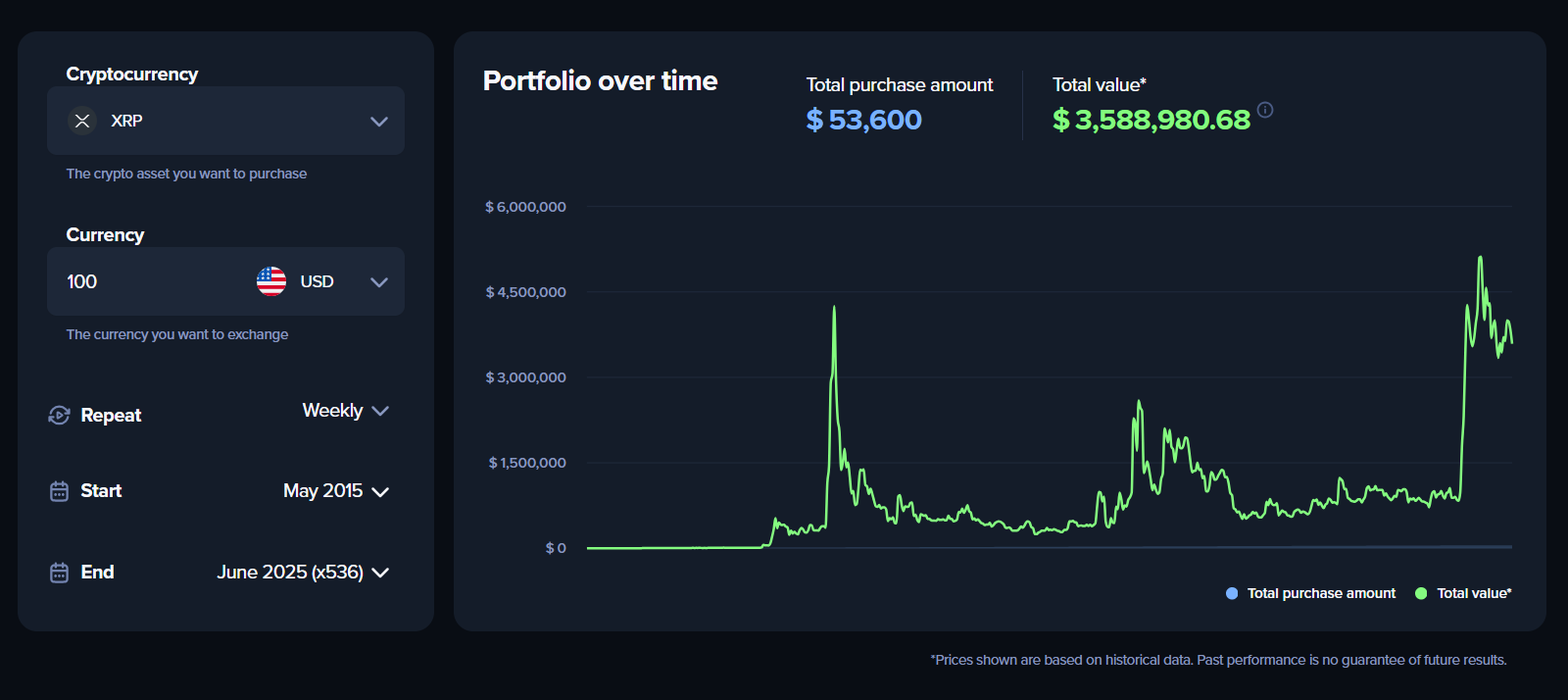
Data from Uphold’s DCA calculator shows that if you had committed $100 into XRP from May 2015 to June 2025, you would have invested a total of $53,600 within this period. However, the value of your portfolio today would be worth $3,588,980, representing an ROI of about 6,595% over a decade.

Results of DCA Into XRP Uphold

However, is this enough for retirement today? This would depend on factors such as the individual’s age, spending habits, and location. Specifically, an April 2025 survey found that most Americans aged 18 and above believe they could retire with $1.26 million. 

Interestingly, the $3.588 million returns from DCA’ing into XRP over the past decade are nearly three times the $1.26 million retirement goal. This indicates that an investor would have set themselves up for retirement if they committed $100 into XRP as a non-essential item since 2015. 

While many would believe they have missed the boat, some analysts suggest otherwise. Notably, several market commentators insist that XRP is still largely undervalued. 

As a result, they expect rapid price surges from the current level. If an investor begins a similar DCA scheme today and these projections materialize, they could see massive gains. However, it is important to note that past performance does not guarantee similar results in the future.

Here’s Potential XRP Price If XRP Adoption Surges After End of SEC Lawsuit

Expert predictions suggest XRP price could eventually reach double digits, as many suggest the imminent end to the SEC lawsuit could drive adoption.

The SEC’s 4-year lawsuit against Ripple is finally nearing its conclusion. Specifically, Ripple has already agreed to drop its cross-appeal, and signs point to the SEC doing the same soon. 

SEC Case to End Soon

Notably, a closed-door SEC meeting scheduled for July 3 has triggered expectations that the case could officially wrap up then. While the lawsuit no longer directly involves XRP, since a 2023 ruling confirmed that XRP isn’t a security, many still believe that ending the case for good could lift the last cloud of uncertainty hanging over XRP.

Although XRP got legal clarity two years ago, some U.S. institutions have remained cautious. Financial analysts and XRP proponents argue that a clean end to the case could finally unlock real momentum for XRP adoption. 

Nasdaq analyst Trevor Jennewine made this point back in March 2025, when he suggested that a final ruling could encourage institutions to embrace XRP more openly. There’s even talk that BlackRock could be waiting for this moment before filing for an XRP ETF. However, this remains speculative.

Ripple’s move to settle the case by accepting the original $125 million penalty and dropping its cross-appeal indicates that it wants to close this chapter and focus on growth. 

XRP Price A Year After the SEC Lawsuit Ends

While the SEC hasn’t confirmed it will drop its own appeal, industry watchers expect that to happen soon. If it does, XRP could benefit from a clearer path forward, especially in the U.S., where regulatory uncertainty has held back broader adoption.

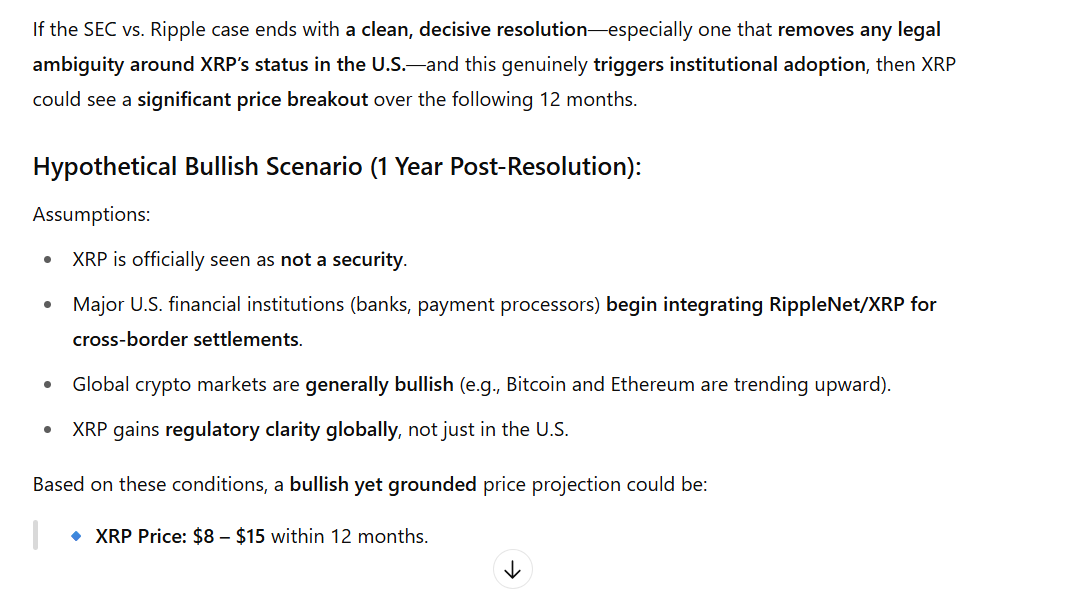
To explore how this could affect XRP’s value, we asked ChatGPT for its bullish price prediction one year after a final resolution, assuming the outcome drives strong institutional interest. At the time, XRP traded at $2.21.

ChatGPT suggested that if institutions like banks and payment firms begin using Ripple Payments and XRP for cross-border payments, then XRP could see a serious price boost. The chatbot predicted that XRP might reach between $8 and $15 within twelve months under those conditions.

XRP Price Prediction After SEC Lawsuit Ends

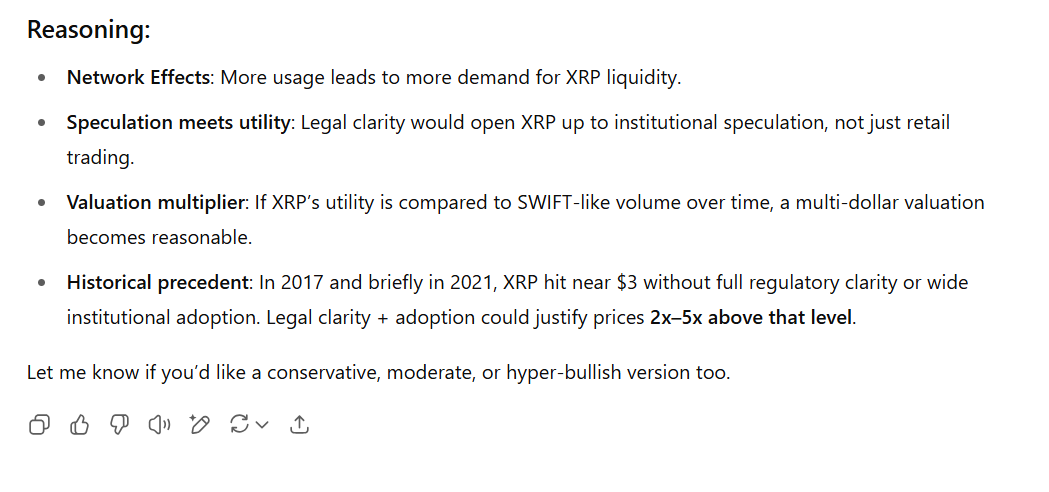
Notably, ChatGPT explained that legal certainty would do more than just boost investor confidence. According to the chatbot, it could lead to real-world use of XRP. Interestingly, this could increase demand as financial firms begin using it for settlements. 

In turn, that demand could push up the price. ChatGPT also pointed out that this wouldn’t just be a hype-driven rally. Instead, the price increase would likely reflect a mix of growing utility and serious investment.

ChatGPT Reasoning
ChatGPT Reasoning

The chatbot added that XRP already came close to $3 during earlier bull markets in 2017 and 2021, even without institutional adoption or legal clarity. With those pieces now falling into place, a price two to five times higher doesn’t seem out of reach. 

DDC Secures $528M to Pursue Bitcoin Treasury, One of the Largest NYSE Capital Raises

More corporate firms are joining the Bitcoin treasury trend, raising significant capital to fund the move.

The latest to do so is DDC Enterprise Limited, a global consumer food brand operator best known for DayDayCook. Today, the firm announced the initial closing of a landmark $528 million capital raise to aggressively pursue a corporate Bitcoin treasury strategy.

DDC is positioning itself among the top Bitcoin-holding public firms globally. It now harbors ambitions to become a major institutional player in BTC acquisition, joining the likes of Strategy and Metaplanet.

Breakdown of the $528 Million Raise to Buy Bitcoin

According to the official press release, the financing comprises a mixture of strategic investments, convertible notes, and an equity line of credit.

Notably, it includes a $26 million PIPE investment from leading digital asset investors, including a debt conversion to strengthen the balance sheet.

Additionally, it includes $25 million in convertible notes from Anson Funds, with an additional $275 million available through subsequent drawdowns.

Moreover, the firm also secured a $2 million private placement and a $200 million equity line of credit, both by Anson Funds.

This capital structure provides DDC with immediate and scalable liquidity to execute its Bitcoin purchase strategy over time.

Maxim Group LLC served as the sole financial advisor for the transaction. DDC confirmed that proceeds from the financing will directly go into purchasing Bitcoin, not for general operational expenses.

High-Profile Backers Align with DDC’s Vision

Notably, the funding round attracted support from top-tier crypto investment firms, including Animoca Brands, Anson Funds, and Kenetic Capital.

DDC’s founder, Norma Chu, called the financing a “watershed moment” for the company, adding:

“With premier institutions backing our vision, we have unprecedented capacity to execute our mission of building one of the most valuable corporate Bitcoin treasuries.”

From Culinary Brands to Crypto-Focused Strategy

While DDC continues to grow its portfolio of Asian-inspired food brands, the company has now strategically repositioned Bitcoin as a core reserve asset. It is one of the first NYSE-listed companies outside the tech sector to formally integrate Bitcoin into its financial architecture.

The move echoes earlier treasury strategies of companies like MicroStrategy. However, it stands out due to DDC’s consumer-focused roots and bold reallocation of capital into digital assets.

In June, Prenetics Global Limited became the world’s first healthcare company to adopt a Bitcoin treasury strategy, purchasing 187 BTC for $20 million.

DDC’s proposed $528 million Bitcoin purchase, which could potentially yield approximately 4,980 BTC, would position it among the top 20 companies with the largest Bitcoin holdings. Meanwhile, the top 100 companies collectively hold approximately 850,000 BTC as of June 30.

Here’s How Much Bitcoin One Needs to Be Financially Safe

0

Capital Club founder Luke Belmar is questioning how much Bitcoin an investor needs for financial safety.

Notably, Bitcoin’s growing role in financial independence is gaining traction, as many investors view it not just as a speculative asset, but as a potential escape route from traditional retirement systems. 

As the price of Bitcoin hovers around $106,981, questions are rising about how much Bitcoin one needs to ensure long-term financial security. With some believing it could serve as an alternative to conventional savings and investment plans, the discussion is now moving towards the amount of Bitcoin required for a safe, financially independent life.

Bitcoin and the Pursuit of Financial Safely

While Bitcoin has seen volatility, it is becoming a serious consideration for those seeking financial safety. Some financial independence advocates argue that accumulating a specific amount of Bitcoin could replace traditional savings.

Most recently, a crypto entrepreneur, Luke Belmar, who is also the founder of Capital Club, a decentralized entrepreneurial network, raised the question of how much Bitcoin would be necessary to feel financially secure.

In response, Bitcoin Exchange Balance, a platform providing daily updates on Bitcoin’s holdings, suggested that a sum of 2,051,088 BTC would be sufficient. The total value of 2,051,088 BTC at the price of $106,981 would indeed be around $219.08 billion. However, this figure might be an overkill, as only four people in the world own assets worth up to $219 billion.

Meanwhile, others emphasize the simplicity of owning just a fraction of Bitcoin. One commenter suggested that even owning 1 BTC could potentially set an individual up for long-term financial security. For those who cannot afford 1 BTC, some argue that stacking small amounts of satoshis (the smallest unit of Bitcoin) over time can still be an effective way to build wealth, especially as Bitcoin’s long-term potential becomes clearer.

Bitcoin’s Long-Term Viability

A full-time trader known as CryptoData shared the view that owning 1 BTC could set most individuals up for financial independence within the next decade. At current prices, this is a sizable commitment but could prove worthwhile if Bitcoin appreciates in value, as some analysts predict.

For instance, if Bitcoin were to reach $1 million per coin, like Rich Dad Poor Dad author Robert Kiyosaki recently predicted, 1 BTC would then represent $1 million in assets, approaching the target required for financial independence.

The 25x Rule, commonly used in personal finance to gauge retirement savings, further illustrates this. By multiplying one’s annual expenses by 25, an individual could determine how much wealth they need to retire. For those who require $50,000 annually, this rule suggests a need for $1.25 million. 

While 1 BTC wouldn’t quite reach the $1.25 million required by the 25x rule, it would still bring one close to the goal. 

Bitcoin LTH Unrealized Profit Crashes to October 2024 Levels: What It Could Mean for Price

Bitcoin long-term holders (LTHs) are now sitting on unrealized profits last seen during the market correction in October 2024. 

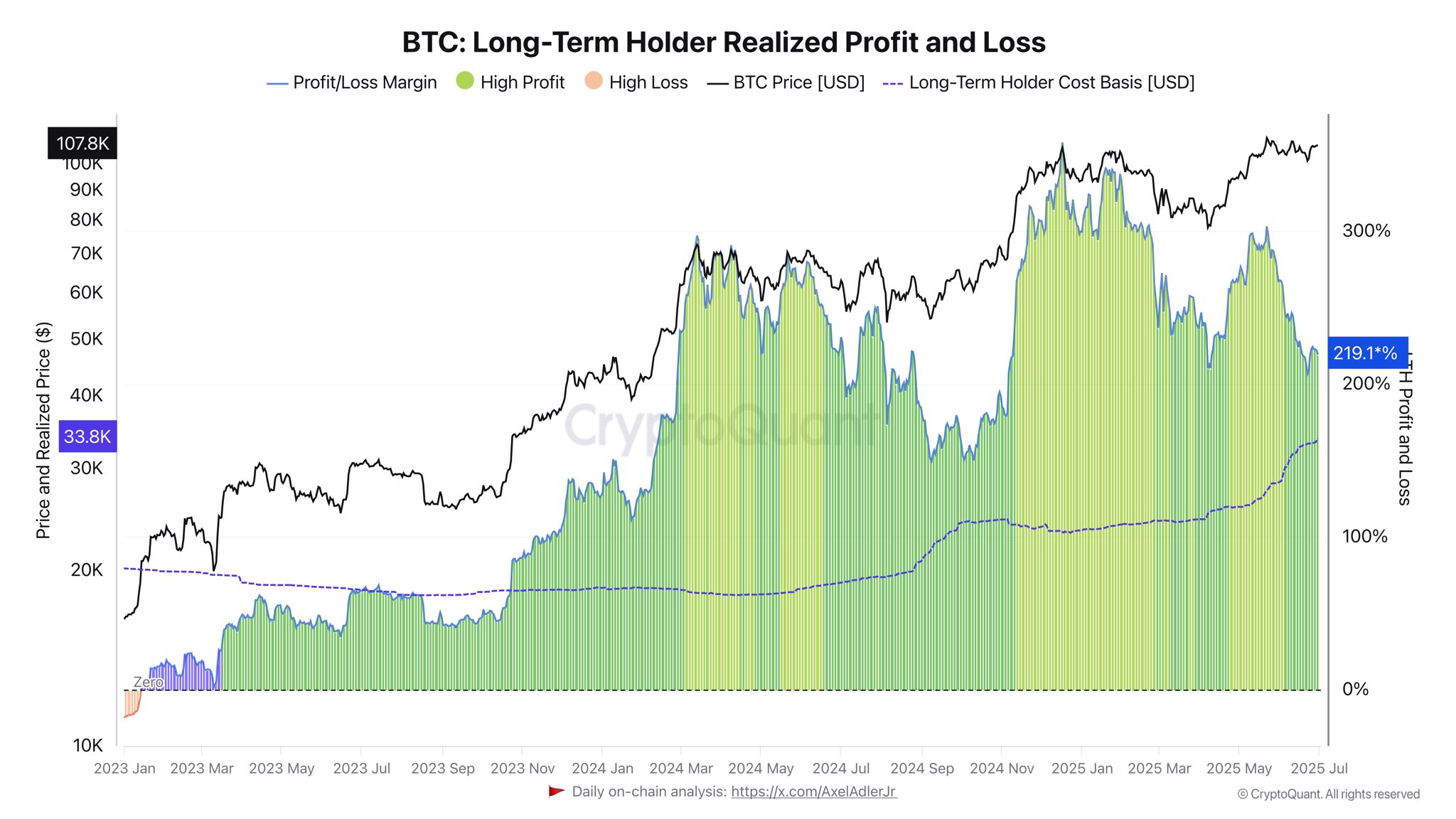
CryptoQuant analyst Darkfost recently highlighted this trend, pointing out a drop in profit margins despite Bitcoin’s recent price strength. His analysis indicates that the market still has room to run before it reaches the kind of overheated conditions that typically mark the end of a bull cycle.

Bitcoin LTHs Profit Margins Collapse

Darkfost centered his commentary on the MVRV ratio, which compares Bitcoin’s market value to the average price at which long-term holders bought their coins. 

Right now, that ratio sits around 220%, meaning LTHs are holding an average gain of 220%. This may sound high, but it falls well below the levels seen at the cycle’s earlier peaks. 

In March 2024, when BTC reached a high of $74,000, the profit ratio climbed to 300%. Also, in December 2024, the ratio reached 357% when BTC claimed a price of $108,000. Now that Bitcoin has recovered to the $107,000 mark, the profit ratio has declined to 220%, largely due to LTHs buying at higher prices.

Specifically, Darkfost noted that the average cost basis for long-term holders now sits at $33,800. For context, this figure represents the average price at which these investors bought their Bitcoin. It is particularly important in understanding profit levels and market behavior. 

BTC LTH Realized Profit and Loss CryptoQuant
BTC LTH Realized Profit and Loss | CryptoQuant

Bitcoin Price if It Reclaims Past Profit Margins

Notably, from this cost basis, Bitcoin would need to rise to $135,200 to bring the MVRV ratio back to 300%, the same level seen in March. To match the 357% margin from December, the price would have to hit $154,400.

With this data, it is logical to conclude that the current unrealized profit level remains far below what investors saw during major tops in the cycle. If the market follows past patterns, Bitcoin likely hasn’t peaked yet.

Darkfost’s observations line up with what seasoned trader Peter Brandt predicted. Back in October 2024, Brandt said Bitcoin could top out at $135,000. However, in May 2025, after reassessing the market conditions, he adjusted his target to between $120,000 and $150,000, with a likely peak sometime between August and September 2025. 

This updated projection fits into the price range Bitcoin needs to reach to restore those earlier MVRV ratios of 300% to 357%. The overlap confirms the view that the market still has more upside left.

Historical Bitcoin LTH Profit Margins

Meanwhile, historical numbers also show how low the current ratio is. For instance, in the 2017/2018 cycle, as Bitcoin hit $19,500 at its top in December 2017, long-term holders saw unrealized profits soar to 4,000%. 

During the 2020/2021 cycle, in April 2021, profits for LTHs hit 1,229% when Bitcoin reached $63,000. However, this was not even the peak of that cycle. Bitcoin pushed to a new all-time high of around $68,000 in November 2021, but by then, LTH unrealized profits had fallen to 348%.

These figures show how low current profit levels still are. While 220% sounds big, it is modest in the context of past cycles. If long-term holders are going to enjoy the same kind of windfalls they did in the past, the price will need to climb back to the $135,200–$154,400 range in the months ahead.

Currently, Bitcoin changes hands at $107,045, trading flat over the past 24 hours.

German Banking Giant to Launch Crypto Custody Services

0

Deutsche Bank is reportedly planning to offer cryptocurrency custody services, enabling its customers to store cryptocurrencies such as Bitcoin. 

Bloomberg reported today that it learned about the development from sources who have direct knowledge of the matter. According to the report, Deutsche Bank plans to launch its crypto custody service as early as 2026. 

Once launched, Deutsche Bank’s customers will be able to hold their crypto assets alongside traditional currencies within the banking platform. 

Key Partners 

The initiative will see Deutsche Bank partner with Bitpanda’s technology unit, a crypto exchange based in Austria. Taurus, a Swiss-based custody tech provider backed by Deutsche Bank, will also be involved in the bank’s crypto custody initiative.

Recall that Taurus launched a custody platform, Taurus-PROTECT, on the Solana network earlier this year. 

Deutsche Bank’s Interest in Crypto Custody Services 

For context, Deutsche Bank has been exploring the possibility of entering the crypto custody service market since 2020. At the time, a World Economic Forum report hinted that the bank plans to launch a crypto custody platform for its institutional clients. 

“Deutsche Bank plans to create a custody platform for institutional clients and their digital assets, granting them seamless connectivity to the broader crypto ecosystem,” an excerpt of the WEF report reads. 

In 2023, a spokesperson confirmed that Deutsche Bank had applied with Germany’s financial regulator to offer crypto custody services. Interestingly, the bank is now taking a significant step toward launching the service, with sources revealing that the crypto custody platform might launch next year. 

Deutsche Bank’s Crypto Involvement 

In the meantime, Deutsche Bank has not released an official statement confirming the potential launch of its crypto custody services by 2026. 

Meanwhile, the German banking giant has been actively involved in crypto-related activities over the past few months. It has thrown its weight behind pro-crypto initiatives, including supporting the U.S. Strategic Bitcoin Reserve (SBR) and applauding the GENIUS stablecoin Act.  

Last month, it hinted at plans to venture into the stablecoin market. Notably, the bank considered becoming a reserve manager for an existing stablecoin project or launching its own stablecoin. 

Before this disclosure, Deutsche Bank and Standard Chartered completed a stablecoin payments trial on the Universal Digital Payments Network (UDPN).  

Furthermore, Bloomberg reported last year that Deutsche Bank was developing a Layer-2 blockchain on Ethereum. The blockchain, which has not yet gone live, aims to eliminate compliance concerns for financial institutions seeking to adopt blockchain technology. 

Tom Lee Says Ethereum Could Be the Next Bitcoin

0

Tom Lee has highlighted the growing impact of stablecoins in both the digital and traditional financial scenes and how they could benefit Ethereum.

Bitcoin, often referred to as digital gold, stands as the most prominent cryptocurrency in existence. Its scarce property and historical price performance back this narrative, drawing the institutional interest seen today.

However, Tom Lee, the CIO of Fundstrat, believes that Ethereum could follow a similar path to Bitcoin and become the next big thing in the financial system. He shared this narrative in a CNBC Squawk Box appearance on June 30, highlighting the reasons behind the sentiment.

Stablecoin: A Game-Changer for Ethereum

Specifically, Lee told CNBC that legal financial institutions and their digital counterparts are beginning to converge, and stablecoin is the first catalyst for this unity. He described stablecoins as the ChatGPT of crypto, as their traction has transcended the digital space to viral adoption from banks and payment merchants.

Underneath these fiat-pegged cryptocurrencies is the Ethereum network, a blockchain Lee sees as the backbone and architecture of stablecoins. Notably, crypto enthusiasts view Ethereum as the smart contract layer of the crypto industry, as it was the first to birth the idea of decentralized finance (DeFi).

Remarkably, the United States has identified the possible impact of stablecoins on its economy; hence, the haste to pass the GENIUS Act into law. Both crypto czar David Sacks and Treasury Secretary Scott Bessent have acknowledged that stablecoins could bring in trillions of dollars to the US treasury market, with the latter projecting a growth of USD-pegged cryptos from $250 billion to $2 trillion.

Other companies are also looking to enter the stablecoin market. Firms such as Visa, Mastercard, and Shopify are exploring the integration of stablecoins, while Amazon, Walmart, and J.P. Morgan plan to create their own stablecoins.

Possible 10x Network Fees Growth 

Interestingly, Lee highlighted that over 51% of stablecoins are on Ethereum, and their utility generates 30% of all network fees for the blockchain. Meanwhile, he had highlighted this in an earlier tweet, stating its possible impact on the Ethereum network.

If USD-pegged stablecoins rally to $2 trillion, as Bessent projected, Lee noted that it would mark an exponential 10x growth in Ethereum network fees revenue. Notably, he emphasized that these figures may increase as other nations begin to mint their own stablecoins.

Essentially, this backs his thesis that Ethereum may be the next Bitcoin.

Lee Joins BitMine as Chairman

Meanwhile, Lee’s comments follow his appointment as chairman of the board of directors for BitMine Immersion Technology on Monday. The firm also announced that it has raised $250 million through private placements to bolster its Ethereum treasury strategy.

Lee believes that BitMine aims to enter the Ethereum hoarding game before institutions flock in en masse as they did with Bitcoin. With the announcement, BitMine’s stock surged over 700% on Monday from around $4 to $50.

BitMine joins Nasdaq-listed SharpLink Gaming to establish an Ethereum reserve. Recall that the betting platform raised $1 billion in June to buy Ethereum under the tutelage of co-founder Joseph Lubin.

Here’s What 1 XRP Would Be Worth If It Matches Bitcoin’s $2.1 Trillion Market Cap

Market watchers are drawing attention to the potential price of XRP if it were to match Bitcoin’s current market valuation.

Amonyx, a notable market observer focused on XRP, highlighted this metric in a post on X. He cited data from CoinGecko, which shows XRP’s hypothetical price if it were to reach Bitcoin’s multi-trillion-dollar market cap.

Specifically, the post suggested that XRP’s price would expand by over 16 times if it reached the $2.1 trillion valuation that Bitcoin currently holds.

At press time, XRP is trading at $2.20 with a market capitalization of $130 billion. This valuation places it as the fourth-largest cryptocurrency, trailing only Bitcoin, Ethereum, and USDT.

Notably, XRP has a circulating supply of 59 billion tokens. Based on this supply, a $2.1 trillion market cap would translate to a price of approximately $35.60 per XRP. To reach this level, XRP’s price would need to surge by over 1,520%.

Can XRP Reach Bitcoin’s Market Cap?

The idea of XRP reaching a trillion-dollar valuation like Bitcoin has become a hot topic in the crypto community. Critics argue that such a milestone is overly ambitious for XRP, at least in the short term.

So far, Bitcoin remains the only crypto asset to achieve and maintain a trillion-dollar valuation. Its closest competitor, Ethereum, briefly reached $561 billion in 2021 before falling significantly below that level.

However, XRP proponents don’t view Ethereum’s struggles to rival Bitcoin as a limitation for XRP’s potential. In fact, some believe XRP could overtake Ethereum as the leading altcoin as early as this year.

Harvard-trained developer Austin King argues that XRP could surpass Ethereum due to Ethereum’s inflationary design, perceived centralization, and XRP’s efficiency and clearer use cases. Attorney John Deaton has also cited growing Wall Street interest in XRP, pointing to over 10 spot ETF filings as evidence that XRP may surpass Ethereum in 2025.

Essentially, many influential voices in the crypto space believe XRP could eventually overtake Ethereum and potentially approach a trillion-dollar market cap in the coming years.

Timeline for XRP to Reach $35 and a $2.1 Trillion Cap

Also, numerous forecasts in the crypto community suggest XRP could surpass $35 and a $2 trillion valuation, some as early as this year. However, there’s skepticism around such aggressive timelines.

Meanwhile, research from notable entities like Bitwise and Changelly points to a longer trajectory. According to Bitwise, XRP may reach $30 by 2030, potentially paving the way for further growth. Changelly’s forecast aligns closely, suggesting XRP could hit $35 by 2032.

While these projections extend nearly a decade into the future, many XRP advocates consider them too conservative. As a result, they remain optimistic, and some even expect triple-digit prices for XRP in the coming years.

Ripple CEO Behind XRP 580% Boom, Analyst Says Round Two Is Here

XRP bulls are taking cues for the next big move from recent posts by Ripple CEO Brad Garlinghouse.

The timing of these posts has only intensified speculation, especially given their historical precedent.

First XRP Pump Signal That Led to a 580% Surge

One post fueling speculation of a price surge for XRP was Garlinghouse’s announcement that the company is dropping its cross-appeal in the SEC case.

This signals an end to the five-year legal saga that has clouded XRP’s price and could lead to another upsurge. At the time of the announcement last week, XRP was around $2, and not much has changed since then.

However, market watchers are convinced a bullish wave is on the horizon. Their conviction comes from what preceded XRP’s price pump in November 2024.

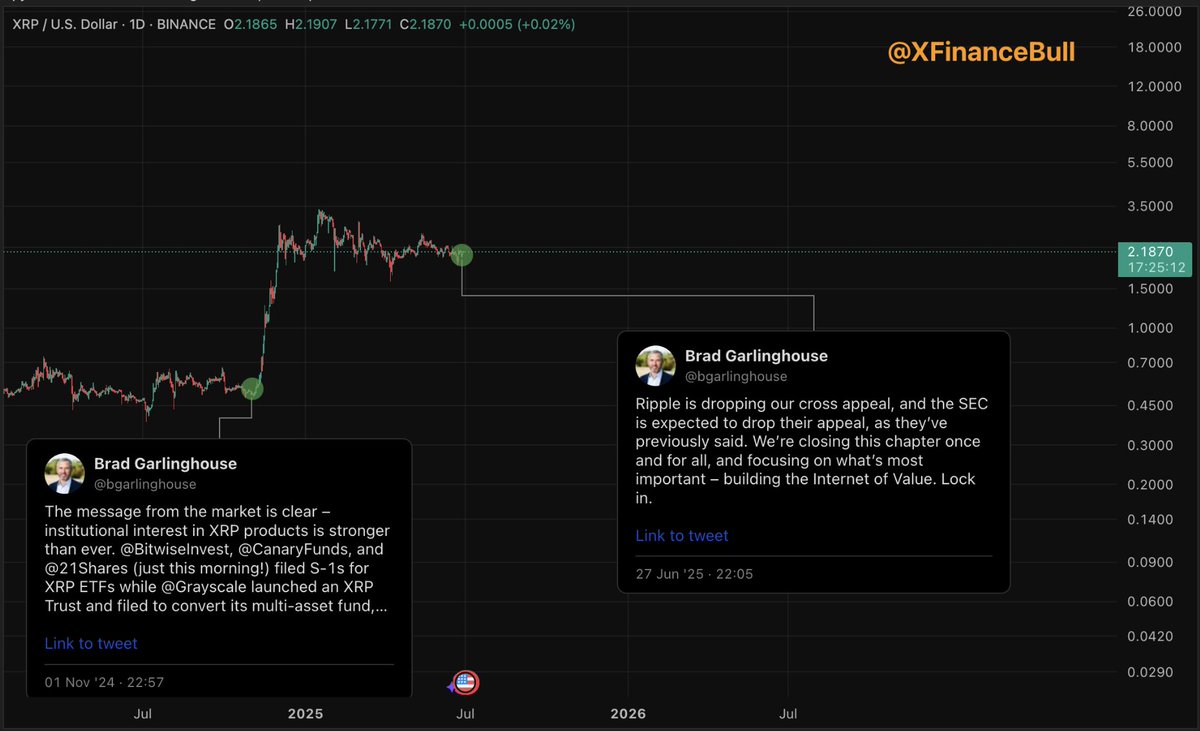
At that time, Garlinghouse contributed to a powerful XRP rally by revealing a wave of institutional interest in XRP-based products through his tweet. That announcement confirmed filings for XRP ETFs by Grayscale, Bitwise, Canary Funds, and 21Shares.

“Institutional interest in XRP products is stronger than ever,” Garlinghouse said at the time. This development added fuel to the upsurge that saw XRP rise from $0.50 to above $2 in just weeks, as investor sentiment improved.

The momentum continued, and XRP went on to surpass $3 for the first time in seven years in January 2025. During this period, XRP soared by over 580%.

Given that Garlinghouse’s announcement contributed to this surge, XRP bulls believe the latest updates will have a similar effect.

“Ripple CEO Did It Once, He’s Doing It Again”

Specifically, XFinanceBull, a well-known analyst on X, sees the same setup unfolding once again. He pointed out how Garlinghouse’s moves helped launch XRP into a new range before and believes this latest message could do it again.

XFinanceBull's post about Ripple CEO and XRP surge
XFinanceBull’s post about Ripple CEO and XRP surge

Garlinghouse’s latest post described this moment as a closing chapter for Ripple, marking the end of legal distractions and a new focus on building the Internet of Value.

With XRP trading at $2.20 at press time, a repeat of history, with another 580% surge, could see XRP reach approximately $15.

Could XRP Even Do 10X?

Meanwhile, another post from Garlinghouse has sparked even more speculation. After the cross-appeal news, XRP supporters resurfaced an image of his XRP tattoo, to which a community member suggested it symbolized his long-term belief in XRP. Ripple’s CEO then amplified the buzz by replying “1,000%” to the post.

Many, including influencer Alex Cobb, interpreted this response as a bold signal that XRP could surge by 1,000%. However, this remains speculative.

If XRP were to climb 1,000% from its current price, it would reach nearly $24 per coin. At that level, XRP’s market cap would hit approximately $1.4 trillion. Interestingly, it would eclipse the market values of companies like Tesla and Berkshire Hathaway.