Home Blog Page 658

XRP Could Surge Soon—Expert Shares Realistic XRP Price Target for Coming Months

XRP price is warming up for a breakout, and current prices may offer a promising entry point for investors, according to analyst Teo Mercer.

In a post on X, Mercer, a Bitcoin analyst with over 2 million followers, stated that XRP is exhibiting “serious signs of life.”

The view suggests that after several months of underperformance, XRP may finally be preparing to move upward. A major factor influencing this perspective is the improving regulatory landscape in the U.S.

XRP’s Realistic Target

Mercer highlighted that as U.S. crypto regulation enters its final stages, the environment is becoming increasingly favorable for XRP. He added that current levels around $2 may present a strong entry point, with the potential for an easy 2x upside.

Specifically, the analyst argued that a move toward the $3 to $4 range for XRP looks realistic in the coming months.

Notably, XRP briefly reached this range in January but faced resistance that has kept its price around $2 over the past seven months. Meanwhile, market watchers are becoming unanimous in their belief that a new breakout to higher price levels is imminent.

Indeed, several efforts in the U.S. to establish a more favorable regulatory environment for crypto are fueling this optimism.

U.S. Regulatory Framework Coming Together

For instance, this month, the U.S. Senate passed the GENIUS Act, which aims to establish the first federal framework for stablecoins. The legislation treats them as payment systems, requiring full backing, transparency, and consumer protections. This lays the groundwork for broader digital asset regulation.

Meanwhile, this week, Republican senators introduced a major crypto bill to provide clear regulatory guidelines for the U.S. crypto industry. The bill seeks to end regulatory uncertainty by defining when a token is a security or a commodity, placing securities under the SEC and commodities under the CFTC. It also reduces the SEC’s authority and positions the CFTC as the primary regulator for the industry.

Building on this momentum, the Federal Housing Finance Agency (FHFA) has directed the $7.8 trillion mortgage giants Fannie Mae and Freddie Mac to recognize crypto assets in qualification assessments.

The agency instructed government-sponsored enterprises (GSEs) to develop proposals for factoring cryptocurrencies into evaluations of borrowers’ financial strength without requiring conversion to U.S. dollars. The new directive aligned with the Trump administration’s pro-crypto stance.

Meanwhile, Ripple and the SEC have settled their years-long legal dispute with a $50 million agreement and dropped appeals, though court approval is still pending.

Essentially, with legal risks reduced, XRP and other crypto assets could benefit from a more supportive environment.

Other “Realistic” Outlooks for XRP This Year

While Mercer has placed up to $4 as a realistic target, some other market watchers are predicting much higher price levels. Analyst Dustin Layton recently claimed that 1,000 XRP, currently worth about $2,000, could generate a $50,000 profit by year-end. 

This implies a 23x return and an XRP price above $52, which he boldly asserted is the “minimum” XRP would deliver for holders. Unsurprisingly, this outlook faced opposition, especially as it would require a $3 trillion market cap for XRP.

Liqwid to Bring Bitcoin to Cardano as a Native Token for Lending Access

0

Liqwid, a leading Cardano DeFi protocol, has announced preparations to integrate Bitcoin into its ecosystem through a dedicated BTC onboarding page. 

This move comes as the Cardano network advances cross-chain capabilities, enabling Bitcoin users to interact with decentralized finance tools while retaining the native security of their assets. 

According to recent updates from Liqwid Labs, users will soon be able to connect wallets, bridge Bitcoin, and access supply and borrowing features through a unified interface. 

This development aligns with the broader trend of bringing Bitcoin into interoperable environments without traditional wrapping or asset conversion.

BTC-Ready Infrastructure and CNT Support in Focus

Liqwid has already equipped its infrastructure to accommodate Bitcoin-native integration. The protocol features secure Bitcoin price oracles, a modular architecture for market expansion, and risk frameworks for asset collateralization. 

Additionally, its on-chain governance system facilitates the streamlined onboarding of new tokens. These elements make it possible for the platform to quickly list Bitcoin as a Cardano Native Token (CNT) once bridging mechanisms go live.

It bears mentioning that recent advancements in Ordinals technology set the stage for this push, allowing Bitcoin to be inscribed and bridged to the Cardano network. Input Output Global (IOG) showcased the potential for Bitcoin Ordinals to become CNTs, allowing users to retain BTC’s original security characteristics.

This eliminates the long-standing dilemma where holders must choose between self-custody and asset utility. With a functioning bridge, Bitcoin can be used across Cardano’s DeFi protocols, including Liqwid, without compromising asset integrity.

No Wrappers and No Trade-Offs

According to Liqwid Labs, the goal is to enable users to supply Bitcoin as collateral and borrow stablecoins such as USDA, USDM, and DJED. This setup offers liquidity access while maintaining BTC exposure.

However, Liqwid Labs co-founder Florian Volery confirmed it will support any functional BTC-to-CNT bridge but will refrain from endorsing any until one is officially live. There will be no wrappers and no trade-offs involved in the integration process.

Further Cross-Chain Strategy with XRP Integration

In parallel with the BTC-CNT initiative, Cardano’s ecosystem is expanding its cross-chain strategy. Notably, Charles Hoskinson, Cardano’s co-founder, recently revealed plans to enhance XRP interoperability.

This effort includes the development of XRP-integrated DeFi tools, the Glacier Airdrop, and potential adoption of Ripple’s RLUSD stablecoin. George Tung, co-founder of CryptosRus, described the strategy as a comprehensive step toward broad cross-chain compatibility across the Cardano network.

New America Healthcare Vision Exposes the Need for Midnight: Cardano Founder Reacts

0

In a reaction, Cardano founder Charles Hoskinson stressed the need for Midnight as the new healthcare vision, fronting public data collection over privacy.

Data privacy is becoming a necessity in the digital scene, especially with the growing means of extracting personal and sensitive data. Meanwhile, it could get worse, as new policies continue to expose sensitive personal information for public use.

Cardano founder Charles Hoskinson emphasized the importance of Midnight in a tweet amid a new government healthcare policy that aims to prioritize the use of data collection devices for every American in the near future.

Hoskinson Emphasizes the Need for Midnight

In a June 25 X post, Hoskinson suggested that it’s all smiles with Midnight, and a lack of protocol could be catastrophic. While he did not state this in clear terms, his choice of emoji while describing the presence and absence of Midnight suggested so.

His response came in response to a tag on a clip from a recent comment by Donald Trump’s pro-Bitcoin cabinet member, Robert F. Kennedy Jr. The current US health secretary made a comment at his recent hearing held by the US House health subcommittee.

In the short video, Kennedy noted that wearable devices are important to the agenda of making Americans healthy again, and his vision is to ensure that every American is wearing a wearable device in the next four years.

While this might seem like a noble cause, considering his focus on real-time health awareness among users, it has not gone down well with a faction of users, especially the tech-savvy. Pundit HustleBitch highlighted that these wearables are electronic data collection devices. This suggests that they provide manufacturers of these technologies with access to the private details of the wearer.

On the note, a Cardano enthusiast tagged Hoskinson in a retweet of the video, simply mentioning Midnight. This drew a response from the Cardano founder.

For the uninitiated, Midnight is a Cardano sidechain focused on privacy and confidentiality. The chain builds on the layer 1 network’s scalability and security, yet leverages zero-knowledge proofs to ensure data security and confidentiality even to transaction validators.

Importantly, this technology ensures that any information that the user wants to be private will remain private despite the transparency of blockchain technology. Midnight uses data encryption and other advanced cryptographic techniques to achieve this level of privacy.

Midnight Launch and Airdrop Details

Notably, this crucial technology remains in the testnet phase. While no exact mainnet launch has been announced, Cardano developers plan to debut the sidechain before the end of 2025.

Moreover, Cardano will airdrop the NIGHT token, the native token of the Midnight chain, in the Glacier drop to eligible users across multiple chains, including XRP and Bitcoin. For eligibility, XRP holders with at least $100 during the June 11 snapshot qualify to participate in the airdrop.

Market Veteran Shares a ‘Better’ Winning Strategy, Says He Didn’t Sit in XRP for Years Like Others

0

A prominent market veteran has discussed what he believes was a better winning strategy for trading XRP over Bitcoin rather than holding for years.

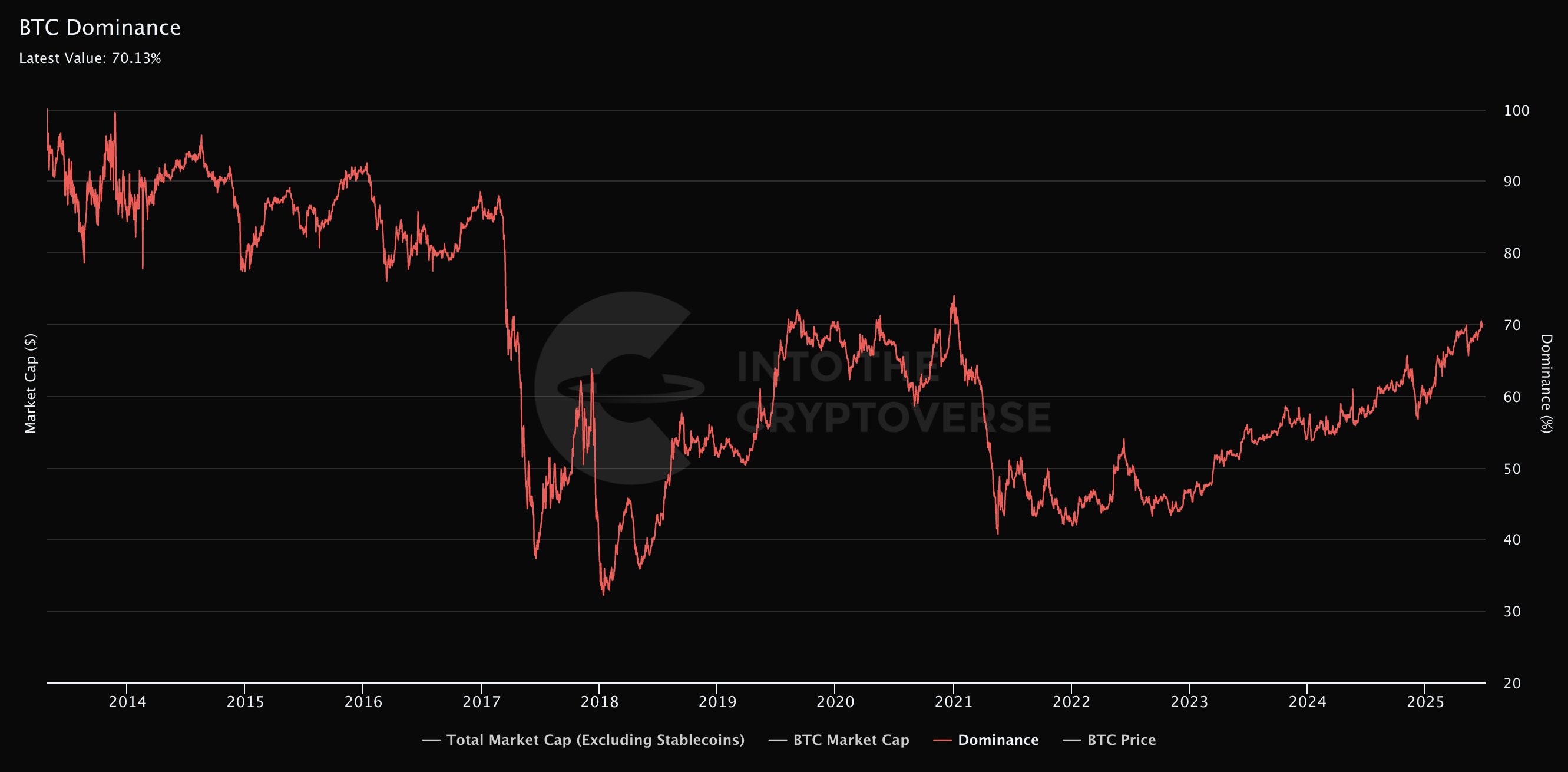
This commentary, which came from Into The Cryptoverse founder Benjamin Cowen, was a direct response to a subtle criticism from another analyst. Originally, Cowen presented an analysis of Bitcoin dominance, which has so far continued to increase, recently hitting 70%, when excluding stablecoins.

Bitcoin Dominance Benjamin Cowen
Bitcoin Dominance | Benjamin Cowen

How Significant is the Bitcoin Dominance Chart?

Replying to Cowen, analyst “GeoMetric” downplayed the importance of looking at the Bitcoin dominance chart. According to him, if he had paid attention to Bitcoin dominance, he would have missed entering the XRP market when XRP traded for $0.35. Notably, this was a perfect opportunity to buy XRP.

GeoMetric argued that traders should see the Bitcoin dominance chart as a market gauge, not a factor that triggers the next price direction. He suggested that by the time the dominance drops, XRP would have already reached greater heights. 

In response, Cowen insisted that he identified the XRP rally from November 2024 early enough. However, he said while he caught the rally soon enough, he did not “sit in XRP for years” mocking the Bitcoin dominance chart while Bitcoin outperformed XRP all that time. 

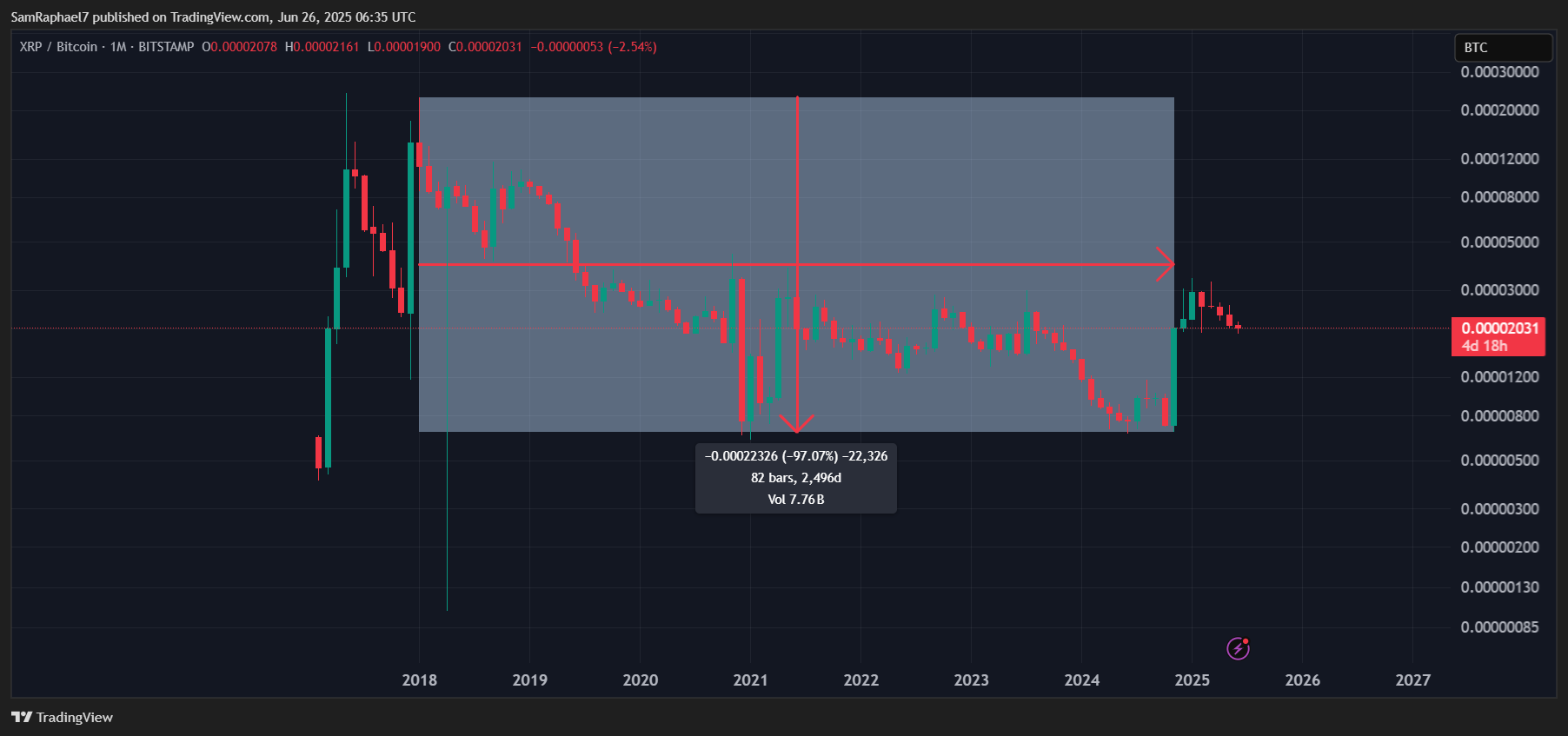
For context, since January 2018, when XRP hit its all-time high of $3.8 and then corrected, Bitcoin had continued to outperform the altcoin. Specifically, the XRP/BTC chart, which traded at a high of 0.00023 in January 2018, collapsed to a low of 0.00000674 by early November 2024. This marked a 97% decline for XRP against BTC.

Bitcoin Outperforms XRP

Cowen Reveals His “Winning Strategy”

Cowen noted that during this downtrend, the XRP/BTC pair formed a double bottom. He identified this signal and confirmed that XRP was on the verge of breaking out against Bitcoin. Notably, this was an ideal time to enter the XRP market, prompting Cowen to make his move.

He used this narration to berate some XRP investors who remained bearish on Bitcoin dominance since 2022, predicting that XRP would break out. However, all this time, Bitcoin continued to outperform while they stayed with XRP, missing out on the gains BTC presented. Cowen said these investors now feel they were right because of the November 2024 breakout.

According to him, the ideal “winning strategy” would have been to enter the Bitcoin market from 2022 to 2024, while BTC outperformed XRP, and then converted some Bitcoin holdings to XRP when the double bottom on the XRP/BTC chart was spotted. This would have allowed the investor to win on both sides: from Bitcoin’s 2022-2024 run, and XRP’s breakout.

At press time, XRP trades for $2.18, while Bitcoin changes hands at $107,700. This brings the XRP/BTC pair to a current figure of 0.00002024. Notably, at the current position, XRP is down 8.9% against Bitcoin this year, but up 200% since the November 2024 low.

FHFA Orders $8 Trillion Mortgage Giants to Recognize Crypto Assets

0

The United States Federal Housing Finance Agency (FHFA) orders two government-sponsored enterprises to prepare to recognize crypto assets in mortgage qualification. 

The FHFA issued the order to Fannie Mae and Freddie Mac in a letter signed by its Director, William Pulte. Notably, the FHFA ordered government-sponsored enterprises (GSEs), such as Freddie Mac and Fannie Mae, to develop systems for recognizing cryptocurrencies as legitimate assets when evaluating a borrower’s financial strength during the mortgage application process. 

For context, Freddie Mac and Fannie Mae currently back the majority of U.S. mortgages. According to Pulte, both enterprises have more than $7.8 trillion in assets, positioning them among the largest companies in the United States. 

Pulte ties the initiative to the current administration’s ambition to position the United States as the world’s crypto capital. The Donald Trump-led administration has continued to embrace cryptos by pushing for clearer regulation and reserves tied to these assets. 

New Order

Previously, both Freddie Mac and Fannie Mae excluded crypto holdings from their mortgage risk assessment processes for mortgage loans. This sometimes prompts crypto owners to convert their assets to U.S. dollars before the loan application closes.

The FHFA indicated that considering crypto assets in the GSE’s assessments could provide a clearer picture of a borrower’s financial strength, potentially allowing more creditworthy individuals to secure mortgages. 

As a result, the FHFA directed Fannie Mae and Freddie Mac to draft proposals outlining how they intend to factor cryptocurrency into their single-family mortgage loan risk assessments without requiring borrowers to convert their holdings to U.S. dollars. 

Eligibility and Safeguards 

Per the directive, the GSEs must consider only crypto assets stored in regulated, centralized exchanges in the United States. During these assessments, enterprises must also consider additional risk mitigants, such as volatility adjustments. 

Furthermore, the FHFA ordered that the board of directors of each GSE must first approve the proposal before sending it back to the agency for further review. 

Industry Stakeholders React 

The broader crypto industry has celebrated the new directive, with top stakeholders like Custodia Bank CEO Caitlin Long supporting the move. 

In his commentary, MicroStrategy (Strategy) executive chairman Michael Saylor said the U.S. housing system has now recognized Bitcoin as a reserve asset. He suggested that the directive serves as a defining moment for the institutional adoption of Bitcoin and its recognition as a form of mortgage collateral. 

Interestingly, White House AI & Crypto Czar David Sacks also responded to the development with a flexed bicep emoji. This signals strength and approval of the FHFA’s move.

Pundit Says No Event Can Make Him Sell His XRP Below $100 Including WWIII

0

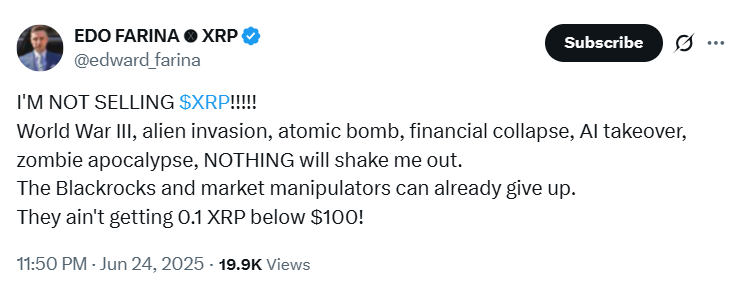
An XRP community pundit has insisted that no black swan event, including WWIII and financial collapse, could make him sell even a fraction of his XRP below three digits.

This commentary came from Edoardo Farina, a crypto founder and Head of Social Adoption at XRPHealthcare, as he continues to advocate for an accumulation culture among XRP proponents despite the persistent price struggles at the $2 mark.

HODLing Through Black Swan Events

In his latest comments, Farina boldly revealed that he would not be selling any of his XRP at the current price regardless of the disruptive global event that occurs. The pundit went on to outline several events that many would consider reasonable enough to pull their funds out of risk assets such as XRP.

Edoardo Farina on X
Edoardo Farina on X

For one, he mentioned a possible World War III. Notably, the market felt the impact of such an event in part following the United States’ recent involvement in the Israel-Iran conflict. Specifically, after the U.S. bombed multiple Iranian nuclear sites, the markets crashed, as concerns of a broader escalation emerged.

Such events often negatively impact risk assets, as investors pull out their funds in anticipation of a market disruption. As a result of this, the broader crypto market slumped over the weekend, with Bitcoin dropping below $100,000 and XRP collapsing below $2. However, since then, the market has recovered.

According to Farina, global conflicts like this will not make him sell any of his XRP holdings, and neither would a larger one such as a world war. He also mentioned other black swan events such as an alien invasion, a financial collapse, a takeover of AI machines, an atomic bomb, or even a zombie apocalypse.

The XRP to $100 Prospect

Notably, while some merely exist in fantasy setups, these are events that are capable of triggering mass selloffs among investors. Farina leveraged this list to highlight his conviction in XRP, bringing up such extremities to confirm that he would not be selling at any point until XRP reached the $100 mark.

This indicates the pundit’s belief that XRP has the potential to reach the $100 price, a massive 4,508% increase from the current XRP price of $2.17. Before now, Farina had expressed his confidence that a $100 price for XRP is attainable. In March, he suggested that XRP ought to be trading above $100 under normal conditions.

Interestingly, besides Farina, other market commentators have insisted that XRP could reach $100. A week ago, The Modern Investor claimed that the market is still early, as XRP still trades below the $100 mark. Also, analyst BarriC boldly projected last month that XRP could rally to $100 before the end of this year, 2025.

While Farina has not specifically revealed the extent of his XRP commitment, he has persistently suggested that investors aim for at least 10,000 XRP. Notably, these 10,000 tokens are currently worth $21,700 but could skyrocket to $1 million if XRP Hits $100. This is the reason behind Farina’s refusal to sell below $100.

If You Hold 1,000 XRP, Expect a Minimum $50,000 Profit This Year: Analyst

Dustin Layton, the influencer behind the pro-XRP “Time Traveler” account, recently stirred excitement about the potential value of 1,000 XRP by the end of this year.

While 1,000 XRP is currently worth around $2,200, Layton confidently claimed that investors holding this amount could see a minimum profit of $50,000 this year. This outlook suggests a base return of approximately 23X for XRP holders in 2025.

He even challenged the crypto community to bookmark the bold tweet and revisit it at the appropriate time in the future. Notably, Layton emphasized that the projected $50,000 profit was for 2025 alone, implying that the gains could further expand into 2026 and beyond.

For context, with XRP trading around $2.20 today, generating a $50,000 profit from holding 1,000 XRP would imply a price of at least $52.20 per coin. Essentially, Layton is projecting that XRP could rise above $50 this year.

Community Reacts: “I Hope You Are Correct”

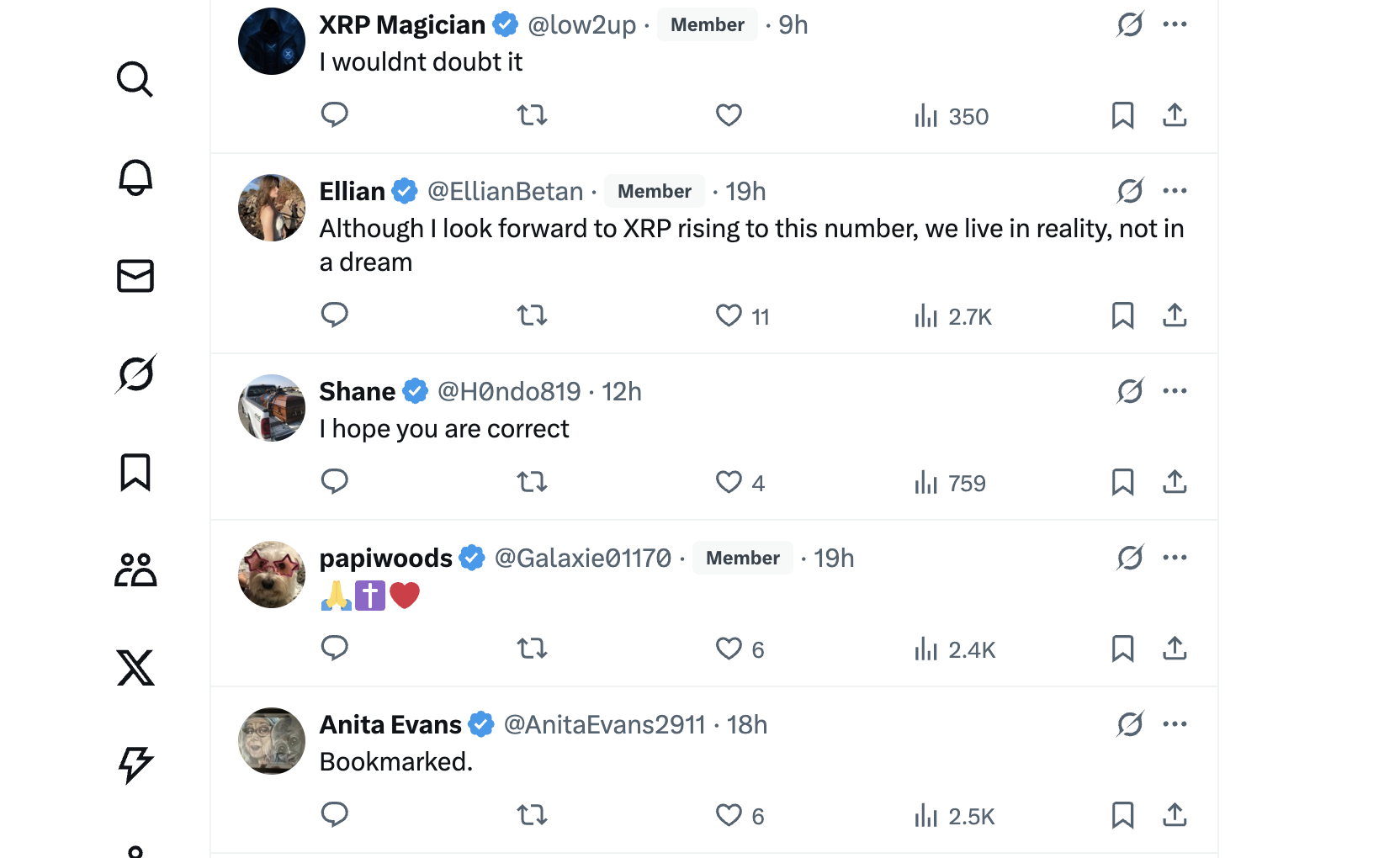
However, most responses to Layton’s tweet expressed skepticism. Many users remarked they hoped the prediction would come true. X user Ellian Betan commented that while the forecast is enticing, it remains a dream, as “the world dwells in reality.”

Meanwhile, another commenter, Tobias, stated that the projection might be possible for those who bought XRP at $0.07. Notably, the actual cost basis is irrelevant, whether one bought at $0.07 or $2, since the prediction is solely about XRP reaching above $50.

Interestingly, accepting the challenge, one commenter asked Layton if he would delete his account should the prediction fail to materialize within the stated timeline.

Opposing Voices in the community

$50 XRP Would Imply a $3 Trillion Market Cap

For context, a price above $50 would place XRP’s market cap above $3 trillion, significantly higher than Bitcoin’s current valuation.

While this price target is ambitious, such lofty projections are common among analysts speculating how high XRP could go this year.

For instance, in March, Elliott Wave analyst XForceGlobal predicted XRP could reach up to $40 this year or the next. He reiterated previous analyses suggesting XRP follows a 5-wave Elliott Wave pattern, with targets of $7–$12 and eventually $20–$40.

Analyst Steph also discussed XRP’s potential for 2025, presenting a scenario where the global crypto market cap doubles to $7 trillion and XRP attains 30% dominance. In this case, the price could hit $34.20.

Some market commentators, like Javon Marks, have even proposed a $99 price for XRP within this year.

Could $50+ XRP Be a Next-Decade Milestone?

These ambitious price projections reflect the high expectations among XRP proponents. However, more conservative voices are warning that such outlooks may be inflated or unrealistic in the near term.

For instance, independent reports from Changelly and Telegaon suggest that XRP may not reach the $50 mark until as late as 2035, far beyond the 2025 timeframe proposed by Layton.

Here’s What Really Happened Behind the Scenes Before Bitcoin Pumped to $108K

Bitcoin is back on the move, climbing dramatically from under $99K to over $108K in just two days.

Behind the scenes, major institutional players made aggressive moves that helped ignite this surge. Here’s what unfolded.

Bitcoin Dips Below $99K on June 22

After weeks of trading in a tightening range, Bitcoin experienced a sudden dip on June 22, falling to a low of $98,200. This sharp correction spooked retail traders and triggered a wave of liquidations, as Bitcoin had been trading above $100K for at least seven consecutive weeks. As a result, market sentiment turned cautious.

But the dip was short-lived.

On June 23, the narrative shifted dramatically. Specifically, ProCap BTC, an institutional investment vehicle led by prominent investor Anthony Pompliano, announced a $1 billion SPAC merger with Columbus Circle Capital to form ProCap Financial.

They revealed they had raised over $750 million in fresh capital, which Pompliano described as the largest amount ever raised for a Bitcoin-focused company. Within hours of the announcement, ProCap began deploying capital aggressively into Bitcoin.

$514.5M in Bitcoin Buys

Less than 24 hours after the merger news, ProCap spent $386.5 million to purchase 3,724 BTC at an average price of $103,785. This accumulation coincided with a swift 5% rebound in BTC’s price, pushing it back above $106,000.

Today, ProCap added another 1,208 BTC worth $128 million to its holdings, this time at an average price of $105,977. This latest purchase brings its total acquisitions to 4,932 BTC worth approximately $514.5 million, acquired in under two days.

Market analytics platform Lookonchain observed a clear correlation between ProCap’s announcements and Bitcoin’s price recovery.

Other Institutional Players Quietly Accumulating Too

While ProCap grabbed headlines, several other institutional and public companies also disclosed significant Bitcoin purchases.

Strategy, led by Michael Saylor, acquired 245 BTC on June 23 for approximately $25 million. Notably, this came just a week after the company purchased 10,100 BTC for over $1 billion.

Also this week, the Smarter Web Company announced additional Bitcoin acquisitions as part of its long-term “10-Year Plan” treasury strategy.

Méliuz S.A. (CASH3), following the completion of a recent share offering, acquired 275.43 BTC for $28.61 million. This brought its total holdings to 595.67 BTC, purchased at an average price of $102,702.

Likewise, The Blockchain Group, Europe’s first public Bitcoin treasury company, added 75 BTC for approximately €6.9 million. As of June 23, it holds 1,728 BTC valued at €155.8 million, with a year-to-date yield of 1,231.7% and a quarter-to-date return of 64.5%.

Together, these moves confirm that Bitcoin accumulation is accelerating across multiple sectors and geographies.

Bitcoin Reclaims $108K, Eyes All-Time High

At press time, Bitcoin has reached an intraday high of $108,125, inching closer to its all-time high near $112,000. With trading volume rising and institutional sentiment turning bullish, momentum appears to favor the bulls.

It’s worth noting that, beyond institutional buying, the ceasefire deal in the Iran-Israel war was a major factor behind Bitcoin’s dramatic comeback.

President Donald Trump’s announcement of the war’s conclusion sent crypto markets surging almost immediately. The initial escalation of the conflict contributed to capital flight, which played a role in Bitcoin’s dip to $98K.

Senator Cynthia Lummis Says the US Needs to Pass Crypto Market Structure Bill Now

0

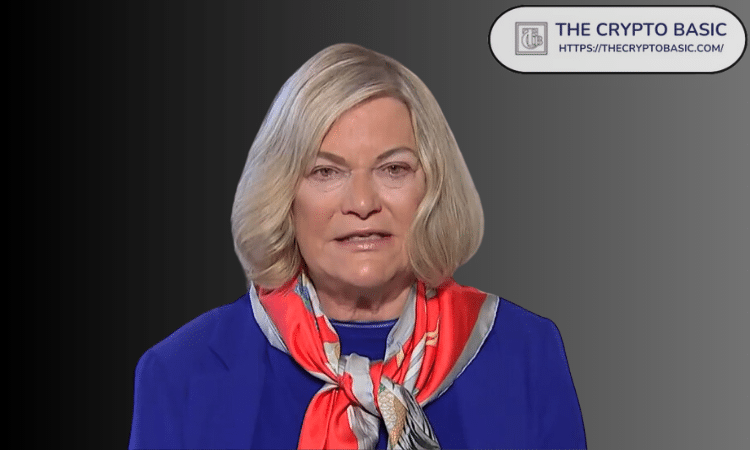
Senator Cynthia Lummis has called on Congress to pass the crypto market structure bill now, emphasizing its importance in driving innovation in the US.

Speaking at an interview on CNBC’s Squawk Box on Wednesday, the pro-Bitcoin senator issued a clarion yet urgent call for the approval of the crypto market bill. She noted that such legislation should have been approved before now, considering that the United States typically leads in innovation, and urged a change of course, probably before the end of the year.

Meanwhile, her comments follow the passage of the GENIUS Act by the US Senate. The stablecoin bill moved closer to becoming law in the U.S. after receiving bipartisan backing, passing with a 68-30 vote on June 17.

The US Needs the Crypto Market Bill

Senator Lummis and her pro-crypto allies are not backing down, despite the recent success of the GENIUS Act. She discussed the new crypto regulatory bill, introduced by her and Senator Tim Scott, aimed at providing a clear framework for the emerging digital asset industry.

The duo, with endorsements from Republican senators Thom Tillis and Bill Hagerty, introduced the bill on Tuesday, looking to build on the bipartisan momentum in the Senate to provide further clarity for cryptocurrencies in the US. The legislation aims to clarify which assets fall into the securities or commodity bracket and who should regulate which.

Meanwhile, Lummis noted that digital assets themselves will be commodities, and the Commodities Futures Trading Commission (CFTC) will regulate them. However, she stressed that most cryptocurrencies are “bundled and sold” by securities; hence, the involvement of the US Securities and Exchange Commission (SEC).

Nonetheless, the Senate subcommittee on digital assets, chaired by Lummis, will focus on the regulatory provisions of the US SEC in the bill, as the Senate Agriculture Committee oversees commodities regulation. Lummis noted that both committees would eventually converge to produce well-rounded legislation on crypto market regulation.

Lummis Sets Ambitious Target for Bill Passage

Furthermore, the pro-Bitcoin Republican senator noted that the Senate’s aim is to pass the bill before the end of the year. Lummis stressed that the United States is already behind in regulating digital assets, as Singapore and Europe have established regulations for the sector.

She stated that the crypto industry wants to grow in the United States but needs clear regulation to do so. Under the former “regulation by enforcement” approach by the US SEC, crypto firms entered into several legal battles with the agency, incurring millions of dollars in legal fees, and Lummis noted that this approach hampered the industry’s growth.

“They (the crypto industry) are asking for regulation; we need to provide it to them,” Lummis told CNBC.

Meanwhile, this crypto market regulation bill is different from the one already making waves in the US House. The CLARITY Act has advanced through both the House Committees on Financial Services and Agriculture, garnering bipartisan support.

The bill will pass soon alongside the GENIUS Act. Moreover, President Trump has urged the House to pass the stablecoin bill swiftly, noting that it will position the United States as an undisputed leader in the cryptocurrency space.

Legal Expert Says Upcoming Ruling in Ripple Lawsuit Won’t Redefine Crypto Legal Status in U.S.

0

Attorney Bill Morgan clarifies that the upcoming ruling in the Ripple case will not redefine the legal status of crypto assets in the U.S. 

Morgan made the assertion in response to a bold claim from market commentator John Squire. In an X post today, Squire suggested that U.S. District Judge Analisa Torres is on the verge of delivering her final decision in the Ripple lawsuit. 

According to Squire, the upcoming ruling could set a landmark precedent that would alter the legal status of crypto assets in the U.S. 

This suggests that Judge Torres’ upcoming decision could play a major role in determining the legal status of cryptocurrencies, particularly in deciding whether they will be classified as commodities or securities. 

Misleading Claim 

However, attorney Morgan refuted this claim as “incorrect.”

The legal expert clarified that the upcoming decision narrowly focuses on the parties’ joint motion for an indicative ruling. In that decision, Morgan contended that the judge would rule on whether there are exceptional circumstances to reduce Ripple’s penalty to $50 million and dismiss the permanent injunction on the company’s XRP sales to institutions. 

For context, Judge Torres denied the parties’ initial attempt to obtain the indicative ruling last month. At the time, she noted a procedural flaw in the joint motion and ruled that the parties had failed to demonstrate “exceptional circumstances” warranting the requested relief.

This month, the parties launched another attempt to secure the indicative ruling, addressing the issues raised in the previous order. Nearly two weeks have passed since the filing, but the judge has yet to issue a decision.

Judge Torres’s Summary Judgment Remains Untouched 

Notably, Morgan said the decision would only focus on the parties’ request to reduce the penalty and vacate the injunction. He suggested that the decision would not define the legal status of crypto assets in the United States, as Squire claimed. 

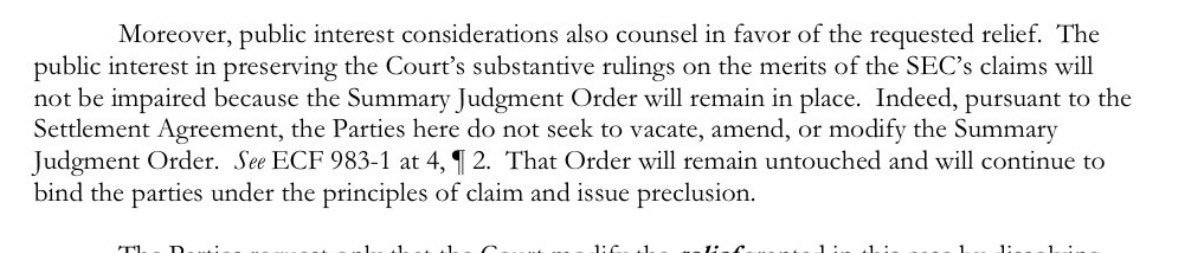
According to him, the SEC and Ripple agreed not to challenge, modify, or vacate Judge Torres’ 2023 summary judgment decision. The lawyer also attached an excerpt from the joint motion corroborating his claims. 

SEC and Ripple agree not to modify Judge Torres summary judgment decision
SEC and Ripple agree not to modify Judge Torres’ summary judgment decision

For context, in the summary judgment decision, the judge stated that XRP is not a security in itself. She also declared that Ripple’s XRP sales to institutional clients were investment contracts, but those conducted on digital exchanges were not. 

The summary judgment decision has played a crucial role in determining the legal status of crypto. According to the ruling, cryptocurrencies are not securities, but can be sold as part of an investment contract. 

In the meantime, the broader legal uncertainty around crypto’s status may soon be addressed. The U.S. Senate recently introduced legislation that would specify the criteria determining when a crypto asset should be classified as a commodity or security.