Home Blog Page 66

XRP Takes About 1,400 Days to Reach a New Cycle Peak

0

Market data indicates that XRP takes about 1,400 days to reach a new cycle peak.

XRP has been in a correction phase for the past 12 months since reaching its cycle high of $3.6 in July 2025. While market participants await a recovery, historical cycle data suggests the correction may not be finished.

Notably, XRP’s three completed market cycles show that the asset has taken an average of 1,414 days to move from one cycle peak to the next after declining from the previous high. 

With only 360 days having passed since the July 2025 peak, the data points to a possible cycle bottom forming around Q4 2026, while a new cycle high could arrive between May and August 2029 if the historical pattern continues.

Past XRP Cycles Show a Similar Structure

XRP’s first major cycle peaked on Dec. 5, 2013, when the price reached $0.0614 after rising 2,017% from the $0.0029 low recorded in August 2013. However, the rally was followed by a sharp decline, and XRP fell to about $0.0028 in July 2014, a drop of roughly 95.4%.

XRP later recovered and reached a new cycle high of $3.31 on Jan. 4, 2017. Essentially, this first peak-to-peak cycle lasted 1,125 days.

The second cycle followed a similar path but lasted longer. After peaking at $3.31 in January 2017, XRP declined for about 27 months before finding a bottom near $0.11 in March 2020 during the COVID-related market crash. 

This move represented a decline of about 96.7%. XRP later recovered and reached $1.96 on April 14, 2021, completing a 1,561-day cycle.

XRP Cycle Tops
XRP Cycle Tops

Meanwhile, following the April 2021 peak of $1.96, XRP dropped to around $0.29 in June 2022, a decline of about 85.2% over roughly 14 months. The recovery that followed pushed XRP to $3.60 on July 18, 2025, exactly 1,556 days after the April 2021 peak.

Averaging all three completed cycles produces a mean cycle length of 1,414 days, which points to a potential new peak in June 2029 from the July 2025 high. This indicates that XRP could find its next cycle top between May and August 2029.

The Bottom May Not Have Formed Yet

In addition, historical data provides clues about where XRP could find its next long-term bottom. Previous cycles took an average of 15 months to complete the bottoming process after each peak. If this pattern repeats, XRP could continue correcting through Q4 2026 before establishing a more durable floor.

Also, the size of past corrections supports the possibility. Specifically, XRP experienced drawdowns of 95.4%, 96.7%, and 85.2% in its three completed cycles, averaging roughly 92%.

Applying similar declines to the $3.60 peak produces several downside targets. A decline matching the deepest historical corrections would place XRP near $0.29, which is also the June 2022 cycle low. 

A milder correction similar to the third cycle would point to around $0.53. In addition, the 78.6% Fibonacci retracement of the move from $0.29 to $3.60 sits at $1.00.

Based on those levels, the most likely range for a long-term bottom appears to be between $0.29 and $1.00, with the $0.53 to $0.67 zone representing a middle-ground scenario.

Key Resistance Levels

Once XRP completes its correction, several resistance levels could determine the next recovery phase.

The first major level is $1.55, which aligns with the 61.8% Fibonacci retracement of the full move from $0.29 to $3.60. A sustained push above that level would confirm that XRP has entered a broader recovery.

Above that, the $1.95 to $1.96 area carries additional importance because it matches both the April 14, 2021 cycle peak and the 50% Fibonacci retracement level. Many previous buyers may look to exit positions around that zone.

The next major resistance stands at $3.31, the cycle high recorded in January 2017. After that, XRP would need to reclaim its $3.60 all-time high before confirming a new cycle breakout.

More Developer Activity on the XRP Ledger as App-Related Transactions Surges

0

XRP Ledger app activity has picked up, with tagged transactions jumping 28.6% as more applications become active on the network.

Developer-related activity on the XRP Ledger is showing renewed momentum, with new data pointing to a noticeable rise over the past week. According to an X post from XRPL dUNL validator Vet, source-tagged transactions have increased sharply as more applications and services come live on the ecosystem.

XRP Ledger Records Stronger App Activity

According to the data, source-tagged transactions reached 676,800 per week, representing a 28.6% increase compared to the first week of the reporting period.

An accompanying chart shows daily source-tagged transactions trending higher after a noticeable drop in late June. Activity accelerated on the third day of July, with several sessions since then pushing above the 80,000 mark. On July 10, tagged transactions on the XRP Ledger reached 120,000 per day, one of the highest readings on the chart.

XRP Ledger App Activity Spike/Vet

Network participation also ticked up during the same timeframe. Average daily active source tags rose to 176, up 13% from the beginning of the reporting period. 

Notably, source tags identify the services and applications generating activity on the XRP Ledger. As such, their increase suggests that more platforms are now operating on the network.

Overall, the metric shows that developers are actively deploying newer applications on XRP Ledger. Also, those apps are generating interest, resulting in more source-tagged transactions processed on the Ledger per day.

While the overall activity grew, the data shows that new wallets per week held steady at 12,400. Vet noted that the flat new wallet count suggests that existing users are becoming more active. The current increase in app usage is from users already registered on the network, not primarily from new addresses.

Rising Developer Activity Fueled by “Make Waves?”

Vet noted that one possible explanation for the higher level of activity is the ongoing “Make Waves on XRPL” initiative organized by XRPL Commons.

For the uninitiated, the three-month competition started on June 22. XRPL Commons offers 50,000 XRP in rewards to developers who launch live applications on the XRP Ledger mainnet and attract active users and measurable on-chain activity.

The hackathon bases the incentives on working products and does not accept prototypes. At the end of the program on September 21, the best projects will receive a share of the 50,000 XRP prize money.

For context, 25,000 XRP will go to the best overall project, selected by the jury. 5,000 XRP will go to the application with the highest number of users. The project with the highest on-chain volume will receive another 5,000 XRP, while 1,000 XRP will be shared among 15 projects with 300 active users.

Vet suggested that this could be the reason why both tagged transactions and active source tags have climbed together. Nonetheless, this remains unconfirmed.

XRP Whale Activity and Price Decline

Despite the increase in app activity, XRP whales have slowed down transactions. Over the past week, transactions exceeding $1 million on the XRP Ledger have dropped from 70 to two, a 97% decline.

At the same time, XRP also pulled back by 6%, as bears continue to dominate market proceedings. At the time of writing, XRP trades at $1.078, continuing to defend key support areas despite weakness.

XRPL Validator: Block XRP Influencers Claiming SWIFT Is Using XRP

XRPL validator Hussein Zangana, better known as Vet, has urged the XRP community to stop spreading claims that SWIFT is using XRP or will adopt it soon.

According to Vet, these claims distract from the real progress happening across the XRP Ledger (XRPL) ecosystem.

His comments came after former SWIFT Chief Innovation Officer Tom Zschach publicly dismissed renewed speculation that SWIFT would integrate XRP.

Focus on Real XRPL Growth

In a post on X, Vet told investors to “block” influencers who claim SWIFT is already using XRP or say with certainty that it will in the future.

He said these rumors are similar to earlier unverified claims involving the Depository Trust & Clearing Corporation (DTCC). According to Vet, such narratives are unnecessary and hurt the community’s credibility.

Instead, he encouraged the community to focus on ongoing XRPL developments. These include security upgrades, on-chain lending, stablecoins, foreign exchange capabilities, permissioned domains for compliant trading, and privacy improvements.

Vet also said Ripple and the XRPL ecosystem are working to onboard institutions and consumers while expanding real-world adoption. He argued that building useful infrastructure is “10000x better” than relying on unfounded speculation.

XRP Doesn’t Need SWIFT

Responding to Vet’s post, XRP community member CharuSan said XRP’s long-term success does not depend on SWIFT integration. He pointed to Ripple’s existing network of financial institutions as a stronger foundation. He also highlighted future developments such as AI agents on XRPL, lending protocols, and other ecosystem innovations as better reasons for optimism.

CharuSan added that XRP could eventually compete with traditional payment networks instead of operating alongside them.

Former SWIFT Executive Rejected XRP Rumors

The discussion follows comments made on July 10 by former SWIFT Chief Innovation Officer Tom Zschach. He rejected viral claims that SWIFT planned to support XRP.

Responding to social media posts claiming SWIFT would adopt public digital assets like XRP instead of launching its own cryptocurrency, Zschach replied, “Not happening.”

The speculation came from posts citing an alleged SWIFT document that supposedly said the organization would support existing digital assets such as XRP. However, no official SWIFT document or announcement backed those claims.

Zschach’s response is consistent with his long-standing skepticism toward Ripple and XRP. During his time at SWIFT, he questioned XRP’s utility and decentralization. He also criticized Ripple’s technology.

Despite recurring speculation whenever SWIFT announces blockchain or digital asset initiatives, neither SWIFT nor Ripple has announced any partnership involving XRP. Instead, Ripple executives have said the company is building an alternative to the SWIFT system. 

XRP Now Critically Close to Descending Channel Breakout After 12 Months

0

XRP is now pushing against the upper boundary of a descending channel that has dictated its movement for the past 12 months. 

At press time, XRP trades at $1.0801, leaving little room between its current price and the channel’s falling resistance line. With the trading range now squeezed to nearly nothing, the chart suggests a breakout or rejection could happen soon.

This current situation resembles the pattern that appeared before XRP climbed to $3.60 in July 2025. Once again, the asset has compressed beneath a declining trendline, and this makes the coming sessions especially important.

A Year of Selling Has Shaped the Current Trend

XRP reached a high of about $3.60 in July 2025 before entering the descending channel that has guided its price ever since. From this peak, the upper trendline continued to slope lower, stopping every recovery attempt over the past year and sending the price back down after each test.

The lower trendline developed alongside it, beginning around the $2.00 area before leading XRP through the $1.50 range, then the $1.30 area, and finally toward its current level near $1.08.

The channel has remained intact from the second half of 2025 into mid-2026, contributing to a decline of more than 70% from the July 2025 peak. 

XRP Descending Channel

Now, XRP sits almost directly below the upper trendline. Since there is barely any gap left between the price and resistance, the chart suggests that a move may not be far away.

XRP Historical Data

Before its major rally, XRP spent about 16 months moving sideways inside an accumulation range defined by a parallel channel between $0.45 and $0.75. 

This period ended with a breakout in November 2024, which pushed the price to around $3.30 by January 2025. The move showed that buyers had built enough demand to break through long-standing resistance.

After the rally, XRP formed a symmetrical triangle that stretched from $3.30 down to support between $1.90 and $2.00. As the price tightened beneath the upper boundary of the triangle, it eventually broke above the trendline in mid-2025, leading to the rally that reached $3.60 in July 2025.

The current situation shares many of the same features. XRP now presses against the upper boundary of the present channel with the same type of price compression that came before the previous breakout.

Key XRP Price Levels to Watch

The next major signal will come if XRP closes a daily candle above the channel’s upper trendline, which now sits around $1.10. A confirmed close above that area would mark a technical breakout and push attention to the next resistance zone.

The first major target lies between $1.50 and $1.60. This area acted as support throughout late 2025 before the price fell below it as the descending channel continued lower. Moving back above that range would strengthen the overall market structure.

If buying pressure continues, $2.00 becomes the next major level to watch. This price acted as the foundation for the mid-2025 rally to $3.60 and has remained an important turning point on the chart. 

From the current price of $1.0801, a move to $2.00 would represent a gain of about 85%. Above that, XRP could face additional resistance around $2.50 and $3.00 as it attempts to recover the July 2025 high.

XRP Ledger’s Consensus Model Better Suited for Long-Term Stability Than Bitcoin’s PoW, XRPL Validator Says

XRPL validator Vet (Hussein Zangana) has argued that the XRP Ledger’s consensus mechanism is better suited for long-term sustainability than Bitcoin’s proof-of-work (PoW) model.

According to Vet, Bitcoin’s mining system was highly effective at distributing BTC in the network’s early years. However, he believes it could face economic challenges as block rewards continue to decline.

In a post on X and an accompanying video presentation, Vet compared the supply dynamics of Bitcoin and XRP. He argued that “supply distribution is only a short-term challenge, while consensus algorithms are permanent.”

Bitcoin Early Success Came With Long-Term Trade-Offs

Zangana explained that Bitcoin’s PoW mechanism originally served two purposes. It secured the blockchain while distributing new BTC through mining rewards.

Bitcoin launched with a 50 BTC block reward, which halves roughly every four years. Vet noted that about 95.5% of Bitcoin’s fixed 21 million supply has already been distributed, leaving relatively little new issuance over the coming decades. 

He acknowledged that PoW helped democratize Bitcoin’s early distribution because users could mine coins with relatively modest hardware. However, he argued that the system becomes more expensive and less efficient as new issuance declines.

According to Vet, Bitcoin will increasingly rely on transaction fees to incentivize miners once block rewards become negligible. He also argued that wider adoption of Layer-2 networks could reduce on-chain activity, making it harder for miners to earn enough fee revenue over the long term.

XRP Ledger Was Built for Long-Term Efficiency

Meanwhile, Vet contrasted this with the XRP Ledger, which did not use its consensus mechanism to distribute XRP. Instead, the network created its entire 100 billion XRP supply at genesis, with tokens distributed over time.

Because XRPL has no mining rewards, Vet said its consensus mechanism focuses solely on validating and settling transactions. This allows for low costs, fast confirmations, and minimal transaction fees.

He argued that this approach made XRP’s early distribution more difficult. However, it also removed the long-term burden of maintaining an expensive mining incentive once token distribution is complete.

According to Zangana, Bitcoin prioritized efficient early distribution, while the XRP Ledger accepted a more challenging launch in exchange for a consensus model built for long-term operation.

Network Performance Will Matter More Than Launch History

Vet also argued that future users will care less about how a cryptocurrency was originally distributed.

Whether Bitcoin relied on mining rewards or Ripple distributed XRP over time, he said most new users will judge a network by how well it works today rather than by its launch history.

He added that the XRP Ledger has grown into a mature ecosystem with numerous developers and applications. As a result, he believes it is now well positioned to benefit from its consensus design after overcoming its initial distribution challenges.

Concluding his analysis, Vet said the next five to ten years will be a key test for Bitcoin as block rewards continue to shrink and the network relies more heavily on transaction fees. 

By contrast, he argued that the XRP Ledger can continue operating efficiently without facing the same structural pressures.

XRP Whale Transactions Exceeding $1M Drops 97%

0

XRP’s price could drop further as whale activity on the XRP Ledger has slowed considerably, signaling reduced participation from large investors.

According to Santiment data shared by Ali Martinez, the number of XRP transactions valued above $1 million has fallen by 97% in one week. This suggests that activities of institutions and large XRP holders have cooled significantly after a period of strong market participation.

XRP Whale Activity Drops Massively

Transactions exceeding $1 million on the XRP Ledger dropped from around 70 over the past week to just two today. A shared chart shows that this drop started slowly, with daily whale activity still well above 52 transactions on July 8.

XRP Whale Activity/Ali Martinez

However, things escalated quickly from July 9, with activities from this caliber of whales declining sharply. By July 12, what was once 70 transactions exceeding $1 million had dropped 97% to 2.

Notably, the decline aligned with the bearish XRP price momentum. Last week, the altcoin slumped over 6% as downward pressure sustained. The price decline has nearly wiped out the asset’s gain in July, which has declined from 14% at its intra-month high to just 3.5%.

While fewer whale transactions do not necessarily signal a bearish outcome, they often indicate reduced market participation by major players. Combined with the recent weakness in XRP’s price, the decline suggests that large investors may be waiting for stronger market confirmation before moving holdings again.

XRP Price Gameplan

Meanwhile, analyst Cryptoinsightuk shared what he noted was his XRP plan for a while now. The technical insight is simple: the coin drops further to a key support area, forms a durable base, then breaks out to higher prices.

An accompanying daily chart shows XRP continuing to trade beneath a well-defined descending trendline. This resistance has capped prices since the swing high of $1.55 on May 14.

XRP Price Plan/Cryptoinsightuk

Price is currently hovering around $1.08, while immediate horizontal resistance sits near $1.11. There, the descending trendline intersects with the horizontal resistance. Notably, XRP retreated to this level after a rejection at the descending trendline on July 4.

The analyst highlights the possibility of one more decline into a demand zone between $0.90 and $0.94. Per the commentary, the area is a potential long-entry region, where buyers may sustainably absorb selling pressure before a larger recovery develops. XRP would have to drop 12.6% to 16% from the current price to reach the key support region.

Possible Breakout if Support Holds

If XRP revisits this demand zone and buyers successfully defend it, the chart suggests a potential rebound that could first reclaim the descending trendline before targeting higher resistance levels. Such a move would strengthen the case for a broader trend reversal after several months of downtrend.

In the meantime, it remains to be seen if XRP offers this new low to market users. For over a month now, XRP has defended the $1 support, with each retest followed by a rebound. Although bears remain on top, a broader crypto market recovery and continued buying pressure from this support could see XRP start to rebound even before reaching the $0.90-$0.94 support.

Forbes Lists XRP Among the 10 Best Cryptocurrencies to Invest in for July 2026

0

Forbes has included XRP among its 10 best cryptocurrencies to invest in for July 2026, placing it fourth behind Bitcoin, Ethereum, and BNB.

The ranking comes from the publication’s latest review of major digital assets based on factors such as real-world use, market size, recent price performance, and trading activity.

The publication limited its selection to cryptocurrencies with market capitalizations above $5 billion, noting that larger assets tend to show greater stability and attract more institutional interest. 

Besides the top four, the list also includes Solana (SOL), TRON (TRX), Hyperliquid (HYPE), Rain (RAIN), UNUS SED LEO (LEO), and Zcash (ZEC).

Why XRP Made the List

According to Forbes, XRP continues to earn attention because of its focus on fast and low-cost cross-border payments. The original XRPL architects developed the cryptocurrency to help move value between different currencies quickly while keeping transaction costs low.

The report noted that XRP traded at $1.11 as of July 10, 2026. At that price, the cryptocurrency had a market capitalization of $69.21 billion, making it the fourth-largest asset in the rankings. Over the previous seven days, XRP posted a modest gain of 0.29%.

Forbes also mentioned XRP’s long-term growth. Since its launch, the asset has climbed about 18,761% to reach its current price. It also reached a 12-month high of $3.65 on July 17, 2025, before pulling back to the current level.

Forbes Weighs XRP’s Strengths Against Its Risks

Forbes highlighted XRP’s role in international payments as one of its biggest strengths. The publication noted that Ripple has built partnerships with financial institutions, which give XRP a practical use case that sets it apart from many other cryptocurrencies.

At the same time, the report acknowledged concerns that some investors continue to raise. Unlike Bitcoin, which releases new coins through mining, XRP enters circulation when Ripple sells tokens from its holdings. Forbes said this has led to ongoing discussions over how much influence Ripple has on the token’s supply.

The publication also pointed out that Ripple co-founder Chris Larsen still owns a significant amount of XRP. It presented this concentration of ownership as another factor investors should consider alongside the asset’s strengths.

Bitcoin, Ethereum, and BNB Lead the Rankings

Meanwhile, Bitcoin took the top spot on the list, with its $1.289 trillion market cap and position as the largest cryptocurrency. Forbes called it digital gold and a store of value, but noted that its proof-of-work network consumes large amounts of energy and processes transactions more slowly than newer blockchain networks.

Ethereum ranked second with a market cap of $216.47 billion. Forbes highlighted its role in smart contracts and decentralized applications alongside its large developer community. However, it also noted that network congestion and high gas fees remain ongoing challenges.

BNB secured third place with a market capitalization of $77.36 billion. The publication mentioned its growing use across the Binance ecosystem and the token’s regular supply burns. 

However, they noted that its future remains tied to Binance’s performance and the regulatory environment surrounding the exchange.

Forbes’ Focus on Utility and Market Size

Forbes said it built its rankings by looking at criteria besides price alone. Specifically, the publication focused on cryptocurrencies that boast practical use alongside a long-term investment case.

Notably, market cap played a major role in the selection process. While Bitcoin and Ethereum together account for about 68% of the total crypto market, Forbes also looked at other large-cap projects that could offer a balance between growth potential and relative stability. 

Using those criteria, XRP earned the fourth spot. Forbes based that decision on the asset’s role in cross-border payments, its institutional connections, and its $69.21 billion market capitalization.

David Schwartz Says Lawyers Told Ripple It Was Unsalvageable After SEC Lawsuit

Ripple CEO Brad Garlinghouse says the company seriously considered shutting down after the U.S. SEC sued Ripple in 2020. 

He described the decision as one of the toughest of his career. Speaking at the University of Kansas School of Business, Garlinghouse said Ripple’s leadership debated whether to dissolve the company instead of fighting what became a four-year legal battle.

Ripple Considered Shutting Down

Garlinghouse said he and Ripple co-founder and Chairman Chris Larsen questioned whether Ripple should continue after the SEC accused the company of conducting unregistered securities sales through XRP.

“We almost decided to shut down the company when the SEC sued us,” Garlinghouse said.

One option was to dissolve Ripple and distribute its XRP holdings to shareholders on a pro-rata basis. Garlinghouse acknowledged that hundreds of employees would have lost their jobs. However, he said shutting down seemed easier than taking on the SEC.

In the end, Ripple chose to fight. Garlinghouse said he is “glad” the company made that decision, even though the outcome was uncertain at the time.

SEC Gave No Warning

Garlinghouse said Ripple repeatedly sought regulatory clarity before the lawsuit. However, he said the SEC never indicated that it viewed XRP as a security.

According to Garlinghouse, he met with SEC officials four times between 2017 and 2019 without legal counsel. He said the meetings focused on Ripple’s technology and XRP’s use cases. At no point, he added, did the agency warn him that XRP could be treated as a security.

Garlinghouse also revealed that the SEC offered him a personal settlement. Under the proposal, the agency would drop its case against him if he paid a fine, while continuing its lawsuit against Ripple. He called the offer “distasteful” and suggested it was meant to pressure him into settling.

He added that the lawsuit ultimately cost Ripple about $150 million in legal fees.

Garlinghouse Defends XRP’s Role

Garlinghouse also defended XRP’s role in Ripple’s payments business. He contrasted it with Bitcoin, saying Bitcoin is better suited for some use cases but remains relatively slow and expensive for payments.

He argued that XRP offers faster settlement, lower transaction costs, and better scalability for cross-border transfers.

Garlinghouse also stressed that XRP is an open-source blockchain asset. While Ripple uses it in its payment products, he said it does not represent ownership in the company like traditional shares.

David Schwartz Reactions

Garlinghouse’s comments sparked discussion within the XRP community. Responding to doubts about whether Ripple was really close to shutting down, Ripple CTO Emeritus David Schwartz said the company received legal advice that it was “done” and “unsavable.” He said some lawyers recommended that executives strike a deal to protect themselves.

Schwartz added that he believes the SEC named Garlinghouse and Larsen personally because it was the expected approach in enforcement actions.

XRP-focused YouTuber Moon Lambo questioned why Ripple’s legal advisers believed the company had no chance of surviving. He described the recommendation to give up without a fight as an extreme position and said he was relieved Ripple chose to contest the case instead.

XRP Faces Funding Rate Reset Risk as Derivatives Data Flashes Warning

0

XRP is showing signs of growing pressure as new Binance derivatives data points to a market that may not have finished its correction.

While the token continues to trade above the important support level at $1, several key derivatives indicators suggest traders should remain cautious. 

Specifically, falling Open Interest, rising funding rates, and a sharp increase in long liquidations have created conditions that often lead to a short-term pullback before the market finds a stronger footing.

XRP currently trades at $1.10, down 4.23% over the past seven days. Although the price has recovered from some of its recent losses, the latest derivatives data suggests that the market is still adjusting after weeks of heavy positioning.

Spot Activity Suggests Traders Are Repositioning

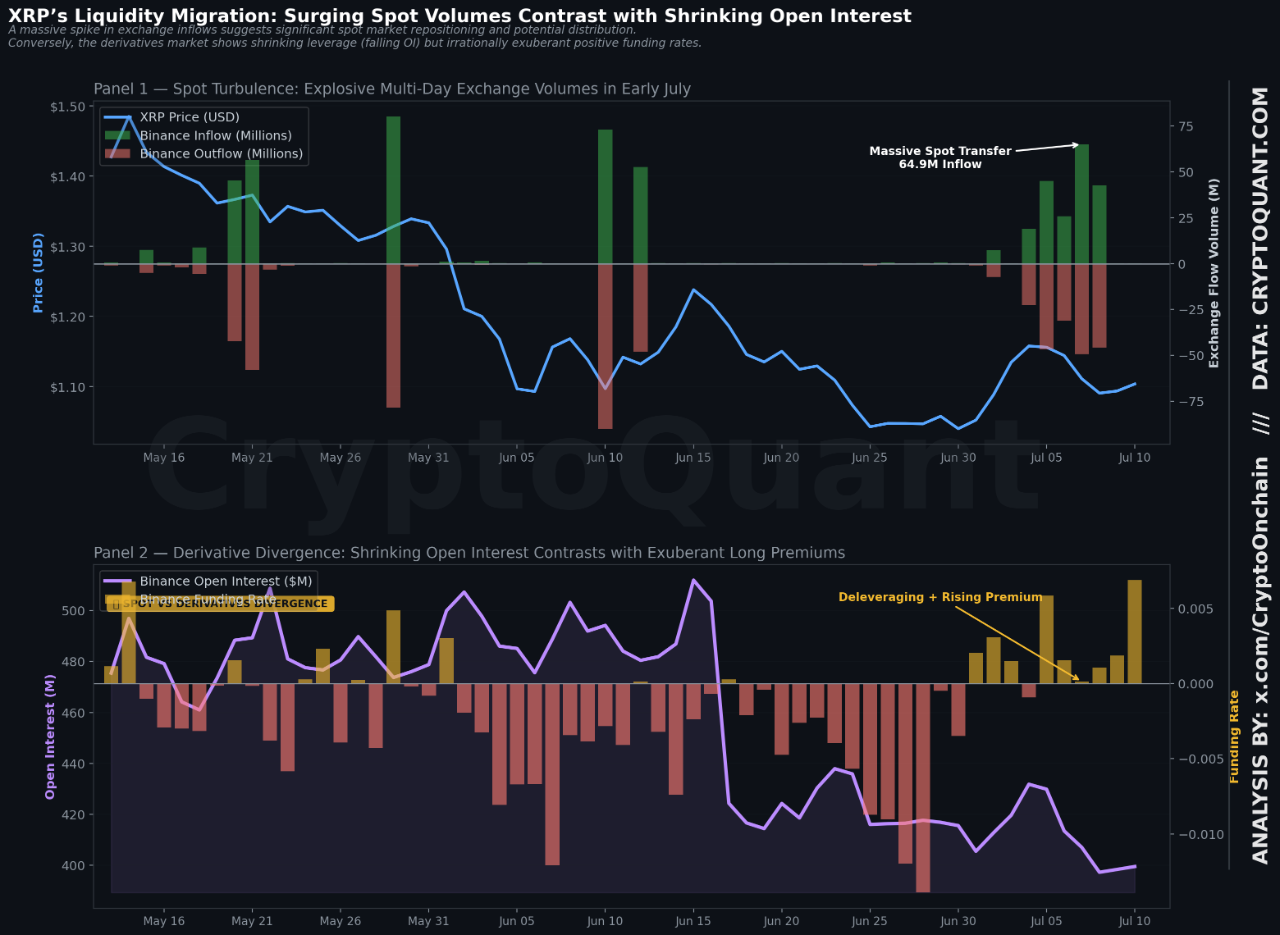
Notably, Binance recorded a noticeable increase in XRP spot activity between July 4 and July 8, with large amounts of the token moving into and out of the exchange. 

The biggest movement came on July 7, when 64.9 million XRP entered Binance while 49.2 million XRP left the platform. This left the exchange with a net inflow of roughly 15.7 million XRP for the day.

However, these figures do not necessarily indicate fresh buying. The large volumes on both sides suggest that existing holders were moving funds and adjusting their positions instead of opening major new long trades.

XRP Open Interest Continues to Fall

Also, the derivatives market has steadily lost leverage over the past few weeks. Specifically, Binance XRP Open Interest exceeded $500 million in mid-June before dropping to $431 million by July 4. The decline continued over the following days, with Open Interest falling further to $399 million by July 10.

This marked a drop of more than $100 million in about three weeks, showing that leveraged traders have continued to reduce their exposure instead of increasing it.

XRP Liquidity Migration CryptoQuant
XRP Liquidity Migration | CryptoQuant

Liquidation data show a similar trend. Long liquidations jumped 94% compared with the previous week and climbed 172% above the three-month average. 

In contrast, short liquidations fell 53%, showing that bullish traders absorbed most of the losses. This suggests that every recent attempt to push XRP higher has met strong selling pressure, forcing more long positions out of the market.

XRP Funding Rate Trend

In addition, toward the end of June, Binance funding rates briefly turned negative, showing that short positions had gained the upper hand and that long traders were collecting funding payments. The situation changed almost immediately, as funding rates then climbed 266% to reach 0.007.

This shows that fewer leveraged positions remain open, yet traders who are still holding long positions now pay higher funding costs. 

Markets have often responded to similar conditions with a funding rate reset, where another round of long liquidations pushes prices lower, brings funding rates back to normal, and clears out excess leverage before a healthier recovery begins.

XRP Approaches a Key Turning Point

XRP’s recent price movement reflects what has happened in the derivatives market. After falling 22% during June, the token recovered to $1.18 by July 4. However, it failed to hold that level and slipped to $1.08 by July 8, around the same time long liquidations reached their highest levels.

The price has since recovered slightly to $1.10, leaving XRP with a 6.62% gain for July despite its recent weekly decline. However, the market still faces strong resistance above current levels.

For now, $1.08 remains the key support level. A break below it could confirm that the expected funding rate reset has started, increasing the chances of another wave of selling from leveraged long positions. 

On the other hand, a move above $1.16, followed by a breakout past $1.18, would show that XRP has worked through its deleveraging phase without another sharp decline.

\XRP Spot Buying Rises as Bearish Sentiment Hits Extremes, CryptoQuant Flags Reversal Signal

XRP saw a sharp rise in spot trading on Binance between July 4 and July 8, even as activity in the derivatives market continued to decline.

Market watcher CryptoOnchain on CryptoQuant said capital is moving into the spot market while leveraged positions continue to unwind. Similar setups have historically preceded funding-rate resets.

Binance Spot Activity Rises While Leverage Shrinks

CryptoOnchain noted that Binance recorded a spike in XRP spot activity during the period. On July 7 alone, inflows reached 64.9 million XRP, compared with 49.2 million XRP in outflows.

However, the surge in spot trading did not reverse the ongoing decline in derivatives activity. Binance XRP Open Interest had already fallen from more than $500 million in mid-June to $431 million by July 4. It later dropped further to $399 million by July 10.

Meanwhile, long liquidations jumped 94% from the previous week and were 172% above the three-month average. Short liquidations, by contrast, fell 53%.

Funding Rates Rise Despite Lower Open Interest

Although Open Interest continued to fall, Binance funding rates recovered after briefly turning negative in late June. Funding rates rose 266% week over week to 0.007.

According to CryptoOnchain, rising funding rates, falling Open Interest, and massive long liquidations suggest that traders opening new long positions are paying higher premiums even as overall leverage declines.

On-Chain Activity Shows Signs of Recovery

The report said XRP’s on-chain data looks more stable than its derivatives market. Active addresses remain 11% below the three-month average, showing network activity has yet to fully recover.

However, transaction volume increased by about 3% to 4% over the past week and month, although it is still 21% below the three-month average. The Network Value to Transactions (NVT) ratio has also declined, which may indicate network usage is stabilizing.

Funding-Rate Reset May Be Next

CryptoOnchain said the current market structure, marked by rising funding rates, falling Open Interest, and heavy long liquidations, has often led to funding-rate resets in the past. Whether that happens again will depend on how traders react to the gap between stronger funding rates and weaker leveraged participation.

CryptoQuant Flags Possible Reversal Signal

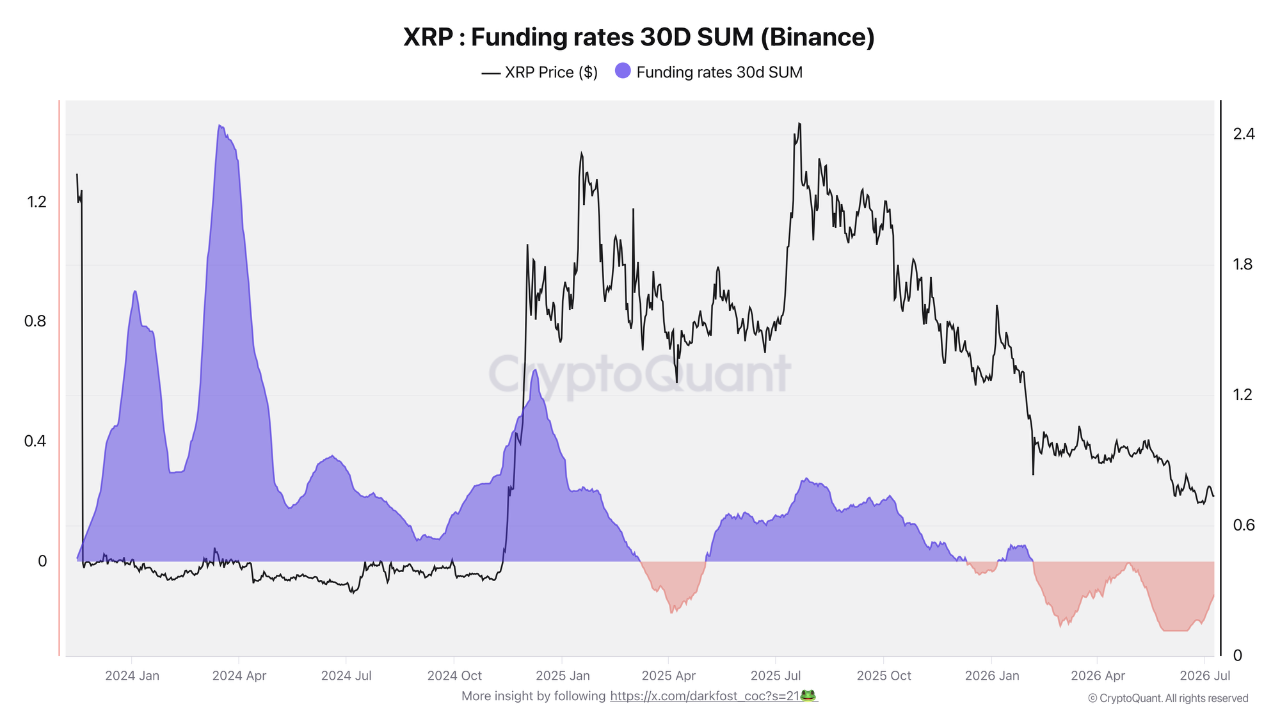
Separately, CryptoQuant analyst Darkfost noted that XRP’s derivatives market has reached extreme bearish levels after its sharp decline, with Binance funding rates turning deeply negative. He said excessive short positioning could act as a contrarian signal, similar to conditions seen in April 2025 before XRP’s price rallied 126%.

While past patterns do not guarantee future results, Darkfost said the combination of a major correction and extreme bearish sentiment could increase the odds of a medium-term recovery.