Home Blog Page 682

Expert Says Bitcoin Is Insanely Early, Representing Just 0.2% of Global Wealth

0

Bitcoin only represents a tiny fraction of the global wealth pie and investors might still be early, a fact highlighted by Walker, host of The Bitcoin Podcast. 

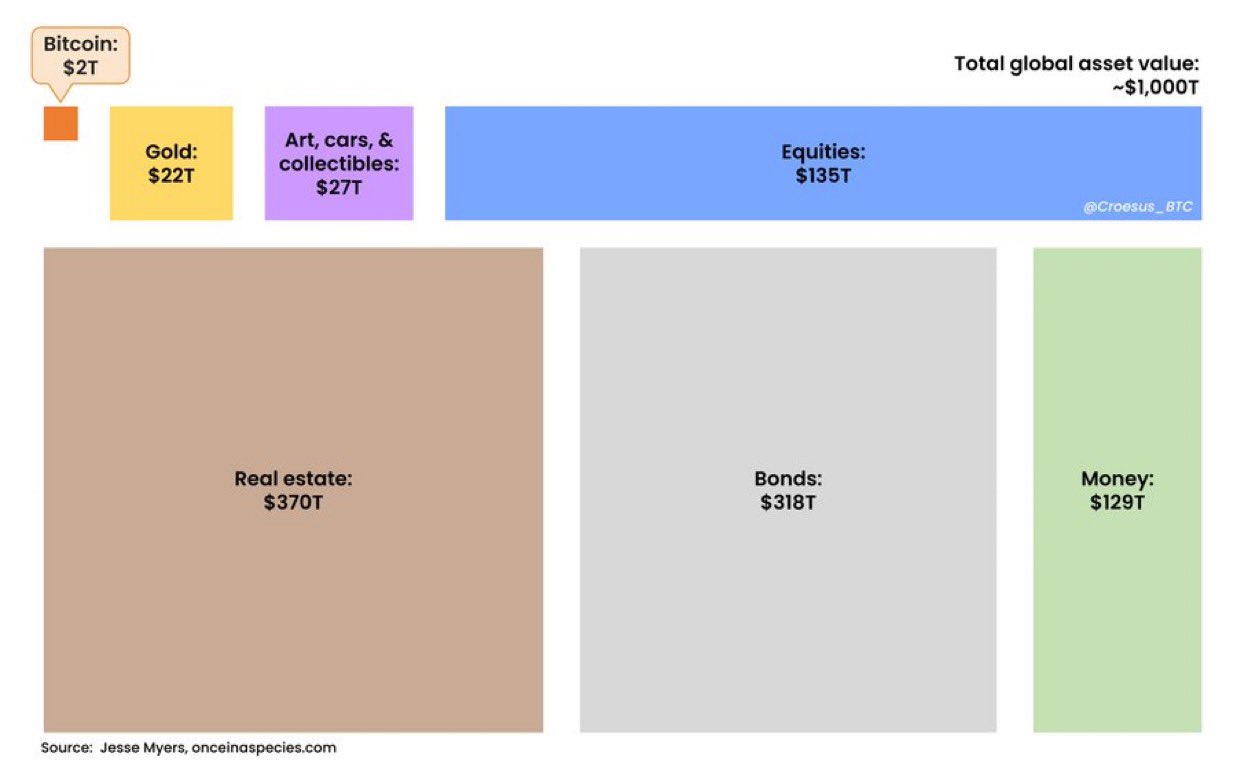
With a global wealth valued at about $1,000 trillion (or $1 quadrillion), Bitcoin’s market capitalization of $2 trillion accounts for just 0.2% of this massive figure. 

This comparison emphasizes how early investors still are in the Bitcoin market especially considering the potential for significant growth as the asset class develops further.

The Dominance of Traditional Asset Classes

Per Walker’s assessment, real estate is by far the largest component of global wealth, representing $370 trillion, or 37% of the total. This asset class includes all forms of land, residential, and commercial properties, which have long been considered reliable stores of value. 
Image

Following real estate, bonds make up the next largest share of global wealth at $318 trillion. These financial instruments, favored for their stability, play a significant role in financial markets and are seen as a steady way to accumulate wealth over time.

Meanwhile, equities, or stocks, contribute $135 trillion to the global wealth picture. Publicly traded companies and their stock values remain a critical part of the global financial system. 

Additionally, cash and other liquid assets, including bank deposits and currencies, make up $129 trillion, showing the substantial amount of readily available capital in the economy. Other categories, such as art, cars, and collectibles, come in at $27 trillion, while gold, a traditional store of value, accounts for $22 trillion in global wealth.

Bitcoin’s Scarcity and Potential

Despite Bitcoin’s small market cap compared to traditional assets, its scarcity sets it apart. With only 21 million bitcoins ever to be mined, its limited supply serves as a potential catalyst for price growth as adoption increases.

Bitcoin’s current position at just $2 trillion in market cap suggests that it’s still in its early stages of adoption. This contrasts with the established wealth represented by real estate, stocks, and bonds, which have been in place for much longer.

Walker emphasized the potential for Bitcoin’s future growth, urging his audience to buy Bitcoin now. He cautioned that failing to do so could result in purchasing at much higher prices later, driven by the fear of missing out (FOMO). 

If Bitcoin’s market capitalization were to reach the same level as gold’s, its price could rise to over $1.15 million per Bitcoin. This would mean that those who delay their investment now could find themselves buying Bitcoin much later, at a significantly higher price.

JPMorgan Might be Late to Buy

Meanwhile, Michael Saylor, chairman of Strategy—one of the largest Bitcoin treasury firms—suggested that institutions like JPMorgan might eventually buy Bitcoin when its price exceeds $1 million.

He suggested that Bitcoin could hit this level before wealth managers are ready to recommend it, and $10 million before it’s widely accepted as a mainstream investment. This suggests that Bitcoin’s journey to full institutional adoption might see significant price increases in the years to come.

Treasury Secretary Predicts Dollar-Pegged Stablecoins Could Exceed $2T Valuation

0

U.S. Treasury Secretary Scott Bessent predicts the global stablecoin market cap could exceed $2 trillion in the coming years. 

Bessent issued the bullish forecast during a recent Senate Appropriations subcommittee hearing, as reported by Bloomberg. During the congressional hearing, Bessent outlined how dollar-pegged stablecoins could strengthen the dollar’s position in the global financial system. 

According to him, dollar-pegged stablecoins have the potential to expand the global use of the U.S. dollar. Specifically, he mentioned that the U.S. Congress is currently working on rules that mandate dollar stablecoin issuers to back every token with top-tier assets, such as U.S. Treasury Bills (T-Bills). 

Congress Invokes Cloture on GENIUS Act Amendment 

Bessent’s commentary comes a few hours after Congress voted to invoke cloture on Bill Hagerty’s substitute amendment to the stablecoin GENIUS Act. Hagerty made the amendment as part of efforts to gain Democratic support for the stablecoin bill. 

With cloture invoked, Congress will schedule a vote to adopt the amendment. According to pro-crypto journalist Eleanor Terrett, a final passage vote on the GENIUS Act could be held early next week. 

Following the advancement of the GENIUS Act in Congress, Bessent indicated that the legislation, mandating dollar-pegged stablecoins to be backed by U.S. Treasury Bills, would expand U.S. Dollar usage globally. 

Dollar-Linked Stablecoin to Hit $2T Valuation 

During the hearing, Bessent referenced a recent industry estimate projecting that dollar-linked stablecoins could reach $2 trillion in the next few years. Based on this assessment, these dollar-linked stablecoins would have up to $2 trillion worth of T-Bills backing them. 

He also cited a conservative estimate from Citigroup analysts, who suggest that dollar-pegged stablecoin issuers could purchase an additional $1 trillion worth of T-Bills by 2030 to back these tokens. 

Interestingly, Bessent characterized the $2 trillion dollar-pegged stablecoin market cap projection as ‘very reasonable.’ Accordingly, he asserted that the stablecoin valuation could ‘greatly exceed’ the $2 trillion mark. 

This view aligns with a similar sentiment expressed by David Sacks, the White House’s AI and Crypto Czar. As reported previously, Sacks suggested that legislation like the GENIUS Act could propel the stablecoin market to trillions of dollars, with the tokens fully collateralized by U.S. Treasuries.  

Currently, the global stablecoin market, comprising tokens pegged to the U.S. dollar and other fiat currencies such as the euro, is valued at $254.82 billion. Dollar-pegged stablecoins account for the majority of this valuation. 

For perspective, the top nine stablecoins are pegged to the dollar. They include USDT, USDC, USDe, DAI, USD1, FDUSD, PYUSD, TUSD, and USDD, with a combined valuation of roughly $233 billion, representing 91% of the total stablecoin market cap. 

Expert Says Ripple CEO Means What He Says Amid Claims XRPL Will Capture 14% of All Bank Liquidity

Ripple CEO Brad Garlinghouse has added weight to the long-standing discussion within the XRP community about the XRPL potentially handling a significant portion of SWIFT’s transaction volume.

His comments on this enduring speculation have further strengthened the community’s conviction in the promising future of XRP.

Notably, this statement came during the ongoing 2025 XRPL Apex event in Singapore. Garlinghouse stated that the XRP Ledger (XRPL) could realistically handle 14% of SWIFT’s total transaction volume within the next five years.

The remark came during a Q&A session in which Ripple’s CTO, David Schwartz, also participated. They addressed questions concerning the future of cross-border liquidity.

Responding to a question about how XRPL might compete with SWIFT’s dominance in global finance, Garlinghouse drew a key distinction between SWIFT’s role as a messaging network and its function in liquidity. He stated that XRP’s strength lies in real-time settlement and liquidity provisioning, not in facilitating messages between banks.

Garlinghouse said that liquidity is what truly matters, and that’s where XRP can deliver real value and solve real-world problems. In this context, he foresees a future in which XRP controls up to 14% of SWIFT’s liquidity.

Community Reaction: “He Means It”

Most recently, XRP community figure Nietzbux expressed strong confidence in Garlinghouse’s forecast, noting that the Ripple CEO has a consistent track record of making statements that later come to fruition.

“When he speaks, he means it; it eventually comes true,” he said.

According to Nietzbux, the projection that XRP could capture 14% of the global bank liquidity currently processed through SWIFT is a serious indicator of Ripple’s strategic intent, not just optimistic rhetoric.

This view reflects a popular sentiment within the XRP ecosystem that Ripple’s leadership often signals its long-term direction well before the broader market catches on.

XRP Price in $21 Trillion Target Volume

While theoretical estimates place SWIFT’s total transaction volume at over $1 quadrillion annually, more grounded numbers suggest a different picture. According to a 2023 Forbes report, SWIFT’s annual volume stood at $150 trillion in real-world volume.

If Ripple’s 14% projection plays out, the XRPL could be handling around $21 trillion annually, or nearly $58 billion daily, within five years. That level of adoption could significantly impact XRP’s price.

While XRP is currently trading at $2.30, estimating the effect of processing $58 billion daily on its price is complex. To assess the potential impact, The Crypto Basic turned to AI-based analysis by ChatGPT.

ChatGPT explained that XRP, used as a bridge asset in cross-border payments, is not consumed per transaction but is instead reused. This makes liquidity and transaction velocity more relevant than supply scarcity.

If each XRP token circulates about 30 times per year, the network would require a liquidity pool of approximately $700 billion to support $21 trillion in annual volume.

Based on XRP’s full supply of 100 billion tokens, this implies a base price of roughly $11.90 per token. Factoring in speculative interest and institutional adoption, ChatGPT noted that XRP’s price could rise further. It sees XRP potentially reaching $17.85 with moderate market enthusiasm, or $23.81 under strong demand.

PEPE Tests Critical 50% Fibonacci Support as Large Holders Boost Net Flows by 1,645%

PEPE retests its 50% Fibonacci level as large holders increase net flows by 1,645%. Can the meme coin bounce back toward $0.00001550?

Pepe has witnessed a steep correction toward the recently broken 50% Fibonacci level, risking a potential bearish turnaround. However, large holders’ net flows and optimism in the derivatives market signal a possible bounce-back for Pepe. Will this extend the bullish trend toward the $0.00001550 resistance level?

On-chain Data Supports Bullish Chances

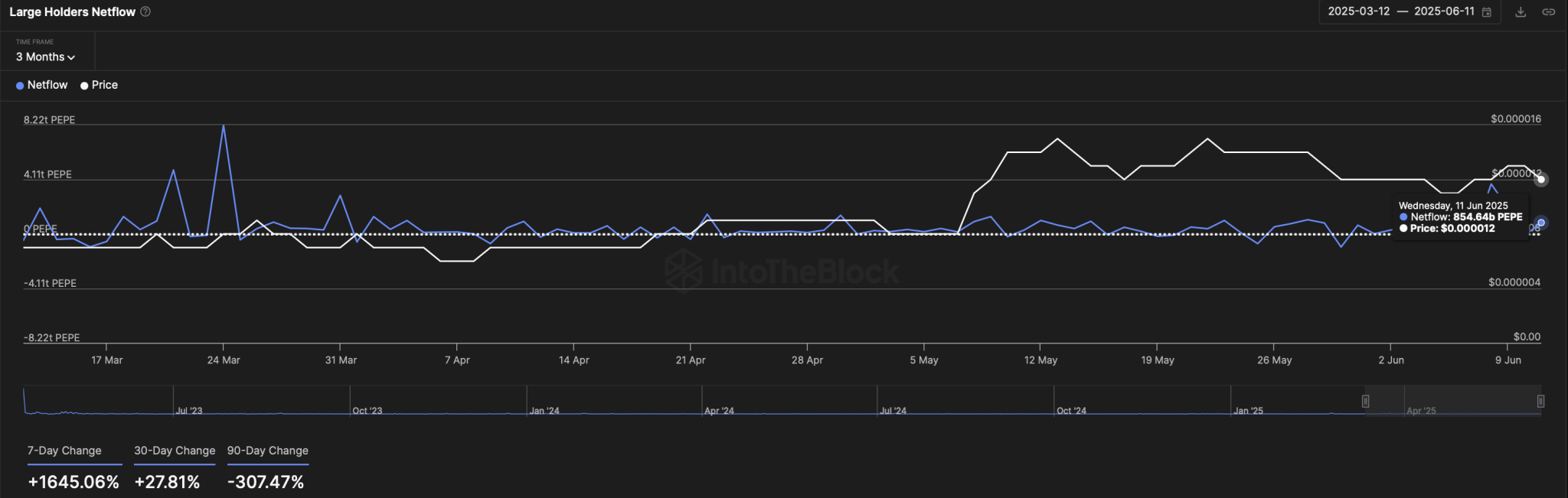
According to IntoTheBlock’s data, large holders’ Net Flow has surged by 1,645% over the past seven days. On June 11, the Net Flow reached 854.64 billion, reflecting increased confidence among large holders. This indicator measures the net flow of holders owning more than 0.1% of the circulating supply.

Large Holders Netflow

Pepe Price Analysis

At the time of writing, Pepe trades at $0.00001242, with an intraday pullback of 0.64%. This reflects a lower price rejection from the 24-hour low of $0.0000121.

PEPE Price Chart
PEPE Price Chart

Following a minor bounce, Pepe holds ground above the 50% Fibonacci level at $0.0000122. However, the recent 4.80% pullback on Wednesday indicates a marginal increase in selling pressure.

Due to prior bullish momentum resulting in a golden cross and hinting at a bullish crossover in the 100-day EMA lines, the meme coin is likely to sustain the prevailing uptrend. Supporting these bullish prospects, the MACD and signal lines are expected to flatten near the zero line, signaling a potential bullish crossover.

Based on price action analysis, an immediate bounce back in Pepe could face resistance at $0.0000155, followed by key resistance at $0.00001705. On the downside, a close below the 50% Fibonacci level could test the 200-day EMA at $0.00001155.

PEPE Derivatives

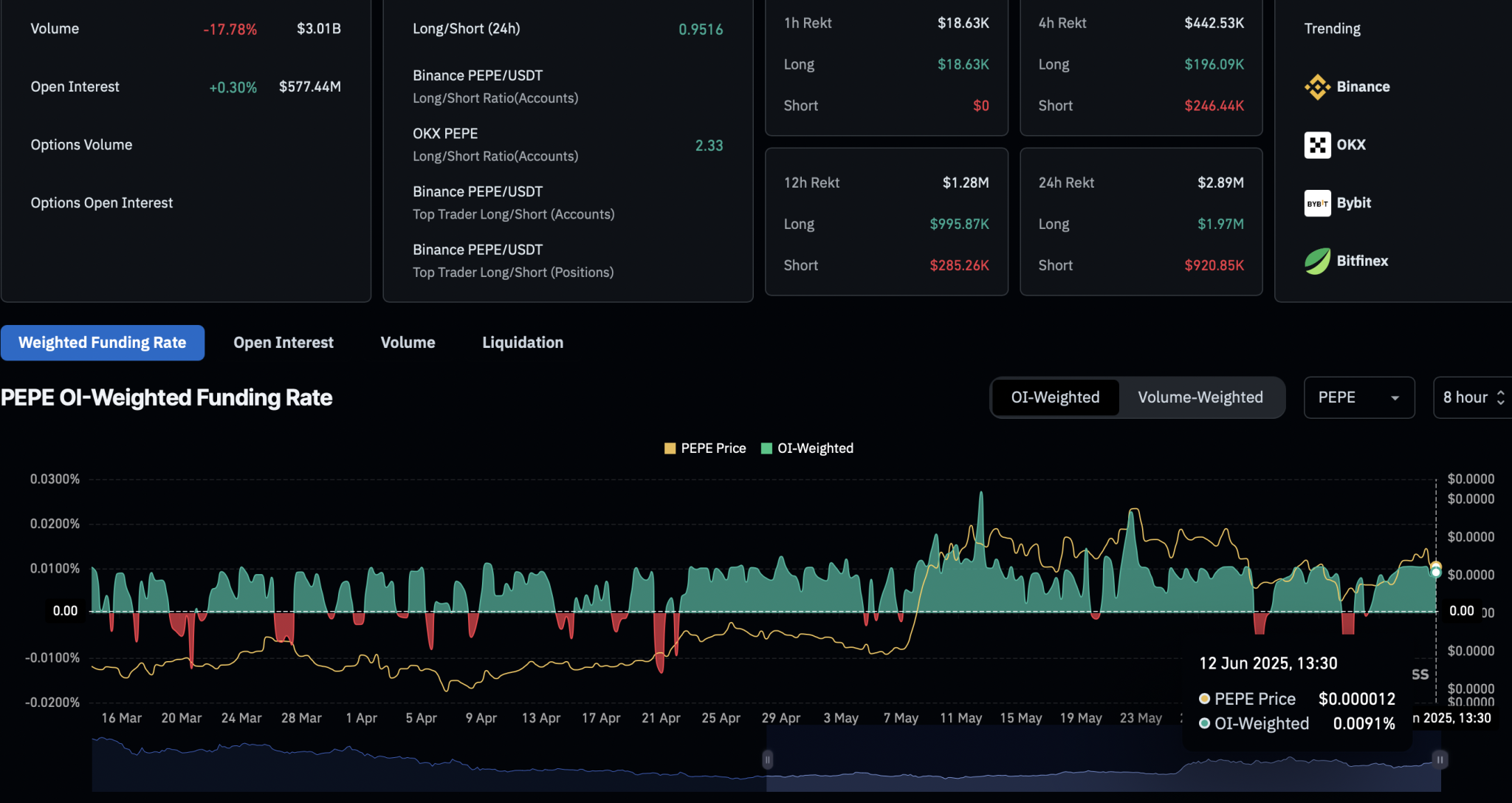
Supporting a bullish sentiment, optimism remains strong in PEPE’s derivatives market, with open interest rising by 0.30% to $577.44 million. However, long liquidations have surged to $1.97 million in the past 24 hours, more than double the short liquidations, which were $920,000.

This signals a significant wipeout of bullish-aligned traders, dropping the long-to-short ratio to 0.9516 as short positions increase. Despite the rise in short positions, the overweighted funding rate remains steady at 0.0091%, reflecting sustained commitment to bullish activity.

PEPE Derivatives
PEPE Derivatives

Ethereum Holds Above $2,700 as ETF Inflows Hit $699M in June

Ethereum remains above $2,700 despite a pullback, supported by $699 million in ETF inflows this June. Can ETH rally to $3,000?

As Bitcoin drops below $108,000, broader market sentiment is gradually turning bearish. Holding firm against increasing pressure, Ethereum floats above $2,700 despite an intraday pullback of nearly 0.5%. However, a short-term pullback in the derivatives market warns of a potential retest of the $2,700 level.

Institutions Continue Supporting Ethereum

Notably, U.S. spot Ethereum ETFs have maintained a streak of inflows since May 16, with the most recent inflow on June 11 valued at $240.29 million. The largest inflow on that day was recorded by BlackRock, contributing $163.64 million, followed by Fidelity with $37.28 million. This week, ETF inflows have surged to $417 million.

BlackRock recorded the largest inflow on the day, $163.64 million, followed by Fidelity, $37.28 million. In the present week, the ETF inflow has surged to $417 million.

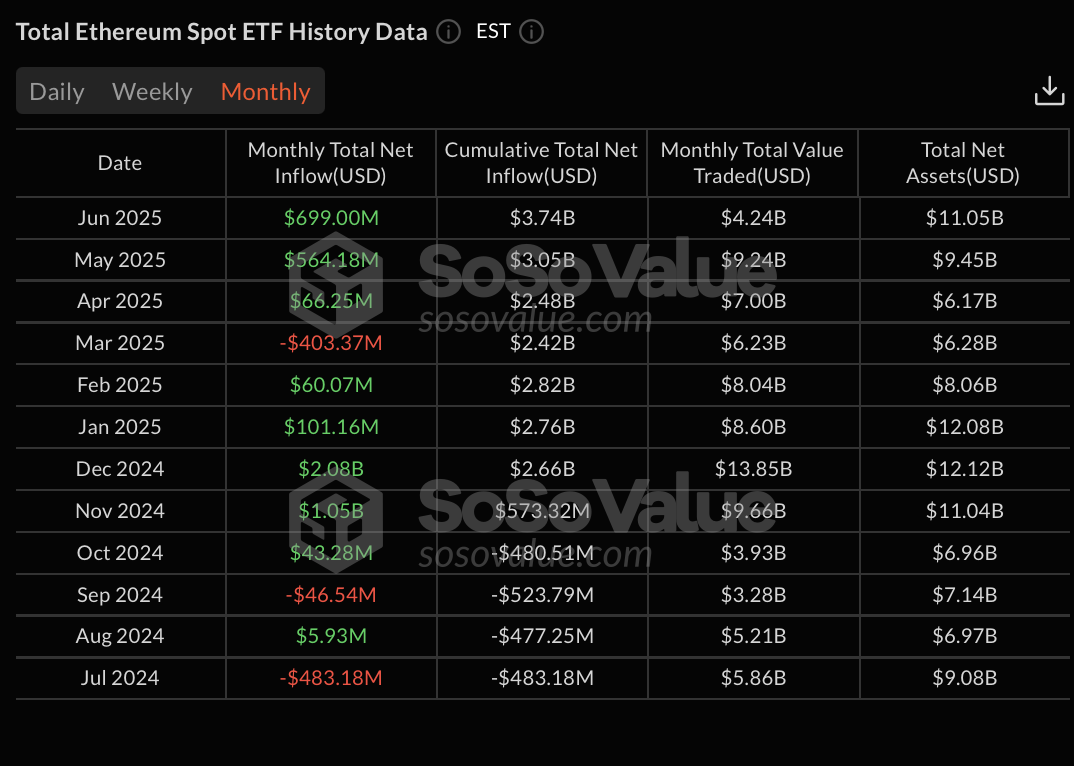
Notably, June’s inflows totaling $699 million have significantly exceeded May’s inflows of $564 million.

Ethereum ETFs Monthly Flow

Ethereum Price Analysis

Amid the strong inflows, Ethereum’s price continues to hold critical levels. On the daily chart, ETH experienced a minor pullback of 1.59% on Wednesday after reaching a high of $2,879. This pullback could be a potential retest of the recently broken 50% Fibonacci retracement level at $2,699.

Ethereum price chart

Notably, the breakout above the Fibonacci level marked a bullish end to a sideways trend, with the 38.20% Fibonacci level providing lower support at $2,395. Overall sentiment remains bullish following the recent breakout, as the rising 50-day EMA hints at a golden crossover with the 200-day EMA.

Additionally, the bullish momentum has led to a positive crossover in the MACD and signal lines. However, the delayed surge of bullish histograms above the zero line signals short-term uncertainty for Ethereum.

According to Fibonacci levels, a potential bounce from the 50% retracement could target the 61.80% level at $3,003. On the downside, crucial support lies at the 200-day EMA around $2,473, followed by the 38.20% Fibonacci level at $2,395.

Open Interest Declines in Ethereum Derivatives

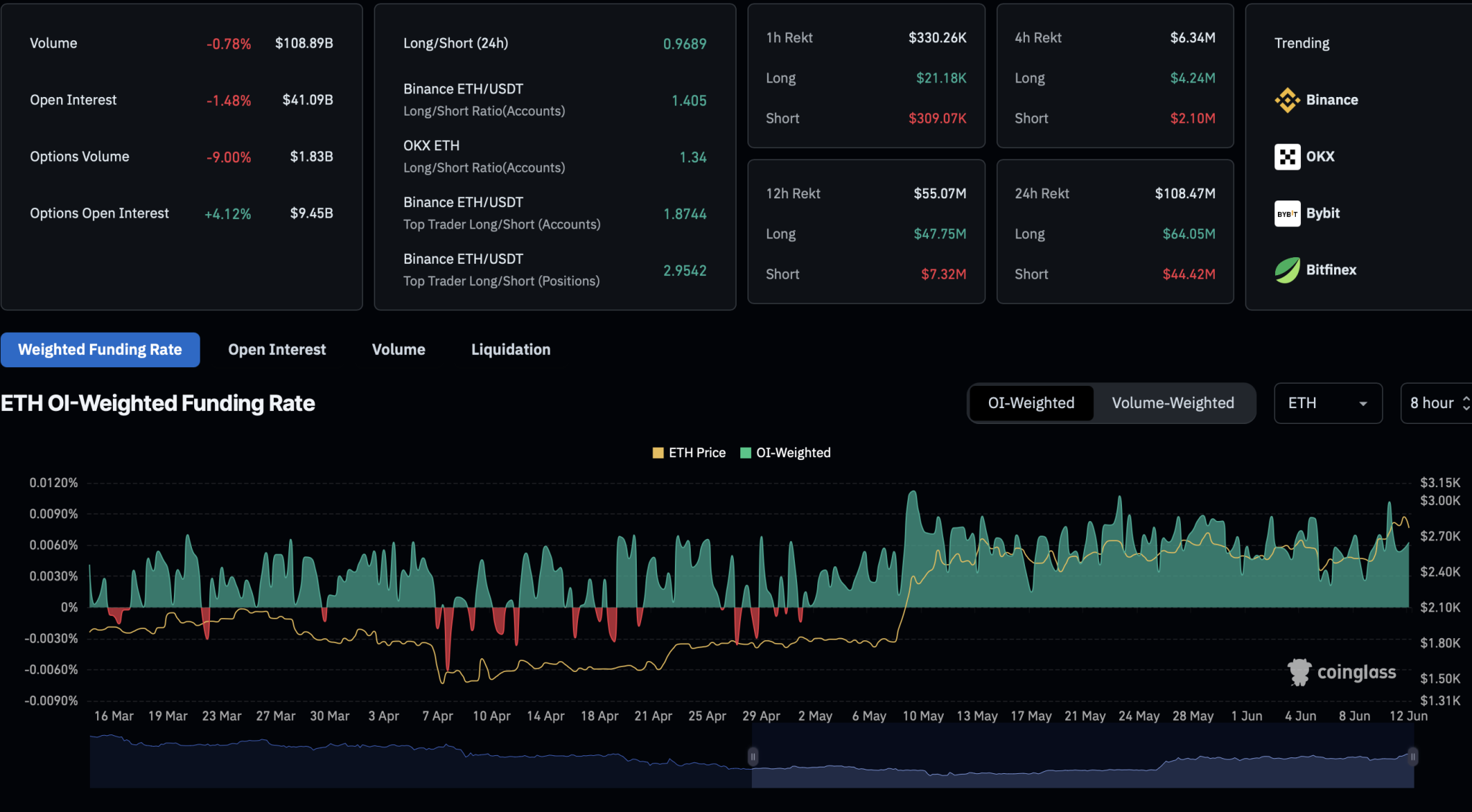
Despite strong institutional support, optimism in the derivatives market has softened. Open interest has declined by 1.48% to $41.09 billion, while the OI-weighted funding rate dropped to 0.0063%, down from a peak of 0.0102% on June 10. This indicates a significant reduction in traders’ interest and bullish sentiment.

Ethereum Derivatives

A large wipeout of bullish traders, reflected in $64.05 million of long liquidations compared to $44.42 million of short liquidations, is driving bearish pressure. Furthermore, the long-to-short ratio over the past 24 hours has fallen to 0.9689, suggesting an increase in short positions.

Analyst Predicts Timeline for Bitcoin to Hit Its Peak of $365K for This Cycle

0

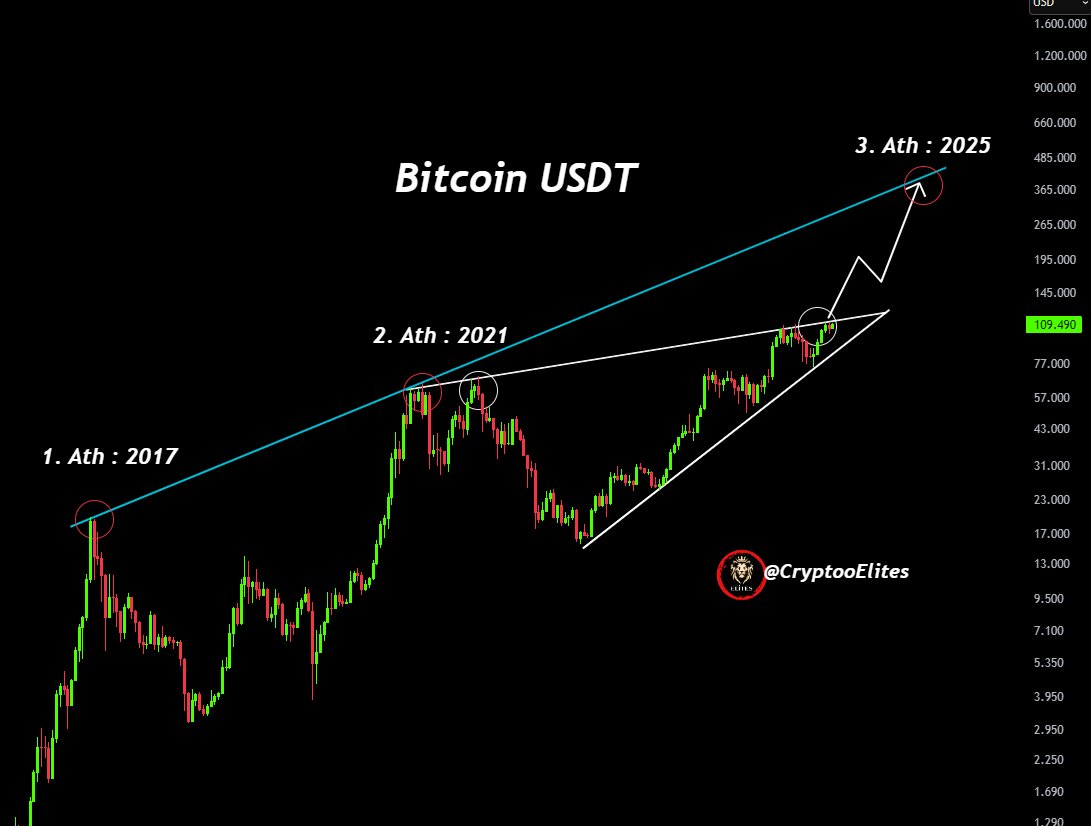
CryptoElites leverages a Bitcoin ascending trendline and historical price movement to predict when BTC will hit its peak all-time high for this cycle.

Notably, between June 6 and June 8, Bitcoin saw a steep surge, crossing the $105,000 mark by June 9. The next day, the crypto firstborn peaked above $110,000 before experiencing slight consolidation. This recent price action has led to increased optimism, with an analyst recently suggesting BTC could hit its cycle top of $365K by December.

Key Patterns Suggesting Future ATH

According to a report from the analyst CryptoElites on X, a recurring pattern in Bitcoin’s price action could signal a new ATH. The analyst points to previous ATH levels to highlight an upward trend. 

Image

The first notable ATH occurred in December 2017 at $19,600, followed by a significant decline below $3,000. After climbing again in October 2020, Bitcoin hit a peak above $64,000 in April 2021 before reaching the cycle top of $69,000 in November 2021. This rally also faced a retracement to just above $15,000 before beginning its next rise.

These recurring patterns are important because they indicate a long-term upward trend, marked by successive ATHs and retracements to accumulation zones. With Bitcoin’s price now at $107,879, it stands within the context of this established pattern, hinting that the next ATH may exceed previous highs.

Ascending Triangle Pattern 

Another bullish development identified by CryptoElites is the ascending triangle, a bullish continuation pattern. This pattern is marked by an upward-sloping lower trendline and a horizontal upper trendline that represents resistance. 

Ascending triangles typically signal a breakout in the direction of the prevailing trend—in Bitcoin’s case, upwards. This suggests that once Bitcoin breaks through its current resistance level, the price could rise substantially.

The ascending triangle began to form after Bitcoin’s 2021 ATH and continued with a higher high of $69,000 on November 1, 2021. Following this, Bitcoin retraced to touch the lower trendline at around $15,500, where it held steady. Most recently, Bitcoin reached an ATH above $112,000, but it failed to break the resistance at the upper trendline. 

If Bitcoin successfully breaks through this resistance and moves toward the historical ATH rising trendline, the analyst projects the possibility of a new ATH. Such a move could push Bitcoin’s price as high as $365,000 by the end of 2025, representing a 238% surge from its current value of $107,902.

Changes in Bitcoin Holder Categories

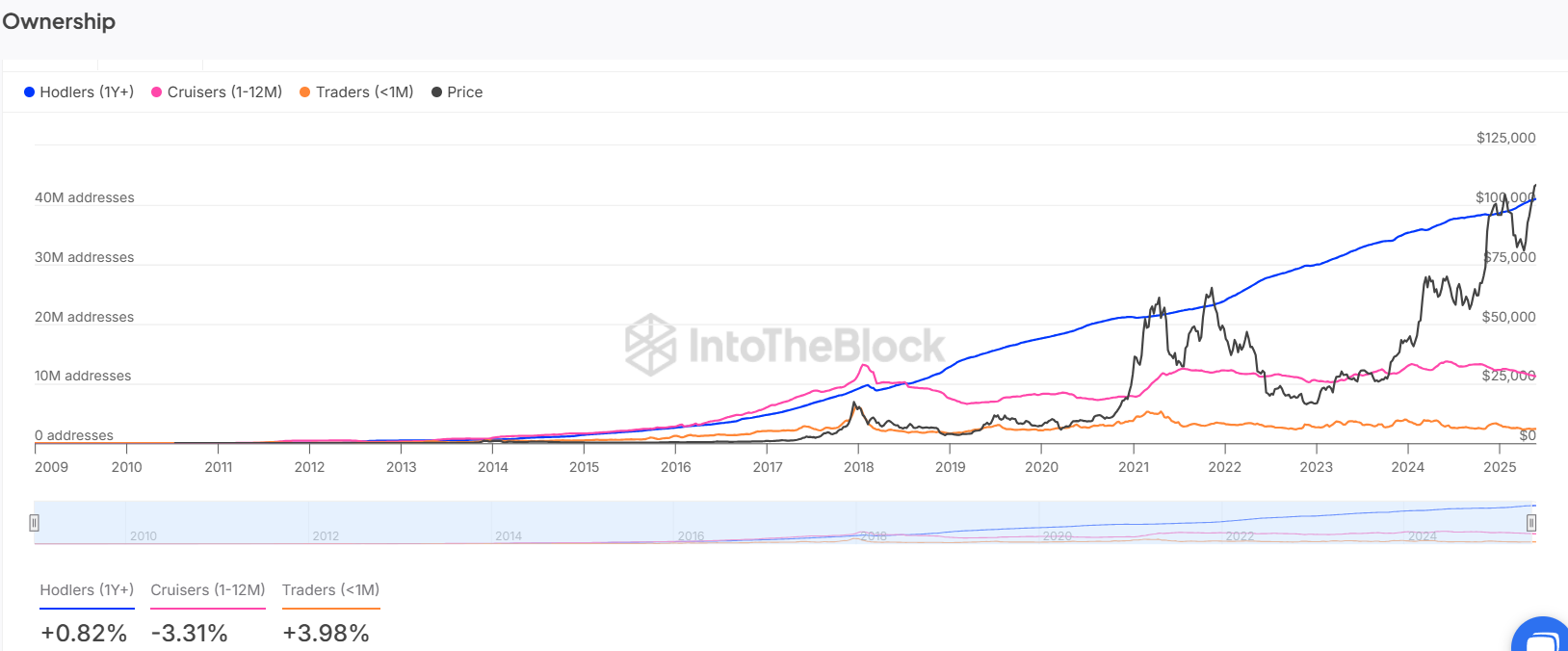
Alongside the price action, recent data about Bitcoin’s holder categories adds more context to the current market dynamics. Bitcoin addresses that have held Bitcoin for more than a year (Hodlers) have seen a slight increase of 0.82%. This suggests a growing number of long-term holders, indicative of confidence in Bitcoin’s future potential.

Screenshot 2025 06 12T110005507
Bitcoin Addresses by Time Held

Meanwhile, addresses holding Bitcoin for 1 to 12 months (Cruisers) have declined by 3.31%. On the other hand, Bitcoin addresses that have held for less than a month (Traders) have surged by 3.98%, reflecting an increase in short-term market activity.

Today, Bitcoin is valued at $107,879, reflecting a 1.60% decline over the last 24 hours but a 3.23% increase over the past week.

Trump Administration To Remove Regulatory Impediments to Bitcoin and Stablecoins: US Treasury Secretary

0

Scott Bessent, the US Treasury Secretary, has reiterated this administration’s commitment to promoting the course of Bitcoin and blockchain technology in America.

He said in his speech at the American Bankers Association in April that the Donald Trump administration remains committed to promoting innovation in the United States. Part of this involves reforming the banking system by incorporating blockchain technology and new payment rails.

Regulatory Clarity to Foster Innovation

To do so, Bessent noted that his administration would identify and eliminate all impediments to the adoption of blockchain technology. Interestingly, the Treasury Secretary has shown commitment to this task since taking over the helm of affairs from Janet Yellen in January.

He played a significant role in the US Bitcoin reserve creation and is collaborating with the White House Digital Assets Executive Director Bo Hines to find budget-neutral ways to buy Bitcoin.

In general, the Trump administration has been persuasive in getting Congress to approve pro-crypto regulations. The GENIUS stablecoin act recently passed to the final approval stage after a favorable 68-30 voting outcome.

The crypto market structure bill also gained bipartisan support in the US House Agriculture Committee and the US House Financial Services Committee on Tuesday. These regulations aim to provide regulatory clarity for digital assets in the United States.

Meanwhile, Bessent believes that a clear crypto framework would foster the incorporation of blockchain technology into the banking system. Furthermore, he suggested that stablecoins would create new payment rails for the traditional financial system and “unleash the awesome power of the American capital market.”

USD-Pegged Stablecoin Market to Hit $2 Trillion by 2028

Bessent further stressed the importance of the stablecoin market to the US dollar’s dominance in a speech at the Senate Appropriations Committee hearing on Wednesday. He noted that the cryptocurrency would strengthen the USD’s position in the global financial market.

However, he mentioned the need for regulation. According to him, bills like the GENIUS Act would encourage mainstream adoption of US dollar-pegged stablecoins and boost their reach extensively both globally and locally.

Bessent also projected a growth in the USD-based stablecoin sector, predicting it could hit $2 trillion in three years. At the current market cap of $246.6 billion, this represents an over sevenfold increase.

Meanwhile, Bessent is not alone in this projection; AI and crypto czar David Sacks has also stated that the US dollar stablecoin market would draw in trillions in liquidity to US Treasury bills.

“Tick Tock, Bears,” Analyst Says XRP Breakout Now Imminent

0

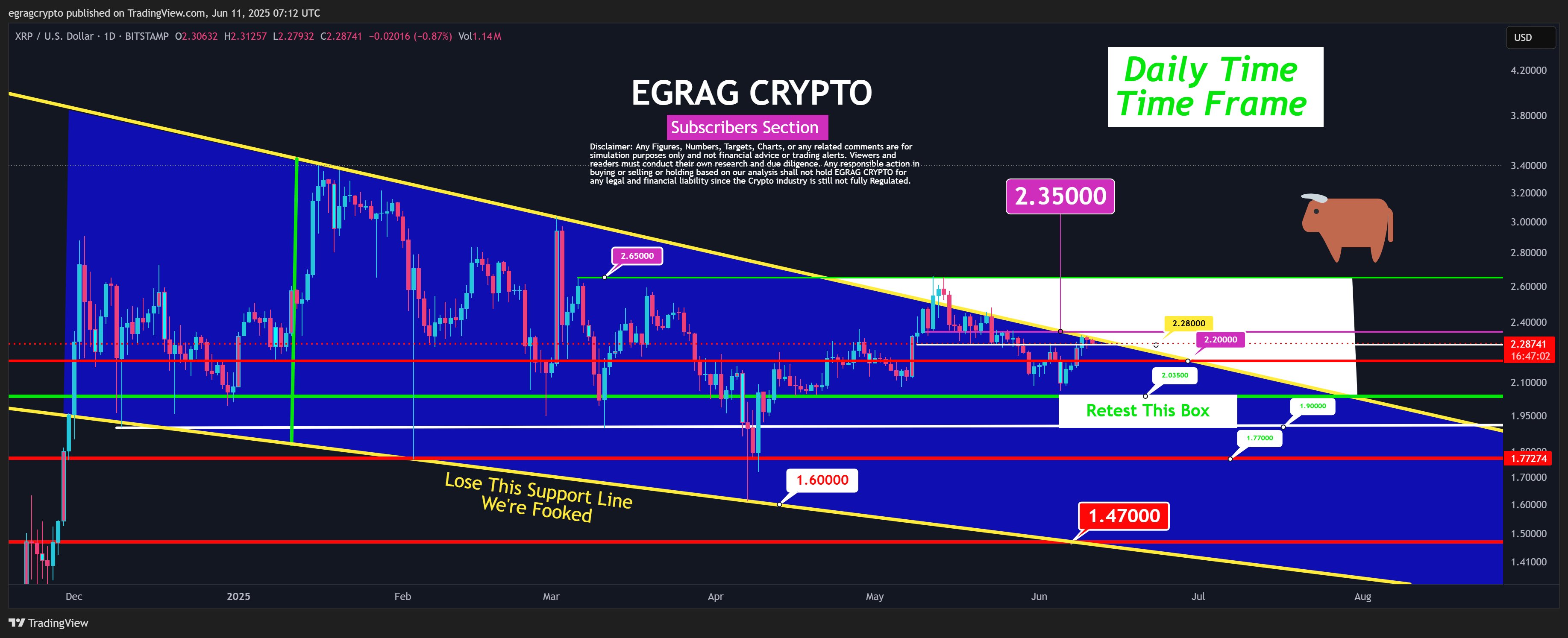
Prominent market analyst EGRAG Crypto suggests an XRP breakout from a multi-month falling wedge could be imminent.

“Tick tock,” he declared in his recent market commentary, suggesting that time is running out for the bears. While this alone does not provide enough context, the accompanying chart confirms the analyst’s intent.

XRP Trades Within Falling Wedge

Notably, data from the daily chart shows XRP has been trading within a falling wedge for several months. For the uninitiated, a falling wedge is a bullish pattern formed when the price declines within narrowing downward-sloping lines. It often indicates that an upward trend may follow.

XRP has been trading within this structure since it collapsed from the seven-year peak of $3.4 earlier this year. Recall that XRP skyrocketed nearly 600% from $0.5 in November 2024 to $3.4 in January 2025. The resistance it faced at $3.4 led to a pullback.

Notably, as XRP has continued to witness lower highs amid this pullback and bearish consolidation, its price has remained within the falling wedge. The asset has made several attempts at breaking upward but faced resistance. 

XRP Falling Wedge EGRAG Crypto
XRP Falling Wedge | EGRAG Crypto

For instance, during a broader market recovery in mid-May, XRP soared to $2.65, effectively breaking above the upper trendline of the wedge. However, when it retested this breakout, the asset fell back into the wedge due to a lack of strength.

XRP Attempting Another Breakout

Now, XRP is attempting to stage another breakout. Due to how close this impending breakout is to the tip of the structure, the analyst believes time is now running out.

As a result, his “tick tock” remark has emerged amid his conviction that XRP could break above the falling wedge soon. Despite this, the analyst is not 100% certain of XRP’s next immediate price movements, so he has presented multiple probabilities.

Data from his chart shows XRP may retest a support box between $1.9 and $2. Nonetheless, such a retest could only allow the asset to grab liquidity at this level, eventually leading to a more explosive recovery. The last time XRP hit $2 was on June 5. What followed was a 10.3% spike over four days.

However, EGRAG also called attention to a more important support level. Notably, this level aligns with the lower trendline of the falling wedge and currently sits at around $1.47. According to EGRAG, a drop below this level could be disastrous for the market.

Chances of a Breakout Continue to Increase

Notably, the longer XRP remains in the falling wedge, the lower the benchmark for a breakout. After a few more days, the asset would need to breach $2.28 to break out of this structure. Should a successful retest occur after a decisive breakout, XRP could be on track for an explosive run.

While EGRAG failed to provide any price targets for such a breakout, he has in the past consistently suggested that XRP could be headed toward the $20 range. Most recently, he predicted a possible rally to $25 if XRP market cap’s W formation led to a valuation of $1.5 trillion. 

Currently, XRP changes hands at $2.24, down 2.17% over the past 24 hours after facing resistance at the falling wedge’s upper trendline. The asset currently boasts a market cap of $131.7 billion.

Ripple Launches $700M Share Buyback at $175 Per Share

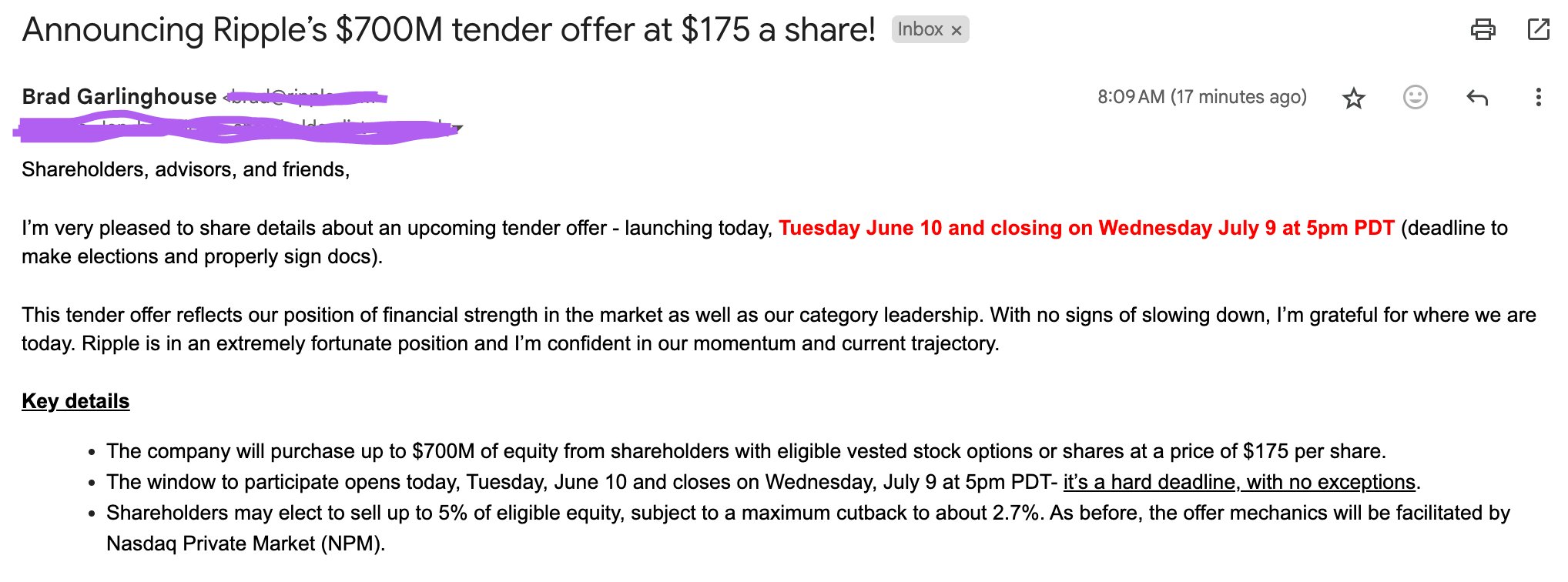
Ripple has announced a $700 million tender offer to repurchase shares from shareholders at $175 per share.

Investor Jeremy Raper highlighted this development in a post on X, sharing the email he received from Ripple CEO Brad Garlinghouse regarding the offer. According to the disclosure, the move reflects Ripple’s financial strength and growth ambitions.

The email stated that the offer opened on Tuesday, June 10, and will close on Wednesday, July 9. It extends it to holders of eligible vested stock options or shares and will be facilitated via the Nasdaq Private Market.

Image
Ripple CEO Brad Garlinghouse’s email to investors | Jeremy Raper on X

Massive Premium Over Private Market Prices

According to the email, the $175-per-share offer represents a 135% premium over Ripple’s most recent secondary market pricing on platforms like Hyve, where shares last traded at around $74 to $75.

Raper interpreted this as a strong sign of Ripple’s confidence in its growth trajectory. The company has significantly increased the price and size of the buyback compared to its previous tender offer in January. At the time, it was $125 per share.

Ripple’s Balance Sheet Strength

The internal communication also disclosed several financial details about Ripple Labs. Raper noted that Ripple possesses $3.7 billion in cash, carries no debt, and holds 41 billion XRP on its balance sheet.

This holding is worth approximately $94.6 billion at market value, or $47 billion if discounted by 50%. Notably, 36.2 billion XRP of Ripple’s holdings are in escrow, with the remainder in spendable balances.

Additionally, Ripple has $600 million in other investments and reportedly generated over $1 billion in EBIT (earnings before interest and taxes) last year. This indicates strong operational profitability.

With 141 million shares outstanding, Raper estimates that Ripple’s balance sheet alone, even when heavily discounted, could justify a share price above $350. At $175 per share, Ripple’s implied valuation is around $25 billion.

Overall, this tender offer rewards existing shareholders and lays the groundwork for a future public listing but does not imply an imminent listing.

When Ripple IPO?

Notably, Ripple’s legal dispute with the SEC has largely resolved, and its ecosystem is expanding through acquisitions. Investors are now speculating about Ripple’s valuation if it were to go public. Many believe a public market valuation in the $35–50 billion range could be attainable because of its crypto asset reserves and growing ecosystem.

As for Ripple’s IPO plans, the company has previously stated that going public is not an immediate priority. It reaffirmed this stance during the January tender offer. 

For context, tender offers like this often provide liquidity to early investors, employees, and insiders in place of a public listing. If an IPO were imminent, Ripple might hold off on such buybacks and instead let the public market determine its valuation.

Moreover, this marks Ripple’s second buyback in less than a year. It suggests that it is managing shareholder expectations and equity ownership internally while deferring any move to go public. At present, the company has indicated it is focusing more on acquisitions than on an IPO.

Nate Geraci Says Grayscale Fund with XRP Next for Approval Before Solana ETFs

0

ETF Store President Nate Geraci has predicted the next crypto spot exchange-traded fund that will gain regulatory approval next.

In a tweet today, he shared that the Solana ETF may not be the favorite for the US Securities and Exchange Commission (SEC) to approve next. According to him, the Wall Street regulator could sanction a Grayscale multi-asset fund containing XRP and Cardano before the Solana spot ETFs.

$800M Grayscale Fund Next in Line: Geraci

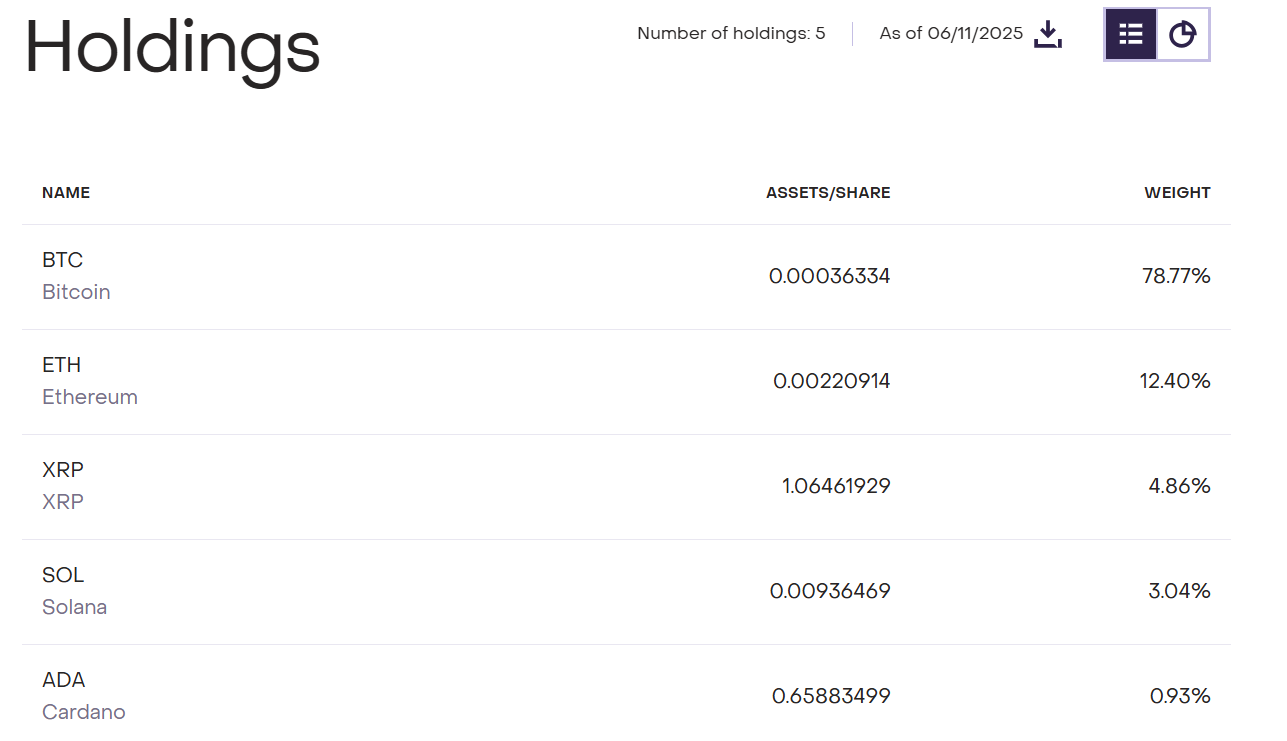
Specifically, Geraci noted that the Grayscale Digital Large Cap Fund would likely gain approval next. The crypto basket product, introduced in 2018, provides exposure to high-caliber digital assets, including Bitcoin, Ethereum, XRP, Solana, and Cardano.

Specifically, Bitcoin accounts for 78.77%, Ethereum for 12.40%, XRP for 4.86%, Solana for 3.04%, and Cardano for 0.93% of the Grayscale Digital Large Cap Fund as of June 11. The GDLC traded at $47.44 as of yesterday, up 14% in the past month and 11% year-to-date.

GDLC Composition
GDLC Composition

In April, Grayscale filed an S-3 form with the US SEC to convert the nearly $800 million asset under management (AUM) fund into an ETF. If approved, it would provide a more diverse exposure to digital assets for institutional and retail investors.

Notably, the US SEC has approved a similar index product. It nodded to Hashdex and Franklin Templeton’s mixed fund in December, which offers exposure to Bitcoin and Ethereum, the first and second-largest cryptocurrencies by market capitalization.

As a result, Geraci suggested that the Grayscale Large Cap fund may be the next to receive regulatory approval, even before the Solana spot ETFs. Recall that the recent report from Bloomberg indicated that the Solana-based ETF could likely be approved as early as July 2025.

Altcoin ETFs Approval Gaining Momentum

Meanwhile, Bloomberg ETF analysts Eric Balchunas and James Seyffart shared that index crypto filings rank among the most likely funds that the US SEC would approve next. Solana and Litecoin ETFs are the only other funds with a 90% chance of approval.

XRP ETFs rank next with an 85% chance of approval, while Dogecoin and HBAR ETFs have an 80% chance. Interestingly, recent developments suggest that the US SEC will finally approve an altcoin spot ETF in the near term.

Remarkably, the US SEC has a deadline of October to decide on the Solana, XRP, Dogecoin, Litecoin, and Cardano ETFs and July for the crypto basket filings.