Home Blog Page 706

Here’s How High Shiba Inu Can Rise if Bitcoin hits $4,878,819 By 2040

0

Bitcoin’s projected rise to $4.87 million by 2040 could have a ripple effect on altcoin performance, with tokens like Shiba Inu expected to soar tremendously. 

Shiba Inu and Bitcoin Correlation 

Notably, Shiba Inu has closely followed Bitcoin’s price action in recent times. The canine-themed token sometimes outperforms or underperforms Bitcoin’s performance. For instance, if Bitcoin experiences a gain of 2%, SHIB could register an increase of 5% and vice versa.

Shiba Inu’s high correlation with Bitcoin majorly drives this. According to data from IntoTheBlock, Shiba Inu has a 30-day correlation of 72% with Bitcoin. Notably, Shiba Inu boasts a higher correlation with Bitcoin over the past 60 days, with the figure standing at 86%. 

Given Shiba Inu’s strong correlation with Bitcoin, BTC will likely influence SHIB’s price action more. In this case, an upsurge in Bitcoin would translate to a proportional or higher growth for SHIB and vice versa. 

Shiba Inu Price if Bitcoin Hit $4,878,819 By 2040

The good news is that several analysts are anticipating a major price surge for Bitcoin. One of such predictions came from experts affiliated with Changelly. The experts predicted that one Bitcoin would be worth $4,878,819 ($4.87 million) by 2040, nearly 15 years from now. 

Specifically, Changelly sets the $4.87 million price as Bitcoin’s average target by January 2040. This represents a 4,400% increase from Bitcoin’s current price of $105,418. 

ChatGPT referenced Changelly’s 2040 forecast for Bitcoin to project how much Shiba Inu could be worth if the doggy-themed token experiences proportional growth. The AI chatbot suggests that applying the 4,400% growth rate to Shiba Inu’s current price would push it to $0.000632. 

Shiba Inu Price if Bitcoin hits $487M by 2040 l ChatGPT
Shiba Inu Price if Bitcoin hits $487M by 2040, ChatGPT

Assuming SHIB’s circulating supply remains unchanged at 589.25 trillion tokens, Shiba Inu’s projected rise to the $0.000632 target would push the asset’s market cap to $372.4 billion from $8.27 billion. 

Grok 2040 Prediction for Shiba Inu 

Meanwhile, AI model Grok referenced different 2040 predictions from multiple entities, such as Changelly, Telegaon, CoinCodex, and Coinpedia Markets, to estimate what SHIB could be worth in the next 15 years. 

Based on these predictions, Grok forecasted a conservative target price range of $0.00001911 to $0.054 for Shiba Inu by 2040. It also predicted an average price range of $0.00002157 – $0.076 and highly optimistic targets of $0.0000310 – $0.089. 

Besides SHIB’s correlation with Bitcoin, Grok expects multiple factors, such as token burns, positive ecosystem developments, and bullish market sentiment, to influence Shiba Inu’s 2040 price action. 

In the meantime, Grok urged investors to approach its 2040 Shiba Inu forecast with caution, given the unpredictable nature of the crypto market. 
Two New Bitcoin Wallets Withdraw $84.2M in BTC From Binance, What’s Happening

0

Two new Bitcoin wallets recently withdrew large amounts from Binance’s hot wallet.

This news comes as Bitcoin (BTC) continues to trade below its all-time high of approximately $111,800, currently priced around $105,503 amid a modest decline of 1.57% in 24 hours and 3.56% over the past week. Meanwhile, significant on-chain movements point to an ongoing trend of Bitcoin moving away from exchanges. 

Specifically, recent data from Lookonchain highlights two newly created wallets receiving major withdrawals from Binance’s hot wallet, signaling a potential change in holder behavior.

Significant Binance Withdrawals to New Wallets

Lookonchain reported that around 09:21:13 UTC, two newly established Bitcoin wallets each withdrew about 400 BTC from Binance’s hot wallet. 

These transactions amount to 800 BTC total, equating to around $84.2 million at current prices near $105,616 per BTC. 

The wallets, holding 400 BTC each, signify a considerable transfer of funds out of Binance custody. This activity drew attention given the size and timing, as large withdrawals to new wallets often suggest intentions to store BTC privately or prepare for long-term holding.

The movement from exchange wallets to new addresses typically indicates reduced selling pressure on the market. It may also reflect large institutional investors or private holders shifting Bitcoin off exchanges to cold storage. This pattern matches recent trends showing lower Bitcoin inflows to exchanges.

Declining Exchange Inflows 

Notably, IntoTheBlock’s on-chain flow volume data for Bitcoin over the past three months reveals notable fluctuations. However, a distinct downward trend in BTC inflows to exchanges has emerged recently, with a 9.5% drop over the last 24 hours and a 16.99% decline over the past week. This data aligns with the significant withdrawals from Binance, suggesting that holders prefer moving Bitcoin off exchanges rather than depositing it.

Screenshot 2025 05 30T172631551
Exchange Inflow Volume

Notably, despite this recent decline, the 30-day inflow volume shows a positive change of 9.43%.

The overall reduction in inflows in the short term supports the idea that Bitcoin holders might be accumulating or storing coins long term, instead of preparing for quick sales. This behavior corresponds with the movement of large amounts of BTC into new wallets, marking a shift towards holding rather than active trading.

Long-Term Holders Not Ready to Sell 

Supporting the holder accumulation narrative, further data from reveals that long-term holders (LTHs) have increased their BTC supply significantly between March 3 and May 25, 2025.

The LTH supply rose from about 14.35 million BTC to roughly 15.74 million BTC, marking a net gain of over 1.39 million BTC in under three months. This accumulation trend continues despite Bitcoin’s price consolidation near current levels.

This trend contrasts with previous market cycles, such as those in 2013, 2017, and 2021, where LTH supply typically fell during bull runs as holders sold for profits. Analysts note that recent brief dips in LTH supply during May 2024 and March 2025 did not reverse the upward trend.

These observations suggest that experienced holders are refraining from selling at current price points, potentially reducing the available supply for newer market participants.

Stripe in Talks with Banks to Integrate Stablecoin Payments

0

Stripe Inc. is accelerating its exploration of stablecoins, engaging in talks with banks to integrate these digital assets into global payments. 

The financial service firm’s co-founder, John Collison, noted in a Bloomberg interview that banks are not dismissing stablecoins as a passing trend. 

Collison also highlighted that a significant portion of future payment volume will involve stablecoins. He cited high foreign exchange fees and lengthy processing times as key issues stablecoins could help resolve.

Notably, stablecoins represent a $240 billion asset class composed of blockchain-based tokens pegged primarily to government-issued currencies, especially the U.S. dollar.

Expanding Use and New Product Launches

Stripe’s growing stablecoin initiatives complement its expanded client base, which now includes over one million UK businesses and solopreneurs. Notably, 45% of FTSE 100 companies rely on Stripe’s services.

This diverse customer range includes AI innovators such as ElevenLabs and Synthesia, fintech firms like Revolut and Monzo, and major UK institutions such as Tesco and Hargreaves Lansdown.

At Stripe Tour London, the company’s annual UK conference attended by 1,700 founders and business leaders, the firm outlined its vision for stablecoins as a critical future component of commerce. 

This event followed the recent announcement of over 60 product updates unveiled at Sessions in San Francisco. Among those updates were enhanced money management tools powered by stablecoins and a collaboration with Visa to create the first global card issuing product. This card will allow users to spend stablecoin balances as easily as traditional currency.

Strategic Acquisitions and Industry Collaborations

Stripe’s acquisition of stablecoin startup Bridge for $1.1 billion last year further demonstrates its commitment to stablecoin infrastructure. The company emphasized the role of stablecoins in improving transaction speed, coverage, and cost efficiencies for businesses worldwide.

Meanwhile, other payment technology companies have also entered the stablecoin space. PayPal, for instance, launched its own stablecoin, PayPal USD, in 2023. 

Additionally, leading U.S. banks, including JPMorgan Chase, Citibank, Bank of America, and Wells Fargo, have joined a joint venture to issue stablecoins. This initiative also involves Early Warning Services, which operates the Zelle payment system, and the Clearing House.

Regulatory Developments and Market Potential

Regulatory efforts in the U.S. are advancing alongside industry developments. A stablecoin bill, known as the GENIUS Act, is currently under consideration.

White House crypto advisor David Sacks recently highlighted that passing this legislation could significantly boost demand for U.S. Treasuries, potentially generating trillions of dollars in demand.

Sacks pointed out that the existing stablecoin market remains largely unregulated. He predicted establishing a legal framework could expand the market to a multi-trillion-dollar level.

This growth would likely stem from increased global demand for dollar-backed digital assets fully backed by U.S. government debt.

Here’s The Direction Bitcoin Price Always Takes After Bitcoin Conference

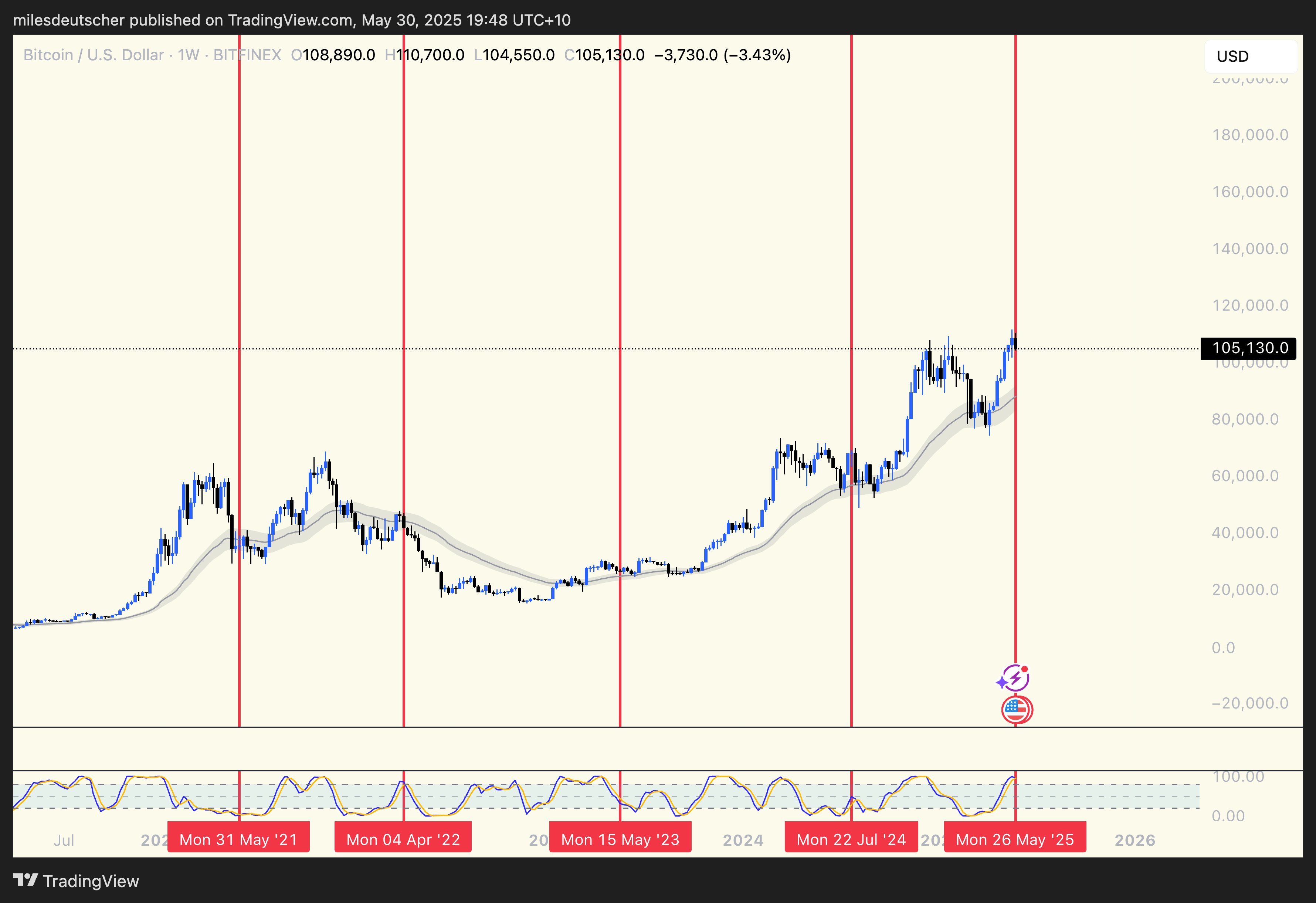
Veteran analyst Miles Deutscher has called attention to a consistent Bitcoin price reaction immediately after each Bitcoin conference.

He discussed this in a recent analytical commentary today, shortly after the conclusion of the latest Bitcoin 2025 Conference. Notably, the conference, held in Las Vegas between May 27 and 29, featured industry leaders like Michael Saylor, as well as prominent personalities such as U.S. Vice President JD Vance.

Bitcoin Price Always Crashes After Each Bitcoin Conference

However, according to Miles Deutscher, Bitcoin price always collapses immediately after every Bitcoin conference. For context, the inaugural year of the Bitcoin conference, organized by BTC Inc. and the Bitcoin Magazine, was 2019. 

Nonetheless, Deutscher’s chart presents the years from 2021 due to 2019’s minimal impact and the fact that 2020 had no in-person attendance as a result of the COVID-19 pandemic at the time.

Notably, the organizers pushed the date of the 2021 conference back to June 4 and 5 due to the pandemic. After the conference, BTC price collapsed the next week, dropping 17% from $35K to a low of $29K by July 2021.

Bitcoin Price Action After Each Bitcoin Conference Miles Deutscher
Bitcoin Price Action After Each Bitcoin Conference | Miles Deutscher

Meanwhile, the 2022 conference held between April 6 and 9. At the time, Bitcoin traded for an average of $44,000. However, the week of the conference and the following weeks, the asset observed considerable declines. It hit a low of $17,593 by June 2022, marking a 60% crash from the $44,000 price.

Further, the 2023 conference in Miami held from May 18 to 20. Bitcoin changed hands at around $27,000 then but eventually slumped 8.3% to $24,757 by June 2023. Also, after last year’s conference from July 25 to 27, 2024, Bitcoin dropped 25% from around $67K to $49,577 by August 2024.

Bitcoin Observing Declines Following Bitcoin 2025 Conference

Interestingly, following the latest conference, this pattern appears to be playing out again. Specifically, Bitcoin opened at $109,474 on May 27, when the conference began. Since then, the asset has dropped 3.5%, currently changing hands at $105,543. 

To put things into perspective, the average drop from all four rounds of declines amounts to 27%. If the pattern plays out and the firstborn crypto observes a decline to this extent, this could push its price below the $100,000 mark, potentially leading to $80,000. 

However, another trend from Deutscher’s chart involves a recovery from the initial drop after the conference. Specifically, Bitcoin price has always recovered weeks after hitting a local bottom from the initial crash, with an average recovery rate of 120%. 

Notably, a 120% rebound from an $80,000 price would lead to a price of $224,000 for Bitcoin, a new all-time high. This aligns with the $250,000 price prediction set out by industry leaders such as BitMEX founder Arthur Hayes and Cardano founder Charles Hoskinson. 

UK Will Be Far Poorer If It Fails to Embrace Bitcoin in Sovereign Fund, Says Reform Chairman Zia Yusuf

Reform UK Chairman Zia Yusuf has unveiled a bold economic blueprint to transform the United Kingdom into a global hub for crypto innovation.

In an interview with Bloomberg, Yusuf emphasized that under a Nigel Farage-led government, the country would embrace Bitcoin and blockchain as tools to reclaim economic dynamism and global competitiveness.

He warned that if the country fails to include Bitcoin in its sovereign fund, it will be significantly poorer in 30 or 40 years than it otherwise could be.

Lower Crypto Tax, Bitcoin Reserve, and Paying Taxes in Crypto

In this context, Yusuf laid out several core components of the proposed crypto bill that Reform UK would introduce if elected. These include reducing the capital gains tax on crypto to 10% for eligible assets.

Moreover, banks would be prohibited from denying services to individuals solely for engaging in legal crypto transactions. The bill also proposes establishing a Bitcoin Reserve Fund, a sovereign wealth fund to hold BTC. Its initial components will be crypto assets seized in criminal investigations and payments received via crypto.

Furthermore, the UK’s tax authority would be required to accept crypto payments, offering citizens a frictionless alternative.

Building Infrastructure for Bitcoin and Crypto Innovation

Acknowledging concerns about cost and implementation, Yusuf argued that the long-term benefits would outweigh the initial investments. Reform UK plans to introduce a two-year regulatory sandbox for major firms, particularly in the City of London, to experiment with crypto and blockchain solutions under a light-touch but supervised regime.

During the interview, the host raised concerns that embracing Bitcoin could undermine the British pound. In response, Yusuf pushed back, framing crypto adoption as an extension of sovereignty rather than a threat to it.

“This isn’t about replacing the pound,” he said. “It’s about enhancing individual and national sovereignty. Bitcoin and stablecoins linked to the pound give citizens choice and protection in an era of politicized finance.”

Yusuf also cited recent de-banking controversies, including Farage’s own experience, as evidence that alternative financial systems are needed to guard against political discrimination in traditional banking.

“We Can’t Afford to Stay Stuck in the 1970s”

Meanwhile, Yusuf cautioned that the UK is falling behind as countries like the U.S., UAE, and Singapore invest heavily in crypto infrastructure. “We can stay stuck in the 1970s or move forward,” he said. “But if we don’t adapt, the UK economy risks being left for dead.”

Yusuf argues that Reform UK’s approach is not a gimmick but a pragmatic response to shifting global realities. With Bitcoin increasingly trading like gold and less like speculative tech, the proposed Bitcoin reserve could serve as a long-term hedge and strategic asset.

Shiba Inu: Whale Makes Massive Move, Scoops Up 4,572,758 BONE in One Go

0

A singular Bone ShibaSwap (BONE) transaction involving over $1 million is sparking speculation within the Shiba Inu community.

BONE, the gas token of the Shibarium network, is down 99.3% from its all-time high, persistently trading in a range in recent times. However, it seems investors see this period of sideways trend as an opportunity to accumulate for what is to come.

Particularly, a whale transaction has been raising eyebrows within the Shiba Inu community. The Thursday shift saw a wallet receive millions of the Bone ShibaSwap token from prominent crypto exchange OKX.

Unmarked Wallet Receives Millions of BONE

The sending wallet “0x91D4” shifted 4,572,758 BONE, worth $1.3 million, to an unknown receiving address “0x073F” on May 29 at exactly 08:42 PM (UTC). Interestingly, this adds to a string of BONE transfers from the same sending address to the receiving address in the past five days.

Data from EtherScan shows that the sending address has moved the token to the same address for five consecutive days, with yesterday’s transfer its largest so far. Meanwhile, the receiving address has retained the BONE tokens received, holding 5,453,234 BONE ($1.57 million) at the time of writing.

Whale BONE Transaction In Last Five Days
Whale BONE Transaction In the Last Five Days

Furthermore, the address “0x073F” now ranks 8th among the over 95,000 holders of BONE by dollar valuation, with its balance accounting for 2.18% of the token’s 250 million supply. However, further analysis has identified another twist to the story.

Whale Accumulation?

Meanwhile, analysis from the market intelligence platform Arkham confirmed that, indeed, the sending wallet belonged to OKX. It identified the “0x91D4” address as an OKX Hot Wallet, which held 3.409 million BONE ($985,030) at the time of writing.

Interestingly, Arkham also shows that the receiving address belongs to the exchange. The platform identified the wallet as an OKX Cold Wallet, a self-custody wallet for OKX, one of the largest offshore cryptocurrency exchanges.

As a result, the attention-grabbing transaction was just OKX moving the BONE token from its hot wallet for storage in the cold wallet. Notably, exchanges perform such transactions periodically to safeguard customers’ funds in the case of an attack on their platform.

Nonetheless, while this was not one such case, whales have actually been accumulating BONE recently. The Crypto Basic highlighted a 5-day buying spree from a new wallet in early May, during which the address acquired 1.76 million BONE.

BONE Remains Unresponsive

Meanwhile, the Shiba Inu ecosystem token continued its correction today, joining a broader market trend. BONE is down 4.13% in the past 24 hours, with higher timeframes looking uglier.

For context, the token has corrected nearly 8% in the past seven days and a staggering 57% from its price a year ago. This suggests that it completely missed out on the broader 2024 market rally, as inherent weakness persists.

Meanwhile, analysis has shown a rebound is on the horizon. Specifically, analyst Crypto Conqueror predicted a bullish reversal to $6, highlighting critical levels to watch.

US Vice President Champions Bitcoin Role as a Store of Value and Means of Payment

0

U.S. Vice President JD Vance outlines Bitcoin’s core value proposition, characterizing it as both a means of payment and a store of value. 

Vance made this known during an exclusive interview on Newsmax’s Greg Kelly Reports. The interview follows Vance’s keynote address at the Bitcoin Conference 2025, where he highlighted Donald Trump’s recent successes in the crypto space. 

Bitcoin’s Value Proposition 

After his keynote address, Vance sat down with Newsmax’s Greg Kelly to explain Bitcoin’s core value proposition to enlighten skeptics. 

Notably, he opened up about his stake in Bitcoin, emphasizing that he is a holder of BTC. However, he stresses that his current role as Vice President of the U.S. requires him to speak carefully about the asset. 

Explaining Bitcoin’s core value proposition, Vance portrayed BTC as both a store of value and a means of payment. He emphasized that people can use Bitcoin to pay for goods and services, just like they used dollar bills and gold 100 years ago. 

“The value proposition of Bitcoin is that it can serve the same function [as gold and dollar bills in payment]. Bitcoin performs this function in a digital way that is secure and safer from fraud while allowing people to buy and sell,” Vance remarked. 

He also highlighted Bitcoin’s utility as a store of value asset. He indicated that it provides a means for users to store value in a modern digital age. 

Trump Administration’s Pro-Crypto Stance 

Despite highlighting Bitcoin’s value proposition, the U.S. vice president conceded that Bitcoin has its associated risks, like every new technology. 

However, he noted that the Trump administration’s approach toward Bitcoin and crypto is to allow people to innovate rather than impose stringent laws that restrict activities in the market. 

Additionally, Vance criticized dictatorial intervention in the market, which could stifle innovation. Instead, he advocates for common sense and clear regulation for the industry that allows crypto businesses to participate in the mainstream economy, 

With clear and fair regulations in place, the vice president expects the law of demand and supply to determine which sector or project succeeds. 

Shift in US Crypto Policy 

Vance’s comments reflect a major shift in the United States’ stance on cryptocurrencies. Since the commencement of Trump’s second term in January, the country has rolled out several initiatives in support of the industry, including the mandate to create a reserve that would hold Bitcoin and altcoins. 

The Trump administration is also advocating for favorable regulations that support innovation in the market and protect investors. At the moment, the U.S. Senate is on track to pass the first-ever stablecoin regulation, the GENIUS Act. 

The legislation cleared a major procedural hurdle earlier this month. It currently awaits a full vote from U.S. Senators to determine whether it would be passed into law. 

Based on this development, it is evident that the U.S. is interested in establishing clear rules for the industry rather than regulating the space through enforcement actions, as observed in the past administration. 

Expert Says He’s NOT Selling a Single XRP Anytime Soon Until XRP Hits This Price, Reveals His Exit Strategy

In a recent video, crypto educator Edoardo Farina, founder of Alpha Lions Academy, revealed his personal XRP exit strategy.

His broader ambition is to hold the majority of his XRP until the token hits $100. Currently, XRP is trading at just $2.15, highlighting a significant journey ahead toward the triple-digit range.

First Exit Point: Selling XRP for Celebration

In the disclosure, Farina emphasized that he has no intention of fully exiting his position. Instead, he plans to leverage XRP for long-term wealth generation through lending platforms once regulations are in place.

Farina noted that he began accumulating XRP at prices as low as $0.20 and plans to start taking profits at $10. At this level, he intends to sell a small portion, around 3% to 4% of his total XRP holdings. 

“A portion of that is going toward the XRP yachting party in Mykonos,” Farina humorously stated.

He also mentioned that the majority of the proceeds will go to diversify into real estate, specifically in Greece, where he has already been investing using profits from other cryptocurrencies.

Farina disclosed that only 10% of his XRP is on exchanges. These are reserved for cashing out or active trading, while the remaining 90% is secured in cold wallets.

While some market commentators have teased the $10 price target as potentially attainable this year, more conservative voices believe it could take longer. Still, XRP supporters are holding on to even more ambitious price outlooks.

$50 and $100: Scaling Out, Not Selling Out

Farina’s second exit target is when XRP reaches $50. At this point, he plans to sell another 3% to 4% of his total holdings. His final planned sale is at $100, where he intends to sell just 2% of his XRP.

“If you sell just 1,000 XRP at $100, that’s $100,000,” Farina pointed out. He emphasized his principle of always removing the initial investment as part of risk management, without compromising the long-term upside.

Notably, analysts at Changelly and Telegaon are unanimous that it could take until the next decade for XRP to reach $100.

The Real Endgame is Lending, Not Selling

While outlining these targets, Farina clarified that his ultimate goal is not to sell most of his XRP. Instead, he hopes to lend it to banks once regulatory clarity is achieved.

According to him, XRP holders will be able to earn rewards through lending platforms and smart contracts, whether in stablecoins, fiat currencies, or XRP itself.

He cautions against rushing to sell before regulatory clarity emerges. In his view, it’s a “dumb move” to exit now without understanding XRP’s potential role in the future financial system, especially as clear regulations are not yet in place.

Ultimately, he urges XRP investors to focus on long-term utility and real-world adoption over short-term price action. He believes selling just 10% of one’s XRP won’t harm a long-term strategy.

XRP to $100: Here’s How XRP Could Hit This Milestone

A growing trend across the XRPL ecosystem could become one of the major contributing factors to a massive XRP price surge.

The XRP Ledger (XRPL), originally engineered to support the seamless tokenization of assets, has recently begun to deliver on its foundational promise. In 2025, it is becoming a major tool for turning real-world assets into digital tokens.

XRPL Tokenization Could Help XRP on the Journey to $100

As XRPL gains more use in tokenization and continues to prove its value in cross-border payments, some market watchers believe these areas of utility could eventually be the factors necessary for a rise to the lofty $100 target.

According to their argument, if large institutions start using the XRPL to tokenize assets at scale, they will end up holding big amounts of XRP. Since XRP is used to move value around, this would reduce the number of tokens available for on-demand liquidity.

Now, with fewer tokens in circulation and growing demand from increased transactions, they believe the price would have to rise, possibly by a large margin.

Essentially, this idea rests on a supply and demand setup. If more institutions move value onto the XRPL and hold XRP in the process, and if transaction volumes keep rising, then the shrinking available supply could push prices up fast. 

Upgrades to Position the XRPL for Tokenization

Notably, recent developments support the XRPL’s growing appeal in tokenization. In 2025, Ripple rolled out a roadmap to grow XRPL’s role in institutional decentralized finance. 

A big part of that plan is the Multi-Purpose Token (MPT) standard, launched in the third quarter of 2024. MPTs combine features of both fungible and non-fungible tokens and allow issuers to store extra information like bond terms or property data. This makes it easier for institutions to tokenize assets.

In October 2024, XRPL also added Decentralized Identity (DID). The move brought the ledger in line with major rules like Know Your Customer (KYC) and Anti-Money Laundering (AML) regulations. This is essential for large firms looking for regulatory-compliant tokenization. 

Real-World Developments Around XRPL Tokenization

Interestingly, real-world projects are already putting these tools to work. Recently, the Dubai Land Department teamed up with Ctrl Alt and the Dubai Future Foundation to launch a $16 billion real estate tokenization project on XRPL. 

This effort lets people buy small pieces of property starting at AED 2,000 and cuts transaction fees in half. Remarkably, over 3,000 investors have signed up so far, showing strong interest.

Other projects are also diving in. Aurum Equity Partners launched a $1 billion fund for tokenized private equity and debt, hosted on XRPL. Ripple also partnered with Ondo Finance in January 2025 to bring tokenized U.S. Treasuries to XRPL.

Meanwhile, Ripple CTO David Schwartz highlighted during the Apex 2023 developer summit that the XRPL was slowly becoming the preferred platform for the tokenization of real-world assets.

Still, not everyone is convinced that XRP can hit $100 anytime soon. If this prediction took shape today, XRP’s market cap would shoot up to about $5.9 trillion, much higher than the entire crypto market, which now sits at roughly $3.33 trillion.

Most experts say XRP would need the whole crypto space to grow a lot more before it could realistically reach that kind of price. Currently, XRP trades for $2.19, requiring a massive 4,466% increase from here to reach $100.

Solana Drops to $163 Amid Bearish Pattern: Is $150 Next?

Solana has dropped to $163, breaking below key Fibonacci support. Network activity is slowing, and long liquidations are rising, signaling a continuation of the bearish trend.

With Bitcoin’s price in decline, Solana is struggling to maintain its bullish momentum. The SOL token currently trades at $163 after a pullback of over 2%, pointing to a deeper correction as a bearish pattern unfolds.

Solana Price Analysis

Following a sudden bearish reversal, Solana is down nearly 7% so far this week. This limits its monthly recovery to 11.01%, reversing from its 30-day high of $187.73.

On the daily chart, Solana’s price action highlights a failed attempt to break above the 61.8% Fibonacci retracement level at $184.52. This level, overlapping with the $180 supply zone, has led to the formation of a double-top pattern.

Solana Price Chart
Solana Price Chart

With three consecutive bearish candles on the daily chart, Solana has now broken below the 50% Fibonacci support at $165.71. A daily close below this level would raise the probability of a deeper correction, potentially down to the psychological support near $150.

This $150 support zone coincides with the Supertrend indicator line at $149 and the 38.2% Fibonacci level at $148.82. Supporting this downside risk, the daily RSI has dipped below the midpoint, signaling waning bullish momentum.

Solana Network Slows Down Amid Price Correction

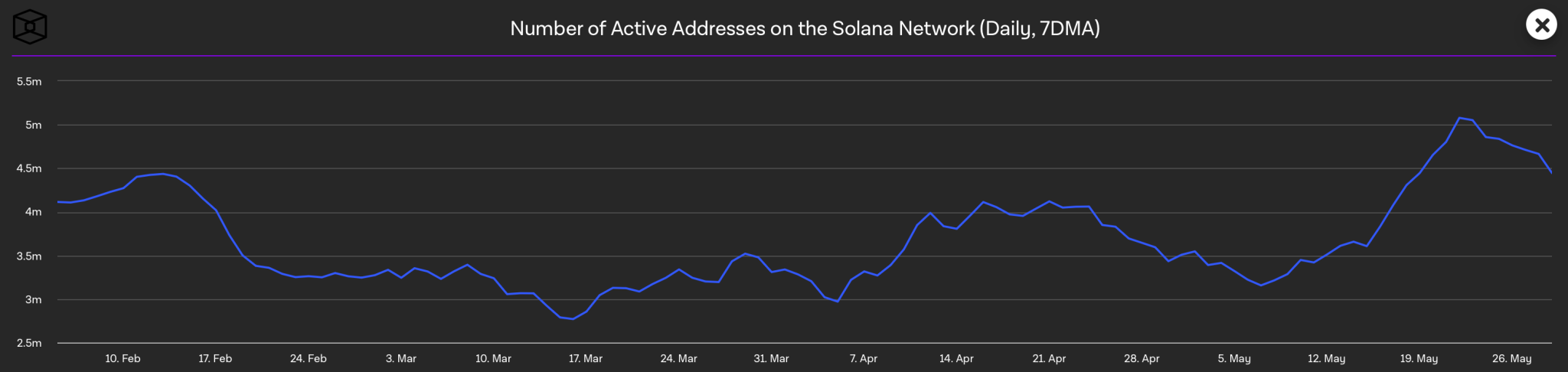
Amid the steep price correction, Solana’s network activity has also declined. According to on-chain data, the number of active addresses on the network has dropped to 4.45 million, down from a 7-day peak of 5.08 million.

As network activity slows, the drop in active addresses may further reinforce the bearish trend.

Solana network Active Address

Bearish Sentiment Reshapes Derivatives Market

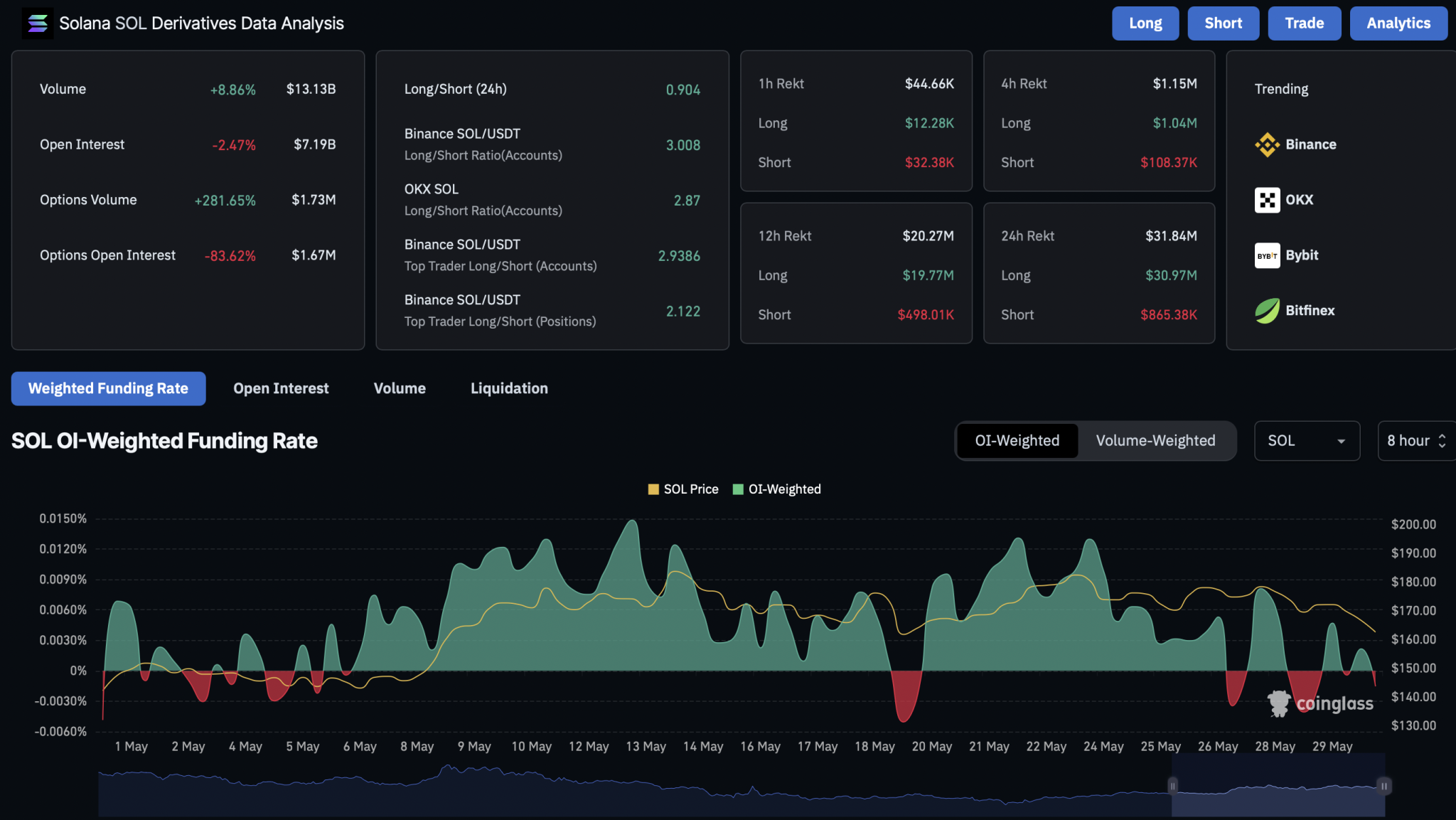
In tandem with the network slowdown, bearish sentiment in the derivatives market continues to grow. Open interest in Solana futures is down 2.47% to $7.19 billion, while the OI-weighted funding rate has turned negative at -0.015%.

Notably, over the past 24 hours, long liquidations have surged to $30.97 million, while short liquidations remain minimal at $865,380.

SOL Derivatives
SOL Derivatives.