Home Blog Page 739

Here is Where XRP May Stand in the Next 10 Years

XRP price could see substantial growth in ten years if the broader crypto market expands, according to sources such as ChatGPT, Grok, and Telegaon.

XRP price rallied over the past few months, with most of its upsurge coming up from November 2024 to January 2025, as it currently trades at $2.40, a notable 253% increase since 2024. 

In 2025 alone, XRP has recorded a steady 15% growth. Currently, the asset’s market cap sits around $140 billion, representing a 4.28% dominance in the broader crypto space, as XRP reasserts itself following years of regulatory uncertainty. 

Interestingly, the lawsuit between Ripple and the U.S. SEC appears to be nearing resolution, with both sides agreeing to settle and drop appeals. This has bolstered optimism about XRP’s long-term trajectory.

Amid this encouraging environment, we explored where XRP price might be heading by 2035 by consulting two prominent AI models—ChatGPT and Grok AI. Each presented forecasts based on various market conditions, including bearish, base, and bullish scenarios. 

Grok Presents XRP Price Predictions for 2035

Grok AI built its forecast on factors such as XRP’s $140 billion market cap, Ripple’s existing partnerships with multiple financial institutions, and the upcoming full circulation of its 100 billion token supply. 

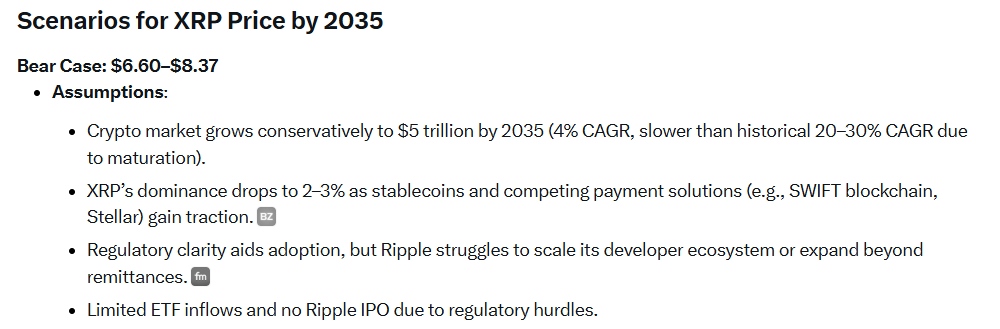
In Grok’s bear case, if the global crypto market grows conservatively to around $5 trillion by 2035 and XRP’s dominance declines to 2–3%, the token could trade between $6.60 and $8.37. This outcome assumes XRP faces increased competition from alternatives like stablecoins and platforms such as Stellar.
XRP Price Prediction Grok Bear Case
XRP Price Prediction | Grok Bear Case

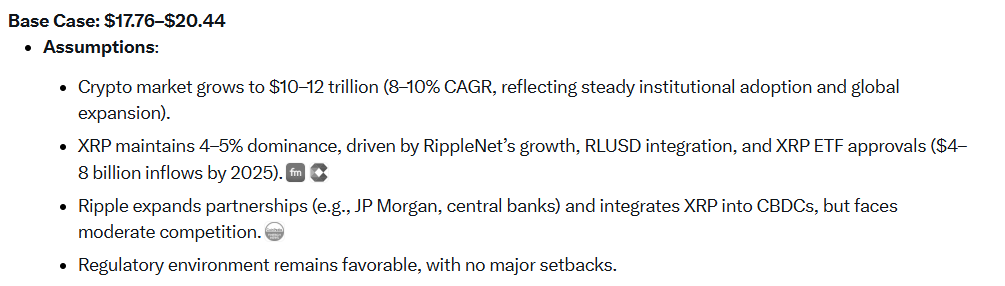
In its base scenario, Grok predicted that the XRP price could land between $17.76 and $20.44. Notably, this assumes the crypto market grows to $10–12 trillion and XRP sustains a 4–5% dominance rate. 
XRP Price Prediction Grok Base Case
XRP Price Prediction | Grok Base Case

Essentially, the projection depends on continued institutional adoption, expansion of Ripple Payments, successful integration of Ripple’s stablecoin RLUSD, and favorable regulatory environments that enable developments such as XRP ETFs. 

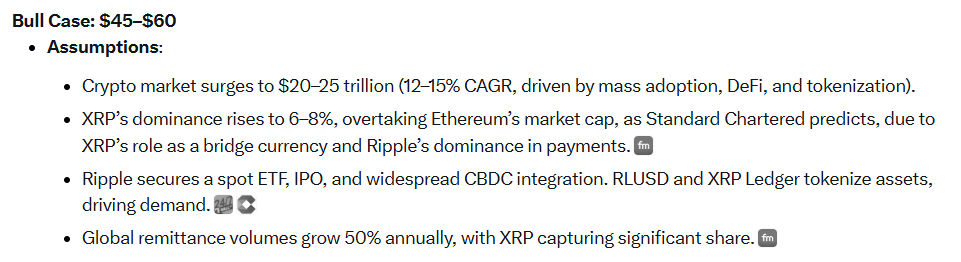
However, for the most optimistic outlook, Grok believes XRP price could climb to between $45 and $60 by 2035. This bull case rests on assumptions of global crypto market expansion to $20–25 trillion, XRP dominance increasing to 8%, and widespread integration into central bank digital currencies (CBDCs), DeFi platforms, and asset tokenization systems.
XRP Price Prediction Grok Bull Case
XRP Price Prediction | Grok Bull Case

ChatGPT Presents XRP Price Predictions for 2035

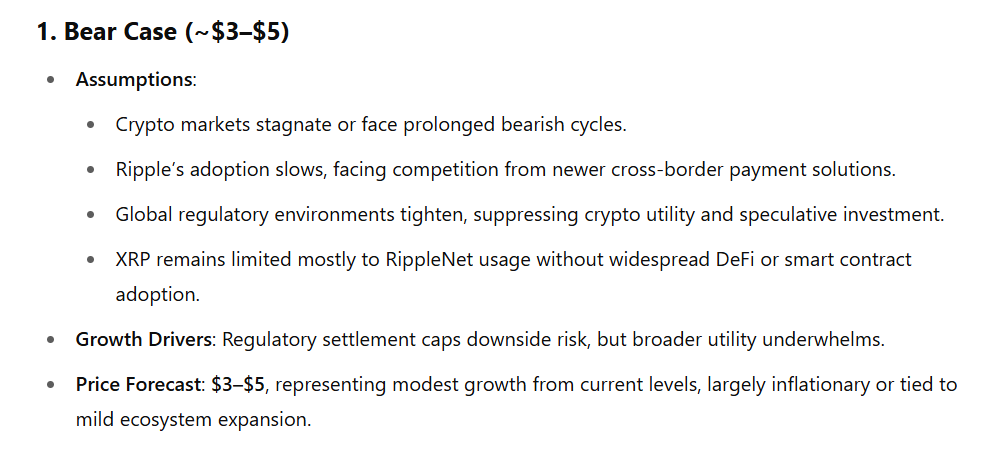
Meanwhile, ChatGPT presented a slightly more conservative but bullish prediction. Under its bear case, where market momentum slows and regulatory tightening limits growth, XRP price might only reach between $3 and $5.
XRP Price Prediction ChatGPT Bear Case
XRP Price Prediction | ChatGPT Bear Case

In a base case, ChatGPT estimated that the XRP price could rise to a range of $10 to $15. This scenario assumes continued market growth, expansion of Ripple Payments product, and a stronger presence in both institutional and retail portfolios. 

XRP Price Prediction ChatGPT Base Case
XRP Price Prediction | ChatGPT Base Case

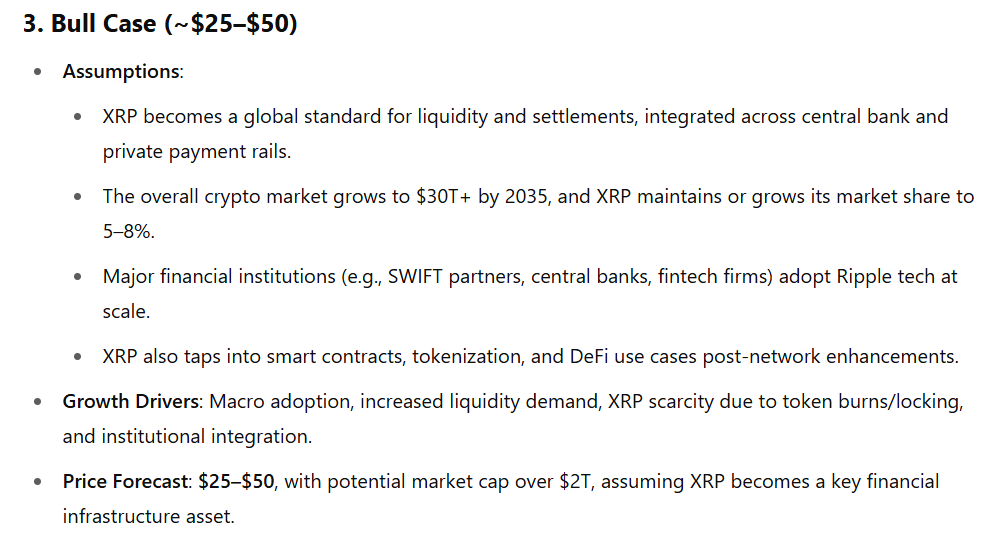
Nonetheless, in a bullish projection, ChatGPT foresaw XRP price potentially climbing as high as $25 to $50 by 2035. This scenario sees XRP capturing massive financial market share through adoption by central banks. The integration of smart contract capabilities and tokenization through the XRP Ledger would further fuel demand.
XRP Price Prediction ChatGPT Bull Case
XRP Price Prediction | ChatGPT Bull Case

Telegaon’s Projections

Interestingly, analysts at Telegaon issued a far more aggressive forecast. They suggest XRP could hit a minimum price of $69.37 by 2035, with an average of $78.16 and a peak as high as $87.49.
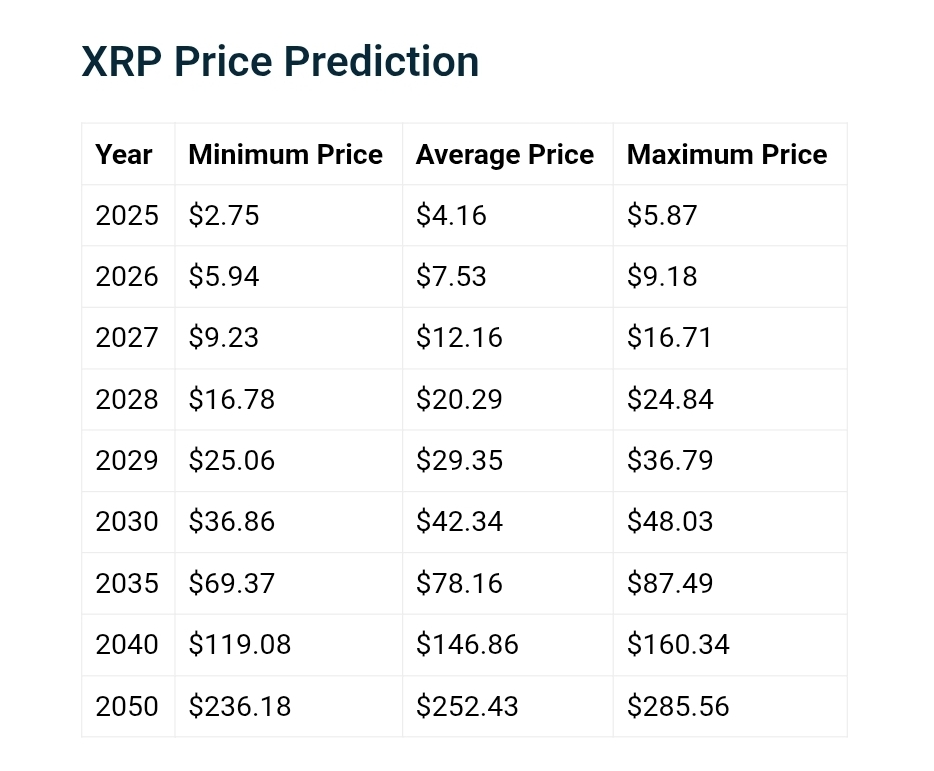
XRP Price Prediction Telegaon

Franklin Templeton to Establish Singapore’s First Tokenized Fund for Retail Investors

Franklin Templeton, a $1.5 trillion asset manager, has secured clearance from the Monetary Authority of Singapore to establish the Franklin OnChain U.S. Dollar Short-Term Money Market Fund.

Notably, this marks a major milestone, presenting the fund as Singapore’s first tokenized fund available to retail investors. In particular, the fund is open with a minimum investment as low as $20. This significantly lowers the barrier to entry for everyday investors seeking exposure to money market instruments through blockchain technology.

Notably, the fund will be structured under the Franklin Templeton Investments Variable Capital Company and will issue shares via Franklin Templeton’s proprietary blockchain-integrated transfer agency platform. This platform enhances transparency, security, and operational efficiency.

The investment strategy aligns with the firm’s Luxembourg-based fund, which currently manages $1.76 billion in assets. The fund focuses on high-quality, short-term U.S. dollar-denominated securities issued globally.

Competing With Institutions, But with Retail in Mind

While other tokenized financial products like VanEck’s VBILL have minimum investment thresholds as high as $100,000 to $1 million, Franklin Templeton is taking a different route by targeting the retail segment directly.

The move highlights the growing push to democratize access to institutional-grade financial instruments.

Meanwhile, Franklin Templeton’s latest push aligns with its broader digital asset strategy. The company has been active in blockchain innovation since 2018. In 2021, it launched the first U.S.-registered mutual fund to record share ownership on a public blockchain.

The firm is also a key participant in Project Guardian, an initiative by MAS that explores using asset tokenization to improve market liquidity and operational efficiency.

More recently, Franklin Templeton partnered with the Arbitrum Foundation to tokenize U.S. Treasury offerings. The ArbitrumDAO approved 35% of allocations to the Franklin OnChain U.S. Government Money Fund (FOBXX), which is now tokenized as BENJI.

Tokenization Market Poised for Explosive Growth

The launch comes amid growing optimism about the tokenization of real-world assets. A joint report by Boston Consulting Group and Ripple projects that the global asset tokenization market could reach $18.9 trillion by 2033.

With the rising demand for tokenized financial products, Franklin Templeton’s latest offering could influence other traditional asset managers to follow.

On Monday, VanEck launched its first tokenized U.S. Treasury fund in partnership with Securitize. The fund is open to only qualified investors and supports on-chain USDC subscriptions. With the offering, VanEck joins institutions like BlackRock and Franklin in advancing tokenization.

Al Abraaj Becomes First Public Bitcoin Treasury Company in the Middle East

0

Al Abraaj Restaurants Group has formally added Bitcoin to its balance sheet, making it the first publicly listed company in Bahrain and the broader Middle East to do so.

The company, listed on the Bahrain Bourse under the ticker ABRAAJ, has initiated its Bitcoin treasury strategy with an initial acquisition of 5 BTC. In an X post, the firm gave a “Big shoutout” to the legend Michael Saylor, the renowned Bitcoin evangelist.

The move follows a similar path taken by Strategy, led by Saylor, which has amassed over 555,000 BTC.

According to the firm’s press release, the decision positions Al Abraaj as the first Bitcoin Treasury Company in the Kingdom of Bahrain and the Gulf Cooperation Council (GCC). The initiative reflects a broader trend of corporations adding Bitcoin as a treasury reserve asset amid ongoing changes in global financial markets.

Strategic Partnership and Treasury Allocation Plans

In support of its Bitcoin strategy, Al Abraaj has partnered with 10X Capital, a New York-based investment firm known for its experience in managing treasury assets for listed Bitcoin companies. The firm previously advised on the $710 million capital raise for Nakamoto Holdings. 

Working with 10X, Al Abraaj aims to raise additional capital to increase its Bitcoin holdings. The company has stated that its long-term goal is to maximize Bitcoin per share. This signals a continued and significant allocation of its corporate treasury into Bitcoin.

Notably, to ensure proper oversight, Al Abraaj has established a Bitcoin Committee. This body includes experienced Bitcoin investors, portfolio managers, and capital markets experts. They will oversee custody, risk management, and compliance. 

The company also noted that its treasury move followed detailed due diligence and aligns with Bahrain’s regulatory framework, which is governed by the Central Bank of Bahrain. The framework provides guidance on digital asset transactions and public company disclosures.

Rising Interest in Bitcoin 

This announcement comes amid rising institutional activity in Bitcoin markets. A May 13 report by André Dragosch, European Head of Research at Bitwise, revealed that public firms have purchased 196,207 BTC in 2025. 

Interestingly, this figure is more than three times the new Bitcoin supply of 60,044 BTC issued during the same period. Notably, corporate purchases now exceed the estimated full-year issuance of 164,250 BTC.

Mastercard Taps MoonPay to Simplify Stablecoin Payments for 150M Businesses Globally

0

Mastercard will roll out new crypto card solutions for stablecoin off-ramp payment with its latest collaboration with MoonPay.

Mastercard’s intentions have been clear from the start: it wants to deepen its presence in the digital asset industry. Today, that foray continued with a new collaboration with crypto payment solution MoonPay.

In a Thursday press release, Mastercard’s latest partner, Moonpay, announced that it will work closely with the card giant to simplify stablecoin payments. The new linkup will make crypto payments seamlessly available to 150 million businesses globally.

Mastercard to Leverage MoonPay for Stablecoin Payment

Mastercard recently disclosed that it is developing a blockchain-based protocol to facilitate crypto transactions among retail and institutional users. The initiative would simplify on-ramp and off-ramp payments, with the firm likening it to a Venmo or Zelle-like system.

Today, it aims to make stablecoin payments available to millions of users globally. At the center of this new initiative is MoonPay’s Iron technology, an infrastructure platform that provides stablecoin payment APIs, allowing merchants and fintechs to integrate rails for swift crypto payments. Notably, MoonPay acquired the firm in March 2025.

MoonPay stressed that the integration will give every crypto wallet instant access to virtual Mastercards for stablecoin-powered transactions. Meanwhile, stablecoin adoption has continued to swell as traditional finance acknowledges the crypto’s potency in several applications, including payments.

The fiat-pegged digital asset sector has grown to a $245 billion industry amid increasing traction. In 2024, stablecoin transfer volume reached $27.6 trillion, trouncing the combined volume of Visa and Mastercard.

Easing Stablecoin Regulation

Meanwhile, two stablecoin bills recently gained Congress approval as the United States facilitates efforts to create a regulatory framework. The STABLE Act and GENIUS Act could soon be passed into law pending the decision from the full House floor. However, it bears mentioning that the GENIUS Act recently faced a major hurdle in Congress.

In the meantime, the stablecoin industry still has hovering uncertainties around its classification. While the US Securities and Exchange Commission has attempted to classify the currency as non-security, its exemption of algorithmic stablecoins failed to clear the lingering doubts.

Nonetheless, the regulator recently dropped charges against PayPal’s stablecoin (PYUSD), reflecting its friendly disposition towards the sector.

Bitcoin Slips 1.8% to Retest $101K as US PPI Falls to 2.3%, Lower Than Forecasts

Bitcoin is experiencing renewed pressure this week, shedding 1.8% today as markets digest the latest U.S. inflation data. 

The crypto firstborn has retested the support at $101,000 level. This pullback coincides with the U.S. Bureau of Labor Statistics’ release of the April Producer Price Index (PPI), which revealed weaker-than-expected inflation at the producer level. 

US PPI Drops Lower than Expected

Specifically, the PPI dropped by 0.5% on a monthly basis, marking the sharpest decline since the series began. Over the past 12 months, the index rose just 2.3%. Notably, this is a signal that upstream inflationary pressures are easing more rapidly than experts expect.

Most of April’s PPI decline came from a massive 0.7% drop in final demand services, while goods prices held steady. Notably, trade service margins fell by 1.6%, with machinery and vehicle wholesaling plunging over 6%. 

Further, a sharp 39.4% collapse in egg prices also contributed to the overall decline in food-related producer prices. Meanwhile, core PPI, which strips out volatile food, energy, and trade services, ticked down 0.1%, the first such decline since April 2020.

These figures arrived just two days after the release of the April Consumer Price Index (CPI), which painted a similarly lower inflation picture. Specifically, headline CPI rose 0.2% for the month, bringing the annual inflation rate down to 2.3%, its lowest since February 2021. 

Core CPI, which excludes food and energy, also rose 0.2% month-over-month and stood at 2.8% year-over-year. Also, egg prices at the consumer level fell 12.7%, though they remain significantly elevated, up over 49% from the same time last year.

How Does This Impact Potential Fed Decisions?

Notably, these two gauges are fundamentally different. The CPI shows price changes experienced by consumers at the retail level, directly impacting household expenses. In contrast, the PPI measures wholesale price changes that affect producers.

Interestingly, the dual release of soft CPI and PPI data has triggered speculation about the Federal Reserve’s interest rate decisions. As producer and consumer inflation both ease, the central bank may find new flexibility to consider rate cuts later in 2025. 

Bitcoin Could Benefit

Such decisions could impact Bitcoin and broader crypto markets. Historically, Bitcoin has responded positively to looser monetary policy, as lower interest rates reduce the opportunity cost of holding non-yielding assets like crypto. 

If the Federal Reserve moves toward easing later this year, crypto markets could benefit from increased risk appetite and capital flows. However, there is still uncertainty. The Trump administration’s tariffs could still act as a potential inflationary wildcard that could complicate the Fed’s path forward. 

Additionally, Bitcoin’s short-term technicals show vulnerability around the $101,000 support level, which, if broken, could lead to further downside despite bullish macroeconomic tailwinds.

Bitcoin, which surged to a five-month high of $105,000 on May 12, is currently trading at $101,660. Despite the dip, Bitcoin remains up 8.26% for May and has gained 9.17% year-to-date, though it has slipped 2.06% over the past week.

Coinbase Launches $20M Bounty After Insider Breach Leaks User Data

0

Coinbase has disclosed a targeted data breach involving insider assistance, as criminals bribed overseas customer service agents to obtain sensitive user data. 

This attack affected fewer than 1% of the company’s monthly transacting users, Coinbase says. The compromised information included personal details such as names, addresses, phone numbers, and partial banking data.

Importantly, login credentials, private keys, and access to user funds remained secure. The attackers attempted to extort $20 million from the platform in exchange for not disclosing the incident.

Coinbase confirmed that it rejected the demand and instead launched an investigation with the introduction of a $20 million bounty, taking steps to secure its systems and notify impacted users. The company also promised to pursue the harshest punishment on the party involved in the breach.

Scope of the Data Breach and What Was Accessed

Criminals targeted Coinbase’s overseas support operations by offering cash bribes to a limited number of customer service agents. These insiders accessed internal tools to extract data belonging to a small portion of transacting users. 

Per a press release by Coinbase, the data included government ID images, masked Social Security numbers, masked bank account identifiers, account balances, and limited internal corporate documents. However, the attackers did not gain access to login credentials, authentication codes, or any capability to move or access crypto assets.

To prevent further exploitation, Coinbase flagged affected accounts and implemented stricter identity verification for large withdrawals. Scam-awareness prompts are now mandatory for flagged users. Additionally, Coinbase is relocating some of its support functions to a newly established U.S. hub and has introduced enhanced monitoring across all operational sites.

Company Response and Additional Platform Announcements

Coinbase has responded by terminating the involved insiders and referring them to both U.S. and international law enforcement. It has pledged to reimburse customers who lost funds through deception. The company has also created a $20 million reward fund for information leading to the identification and prosecution of the attackers. 

These reports come on a day when the exchange announced upcoming ERC-20 versions of several cryptocurrencies—including XRP, Litecoin, Dogecoin, and Cardano—on its Ethereum Layer-2 network, Base. These tokens are not yet live or tradable. 

Coinbase will also be added to the S&P 500 index on May 19, 2025, following the removal of Discover Financial Services after its acquisition by Capital One.

Ongoing Threats Highlighted by Analysts and Investigators

The breach has exposed a broader issue with persistent social engineering scams targeting Coinbase users. On-chain analyst ZachXBT reported that users lost $45 million to such scams in just the past week. 

He further revealed that these attacks have continued for several weeks, with another $46 million stolen earlier. These scams often involve phishing links, impersonation, and baiting tactics aimed at convincing users to surrender sensitive information.

According to ZachXBT and fellow blockchain investigator “Tanuki42,” the attacks appear to uniquely affect Coinbase users. They identified root causes linked to internal system vulnerabilities. Their analysis estimates total losses at over $330 million annually. 

Ripple CTO David Schwartz previously warned about similar attempts, sharing a phishing email he received from an impersonated Coinbase representative. 

Expert Predicts When XRP Lending Returns Will Surge

As the XRP community eyes opportunities for passive income through lending, industry commentators remain divided on the associated risks and the timing.

Vandell Aljarrah, co-founder of Black Swan Capitalist, sparked a discussion on X by urging XRP holders to adopt a long-term mindset when considering lending their tokens. He argued that significant returns from XRP lending are unlikely to materialize through current DeFi channels alone.

Aljarrah emphasized that meaningful returns will only emerge once financial advisors begin recommending XRP to high-net-worth clients. He believes this will require a regulatory framework that ensures insurance and protection for lenders.

Notably, the XRP Ledger, unlike networks such as Ethereum and Solana, offers limited DeFi services that allow token holders to earn passively. With most XRP remaining idle, several initiatives have emerged aiming to provide holders with opportunities to earn moderate yields on their assets.

However, some observers, including Aljarrah, caution that investors may be putting themselves at risk by relying on third-party services to earn yields on their XRP.

Divided Opinions: Security vs. Opportunity

The post sparked a flurry of responses from the XRP community. While some echo Aljarrah’s caution, warning about the dangers of premature lending, others view current platforms as viable options offering attractive yields.

One user, Jack Joseph, warned that impatience could lead to irreversible losses. Another commentator stated they would never lend their XRP until legislative clarity is established. Calling the current environment “the Wild West,” user BLKWOLFCapital emphasized the potential dangers of trusting unregulated DeFi services.

Still, some users pointed to the potential gains from even modest returns. User Heath Junkie estimated that a 2% return on a $1 million XRP portfolio could yield $20,000 annually. He suggested that for large holders, even conservative lending could pay off significantly if executed safely.

Meanwhile, Aljarrah acknowledged these perspectives. He clarified that while there are opportunities in the current environment, the decision ultimately comes down to individual risk tolerance. “There’s no right or wrong,” he said.

Native Staking on XRPL with Support from Ripple

Meanwhile, the XRP community is actively exploring native staking and lending on the XRP Ledger. Community member Mickle proposed implementing native XRP staking, citing Babylon Labs’ Bitcoin model as a reference.

In response, Flare CEO Hugo Philion revealed that Flare is developing staking tools for XRPL using Flare XRP (FXRP). Additionally, Ripple engineers introduced the XLS-65 and XLS-66 proposals to enable native yield farming and decentralized lending. 

XLS-65 outlines a “Single Asset Vault” for flexible asset management and staking, while XLS-66 supports uncollateralized, fixed-term lending through these vaults. Both proposals confirm Ripple’s active role in bringing native staking and lending capabilities to XRPL.

Here Is How Much XRP Ripple Holds as Compared to the Last Quarter of 2024

0

A recent report shows how Ripple’s XRP holdings have evolved since the last quarter of 2024, including other details on the ecosystem’s performance.

Notably, Ripple holds a substantial part of XRP’s 100 billion total supply. The cross-border payment giant, which is a major contributor to the XRP Ledger, received 80 billion XRP in an initial allocation in 2012 to support its business development. 

Meanwhile, while the stash has reduced over the years to its current valuation, it still holds over 40% of the XRP’s supply. Ripple’s recent quarterly disclosure has revealed its holdings compared to the last quarter of 2024.

Ripple’s XRP Holdings

Ripple subdivides its holdings into two categories: XRP held in its spendable wallet and those locked up in escrow. The firm uses the former to conduct its payment ventures and releases 1 million XRP from the latter every month.

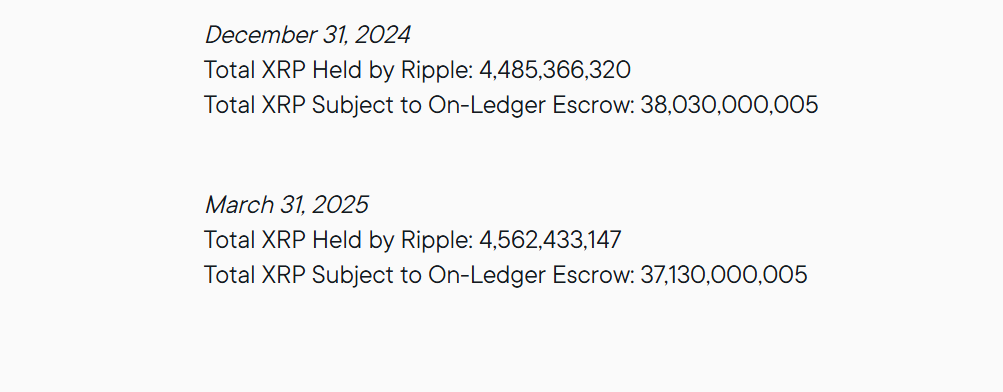
As per its Q4 2024 attestation filing, Ripple held 4,485,366,320 XRP in its wallet and 38,030,000,005 XRP in its on-ledger escrow account. However, its Q1 2025 market report shows a notable variation.

For context, Ripple’s wallet balance has 4,564,433,147 XRP, and its locked escrow address has 37,130,000,005 XRP as of March 31. The report shows a 79,066,827 XRP increase in the amount held and a 900,000,000 XRP decrease in escrow.

Ripple Current Holding of XRP
Image Source: https://ripple.com/insights/q1-2025-xrp-markets-report/

Notably, considering the standard 1 billion XRP that should be released to Ripple every month, the escrow account should be down by 3 billion XRP by the end of Q1 2025. However, the firm does not use all the monthly unlocked stash, relocking 70% each month.

Remarkably, Ripple’s massive XRP holdings have been a long-standing debate in the crypto community. While some disagree, XRP community researcher Anderson believes the fintech firm’s holding is beneficial for XRP’s long-term adoption.

Key Highlights from Q1 2025 Market Report

Meanwhile, Ripple revealed it will discontinue its quarterly market report in its current form, citing regulatory misuse of information. It stressed that these disclosures, dating back to 2017, formed the basis for the US Securities and Exchange Commission’s prosecution of the firm.

However, it would continue to adhere to its transparency policy on its operations through official channels and keep its XRP holdings publicly on its website.

The report also highlighted increased institutional adoption of XRP products. It spotlighted progress like Franklin Templeton’s XRP spot ETF filing, CME Group’s derivative expansion to include XRP, and the launch of the first futures product in the United States through Teucrium’s 2x Long Daily XRP ETF.

Other notable events include the US SEC’s pause on its case against Ripple and the $1.25 billion acquisition of brokerage firm Hidden Road.

Expert Says BlackRock Clearly Wants XRP ETF, But Issues a Warning to Investors

As speculation grows around a potential BlackRock XRP ETF filing, industry expert Vandell Aljarrah suggests the asset manager clearly wants to enter the market.

However, Aljarrah, who is the co-founder of Black Swan Capitalist, issued a warning to investors about this potential development. He suggested that the anticipated move is less about enhancing crypto adoption and more about profit and control by institutional players.

BlackRock Wants an XRP ETF, But There’s a Catch

In a recent post, Aljarrah stressed that investors should not automatically equate an XRP ETF with broader access to utility-driven crypto adoption. He argued that while the prospect of an ETF might appear to validate XRP in the eyes of Wall Street, it strips the asset of its inherent functionalities. 

When held in its native form, market participants can use XRP for real-time remittances, liquidity provisioning, staking, and self-custody. However, an ETF version offers exposure only to price movement, without granting access to these core utilities.

Nonetheless, he is confident that BlackRock would express interest in an XRP ETF. Aljarrah further warned that institutions could subtly manipulate ETFs, suggesting that control over the asset changes significantly from individual investors to powerful financial institutions.

Momentum Around XRP ETFs Grows

Despite these concerns, the momentum behind XRP ETF filings builds. Since October 2024, a growing number of asset managers have submitted applications to the U.S. Securities and Exchange Commission (SEC). 

Firms like Bitwise, Grayscale, WisdomTree, 21Shares, and ProShares have all entered the race to launch spot and futures-based XRP ETFs. At press time, multiple applications are under regulatory review. ProShares has secured approval for three futures-based XRP ETFs, including an inverse fund offering -2x exposure.

Grayscale, a major player in the crypto investment space, currently manages over $16 million in assets for its XRP Trust. It has partnered with NYSE Arca to seek listing approval. Meanwhile, MEMX, a U.S.-based exchange, filed a proposal to list an XRP ETF similar to those for Bitcoin and Ethereum, under the Commodity-Based Trust framework.

While BlackRock has not yet filed for an XRP ETF, market watchers believe it’s only a matter of time. The asset management giant has focused on its highly successful Bitcoin and Ethereum ETFs, which collectively pulled in over $43 billion. 

Analysts suggest that BlackRock is waiting for optimal legal clarity and market readiness before making its move. Industry voices like Nate Geraci of ETFStore predict that BlackRock will not cede the altcoin ETF market to competitors like Bitwise and Grayscale for long.

Regulatory Atmosphere Now Favorable 

Meanwhile, regulatory momentum has shifted in favor of these filings since the resolution of the Ripple-SEC lawsuit. The court ruled in July 2023 that XRP was in itself not a security. 

Following the SEC’s decision to drop its appeal this year and settle with Ripple, institutional restrictions have eased. The SEC has since opened a public comment period for several filings and begun a 240-day review cycle, raising approval odds to over 80% for 2025, according to Polymarket.

While President Trump Tours Middle East, Ripple Executives Engage With UAE Officials

0

U.S. President Donald Trump attended a state dinner in Qatar while Ripple executives held key meetings in Dubai. 

Both visits occurred amid growing U.S. engagement in the region, underscoring rising interest in financial and technological cooperation between Gulf and American institutions. 

Ripple President Meets Dubai Leaders 

While Trump, a pro-crypto president, continued his diplomatic engagements in Doha, Ripple leadership gathered in Dubai for the 2025 FinTech Summit. The company’s President, Monica Long, met with United Arab Emirates officials, including Emirates Group Chairman Ahmed bin Saeed.

Their discussions focused on expanding digital payment infrastructure and driving innovation in financial services. The meeting followed Ripple’s recent approval from the Dubai Financial Services Authority (DFSA), granted on March 13, 2025. 

The license enabled Ripple to offer regulated digital payment services within the Dubai International Financial Centre (DIFC), marking a regional first for a blockchain-based payments provider.

Following the DFSA license, Ripple intensified its efforts across the Middle East, targeting inefficiencies in cross-border payments. The company reported heightened interest from crypto-native firms and traditional financial institutions in the region.

According to a 2024 Ripple-conducted survey, 64% of finance executives in the Middle East and Africa cited faster settlement times as blockchain’s key value in international payments.

Trump Holds Talks with Syrian and Qatari Leaders

Meanwhile, President Trump’s diplomatic agenda began in Saudi Arabia, where he held a meeting with Syrian leader Ahmed al-Sharaa. Trump’s regional tour then continued in Doha, where he was welcomed by Qatari Emir Sheikh Tamim bin Hamad Al Thani.

The Doha visit included bilateral talks that concluded with several commercial agreements. Among them was a record order of aircraft from Boeing, which the White House stated could generate up to $1.2 trillion in economic value. 

During Trump’s tour, several American tech companies revealed new artificial intelligence agreements in the Middle East. The announcements came as U.S. President Donald Trump secured $600 billion worth of business commitments from Saudi Arabia to U.S. firms.

Notably, a government-backed venture fund based in Abu Dhabi is involved in a $2 billion transaction using a U.S. dollar-pegged stablecoin issued by World Liberty Financial.

The digital asset, USD1, is linked to the Trump family, which maintains majority ownership of the crypto firm. Current U.S. President Donald Trump is identified as the company’s “chief crypto advocate,” and he and his family are positioned to benefit financially from the transaction.