Home Blog Page 770

Experts Predict Final Timeline for SEC to Approve XRP ETF After Delaying Franklin Application

0

Popular crypto journalist Eleanor Terrett reveals the final possible date the U.S. SEC must approve or disapprove XRP spot ETFs. 

Terrett made this known after discussing with Bloomberg ETF analyst James Seyffart. This comes after the U.S. SEC delayed its decision on Franklin Templeton’s XRP ETF filing. 

SEC Delays Decision on Franklin’s XRP ETF 

The SEC, which was expected to decide the fate of Franklin Templeton’s XRP ETF application on May 3, delayed this decision until June 17, 2025. The postponement will give the SEC additional time to evaluate Franklin’s filing to ascertain whether to approve its spot XRP ETF product for launch. 

Last month, the SEC also postponed its decisions on multiple XRP ETF applications from VanEck, Canary, Grayscale, and 21Shares. Following the delayed decision, it set May 21 – 22 as the new date to reconsider these filings. 

Final Decision Deadline for XRP ETFs 

With the SEC now postponing its decision on Franklin Templeton’s application, Terrett characterized the early deadlines as ‘intermediate.’ She emphasized that the regulator would approve or disapprove several crypto-related ETFs, including those tied to XRP, in Q4 2025. 

For XRP ETFs, Seyffart told Terrett that the SEC’s final decision deadline for these products is around mid-October, specifically October 18, 2025. In his view, October 18 is the statutory deadline for the SEC to decide whether at least one XRP ETF will launch. 

This timeline falls within the 240-day ultimate decision countdown for most XRP ETFs. For context, the SEC typically has up to 240 days from the date the filing is published in the Federal Register to either approve or deny a potential issuer’s request to launch an ETF. 

SEC Might Issue Decision Earlier 

The applications for most XRP ETFs were filed earlier this year, potentially pushing the ultimate decision into the October-December 2025 timeframe. While each XRP ETF has its statutory deadline, the SEC might announce its decision for all of them on a particular date, just like it did for Bitcoin and Ethereum last year. 

Seyffart expects this to happen by October 18, 2025, 176 days or approximately six months from today. Meanwhile, Terrett suggests that the SEC might issue its decision on the multiple XRP ETFs sooner, similar to how it quickly approved dual Bitcoin and Ethereum ETFs earlier this year. 

However, she believes an early decision hinges on how the SEC actively engages with the XRP ETF applications. If the SEC frequently raises back-and-forth questions and requests about the applications, the regulator would likely issue its decision earlier.

In the meantime, XRP enthusiasts remain confident that an ETF tied to XRP is coming to market this year. Data from Polymarket suggests a 78% chance that an XRP ETF would go live in the U.S. by the year’s end. 

Here’s How XRP Could Lead the Charge if Trump’s 2025 Tax Plan Supercharges Crypto

XRP commentator “All Things XRP” recently shared a theory suggesting that Donald Trump’s rumored 2025 tax plan could propel XRP to the forefront of the next bull market.

The theory proposes that Trump’s plan to eliminate federal income taxes for Americans earning under $200,000 could significantly boost disposable income. With 90% of American wage earners potentially benefiting from this tax cut, the commentator argues that billions of dollars could flow into the crypto space.

“All Things XRP” cited data indicating that 28% of Americans already invest in crypto assets, with another 14% willing to join. He argues that XRP could be the unexpected beneficiary of this economic shift.

Why XRP Could Be the Prime Beneficiary

He cited several unique advantages that could make XRP the favored asset in this scenario. Notably, he claimed that Bitcoin is slower and Ethereum is more expensive. In contrast, XRP’s fast and low-cost payment features could make it ideal for institutional and retail adoption.

He also emphasized that the coin has been gaining traction in the financial sector. Ripple is expanding its U.S. operations, and XRP is seeing increased institutional adoption.

Moreover, the commentator noted that XRP’s prospects have improved following the resolution of Ripple’s legal battle with the SEC.

With these hurdles cleared and the launch of an XRP ETF in Brazil, he argued the foundation is in place for a potentially explosive surge in demand.

“A Perfect Storm for XRP”

The theory also suggests that rising disposable income from tax cuts would boost economic activity. Increased spending would lead to more business transactions, which in turn would drive demand for fast, cross-border payment solutions. According to “All Things XRP,” XRP could benefit from this trend.

He further noted that this could create a perfect scenario for XRP’s growth. Specifically, he claimed XRP could soar due to media FOMO, increased business use, accelerated ETF approvals, mass adoption, and widespread speculation.

Based on these theories, the analyst concluded that if Trump’s tax plan successfully boosts disposable income and encourages widespread adoption of crypto, XRP could emerge as the leader of the next crypto bull run.

Speculation, Not Certainty

Despite the optimistic outlook, the commentator emphasized that this theory is speculative. He noted that political gridlock, changing regulations, and crypto’s inherent volatility could all derail this scenario.

In particular, he described it as a “wild theory,” not a prediction. However, he concluded that sometimes wild theories are early glimpses of the future.

How a Decentralized Infrastructure Provider Quietly Redefined Web3 RPC

0

A quick rewind to the early days of blockchain offers up a very different digital development landscape, one where in order to interact with the blockchain, projects had little choice but to run their own nodes. The entire process was not only expensive and technical but also distractingly complicated for teams that just wanted to build.

Subsequently, there was the advent of ‘specialized node service providers,’ who promised a way out of this entire ordeal by allowing individuals/projects to outsource node access and focus on their core products. And, while this shift was undoubtedly meaningful, it came with its own set of growing pains.

For instance, in the wake of Web3 entering the mainstream, the cracks in the aforementioned model became clear, as it became obvious that most node providers were able to specialize in just a few blockchains, forcing decentralized applications (dApps) to stitch together access to multiple vendors for even basic multi-chain functionality.

The result, as one can imagine, was increased engineering complexity, bloated operational costs, and unreliable performance across chains and geographies.

Furthermore, to add to the problem, pricing models didn’t help. Most providers offered tiered SaaS packages, but growth often meant skyrocketing costs that teams struggled to predict. If that wasn’t enough, regional gaps in performance become even more glaring and what was supposed to be a solution became a whole new headache.

To put it simply, in the race to make Web3 accessible, the industry accidentally ended up creating a fragmented, hard-to-scale infrastructure maze.

dRPC’s New Playbook for Web3 Access

At a time when developers juggled multiple providers and unpredictable bills, dRPC introduced a very different vision, offering a way to connect to 100+ chains through a single, distributed access layer. But rather than spinning up a totally new infrastructural footprint, dRPC tapped into a global network of permissioned providers — who were meant to compete in real-time based on performance and quality.

Moreover, the platform routed every RPC request to its proprietary load balancer which in turn moved it to whichever provider could serve the request best, fastest, and most reliably. In practice, this enabled developers to no longer have to think about regional gaps, downtime, or vendor sprawls.

One integration. One entry point. Hundred-plus chains. All without giving up transparency or performance.

From the outside looking in, this shift seems to have ushered in more than just technical convenience for users, introducing a marketplace dynamic into the Web3 access layer. For the first time, RPC providers have been incentivized to perform better, not just exist while developers were offered lower latency, higher reliability, and no surprise invoices eating into their budgets.

Quietly but decisively, dRPC has rewired the underlying assumptions about how dApps can connect to the blockchain universe.

Bringing Visibility to the Read Layer of Blockchains with NodeHaus

If dRPC’s core platform sought to simplify access, NodeHaus, the firm’s newly launched infra dashboard, seems to have taken aim at something even deeper, i.e. visibility.

Since going live this month, it has become clear that NodeHaus isn’t just another metrics dashboard but a direct answer to a major blind spot in today’s blockchain infrastructure.
Historically, most blockchain analytics have focused on write operations such as token transfers, smart contract deployments, that sort of thing.

However, when looking at the bare bones of the matter, one can see that the vast majority of blockchain interactions today are read operations (such as balance checks, fetching transaction history, querying contract states) and until NodeHaus, they have remained largely invisible — so much so that developers and blockchain foundations seem to be optimizing infrastructure without truly understanding how users are interacting with their chains on a day-to-day basis.

NodeHaus changes that. It offers a clear, real-time view into both read and write activities, helping foundations and dApps make better, faster, more cost-efficient decisions. Instead of guessing at load balancing strategies or node distribution needs, teams can now optimize based on actual user behavior.

Beyond visibility, NodeHaus is also part of dRPC’s broader plan to open up infrastructure tooling. Their existing load balancer, Dshackle, already used widely in the industry, is being reimagined into an even smarter, faster tool aiming to become a de facto standard for teams serious about reliability.

And in a post-VC bubble era, where every dollar spent matters more, infrastructure intelligence like this isn’t just a bonus. It’s survival.

The New Rules of Web3 Infrastructure

The shift that dRPC sparked seems to still be unfolding; however, some patterns have become abundantly clear. Projects can no longer afford fragmented, overpriced, or opaque access models. They need predictability, transparency, and performance baked into the infrastructure layer itself.

Foundations, too, are starting to recognize that real-time insights into blockchain access — not just transactions — are crucial for scaling responsibly. In this environment, NodeHaus, and tools like it, seem to be pointing toward the way forward.

XRP or XLM, Which is Best to Replace SWIFT? Grok AI and ChatGPT Share Shocking Results

0

AI models from xAI and ChatGPT, developed by OpenAI, suggest that the most suitable blockchain networks to replace SWIFT are the XRP Ledger and Stellar (XLM), securing mentions.

Notably, proponents already see blockchain as a potential alternative to SWIFT, the long-standing cross-border messaging system that connects over 11,000 financial institutions worldwide. 

SWIFT, despite its reliability and vast network, suffers from high fees, slow transaction times, and centralization vulnerabilities. Recently, we asked AI chatbots Grok and ChatGPT to present what they believe could be the best blockchain to replace or complement SWIFT.

Grok AI Picks XRP Ledger

In response, Grok evaluated multiple blockchains using important criteria such as transaction speed, cost, scalability, security, interoperability, adoption, and regulatory compliance. Notably, Grok concluded that the XRP Ledger is the most suitable blockchain to replace SWIFT.

Grok AI Picks XRP Ledger

It highlighted the network’s strengths. According to the chatbot, transactions on the XRP Ledger complete in 3 to 5 seconds, far quicker than SWIFT’s 1 to 5-day processing window. In addition, costs are minimal, with fees amounting to just fractions of a cent compared to SWIFT’s $15 to $50 per transaction. 

Moreover, Grok noted that the network processes around 1,500 transactions per second. Importantly, the Ripple Payments service, boasting over 300 institutions including Santander, Standard Chartered, and American Express, also shows massive traction in the finance scene.

Grok also stressed that the XRPL is interoperable with traditional banking systems, with a reduced risk of central point failure due to its decentralized validator network. 

However, the AI chatbot cautioned that ongoing regulatory scrutiny, particularly the SEC’s lawsuit in the U.S., and Ripple’s smaller institutional network compared to SWIFT could be potential hurdles. However, the lawsuit might be close to an end at press time.

Stellar, a Close Second

Meanwhile, Stellar (XLM) came in a close second, with Grok noting its impressive transaction speeds (2–5 seconds) and near-zero fees (around 0.00001 XLM). Stellar supports around 1,000 transactions per second and has secured integration into projects like IBM’s World Wire and MoneyGram. 

Grok Mentions Stellar

Further, fintech startup Lightnet, backed by $31.2 million in funding, is leveraging Stellar to build a SWIFT alternative for Asia. According to Grok, while institutional adoption lags behind Ripple’s, Stellar’s push into emerging markets and remittance channels makes it a strong complementary or regional alternative.

Other Platforms

Grok also highlighted three other platforms, Hedera Hashgraph, Ethereum with Layer-2 scaling, and the XDC Network, as complementary technologies. For instance, Hedera boasts high throughput (10,000 TPS), strong security through aBFT consensus, and backing from giants like Google and IBM. 

Also, it noted Ethereum’s smart contracts and institutional pilots using Layer-2s like Arbitrum and Optimism, though its high base fees and slower speeds are concerns. Grok also identified XDC, with ISO 20022 messaging compatibility and a trade finance focus, as a potential complement for niche financial systems.

Grok Summary
Grok Summary

ChatGPT Also Chooses XRPL

Responding to the question, ChatGPT clarified that SWIFT is not a payment system but a secure messaging network. However, to replace or enhance SWIFT, the AI chatbot said a blockchain must meet six critical standards: global interoperability, high security, speed, regulatory compliance, privacy, and operational reliability. 

ChatGPT Mentions XRPL and Stellar

Interestingly, the XRPL again emerged as the top candidate in ChatGPT’s assessment. According to ChatGPT, the Ripple Payments network is already functioning globally, connecting hundreds of banks and financial institutions. 

Its messaging layer and instant settlement via XRP make it uniquely suited to replace SWIFT’s legacy infrastructure. It pointed to live implementations through major institutions like Santander and SBI Holdings as proof that the XRPL technology is already showing how it could replace SWIFT.

Stellar Secures Honorable Mention

Meanwhile, Stellar also emerged as an option for its ability to facilitate fast, low-cost international payments. ChatGPT noted Stellar’s strong performance in remittances and real-time currency exchange, with IBM’s World Wire and select banks actively using the platform. 

However, ChatGPT acknowledged that Stellar’s presence among large institutions is still relatively modest compared to Ripple.

Overledger, Ethereum, and Corda

Interestingly, ChatGPT also noted Quant’s Overledger Network as a potential SWIFT replacement due to its focus on interoperability. Quant’s role in bridging blockchain with legacy systems made it stand out in banking-grade deployments. It noted Quant’s engagement with central banks and financial enterprises as a sign of its real-world relevance.

Further, ChatGPT recognized Ethereum’s private and permissioned variants, such as ConsenSys Quorum, as strong complements to SWIFT. For context, JPMorgan and others are already exploring these setups for cross-border payments and tokenized asset transfers. 

ChatGPT Summary
ChatGPT Summary

In addition, ChatGPT mentioned Corda (by R3) and Hyperledger Fabric for their enterprise-grade capabilities. However, it mentioned them primarily as complementary solutions rather than full replacements.

Essentially, while both AI chatbots evaluated multiple blockchains, they identified XRP Ledger as the most viable replacement for SWIFT.

Eric Trump Confirms Crypto Payments Will Be Allowed for Trump Tower Dubai

Eric Trump, VP of the Trump Organization, has confirmed that crypto assets will be accepted for real estate transactions at the company’s newly announced luxury development in Dubai. 

This $1 billion project is under development in collaboration with the London-listed Dar Global. It marks a significant move into the Middle East for the Trump brand and an institutional embrace of crypto asset payments in high-end real estate.

The development will include a Trump-branded hotel, residential units, two ultra-luxury penthouses priced at Dh75 million (approximately $20.4 million), and a private clubhouse. It is located at the entrance of Downtown Dubai on Sheikh Zayed Road. Notably, the project is scheduled for completion in five years.

Eric Trump’s statement reflects the company’s recognition of evolving buyer preferences. By accepting crypto, the Trump Organization is catering to a growing class of crypto-native investors and high-net-worth individuals seeking to diversify their holdings into hard assets like premium real estate.

Moreover, accepting crypto in this real estate venture further deepens the Trump family’s ties with technology. Initially a vocal critic of Bitcoin and cryptocurrencies, President Donald Trump has since shifted his stance to become one of the most prominent advocates for crypto.

As president, he signed executive orders to establish Bitcoin reserves and to position the U.S. as the leading market for crypto technology.

Dubai’s Crypto-Forward Real Estate Ecosystem Grows Stronger

Meanwhile, the latest announcement aligns with Dubai’s positioning as a hub for real estate and crypto innovation. With favorable regulations and increasing global appeal, the city continues to attract capital from across Europe, Asia, and Africa.

According to Knight Frank, Dubai saw 111 property sales above $10 million in Q1 2025, totaling $1.9 billion, and welcomed 7,200 new millionaires in 2024 alone. This contributed to the UAE’s total of 130,500 dollar millionaires.

Trump Tower
Trump Tower | Bloomberg

Growing Adoption of Crypto Payments 

This development aligns with a broader trend of traditional industries intersecting with the crypto economy.

In 2023, The Crypto Basic reported that Bahrain-based real estate developer Bin Faqeeh began accepting Bitcoin (BTC) and Shiba Inu (SHIB) for property purchases via Binance Pay. 

This move reflects growing crypto adoption in the real estate sector, following similar actions by companies like Condos.com and Pacaso.

Earlier this month, Lomond School in Scotland became the first UK educational institution to accept Bitcoin for tuition payments. This further highlights the growing trend of crypto payments in traditional sectors.

Analyst Sees Bullish Breakout Ahead for Shiba Inu, $0.00004 in Sight

0

Trader Mike on TradingView highlights historic Shiba Inu patterns, identifying key resistance and future liquidity targets for the token.

Notably, Shiba Inu (SHIB) showed signs of mild volatility in its latest trading session, maintaining a narrow range between $0.00001333 and $0.0000138. Despite a slight intraday decline of 1.4%, SHIB remains up by 6.1% over the past week. 

Amid this short-term decline, analysts continue to monitor price action closely, pointing to historical patterns and technical developments that could influence SHIB’s next move. 

Shiba Inu Historical Patterns 

For instance, Trader Mike, a technical analyst and trader on TradingView, revisited SHIB’s historical price patterns to map out potential future moves.

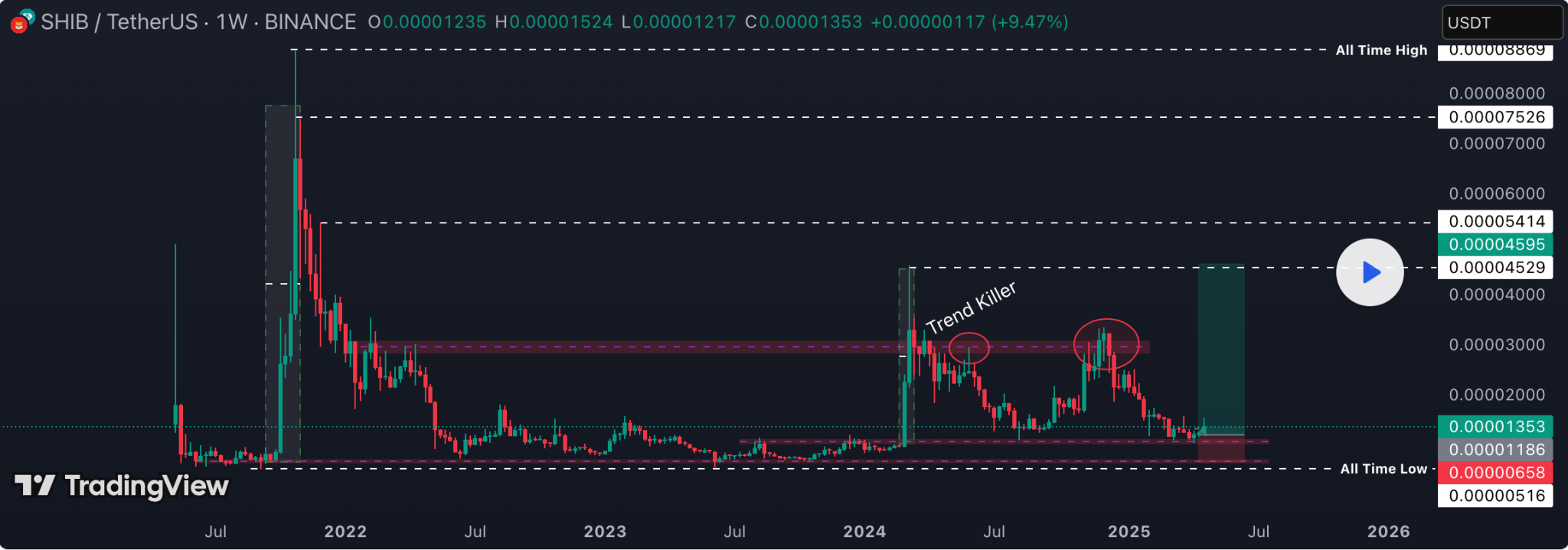
He highlighted the token’s major bull run from September 27 to October 25, 2021, during which SHIB surged from roughly $0.00000600 to $0.00008869. According to his analysis, this uptrend featured strong buying activity, represented by large candlesticks.

Shiba Inu Price Prediction | TradingView

Following this peak, SHIB entered an extended bearish period lasting from November 1, 2021, to February 19, 2024. During this phase, the candlesticks became notably weaker, often displaying significant wicks, which Trader Mike interpreted as possible signs of market manipulation rather than purely organic selling pressure. 

Importantly, he noted consistent buyer presence despite the overall decline. Building on this, he emphasized SHIB’s key resistance at $0.00003000, which he termed the “Trend Killer.” Notably, SHIB has tested this level but has yet to achieve a clean break above it.

Key Entry Points and Liquidity Targets

Meanwhile, Trader Mike shared that he entered a SHIB position after a bullish daily candle close on April 9, 2025, when the token traded near $0.0000167. 

From this position, he identified several projected liquidity zones, starting with a near-term target at $0.00004529, representing a 249% increase from his entry. Other critical targets include $0.00004595, $0.00005414, $0.00007526, and the $0.00008869 level last seen during the 2021 rally.

Further Optimism in SHIB

At the same time, further optimism emerged from another analyst known as Rose Premium Signals on X. This analyst observed that SHIB had broken out of a falling wedge pattern, a typical bullish signal. 

Such breakouts often signal bullish reversals, and Rose Premium Signals identified potential price targets at $0.00001510, $0.00001850, $0.00002110, and $0.00002460 levels that would significantly exceed current prices.

Futures Open Interest is Surging

In addition to technical analysis, derivatives market data appears to reinforce the observed bullish signals. CoinGlass data shows that SHIB’s Futures Open Interest nearly doubled in April, rising from below $97 million to almost $190 million by April 27. 

Shiba Inu Futures Open Interest | Coinglass

This surge in open interest occurred alongside SHIB’s price gains, often considered a positive sign. It typically indicates that new capital is entering the market through leveraged long positions.

Bitcoin Supply In Profit Surpasses 90% as Market Enters Euphoria: Here’s What Happens Next

0

The percentage of Bitcoin supply in profit has continued to rise amid the recent market rebound, as analysis identifies what this might mean for prices.

The resistance at $95,000 has been a major obstacle to Bitcoin’s renewed bullishness. For context, the premier asset has hovered around the price mark since Friday, failing at each attempt to recapture higher prices.

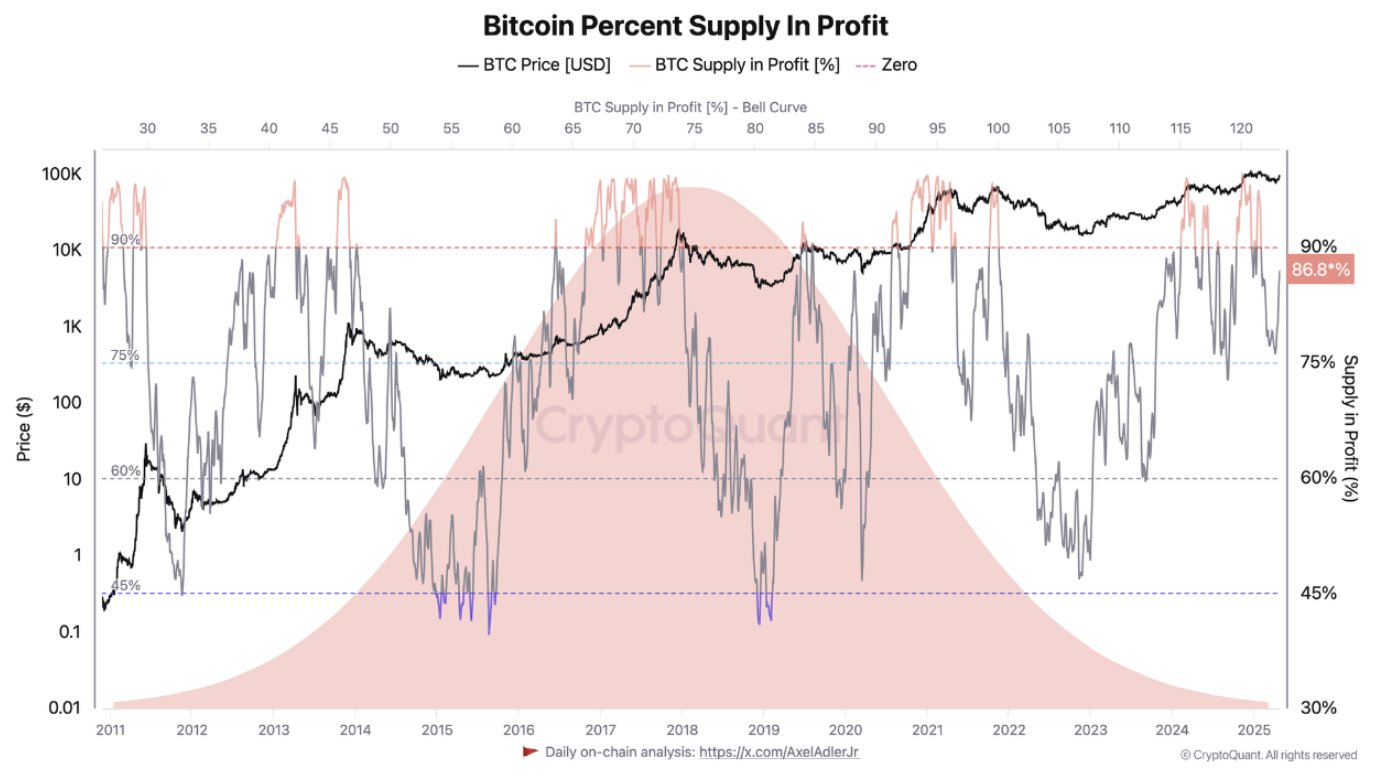
Nonetheless, CryptoQuant data cited by analyst Darkfost shows that Bitcoin holders have benefited from the recent rebound. The percentage of Bitcoin supply in profit has surpassed 90%, with data from IntoTheBlock confirming it stands exactly at 91% at the time of writing.

Bitcoin Supply in Profit Shows Market Now in Euphoria Stage

The Tuesday analysis from Darkfost, a prominent technical analyst and verified CryptoQuant author, highlights that a Bitcoin supply profit of above 90% signals that the asset is now in the euphoria stage of the cycle. For the uninitiated, this phase is the final stage in every bull cycle, according to Wall Street’s Cheat Sheet, and is characterized by intense market upsides.

Notably, the supply of Bitcoin in profit dropped close to a crucial level of 75% during the last price corrections, with CryptoQuant identifying that a fall below this level would have triggered higher profit-taking.

Meanwhile, the analysis indicated that the current Bitcoin supply profitability is not bad. In fact, it is good for the market, as investors are not under pressure to sell their holdings due to uncertainties. 

Interestingly, entering the euphoria stage could spark a Bitcoin rally to new all-time highs, as previous cycles have shown, reinstating the positivity that comes with this phase of the bull cycle.

Remarkably, analysts at Standard Chartered have predicted a surge to $120,000 by the end of Q2 2025, with other commentators projecting a range of between $200,000 and $250,000 by the end of the year.

Analysis Calls for Caution Amid Excitement

While positive price actions accompany the euphoria phase, CryptoQuant warns of a possible correction. It noted that this stage of the cycle is usually temporary and followed closely by a short to mid-term price capitulation.

Meanwhile, an accompanying chart supports this theory, highlighting that Bitcoin has usually retraced extensively after each euphoria phase. The data shows that this has happened in the last three Bitcoin bull cycles, with the Bitcoin supply in profit dropping to at least 50% each time, as is typical in a bear market condition.

Bitcoin Supply in Profit Chart | CryptoQuant

Furthermore, while the specifics on the end of the euphoria stage remain uncertain, Ki Youn Ju, the CEO of CryptoQuant, earlier suggested that the phase typically lasts between three and twelve months.

At the time of writing, BTC is trading at $94,893.

Nasdaq Seeks SEC Blessing to List and Trade 21Shares Dogecoin ETF

0

Leading New York-based exchange Nasdaq has officially submitted a 19b-4 application with the SEC to list and trade shares of the 21Shares spot Dogecoin ETF. 

Nasdaq submitted the filing today under Section 19(b)(1) of the 1934 Securities Exchange Act. According to the filing, the exchange seeks to list and trade 21Shares spot Dogecoin ETF as a commodity-based trust shares under the Nasdaq Rule 5711(d). 

The Nasdaq filing comes three weeks after 21Shares submitted an S-1 application to launch a spot-based Dogecoin ETF that will track DOGE’s performance. 

Nasdaq files to list 21Shares Dogecoin ETF

Details of 21Shares Dogecoin ETF 

Like 21Shares, Nasdaq also provided key details for the proposed spot Dogecoin ETF. The Dogecoin ETF is organized as a Maryland statutory trust, with 21Shares highlighted as the fund’s sponsor and manager. 

An unnamed trust company in Maryland will serve as the trustee of 21Shares’ Dogecoin ETF. 21Shares is expected to appoint a third party as the ETF administrator. Coinbase Custody will hold the ETF’s Dogecoin on behalf of the trust. 

Investment Objective 

The filing clearly characterized 21Shares’ spot Dogecoin ETF as a passive investment vehicle with no plans to generate additional returns for investors.  

This indicates that 21Shares will not speculatively buy DOGE at lower prices in anticipation of future price increases or sell Dogecoin at a higher value to lock in profit. Additionally, the sponsor of the ETF will not utilize strategies such as derivatives or leverage to meet its investment objectives. 

Per the filing, the ETF will only track Dogecoin’s performance by mirroring the CF DOGE-Dollar US Settlement Price Index. 

Growing Interest in Dogecoin ETFs 

The development comes as top asset managers file to launch spot-based exchange-traded funds for Dogecoin. Unlike most crypto ETFs, only a handful of asset managers—Bitwise, Grayscale, and 21Shares — are seeking the SEC’s permission to launch spot ETFs tied to Dogecoin. 

NYSE Arca has already submitted exchange applications to list and trade shares of Bitwise’s spot Dogecoin ETF and Grayscale’s converted Dogecoin Trust. The SEC has also acknowledged the Grayscale and Bitwise applications, with the final deadline for potential approval set for October 11 and November 12, 2025, respectively. Notably, 21Shares DOGE ETF will also undergo a similar process. 

Following Nasdaq’s application, the SEC is expected to acknowledge the filing within two weeks. This acknowledgment automatically kicks off a 240-day window in which the SEC must decide whether to approve or disapprove the application. 

Interestingly, the SEC has clarified that meme coins like Dogecoin are not securities. Therefore, DOGE is not subject to any regulatory uncertainty that could hinder the potential launch of spot ETFs tied to the cryptocurrency. 

UK Government Finally Releases Comprehensive Draft Legislation for Bitcoin and Crypto Firms

The UK government has finally released a comprehensive draft legislation aimed at regulating the services of Bitcoin and crypto-focused firms.

The announcement came today, April 29, during a summit held in London as part of UK Fintech Week. Chancellor Rachel Reeves presented the new rules, which look to encourage innovation in the digital asset scene while ensuring investor protection and market integrity.

UK Government Presents Bitcoin and Crypto Regulation Draft

Notably, the proposed regulations mark a step forward in the government’s broader “Plan for Change” economic initiative. These rules will now formally bring crypto firms, ranging from exchanges to service agents, under the same regulatory expectations as traditional financial institutions. 

This move looks to close existing gaps that have allowed fraudulent or unstable operations to thrive in recent years. With an estimated 12% of UK adults holding crypto assets like Bitcoin and Ethereum, the need for stronger consumer safeguards has become more pressing. 

The draft legislation presents stringent standards for transparency, operational resilience, and consumer protections, mandating compliance from all crypto service providers operating with UK customers. Specifically, the framework ensures that these firms adopt robust practices similar to those required in traditional finance.

International Coordinated Efforts

In addition, the announcement also highlighted international coordination efforts. Chancellor Reeves disclosed that the UK has initiated discussions with the United States to develop shared principles for the responsible development of digital assets. 

These talks, which included meetings in Washington with U.S. Treasury Secretary Scott Bessent, explore opportunities for cross-border cooperation, including a potential transatlantic sandbox for digital securities as suggested by SEC Commissioner Hester Peirce. 

In her remarks, Reeves stressed that while the UK remains open to innovation and technological advancement, it will not tolerate misconduct, fraud, or regulatory evasion. 

She also announced that the government will reveal a Financial Services Growth and Competitiveness Strategy on July 15. Notably, this would set the direction for long-term development in sectors like fintech, which plays a major role in the country’s investment and growth strategy.

UK’s Historical Push for Crypto Regulations

This draft legislation follows several years of growing policy and regulatory preparations. The Financial Conduct Authority (FCA) had previously outlined a roadmap toward full regulation by 2026, involving a phased approach to issues such as stablecoin oversight, market abuse prevention, and crypto lending. 

Meanwhile, in late 2024, the government announced intentions to consolidate crypto regulation into a single framework and began engaging with industry on draft provisions.

Earlier measures also sought to solidify the legal status of digital assets in the UK. A proposal in September 2024 under the Labour government aimed to classify assets such as NFTs and cryptocurrencies as property. This was to allow for clearer legal protections and the recovery of stolen digital assets through the courts.

The UK’s latest push toward finally regulating the local crypto industry comes on the back of increased engagement in the U.S., where the Trump administration has promised to outdo years of regulatory uncertainty that plagued the industry. So far, the U.S. Congress has passed bills to allow banks to engage with the crypto sector, as well as stablecoin laws.

Here’s How High Shiba Inu Can Go if a SHIB ETF Captures 5% of Bitcoin ETF Inflows

Shiba Inu could witness a major price breakout if a spot SHIB ETF is approved and captures just 5% of Bitcoin ETF inflows since January 2024.

U.S.-listed Bitcoin spot ETFs have amassed $38.9 billion in inflows since their inception. This institutional surge has significantly contributed to Bitcoin’s performance in the lead-up to its April 2024 halving and beyond.

In particular, Bitcoin first surpassed the $73K mark in March 2024 due to ETF investments. It went on to set a historic record by trading above $100K by the end of the year, with ETFs playing a major role in this achievement as their BTC holdings crossed 1.1 million, surpassing even Satoshi Nakamoto’s estimated holdings.

Calls for SHIB ETF

Now, this success has prompted other crypto communities to advocate for similar investment products tailored to their assets.

Notably, the Shiba Inu community has been particularly vocal about the need for an ETF. At press time, a petition urging Grayscale to consider a SHIB ETF has gathered over 11,600 signatures.

This grassroots interest stems from the hope that a fund investing in SHIB could propel the asset upward, much like what was seen with Bitcoin.

While a SHIB ETF remains speculative, The Crypto Basic examines the potential impact of even modest ETF inflows.

Shiba Inu Price if It Captures 5% of Bitcoin ETF Inflows

If Shiba Inu were to attract just 5% of the $38.9 billion in Bitcoin ETF inflows, that would translate to $1.945 billion entering the SHIB market.

Using a conservative 1:10 multiplier effect commonly applied in speculative forecasting, this capital could potentially increase Shiba Inu’s market cap by up to $19.45 billion. The idea is that every $1 of ETF inflow can generate $10 of market cap growth.

With Shiba Inu’s current market cap at $8.19 billion and its price at $0.00001371, a $19.45 billion boost would raise its total valuation to $27.64 billion. Assuming the circulating supply remains around 589 trillion SHIB, this would equate to a projected price of approximately $0.00004693.

This represents a more than 240% increase from the current price. Notably, this projected price would still place SHIB below its all-time high.

When Can SHIB Reclaim $0.000046?

Reaching this level would mark a historic development, as Shiba Inu last saw the $0.000046 price point in 2021. It came close again in March 2024, buoyed by Bitcoin’s ETF-induced surge, but has since dipped significantly.

Interestingly, the prediction platform Telegaon suggests Shiba Inu could reach $0.000046 and even surpass it by the end of 2025. Notably, their forecast did not account for any ETF-related buying pressure.

However, analysts at Changelly are less optimistic, believing it could take Shiba Inu another three years to re-enter the $0.000046 range.