Home Blog Page 778

Cardano Breakout Sparks Optimism As ADA Targets $1.40 After Breaking Out of Descending Wedge

0

Cardano price action has caught the attention of prominent analysts as ADA breaks out of a descending wedge pattern, signaling a potential for higher prices. 

The crypto asset has seen a surge of over 6% in the past 24 hours, with its current price hovering around $0.7195. This price movement follows a series of higher lows and higher highs in the past week, indicating an upward trajectory. 

However, the analyst Justin Wu suggests that the breakout from the descending wedge could pave the way for a more substantial price increase.

Cardano Price Breakout from Descending Wedge

According to Justin Wu, Cardano’s price has broken free from a descending wedge that had persisted since February 2025. The wedge pattern, characterized by a series of lower highs and lower lows, had seen Cardano’s price steadily decline. By the end of March 2025, ADA reached a local low of around $0.51.

Cardano Price Prediction

Notably, as the Cardano price approached the apex of the wedge, volatility decreased, leading to a breakout between April 11 and 12, with ADA gaining over 8% during this period. This technical signal is often seen as a bullish indicator, suggesting that ADA may now experience upward momentum.

However, after the breakout, ADA faced consolidation before seeing improved price action in the past few days. Notably, Cardano price has successfully held its major support zone just above $0.51, a critical level that the analyst had been watching. The price action over the past week further confirms this trend, with Cardano showing signs of strength as it continues to climb.

Cardano Price Targets Post-Breakout

Following the breakout, Wu has set his sights on two important resistance levels. The first resistance level is $1.2456, which is expected to challenge bulls.

If Cardano manages to surpass this level, the next target would be around $1.4642. Reaching this target would require a price increase of about 103.5% from its current price of $0.7195.

Other Analysts’ Perspectives

This analysis aligns with other bullish forecasts. For one, CryptoPatel, another well-known analyst, projected a significantly higher upside for Cardano. His analysis points to a potential rise toward $5, supported by a rising channel pattern visible on the weekly chart. He also notes ongoing accumulation between $0.45 and $0.65, with the lower boundary serving as critical support.

In addition to Justin Wu and CryptoPatel, Javon Marks also expressed optimism about Cardano’s future. Marks highlights the potential for another breakout, similar to the previous one that resulted in a nearly 300% gain. 

According to his analysis, ADA could see price targets between $2.70 and $2.91, indicating a possible rise of over 260% from its current price. This suggests a strong possibility for significant growth if the breakout momentum continues.

How Much XRP Does One Need to Be Happy? Experts React

There has been widespread debate about how XRP holders should position themselves for the coin’s future possibilities.

In a tweet, widely followed community commentator “The Modern Investor” sparked conversation in the XRP community when he asked how many tokens one needs to be happy. The tweet garnered attention, even though he provided no context as to what constitutes happiness in holding XRP. Many community members equated it to achieving financial success.

XRP Army Reacts

Some users suggested that holding as many as 100,000 tokens could represent financial success or happiness. However, others believe fewer tokens might be enough. X user Erin Smith believes the more XRP one has, the happier they will likely be.

Another commentator, Jack Joeshop, argued that investors should commit 1% of their portfolio to XRP. Meanwhile, one added that investors should aim to hold enough XRP to generate an annual income of $75,000.

Notably, X user Señor Steak provided a more detailed breakdown for different years. He suggested investors should hold 100,000 XRP tokens by 2025. For 2028 to 2029, he finds a 10,000-token holding reasonable for achieving happiness. Interestingly, he proposed that just 1,000 tokens would be sufficient between 2032 and 2033.

He cited the coming of ETF investing in XRP and DeFi functionality via Flare as factors that could boost XRP’s price in the coming years. However, while he expects the price to rise, he did not specify by how much.

1,000 XRP for a Joyful Life

In a separate conversation, XRP advocate Duefe argued that holding just 1,000 XRP would be enough to live a joyous and fulfilling life by 2029. Similarly, Edoardo Farina suggested that holding 10,000 XRP could lead to unimaginable success.

Essentially, these perspectives suggest that if XRP’s price rises to certain levels, retail investors with strategic holdings could achieve financial breakthroughs. For example, someone holding 10,000 XRP would see their portfolio reach $1 million if the price of a single XRP hits $100.

When Can This Dream Materialize?

While various market commentators offer differing opinions on how much XRP one should hold, there is little consensus on what amount guarantees financial success. This is mainly due to the uncertainty surrounding future prices, despite XRP’s history of notable uptrends.

For instance, although many are hopeful, uncertainty persists over whether XRP will ever reach $100, which would turn 10,000 XRP into $1 million. An even greater leap to $1,000 per XRP would be needed to make holders of 1,000 tokens millionaires, though skepticism about this price point remains high.

Crypto exchange Changelly predicts XRP could be worth as much as $1,340 by 2040. However, analysts at Telegaon estimate a maximum value of $160 by that year. According to them, even by 2050, XRP’s price may still fall below $300, far from the coveted $1,000 mark.

Top Pundit Raises Concerns Around XRP Futures Contracts on CME Group: Details

0

Prominent crypto commentator and XRP community figure Eri has drawn the attention of the XRP community to a crucial detail of the CME XRP futures contract.

While XRP proponents beam with excitement over the imminent launch of the Chicago Mercantile Exchange (CME) XRP futures contract, popular community figure Crypto Eri has raised concerns about the contract’s settlement.

For perspective, the prominent derivatives marketplace announced yesterday that it would launch an XRP futures contract on May 19, after months of speculation. The product will provide institutional derivative exposure to XRP, the fourth-largest cryptocurrency by market cap, with contract sizes of 50,000 XRP and 2,500 XRP.

Futures Contract Not XRP Settled

Meanwhile, Crypto Eri highlighted in a Thursday post that the CME XRP futures contract will be cash-settled in US dollars and not in XRP. For the uninitiated, this means that all transactions, including the initial purchases and final settlement for the derivative product, will be handled in USD.

Excerpt from CME Futures Contract Details

Interestingly, this sidelines the underlying asset (XRP), ensuring minimal interaction between contract buyers and the cryptocurrency. Furthermore, the contract clause has replaced the spot XRP volume that users would have handled from deposits to a brokerage account for trading and settlement when the contract expires with USD, removing the need to actually hold XRP.

Notably, Mickle, another XRP community figure, pointed out that the derivatives marketplace follows a similar approach for its Bitcoin contracts, looking to highlight that it is a common practice.

In response, Eri stressed that there is a need for derivative contracts that, at the very least, allow purchases with XRP, if not settlements as well. Notably, a physically settled XRP futures contract will enhance the asset’s liquidity, attract institutional exposure, and influence its price action.

Currently, Bitnomial XRP futures remain the only institution-grade contract physically settled in XRP. The CME XRP derivative contract will be cash-settled, while the Coinbase Derivatives XRP product, launched earlier this week, also settles contracts in USD.

XRP’s Growing Institutional Interest Sparks Optimism

Nonetheless, the growing adoption of XRP by institutions has fueled optimism among proponents. Particularly, the Commodity Futures Trading Commission’s (CFTC) approval to list futures contracts tracking the prominent digital asset confirms the change in its classification as regulatory tides recede in the United States.

With XRP’s potential regulatory clarity and growing institutional interest, an XRP spot exchange-traded fund (ETF) may not be far off. Multiple applicants, including Grayscale, Bitwise, Canary Capital, and others, are seeking approval from the US Securities and Exchange Commission. Notably, the arrival of pro-crypto chair Paul Atkins has boosted the chances of approval.

$39M in RLUSD Burned on XRP Ledger and Minted on Ethereum—Here Are the Details

0

Well-known XRPL dUNL validator Vet recently took to X to clarify the recent RLUSD burning events. 

Notably, Vet first cited the $39,000,000 worth of RLUSD that has been burned on the XRP Ledger and subsequently minted on Ethereum. 

This large-scale transfer has sparked speculation about the motives behind these actions, especially concerning the UK, SBI, and institutional liquidity support. Before delving into these questions, Vet provided an educational overview of stablecoin inventory transfers.

He noted that stablecoin issuers, such as Circle and Tether, frequently perform inventory transfers to manage the supply of their tokens across various blockchains. 

These transfers are done to address shortages, meet heightened demand, and stabilize the value of the stablecoins. Essentially, this process ensures that the stablecoin can maintain its 1:1 peg with the US dollar, even as its usage grows across different platforms.

Clarifying the RLUSD Burns

Vet strongly believes that the recent RLUSD burn on the XRP Ledger, followed by the minting of new tokens on Ethereum, is part of Ripple’s strategy to manage its inventory in response to market demand. This move aligns with the expanding presence of RLUSD on major Ethereum-based DeFi protocols.

The minted RLUSD tokens are then transferred to the B2C2 Group, a UK-based crypto liquidity provider acquired by SBI Holdings in 2020. B2C2 specializes in institutional liquidity and executes OTC trading and derivatives for clients, which helps Ripple maintain liquidity for RLUSD on Ethereum.

DeFi Use Cases Needed on the XRP Ledger

However, amid this clarification, further questions emerged. A community member expressed confusion over why RLUSD was issued on the XRP Ledger, then burned, and reissued on Ethereum. 

However, Vet clarified that the rationale is to maintain inventory across supported chains to respond quickly to demand. By holding inventory on the XRP Ledger and Ethereum, Ripple can react to market fluctuations, burning on one chain and minting on the other as needed.

For example, if demand spikes on the XRP Ledger, they can issue more RLUSD there, and vice versa for Ethereum.

Another commenter pointed out that RLUSD would likely see more demand on the XRP Ledger if exchanges used the XRPL token. However, Vet explained that the real issue lies in the lack of decentralized finance (DeFi) use cases on the XRPL.

While XRP could logically benefit from DeFi applications, Ethereum has the most mature DeFi ecosystem, which drives much of the current demand for RLUSD on that chain.

RLUSD’s Integration into Ethereum

In parallel with these burns, RLUSD has made significant strides in its integration into Ethereum’s decentralized finance (DeFi) ecosystem. 

On April 21, Aave, a major DeFi protocol, announced that users could now supply and borrow RLUSD on its V3 Ethereum core market. This is a step in enhancing the liquidity and usage of RLUSD within the Ethereum network.

Ripple CEO Shares What He Calls an Incredibly Important Step for XRP Continued Growth

0

Ripple CEO Brad Garlinghouse reacts to the upcoming launch of XRP futures on CME Group’s trading platform, suggesting that the launch is long overdue.  

In a statement yesterday, the Ripple CEO acknowledged the delay in launching XRP futures, noting that the product is ‘overdue in a bunch of ways.’ 

This suggests that although XRP has existed since 2012 and has recorded increased volumes, derivative marketplaces like CME Group have stalled in launching future products for the coin. Despite this delay, Garlinghouse characterized CME Group’s XRP futures as a crucial step in enhancing the growth of the XRP market. 

He calls CME Group’s XRP futures incredibly important for XRP growth. The Ripple CEO’s statement suggests that the launch of XRP futures on a Tier-1 derivatives exchange like CME Group could potentially lure professional investors and hedge funds to adopt XRP. The product would also provide a regulated way for investors to gain exposure to XRP, while also laying the groundwork for future offerings like spot ETFs.

CME Confirms XRP Futures Launch  

Garlinghouse’s statement comes a few hours after CME Group confirmed it would launch XRP futures on its trading platform. The Crypto Basic reported that CME Group will launch the XRP futures on May 19, pending regulatory approval from the U.S. CFTC. 

Notably, the product would give investors indirect exposure to XRP as they can hedge against its future price movement without owning it or creating a blockchain wallet. 

The CME Group XRP futures come in two separate contract sizes: Micro XRP futures (MXP) and XRP futures (XRP). The XRP futures are designed for institutional players, with a contract size of 50,000 XRP. In contrast, the micro version is suitable for retail investors, boasting a contract size of 2,500 XRP. 

CME Group’s XRP futures are cash-settled, meaning that investors will receive cash instead of physical XRP once the contract expires. 

CME Becomes Third Derivatives Exchange to Launch XRP Futures 

Once the product goes live on May 19, CME Group will automatically become the third derivative marketplace to launch XRP futures in the United States. Recall that Bitnomial and Coinbase already offer similar XRP products to U.S. investors. 

While Bitnomial launched its XRP futures on March 20, Coinbase rolled out the product on April 21. Notably, the upcoming launch of XRP futures on CME Group is significant for XRP, given that the platform ranks as the largest derivatives exchange in the world. 

For context, CME, which currently offers three crypto futures tied to Bitcoin, Ethereum, and Solana, recorded an average trading volume of 198,000 contracts in Q1 2025. 

Given CME’s position in the derivatives market, its decision to launch XRP futures would further enhance the coin’s credibility, potentially leading to the continued growth of the XRP market, as Garlinghouse suggests. 

The futures product could also facilitate the launch of the XRP ETF in the United States. It is worth noting that the SEC usually considers whether a crypto asset has a futures product before it approves it for an ETF. The SEC followed this measure when it approved Bitcoin and Ethereum for spot ETFs last year. 

Amazon’s $1 Trillion Comeback: Why XRP Might Be on a Similar Path and Surprise Everyone

0

An XRP community pundit has suggested that XRP might be following the path set by Amazon from 2001, following its crash.

Amid an explosive rally from November 2024 to mid-January 2025, XRP surged 578%, climbing from $0.50 to a seven-year high of $3.39. However, the bullish momentum proved short-lived as the asset faced significant selling pressure between February and March 2025. 

Amid a broader crypto market downturn, XRP declined nearly 32%, yet managed to maintain strong support above the $2.00 mark, showcasing notable resilience despite unfavorable market conditions.

In the wake of XRP’s latest struggles, the analyst behind the XRP community-driven account “XRP Investing” has pointed out similarities between XRP’s market trajectory and Amazon’s historic comeback after its early 2000s crash. 

Amazon Recovers After 95% Crash

First, he noted Amazon’s infamous crash. In 1999, Amazon stock (AMZN) hit a peak of $106.69 (around $5 at current prices, considering its 20-to-1 stock split). Just two years later, by 2001, the price had plummeted to $5.97 (around $0.2 at current valuations), marking a staggering 95% drop. 

At the time, many analysts declared the company defunct. Despite the skepticism, Amazon pressed forward under Jeff Bezos’s leadership, doubling down on growth initiatives instead of retreating.

Amazon Historical Price Performance

As the dot-com bubble deflated, Amazon began laying the foundation for its future dominance. The company expanded into new retail verticals, pioneered cloud computing through AWS, and built infrastructure that would later support exponential scale. 

Though it took nearly a decade to recover, Amazon eventually transformed into a trillion-dollar enterprise, proving that short-term volatility does not necessarily signal the end for companies with strong fundamentals. At current prices, AMZN is up over 67,000% from the 2001 floor price.

XRP Might be Following Amazon’s Path

With XRP, the analyst called attention to the SEC’s lawsuit against Ripple in December 2020, which triggered a sharp drop in XRP’s price from $0.70 to $0.20—a 71% decline. At the time, headlines intensified concerns of collapse amid delistings from American exchanges like Coinbase.

However, Ripple, much like Amazon in its early days, continued developing its technology and expanding its vision despite regulatory uncertainty. Today, the lawsuit is near an end, with both parties having dropped their respective appeals.

Now, XRP trades at $2.20. From its post-lawsuit low of $0.20, this marks an impressive 945% increase. Though the asset still trades below its all-time high, it is clearly on an upward trajectory. 

Meanwhile, Ripple has broadened its use cases, focusing on global payment infrastructure and institutional adoption. Interestingly, this mirrors Amazon’s long-term innovation playbook.

The analyst argues that XRP’s value expands beyond its market price to its real-world utility. Like Amazon, which survived and thrived by solving tangible problems in commerce, XRP is aiming to reshape financial systems. 

For context, its core features, such as instant cross-border payments, minimal transaction fees, and growing institutional partnerships, help set it up as a future cornerstone of the finance scene.

The analyst further noted that regulatory hurdles, like those Amazon faced during its early years, are temporary. Amazon endured scrutiny over mounting losses, while XRP battled classification issues. Yet in both instances, resilience trumped resistance.

Essentially, he emphasized that investors should not see XRP’s current $2.20 price as its peak. Highlighting Amazon’s journey, which took years post-crash to reclaim and surpass its previous highs, the analyst believes XRP is still in the early stages of a long-term breakout.

One of Bitcoin Most Powerful Indicators Emerges as Whales Add 19,255 BTC

0

One of the most powerful indicators for Bitcoin has emerged as Bitcoin whales scoop up thousands more BTC in an effort to bolster their holdings.

Bitcoin (BTC) has shown notable price stability around $93,000 as of Friday, following a strong 10% rally this week. After surging past key resistance levels earlier this week, Bitcoin briefly reached a high of $94,430 on April 24 before stabilizing below this mark.

This price action has drawn attention from analysts, with a focus on the behavior of large Bitcoin holders, often referred to as whales and sharks. Market intelligence platform Santiment provides insights into the link between Bitcoin’s price movements and the accumulation patterns of these stakeholders.

Whale Accumulation Correlates with Price Surge

Santiment’s analysis reveals a correlation between Bitcoin’s recent price rise and the accumulation activities of wallets holding between 10,000 and 100,000 BTC. These wallets represent some of the most influential players in the market. 

In the past week alone, wallets in this category added 19,255 BTC, driving the total holdings of this group to 13.47 million BTC. This figure represents an all-time high in their cumulative balance.

Bitcoin Whales Santiment
Bitcoin Whales | Santiment

Notably, this surge in accumulation has coincided with a steady price increase, from fluctuations between $75,000 and $85,000 earlier in the year to the more recent rise above $93,000.

Despite a brief dip in early April, which also saw Bitcoin’s price retreat temporarily, the overall trend from mid-March has been upward. This consistent accumulation suggests that these large holders remain confident in Bitcoin’s long-term price potential. The purchase spree, coupled with the price increase, indicates a growing belief in Bitcoin’s bullish momentum.

Market Participation Support Positive Outlook

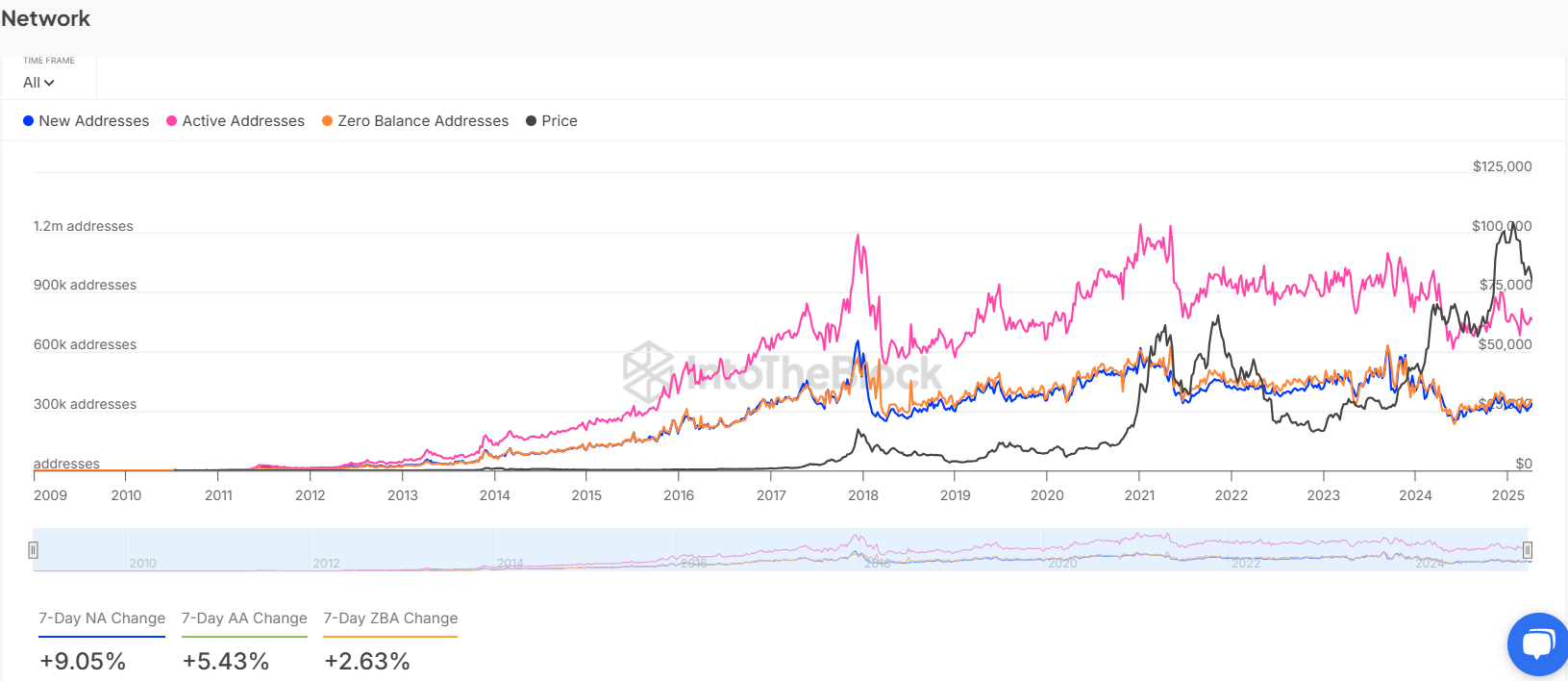
Other key indicators provide further support for a continued upward trend in Bitcoin’s price. Data from IntoTheBlock highlights significant network growth metrics, such as a 9.05% increase in new addresses and a 5.43% rise in active addresses over the past week. 

Bitcoin Daily Active Addresses | IntoTheBlock

Additionally, the number of zero balance addresses has risen by 2.63%. These metrics suggest that more users are entering the Bitcoin network, further strengthening the case for ongoing bullish momentum.

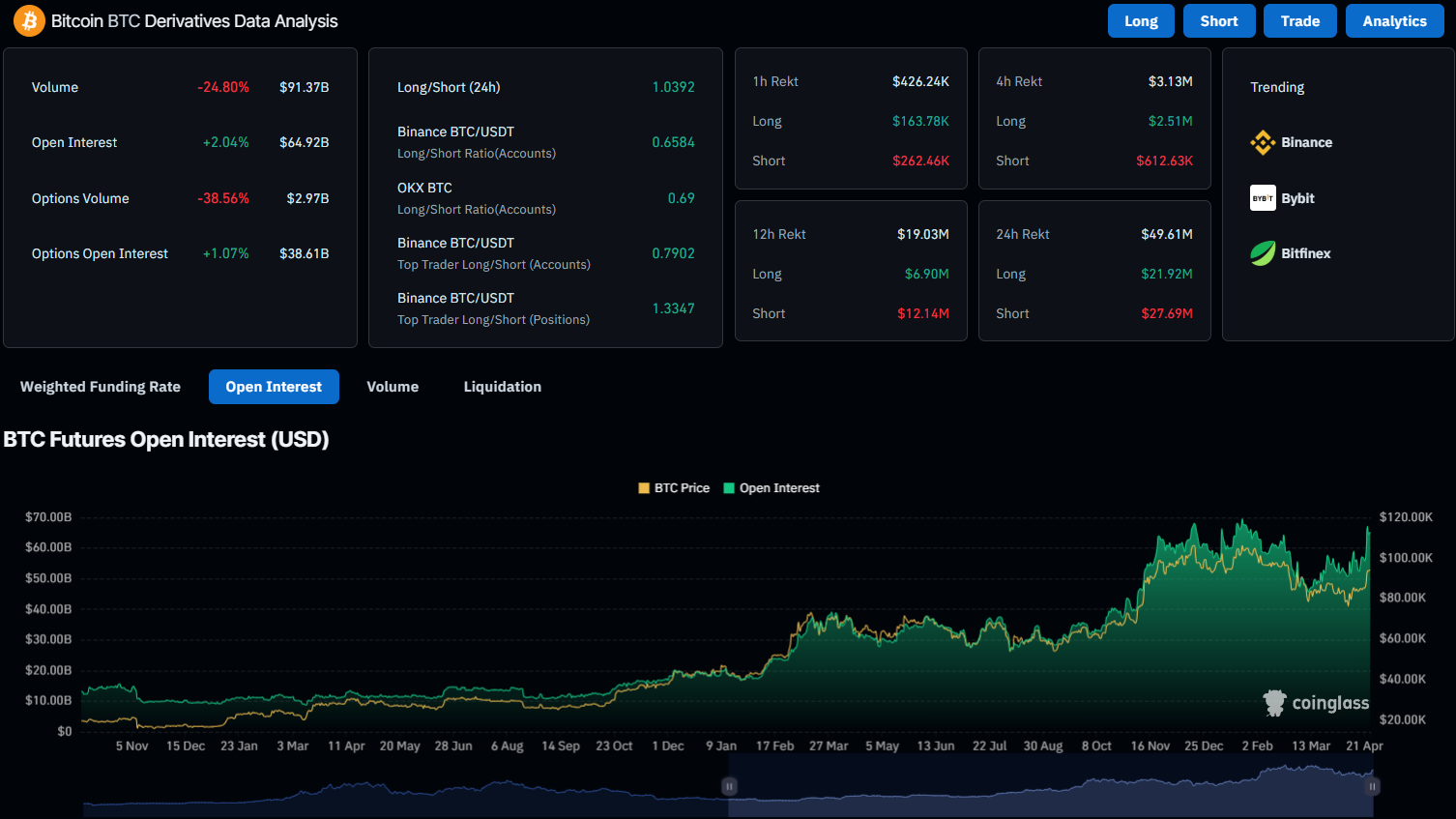
Meanwhile, Bitcoin’s derivatives market shows an increase in open interest, with Coinglass data showing a steady rise of 2.04%, reaching $64.92 billion. 

Bitcoin Derivatives Data | Coinglass

This growth in open interest signals a rising level of market participation. Further, the long-to-short ratio in the futures market stands at 1.0392, suggesting a slightly higher number of long positions than short positions. This sentiment is further confirmed by liquidation data, which shows that short positions have been liquidated at a higher rate compared to long positions.

Coinglass data shows that, over various time frames, the liquidation of short positions has consistently outpaced the liquidation of long positions. 

For example, in the last 24 hours, $27.69M worth of short positions were liquidated, compared to only $21.92M in long liquidations.

Ark Invest Raises Bitcoin Price Predictions for 2030: $300K Worst Case, $2.4M Bull Case

Ark Invest, a leading multibillion-dollar asset manager, has updated its Bitcoin price predictions for the end of the decade.

Notably, the firm now presents a bolder outlook for Bitcoin price than before. These updated projections are included in its latest industry report in the Big Ideas 2025 series.

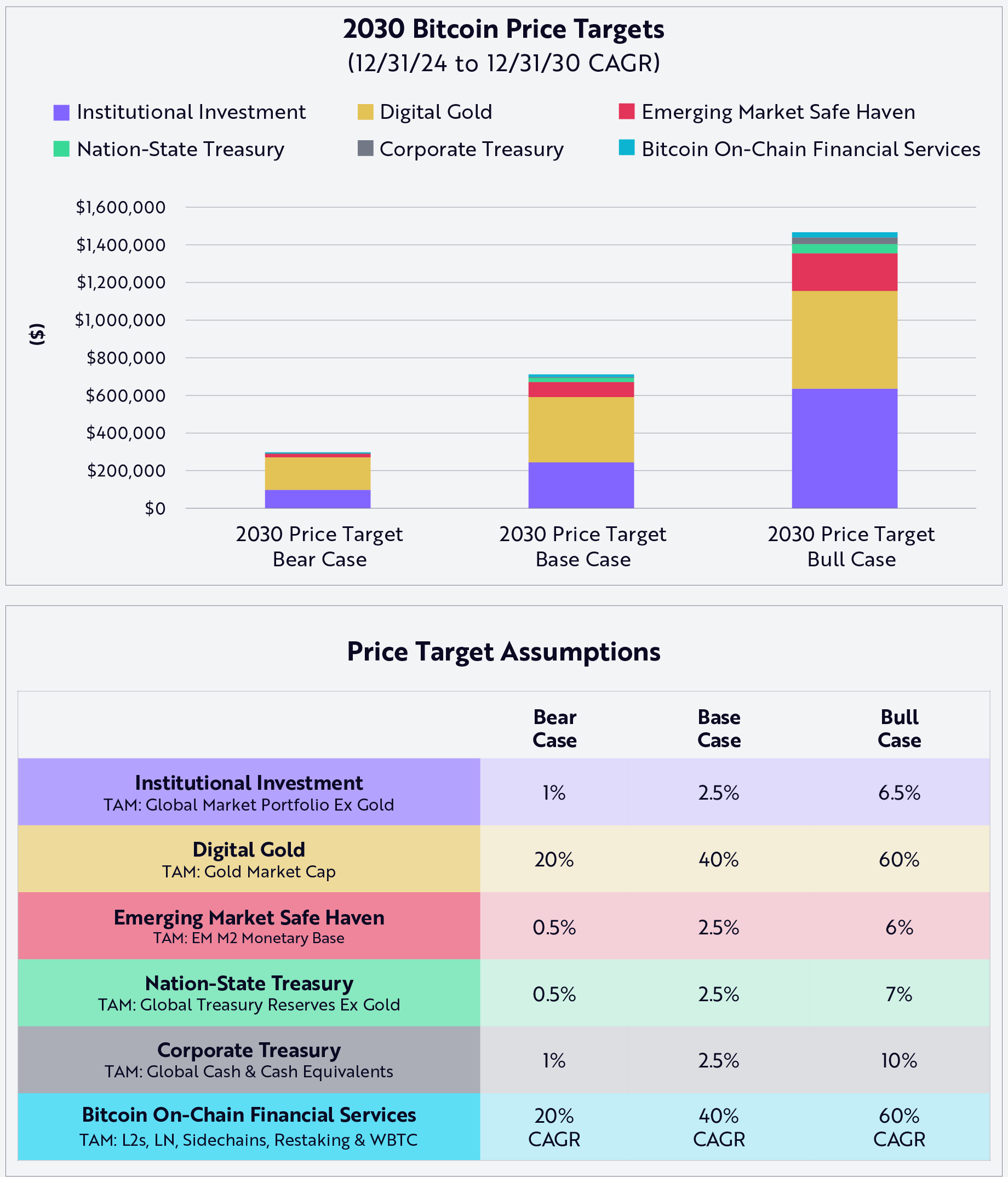
In this revised edition, Ark Invest argues that the minimum price Bitcoin could reach in the next five years is between $300,000 and $500,000 per coin. This represents the worst-case scenario, where things do not unfold optimistically. Despite the bearish connotation, these targets still translate to a 220% to 533% increase.

Meanwhile, in a bullish scenario, the asset manager projects that the price of 1 Bitcoin could soar as high as $2.4 million by the end of 2030. This would mean a potential 2,462% increase. However, in the base case, Ark Invest expects BTC to reach $1.2 million per coin, a 1,181% increase from current levels.

At the moment, Bitcoin is trading at $93,000, with a $1.85 trillion valuation, putting it on par with silver, the world’s seventh most valuable asset.

The Arguments Behind the Bold Bitcoin Price Predictions

Ark Invest made these bold price predictions based on Bitcoin’s diverse use cases and potential to attract significant investment. The firm identified six key drivers behind Bitcoin’s price growth.

One of the primary drivers is institutional investment, mainly through spot ETFs. Another is Bitcoin’s role as “digital gold”—a store of value and a safe haven in emerging markets facing inflation and currency devaluation.

Ark also cited secondary drivers, including Bitcoin’s adoption as a nation-state treasury asset, a corporate treasury reserve, and its use in on-chain financial services.

Assumptions Per Scenario

From the point of institutional investment, Ark Invest projects Bitcoin sees a 1% contribution in the bear case, 2.5% in the base case, and 6.5% in the bull case.

As for the “digital gold” factor, it projects a 20% contribution in the bear case, 40% in the base case, and 60% in the bull case.

Meanwhile, for emerging market safe haven use, corporate treasury, and nation-state adoption, the firm suggests a contribution ranging from 0.5% to 7%, depending on the scenario.

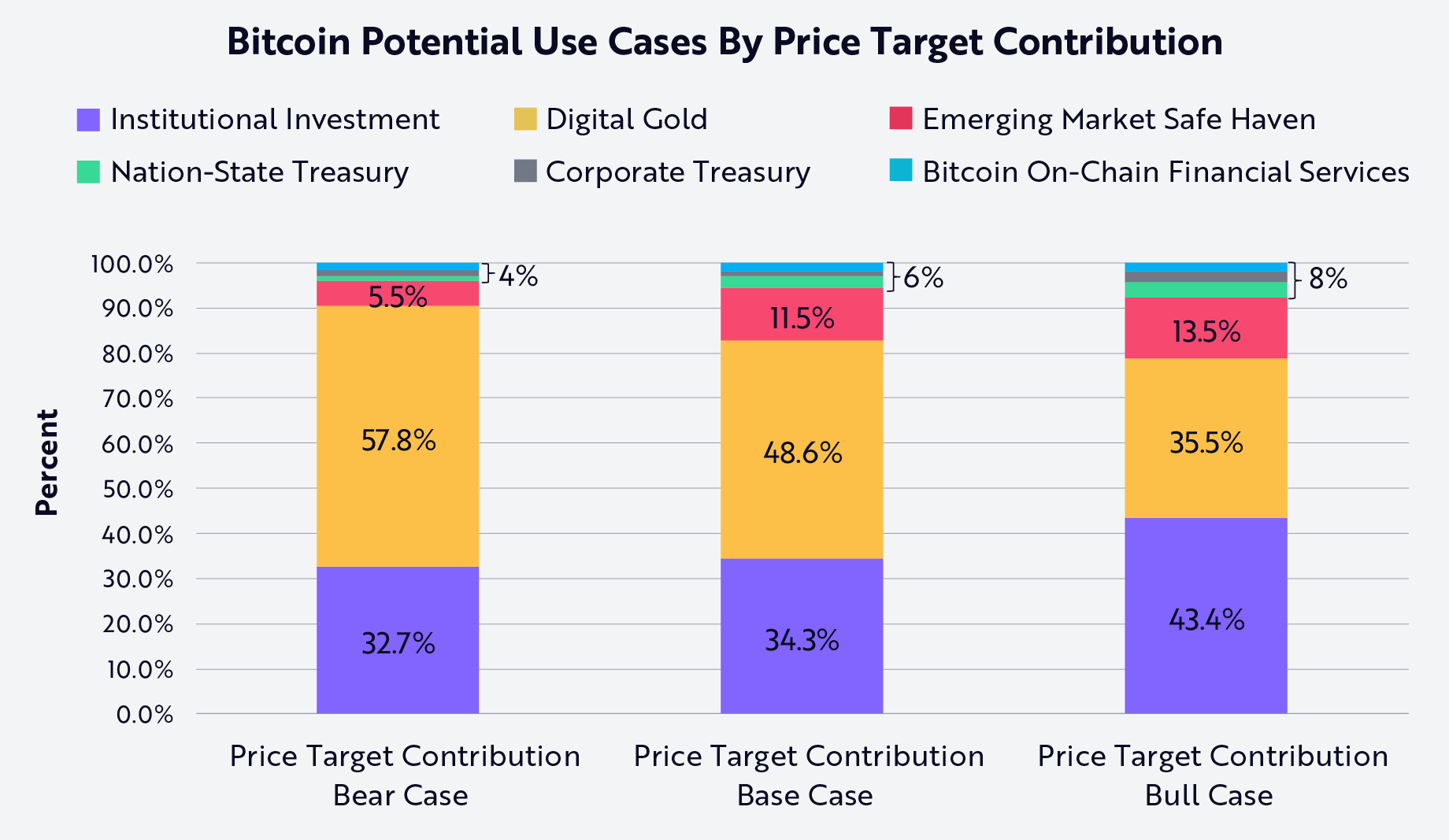
Notably, digital gold remains the largest contributor in all scenarios, but it’s penalized in Ark’s model since it competes directly with gold in a zero-sum market.

Meanwhile, in terms of use-case contribution, Ark Invest suggests that in a bull case, institutional adoption becomes the dominant driver, surpassing digital gold, with a 43.4% contribution.

However, in the bear case, it expects digital gold to take the lead with 57.8%, while institutions make up 32.7%, and the rest contribute less than 10%. In the base case, Ark estimates digital gold contributes 48.6%, while institutional adoption accounts for 34.2%.

Notably, Ark Invest assumes that Bitcoin on-chain financial services will grow at a compound annual growth rate (CAGR) of 20–60% over the next five years.

Bitcoin Price Predictions Based on Active Supply

Based on these factors, Ark Invest estimates that Bitcoin’s minimum price by 2030 will be around $300,000. On average, it expects Bitcoin to reach $710,000, with a bullish scenario projecting a price of up to $1.5 million per coin.

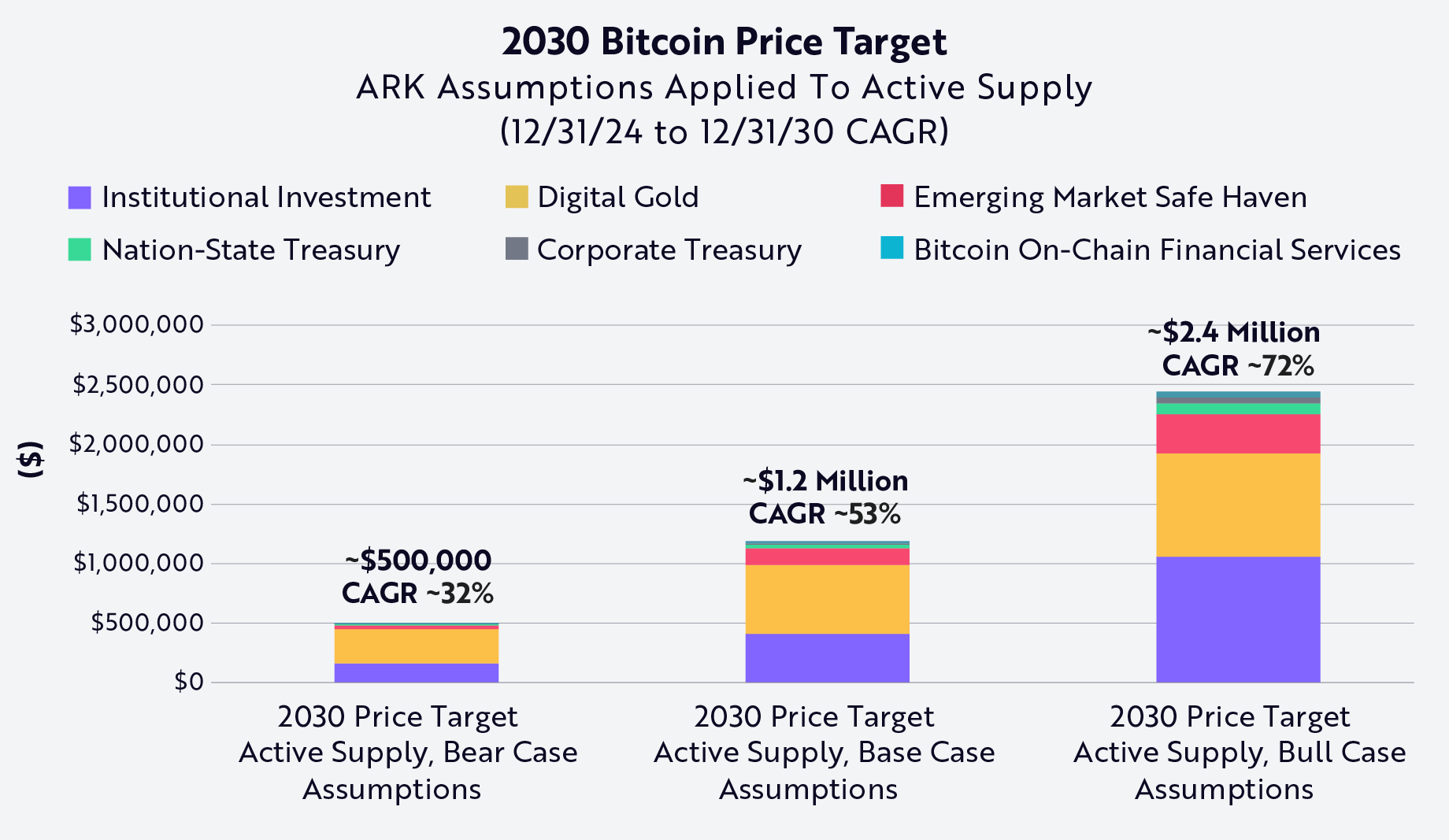
These projections consider Bitcoin’s entire supply. However, the firm noted that Bitcoin’s network liveliness has hovered around 60% since early 2018. This suggests that approximately 40% of the supply is “vaulted”, or inactive.

Taking this into account, Ark adjusted its Bitcoin price predictions upward by roughly 40% to reflect only the active supply. The revised targets are as follows:

  • Bitcoin Bear Case (with active supply): ~$500,000 (~32% CAGR)
  • Base Case: ~$1.2 million (~53% CAGR)
  • Bull Case: ~$2.4 million (~72% CAGR)


XRP to $100 Possibility, Analyst Busts The Most Common Myth

A growing number of XRP advocates are pushing back against the widespread belief that XRP may never reach $100 due to its market capitalization.

According to the crypto analyst “All Things XRP,” this belief is not only outdated but also based on a fundamental “misunderstanding” of how financial markets function.

Market Cap Is Not a Ceiling

Notably, critics often argue that XRP’s large supply makes a high price point like $100 mathematically impossible. However, the analyst explains that market cap, calculated as price multiplied by circulating supply, is not a true reflection of invested capital.

Drawing a comparison to real estate, he argued that saying XRP can’t hit $100 is like saying no one can buy a $10 million home because the average house costs $300,000.

To support his claim, “All Things XRP” cited a case where an $80 million inflow into XRP supposedly led to a $17 billion increase in market cap. This was a staggering 212x multiplier.

In his view, this shows how relatively small capital inflows can spark massive price surges, especially in low-liquidity environments.

The analyst further claimed that XRP’s liquid supply is minimal, with less than 5% of the total supply actively traded. Most tokens are either in long-term holdings or locked in escrow. According to him, this limited liquid supply amplifies the impact of new demand.

More Than a Coin: XRP as Financial Infrastructure

“All Things XRP” also emphasized that the token’s utility goes far beyond speculation. He pointed out that XRP is built for cross-border payments and integrated into worldwide banking systems and payment platforms.

Given the trillions of dollars in potential daily transaction volume, the token could serve as the backbone for next-generation finance.

He also highlighted XRP’s expanding ecosystem, including DeFi integrations, EVM-compatible sidechains, and passive income opportunities through staking and liquidity protocols. As adoption grows, so does the pressure on its limited tradable supply.

“$100 XRP Not Far-Fetched”

“All Things XRP” suggested that even an $8 billion capital inflow could push XRP’s price into the $30–$40 range. With additional catalysts such as speculative rallies, ETF approvals, and institutional interest, the $100 mark may not be as far-fetched as critics claim.

He further pointed to the $300 trillion global cross-border payments market as a massive opportunity. With its speed, scalability, and cost-efficiency, XRP is in a good position to capture a share of this flow. This could potentially support a much higher valuation.

While skeptics continue to dismiss XRP’s potential based on market cap metrics, proponents argue that liquidity, adoption, and growing use cases make ambitious price targets possible.

However, critics of this alternative perspective often fail to propose a viable valuation model that accounts for a potential $100 XRP price.

Using Bitcoin as an example, its current market cap is $1.83 trillion, based on a circulating supply of 19.85 million coins and a unit price of $92,600. Just 12 years ago, Bitcoin was trading around $100, with a market cap of $1.1 billion and a circulating supply of about 11 million tokens at the time.

This comparison shows the relevance of market cap as a valuation metric, especially for crypto assets with fixed supply like XRP. At $100, XRP’s market cap, based on a circulating supply of 58 billion tokens, would be $5.8 trillion.

While critics argue that such a valuation is excessive for the near term, others believe it’s not entirely unrealistic in the long run.

538.04 Trillion Shiba Inu Cluster Holding Back SHIB Upsurge: What’s Next

0

A key resistance cluster holds significant selling pressure for Shiba Inu, challenging its near-term bullish momentum.

Notably, Shiba Inu (SHIB) recorded an 18% price increase between April 18 and April 25, climbing from $0.0000118 to a high of $0.0000139. This upward movement appeared alongside rising trading volumes, reflecting a short-term bullish sentiment across the broader crypto market. 

However, data from IntoTheBlock highlights that this rally now faces a crucial resistance zone and weakening on-chain fundamentals, putting SHIB’s near-term direction in question.

Shiba Inu Resistance Cluster

During the week, Shiba Inu charted a pattern of higher highs and higher lows. This classic bullish formation signaled growing upward momentum. Yet, despite this technical strength, a major hurdle now looms between $0.000014 and $0.000019. 

Within this range, approximately 538.04 trillion SHIB are held across 145,600 wallet addresses, according to IntoTheBlock. These tokens were acquired above current prices, making them potential sources of selling pressure.

At the present value of $0.000014, only 15.03% of SHIB holders are in profit, controlling 148.05 trillion SHIB, valued near $2.07 billion. Meanwhile, a further 2.27% of holders are positioned at break-even levels.

In contrast, 82.70% of addresses remain at a loss, collectively holding 814.57 trillion SHIB, which equals $11.39 billion in unrealized losses. As the price nears the area where these addresses bought SHIB, many of these holders may sell to recoup losses, which could stall further gains.

It is worth mentioning that IntoTheBlock’s analysis often accounts for tokens no longer in circulation. Specifically, the circulating supply of SHIB is around 589 trillion tokens. 

Shiba Inu Active Addresses by Profitability

On-Chain Activity Lags Behind

Despite SHIB’s upward price movement, supporting on-chain activity has failed to keep pace. IntoTheBlock’s 7-day address metrics show softening engagement. Active addresses dropped by 17.88%, suggesting declining user participation in transactions.

New addresses rose marginally by 0.99%, pointing to limited new interest from retail participants.

Shiba Inu Daily Active Addresses

Ownership trends further reflect this waning momentum. Long-term holders, those holding SHIB for over one year, rose moderately by 1.98% during the same week. Further, cruisers holding SHIB between one and twelve months declined by 3.85%, while short-term holders under one month dropped significantly by 12.67%.

This pattern suggests shifting from speculative activity to moderate, longer-term holding, limiting the rapid trading volume typically required to push past resistance zones.

Shiba Inu Addresses by Time Held

Long-Term Growth Potential

As Shiba Inu faces strong resistance, projections from crypto industry analysts suggest long-term optimism. A panel of 26 experts polled by Finder forecast SHIB could reach $0.0001971 by the end of 2030. 

Separately, analysts at Changelly expect the token to hit a similar target of $0.000199 by May 2031. These estimates point toward substantial upside over several years, though current resistance levels remain critical to near-term price action.