Home Blog Page 780

Japan’s Largest Resale Platform Now Supports XRP

Mercoin, the crypto trading subsidiary of Japanese e-commerce firm Mercari Inc., has announced the addition of XRP to its platform.

Starting today, April 24, XRP is now available on Mercoin. This addition marks the third crypto asset available for trading on the platform, following Bitcoin (BTC) and Ethereum (ETH).

XRP will be available for purchase starting from just 1 yen (about $0.007). Users can use various payment methods, including bank recharge balances, Mercari sales, and Mercari points, making it easier for first-time traders to get started with small amounts.

The introduction of XRP aligns with Mercoin’s mission to provide more trading options and enhance accessibility for its growing user base.

Continued Growth and Success Among Inexperienced Traders

Since its launch in March 2023, Mercoin has focused on attracting new crypto users, with a significant emphasis on simplicity and security. The firm started by offering only Bitcoin at launch and later added Ethereum 14 months after its launch.

The company’s service is showing success, surpassing 3 million users by December 2024, just under two years after its debut. Notably, 90% of users on the platform are newcomers to crypto trading.

Now, Mercoin is introducing XRP, the fourth biggest crypto asset, as its beginner users become more familiar with BTC and ETH. The official announcement emphasized that XRP is one of the most traded assets in the global crypto market. Indeed, XRP boasts a 24-hour trading volume of $4.3 billion, the sixth largest in the market.

Interestingly, Mercoin noted that it plans to explore various avenues to further promote XRP awareness in Japan, expanding the pool of XRP enthusiasts.

Industry Reaction to XRP Listing on Mercoin

The recent announcement from Mercoin has caught the attention of the crypto community, particularly due to the influence of its parent company, Mercari Inc. 

Emi Yoshikawa, former Ripple VP of Strategic Initiatives, highlighted the importance of Mercoin’s decision to list XRP. Yoshikawa pointed out that Mercari is Japan’s leading marketplace app and the country’s largest resale platform, with millions of users who maintain a balance from selling unused items (MAU: 20+ million).

She also mentioned that users can now convert their balances or Mercari points into XRP starting from just ¥1. Additionally, Yoshikawa emphasized that almost all users purchasing crypto through Mercari are newcomers, making this a strong example of crypto reaching mainstream audiences beyond the typical crypto crowd.

CME Group to Finally Launch XRP Futures Trading: ETF Approval Next?

0

Derivatives marketplace CME Group confirms plans to launch XRP futures trading next month, bolstering the chances of an XRP ETF approval.

The world’s largest derivatives marketplace, CME Group, officially announced today in a press release that it will launch XRP futures on May 19, 2025, pending regulatory approval. 

Details of the CME Group XRP Futures Launch

Notably, this long-anticipated move follows months of speculation and a growing demand for regulated XRP products. Per the release, market participants will be able to choose between two contract sizes: a micro contract of 2,500 XRP and a standard contract of 50,000 XRP.

Further, the XRP futures will be cash-settled and benchmarked against the CME CF XRP-Dollar Reference Rate, which updates daily at 16:00 UTC. With this launch, CME Group will expand its crypto product suite, which already includes Bitcoin, Ethereum, and, most recently, Solana (SOL) futures. 

According to CME, the inclusion of XRP reflects growing institutional and retail interest in the crypto asset and its underlying technology, the XRP Ledger (XRPL).

Giovanni Vicioso, CME Group’s Global Head of Crypto Products, stressed that the firm continues to see growing demand for regulated crypto derivatives. The launch of XRP futures will provide investors with better tools for managing exposure in a regulated environment.

Growing Interest in XRP and Crypto Products

Interestingly, recent crypto futures trading data from CME confirms this growing interest. Specifically, Q1 2025 saw an average daily volume of 198,000 contracts, translating to $11.3 billion in notional value. This represents a 141% increase year-over-year. 

In addition, open interest also climbed 83%, reaching an average of 251,000 contracts valued at $21.8 billion. The firm also confirmed that since Solana futures debuted on March 17, over 43,000 contracts worth approximately $705 million in notional value have traded.

Meanwhile, Robinhood is also expected to offer CME’s XRP futures, continuing its push into crypto derivatives. The brokerage seems to make institutional-grade trading tools accessible to retail users through its mobile futures trading ladder.

Sal Gilbertie, CEO of Teucrium, noted that XRP was specifically designed for financial applications and is already used in global value transfers via the XRP Ledger. 

Teucrium’s 2x Daily Long XRP ETF (XXRP), the first XRP ETF in the U.S., recently reached $35 million in assets under management within ten trading days, showing investor appetite for regulated exposure to XRP. Gilbertie views CME’s XRP futures launch as a major milestone that supports ecosystem growth.

Growing List of XRP Futures Trading Venues: XRP ETF Next?

This announcement follows earlier developments that hinted at the launch of XRP derivatives. On Jan. 22, a test version of CME’s website mistakenly published details about XRP and Solana futures launching in February, triggering a brief uptick in both tokens. 

While CME initially denied the legitimacy of the leak, Solana futures went live on March 17. Interestingly, this lent some credibility to the earlier posting.

More recently, Bitnomial introduced physically settled XRP futures in March 2025, becoming the first U.S. exchange to do so under CFTC regulation. Coinbase Derivatives followed with its own XRP futures last week.

The growing list of regulated XRP futures products suggests a change in how regulators, particularly the CFTC, classify the token. XRP’s inclusion in CME’s lineup indicates implicit recognition of XRP as a commodity, a major step toward potential approval of spot and leveraged XRP ETFs. 

Currently, more than ten XRP ETF filings await SEC approval, and the existence of regulated futures is a necessary precondition for such approvals, just as it was for Bitcoin and Ethereum ETFs.

Notably, with XRP futures finally arriving at CME Group, the road toward the first U.S.-based spot XRP ETF appears more attainable than ever.

Twenty One Capital CEO Says Firm Aims to Make Investors Rich in Bitcoin

0

Jack Mallers has announced joining Twenty One Capital, a new venture that aims to provide exposure to Bitcoin as no company has ever done.

In a Bloomberg appearance, the Strike founder disclosed that he is joining Twenty One Capital, a new crypto firm focused on buying Bitcoin, as the new CEO. He also revealed the dynamics that his latest venture offers, including making users rich in Bitcoin terms, not just in fiat currency.

Twenty One Capital Debuts New Dynamics

Notably, the new Bitcoin-focused firm has its majority shares owned by prominent stablecoin issuer Tether. Furthermore, financial market titans Cantor Fitzgerald and SoftBank Group have also backed Twenty One Capital, which will launch with 42,000 BTC ($3.6 billion) in its balance sheet.

Meanwhile, the new CEO, Mallers, has vowed to expose Bitcoin enthusiasts to the asset, through owning shares of the venture, in ways not yet seen. He mentioned some of the metrics the firm will launch, including the Bitcoin per Share (BPS) and Bitcoin Return Rate (BRR).

Interestingly, Maller stressed that, unlike other Bitcoin investment vehicles, such as exchange-traded funds (ETFs), which offer static shares and earnings in fiat, Twenty One Capital is taking a whole new approach to incentivizing holders.

One of which is growing holders’ Bitcoin per share. Maller noted that this presents investors with more exposure to Bitcoin through its shares, providing them with wealth in Bitcoin terms rather than in fiat currency.

Remarkably, Twenty One Capital would pursue this venture using the MicroStrategy playbook. It would raise capital through several equity and debt instruments, all aimed at buying more Bitcoin. For context, the firm has already announced plans to raise $585 million, with $350 million in convertible note sales and $200 million in private placements.

Prominent Institutions Backing New Bitcoin Venture

Interestingly, Maller’s new initiative has already gained traction, with Tether owning a majority of the crypto business, thanks to a $1.5 billion Bitcoin contribution. SoftBank also contributed $900 million worth of Bitcoin for a minority stake in Twenty-First Capital, with Tether’s Bitfinex also remitting $600 million.

Furthermore, the firm will merge with Fitzgerald’s SPAC, Cantor Equity Partners (CEP), and rebrand to XXI. This collaboration boosts its $3.6 billion valuation, with its balance sheet already making it the third-largest public company holding the premier asset, after Marathon Digital (MARA) and Strategy.

Meanwhile, Maller will maintain his status as CEO and founder of Strike while managing Twenty One Capital. He founded the crypto platform in 2020, leveraging the Bitcoin Lightning Network to allow users to buy, send, and hold the pioneering cryptocurrency.

PEPE Completes Double Bottom Pattern: Is $0.000010 Next?

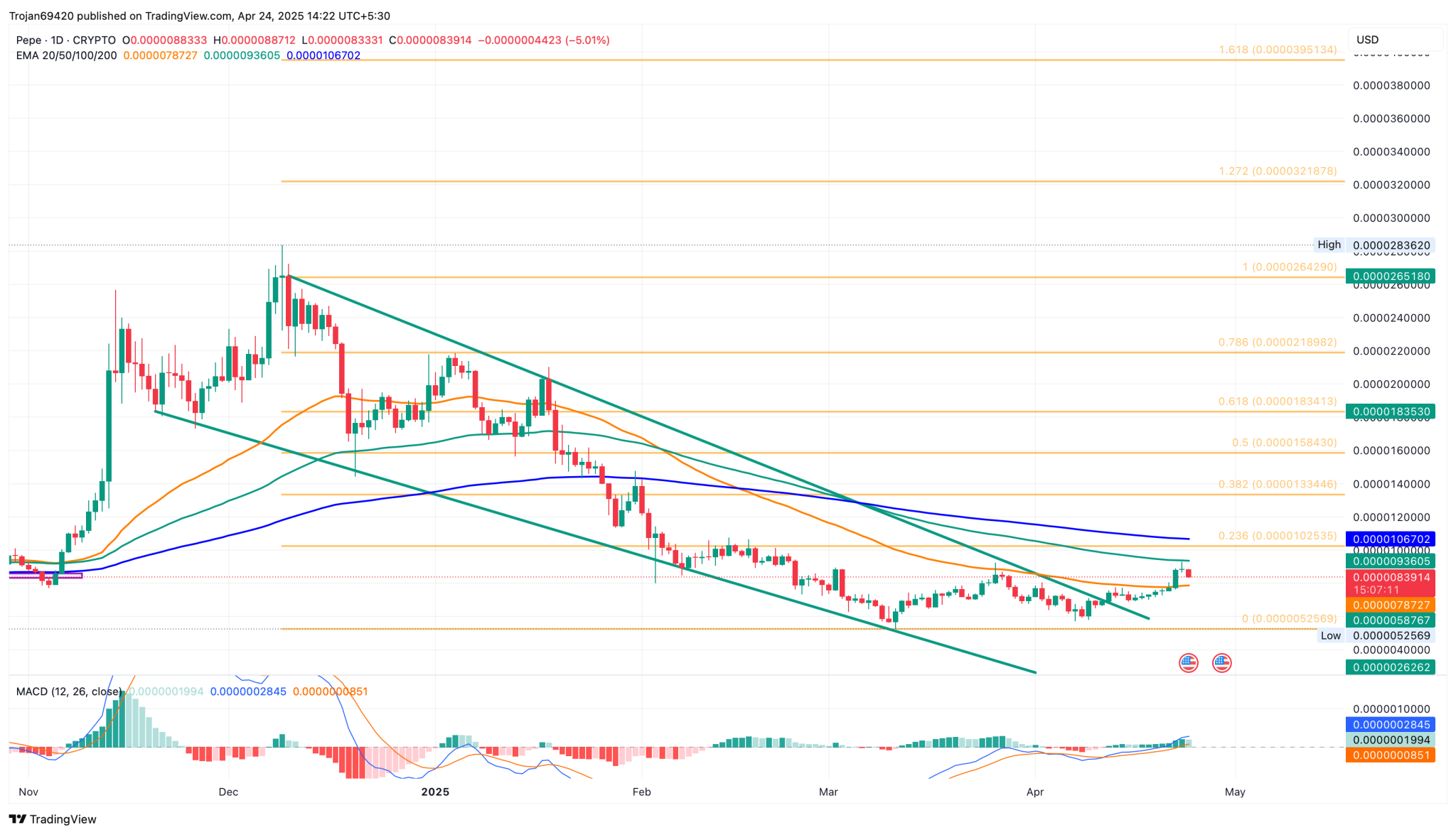
PEPE pulls back 5% after hitting resistance near $0.00000936. Whale accumulation hints at a potential recovery toward $0.00001025 and possibly $0.00001584.

As the crypto market experiences an intraday pullback, the meme coin segment is flashing red. The total market cap of the meme coin sector has dropped by 3.47% to $52.05 billion.

Among the top meme coins, Dogecoin, Shiba Inu, and PEPE have seen pullbacks ranging from 6% to 9%. Currently, PEPE is trading at $0.000008366 while still holding onto a 7-day gain of nearly 14%.

Will this short-term dip trigger a deeper correction, or is the meme coin gearing up to break past the $0.000010 barrier?

Pepe Price Analysis

Pepe’s price action in the daily chart showcases a bullish breakout of a falling wedge pattern. This has led to a significant rise in market prices. 

Pepe Price Chart
Pepe Price Chart

With a post-retest turnaround, Pepe’s recovery run surpassed the 50-day EMA line at $0.000007872. On April 22, PEPE posted a nearly 14% surge, forming a bullish engulfing candle.

However, the uptrend failed to surpass the 100-day EMA line at $0.000009360. Taking a bearish turnaround from the dynamic resistance, Pepe witnessed a minor intraday pullback. 

Currently, it is trading at $0.0000083 with a pullback of nearly 5%. This creates an evening star pattern from the dynamic resistance, teasing a sharper correction move. 

Additionally, this bearish reversal reflects a failed attempt to maintain a position above the $0.000008832 resistance level, considered the neckline of a double bottom pattern.

If PEPE fails to sustain above this neckline, the bullish pattern may be invalidated. However, the MACD and Signal lines still show a positive trend, supporting the potential for continued upward momentum.

The appearance of bullish histogram bars further supports the likelihood of an extended rally.

Whale Adds More PEPE Amid Bullish Momentum

Amid the recent price surge, a wallet possibly belonging to Bitpanda has started a new buying spree over the past 48 hours. Recently, the wallet accumulated 208 billion PEPE tokens worth $1.64 million, bringing its total holdings to 553 billion PEPE, valued at nearly $5 million.

Pepe Price Targets

According to Fibonacci retracement levels, a successful breakout above the double bottom neckline could lead PEPE to test the 23.60% Fibonacci level at $0.00001025. If momentum continues, the next key target would be the 50% Fibonacci level at $0.00001584.

On the downside, key support remains at the 50-day EMA around $0.000007873, followed by horizontal support at $0.0000052.

Industry Pundit Advocates Early Bitcoin Investment Over Traditional Jobs

0

Davinci Jeremie, an expert crypto pundit, has reiterated his encouragement for young adults to consider investing in Bitcoin during their 20s and 30s rather than dedicating those years solely to traditional employment.

His message, shared on social media X, advocates for early savings in Bitcoin, suggesting that the crypto could offer long-term financial benefits. 

This endorsement comes at a time when Bitcoin price has experienced notable price movements, surging from around $84,000 on April 20 to a peak of $94,000 by April 23. As of today, the price sits at $92,096.52, reflecting an 8.86% increase over the past week, despite a slight 2.31% decline in the last 24 hours.

The Power of Time and Bitcoin Investments

Jeremie’s latest messages emphasize the importance of time in achieving financial freedom, not just the accumulation of wealth. 

Jeremie’s advice is not just a recent trend; he has been an advocate for Bitcoin for years. As an early Bitcoin adopter, Jeremie made headlines as far back as 2013, when he famously urged people to just buy $1 worth of Bitcoin for around $140 per coin in a YouTube video. If individuals had followed his advice back then, they would now be sitting on substantial gains.

Recall, in a separate post on Wednesday, he urged young individuals to “stack as much Bitcoin” early to build both assets and the financial freedom to enjoy them later in life. The idea is to avoid reaching financial independence too late, which could limit the ability to enjoy life. 

Path to Financial Freedom

Jeremie’s emphasis on financial freedom through Bitcoin ties into the broader Bitcoin community’s belief in the cryptocurrency’s long-term potential. Industry leaders like Michael Saylor, the CEO of Strategy, have forecasted Bitcoin to reach monumental price levels.

Saylor, in particular, predicted that Bitcoin could surpass $500 trillion market cap, translating to over $23 million per coin, considering its total supply. If such predictions come to fruition, those who invest now could see substantial returns, hence gaining financial freedom.

For instance, a $10,000 investment in Bitcoin today would procure just 0.1081 BTC today. If Bitcoin ever claimed the $23 million mark as predicted by Saylor, this 0.1081 BTC would be worth $2.48 million, presenting massive returns.

Bitcoin as a Financial Strategy

Additionally, on April 22, Jeremie reinforced his point, recommending that young people focus on personal financial strategy, with a specific emphasis on saving Bitcoin. His guidance also called attention to the importance of working with partners who align with one’s financial goals. 

Jeremie also advised that investors avoid relationships where personal financial strategies clash, particularly those that prioritize independence over shared goals.

Bitcoin’s Integrity and Resistance to Inflation

Still, on Wednesday, Jeremie described Bitcoin as “fair and honest money,” attributing this quality to its mathematical foundation and the fact that it cannot be manipulated.

Unlike traditional fiat currencies, which are subject to inflationary pressures and interventions like bailouts, Bitcoin operates through decentralized mechanisms. Jeremie pointed out that Bitcoin must be earned, mined, or held with foresight, ensuring that it is not created or favored unfairly.

Cardano Holds Above $0.67 Support: Is $0.76 Breakout Next?

Cardano pulls back to $0.67 after a breakout, but a long-dominated derivatives market hints at a potential move toward $0.76.

With a short-term pullback in the crypto market after an intense bull run, altcoins are slowing down. Cardano, one of the top-performing altcoins in the recent market rally, records an intraday pullback of more than 2%. 

However, ADA’s price analysis hints at a potential post-retest bounce-back from the $0.67 mark. Will this propel Cardano to the $1 mark? 

Cardano Price Analysis 

In the recent market turnaround, Cardano surged from $0.62 to $0.69 in three days. This accounts for a price rally of 13.5%. With this massive surge, Cardano marks a bullish breakout of an Adam and Eve pattern in the 4-hour price chart. 

Cardano Price Chart
Cardano Price Chart

According to Fibonacci retracement levels on the 4-hour chart, the pattern’s neckline aligned with the 61.80% retracement level near $0.67.

The breakout rally faced resistance near the 78.60% Fibonacci level at $0.7156, leading to an intraday pullback to retest the 61.80% level.

However, the recent surge in bullish sentiments has led to a positive crossover in the 50 and 100 EMA lines. 

Meanwhile, the MACD and signal lines warn of a negative crossover due to a sudden pause in bullish momentum. 

If a post-retest recovery occurs, the price will likely target the $0.76 resistance, followed by the 1.27 Fibonacci extension level at $0.83. On the downside, key support lies at the 200 EMA line at $0.65, followed by the $0.61 support zone.

Derivatives Market Signals Strong Upside for ADA

Despite this short-term pullback, Cardano’s broader market anticipation remains highly bullish. In the derivatives market, the long positions account for nearly 84.42% over the past four hours. 

This records an impressive long-to-short ratio of 5.41, signaling strong bullish sentiments for Cardano.

Cardano Long/Short Ratio Chart

Furthermore, Cardano’s open interest has surged by nearly 4%, along with the increased long positions, reaching $774 million. 

Moreover, the funding rate remains highly positive at 0.01404%. Overall, the derivatives data highlights crypto traders’ strong bullish outlook for Cardano. 

Liquidation Map
Liquidation Map

Amid growing optimism, Binance’s ADA-USDT liquidation map shows the potential for significant short liquidations if the uptrend continues. According to the data, a price rise to $0.721 could trigger $7.77 million in short liquidations, including 50x leveraged positions worth $812,800.

Ethereum Targets $2,000 as Breakout Above $1,800 Could Trigger $317M in Short Liquidations

Ethereum breaks key levels but struggles at $1,800. Could growing network activity and increasing long positions spark a move toward $2,000?

As the crypto market recovery pauses, Bitcoin drops below $93,000, while Ethereum continues to struggle below the $1,800 level. Currently, Ethereum is trading at $1,769, showing an intraday pullback of nearly 1.5%.

While Ethereum continues to face resistance, optimistic traders anticipate a post-retest bounce. Could this recovery push the price past the $2,000 mark? Let’s find out.

Ethereum Price Analysis 

On the 4-hour price chart, Ethereum’s trend showcases a bullish breakout from a long-standing supply zone, surpassing the 38.20% Fibonacci level near $1,675.

Ethereum price chart

Following this breakout, Ethereum rallied past the 50% Fibonacci level and the 200 EMA line near $1,755. However, the uptrend failed to maintain momentum above the $1,834 mark, resulting in short-term consolidation and a minor pullback.

This current pullback may be a potential retest of the 200 EMA line and the 50% Fibonacci level. Notably, the recovery has positively influenced the 50 and 100 EMA lines, hinting at a possible bullish crossover.

Furthermore, the bullish recovery has extended the uptrend in the MACD and Signal lines, signaling strong bullish momentum. As a result, technical indicators support the likelihood of a post-retest reversal in Ethereum’s price.

Based on the Fibonacci levels, a successful post-retest reversal that breaks above the 61.80% Fibonacci retracement ($1,834) could open the door for Ethereum to reach $2,000. Such upward momentum would also increase the chances of a golden crossover between the 50 and 200 EMA lines—a strong bullish signal.

Conversely, if Ethereum fails to hold above the 50% Fibonacci level, the price could retrace further to test the $1,675 support-turned-resistance zone.

Analyst Signals Major Ecosystem Boost Incoming for Ethereum

Amid Ethereum’s recent bullish recovery, a new analysis by Carmelo Alemán, an analyst at CryptoQuant, highlights a major boost in network activity. He notes a sharp increase in active Ethereum addresses from 306,211 to 336,336 in just 48 hours.

This represents a nearly 10% surge between April 20 and April 22. The analyst also notes overall growth in Ethereum active addresses alongside the broader market recovery.

Carmelo projects a potential expansion in the broader Ethereum ecosystem, which could serve as a launchpad for multiple projects built on Ethereum. As the ecosystem grows, demand for ETH is expected to rise, potentially driving prices higher.

Ethereum: Active Addresses

Bullish Traders Bet Big on Ethereum Breakout Rally

As price action analysis suggests a potential rebound, bullish sentiment in Ethereum’s derivatives market continues to grow. According to Coinglass data, long positions in the derivatives market are nearing 55%.

Based on Coinglass’s Long-to-Short Ratio chart, long positions now account for 54.98%, driving the ratio to 1.02. This marks a notable increase over the past three hours, up from 46.3%.

Long/Short Ratio Chart

With renewed optimism for a breakout rally, derivatives traders are betting big on Ethereum. According to the Ethereum exchange liquidation map, a breakout above $1,800 could lead to significant short liquidations.

The data indicates a cumulative short-liquidation potential of $317.36 million near the $1,809.60 level.

Liquidation Map
Liquidation Map

Spanish University Launches World’s First Master’s Degree in Bitcoin

0

The University of the Hespérides has announced the launch of the first-ever Spanish-language Master’s program dedicated exclusively to Bitcoin.

Starting on April 28, the fully online program will provide students with technical, economic, legal, and philosophical expertise to navigate the emerging Bitcoin landscape. This initiative responds to the growing need for informed professionals capable of understanding Bitcoin beyond its role as a digital asset.

An Interdisciplinary Curriculum

The master’s degree in Bitcoin is designed as a comprehensive and interdisciplinary curriculum that will cover multiple aspects of cryptocurrency. The program will address Bitcoin’s philosophy, history, economic implications, technological foundations, regulatory challenges, and business development strategies.

Students will engage with Bitcoin not only as an investment tool but as a revolutionary monetary system with the potential to reshape global finance.

Experts such as Álvaro D. María, the program director, emphasize the importance of education to address common misunderstandings surrounding Bitcoin.

According to María, the program aims to bridge the knowledge gap and equip students with the expertise required to interact with Bitcoin responsibly and effectively. Maria said:

“This program is intended to close that gap and train professionals who will engage with Bitcoin knowledgeably and responsibly.”

Additionally, the program will delve into practical questions such as Bitcoin’s unique characteristics, the principles behind its protocol, and how regulatory environments influence its adoption.

Global Push for Bitcoin Education

The University of the Hespérides initiative is part of a larger global movement to incorporate Bitcoin into academic curricula. Other institutions have also begun integrating Bitcoin and blockchain education into their programs. 

For example, the University of Cincinnati introduced Bitcoin and Web3 technology into its classrooms in 2022. Similarly, Salvadorian Non-profit Mi Primer Bitcoin, in partnership with El Salvador’s Ministry of Education, began offering Bitcoin-focused courses in 2023.

In the United Kingdom, Lomond School made headlines by becoming the first institution to accept Bitcoin as a payment option for tuition fees.

Starting in the autumn of 2025, the school will also introduce lessons on Bitcoin and blockchain technology, helping students understand the potential of decentralized systems and the role of Austrian economic theory in modern finance.

How Long Until XRP Gets Its Own Strategy? Expert Reacts as Solana Receives $500M Investment

The XRP community is pondering the arrival of a strategy that invests in XRP, similar to what is available with other prominent crypto assets like Bitcoin and Solana.

Dom Kwok, Co-founder of EasyA Labs, expressed this perspective in a tweet. Specifically, he asked how long it will take until the crypto community sees an XRP strategy that commits to investing in the asset.

Kwok’s tweet came in response to an announcement by SOL Strategies, a Canadian investment company, about securing a $500 million convertible note facility to fund the purchase and staking of SOL tokens. The move marks the largest staking-yield-tied financing deal in the Solana ecosystem.

As part of the deal, SOL Strategies will initially draw $20 million by May 1, 2025. It has the option to access up to $480 million more over time. Interest on the notes will be paid in SOL, tied directly to staking returns, up to 85% of the generated yield. 

Beyond SOL Strategies, DeFi Dev Corp (Janover) recently announced the acquisition of 88,164 SOL tokens worth $11.5 million for its crypto treasury strategy. This development came a few weeks after the firm made an earlier $4.6 million Solana investment.

Given this massive investment entering the Solana ecosystem, XRP community members wonder when a similar initiative might emerge for XRP.

Already, many companies have adopted a Bitcoin strategy, following in the footsteps of Bitcoin firm Strategy (formerly MicroStrategy). These firms add BTC tokens as part of their financial investments through continuous acquisitions. 

A specific example includes Metaplanet Inc., which just bought over $13 million worth of Bitcoin today, bringing its holdings to 5,000 BTC. Other Bitcoin-buying firms include GameStop and Rumble.

But Wen an XRP Strategy?

XRP enthusiasts eagerly look forward to a similar large-scale initiative, and one of their biggest hopes includes exchange-traded funds (ETFs). Several firms have already sought the SEC’s permission to list ETFs that would directly invest in XRP.

Recent reports suggest that such funds could take until the end of this year to go live, as the applications remain under review.

Notably, an XRP ETF recently launched in the U.S., but this fund, which is a leveraged product, does not directly invest in XRP. Instead, it capitalizes on XRP’s daily performance.

Meanwhile, outside of the U.S. market, funds investing in XRP exist, and these funds are attracting investments weekly. However, these investments are not as robust as what the U.S. market would witness.

Notably, the most recent investment report by CoinShares shows that XRP investments attracted $37.7 million last week. Interestingly, during the same period, Bitcoin investments reported a drain of $6 million. Ethereum investments posted more significant outflows of $26 million.

CoinShares chart showing XRP investments inflow
CoinShares chart showing XRP investment inflow

Proposal for XRP Strategy in Japan

Beyond ETFs, other significant financial institutions are receiving requests to adopt MicroStrategy’s Bitcoin investment style.

Recently, shareholder GAM Investments urged Japanese financial giant SBI Holdings to adopt an ambitious XRP-focused strategy. GAM proposed that SBI implement an XRP buyback program, similar to MicroStrategy’s Bitcoin accumulation approach.

GAM pointed out SBI’s market undervaluation, highlighting the hidden value of its crypto assets, particularly its substantial stake in Ripple and XRP holdings.

They also suggested that SBI’s underperformance is partly due to the lack of a clear strategy regarding its investments in Ripple and XRP. To address this, GAM recommended increased transparency, including daily valuations of its XRP holdings and regular updates on its net asset value (NAV).

Here’s the Only Way Shiba Inu (SHIB) Could Reach $1

0

Shiba Inu could reach the audacious $1 target without expanding its market cap if the initiative detailed in this article comes to fruition. 

Shiba Inu’s community and team members have remained optimistic about SHIB’s prospects. This optimism has sparked some audacious predictions, with a handful of the community projecting that SHIB could hit a target of $1 someday. 

Shiba Inu to $1 Forecasts 

While several crypto investors believe Shiba Inu would never reach the $1 target, others, particularly most SHIB enthusiasts, think it is possible. 

In a recent analysis, popular Bitcoin bull Davinci Jeremie asserts that Shiba Inu would need a market cap of around $600 trillion for its price to rise to $1. 

This $600 trillion valuation surpasses the current market cap of top financial instruments like gold by a considerable margin. At press time, gold has an estimated market cap of $22.41 trillion. The projected $600 trillion market cap is roughly 2,577% higher than gold’s market cap of $22.41 trillion.

Despite the pessimism surrounding SHIB’s potential surge to the $1 target, Lucie, the marketing lead of the Shiba Inu ecosystem, recently shared ChatGPT’s opinion on the debate. The AI service stressed that reaching the $1 target is not impossible for SHIB. 

However, it notes that achieving the milestone requires a perfect storm, driven by a major bull run, massive adoption, and consistent burns. 

For context, SHIB is currently trading at $0.00001319 per token, with its market cap standing at $7.77 billion. This implies that SHIB must rise by 7,581,401% to clinch the highly ambitious $1 target. 

One Way for SHIB’s Surge to $1 without $600T Cap

Meanwhile, proponents believe SHIB reaching the $1 target without its market cap growing exponentially is only possible if almost all of its supply is burned. Shiba Inu currently has a total supply of 589.5 trillion tokens. 

For Shiba Inu to clinch the $1 target without a heavy valuation, about 99.9987% of its supply must be burned. If this happens, Shiba Inu would be left with a supply of 7.77 billion tokens. 

At a target price of $1 per token, SHIB would maintain its current market cap of $7.77 billion, assuming 99.9987% of its supply is burned. 

Timeline for Burning 99.9987% of Shiba Inu Supply 

While it is technically possible for SHIB to reach the $1 target with such a hefty supply reduction, given the asset’s monthly burn rate, it could take thousands of years for Shiba Inu to have its supply reduced by 99.9987% to 7.77 billion. 

Data from Shibburn indicates that the broader Shiba Inu community burned 15.64 billion SHIB last month. If the asset continues to record a monthly burn of 15.64 billion, it would translate to an annualized figure of 187.68 billion. 

Therefore, Shiba Inu would take approximately 3,141 years to burn 99.9987% of its total supply, potentially leaving 7.77 billion tokens in circulation. 

The whole essence of burning 99.9987% of SHIB is to artificially inflate the perceived value of the remaining tokens to a target of $1 without expanding the asset’s market cap. While it is technically possible for SHIB to reach the $1 target through burns, Shiba Inu’s current burn rate makes it highly unlikely for the asset to achieve this feat.