Home Blog Page 793

Ripple to Launch Asia’s First XRP Investment Product: Details

0

San Francisco-based payments company Ripple has inked a partnership with HashKey Capital to introduce the first-ever XRP tracker fund in Asia.  

Popular XRP community figure Crypto Eri called the public’s attention to the development today. According to Eri, Ripple will be investing in HashKey Capital’s new HashKey XRP Tracker Fund–the first Asia-based fund designed to mirror the price of XRP. 

HashKey Launches Asia’s First XRP Tracker Fund  

Hashkey also confirmed the development in a statement issued on X today, emphasizing that the fund aims to expand institutional access to XRP. According to HashKey, the fund was created in partnership with Ripple. 

Ripple’s decision to partner with HashKey and become an anchor investor of the fund could enhance the product’s credibility. 

HashKey referred to the fund as the first in Asia, adding that it will not be the last. This indicates that several crypto management firms in the region could plan to roll out investment products tracking the price of XRP. 

Investors seeking to invest in the fund can do so through fiat currencies or in-kind contributions. They can also subscribe to or redeem shares of the HashKey XRP fund monthly. 

Ripple and HashKey Execs React 

Commenting on the development, Vivien Wong, HashKey’s Liquid Fund partner, highlighted XRP’s significance in the crypto market. According to her, XRP has successfully captured the attention of global enterprises, which leverage it for multiple purposes, ranging from asset tokenization to store of value. 

Fiona Murray, the Managing Director of APAC at Ripple, emphasized the growing demand for regulated digital asset products among professional investors in the Asia-Pacific region. She suggested that the HashKey XRP Tracker Fund product was developed to cater to these needs, adding: 

“HashKey Capital’s popularity and strong crypto traction in the APAC region will be essential in strengthening Ripple’s leadership role in crypto and blockchain technology across Asia.” 

Meanwhile, Ripple and HashKey plan to explore other opportunities, including launching a money market fund on the XRP Ledger (XRPL). 

For context, HashKey Capital is an established player in the crypto sector with a strong pedigree in offering investment products tied to cryptocurrencies, such as Bitcoin and Ethereum. 

Two of its crypto products–the Bosera HashKey Bitcoin Spot ETF and the Bosera HashKey Ether Spot ETF–are currently trading on the Hong Kong Stock Exchange. The newly launched XRP fund represents HashKey Capital’s third investment product, which tracks the performance of crypto. 

HashKey expects the XRP product to evolve into an exchange-traded fund within the next two years. For this conversion to occur, the company must obtain regulatory approval from the necessary regulators.   

Growing Institutional Interest in XRP

In the meantime, institutional interest in XRP has continued to gain momentum. As a result, top asset managers are seeking to roll out investment products tied to the fourth-biggest cryptocurrency. 

In the United States, over 11 financial institutions, including Bitwise and Canary, have filed with the U.S. SEC to launch spot-based XRP ETFs. Many expect the securities regulator to approve at least one of these filings before the end of this year. 

Shiba Inu Needs to Reach $0.0003258 to Match Ethereum’s Market Cap: Here’s the Timeline

Shiba Inu would need to increase 27-fold to match the current valuation of Ethereum, potentially taking until the next decade to achieve this.

Since last year, Shiba Inu’s market cap has consistently declined. In March 2024, it held a top-ten position with a $20 billion market cap. Today, it has dropped to $7 billion, ranking 16th in the market. This represents a loss of over 65% in one year.

However, community analysts and industry experts have forecasted a significant rebound for Shiba Inu this year. In light of growing optimism around the asset’s potential performance, The Crypto Basic examines a hypothetical scenario where SHIB rises to match Ethereum’s current market cap.

Shiba Inu at Ethereum’s Market Cap

As of today, Ethereum has a market cap of $192 billion. Although still substantial, this figure marks a dramatic drop of over 60% from its near half-trillion-dollar level a year ago.

For Shiba Inu to reach Ethereum’s current valuation, it would require another historic price rally — one that could greatly reward current holders. Given Shiba Inu’s circulating supply of 589.25 trillion tokens, the $192 billion market cap would mean to a price of $0.0003258 per token.

Currently, Shiba Inu is trading at just $0.0000120. Achieving Ethereum’s market cap would require SHIB to break several milestones: eliminating another zero, surpassing the $100 billion threshold, and setting a new all-time high.

To reach this ambitious target, the second-largest meme coin would need to grow by 2,615%. For perspective, if this growth occurs, a wallet holding 1 billion SHIB tokens worth $12,000 today would see its value rise to $325,800.

Timeline for Shiba Inu to Rally 2,615% to $0.0003258

While the prospect is tantalizing, the real question is whether Shiba Inu can reach $0.0003258 — and how long it might take.

In an interview with Forbes, Himanshu Maradiya, Chairman of the CIFDAQ Blockchain Ecosystem, stated that Shiba Inu could reach the $0.0003 level this year. However, Maradiya noted it could happen only under favorable market conditions.

Indeed, since that 2024 interview, Shiba Inu has struggled amid unfavorable market conditions. More recently, experts interviewed by Finder suggested SHIB could enter the $0.0003 range between 2030 and 2035.

Analysts at Telegaon offered a more optimistic timeline, predicting Shiba Inu could reach a maximum price of $0.000312 within four years. By 2029, they expect the $0.00032 level to be a minimum threshold for SHIB.

Meanwhile, some in the crypto community had previously hoped Shiba Inu could hit $0.0001 this year. But with the current underperformance, many are now more focused on whether SHIB can even reclaim its previous peak of $0.00008845 this cycle.

US Set to Auction Record $31T in Treasury Debt in 2025: Here’s How Bitcoin Could React

Bitcoin might find itself battling macroeconomic headwinds for a longer time, as the U.S. looks set to auction a record amount in Treasury debt this year.

Currently battling the bears around the $80,000 territory, Bitcoin (BTC) has been a victim of macroeconomic uncertainties for most of this year. Due to these headwinds, the crypto firstborn has collapsed 9.41% year-to-date, losing over $170 billion in valuation.

US Treasury Set to Auction Record Debt Figure in 2025

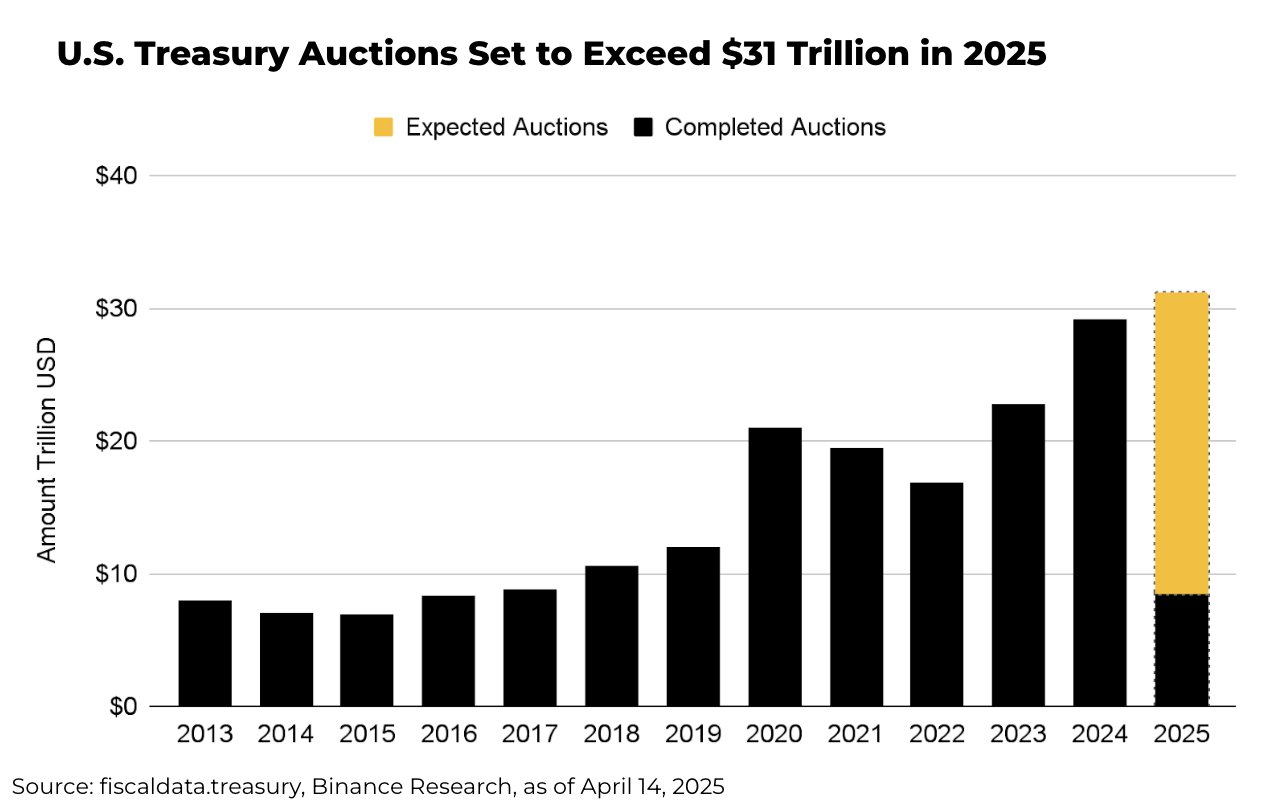
However, recent reports suggest these bearish macro factors are not cooling off soon. Specifically, the United States Treasury Department is preparing to auction over $31 trillion in debt. This is according to Binance Research, the research arm of the world’s largest crypto exchange.

US Treasury Auctions Binance Research
US Treasury Auctions | Binance Research

Data confirms that this would mark an unprecedented annual figure. For context, in 2024, Treasury debt auctions were worth a little under $30 trillion, and in 2023, the figure was slightly above $20 trillion.

Binance confirmed that the figure represents 109% of the projected U.S. GDP and 144% of M2 money supply, near-record ratios that signal intense pressure on financial markets. This reality might have implications for investors eyeing Bitcoin as a hedge or risk asset.

US Debt Issuance Ratios Binance Research
US Debt Issuance Ratios | Binance Research

According to Binance Research, the $31 trillion Treasury supply could massively influence markets. The sheer scale of issuance, even with stable demand, could be challenging. 

Foreign investors, who hold roughly one-third of U.S. debt, are particularly important. Interestingly, a recent Reuters report confirmed that Treasury holdings of foreign entities spiked 3.4% in February to $8.817 trillion.

Major holders include Japan ($1.1 trillion), China ($784 billion), and the UK ($700 billion), based on recent Treasury data. Any reduction in their appetite, possibly due to geopolitical tensions or portfolio decisions, could increase financing costs and push bond yields higher, potentially squeezing risk assets like Bitcoin.

Two Possible Scenarios for Bitcoin

In its report, Binance Research mentioned two possible scenarios for Bitcoin. For the first, they confirmed that persistent upward pressure on interest rates from the massive Treasury supply could dampen demand for cryptocurrencies, as higher yields make bonds more attractive. 

However, if the government resorts to debt monetization by printing money to fund deficits, Bitcoin’s appeal as a hedge against currency debasement could strengthen. Notably, this is likely to trigger renewed interest among market participants.

Other Macro Factors Impacting Bitcoin Price

Meanwhile, besides these, other macroeconomic factors will also determine Bitcoin’s trajectory. Global tariff tensions continue to create uncertainties. Further, Inflation, currently at 2.5% annually per the latest CPI, remains above the Federal Reserve’s 2% target.

Federal Reserve Chair Jerome Powell recently warned that these tariffs could sustain higher inflation and slow growth, complicating the Fed’s dual mandate of price stability and full employment. 

Yesterday, April 17, Trump publicly urged Powell to cut interest rates, citing the European Central Bank’s recent reduction from 2.5% to 2.25%. Trump argued that lower rates, like those in Europe, would boost U.S. competitiveness, but Powell emphasized a cautious approach.

The Fed’s benchmark rate, currently at 4.25%–4.5%, remains at this mark due to a pause after three cuts in 2024. Markets anticipate potential cuts starting in June 2025, with a possible 1% reduction by year-end, according to CME Group data. 

Lower rates typically favor risk assets like Bitcoin by reducing the appeal of fixed-income securities. However, Powell’s hawkish stance, warning of persistent inflation, has tempered expectations for immediate cuts, contributing to Bitcoin’s recent price stagnation.

Meanwhile, Bitcoin’s price has shown resilience but lacks clear direction since April 12, trading between $86,400 and $82,700. BTC is currently seeing a 2% gain in April, rebounding from a 2.11% drop in March and a sharp 17.66% decline in February. 

Technical Pattern Suggests XRP Could Dip to $1.60—Here’s Why

0

XRP prospects of continuing its recovery from the April 7 low fade following the appearance of a bearish signal on its price chart. 

The fourth biggest cryptocurrency has made a remarkable effort over the past week to recover from the April 7 broader market downturn. Recall that the price of XRP plummeted to a low of $1.6401 on that day, closing below the $2 mark for the first time since December. Notably, XRP has recovered from this low, trading above the $2 mark.

XRP Recovery Fizzling Out 

However, XRP’s recovery may be fizzling out due to its price chart flashing a rising wedge breakdown. For context, a rising wedge is a bearish pattern that helps to identify potential trend reversal, particularly during an uptrend. 

This bearish pattern forms through the convergence of two upward-sloping lines, ensuring that the higher lows connect with the higher highs. Amid this convergence, should the price drop below the lower trendline, it would mark a shift from bullish to bearish momentum. 

Specifically, XRP’s chart displayed the rising wedge breakdown on Wednesday. This bearish momentum indicates that buyers might be losing conviction in the asset, giving sellers control over XRP. 

Potential Crash to $1.6? 

Veteran investor Thomas Bulkowski, in his technical analysis theory, marked the starting point of the wedge as the initial support level following a breakdown. Based on this, XRP’s support level stands at $1.60, meaning its price could retest this level in another market downturn. 

Another factor reinforcing XRP’s bearish sentiment is that the coin has slipped below the Ichimoku cloud. This is a technical indicator that offers insights into an asset’s trend direction.  

Notably, when the price of an asset sits above the cloud, it indicates a bullish momentum.  However, if it drops below the cloud, as observed in the XRP’s hourly chart, it signifies a bearish trend. 

XRP's hourly chart. (TradingView/CoinDesk)
XRP one-hour chart | TradingView

At the moment, XRP is trading at $2.07 after experiencing a slight dip of 0.60% over the past 24 hours. In contrast, the coin is up 3.81% over the past seven days. 

Expert Predicts XRP to Hit $24 

Despite the bearish signal on XRP’s chart, popular crypto educator Davinci Jeremie suggested that the coin will likely reach a target price of $24 this year. 

The expert believes several U.S. officials are endorsing XRP, which could trigger a major rally toward the $24 target. Achieving this target demands a surge of 1,059% from the current price. 

However, he encouraged investors to resist buying XRP, characterizing it as a ‘banker’s coin.’ Therefore, Jeremie urged that market participants sell their XRP for Bitcoin. 

This Is the Dogecoin Price Level One Analyst Says Could Trigger a 400% Surge

0

A market watcher has argued that Dogecoin may drop 40% to form strong support before a potential 400% surge.

Dogecoin has been experiencing a challenging week, with the price struggling beneath key resistance levels. Currently, Dogecoin is trading at $0.1552, reflecting a 0.37% decline in the last 24 hours and a 2.06% drop over the past seven days. 

The meme coin attempted to break through the $0.16 resistance multiple times but failed, dipping as low as $0.151 before recovering slightly. Despite these fluctuations, some analysts believe the coin may soon see a significant upward movement after a potential short-term decline.

Dogecoin Likely to Pump 400% after a Dip Under $0.1 

One notable analysis from TradingView, shared by SwallowAcademy, suggests that Dogecoin could face a further decline before experiencing a major surge. The chart highlights DOGE’s price action against Tether (USDT) on a daily timeframe. 

It shows the volatility Dogecoin has experienced, notably a sharp upward movement in early 2024, followed by a significant decline after reaching a peak near $0.23. In the latter part of 2024, the price dropped again to around $0.09, where it found support before rebounding to over $0.45. 

Now, SwallowAcademy predicts a similar pattern may unfold in 2025. The analyst believes Dogecoin could drop an additional 40% to the awaited entry, forming the solid support zone again, before rebounding by fourfold. Specifically, the analyst suggests that after a 400% surge from the support level of $0.09, Dogecoin would rise to $0.45.

For now, Dogecoin is trading above $0.15, and the analyst is awaiting a dip to $0.09.

Dogecoin Price Prediction

DOGE “False Break” Signals Possible Reversal

Meanwhile, a different pattern has caught the attention of market watchers. Trader Tardigrade has pointed out Dogecoin’s first false break since December 2024. The coin has generally been following a downtrend, marked by lower highs and lower lows, a sign of a bearish market. 

However, after dropping to $0.13 on April 7, the price rebounded but failed to maintain the momentum and quickly dipped again. The analyst interprets it as a “false breakdown” — a sign that the downward trend may not last. 

According to the chart, this could be an early indicator of a bullish reversal. With the price remaining above the support line for several days, the false break suggests that Dogecoin may be gearing up for an upward move. Per Trader Tardigrade, the next potential target could be $0.42.

Mixed Short- and Long-Term User Activity

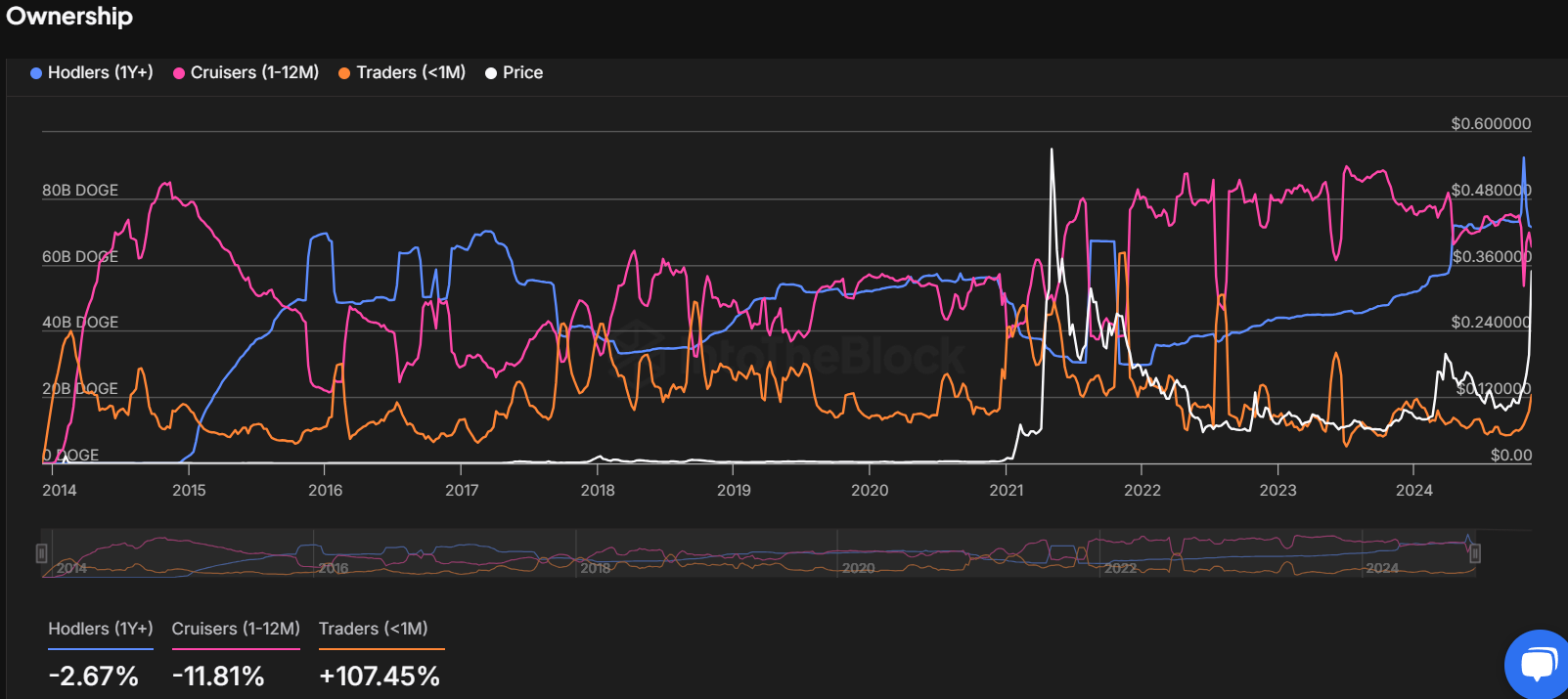
In addition to the technical chart patterns, data from IntoTheBlock reveals fascinating insights into Dogecoin’s user activity. The data reiterate that Dogecoin may face short-term pressure due to shifting activity among different holder categories. 

Dogecoin Holders Balance by Time Held

Over the past month, the number of long-term holders (those holding for one year or more) decreased by 2.67%. Cruisers—those holding between one and twelve months—declined by 11.81%.

In contrast, short-term traders holding for less than a month increased by 107.45%. This trend suggests growing speculative interest, which may contribute to near-term volatility and price fluctuations.

However, the long-term outlook appears more favorable based on the behavior of large holders. Further data highlights a consistent and steep rise in large holder inflows.

Over the past seven days, inflows rose by 5.33%, followed by a sharp 323.86% increase in the last 30 days. Most notably, a significant 3,722% increase occurred over the last 90 days.

Expert Says Let Numbers Speak as Bitcoin Outperforms Gold 13,693% in a Decade

An expert analyst says let the numbers speak amid the massive Bitcoin growth against gold within the past decade.

The debate between Bitcoin and traditional assets like gold grows more intense every day. A recent comparison of Bitcoin’s performance against gold over the past decade highlights the dramatic growth of the crypto firstborn, illustrating how its value has soared compared to gold’s steadier rise. 

This discussion focuses on a chart shared by crypto Key Opinion Leader (KOL) and entrepreneur Ted, which tracks Bitcoin’s value against gold from April 2015 to April 2025. According to the chart, Bitcoin has experienced a staggering 13,693.69% increase in value during this period, showcasing its outperformance when compared to the more stable gold market.

Bitcoin’s Massive Rise

Per the analyst, in April 2015, Bitcoin and gold were roughly on par. At that time, Bitcoin’s value fluctuated between $200 and $250, while gold was priced at around $1,200 to $1,300 per ounce.

However, over the past decade, Bitcoin’s price surged far beyond the price of gold, with a massive increase in value. By April 2025, Bitcoin will have risen to an estimated value of $84,000 per coin, marking an explosive surge of around 33,500% within the past decade.

This incredible rise stands in sharp contrast to gold’s steadier price appreciation. Gold’s value has increased significantly over the decades, yet at a much slower rate compared to Bitcoin. Within the same period, gold has only risen by a meager 156%. Notably, the precious metal’s appeal lies more in its slow but steady growth and inflation-proof tendencies.

For instance, per another market watcher on X, in 1933, the price of one ounce of gold was $20.67. Fast forward to 2025, and its value is around $3,334 per ounce. While gold’s growth has been consistent, it has failed to replicate the rapid, exponential increases seen in Bitcoin’s value. For context, Bitcoin has shown remarkable growth from being worth $1 in 2011 to $84,000 in 2025 and even hitting an ATH near $109K.

The Market Dynamics: Gold vs. Bitcoin

The performance difference between Bitcoin and gold can also be attributed to their distinct market dynamics. According to market pundit Belle, Bitcoin’s smaller market capitalization compared to gold plays a crucial role in its price volatility. 

Gold’s market is massive, with a market capitalization of approximately $22.535 trillion. This size provides a level of stability that Bitcoin, with a market cap of around $1.667 trillion, lacks. Gold’s market, despite impressive daily fluctuations, remains more resilient due to its established position in the global economy.

Notably, gold recently saw a $1 trillion increase in its market capitalization within just one day, a scale far beyond Bitcoin’s capabilities.

In contrast, Bitcoin’s market cap is far more susceptible to smaller shifts, meaning even a relatively minor change can trigger significant price surges. If Bitcoin’s market cap were to increase by $1 trillion, its value could potentially rise from $84,000 to $135,000, far outpacing gold’s price increase with the same market growth.

Cardano Could Rally 3,144% to $20 If It Becomes Bitcoin DeFi Enabler: Analyst

0

A prominent Cardano ecosystem participant has elated the community with a prediction that ADA could reach $20 if a recent partnership runs its full course.

Altcoin Oracle, a delegated representative (DRep) in Cardano’s newly integrated decentralized governance system, recently shared a bold but bullish prediction. In an April 17 tweet, he suggested that Cardano could rally to $20 owing to a recent partnership between the Cardano and Bitcoin ecosystems.

Cardano to Become Bitcoin DeFi Catalyst

The DRep employed the AI bot ChatGPT to dissect Cardano’s price targets if the layer 1 network becomes a primary Bitcoin decentralized finance (DeFi) enabler. For the uninitiated, Cardano founder Charles Hoskinson has dwelled extensively on this project, which was born out of a collaboration with BitcoinOS, and its implications for the blockchain.

Last year, Cardano’s development arm, EMURGO, partnered with BitcoinOS to introduce DeFi features on the network that houses the pioneering blockchain network. The project, which Hoskinson has emphasized is the ecosystem’s main focus this year, will unlock smart contract properties for Bitcoin developers and leverage the network’s over $1.6 trillion liquidity for the Cardano ecosystem.

Meanwhile, Altcoin Oracle highlighted that the massive project would not only allow Bitcoin users to access features like lending, borrowing, and yield-bearing protocols but also significantly impact ADA’s price. He asked ChatGPT about the implications for Cardano by 2030 if the Cardano network becomes a primary Bitcoin DeFi enabler.

Analysis Highlights Implications for Cardano

ChatGPT predicted that Cardano’s market cap would skyrocket to between $500 million and $1 trillion, spurred by liquidity influx and institutional adoption of DeFi on the Cardano network. Recall that Hoskinson had earlier asserted that DeFi on Bitcoin would trounce that on the Ethereum and Solana blockchains.

Meanwhile, with a market cap and a hypothetical supply of 50 billion ADA, the AI bot predicted a surge to between $10 and $20, representing a staggering 1,522% and 3,144% increase from the current price. However, if Cardano maintains its current supply of 35.28 billion, the asset will rally to between $14 and $28 on the same valuation.

ChatGPT Cardano Predictions

Furthermore, the bot predicted that Cardano would rival Ethereum in total value locked (TVL) and decentralized applications. Recall that the meager developer traction to the Cardano ecosystem had been a significant concern, bringing about the “ghost chain” tag.

Additionally, Ethereum has a TVL in DeFi of $46.32 billion per DeFiLlama, controlling approximately 52% of all TVL across all crypto networks. Cardano, on the other hand, has just $288 million, with newer chains like Aptos ($973 million) and Sui Network ($1.2 billion) outperforming the blue-chip network by a significant margin.

As a result, the hypothetical widespread adoption that would stem from the collaboration would ensure Ethereum has a proper DeFi contender in Cardano.

Finance Exec Breaks Down How US Could Acquire $200B in Bitcoin and Save $354B at the Same Time

0

The U.S. could acquire $200 billion worth of Bitcoin and save an estimated $354 billion in the process, according to Andrew Hohns, CEO of Newmarket Capital.

During the Bitcoin For America event, Hohns presented a strategy that uses Bitcoin in bond issuance to cut government borrowing costs. The plan could also benefit from Bitcoin’s long-term growth.

A Groundbreaking Bond Structure

Hohns’ proposal involves issuing $2 trillion in bonds, where 10% of it, around $200 billion, would be invested directly into Bitcoin. The remaining 90 percent would be used for government operations.

Notably, the plan involves issuing the bonds at a 1% interest rate, significantly lower than the current U.S. 10-year Treasury rate of 4.5%. This would lead to annual savings of 3.5%, or $70 billion, on the $2 trillion total. Over 10 years, this amounts to $700 billion in savings.

After considering the $200 billion cost of acquiring Bitcoin, the net savings on interest would be approximately $554 billion in present value terms. Thus, the government could acquire $200 billion in Bitcoin and save $354 billion on interest payments. 

Bitcoin saving cost
Bitcoin saving costs for US

Bond investors would receive an annual return of 4.5%, while also benefiting from a share of any Bitcoin gains. Specifically, both the U.S. government and investors would split any appreciation in Bitcoin. Additionally, Hohns proposed that gains from the Bit Bonds be exempt from income and capital gains taxes, providing a potential tax advantage for American households.

Bitcoin’s Role in Reducing National Debt

The plan aims not only to reduce borrowing costs but also to leverage Bitcoin’s potential for substantial appreciation to help manage the U.S. national debt. If Bitcoin continues its historical growth rate of 37% annually, the government’s Bitcoin holdings could surpass $1.7 trillion by 2035 and potentially exceed $50 trillion by 2045. This could play a crucial role in reducing the national debt over time.

In addition, the strategy aligns with Treasury Secretary Bessent’s goal of diversifying debt maturities to reduce refinancing risks. Hohns emphasizes that this proposal offers a “win-win-win” scenario, benefiting taxpayers, investors, and policymakers alike.

Expert Support for Bitcoin-Based Debt Management

The concept of using Bitcoin to address national debt has gained traction from other financial experts, such as Matthew Sigel, Head of Digital Asset Research at VanEck.

Sigel has proposed a similar approach to help manage the U.S. government’s $14 trillion debt. His version involves using the bond proceeds to purchase Bitcoin, with investors receiving all Bitcoin gains up to a 4.5% annual return. Any additional gains would be split between investors and the government, creating a shared incentive.

This idea also resonates with Senator Cynthia Lummis, who has advocated for the U.S. government to acquire Bitcoin as a strategy to reduce national debt. Lummis proposed that the U.S. acquire 200k BTC tokens annually over five years to reach 1 million units. She believes this could cut the national debt by as much as 50% over the next two decades.

Pundit Explains Why Ripple Is Not Going to Integrate with SWIFT Even After Hidden Road Acquisition

Crypto analyst Arthur has triggered discussion with the claim that Ripple won’t integrate with SWIFT, even after acquiring prime brokerage firm Hidden Road.

Ripple’s recent $1.25 billion acquisition of the prime broker continues to garner commentaries from industry observers regarding its impact.

In his commentary, Arthur argued that Ripple’s original mission was to replace SWIFT, not partner with the payment processor. He noted that Ripple positioned itself from day one as a more efficient and transparent alternative to the SWIFT messaging system.

Essentially, he argues that the idea of collaboration naturally opposes Ripple’s original mission to render the legacy system obsolete. As a result, the acquisition of Hidden Road—while it further connects Ripple to traditional finance (TradFi)—may not facilitate integration with systems like SWIFT.

Hidden Road is Ripple’s Direct Line into TradFi

Arthur asserted that Ripple’s acquisition of Hidden Road is not a bridge to the old system but rather a shortcut around it. 

With Hidden Road, Ripple now taps directly into core financial services infrastructure, including clearing, custody, FX, and prime brokerage, allowing it to bypass SWIFT altogether. According to Arthur, this is a strategic signal: “We don’t need you anymore.”

Notably, members of the XRP community have long speculated about XRP “capturing a portion” of SWIFT’s daily transaction volume. They use this hypothetical scenario to justify ambitious price predictions, sometimes as high as $100 per XRP.

SWIFT as A Liability in a Changing World

In parallel, some continue to speculate about a Ripple-SWIFT collaboration, holding out hope that XRP could “capture” part of SWIFT’s multi-trillion-dollar daily turnover. However, Arthur has gone so far as to argue that SWIFT is actually a liability.

The pundit claimed that SWIFT has become a tool of sanctions and control. Arthur stressed that many are wary of centralized systems in the current geopolitical climate. As a result, SWIFT’s position could be a liability for emerging technologies like Ripple.

Emerging markets actively seek censorship-resistant, neutral alternatives and may find Ripple’s blockchain-native architecture more appealing, especially without ties to SWIFT.

TradFi Comes to Ripple, Not the Other Way Around

Furthermore, Arthur argued that Ripple’s strategy is to attract institutions to operate on its terms rather than integrating with legacy financial infrastructure.

Ripple’s offerings include liquidity services, custody solutions, and blockchain-based compliance tools. These enable institutions to access modern settlement rails without compromising security or oversight.

According to Arthur, the overarching narrative is that Ripple is not trying to coexist with SWIFT. Instead, it is accelerating beyond it. With Hidden Road in its arsenal, Ripple strengthens its position as a sovereign, institution-ready alternative to the traditional financial system. Nonetheless, these remain mere speculations, especially without a formal confirmation from Ripple.

Expert Shares “Big Bang” Entry for Shiba Inu as Double Bottom Formation Targets 1,346% Rally to $0.000173

0

A prominent market analyst has provided a strategic entry for Shiba Inu to capitalize on the token’s impending surge to unprecedented prices.

Specifically, pseudonymous analyst “illagodzilla” shared in a TradingView commentary that Shiba Inu is ready for a face-melting rally, which would have him and other enthusiasts emphasizing that they “knew it.” He based this bold prediction on a bullish double bottom formation on the meme coin’s higher timeframe.

Shiba Inu Ready to Explode?

An accompanying chart shows that Shiba Inu’s recent downside is part of a broader bullish picture. Notably, the second-largest meme coin has corrected for four consecutive months, resulting in a 43% year-to-date retracement.

Shiba Inu Double Bottom Structure

Meanwhile, SHIB is close to completing the formation of a double bottom on the monthly timeframe. For perspective, the first bottom kicked in in June 2023, with the rebound to the March 2024 high of $0.4567 forming the neckline.

With Shiba Inu’s 73% price correction from the neckline, the token is now approaching the base of the structure. Meanwhile, the analyst highlighted that upon completion, Shiba Inu would rebound to two targets, both of which would provide staggering portfolio upsides for buyers now.

For context, he predicted a 640% surge to $0.00008854, SHIB’s all-time high. Notably, the dog-themed token reached that price mark in October 2021, followed by a massive rejection and a sideways trend that led to its current price.

Furthermore, he predicted a 1,346% rally to $0.000173, a new all-time high for Shiba Inu. Interestingly, iIlagodzilla joins a long list of commentators predicting that SHIB would chalk off one more decimal.

To provide context, market watcher Oscar Ramos predicted a surge to $0.00017 this year, calling it a realistic target for Shiba Inu. Recently, the Shiba Inu team endorsed an analysis that suggests the prominent token would surge to $0.0001833.

Analyst Highlights “Big Bang” Entry Point

The recent analysis identified a sniper entry, which the commentator termed a “big bang buy.” His chart highlighted the support at $0.00000808 as a key point, which would not only complete the W-shaped bullish structure but also serve as a good buy point for new market entrants and a DCA for holders.

If Shiba Inu follows this pattern before the rally, it would further correct 56% from its current price of $0.00001196. However, SHIB has shown signs of life today, surging nearly 2% despite a broader market correction.

Meanwhile, some of the momentum may be coming from a recent comment by Shiba Inu’s lead, Shytoshi Kusama, who teased that something big is on the horizon.