Home Blog Page 848

Trump-Backed World Liberty Financial Issues Stablecoins on Ethereum and BNB: Key Details

0

President Donald Trump looks set to take on crypto behemoths Tether and Circle through his decentralized finance project World Liberty Financial (WLFI).

The project has issued a stablecoin called World Liberty Financial USD (USD1) on the leading Layer 1 blockchains, Ethereum and BNB, according to blockchain data recently highlighted by an on-chain sleuth.

Binance founder Changpeng “CZ” Zhao drew attention to the product in a post on X on Monday, welcoming it—and possibly the WLFI project itself—to the BNB Chain.

What We Know About USD1

Although the WLFI team has kept details about the USD1 token under wraps, blockchain data has provided some key insights:

  • The token was quietly deployed on Ethereum and the BNB Chain 20 days ago.
  • The token has a 3.5 million supply on both Ethereum and the BNB Chain.
  • Renowned market maker Wintermute and prominent crypto custodian BitGo are involved in the launch, according to Arkham Intelligence data.
  • The token is not yet tradable, according to the WLFI team.

WLFI’s USD1 issuance comes as the Trump administration is pushing to have stablecoin regulations go live before the end of the year. One such bill, the Guiding and Establishing National Innovation for U.S. Stablecoins (GENIUS) Act, has advanced to a full Senate vote after clearing the Senate Banking Committee despite resistance from Democrats.

The Trump administration has thrown its weight behind a common argument of crypto proponents that dollar stablecoins will further solidify the U.S.’s role as the world’s reserve currency while also driving demand for U.S. debt instruments.

This viewpoint comes as these products, which largely maintain their peg with a mix of U.S. treasury bills and cash, have ballooned into an over $230 billion sector with growing adoption in payments and remittances.

Thanks to their ease of use, stablecoins have also become a popular choice for citizens in developing countries seeking a hedge against inflation and currency devaluation.

This success has made stablecoins a big business. For instance, Tether reported $13 billion in profits last year. The Trump-backed WLFI is eying a piece of this pie with USD1.

Flare to Offer XRP Holders Low-Risk Staking Opportunities with Multi-Ecosystem Rewards: Founder Hugo Philion

Flare Networks is set to unlock new yield opportunities for XRP holders through staking. 

Co-founder Hugo Philion tweeted about this development on Monday, revealing that Flare’s institutional associate is building XRP staking. This would allow users to secure networks and services across multiple ecosystems. In return for their participation, users will earn tokens.

Philion emphasized that staking is a low-risk endeavor, noting that validators “rarely mess up.” He also stated that participating in staking is a reliable way for XRP holders to generate passive income and expand their holdings beyond the XRP Ledger (XRPL).

The announcement has garnered attention within the community. However, Zach Rector raised a concern about the timing of Flare’s DeFi offerings, particularly with the upcoming programmability on XRPL.

Flare Has Edge Over Upcoming XRPL Programmability

Philion responded by addressing the limitations of XRPL’s programmability compared to Flare’s more comprehensive features. According to him, XRPL’s programmability will have rigid boundaries.

In contrast, Flare’s ecosystem provides full Ethereum Virtual Machine (EVM) compatibility, protocol-managed wallets, decentralized data, and off-chain computing. These features enable broader and more flexible use cases.

While XRP holders are accustomed to the XRP Ledger, Flare presents an additional layer of functionality with its support for other major digital assets, such as Bitcoin (BTC), Dogecoin (DOGE), and Wrapped Ether (wETH).

“Flare is highly complementary to XRPL here,” Philion wrote.

Cross-Chain Innovation for XRPL

Furthermore, Flare will enhance XRPL’s capabilities by enabling trustless asset bridging and oracle services. Currently, assets on XRPL require trust in the issuer, but Flare’s protocol-managed wallets will allow seamless transfers between networks. 

Additionally, Flare can provide oracles for real-world data, a major feature that XRPL currently lacks.

Philion also highlighted that for XRP holders seeking more advanced financial transactions, Flare’s smart contracts and off-chain computing will facilitate functionalities beyond XRPL’s upcoming programmability.

With these developments, Flare seeks to position itself as an important infrastructure layer for XRP holders looking to maximize their assets in the DeFi scene.

Mt Gox Shifts $1 Billion Bitcoin Amid Market Rebound

0

Bankrupt exchange Mt. Gox moved $1 billion worth of Bitcoin to its hot wallet and an unmarked address, coinciding with the premier asset’s recent price rebound.

On-chain intelligence resource Arkham highlighted the latest development, which raised curiosity among the crypto community. The notable transaction saw Mt. Gox shift 11,501 BTC ($1.01 billion) to two new addresses late Monday.

Notably, the transfer coincided with Bitcoin’s recent rebound. The asset pushed close to $89,000 on Monday before closing around $87,000. At the time of writing, Bitcoin trades at $86,587.

Mt. Gox Shifts New Bitcoin

Per Arkham, Mt. Gox moved 11,501 BTC from its new wallet “1Pazv.” It then transferred 10,608 BTC ($928 million) to an unidentified address, “1DcoA,” sparking speculations of another round of customer repayment.

Meanwhile, the new addresses sent the other 893 BTC ($77.3 million) to Mt. Gox’s hot wallet “1Jbez.” Notably, the receiving address has moved the bitcoins to another wallet, “1FodP,” which still holds the asset at the time of writing.

Mt Gox Bitcoin Transfer

For context, the Monday transfer is Mt. Gox’s third significant transaction since the start of the month. Data shows it moved 12,000 BTC ($1 billion) on March 6 and 11,833 BTC ($905 million) five days after.

Shift to Exchange or a Mere Shuffle?

Notably, the “1Pazv” wallet from which Mt. Gox moved the funds yesterday received the 11,501 BTC from another address tied to the exchange two weeks ago. Notably, address “1Mo1n” received around 11,834 BTC from another Mt. Gox wallet on March 6 and moved it to the sending address today, which Arkham branded an unmarked address at the time.

As a result, speculations have emerged that today’s transfer may also be part of another Mt. Gox internal wallet shift and may not be related to the creditor distribution. Meanwhile, Spot On Chain reported today that some of Mt. Gox’s last transactions ended up in the crypto exchange Bitstamp.

Mt. Gox has made considerable progress in its repayment process, which kickstarted in July 2024. Notably, the bankrupt exchange controlled over 70% of all Bitcoin trades while it was functional, cementing its position as the largest platform back in the day before its collapse.

As the bankruptcy proceedings progress, last October, the trustees in charge of Mt. Gox’s restructuring moved its repayment by one year, giving customers yet to complete the reimbursement requirements ample room to do so.

Ethereum Holds Above $2k: Will Post-Retest Rally Hit $2,500?

The growing complexity in Ethereum price trend over the $2,000 level warns of increased volatility. Will a post-retest reversal navigate a rally to $2,500?

Amid the growing anticipation of the crypto market reclaiming a $3 trillion valuation, Ethereum maintains dominance above the $2,000 mark. After recently retesting the psychological $2,000 level, Ethereum is trading at $2,954, with an intraday pullback of 1.28%.

However, a lower price rejection and a short-term recovery on the 4-hour chart suggest a potential bounce-back. Will this post-retest reversal help Ethereum reach the $2,500 mark?

Ethereum Price Analysis Hints Extended Recovery

On the 4-hour price chart, Ethereum’s price trend shows a reversal rally with a breakout from a consolidation range. Ethereum marked an upswing near the $2,100 level, crossing above the 100 EMA line.

Ethereum Price Chart

However, a higher price rejection has led to a retest of the 100 EMA line near the $2,000 psychological level. Despite this minor setback, the overall trend remains bullish, with the uptrend maintaining its bullish momentum.

The short-term recovery also increases the likelihood of a positive crossover between the 50 and 100 EMA lines.

Ethereum ETFs Mark Net Zero Flow

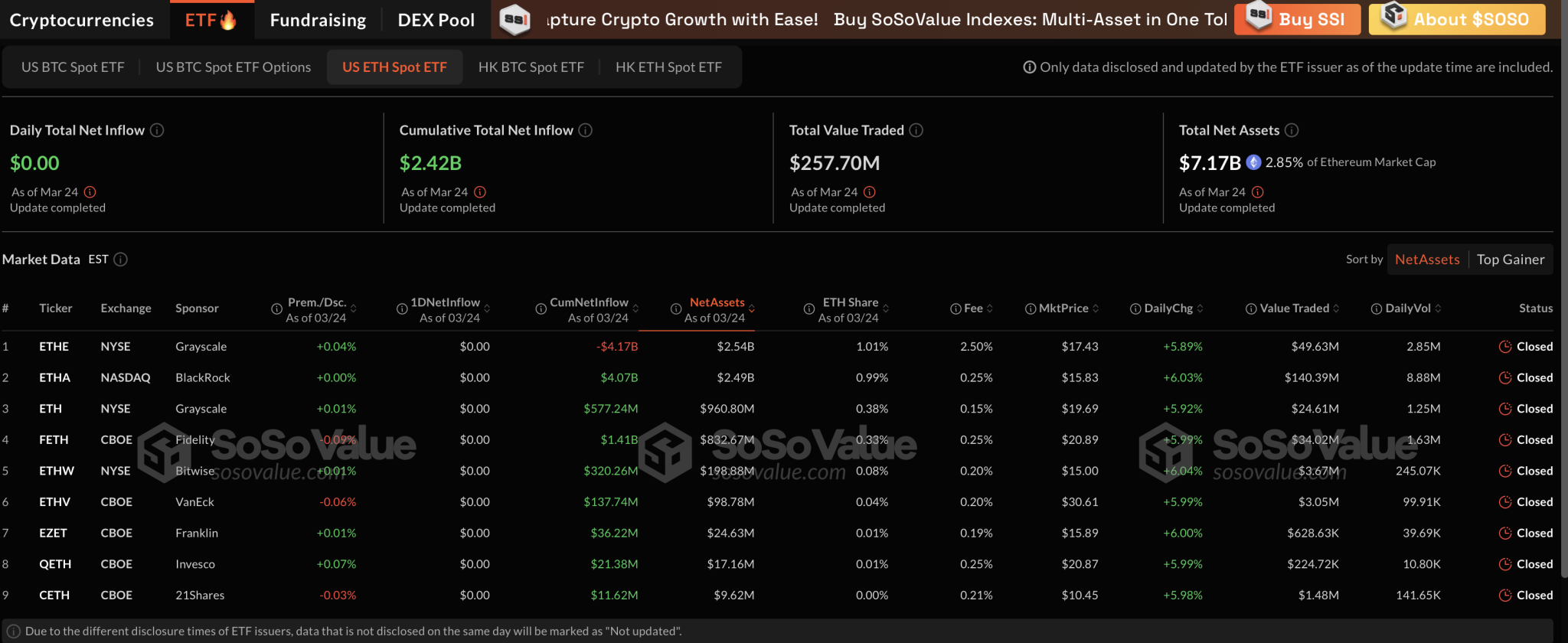
As Ethereum’s price trend hints at a potential bounce-back, institutional investment in the token reported a net-zero flow on March 24. This marks the seventh day of net-zero flow since the inception of Ethereum ETFs in the U.S. market.

Ethereum ETFs
Ethereum ETFs

Currently, the total net assets held by Ethereum ETFs amount to $7.17 billion, or 2.85% of Ethereum’s market cap. Meanwhile, the cumulative net inflow stands at $2.42 billion since inception.

Bulls Gain Momentum Amid Post-Retest Reversal

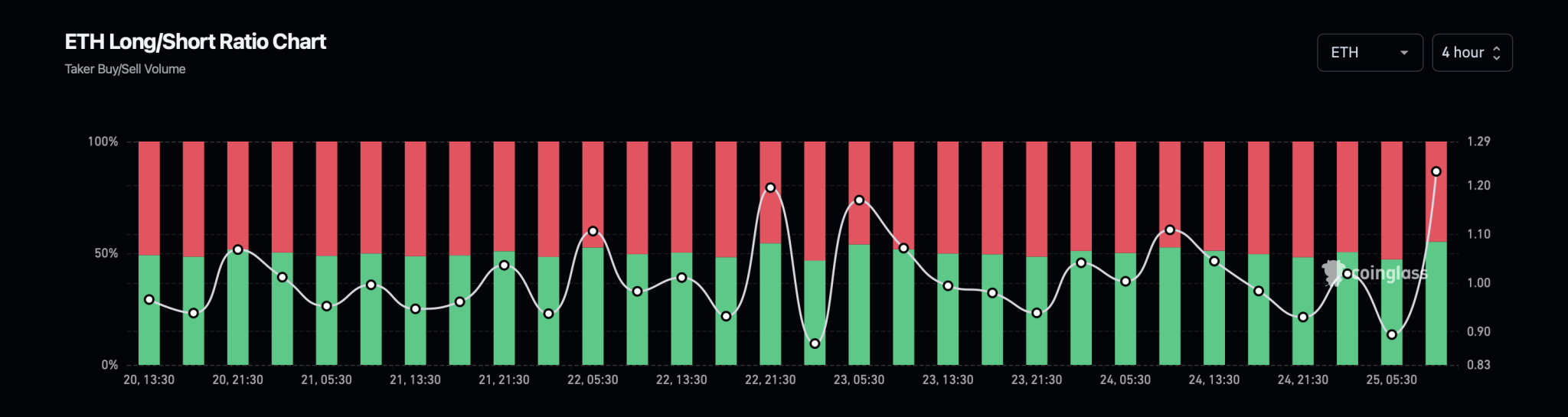
With short-term recovery and growing prospects of a bull run, sentiment in the Ethereum derivatives market is turning bullish. The Ethereum long/short ratio chart shows that long positions have risen to 55% of total contracts in the past four hours.

Ethereum Long/Short Chart

This brings the long-to-short ratio to 1.2287, reflecting a significant increase in bullish positions. Furthermore, the open interest of Ethereum derivatives has increased to $21.75 billion, showing a 3.21% surge, with a positive funding rate of 0.0026%.

Analysts Target Extended Recovery in ETH Prices

As Ethereum shows signs of recovery, crypto analyst Gert van Lagen has highlighted the potential formation of an inverted head-and-shoulders pattern on the weekly chart. According to the analyst, with Ethereum bouncing off the $1,800-$2,000 support level, the price trend is close to completing the bullish pattern.

The short-term recovery could mark the start of the right shoulder of the pattern, with the neckline positioned near the $4,000 psychological mark.

Meanwhile, Michael van de Poppe identifies crucial resistance in Ethereum’s short-term recovery. The analyst highlights a supply zone between $2,100 and $2,150.

A bullish breakout above this supply zone could drive Ethereum to a 30% surge, potentially reaching the $2,800 mark.

Expert Makes XRP Case Conclusion Prediction—Here’s What to Expect

0

Renowned crypto YouTuber Zach Rector has issued a final prediction for the Ripple and XRP lawsuit: The SEC will officially vote to drop the appeal this week. 

According to Rector, U.S. SEC commissioners will formally vote to approve the dismissal of the Ripple lawsuit during its upcoming closed-door meeting.

SEC Closed Meeting 

For context, the SEC’s next closed meeting will be held this week, on March 27, at 2:00 p.m. (ET). The event will be held remotely at the SEC’s headquarters in Washington, DC, with commissioners, their counsels, and secretaries attending. Since it is a closed meeting, the public is not permitted to attend. 

Notably, the meeting agenda includes the institution and settlement of injunctive actions and administrative proceedings, the resolution of civil litigation, and deliberation relating to other enforcement proceedings. 

SEC Commissioners to Vote on Dropping Ripple Appeal 

It is noteworthy that the SEC did not specifically mention Ripple on the agenda. However, several experts speculate that the commission might discuss its case against the company and also approve its decision to drop the appeal at the meeting. 

Besides Rector, prominent crypto journalist Eleanor Terrett shared this sentiment last week. She forecasts that the SEC will formally vote to end the Ripple appeal on March 27. Afterward, the commission will issue an official announcement, informing the public that it has dropped its appeal against Ripple. 

Even though Ripple claims that the SEC has agreed to drop the appeal, the regulator has not confirmed this decision. An official statement from the SEC will confirm whether it has decided to end its multi-year enforcement action against Ripple. 

The SEC is expected to issue this statement after the closed-door meeting slated for March 27, 2025. 

Paul Atkins First Congressional Hearing

Meanwhile, the meeting date coincides with when the Senate will hold its first hearing to decide whether to confirm Paul Atkins as the SEC’s permanent chair. 

On March 27, the Senate Banking Committee will screen Atkins, alongside Jonathan Gould as Comptroller of the Currency and Luke Pettit as Assistant Secretary of the Treasury. The committee will also screen Marcus Molinaro to be Federal Transit Administrator. 

Recall that Trump nominated Atkins as the permanent chair of the SEC in December 2024. In the meantime, Mark Uyeda currently serves as the temporary chair of the SEC. 

Since Atkins’ confirmation has been delayed, Uyeda has been making some top decisions, including dismantling the commission’s crypto enforcement unit and dismissing crypto-related litigation. The move to drop its appeal against Ripple is another major decision from the Uyeda-led SEC. 

Remaining Portion of Ripple Lawsuit 

If the SEC confirms it has ended the appeal, all that will remain in the case is Ripple’s cross-appeal. Speculation suggests that the company is currently negotiating to drop the court’s order relating to its securities law violation through its XRP institutional sales. 

The order involves a fine of $125 million and a permanent injunction prohibiting its future institutional sales. 

Last week, Ripple CEO Brad Garlinghouse suggested that the company wants the SEC to ‘drop everything,’ particularly the injunction and fine. Whether the SEC will agree to this demand remains to be seen. 

Trump Media to Launch ETF Basket on Made-in-America Assets Like XRP

0

President Donald Trump’s media company partners with Crypto.com to introduce a basket ETF containing Made-in-America assets like XRP.

Trump Media & Technology Group (TMTG) has revealed a partnership with leading crypto exchange Crypto.com to launch a series of exchange-traded funds (ETFs) on digital assets and U.S.-centric investments. 

The partnership, which falls under TMTG’s Truth.Fi financial services brand, looks to present investors exposure to a mix of crypto assets and stocks from industries that align with an “America First” economic vision.

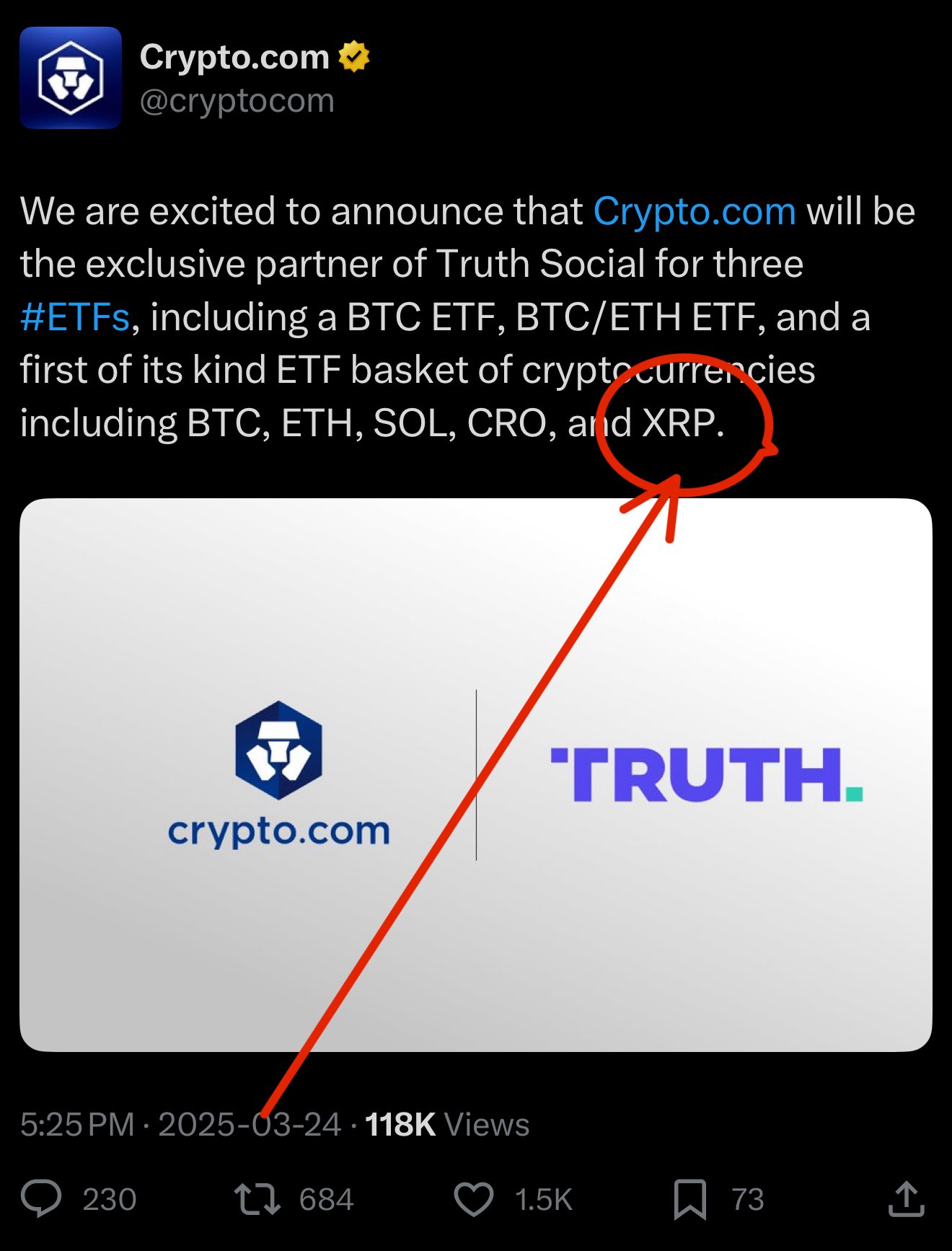
While the official press release highlighted Bitcoin (BTC) and Cronos (CRO) among the digital assets included, initial statements from Crypto.com suggested that the ETFs would also feature Ethereum (ETH), Solana (SOL), and XRP. 

However, the company later deleted this post and replaced it with a more ambiguous statement, mentioning only “CRO and other digital assets” without naming XRP or the other tokens. 

A New ETF Approach Under Trump Media’s Vision

Notably, TMTG, the parent company of Truth Social, has been expanding beyond social media into fintech. The company’s CEO, Devin Nunes, noted that the new ETFs are part of an effort to provide investment options that sync with American economic values. 

He stressed that the initiative was designed to support high-growth U.S. companies while avoiding what he called “political distractions.”

Crypto.com will help in developing and managing the ETFs, leveraging its broker-dealer arm, Foris Capital US LLC, to handle custody and backend technology. The funds, once approved, will be accessible to investors in the U.S., Europe, and Asia.

Did Crypto.com Reveal Too Much About XRP?

The brief mention of XRP in Crypto.com’s now-deleted announcement has triggered questions within crypto circles, with some ascribing it to regulatory concerns.

Crypto.com on X
Crypto.com on X

Despite the SEC dropping its appeal in the Ripple lawsuit, the agency is yet to approve any XRP ETF amid multiple filings.

Several firms, including Grayscale, Canary Capital and WisdomTree, have recently filed for XRP ETFs. Notably, the agency has already acknowledged 19b-4 filings for most of these products, with the XRP community awaiting a decision.

Some speculate that Crypto.com’s deletion was a deliberate move to avoid drawing regulatory attention before any official filings are made. Amid these speculations, it is important to note that, besides XRP, the exchange also chose not to mention other assets like Ethereum and Solana. 

Trump Media’s Move into Finance

This ETF launch could mark a major step for TMTG as it enters the investment scene. The company plans to back the funds with up to $250 million from its own reserves, held with Charles Schwab. Alongside the ETFs, TMTG is also introducing separately managed accounts (SMAs).

World Liberty Financial, another financial project inspired by President Donald Trump, has also continued to make progress within the crypto scene. Amid its accumulation spree, the project recently partnered with Sui to add the token to its Macro Reserve.

Here’s How Much XRP You Need to Hold to Be Ahead of 95% of Investors

0

A crypto founder and XRP community figure has called attention to the XRP Rich list, specifically spotlighting the top 5% percentile.

Amid the ongoing market uncertainty that has capped XRP’s growth prospects, mixed sentiments among market participants. This has led to bearish and bullish reactions, as different tiers of addresses employ varying techniques to either mitigate losses or set themselves up for more substantial gains.

Holding 10,000 XRP Takes You to Top 5%

Interestingly, the number of wallets holding at least 10,000 XRP ($24,500) and at most 100,000 XRP ($245,000) has increased by over 5,000 since February, when the current downturn began. 

As this class of addresses increases, Dr. Artur Kirjakulov, founder of market resource XPMarket, confirmed that the investors at the lower end of the tier might have made it to an elite group.

Specifically, Kirjakulov recently shared data indicating that addresses holding at least 10,000 XRP are within the top 4.72% (approximately 5%) address percentile. This entails that if you hold at least 10,000 XRP, you are among the top 5% XRP holders, essentially outholding 95% of all XRP addresses.

XRP Rich List Artur Kirjakulov
XRP Rich List | Artur Kirjakulov

For context, there are about 6.3 million XRP accounts. Of this figure, those holding between 10,000 and 25,000 XRP, making up the top 4.72%, amount to 161,048. These accounts collectively hold 2.43 billion XRP, accounting for 4.17% of the circulating XRP supply.

Notably, the majority of addresses only hold between 0 and 500 XRP ($1,225). Particularly, addresses with 0 to 20 XRP ($49) total 2.58 million, while those holding 20 XRP to 500 XRP amount to 2.52 million. Together, these add up to 5.1 million, accounting for nearly 81% of the total XRP addresses. 

Despite making up most of the addresses, these tiers only hold 226 million XRP. Meanwhile, there are only 296,992 addresses holding at least 10,000 XRP. Despite this, these addresses boast a cumulative balance of 60.24 billion XRP tokens.

Mixed Behaviors

Interestingly, data from behavior analytics platform Santiment confirms that these addresses have shown mixed behaviors. Particularly, since February, addresses holding between 1,000 and 100,000 XRP have only accumulated more tokens, adding 200 million XRP to their cumulative balance within this period.

XRP Addresses Santiment
XRP Addresses | Santiment

Meanwhile, those holding from 100,000 to 1 million XRP have distributed their holdings. According to data, this tier of addresses has reduced its balance to 6.62 billion, representing a 50 million drop since February.

Financial Expert Reveals Why XRP Has Not Exploded Yet

0

A financial expert has called attention to several factors possibly contributing to the recent XRP price stagnation.

Despite optimism among investors, XRP has not experienced the explosive price movement many anticipated, mostly consolidating at $2. Experts attribute this stagnation to factors like market disinterest, low liquidity, and a lack of significant catalysts.

Market Conditions Limit XRP’s Growth

According to financial analyst Austin Hilton, the current state of the crypto market is due to a widespread lack of enthusiasm. In a recent video analysis, he explained that many investors have withdrawn their capital and are waiting for a major event to set things in motion.

“There are millions upon millions of existing crypto investors who have pulled their money out and are sitting on the sidelines waiting for something big to happen,” Hilton noted. This drop in interest is a major reason why XRP has struggled to gain momentum.

Meanwhile, institutional investors are quietly accumulating digital assets, including XRP. Despite high daily trading volumes, reaching over $4 billion at one point, the price has remained largely unaffected. 

Hilton noted that until a massive positive event occurs, the market is unlikely to witness major price movements. However, events such as progress in the XRP ETF products launch, the resolution of the SEC vs. Ripple lawsuit, and XRP reserve disclosures have failed to trigger any sustainable run due to the disinterest.

Summer Market Slowdown

Another factor influencing XRP’s price is the seasonal trend of crypto investing. According to Hilton, the summer months tend to be slow for the market, as many investors focus on personal activities rather than trading. 

Hilton pointed out that May through July often see reduced trading activity, and this year is likely to follow the same pattern. However, as the year progresses, experts believe the fourth quarter could bring renewed momentum. 

Hilton stressed that while short-term movements may remain limited, the long-term outlook for XRP remains positive.

XRP Resistance and Support Levels

Hilton pointed out that XRP is currently within a tight corner. Resistance comes in at $2.60 and $2.80, meaning that unless trading volume increases with massive buy pressure, XRP will struggle to break past these barriers. 

On the other hand, the market features support levels at $2.24 and $2.30. If prices fall below these levels, the asset could slip below $2, further dampening investor sentiment.

Hilton pointed out that low liquidity in the market is a major issue, preventing XRP from achieving upward momentum. He also cautioned against expecting a dramatic price surge in the near term, particularly because there are no major positive catalysts currently driving the market forward.

Historical XRP Patterns Suggest a Potential Uptrend

Meanwhile, another market expert, Dom, believes that XRP’s price action is behaving differently this time compared to previous cycles. Typically, XRP price has risen quickly to new highs but has not spent much time consolidating at those levels. This time, however, things appear different.

“The longer price spends time at a level, it’s always just reflective of how much market participants ‘agree’ on that price,” Dom noted. 

Unlike past market cycles where XRP’s value skyrocketed and then quickly declined, the current price range above $2 has shown more stability. He noted that price consolidation at these levels suggests that XRP could be building a strong base for a future breakout.

XRP Historical Price Performance Dom
XRP Historical Price Performance | Dom

This behavior contrasts with previous cycles, where XRP would reach a peak and rapidly decline, providing little opportunity for investors to exit at high prices. 

According to Dom, “We have been seeing range building, acceptance, and volume holding up above $2.” He suggests that this stability could lead to a potential upward expansion once the market gains confidence. Currently, XRP trades for $2.47, up 3.33% in the past 24 hours.

Ripple Co-founder McCaleb Defends Selling His XRP Amid Accusations of Deliberate Harm to Investors

Ripple co-founder Jed McCaleb recently addressed renewed criticism surrounding his departure from Ripple and his decision to sell off his XRP holdings.

McCaleb’s statement came after XRP holder Jim Knox accused him of deliberately harming Ripple investors due to personal disagreements.

However, McCaleb clarified his stance, stating that he informed the Ripple community about his decision to leave the company and his loss of belief in the project before selling his XRP.

According to him, his intention was to allow XRP holders the opportunity to “front-run” him — essentially enabling them to act on the information before he made his sale. McCaleb argued that this was more transparent than selling without prior notice.

“I told the Ripple community I was leaving. I did that before I sold my XRP. The alternative was to sell without telling people. Is that better?” McCaleb stated.

Further defending his actions, McCaleb pointed out that during his transition out of Ripple, XRP holders were given the chance to swap their tokens for Stellar (XLM). This move sought to reduce their potential losses from the situation.

McCaleb used this explanation to address critics who painted his departure as a hostile maneuver against the community.

Jim Knox had accused the former Ripple executive of intentionally attempting to harm Ripple investors. Knox suggested that McCaleb’s actions were driven by personal frustrations with the team’s decisions rather than a genuine concern.

McCaleb’s Space Station Ambitions

This exchange followed recent reports about McCaleb’s ambitious plans to build a commercial space station with his startup, Vast Space. A Bloomberg article highlighted that McCaleb is risking a significant portion of his crypto fortune to secure a NASA contract to replace the International Space Station (ISS).

Despite the criticisms surrounding his XRP departure, McCaleb’s forward-looking projects in space exploration have captured the interest of some members of the XRP Army. However, some remain wary of his motivations.

“That’s not the kind of person you can trust,” Knox remarked in response to an optimistic post about McCaleb’s space endeavor.

A Glimpse at McCaleb’s XRP Sales Saga

Notably, Jed McCaleb originally owned 9 billion XRP from 2012, when the XRP Ledger first launched.

For context, in 2011, McCaleb, David Schwartz, and Arthur Britto began developing the XRP Ledger to enable faster, scalable transactions. They generated 100 billion XRP upon launch.

In September 2012, McCaleb and co-founders Chris Larsen and Britto formed Ripple (originally NewCoin, Inc.). This company received 80 billion XRP as a gift, while the founders retained the remaining 20 billion.

After McCaleb’s departure from Ripple in June 2013 due to differing visions, he began selling his XRP holdings. Some argue McCaleb intended to aggressively dump his XRP bag, but Ripple checked the move with legal action, enforcing measured sales, including some charitable donations. By July 2022, McCaleb was completely out of XRP.

US Government Recovers $7M in Crypto Investment Fraud; Victims Can Now File Claims

The United States has successfully recovered $7 million from an international crypto asset investment fraud scheme using civil asset forfeiture. 

The recovered funds were seized from a foreign bank account and will now be available for victims to claim. 

How the Crypto Scam Worked

According to the official statement, the perpetrators employed social engineering tactics to build trust with victims before introducing them to fraudulent crypto investments. They directed victims to spoofed websites designed to resemble legitimate trading platforms. These fake sites falsely displayed substantial returns, tricking investors into believing they were making profits.

However, when victims attempted to withdraw their funds, the scammers used deceptive tactics such as claims that taxes were owed on the profits. As a result, they coerced the victims into depositing even more money. 

Notably, the criminals laundered the victims’ funds through a network of over 75 bank accounts registered under the names of shell companies. The perpetrators made the transfers appear domestic to disguise the movement of funds, even though they ultimately sent the money to accounts abroad.

In June 2023, U.S. Secret Service agents seized a portion of the stolen funds from a foreign bank account. The government filed a civil asset forfeiture complaint in U.S. District Court, notifying potential property owners and allowing time to contest the forfeiture. 

The case settled with the foreign bank forfeiting $7 million to the U.S. government. Now, this will allow victims to petition for the return of the funds they lost.

Submitting Claims for Compensation

The U.S. government has begun the process of inviting victims of the scheme to submit petitions for the recovery of the stolen funds. The U.S. Attorney’s Office for the Eastern District of Virginia, along with the U.S. Secret Service, is overseeing the process.

Specifically, affected individuals can file a complaint via the provided email contact: cryptofraud@usss.dhs.gov to submit their claims.