Home Blog Page 91

Crypto Founder Says XRP Won’t Climb in a Nice Steady Line, It Will Move in ‘Violent Leaps’

XRP could see explosive price moves rather than gradual gains if real-world utility continues to expand, according to Black Swan Capitalist founder Versan Aljarrah.

The market commentator believes XRP’s long-term growth could be driven by demand for cross-border payments, tokenization, and institutional adoption. If that happens, he expects the asset to experience sharp price surges over short periods rather than a slow, steady climb.

Aljarrah Expects Sharp XRP Price Breakouts

In a post on X, Aljarrah said XRP “won’t climb in a nice steady line” and will instead move in “violent leaps”. He argued that regulatory clarity, bank adoption, tokenization, and cross-border payment volumes could create powerful catalysts for the asset.

“The infrastructure has already been built and tested in silence for over a decade,” Aljarrah said.

He added that once conditions align, XRP’s gains may go far beyond typical 2x or 3x moves.

According to Aljarrah, several factors could combine to accelerate price action. These include trapped liquidity, short sellers covering positions, and institutional investors entering the market at the same time. Together, they could trigger multiple explosive rallies within a relatively short period.

XRP’s Role in the Emerging Digital Economy

Aljarrah expanded on this view during a podcast discussion with crypto analyst Edo Farina.

He described XRP as a settlement infrastructure for the emerging digital economy. In his view, the growth of real-world asset tokenization could significantly increase demand for settlement networks, creating a major opportunity for XRP.

“XRP at the end of the day is the settlement infrastructure for the new economy,” he said.

Aljarrah argued that as tokenization volumes increase, demand for efficient settlement systems will rise alongside them. He believes blockchain networks that provide this infrastructure could eventually become less dependent on crypto market trends and develop their own growth paths.

Commodities, Infrastructure, and Blockchain Networks

In a related Substack post, Aljarrah linked his bullish blockchain outlook to broader economic trends. He pointed to rising investment in physical assets such as gold, silver, platinum, rare earth elements, and other critical metals needed for future infrastructure.

He argued that the growth of the new economy is exposing the limits of traditional banking systems. As a result, he remains bullish on XRP, XLM, and HBAR, which he sees as networks built for fast, low-cost cross-border payments and real-world asset tokenization.

Still, he cautioned that the transition will take time and will be volatile.

XRP Price Still Under Pressure

Despite Aljarrah’s bullish outlook, XRP’s recent price performance remains mixed. According to CoinMarketCap data, XRP was trading at $1.16 at press time, down 2.8% over the past 24 hours. The token is still up 4.4% over the past week. However, it remains down 16% over the last month and roughly 36% year-to-date.

The gap between XRP’s current price performance and long-term predictions continues to fuel debate among investors.
XRP Spot Buyers Aggressively Accumulate as Binance Perp CVD Hits Record Low of -$792M

0

Recent XRP on-chain analysis highlights a divergence between spot demand and perpetual trading activity on the leading exchange, Binance.

An analysis from Xaif Crypto shared that XRP has flipped a major signal. Spot activity has climbed considerably while perpetual selling pressure is building. According to him, this divergence is setting up a potential short squeeze.

XRP Spot Demand Reaches Its Highest Level Since Mid-May

The post builds on a separate analysis from CryptoQuant’s verified author Amr Taha. The commentary cited recent exchange data showing that spot buyers are returning aggressively, while derivatives participants continue to lean heavily in the opposite direction. 

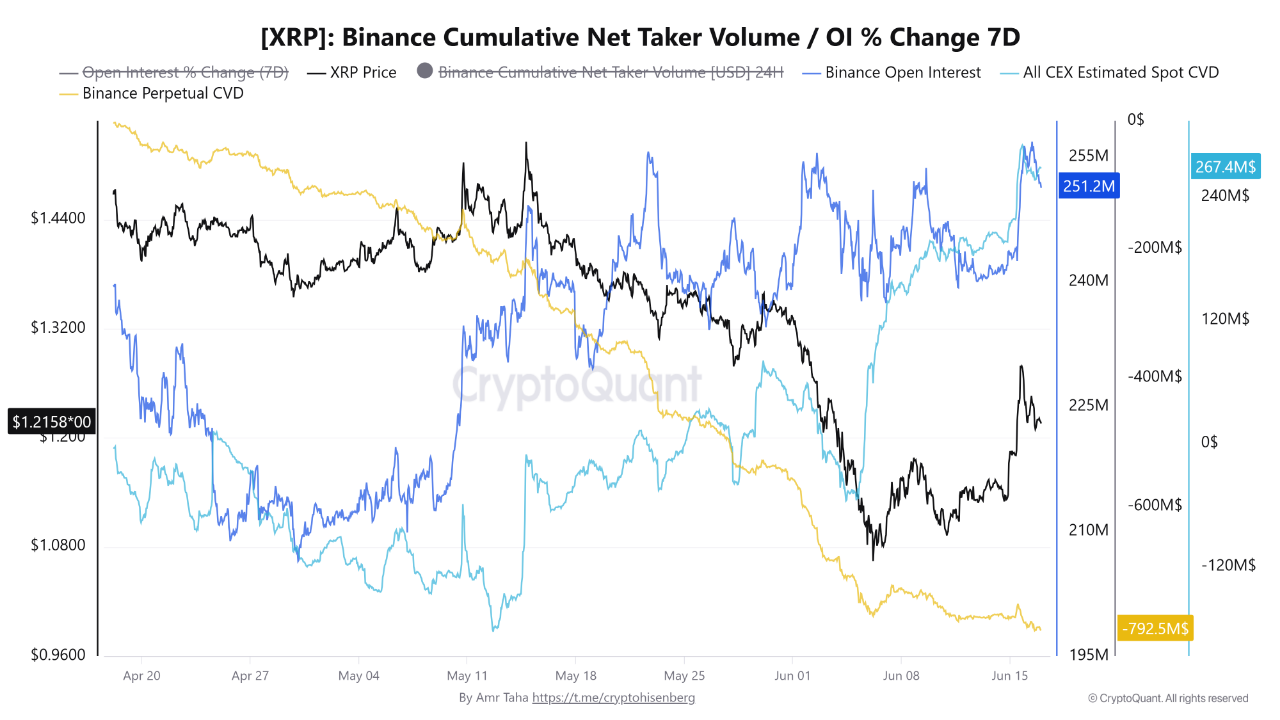
Per the data, the XRP All CEX Estimated Spot Cumulative Volume Delta (CVD) rose to $267.4 million, its highest level since mid-May. For the uninitiated, this metric measures the balance between aggressive buyers and sellers across major exchanges.

Notably, this is a considerable improvement, considering that the same indicator stood near negative $177 million on April 12. The shift suggests that spot buyers have become more aggressive, with fresh capital entering the XRP market through direct purchases on exchanges.

Binance Futures Sellers Build Pressure

In contrast, the Binance Perpetual CVD recently fell to a new record low of -$792 million. Just a few weeks earlier, specifically on May 12, the same metric was at -$218 million.

Per the analysis, the decline highlights a sharp increase in aggressive selling activity within the Binance perpetual futures market. In other words, many leveraged participants have continued positioning for further pullbacks even as XRP’s price briefly recovered to $1.21.

XRP Spot and Futures CVD/CryptoQuant

This creates a rare divergence between spot and derivatives activity. Such conditions can sometimes produce powerful moves if XRP continues trending higher. It also signals that a recovery attempt is not driven by derivative optimism but by actual spot demand.

XRP OI Continues to Climb

Another factor that Taha noted was worth monitoring is open interest. At the time of the analysis, the Binance open interest stood at $251 million, staying close to the highest levels seen since mid-May. Currently, it trends at $424 million.

XRP OI on Binance/CryptoQuant

Per the analysis, if spot buyers continue absorbing the heavy futures selling, bearish positions will face more pressure. However, if spot demand begins to fade, the combination of elevated leverage and persistent futures selling could quickly shift momentum back to the downside.

In the meantime, XRP trades at $1.17, joining a broader crypto market sideways trend following the FOMC meeting yesterday. XRP spot flows show sustained buying pressure, keeping the possibility of a short squeeze in place.

Dubai-Based Goldgenie Sees 300% Surge in Crypto Payments, With XRP Among Key Payment Options

0

Luxury technology and customization company Goldgenie has reported a sharp increase in cryptocurrency payment activity over the past six months, with XRP emerging as one of the preferred payment options among customers.

In a recent update, Goldgenie revealed that crypto payments surged by 300% over the past six months, underscoring growing demand for digital asset transactions among high-net-worth consumers.

Notably, Goldgenie has accepted cryptocurrency payments since 2015 and currently supports several major digital assets, including XRP, Bitcoin, Ethereum, and stablecoins. According to the company, the past six months marked its strongest period of crypto payment growth since introducing digital asset payment options more than a decade ago.

Factors Driving Adoption

Goldgenie serves customers across the Middle East, Europe, the United Kingdom, North America, and Asia. The company attributes the rise in crypto payments to several factors, including increasing familiarity with digital assets, the rapid expansion of stablecoin usage, and significant improvements in payment infrastructure.

Notably, Goldgenie expects cryptocurrencies, including XRP, to play a growing role in luxury commerce as more consumers seek flexible and efficient payment alternatives.

Through the company’s payment infrastructure, customers can use cryptocurrencies such as XRP to purchase high-value luxury products. This includes customized devices, bespoke technology projects, and premium gifts. 

Goldgenie noted that crypto payments appeal particularly to international buyers because they offer a more flexible and globally accessible settlement compared to traditional cross-border payment methods. 

XRP Growing Utility in Payments

While Goldgenie supports several cryptocurrencies for commerce, XRP stands out because it was specifically designed for payments. The digital asset enables low-cost, high-speed transactions, with transfers settling within seconds and costing only a fraction of a cent in fees.

Thanks to these advantages, businesses and consumers have increasingly adopted XRP for retail and commercial payments. 

Beyond retail commerce, financial institutions and fintech firms are also leveraging XRP-powered technology for cross-border transactions through Ripple’s payment network. Companies such as Braza Bank, Banco Genial, SBI Holdings, and Azify have integrated Ripple Payments to streamline international money transfers.

Earlier this week, Ripple expanded the reach of the XRP Ledger through its investment in Flutterwave, further strengthening the network’s presence in global payments and financial infrastructure. 

XRP at “Range-Rebuild” Phase—Key Levels to Watch

0

XRP is stuck within a price range, with a recent analysis highlighting levels the coin needs to reclaim for bulls to gain control of proceedings.

XRP has failed to maintain a clear price direction in recent times, with uptrends followed by pullbacks to lower prices. According to prominent market watcher EGRAG Crypto, this price action is not random but part of a broader range trend.

In his recent analysis, he highlighted what needs to happen for XRP before bulls can gain control of the market again and force a breakout to higher prices.

XRP in a Range

EGRAG identified the battle between buyers and sellers. The former is defending key support areas while the latter is fighting to keep XRP below important resistance areas. This behavior led to the conclusion that the coin is currently in a “range-rebuild” phase.

Most recently, XRP visited $1.05, breaking below its February low of $1.12. However, prices rebounded sharply, as buyers stepped in to violently defend the demand zone. Notably, the daily closing on that day printed a long lower wick, showing clear price rejection.

The analyst highlighted that this was not random but confirmed his analogy that both bulls and bears keep stepping in at key levels in an attempt to regain control of the market. The upper wick seen on the daily closing on June 15 also reflected higher price rejection as bears defended the $1.30 resistance area.

XRP Key Levels/EGRAG Crypto

Key Levels to Watch for Bulls

EGRAG noted that the levels are clear, and how XRP reacts to each of them will determine whether its rebuilding phase continues or further price weakness endures. One of the most important support levels to watch is the $1.11 level.

He called this the “survival zone” where bulls need to defend to avoid an aggressive downtrend. Holding it invalidates the possibility of a crash to $0.88.

$1.28 is the immediate resistance and the next level to watch. XRP has already lost momentum around it after testing earlier in the week. Reclaiming this zone is the first show of strength and would build the momentum for a further uptrend.

Once XRP reaches $1.35-$1.38, bulls start gaining control of the market. Meanwhile, $1.50 is the major breakout zone. The coin has stalled around this resistance zone multiple times since February, and finally breaking above will shift the market structure bullish.

IF XRP breaks out of the current range, the path towards $2.30 becomes visible. It last reached this level in January and would require a 93% growth from the current price to reclaim it.

Momentum Still Relatively Weak

In the meantime, XRP is still struggling to sustain an uptrend. The rejection at $1.30 on Monday has seen it drop over 3% to $1.19 at press time. The altcoin remains below key moving averages, showing weak price momentum.

The daily RSI also started to tilt lower, further confirming that bears still lack the required strength to drive further upside. Nonetheless, it remains around 45.84, somewhere around the neutral ground.

XRP 1D Chart
XRP 1D Chart

On-chain data further shows caution among market traders. XRP futures flows show that derivative interest is dwindling. In the past 24 hours, traders have closed more futures contracts ($615 million) than they have opened ($564 million). Open interest has also dropped by 5% to $2.75 billion.

Analyst Who Correctly Predicted XRP Rebound to $1.26 Reveals What Comes Next

0

A prominent market analyst who correctly predicted the recent XRP rebound to $1.26 has now mentioned what traders should expect next.

XRP recently recovered from its yearly low of $1.05, joining the broader crypto market resurgence. This rebound helped XRP climb to a high of $1.29 on June 15. However, after reaching that level, buying pressure weakened as the asset faced resistance.

As XRP enters a period of uncertainty, well-regarded analyst EGRAG Crypto, who accurately projected XRP’s recent rebound, says the next move will depend on how the asset reacts around several important support and resistance levels.

XRP Followed Previous Forecast Step by Step

In his latest analysis, EGRAG pointed out that the roadmap he presented earlier played out almost exactly as expected.

His previous outlook discussed three important price levels. First, he argued that XRP first needed to hold the $1.14 support zone to open the door for a retest of $1.1938. If the asset managed to break above $1.1938, the next target would be $1.2600. 

However, he confirmed that XRP was still at risk of a steeper drop. On the downside, EGRAG warned that a break below $1.09 could send prices back toward $1.05.

According to the analyst, XRP respected the structure throughout the recovery. Specifically, the price successfully held the key $1.14 support area before advancing toward $1.1938. 

XRP 4h Chart EGRAG Crypto
XRP 4h Chart | EGRAG Crypto

After reaching that level, XRP moved above it and climbed toward the next projected target. The rally eventually pushed beyond the $1.2600 objective, with XRP reaching a high of $1.2996, where it faced a roadblock.

XRP Faces Its Next Test

Although XRP achieved the projected targets, the asset has started to show signs of rejection after reaching the $1.2600 area. EGRAG explained that this is common after a strong upward move and does not automatically signal a trend reversal.

However, he stressed that the market has now entered a critical phase. He believes that XRP must continue holding above $1.19 to keep its bullish structure intact. As long as the price remains above that level, the recovery trend stays in place.

If XRP falls below $1.19, the market could revisit lower support levels. A deeper decline below $1.14 would weaken the structure further and raise concerns about the strength of the rebound.

Additional Support and Resistance Levels

Meanwhile, another market analyst, Chart Nerd, pointed out that, during the recent rebound effort, XRP tested its daily 50-day exponential moving average, which currently sits at $1.28. 

The asset touched that level but failed to move higher, leading to the rejection that followed. At the same time, the daily 20-day exponential moving average near $1.20 has started acting as support.

XRP 1D Chart Chart Nerd
XRP 1D Chart | Chart Nerd

Chart Nerd also highlighted the neckline of a double-bottom pattern as another important support zone if XRP experiences a deeper pullback. He believes this level could provide a strong area for buyers to step in and support the market.

However, he warned that losing that support could increase selling pressure and potentially send XRP back toward the $1 level.

Despite that risk, Chart Nerd suggested that if support continues to hold and the current trend remains intact, XRP may be moving through a wave-four correction before making a final wave-five advance. If this happens, the asset could revisit the $1.40 highs before entering a larger corrective phase.

Top Trader Closes $13.55M HYPE Position, Locks In $2.83M Profit and Rotates Into UNI

Crypto trader Garrett Jin (@GarrettBullish) has exited his entire position in Hyperliquid’s HYPE token. 

According to Lookonchain, he sold 184,102 HYPE worth about $13.55 million at an average price of roughly $73.60. Notably, the trade generated a profit of around $2.83 million.

After closing the HYPE position, Jin opened a long position in Uniswap’s UNI token. He also continues to hold sizable long positions in Bitcoin and Zcash.

His current portfolio includes a long position of 1,268 BTC valued at approximately $83.39 million, 50,013 ZEC worth about $25.2 million, and 80,000 UNI valued at roughly $271,000.

HYPE Reaches New All-Time High Before Exit

Jin’s sale came after a strong rally in Hyperliquid’s HYPE token. According to CoinMarketCap data, HYPE is trading at $72.63, up 30% over the past week. Earlier this month, the token dropped to around $52 before staging a sharp rebound.

On Tuesday, HYPE reached a new all-time high of $76.85. The token has gained about 60% over the past month.

The timing of Jin’s exit suggests he took advantage of the record rally and locked in millions of dollars in profit.

Image

UNI Draws Attention After $100 Price Forecast

Following the HYPE sale, Jin increased his exposure to Uniswap’s UNI token. UNI is currently trading at $3.63, up 23% in the past 24 hours and 48% over the last seven days. Despite the recent rally, the token remains about 92% below its all-time high of $45.

Part of UNI’s momentum has been driven by bullish forecasts from Standard Chartered. The bank recently predicted UNI could reach $100 by 2030, implying nearly 40x upside from current prices.

The forecast has renewed investor interest in the decentralized exchange token and may be encouraging traders to rotate capital into UNI.

ZEC Surges While Bitcoin Faces Weakness

Jin is also maintaining a large long position in Zcash. ZEC is trading at $507 after rising 21% over the past week. Earlier this month, the privacy-focused cryptocurrency fell to around $250 before rebounding more than 100%.

Over the past year, ZEC has gained approximately 1,105%. Even so, it remains about 91% below its all-time high.

Meanwhile, Bitcoin is trading at $64,800, down 2.48% over the past 24 hours. Despite the daily decline, BTC remains up 6% over the past week.

Bitcoin has struggled over longer time frames. The asset is down 16% over the past month and 39% over the past year. After reaching an all-time high of $126,200 in October 2025, BTC now trades about 49% below that peak.

Despite the recent weakness, Standard Chartered remains optimistic on Bitcoin’s long-term outlook. The bank expects BTC to reclaim $100,000 later this year, rise to $200,000 in 2027, and eventually reach $500,000 by 2030.

BitMEX Founder Arthur Hayes Denies Using X Followers as Exit Liquidity, Says He Never Gives Investment Advice

0

Maelstrom CIO and BitMEX co-founder Arthur Hayes has rejected accusations that he is using his X influence to create exit liquidity for his own trades.

The allegations came from on-chain investigator ZachXBT, who accused Hayes of promoting cryptocurrencies such as Zcash, NEAR Protocol, and Hyperliquid before selling his holdings and leaving followers with losses. 

Hayes Denies Claims 

In response, Hayes argued that he neither manages money for others nor provides financial advice. He stressed that he never instructs people to buy, sell, or hold any asset.

According to Hayes, his posts simply disclose his personal investment decisions. He emphasized that readers are free to agree or disagree with his views, conduct their own research, and make independent investment choices.

Furthermore, Hayes challenged critics to find any instance where he explicitly told followers what they should do with their money. Instead, he maintained that he merely shares what he is doing and leaves investment decisions entirely up to his audience.

Hayes also acknowledged that a large percentage of his market predictions—roughly 70% to 90%—turn out to be wrong. However, he argued that successful investing does not require a high win rate.

Instead, Hayes explained that he generates profits by allocating larger amounts of capital to ideas in which he has the highest conviction while limiting exposure to lower-confidence trades. As a result, his winning positions can outweigh losses from incorrect calls. 

Crypto Enthusiasts React 

Meanwhile, Hayes is known for publicly disclosing his trades on X, where he has amassed more than 802,000 followers. He has frequently shared his positions in tokens such as ZEC, HYPE, NEAR, and WLD.

Notably, Hayes often updates followers when he exits positions after losing confidence in a project. Critics, including ZachXBT, argue that this pattern of publicly promoting tokens and later selling them effectively turns followers into exit liquidity. Hayes, however, maintains that he is simply documenting his investment activity rather than encouraging others to copy his trades. 

Given his influence in the crypto market, some interpret his remarks as indirect signals that may guide investor behavior. 

Hayes Returns to Ethereum

Meanwhile, Hayes appears to be rebuilding his exposure to Ethereum after previously dumping his entire holdings. Last year, he sold nearly 1,900 ETH to rotate capital into decentralized finance (DeFi) tokens.

However, recent on-chain data shows that Hayes has resumed accumulating Ethereum. He purchased 1,400 ETH yesterday, bringing the wallet’s holdings to 4,400 ETH, valued at about $7.78 million. This move suggests renewed confidence in Ethereum despite his earlier shift toward alternative crypto investments. 

Bitcoin CVDD Model Shows Price Likely to Bottom Near $48K

0

The Bitcoin CVDD model that has historically nailed the bottom now indicates that the premier crypto asset has a local base at $48,000.

Bitcoin (BTC) dropped under $60,000 on June 5, breaking below its February low of $60,130. While its price has recovered to $65,000, the decline may have done more than shake market confidence.

According to on-chain data highlighted by CryptoQuant analyst Axel Adler Jr., the move pushed a key behavioral metric into a territory historically associated with capitulation phases. Additionally, a separate valuation model now points to $48,000 as the cycle’s possible price bottom.

The Bitcoin Drop to $60K Triggered a Rare On-Chain Signal

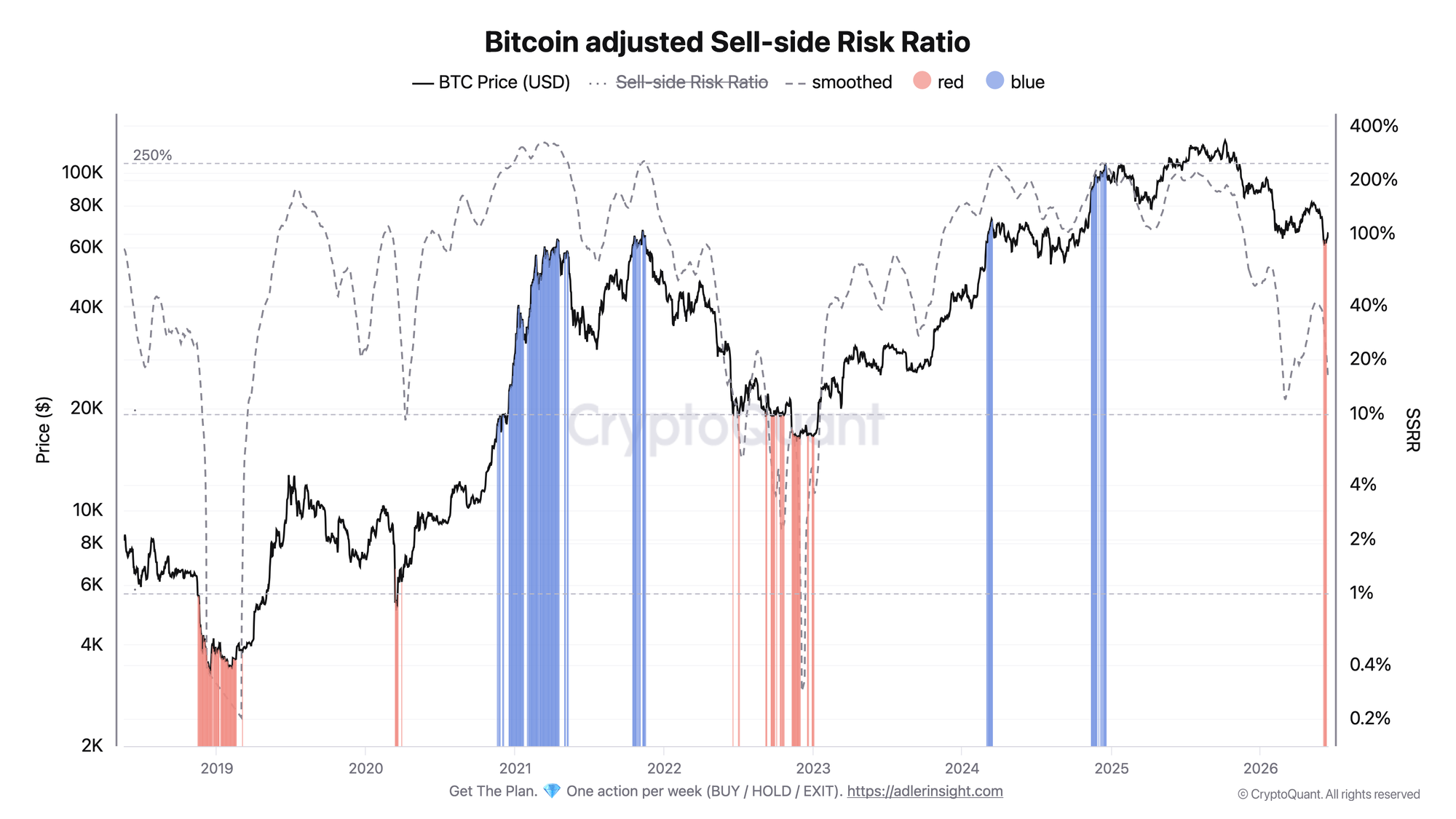
Adler highlighted that one of the most notable developments during the early June decline was the behavior of Bitcoin’s Adjusted Sell-side Risk Ratio (SSRR). The metric slipped into its red zone for the first time since the previous market cycle. 

Notably, the metric compares the value of Bitcoin supply in profit and underwater against realized capitalization. The red zone indicates that the value of coins sitting at a loss has caught up with and is beginning to exceed the value of coins sitting at a profit.

Bitcoin Adjusted SSRR/CryptoQuant

The development matters because it reflects growing stress among holders. Adler also linked this event to local capitulation phases and subsequent bottom formation, citing historical context. He noted that comparable conditions occurred in 2019 and 2023, both of which eventually gave way to broader recoveries.

While the SSRR printing red bars does not confirm a bottom, it does suggest that BTC has moved from a phase dominated by optimism into one characterized by significant unrealized losses and heightened caution, historically linked with local base formations.

The Bitcoin CVDD Model Continues to Point Toward $48K

Adler’s analysis also featured the Cumulative Value Days Destroyed (CVDD) model, which approaches Bitcoin from a valuation perspective.

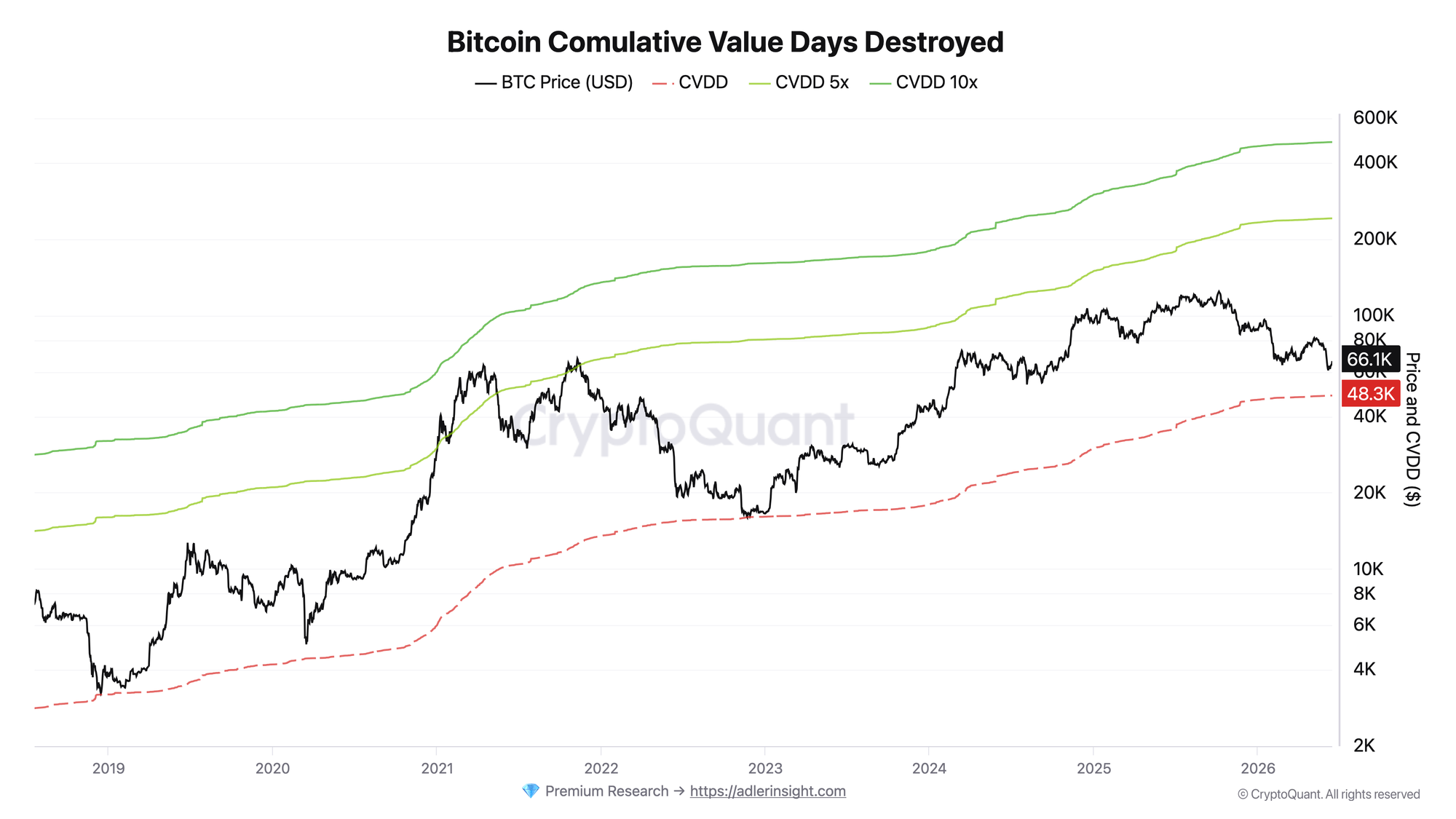
The model incorporates both the value and age of coins that move on-chain, creating what analysts view as a long-term estimate of Bitcoin’s fundamental floor. Throughout Bitcoin’s history, price has rarely closed below the base CVDD line for any meaningful period.

Bitcoin CVDD Chart/CryptoQuant

Notably, the CVDD line continues to rise gradually over time, moving Bitcoin’s bottom higher in each cycle. According to the analysis, that line currently sits near $48,300, 25% away from the current price of $65,000.

Interestingly, this aligns with a separate projection from Ali Martinez. His commentary shows that the CVDD line accurately marked the bottom of the 2022 bear market and started a new bull market. BTC eventually surged to $126,200 three years later from the $15,000 lows.

What Could Confirm the Next BTC Trend

Adler noted that the next phase will likely depend on whether Bitcoin can maintain its footing above the levels where stress first appeared.

A positive scenario would involve price holding above the $60,000 region while SSRR gradually climbs out of the red zone. Such a development would suggest that the BTC supply at a loss is shrinking and that selling pressure is beginning to ease.

A bearish scenario involves Bitcoin revisiting lower levels and SSRR producing fresh negative readings. Here, attention could quickly shift toward the CVDD support zone near $48,000. Notably, the asset has not reached that low in the current cycle.

Stablecoin Market Cap on XRP Now Approaching $1B Milestone as RLUSD Adds $383M in 1 Month

0

The stablecoin market cap on the XRP Ledger is now approaching the $1 billion milestone, driven by RLUSD’s impressive growth on the network.

Amid the recent global push surrounding tokenization trends, the XRP Ledger-based stablecoin market has continued to see impressive growth after gaining traction later than most crypto ecosystems.

Specifically, the stablecoin market cap on the XRPL has hit $907 million, according to leading tokenization platform RWA.xyz, approaching the $1 billion milestone. For context, the stablecoin market on the network was valued at just under $277 million at the start of the year.

RLUSD Contributing to the Growth

Much of this growth comes from the expansion of the Ripple stablecoin, RLUSD, on the XRP Ledger. Notably, when the XRPL-based stablecoin market cap stood at $277 million on Jan. 1, 2026, RLUSD had a valuation of $235 million, representing 84% of the total.

While other stablecoins native to the network have also recorded an impressive growth in valuation, RLUSD has seen the biggest rise since then. 

Today, RLUSD’s market cap on the XRPL has reached a high of $763 million, marking an 84.1% share of the $907 million total XRPL-based stablecoin market cap. This indicates that RLUSD has added about $528 million in valuation year-to-date.

Stablecoins on the XRP Ledger RWAxyz
Stablecoins on the XRP Ledger | RWAxyz

Meanwhile, the USDB stablecoin from Brazilian group Braza has grown from $34 million at the start of the year to $115 million today. This makes it the second-largest stablecoin on the XRPL. 

Also, BBRL, a stablecoin pegged to the Brazilian Real and also issued by Braza, has risen from $2.6 million to $11.6 million within the same period. However, USDC, which launched on the XRPL last June, has declined in XRPL-based value from $9.3 million at the start of the year to $5.6 million today.

RLUSD Growth Trends

Notably, the RLUSD growth comes as Ripple continues to mint more of the stablecoin across the XRPL and Ethereum, its two native networks. This has brought RLUSD’s total market cap to $1.63 billion, making it the eighth-largest stablecoin in the crypto market.

Of this total figure, about $763 million now resides on the XRPL, making up a 46% market share. This represents a massive improvement, as the XRPL market share stood at a meager 17.5% at the start of this year. 

Ripple’s recent RLUSD mints have continued to prioritize the XRPL, including a single-day $200 million deployment last month. As a result of this focus on the XRPL, the RLUSd market cap on the network has grown by $383 million in the past month.

Other XRPL-based Tokenization Metrics 

Meanwhile, besides the stablecoin growth, the XRPL is witnessing growth in other tokenization-centered metrics. For instance, RWA holders have increased 69.57% over the past 30 days to 117 today. Also, stablecoin holders have risen to 59,240, while stablecoin transfer volume in the last month has spiked 81% to $4.83 billion.

XRPL Tokenization Trends RWAxyz
XRPL Tokenization Trends | RWAxyz

Despite the impressive growth in most metrics, some areas have seen declines over the last 30 days. Specifically, distributed tokenized value has dropped 10.83% within this period to $360.25 million, with represented value also dropping 0.30% to $3.67 billion. 

XRP Utility Continues to Expand, Flare CEO Explains How Flare Is Unlocking New Use Cases

Ripple has highlighted the growing utility of XRP, with Flare co-founder and CEO Hugo Philion explaining how Flare is giving XRP holders access to new use cases.

Speaking on Ripple’s Onchain Economy series, Philion said Flare aims to extend the XRP ecosystem by bringing XRP into a smart contract environment. This allows XRP holders to access decentralized finance (DeFi) applications and other blockchain-based services.

Flare Connects XRP to Smart Contracts

Philion described Flare as a Layer-1 network focusing on interoperability and data protocols. One of its key products is FXRP, a bridge that connects the XRP Ledger to the Flare network.

Through FXRP, XRP can be used in smart contract applications. This opens the door to DeFi services that are not available directly on the XRP Ledger.

For example, users can use XRP as collateral, borrow against it, access stablecoins, and interact with tokenized assets. These assets can include commodities such as gold and other real-world assets.

According to Philion, these tools allow XRP holders to do more with their tokens instead of simply holding them.

Given this utility, FXRP has gained wide acceptance in the crypto community. The most recent data show that FXRP has a circulating supply of 155.76 million and a TVL of $186 million.

New Yield Opportunities for XRP Holders

Philion also highlighted yield generation as an important use case. Through Flare, users can deposit XRP as collateral to borrow stablecoins. They can then deploy those stablecoins into other markets that offer returns.

This approach allows users to earn yield while still maintaining exposure to their XRP holdings.

Flare has also integrated wallet features that let users manage XRP on Flare directly from the XRP Ledger. Philion said this creates a smoother experience between the two networks.

Privacy May Drive Institutional Adoption

Looking ahead, Philion discussed a new initiative called Flare Confidential Compute.

The system operates outside the blockchain and uses trusted execution environments to verify confidential computations. It is designed for applications that require significant computing power, such as AI models and continuous risk-monitoring systems.

Philion believes privacy will be an important requirement for institutional participation in blockchain networks. He previously noted that FXRP surpassed 100 million in supply solely through retail, without institutional participation.

Flare Sees Growth Potential in Tokenized Assets

Philion said Flare’s technology significantly expands the capabilities of Ripple and the XRP Ledger, especially in the real-world asset (RWA) sector.

He noted that once RWAs are issued on blockchain networks, Flare’s interoperability and smart contract tools can unlock additional functionality for those assets.

According to Philion, this could become a major growth area for both Flare and the XRP ecosystem as demand for blockchain utility continues to increase.