




Cardano remains significantly underrepresented in crypto exchange-traded funds compared with Bitcoin and Ethereum, with ADA ETF assets accounting for only around 0.8% of its circulating market capitalization.
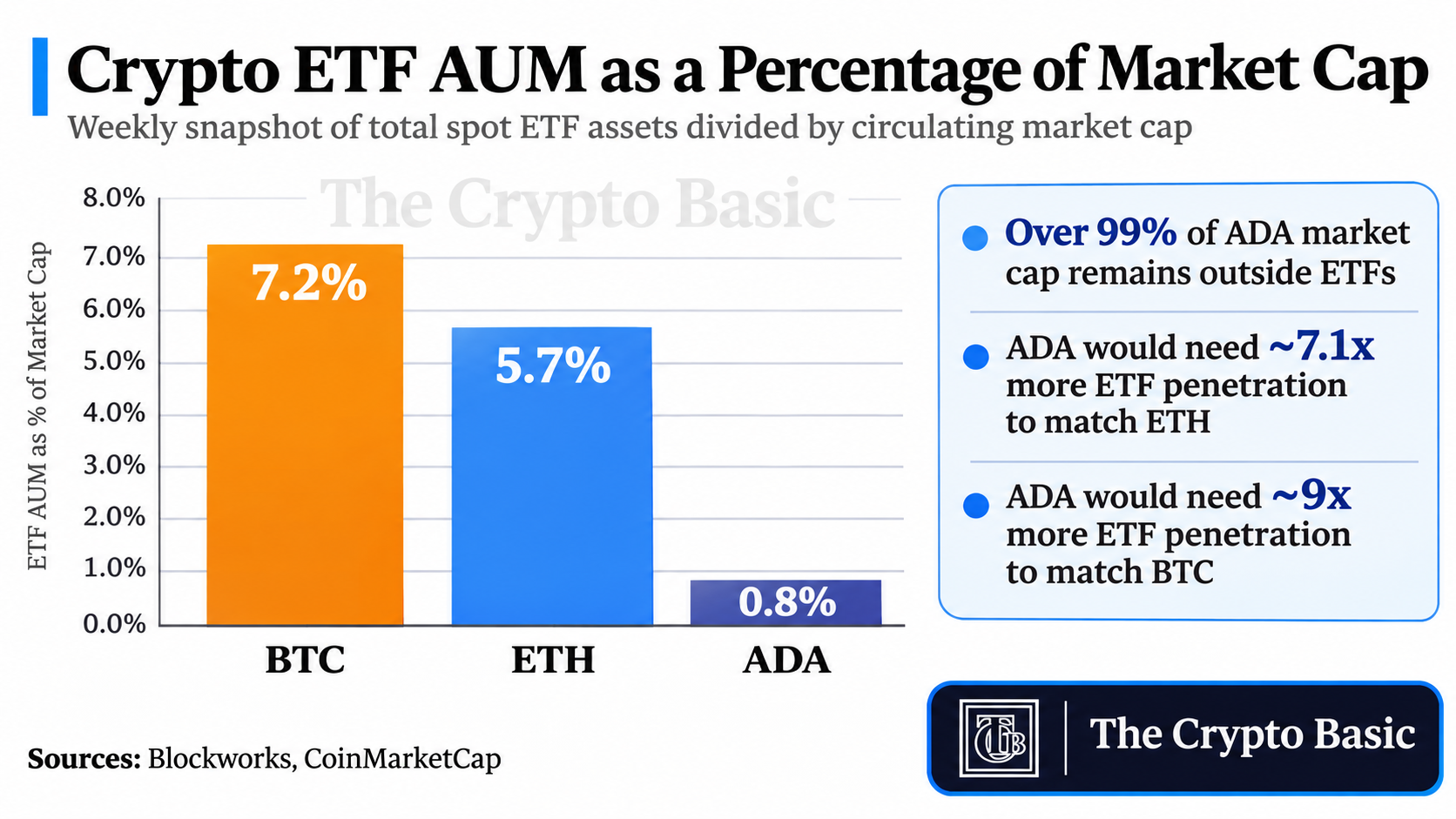
Blockworks data shows a major gap in ETF penetration among the three assets. In the latest weekly snapshot, Bitcoin ETF AUM represented approximately 7.2% of BTC’s market cap, while Ethereum stood around 5.7%. Cardano was much lower at approximately 0.8%.
This means roughly 99.2% of Cardano’s circulating market value remains outside ADA-focused spot exchange-traded products, potentially leaving substantial room for additional institutional investment vehicles if demand develops.
Blockworks’ continuously updated dashboard currently puts ADA’s AUM-to-market-cap ratio at 0.84%, with approximately $62.6 million in AUM across 11 tracked Cardano-linked products. The same live dataset currently places Bitcoin at 7.68% and Ethereum at 6.4%, showing that the large relative gap remains despite weekly changes in prices and fund assets.
ADA ETF Penetration Trails Bitcoin and Ethereum by a Wide Margin
The difference becomes clearer when comparing the ratios directly.
At the 0.8% level in the Blockworks snapshot, Cardano’s ETF penetration would need to increase approximately 7.1 times to equal Ethereum’s 5.7% ratio.
Matching Bitcoin’s 7.2% ratio would require ETF AUM relative to ADA’s market capitalization to expand roughly ninefold.
This does not mean those multiples of capital will necessarily enter ADA ETFs. Bitcoin and Ethereum have much deeper institutional markets, more established ETF infrastructures and longer histories of regulated U.S. spot products.
However, the comparison shows how little of Cardano’s existing valuation is currently represented inside exchange-traded investment vehicles.
Notably, Blockworks currently reports that 98.36% of ADA-linked fund AUM comes from spot products, while only 4.21% of the total AUM is associated with U.S.-listed products.
That geographic imbalance could become important if additional U.S. investment vehicles eventually enter the market.
Cardano Already Attracted More Than $44M in Previous ETF Flows
Cardano-linked investment products have already shown signs of demand despite their relatively small footprint.
The Crypto Basic reported in July that more than $44 million had flowed into ADA investment products, including $37.2 million during 2025 and another $6.9 million during the first part of 2026.
ADA has also gained exposure through diversified institutional products. Cardano joined the Hashdex Nasdaq crypto index fund and was subsequently added to T. Rowe Price’s active crypto ETF.
However, Cardano suffered a setback in August when Grayscale withdrew its planned standalone spot ADA ETF. Grayscale said it no longer intended to proceed with the offering, which had never become effective.
This leaves Cardano with far less dedicated institutional distribution than Bitcoin and Ethereum.
Low ETF Share Could Represent Opportunity, Not Guaranteed Inflows
ADA currently trades around $0.175, with a circulating market capitalization of approximately $6.45 billion, according to CoinMarketCap.
The low ETF penetration comes as Cardano’s price remains under significant pressure. ADA recently failed to recover its former $0.19 range support, keeping the short-term technical structure bearish.
That creates an interesting contrast.
ADA’s price is near multi-year lows while regulated investment products control only a small fraction of its market value. Additional spot products—particularly products with broader U.S. distribution—could create another channel through which traditional investors gain exposure without directly holding ADA.
Still, 99% of ADA sitting outside ETFs should not be interpreted as 99% of supply waiting to enter ETFs. Most cryptocurrency market capitalization naturally remains outside funds, and a higher ETF-to-market-cap ratio depends on investor demand rather than product availability alone.
For Cardano, however, the comparison with Bitcoin and Ethereum highlights how early its institutional fund penetration remains. If new ADA products attract meaningful capital, there is substantially more room for the ETF share of Cardano’s market value to expand from today’s sub-1% level.