Home Blog Page 1025

Something Massive Cooking For XRP as Ripple CEO Meets with Trump

0

Something significant might be in the works for XRP as Ripple executives have met with U.S. president-elect Donald Trump.


In a tweet today, Ripple CEO Brad Garlinghouse confirmed having dinner with Trump. Stuart Alderoty, Ripple’s chief legal officer, was also present at the late-night event.

While the Ripple executives have kept the details of the crucial meeting with Trump under wraps, Garlinghouse gave the XRP Army a hint. Specifically, he disclosed that the development represents a “strong start” to the new year, 2025.

XRP Army Excited, Says Road to $10 Now Open

The XRP community has been buzzing with excitement since the disclosure, estimating the pivotal significance of Ripple’s leadership meeting with pro-crypto President Trump. The development has attracted various commentaries and speculations on what’s next for XRP and Ripple.

Charles Hoskinson, founder of Cardano, commented, cheering the outcome and saying, “Nicely done, Brad.”

Widely followed XRP technical analyst Egrag remarked that XRP may now be ready for a “send to Valhalla,” a metaphor for a lofty price point for XRP.

Meanwhile, Edo Farina, CEO of Alpha Lions Academy, stated that Ripple’s executive meeting with incoming president Trump means XRP could play a key role in the American financial system.

XRP YouTuber Moon Lambo highlighted the significance of the Ripple executive meet-up with Trump for the broader crypto community. He suggested those who still have doubts about Trump’s campaign promises of making “crypto great again” can put those fears to rest.

Overall, many commentators acknowledged that the latest development could mark the start of XRP’s bull run for 2025, with big moves potentially brewing. Some have suggested it’s a “checkmate,” and “nothing is stopping” XRP from rallying to $10 anytime soon.

Crucial Events for XRP to Unfold Under the Trump Administration

Notably, XRP proponents expect the four-year-long-running Ripple lawsuit with the SEC to finally be put to rest.


The suit is currently in an appeals phase. Legal experts have cited significant rationale for why the appeal will be dismissed soon after the new SEC chair, Paul Atkins, takes over leadership.

Furthermore, the XRP Army expects the launch of XRP ETFs under the Trump administration. Already, four applications are on the SEC’s desk, pending comments.

Additionally, many expect Ripple’s IPO to occur under the new U.S. administration. Ripple has been considering a U.S. IPO but previously shelved the idea due to regulatory challenges. 

At one point, the company even considered an overseas IPO. With the anticipated favorable regulation, Ripple’s CEO has said its IPO plans will change.

The XRP community views Ripple’s IPO as an avenue to promote XRP to a broader audience, potentially propelling its price.

Ripple President Reveals When RLUSD Will Launch on Coinbase, Says XRP ETF To Launch Soon

0

Ripple President Monica Long reveals the company’s strategic plans to roll out its stablecoin, RLUSD, on major trading platforms like Coinbase. 

Monica made this known in a recent interview with Bloomberg. Recall that on December 17, Ripple USD launched on five exchanges, such as CoinMENA, Bitso, Uphold, MoonPay, and Archax. 

The crypto payments company announced additional listings on other platforms like Mercado Bitcoin and Independent Reserve. 

RLUSD to Launch on Coinbase Imminently 

However, Ripple has yet to announce the stablecoin’s launch date on leading exchanges like Coinbase and Binance. During a recent interview on Bloomberg, Monica was asked when Ripple plans to launch RLUSD on these platforms, specifically Coinbase. 

Responding, she emphasized that Ripple is expanding RLUSD’s availability and distribution to more platforms. She pointed out that announcements about major exchange listings, including Coinbase, will come soon. When asked how soon this will happen, she said, ‘imminently.’  

Ripple President Expects More Adoption for RLUSD 

Furthermore, Monica was asked to provide insights into RLUSD’s adoption and growth potential over the next year. Notably, she tied the adoption of the Ripple stablecoin to the overall crypto market growth, suggesting that stablecoins are essential for payments and trading. 

The Ripple President expects this year to be “big” for crypto, adding that demand for stablecoins will surge alongside. According to her, RLUSD will have a premium role in Ripple’s payment solution. 

“So we see a really strong growth trajectory for our payments solution, with that Ripple USD will have a premium role,” Monica remarked. 

In the meantime, RLUSD’s trading volume has skyrocketed by 211.81% over the past 24 hours to $75.69 million. The stablecoin maintains its $1 price alongside a notable market cap of $53.09 million at press time. 

XRP ETF to Launch Soon 

Meanwhile, the interviewer probed Monica to comment on the likelihood of an XRP ETF launching soon. 

The Ripple President responded with optimism about an XRP ETF in the United States. She expressed that XRP is the next crypto lined up for a spot-based exchange-traded fund after Bitcoin and Ethereum. 

Monica highlighted the multiple filings from companies such as Canary Capital, Bitwise, 21Shares, and WisdomTree and noted that the incoming administration could expedite their approvals. 

In the meantime, the SEC has not acknowledged any of the filings exclusively tied to XRP. However, crypto enthusiasts expect this to change under the incoming leadership of pro-crypto advocate Paul Atkins. 

Senior Analyst Shows Ideal Selling Strategy for XRP, Predicts a Perfect Exit Point

0

Maelius, a notable market analyst, identifies the ideal selling strategy for XRP holders, predicting a perfect exit point for the market.

XRP has experienced price volatility since December 2024 alongside the broader crypto market. A strong rebound at the start of 2025 saw Bitcoin break the $100,000 mark, allowing XRP to climb to $2.5. 

However, resistance at these levels led to a price retracement. By Jan. 7, Bitcoin fell below the $100,000 mark, while XRP dropped 6% to $2.3. Despite this consolidation, analysts remain optimistic about XRP’s potential for further growth, though opinions vary on the extent of the next surge.

XRP Slipping into Wave 3

Prominent market analyst Maelius recently shared his take on XRP’s price trajectory and outlined selling levels for investors. Maelius noted that XRP’s historical price movements tend to be rapid, with brief corrections. 

According to him, the asset typically exits accumulation phases in two swift waves, separated by one correction. This often attracts retail investors during the second wave, many of whom buy at greater prices. 

He further explains that XRP’s third wave (W3) often leads to an extensive shakeout phase that eliminates weaker retail hands. This prepares the market for a final move, which typically coincides with a peak in media attention and retail interest. 

XRP 1W Chart Maelius
XRP 1W Chart | Maelius

The analyst’s chart suggests XRP has now slipped into this cycle’s wave 3, after completing wave 2 on the back of the early November to December 2024 upsurge. Citing historical comparisons, he predicts that XRP could reach $10 in the current W3 phase. 

XRP Targets $10-$13

Maelius then linked XRP’s price potential to its market dominance (XRP.D). He suggests that dominance is close to a resistance zone that historically has limited XRP’s market share. In past cycles, XRP dominance peaked during W3, but further gains faced roadblocks in subsequent moves. 

Assuming the total cryptocurrency market cap grows from the current $3.5 trillion mark to $6.2 trillion (a 2.618 Fibonacci level), Maelius estimates XRP’s price at $4.3, if XRP.D remains stable. For context, XRP market dominance currently sits at 3.9%.

TOTAL Crypto Market Cap Maelius
TOTAL Crypto Market Cap | Maelius

However, if XRP dominance grows further to reach the lower end of its resistance zone (around 12%), XRP could hit $13. Meanwhile, hitting the upper resistance level implies a price of $26, though Maelius believes this is highly unlikely.

XRP Market Dominance Maelius
XRP Market Dominance | Maelius

Ideal Selling Strategy

Maelius noted the importance of having a good exit strategy. He advises selling a major portion of holdings as XRP approaches $10-$13 during W3. While the possibility of XRP reaching $26 exists, the analyst warns that risk-reward ratios diminish as prices go parabolic. 

He also highlights the potential for XRP to underperform the broader market once its dominance reaches resistance levels. At press time, XRP changes hands at $2.30, up 1.59% today. From this level, the asset would need to rally 334%-465% to reach the W3 targets of $10-$13.

Smart Crypto Starts With Transaction Simulation For Predictable Costs

0

A network of nodes validates blockchain transactions. The nodes earn crypto as fees, incentivizing them to process these transactions. Fees increase as users compete to achieve higher processing speeds when there are more transactions than usual on a blockchain. This sometimes happens when a particular cryptocurrency’s price increases. More users tend to move their assets around during these periods, leading to more transactions and higher fees.

Likewise, increased demand for a particular token leads to correspondingly higher fees. This happens when there is a lot of hype around a given project. Bitcoin transaction fees were relatively high when the Bitcoin-based protocol BRC-20 was popular in the spring of 2023.

Users’ options to avoid high costs

An obvious option is to wait for fees to go down before sending cryptocurrency, but it’s not feasible if you want to send it quickly. Fees can also be slightly lower during slow hours in leading markets, like nighttime in the US.

If a user is sending crypto to another exchange, they can exchange it for an asset like Ripple or Litecoin, whose fees tend to be lower. Then, they swap it back to their preferred asset on the other exchange. However, they’ll still be charged buying and selling fees.

A transaction simulation is an excellent way to predict fees, help keep crypto novices informed, and prevent mistakes. The simulation feature of Ambire Wallet, an open-source smart wallet that uses account abstraction, informs users of the effect of a transaction on their balances before they sign off on it. In addition to providing all the features and functions available from widely adopted solutions like Metamask, Ambire offers account recovery, prepayment of gas fees to avoid spikes, and transaction batching. It’s more affordable to send one large transaction instead of a few small ones. Blockchain activity determines the costs, not the amount of crypto you’re sending, so you’d pay the same fee for a small and a large transaction value. Ambire Wallet users combine transactions and broadcast them together, which saves both time and money.

The anatomy of transaction simulation

Ambire greatly alleviates the complexity of transaction simulation. The intricate process starts with defining input parameters and ends with assessing transaction outcomes. There are several critical stages, each contributing to the reliability and accuracy of the simulation results.

A series of input parameters defines the transaction’s behavior and features. These parameters include sender address, transaction type, receiver address, gas price and limit, and other relevant attributes. Users customize the simulation to accurately reflect objectives and scenarios, but not without meticulously defining these parameters. After defining them, validation procedures are performed to ensure the transaction’s integrity and feasibility. Validation involves verifying address authenticity and evaluating the parameters’ compliance with preset criteria.

Following validation, the simulation prepares the blockchain environment based on current data and system configuration. This includes retrieving relevant information, including, but not limited to, contract codes, account balances, and gas, which measures the computational resources consumed while the simulated transaction is being executed. Gas estimation involves evaluating the consumption of separate transaction elements and operations. Memory usage, opcode cost, and storage access are considered to accurately estimate the total gas required to execute the transaction. This determines the gas fees associated with the transaction.

Finally, the transaction simulation executes the operations entered in the input parameters. This stage involves simulating fund transfers, executing smart contract functions, and updating contract storage according to predetermined transaction logic. The simulation tracks each operation’s gas consumption during execution, monitoring the use of computational resources throughout the process. Tracking gas use makes it possible to assess how efficient transaction operations are and identify potential issues that may impact performance.

The simulation ends with an evaluation of transaction results, specifically the cost and integrity of the transaction. The evaluation involves verifying the completion of transaction operations, checking for errors, and examining the ensuing alterations to the blockchain state.

Simulations empower users to gauge the effectiveness of the entire process and attain valuable insights into the transaction’s impact on their finances, investment, and the whole blockchain.

Transaction simulation reduces risk

Even novices know that you can’t reverse a blockchain transaction. Once a user signs a transaction, they cannot change or undo it. Simulation lets them predict potential issues or consequences, greatly reducing the risk of irreparable errors. You can simulate swaps, trades, or liquidity provisions in DeFi interactions to make sure they won’t lead to unexpected losses ensuing from non-optimal trade execution or slippage.

Ethereum transactions can incur substantial gas fees depending on their complexity and the degree of network congestion at any given time. Simulating transactions provides an estimate of the gas required, preventing users from underpaying, which can lead to stuck or failed transactions. Overpaying is equally undesirable, as excessive gas fees inflate transaction costs needlessly. By providing accurate gas estimates, simulation makes it possible to set the proper gas limits and keep expenses in check.

The outcomes of blockchain transactions aren’t immediately apparent, especially if the transactions involve complex DeFi protocols or smart contracts. When voting in DAOs or implementing complex financial strategies, simulation helps users understand the implications of their decisions, leading to economically viable and safe choices. Ultimately, simulation clarifies the result of a transaction’s execution so involved parties are fully informed.

Bitcoin Funding Rates Show Traders are Cautious as BTC Drops Below $100K Again

0

Despite the latest Bitcoin upsurge, funding rate data indicates caution among traders amid recent resistance.

Bitcoin started 2025 with a strong rally, climbing 4% on Jan. 6 to reclaim the $100,000 mark for the first time in weeks. The price peaked at $102,760 today before facing resistance, leading to a sharp correction that pushed Bitcoin back below six figures. 

Cautious Market Sentiment Evident in Funding Rates

Meanwhile, despite yesterday’s upsurge, Glassnode disclosed today that funding rates, a notable metric for assessing trader sentiment in derivatives markets, show a cautious outlook in the market. 

According to the disclosure, the weekly moving average of perpetual funding rates fell to 0.009%, below the neutral level of 0.01%. This marks a decline from mid-December’s high of 0.026%, showing limited interest in paying premiums for leveraged long positions.  

In addition, Coinglass data reveals that the Open Interest-Weighted Funding Rate increased slightly to 0.0058% but marks a significant drop from Jan. 5’s high of 0.0113%. Similarly, the Volume-Weighted Funding Rate rose to 0.0051%, still far below its previous peak of 0.0111%.  

Notably, these declining funding rates suggest that traders are exercising caution, as Bitcoin battles at the $100,000 psychological mark. The reluctance to take on leveraged exposure indicates concerns about the sustainability of the recent rally.  

Despite this, Bitcoin derivatives trading activity has surged, with 24-hour volume increasing 41.54% to $85.32 billion. Open Interest also rose but by a modest 2.08%, reaching $64.87 billion. The Long/Short Ratio stands at 1.0243, suggesting a near-even split between bullish and bearish sentiment.  

Bitcoin Current Position 

Notably, on the daily chart, the Chande Momentum Index (CMI) rose to 58.71 during Bitcoin’s breakout above $100,000. However, the indicator has since retraced to 47.90. This is largely due to waning bullish strength as the price slipped below $100,000.  

Bitcoin 1D Chart
Bitcoin 1D Chart

At the time of writing, Bitcoin trades at $99,866 amid a 2.19% decline for the day. Bitcoin’s immediate resistance lies at $101,536, the upper Bollinger Band. Support is at the 20-day moving average of $96,642, a level tested during the Jan. 5 lows.  

Interestingly, market analyst Rekt Capital noted the importance of a daily close above $101,165 to confirm a breakout from Bitcoin’s recent trading range. According to him, failure to reclaim this level could signal prolonged consolidation or further downside. Meanwhile, losing support at $96,642 could intensify bearish pressure.

Binance Bitcoin Netflow Turns Negative Amid Accumulation, As BTC Holds Above $100K

0

Binance’s two-week simple moving average (SMA) netflow of BTC has turned negative, signaling potential short-term bullish momentum for Bitcoin.

Bitcoin achieved a major milestone yesterday, surpassing the $100,000 mark for the first time since December 19, 2024. This surge followed multiple attempts since January 4, where the crypto faced consistent resistance and retreated by a few thousand dollars each time. 

However, bulls later gained the upper hand and propelled Bitcoin to a fresh yearly high of $102,700 on Monday. Notably, the premier crypto is now trading at $100,619, reflecting a 6.74% rise in the past 7 days.

Netflow Data Show Accumulation Trend

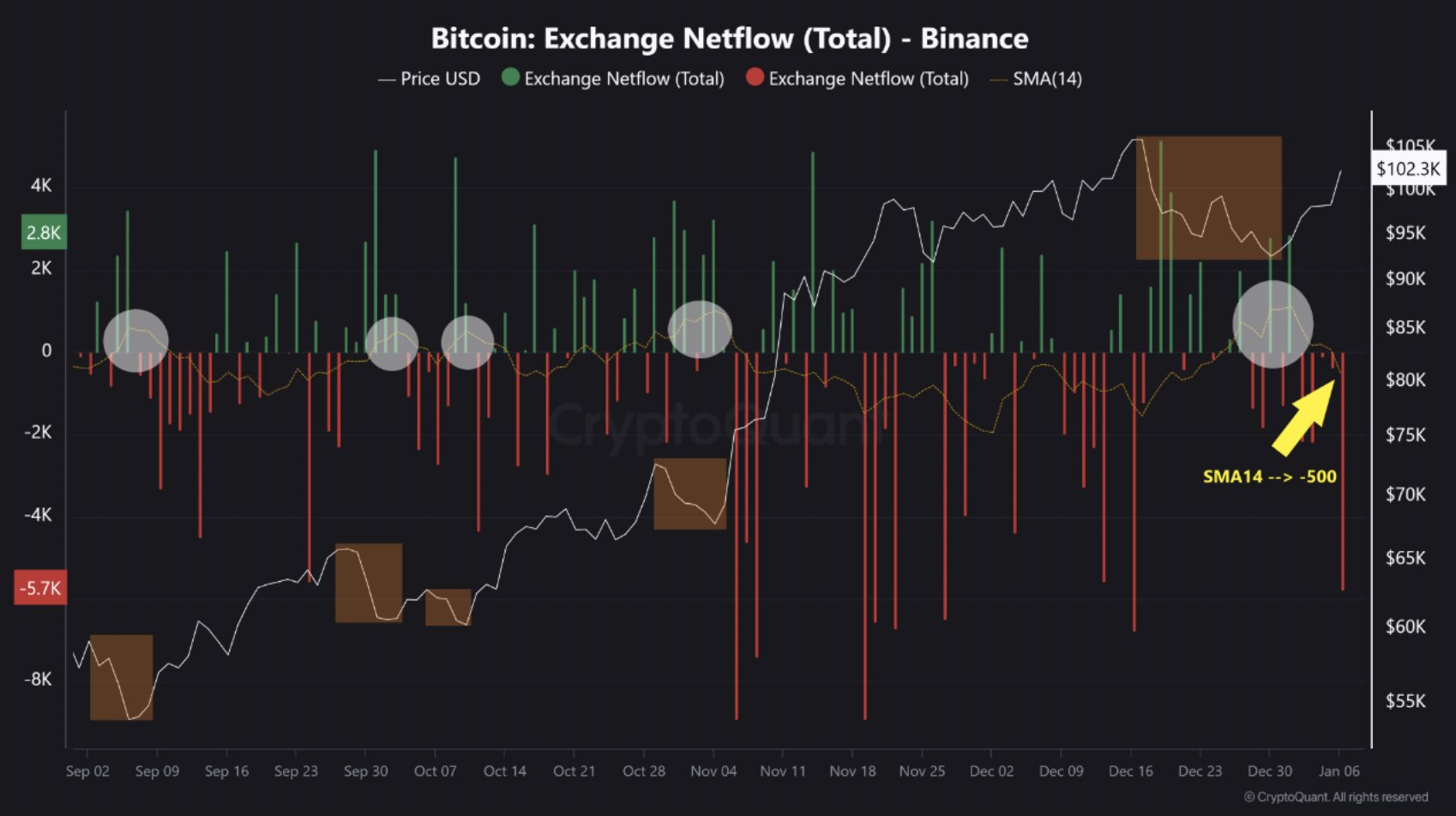
Amid the rally, Binance’s netflow data revealed a shift toward accumulation among investors. Analysis by CryptoQuant showed the Binance Netflow SMA 14 turning negative for the first time since December 25, 2024. 

Historical patterns suggest that when this metric dips below zero, Bitcoin often experiences short-term bullish movements. On January 6, Binance reported a Netflow of -5,407 BTC, bringing its 14-day SMA netflow to negative 483 BTC.

These figures highlight increased accumulation activity, contrasting previous periods of selling pressure when the metric entered positive territory. According to CryptoQuant, this pattern indicates a potential short-term bullish shift in Bitcoin’s price momentum.

Image
Graph of Binance Bitcoin flow by CryptoQuant

Retail Activity and Buying Opportunities

Parallel data analysis indicated a sharp drop in retail demand, which some analysts interpret as a bullish signal. CryptoQuant’s review of 30-day retail demand variation highlighted that demand surged by over 30% as Bitcoin approached $100,000, aligning with the establishment of a local top at $108,000. 

Following a correction, retail demand variation plummeted to -16%, a level historically associated with ideal buying opportunities. While a measured increase in retail participation is generally positive, the sharp decline underscores the shifting dynamics in Bitcoin’s investor base, where retail activity has diminished as quickly as it rose.

Coinbase Premium Index and Derivatives Data

Adding to the bullish sentiment, the Coinbase Premium Index crossed its two-week Simple Moving Average for the first time in nearly a month. This crossover, observed when Bitcoin traded at $98,100, marked renewed U.S. buyer activity and was followed by a 4% price increase to $102,000. 

Additionally, derivatives market data reflected heightened trader engagement. As of January 7, open interest climbed by 2.74% to $64.86 billion. At the same time, the long-to-short ratio exceeded 1, indicating a preference for bullish positions.

Backpack Exchange Takes Over FTX EU for Q1 Relaunch, Vows Swift Customer Refund

0

The Backpack crypto exchange has acquired the European arm of the collapsed FTX exchange, FTX EU, and is planning a first-quarter launch. 

Backpack CEO Armani Ferrante confirmed the acquisition in a tweet today. The deal reportedly received approval from the Cyprus Securities and Exchange Commission (CySEC) and the FTX bankruptcy court. It sets the stage for Backpack to broaden its presence across the European Union.

Notably, the acquisition comes as part of Backpack’s strategic growth plan. Backpack EU, the new European entity, will offer a wide range of crypto derivative services, including perpetual futures, across the EU. 

Furthermore, the company emphasized its commitment to returning funds to FTX EU customers as quickly as possible as part of the ongoing bankruptcy claims process. CEO Armani Ferrante stressed the importance of customer restitution in rebuilding trust within the crypto industry.

Ferrante promising swift refunds
Ferrante promising swift customer refunds

FTX EU Path to Re-Activation

Backpack EU is set to relaunch in Q1 2025 after securing a license reactivation. The exchange will provide further details on its support channels, including how FTX EU customers can access their funds and how new users can sign up.

This acquisition marks a significant milestone in the FTX EU saga, which had seen multiple ownership changes since FTX’s collapse in November 2022. FTX EU, originally Digital Assets AG, was acquired by FTX in 2021 before eventually being sold back to its founders for $32.7 million in early 2024.

Former FTX Employees Found Backpack 

Ferrante, a Solana developer, founded the Backpack exchange in 2022. He reportedly raised $20 million in FTX and Jump Crypto investments to support the platform’s development. 

His journey began with introducing the Backpack Wallet, a non-custodial service. Before launching Backpack, Ferrante developed Anchor, a security protocol and developer tool for Solana.

Tristan Yver, another co-founder of Backpack, previously worked at FTX for over two years before departing the company in May 2022.

Following FTX’s downfall in 2022, Backpack faced significant losses, with $14.5 million—88% of its operational funds—wiped out.

Czech Republic National Bank Governor Considers Strategic Bitcoin Reserve

0

Bitcoin’s status as a treasury reserve asset has continued to gain momentum, with the Czech National Bank governor, Ales Michl, recently considering the idea.

Countries globally are beginning to notice Bitcoin’s intrinsic feature as a store of value. Corporate entities are not left out either, with notable firms incessantly aping into the pioneering cryptocurrency.

In a recent media appearance, the Czech Republic’s Ales Michl confirmed that the FOMO got to him. The National Bank governor told CNN that he considered investing a portion of the bank’s reserve in Bitcoin.

Governor Considered Buying a Few Bitcoin

Michl noted that he considered buying Bitcoin for its foreign exchange reserve. He viewed the largest cryptocurrency by market cap as a worthy asset for reserve diversification.

Meanwhile, the ploy has not materialized yet. Notably, the governor would need approval from all seven Czech National Bank (CNB) board members to pursue such an endeavor.

Nonetheless, Janis Aliapulios, the adviser to the National Bank board, confirmed the development. He noted that although the board considered the proposition, it is currently not pursuing Bitcoin diversification.

However, Aliapulios suggested that the CNB will be open to embracing the crypto firstborn in the future. While it did not pull through this time, Michl remains open to considering Bitcoin as a treasure reserve asset.

Notwithstanding, the Czech National Bank will pursue expanding its gold stash. Michl disclosed the central bank will increase its gold’s percentage holding among its total assets to 5% by 2028.

Trump’s Bitcoin Embrace Driving Widespread Adoption

A few months back, the international market viewed Bitcoin as an unstable asset with heightened volatility. While Bitcoin remains volatile, the perception around the asset has changed by a great deal.

This utter paradigm shift comes from President-elect Donald Trump’s glaring embrace of the digital asset. Not only did he call Bitcoin the currency of the future, but he also teased the creation of a US national stockpile of the premier asset.

While the bill presented by Senator Cynthia Lummis progresses, other countries are keying into the Bitcoin FOMO. Russia, Switzerland, and Brazil are considering the asset, while market expert Anthony Scaramucci predicted China would soon join the bandwagon.

Meanwhile, the US growing crypto involvement contributed to Bitcoin’s surge to an all-time high of $108,000 early last month. After a slight correction, the asset recently reclaimed six figures, reinstating its credibility.

Binance Founder Changpeng Zhao Says “$100K is Boring” as Bitcoin Recovers Key Level

0

Former Binance CEO Changpeng “CZ” Zhao asserts that the $100,000 price point is “boring” in response to the recent Bitcoin recovery.

Much to the relief of most crypto proponents, Bitcoin is back above the $100,000 price point. The asset had fallen below the keenly watched level on December 19 due to Fed hawkishness. Amid its recent recovery, former Binance CEO Changpeng “CZ” Zhao is stoking excitement.

“100K is Boring”

Former Binance CEO Changpeng “CZ” Zhao has asserted that the $100,000 price point is “boring” in response to Bitcoin’s surge back above the level over the past 24 hours, the first time the asset has traded above it since December 19.

“100K is boring, right?” Zhao wrote in an X post on Tuesday, January 7.

The statement triggered excitement as it suggests that Zhao is anticipating higher prices for Bitcoin. Zhao himself has alluded to this in recent statements. 

On January 3, the influential crypto figure dubbed 2025 a “‘send it’ year.” Crypto enthusiasts often use the phrase ‘send it’ to express excitement when asset prices are soaring.

The sentiment comes as several analysts maintain that Bitcoin’s price is set to soar higher in 2025, with some, like Bitwise CIO Matt Hougan, tipping the asset to hit the $200,000 price point driven by institutional adoption and nation-state interest.

While Binance’s Zhao has not offered a Bitcoin price prediction for 2025, he has in the past implied that he expects the asset to one day exchange hands for $850,000 per coin.

Speaking at Bitcoin MENA 2024, he asserted that the asset would eventually surpass gold in market capitalization. For context, gold boasts a market cap of $17.8 trillion at the time of writing. On the other hand, Bitcoin has a valuation of $2 trillion.

Bank of America Doing 100% of Internal Transactions on XRP with 83 Patents: Sound Planning CEO on FOX Business

0

A recent publication from FOX Business News spotlights a statement that Bank of America is conducting “100% of its internal transactions” using XRP.

Specifically, the suggestion came from David Stryzewski, CEO of Sound Planning Group, during a discussion on FOX Business on Monday, January 6. Stryzewski claimed that Bank of America had not only integrated XRP into its daily operations but had also filed 83 patents related to the blockchain technology behind Ripple.

Accordingly, he expressed a bullish sentiment on XRP, stressing that it would serve as a key vehicle in the future of finance.

“XRP is going to be the track that everything runs on in the future,” Stryzewski stated during the segment on FOX Business.

Furthermore, he bolstered his bullish view on XRP by noting that Ripple is progressing in the payment market despite regulatory challenges. He cited Ripple’s recent launch of its stablecoin as a move that strengthens its position in the payment market.

Given these efforts, Stryzewski mentioned in the interview that XRP is the crypto asset market participants should watch.

Meanwhile, Stryzewski’s claim that Bank of America uses XRP for internal transactions has triggered spirited conversations in the XRP community. They view the claim as further confirmation of XRP adoption in the mainstream banking sector by leading financial institutions.

However, Stryzewski’s assertion that Bank of America is conducting 100% of its internal transactions using XRP remains unconfirmed.

Ripple and Bank of America Connections

Yet, Ripple and Bank of America have a history of association. According to Ripple’s official website, Bank of America is part of Ripple’s global payments network, RippleNet, and serves on its Governance Committee. 

This committee consists of leading global financial institutions that work together to develop and maintain standardization in global cross-border transactions. Other members include companies such as Nium, Santander, and Standard Chartered.

Also, in 2017, Bank of America filed a patent for a settlement system that references a “ripple” distributed ledger. The system sought to enable real-time settlements and facilitate interbank communication using decentralized ledger technology (DLT), where both banks can verify transactions.

Although the patent mentions “prefunded ripple settlement,” it does not directly reference Ripple’s payment token, XRP.