Home Blog Page 103

XRP “Most Realistic” Chart Reveals When Price Could Hit $10

The “most realistic” XRP chart points to a possible rally to $10, according to well-known analyst Celal Küçüker, who has shared the timeline for this target.

Küçüker’s analysis comes at a time when sentiment surrounding XRP has declined to new lows amid the latest market-wide pullback. With this decline, XRP’s year-to-date loss has grown to 38%.

Despite the decline, the analyst suggests XRP could reach $10 between December 2026 and February 2027, calling this chart “most realistic.”

XRP’s Rising Channel

Küçüker’s chart shows that XRP has maintained its position within a rising channel that has dictated its price action for more than six years now.

For context, this channel started forming on the monthly chart after XRP fell to $0.11 in March 2020 and then staged a recovery effort. 

XRP Rising Channel Celal Kucuker
XRP Rising Channel | Celal Kucuker

The channel’s support trendline emerged at this point and has remained relevant to this day, as XRP has continued to find support at the line. Notably, this support trendline trends upward, indicating that since March 2020, XRP has continued to see higher lows. 

Meanwhile, overhead, XRP faces a resistance line that has capped its upside potential. The first time XRP tested this trendline was when it ran to $1.96 in April 2021. The resistance at this line led to a pullback. 

XRP retested the trendline at $3.4 in January 2025 and $3.6 in July 2025, facing a roadblock each time. Also, the upper resistance trendline has continued to trend upward, showing that XRP has seen higher highs since April 2021. This has resulted in the formation of the rising channel.

Historical Pattern

Interestingly, Küçüker’s chart shows a historical pattern surrounding the rising channel that persistently leads to an upward trend for XRP. 

Specifically, whenever XRP’s price drops to find support at the lower trendline, what follows is a recovery and then a price spike to higher highs until it finds resistance at the upper trendline. This pattern resulted in the rally to $1.96 in April 2021, $3.4 in January 2025, and $3.6 in July 2025.

Timeline for XRP to $10

With XRP now eyeing a retest of the lower trendline again amid the ongoing downtrend, Küçüker believes the pattern could play out again. 

First, he expects XRP to decline further toward $0.87, which aligns with the 0.618 Fibonacci retracement and the lower support trendline. Notably, analysts like Chart Nerd and Casi also believe a potential drop toward similar levels may play out.

Once bulls find strength here, they could engineer a rebound campaign that would help XRP recover the losses of the last few months and eventually aim for higher prices.

The market analyst sees XRP soaring to a higher high of around $10 during this rally, similar to the historical pattern that has played out for six years. He believes this is the “most realistic” XRP chart in the market today and suggests that the rally to $10 could happen between December 2026 and February 2027.
Ripple CTO Emeritus Reveals Where XRP Is Headed

Popular XRP community figure BankXRP has highlighted how the XRP Ledger (XRPL) is evolving beyond its original role as a payments-focused blockchain into an infrastructure for tokenized finance.

Drawing on recent remarks from Ripple CTO Emeritus David Schwartz, BankXRP argued that XRPL is positioning itself as a platform for real-world asset (RWA) tokenization, stablecoins, and institutional financial products.

Schwartz Outlines XRPL’s Next Phase

Schwartz made the remarks during a recent “XRP In A Minute” segment, where he revealed where XRP and its native blockchain are headed. 

According to him, Bitcoin first demonstrated that public blockchains could securely store and transfer value without relying on centralized intermediaries.

He explained that XRPL later expanded on this concept by supporting not only its native digital asset but also issued assets capable of representing stablecoins, tokenized real-world assets, and other financial instruments.

Furthermore, Schwartz emphasized that enterprises are already using XRPL to tokenize real-world assets. Looking ahead, he stated that the network could eventually support a broader range of tokenized financial products, including securities, money market funds, stocks, repos, and loans.

At the same time, Schwartz suggested that growing enterprise adoption could drive wider retail participation. He also noted that decentralized finance applications could leverage tokenized assets on XRPL to provide services traditionally offered by banks and other financial institutions. 

BankXRP Points to Strong On-Chain Growth

Following Schwartz’s remarks, members of the XRP community, including BankXRP, reinforced the narrative with on-chain data. According to BankXRP, XRPL’s real-world asset market cap reached $2.25 billion in the first quarter of 2026, marking a 124% quarter-over-quarter increase.

In addition, BankXRP highlighted the growing role of Ripple USD (RLUSD) as a liquidity layer for the ecosystem. Through its integration with Wormhole, RLUSD now operates across more than 40 blockchains. The stablecoin currently boasts a market cap of approximately $1.7 billion, with BankXRP claiming that about $340 million resides on XRPL. 

As a result, BankXRP argued that XRPL has moved beyond theoretical discussions and into practical implementation. To support this view, he pointed to a recent pilot involving Ripple, JPMorgan Chase, Ondo Finance, and Mastercard. The initiative demonstrated a cross-border tokenized treasury redemption model in which banks handled cash settlement while XRPL managed the tokenized assets.

Utility Continues to Grow Despite Price Weakness

Moreover, BankXRP drew attention to the rising network activity despite XRP’s price decline, particularly in the first quarter.

Specifically, XRPL’s daily transaction volume surged 35.3% quarter-over-quarter to 2.48 million transactions during the first quarter of 2026. This trend suggests that network utility continues to expand even during periods of market weakness.

Despite these developments, BankXRP argued that the pace of future institutional adoption, particularly once existing pilots and enterprise initiatives transition into fully operational products, remains uncertain.

Latest Data Shows Continued Expansion

Meanwhile, XRPL continues to strengthen its position within the tokenized real-world asset sector. Recent data from rwa.xyz underscores the growth in both institutional and stablecoin activity across the network.

According to the data, XRPL’s represented asset value climbed to $3.57 billion, reflecting a 13.68% increase over the past 30 days. During the same period, the number of RWA holders surged 96.43% to 110.

The XRPL ecosystem now hosts 302 tokenized real-world assets. Although distributed asset value declined 11.31% over the month to $384.6 million, RWA transfer volume still reached $50.13 million during the last 30 days.

Stablecoin activity also recorded substantial growth. The network’s stablecoin market cap rose 78.36% month-over-month to $888.5 million, while 30-day transfer volume jumped 119.74% to $4.67 billion. Meanwhile, the number of stablecoin holders increased modestly to 59,000. 

XRPL RWA Activity
XRPL RWA Activity

These metrics indicate that tokenized assets and stablecoins are becoming increasingly important components of the XRPL ecosystem as the network expands beyond its traditional payments-focused use cases. 

Korean Traders Pull $135M in XRP from Upbit, as Global Exchange Outflow Hits $321M

South Korean XRP traders have led the charge, as investors pull XRP tokens off exchanges despite the latest price crash.

In the past seven days, traders have withdrawn more than $321 million from crypto exchanges, pointing to investor resilience amid the ongoing decline. Of this figure, Upbit, Korea’s largest exchange, accounts for the largest share at $135 million.

Key Points

  • XRP Investors have pulled more than $321 million worth of the token from exchanges over the past week.
  • South Korean traders are leading the charge, having withdrawn $135 million in XRP from Upbit.
  • Exchange withdrawals often point to bullish investor sentiment, leading to reduced selloffs on these platforms.
  • XRP reserves on Upbit have collapsed this month due to these outflows.
  • The trend comes despite XRP’s latest struggles, as prices retest the $1 psychological mark.

Global XRP Exchange Outflows Hit $321M

Data from market analytics resource Coinglass confirms this ongoing trend. Specifically, over the past week, global exchanges have recorded a combined net outflow of $321 million worth of XRP tokens, as investors pull their assets off centralized trading platforms.

For context, when exchange outflows spike, it means large amounts of crypto are being withdrawn from exchanges into private wallets. This indicates that holders are moving to self-custody rather than preparing to sell, reducing the available supply readily available for selloffs.

Upbit Leads, Coinbase and Binance Follow

Of the $321 million total, Upbit accounts for the largest share, with $135.9 million worth of XRP, or 42% of the global figure, flowing out of the trading platform within the past seven days. Over the last 24 hours alone, investors have taken off $11.35 million in XRP from Upbit.

XRP Exchange Flows Coinglass
XRP Exchange Flows | Coinglass

Meanwhile, Coinbase comes in at a distant second, having recorded $73.03 million worth of XRP net outflows in the last week. Interestingly, on the daily timeframe, Coinbase has seen greater outflows than Upbit, with $14.67 million in XRP flowing out of the trading platform over the past 24 hours.

Binance, the world’s largest crypto exchange by trading volume, has witnessed $60.93 million worth of XRP outflows in the past week, representing the third-largest net outflow among global exchanges. Bybit and OKX saw $15 million each. Only Bitstamp (+$10.78 million) and Crypto.com (+$2.44 million) recorded inflows within this period.

XRP Exchange Reserves Drop Despite Price Struggles 

Due to these sustained outflows, XRP reserves on multiple exchanges have continued to decline this month. According to data provided by CryptoQuant, a leading crypto data platform, Upbit’s XRP reserves have dropped from 6.515 billion XRP on May 30 to 6.497 billion tokens today.

XRP Exchange Reserve on Upbit CryptoQuant
XRP Exchange Reserve on Upbit | CryptoQuant

Notably, this trend comes despite XRP’s recent price struggles, which have resulted in consistent declines for the crypto asset. Specifically, the crypto market entered a renewed bearish phase this week, as Bitcoin (BTC) collapsed below $60,000. In response, altcoins like XRP saw a massive crash.

From trading for $1.33 at the start of this month, XRP has since dropped to $1.08 at press time, representing an 18.6% decline in June. The asset has seen five consecutive intraday losses this month and is on track to record a sixth one. Despite the decline, many traders have gone long, expecting an imminent rebound.

Seasoned Analyst Identifies a Good XRP Entry Point Before Rally to $30

A market analyst known as Dr Cat has identified what he sees as an attractive long-term entry point for XRP.

In a recent post on X, he argued that the asset could eventually rise to around $30 in the next major crypto market cycle.

The outlook comes as XRP continues to struggle alongside the wider crypto market. The token recently dropped to $1.09 during a sharp correction. At the same time, Bitcoin fell to around $59,000 after trading above $70,000 just a week earlier.

Key Points

  • Analyst Dr Cat sees XRP buy zone at $1.034, backed by Ichimoku cloud support.
  • He projects XRP could reach $30 in 2027–2028 if Bitcoin hits ~$250K and cycle plays out.
  • Worst-case risk: XRP could drop another 50% if Bitcoin sees a deeper market correction.
  • XRP is down 19% weekly and 23% monthly, but some view the weakness as accumulation.

Good XRP Entry Point

In a post on X, Dr Cat said long-term investors may find $1.034 a favorable buying area for XRP in USDT terms. He added that this level aligns with a thick Ichimoku cloud support zone. He views this area as offering a strong risk-to-reward setup.

Notably, he also projected that XRP could reach about $30 in late 2027 or 2028. This scenario assumes XRP trades around 12,000 satoshis against Bitcoin. It also assumes Bitcoin rises to roughly $250,000.

Meanwhile, the analyst warned that downside risks still exist. He noted that if Bitcoin sees a deeper correction, XRP could fall another 50% from current levels. Even so, he still considers the $1.034 zone a strong long-term opportunity.

Image

XRP Holders Need Patience

While the $30 target is highly bullish, Dr Cat said investors may need to wait a long time. He explained that his higher-timeframe analysis suggests the next major XRP expansion may not begin before September 2027.

This means investors entering now could face long consolidation periods. They may also experience continued volatility before any major upside appears.

What Would a Move to $30 Mean?

Using XRP’s recent low of $1.09 as a reference, a move to $30 would represent a gain of about 2,652%. Such a rally would be one of XRP’s largest moves in history.

Meanwhile, recent data from CoinMarketCap shows XRP has been heavily affected by the latest market downturn. The token is down 19.3% over the past week, 23% over the past month, and 41% year-to-date. From its all-time high of $3.65, XRP has now fallen more than 70%.

Despite the decline, some analysts still see the weakness as a potential accumulation phase. Dr Cat’s $30 forecast is among the most bullish long-term targets currently being discussed in the XRP community.

In a separate post, Digital Outlook argued that the current decline looks similar to conditions that preceded XRP’s explosive rebound after the lawsuit news. After the SEC sued Ripple in December 2020, XRP fell to about $0.17.

But sentiment reversed sharply, and by April 2021 it had surged to around $1.96 during the broader crypto bull run—more than 1,000% from its lows. Digital Outlook argues today’s fear-driven market feels similar and could precede another strong recovery.

Dormant Shiba Inu Whale Moves 400B SHIB After 10 Months of Inactivity

0

A Shiba Inu whale has resurfaced after nearly 10 months of dormancy, transferring almost 400 billion SHIB tokens. 

The activity emerged this week and quickly drew market attention due to its timing, which coincided with a broader cryptocurrency market downturn.

Key Points

  • A dormant Shiba Inu whale became active after nearly 10 months of inactivity.
  • The holder subsequently transferred nearly 400 billion SHIB through BitGo’s Forwarder Smart Contract.
  • SHIB has declined 17.71% over the past week and lost the psychological support level at $0.000005. 
  • CoinGlass data shows more than $382,000 in SHIB futures positions were liquidated over the past 24 hours. 

Whale Transfers Nearly 400B Through BitGo 

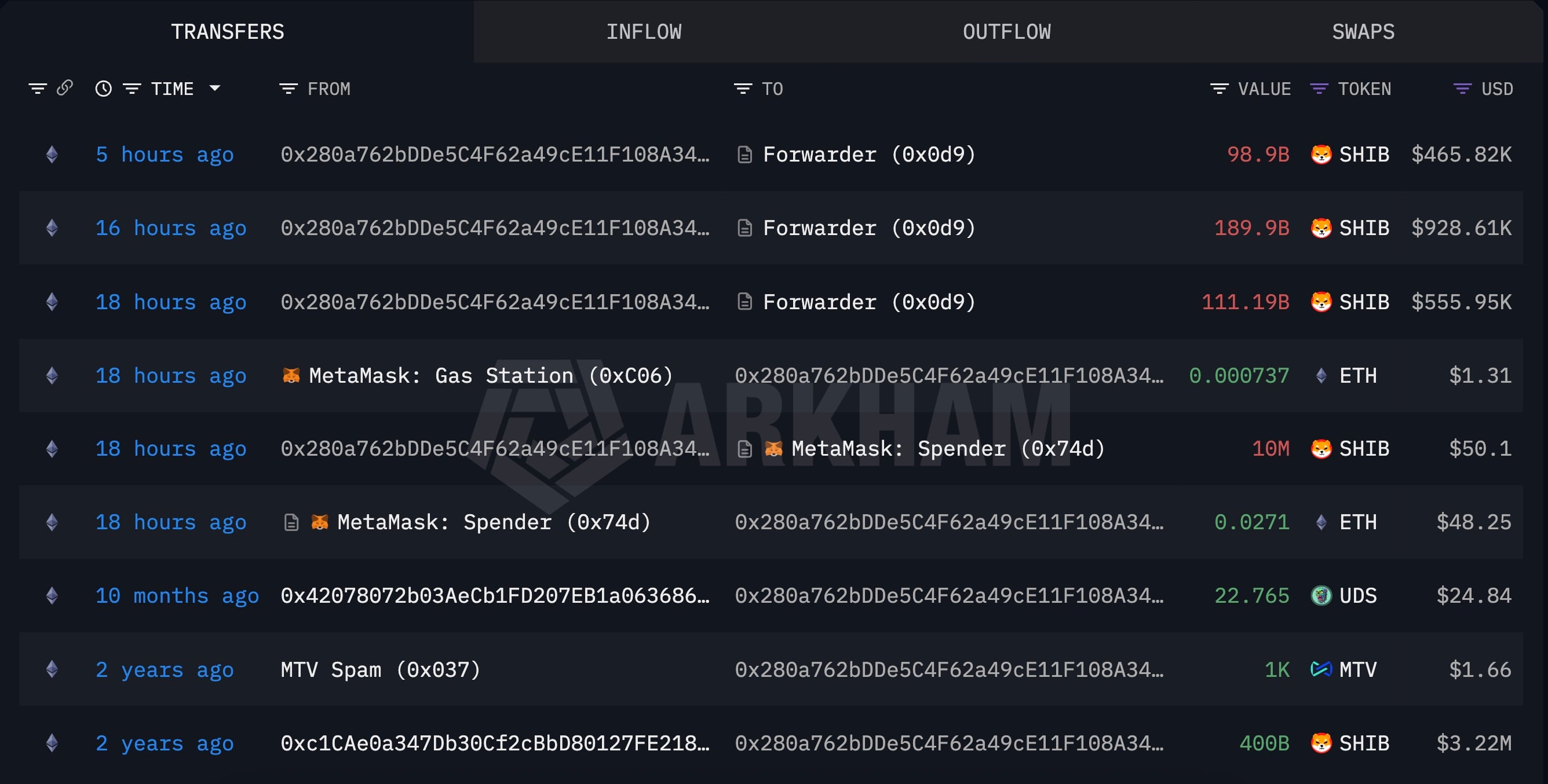
According to data from Arkham Intelligence, the whale first conducted a test transaction by moving 10 million Shiba Inu tokens through a MetaMask swap. Shortly afterward, the holder moved nearly 400 billion SHIB via BitGo’s Forwarder Smart Contract across three transactions.

The whale initially transferred 111.9 billion SHIB, followed by another transaction involving 189.9 billion SHIB. The user then completed a third transfer of 98.9 billion SHIB. In total, the investor moved 399,989,999,938 SHIB (399.98 billion tokens) through BitGo’s forwarding infrastructure. After the transfers, the wallet retained only 110 SHIB, effectively emptying the address.

Article image

BitGo Route Clouds Sale Speculation  

Notably, the use of BitGo’s Forwarder Smart Contract makes it difficult to determine whether the whale sold the tokens. Institutional investors frequently use BitGo’s infrastructure to consolidate assets into cold storage or facilitate over-the-counter (OTC) transactions without creating visible selling pressure on public exchanges.

Consequently, the transfers do not necessarily indicate a market sale. Instead, they signal that a long-dormant holder has taken significant action during heightened market uncertainty.

SHIB Slides Below Key Support

Meanwhile, the whale’s reactivation coincided with a sharp decline across the broader crypto market, which has weighed heavily on SHIB. 

Over the past week, Shiba Inu has fallen 17.71%, losing the key psychological support level at $0.000005. At press time, SHIB traded at $0.000004535, down an additional 3.78% over the previous 24 hours.

The recent decline has also pushed SHIB closer to falling out of the top 30 cryptocurrencies by market capitalization. The token currently ranks 29th, with a market value of $2.65 billion.

$382K in Shiba Inu Leveraged Position Liquidated 

In the meantime, leveraged traders have suffered substantial losses. Data from CoinGlass shows that more than $382,000 worth of SHIB futures positions were liquidated over the past 24 hours, representing roughly 84.45 billion SHIB.

 Long traders accounted for the vast majority of those losses, with liquidations totaling $365,660, while short traders recorded losses of $17,320. 

Shiba Inu liquidation

Ex-Ripple CTO Says Enterprises Will Tokenize Stocks, Repos and Loans on the XRP Ledger

Former Ripple CTO David Schwartz believes the XRP Ledger’s utility is expanding beyond payments and stablecoins. 

He said enterprises are increasingly using the blockchain to bring traditional financial assets on-chain.

Speaking in a recent edition of XRP in One Minute, Schwartz highlighted how the XRP Ledger has evolved since its launch. He said it is now positioning itself as a platform not only for digital assets like XRP, but also for tokenized real-world assets.

Key Points

  • David Schwartz says the XRP Ledger is evolving beyond payments into a platform for tokenized real-world assets.
  • He expects enterprises to bring tokenized stocks, securities, and money market funds onto XRPL.
  • Schwartz also sees tokenized repos and loans expanding access, efficiency, and transparency in finance.
  • He argues enterprise adoption will drive retail participation as blockchain-based financial products grow.

XRP Ledger Moving Beyond Payments

According to Schwartz, Bitcoin introduced the concept of a public blockchain that allows users to hold and transfer value digitally. The XRP Ledger followed soon after, offering a native digital asset, XRP, alongside support for issued assets.

These issued assets can represent stablecoins and a broad range of tokenized instruments. Schwartz said enterprises are already using the XRP Ledger to issue tokenized real-world assets (RWAs).

The RWA sector has gained significant traction across the blockchain industry. Institutions are increasingly exploring ways to bring traditional financial products onto decentralized networks.

Tokenized Stocks and Securities Coming to XRPL

Looking ahead, Schwartz said the XRP Ledger will support an even wider range of tokenized financial products.

According to him, enterprises will soon offer tokenized securities, money market funds, and tokenized stocks on the network. He suggested that these products could become a major part of the ledger’s future ecosystem.

Schwartz’s remarks suggest the XRP Ledger’s future role could extend well beyond cross-border payments. Instead, it may serve as infrastructure for a growing ecosystem of tokenized financial assets.

Tokenized Repos and Loans Next

Schwartz also pointed to additional financial products that could arrive on the XRP Ledger in the near future. These include tokenized repurchase agreements (repos) and tokenized loans.

Repos are a core part of traditional financial markets. They allow institutions to borrow and lend short-term liquidity using securities as collateral.

Bringing repos on-chain could improve settlement efficiency and transparency. It could also expand participation by making these markets more accessible.

Schwartz added that tokenized loans could similarly broaden access to credit markets through blockchain-based infrastructure.

Enterprises Could Drive Mass Retail Adoption

Schwartz argued that enterprise adoption will be key to attracting mainstream users to decentralized finance.

He said businesses will create the products and services that encourage mass retail participation. In his view, enterprises can help bridge the gap between traditional finance and decentralized financial systems.

Schwartz suggested that as more real-world financial products become available on blockchain networks, decentralized finance could move closer to delivering services traditionally provided by banks and other intermediaries.

His comments come as the XRP Ledger continues expanding its tokenization capabilities. At the same time, institutional interest in blockchain securities, funds, and other real-world assets continues to grow across the digital asset industry.

RWA Sector at a Glance

According to RWA.xyz, the total value of tokenized real-world assets on blockchains currently stands at about $31.18 billion in distributed asset value. This represents freely transferable on-chain tokenized assets.

Meanwhile, represented asset value totals $280.58 billion, including restricted or platform-bound asset representations. Stablecoins, or tokenized fiat currencies, account for an additional $299 billion.

Notably, earlier data from RWA.xyz showed that the XRP Ledger climbed 63% in the platform’s RWA rankings over a 30-day period as of May. During that time, XRPL accumulated more than $3.6 billion in tokenized real-world assets within five months.

Separately, data from Evernorth showed that tokenized U.S. Treasuries on XRPL increased from $50 million last year to $418 million in April, marking an eightfold increase. Platforms such as Ondo Finance, OpenEden, and Zeconomy have contributed to the growth.

However, these figures have since declined amid the ongoing downturn in the crypto market.

Top Cardano Contributor Leaves Ecosystem After Declaring Bankruptcy

0

A long-time Cardano contributor known as Chicken (@navir333) has announced his departure from the ecosystem, adding to growing tensions within the Cardano community.

His statement has drawn significant attention because he has spent years contributing to Cardano as an advisor and builder in multiple ecosystem projects. Moreover, his exit comes at a challenging time for Cardano, which is already grappling with project shutdowns, governance disputes, and declining market performance.

Key Points

  • Long-time Cardano contributor Chicken has announced his departure from the ecosystem.
  • His decision stems from mounting business debt, which ultimately led him to file for Chapter 7 bankruptcy. 
  • He also criticized Cardano, arguing that broader ecosystem challenges have made it difficult for independent builders to succeed. 
  • Many Cardano proponents described his departure as a significant loss for Cardano, whose native token ADA recently fell to 16th place by market cap.

Chicken Exits Cardano Ecosystem 

In a statement published on X, Chicken revealed that financial hardship had forced him to leave Cardano. He explained that mounting business debt, roughly 14 months of unemployment, and the exhaustion of his unemployment benefits five months ago ultimately pushed him to file for Chapter 7 bankruptcy.

Although he accepted responsibility for his financial difficulties, he argued that broader ecosystem problems have made it difficult for independent builders to succeed. Specifically, he criticized the ecosystem’s focus on research initiatives over sustainable revenue generation.

Notably, Chicken directed part of his criticism toward recent comments from Cardano founder Charles Hoskinson, who recently announced a temporary break.

According to Chicken, Hoskinson’s remarks reinforced his belief that Cardano’s leadership lacks a clear strategy for creating long-term economic value and ensuring the ecosystem’s sustainability. 

Chicken Criticizes Cardano Strategy 

At the same time, he criticized Cardano’s governance structure, arguing that funding entities wield excessive influence over treasury decisions while ordinary ADA holders have limited power to shape outcomes. 

Additionally, Chicken questioned the value generated by treasury-funded research programs. He argued that Cardano has allocated significant resources to research initiatives without establishing clear mechanisms for returning value to the treasury. Consequently, he believes these expenditures have increased selling pressure across the ecosystem by driving token outflows without producing sufficient economic activity. 

Among the factors that influenced his decision, Chicken identified the closure of TapTools as a major turning point. For context, the analytics platform recently announced plans to wind down operations in the coming weeks, while Hoskinson warned that additional projects could face similar outcomes amid difficult market conditions.

Reacting to the shutdown, Chicken stated that TapTools’ shutdown highlights the growing disconnect between ecosystem leadership and the needs of builders, entrepreneurs, and users.

Looking ahead, he proposed a hard fork as a potential solution for resetting leadership dynamics and giving a new generation of contributors greater influence over Cardano’s future direction.

Community Reacts 

Despite his criticism, Chicken’s message was not entirely negative. He thanked community members for their support and reflected positively on the relationships he built throughout his time in the ecosystem. In response, many Cardano supporters expressed appreciation for his contributions and wished him success in rebuilding his career.

For context, Chicken has been a prominent figure within the Cardano ecosystem for years. He has served as an advisor to projects such as Xerberus, Metera Protocol, and SyncAI Network, among others. 

Given his involvement across multiple initiatives, many community members view his departure as a significant loss for an ecosystem already navigating governance disputes and project closures.

Meanwhile, ADA, Cardano’s native cryptocurrency, has fallen out of the top 15 digital assets by market capitalization and now ranks as the 16th-largest cryptocurrency globally. 

Heavy Long Exposure Builds on XRP as More Traders Bet on Price Rebound

0

XRP has dropped alongside the broader crypto market, but traders continue to open more long positions, expecting a rebound.

XRP has fallen along with the broader crypto market, which has lost nearly $400 billion this week. However, amid the decline, multiple traders are betting on a rebound. 

CryptoQuant analyst Pelinay noted that investors are opening more long positions on XRP as prices drop. This growing confidence may not be a good sign in the short term, as it can lead to a long squeeze when prices drop lower. 

Key Points

  • XRP fell with the broader market, which has lost nearly $400 billion this week alone.
  • While the price dropped from $1.4 to $1.17, traders increased long positions, as the leverage ratio rose from 0.13 to 0.18.
  • Low volatility and high leverage raise the chances of a sharp downside move.
  • XRP later hit a yearly low of $1.04 before recovering slightly to $1.08.
  • Having lost the $1.10-$1.15 support, XRP needs to maintain the critical $1 mark to avoid panic selling.

XRP Seeing Rising Leverage Despite Price Decline

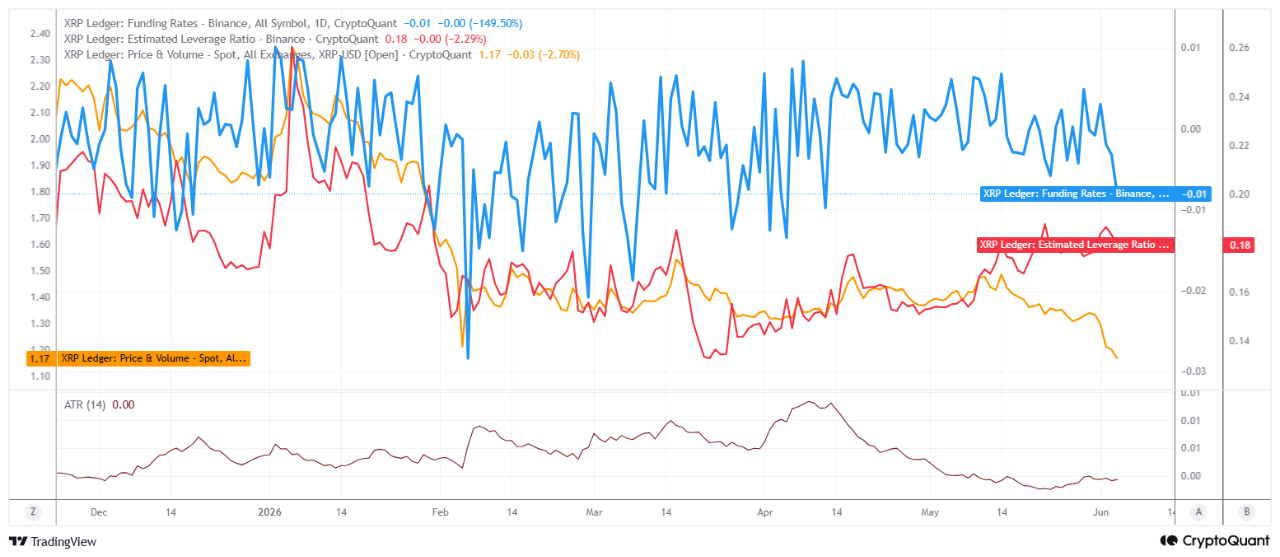
Pelinay pointed out that leverage is rising while price continues to fall, and this is a major concern. Specifically, XRP’s price dropped from about $1.40 to $1.17, but the Estimated Leverage Ratio increased from 0.13 to 0.18 during the same period. This shows that traders are taking on more risk instead of stepping back.

Meanwhile, funding rates stayed mostly negative, which means there is still strong short interest in the market. However, XRP has not managed to bounce back in any sustainable way. Normally, negative funding can support a price recovery, but in this case, the lack of movement suggests that the market remains weak.

XRP Charts CryptoQuant
XRP Charts | CryptoQuant

Rising leverage, falling prices, and negative funding can create an unstable market condition when they occur together. They show that many traders are expecting a reversal, but the market is not yet supporting this sentiment.

XRP’s Long Squeeze Risk

As more traders open leveraged long positions, the chance of a long squeeze increases. If prices keep falling, even slightly, it could trigger liquidations across the market. This can lead to sharp and fast price drops as positions are forced to close.

Pelinay also mentioned XRP’s volatility. The Average True Range (ATR) is near its historical lows, which means price movement has been very tight. Such periods often come before a big move. Based on current signals, the next move is more likely to be downward than upward.

Low volatility alongside high leverage is a risky combination. According to Pelinay, it often leads to sudden and strong price swings, especially when the market is already showing signs of weakness.

Key XRP Support Levels

The analyst highlighted important support levels to watch. The first key range was between $1.10 and $1.15, with XRP trading just above it at the time. Below that, the next support sits at $1.00, which represents an important psychological level.

Following the analysis, XRP dropped further and hit a new yearly low of $1.04. It then saw a small recovery as buyers stepped in around the $1 level. Despite this bounce, XRP is now trading at about $1.08. This marks a 7.6% drop since the analysis and an 18.71% decline over the week.

Now that XRP has lost the $1.10 to $1.15 support range, the $1 level has become even more important. If the price falls below $1, it could trigger panic selling and push the price down faster.

Pelinay noted that the market has not confirmed a bottom yet. For a stronger recovery to play out, a few things need to happen. First, leverage should start to fall, showing that traders are reducing risk. 

Second, funding rates should turn more negative before returning to normal levels. Finally, XRP needs to reclaim and hold above the $1.10 to $1.15 range. Until these signs appear, the market remains at risk.

Cardano Crashes Out of Top 15 Crypto Assets Following Sharp Price Collapse

0

Cardano has suffered one of the most significant setbacks in its history, falling out of the top 15 cryptocurrencies by market capitalization after weeks of intense selling pressure. 

The latest drop occurred after both Monero and Canton surpassed Cardano’s market valuation, pushing ADA to 16th place in the global cryptocurrency rankings. The development reflects not only the token’s recent price collapse but also growing concerns surrounding the broader health of the Cardano ecosystem. 

Key Points 

  • Cardano has dropped out of the top 15 cryptocurrencies by market cap following weeks of intense selling pressure and ecosystem uncertainty.
  • Cardano now ranks as the 16th-largest cryptocurrency globally, with its market capitalization declining to $5.43 billion.
  • Monero and Canton have overtaken Cardano, occupying the 15th and 14th positions with market caps of $5.49 billion and $5.68 billion, respectively.
  • The decline comes amid growing ecosystem challenges, including the shutdown of TapTools and warnings from Charles Hoskinson that additional Cardano-based projects could fail later this year.

Cardano Drops Out of Top 15 

Following a devastating collapse over the past few weeks, Cardano has crashed out of the top 15 crypto by market cap. The shift occurred today after both Monero and Canton surpassed ADA in market value.

Currently, Cardano now ranks 16th among the world’s largest cryptocurrencies, according to CoinMarketCap data. Currently, the network holds a market cap of $5.43 billion, placing it behind Monero and Canton, which command valuations of $5.49 billion and $5.68 billion, respectively. 

Cardano drops out of top 15

Factors Behind the Recent Fall 

Notably, Cardano’s exit from the top 15 coincides with a sharp decline in ADA’s price and mounting challenges across its ecosystem. Several factors have fueled the downturn, including project shutdowns, governance disputes, and uncertainty surrounding founder Charles Hoskinson’s announcement of a temporary break.

As previously reported, leading Cardano analytics platform TapTools revealed plans to cease operations in the coming weeks. The announcement followed the closure of other notable ecosystem projects, including JPG.store and JX Door. 

Meanwhile, Hoskinson warned that additional Cardano-based projects could shut down later this year as the prolonged bearish market continues to pressure builders and businesses.

Governance Issues 

At the same time, several key treasury proposals designed to strengthen the Cardano ecosystem failed to secure approval. DReps rejected several proposals from Input Output Global’s nine-item treasury package. The company’s research proposal is still facing strong rejection, with over 80% of the votes against it. 

Further intensifying bearish sentiment, Hoskinson announced that he was taking a break without initially clarifying whether he was stepping away from the Cardano ecosystem or merely reducing his activity on X. As a result, uncertainty spread throughout the community and weighed heavily on ADA’s price, even as the broader crypto market faced its own challenges.

Recognizing the confusion, Hoskinson later released a video clarifying that he was not leaving the Cardano ecosystem. However, by then, market sentiment had already deteriorated, and ADA had suffered substantial losses.

Earlier today, the token fell below the $0.15 mark and touched a low of $0.1493. Although ADA has since recovered slightly to trade around $0.15, it remains down 9% over the past 24 hours and approximately 36% over the past week.

Pundit Says “I’ve Seen This Movie Before” as XRP 70% Drop Mirrors Setup That Delivered 1,200% Gains

XRP latest market downturn is drawing comparisons to one of the asset’s most dramatic recoveries. 

Crypto commentator Digital Outlook argues that the current sell-off resembles the conditions that preceded XRP’s explosive rally after the SEC lawsuit in late 2020.

The commentator recalled aggressively accumulating XRP during the market panic triggered by the U.S. Securities and Exchange Commission’s lawsuit against Ripple. In his words:

“I put in multiple five figures the day before the SEC lawsuit dropped. The price collapsed to $0.17, and four months later? $1.97. That’s 1,200% return. I’ve seen this movie before, guys.”

Key Points

  • Digital Outlook says XRP’s current sell-off resembles the 2020 crash that preceded a 1,200% rally.
  • XRP has fallen more than 70% from its cycle high, with the latest drop fueled by broader market weakness.
  • A repeat of XRP’s historic rebound could theoretically send the asset toward the $14 level.
  • XRPL validator Vet urged the community to focus on building and long-term growth during the downturn.

1,200% After Historic Crash

Data from CoinMarketCap supports the historical comparison. Following the SEC’s lawsuit against Ripple in December 2020, XRP’s price plunged to a low of about $0.1748. It marked one of the asset’s steepest declines.

However, sentiment shifted rapidly in the months that followed. By April 2021, XRP had surged to roughly $1.96 during the crypto bull market. That represented a gain of more than 1,000% from its post-lawsuit lows.

Digital Outlook believes the current market environment is similar to that period. In his view, today’s fear could eventually give way to another major recovery.

XRP Down More Than 70% From Peak

The latest decline has been severe. XRP fell to around $1.09 this week during the ongoing crypto market correction. The downturn also pushed Bitcoin to $59,000 after it traded above $70,000 just a week earlier.

Current market data shows XRP is down 19.3% over the past seven days. It has also fallen 23% over the past month and 41% year-to-date. From its cycle peak of $3.65, XRP has now declined by more than 70%.

The weakness has not been limited to XRP. Bitcoin has also posted significant losses. It is down 34% year-to-date, 25% over the past month, and 17% over the past week.

As a result, some XRP supporters view the current decline as a potential accumulation phase rather than a sign of failure. They see parallels with previous market cycles.

What a Similar Recovery Could Mean

While Digital Outlook did not provide a specific price target, his reference to XRP’s previous 1,200% recovery has fueled optimism among bullish investors.

If XRP were to replicate a similar percentage gain from its recent low near $1.09, the asset could theoretically climb toward the $14 level in a future bull run.

However, past performance does not guarantee future results.

XRPL Validator Urges Community to Focus on Building

Amid growing fear across the market, XRP community figure Vet encouraged investors to focus on long-term development rather than short-term price action.

According to Vet, periods of market weakness often create opportunities for education and building within the ecosystem.

He argued that XRP and the broader digital asset industry have repeatedly survived major downturns despite recurring predictions that the sector was finished.

The validator advised community members who feel overwhelmed by the volatility to step away from the charts temporarily. He suggested returning with a longer-term perspective.