Home Blog Page 1041

Grayscale Unveils Top 20 Crypto Picks for Q1 2025: Key Themes and New Additions

0

As the crypto world counts down the final hours of 2024, Grayscale, a leading crypto asset manager, has updated its Top 20 crypto assets for Q1 2025. 

Each quarter, Grayscale meticulously evaluates a broad spectrum of digital assets. The outcome of this comprehensive analysis is the creation of a Top 20 list. 

According to the disclosure, the list includes crypto assets that, in Grayscale’s view, exhibit strong potential for the upcoming quarter. Notably, the list reflects assets across various sectors, focusing on promising opportunities.

Grayscale’s selection process considers key factors such as network growth, adoption trends, upcoming catalysts, the sustainability of project fundamentals, supply inflation dynamics, token valuations, and potential tail risks.

For this quarter, Grayscale is honing in on three pivotal themes that will shape the market landscape heading into 2025. 

First, the potential regulatory changes stemming from the incoming U.S. administration, especially concerning DeFi and staking. Second, the continued advancements in decentralized AI technology and their integration with blockchain systems. Third, the rapid expansion of the Solana ecosystem.

With these central themes, Grayscale welcomes six new crypto assets to its list for Q1 2025.

New Additions to the Top 20 List

Hyperliquid (HYPE): A Layer 1 blockchain supporting decentralized financial applications, primarily a DEX for perpetual futures with an on-chain order book.

Ethena (ENA): A unique stablecoin protocol, USDe, backed by hedged positions in Bitcoin and Ether collateral. It offers users the opportunity to profit from spot and futures price differences.

Virtual Protocol (VIRTUAL): A platform on the Base network for creating tokenized AI agents. These agents are capable of performing autonomous tasks and interacting with other users.

Jupiter (JUP): The leading DEX aggregator on the Solana network, with the highest total value locked (TVL) among Solana-based applications. 

Jito (JTO): A liquid staking protocol on Solana that has rapidly gained traction, generating over $550 million in fees during 2024.

Grass (GRASS): A decentralized data network that rewards users for sharing unused internet bandwidth, which is then used to scrape online data for AI training purposes.

Returning Assets and Long-Term Trends

Meanwhile, Grayscale continues to back themes from previous quarters that remain crucial in the crypto space. These include Ethereum scaling solutions, decentralized physical infrastructure networks (DePIN), and tokenization. As such, notable assets like Optimism, Chainlink, and Helium have made their return to the list.

Assets Removed from the Top 20

On the other hand, this quarter, Grayscale rotated out Celo from the list. While the project remains an important part of the broader crypto ecosystem, the research team believes the revised list offers stronger risk-adjusted returns for Q1 2025.

Grayscale updated list

Creditor Champion Debunks Claims of FTX $16B January Repayment

0

A notable FTX creditor has rebuffed plans that the defunct crypto exchange FTX would resume customer repayment as early as January 2025.

For context, the news made the rounds since the weekend that the Sam Bankman-Fried-owned crypto exchange will repay its creditors starting from January 3. The speculation also suggested that FTX would distribute $16 billion to its customers within 60 days of the repayment start date.

FTX Creditor Responds

In a tweet today, Sunil, a self-acclaimed FTX creditor champion, refuted the claims. He noted that the January payments were false and provided the actual distribution details.

Sunil stated that FTX has recovered $13 billion from debtors, which could increase to $14 billion in March. Meanwhile, the creditor noted that the bankruptcy estate of the defunct exchange does not intend to distribute the entire amount.

He stated that FTX filed to reserve 50% of the recovered funds. As a result, it can only distribute half of the disputed claims, worth $7 billion, in the initial repayment phase.

Meanwhile, Sunil noted that FTX would fully recompense its customers in two to three years.

Community Seeks Clarity

Notably, the FTX bankruptcy estate announced earlier this month that it would resume repaying creditors on January 3. The press release also stated that it would reimburse affected customers up to $16 billion from that date.

Amidst the inconsistencies, users have sought clarification on the actual repayment date. For instance, a user pointed to an earlier X post from the FTX page confirming the distribution will resume in January and asked what Sunil made of it.

Meanwhile, the FTX bankruptcy proceeding has had its fair share of controversy. Earlier, customers fumed at the cash repayment ruling by the presiding judge, John Dorsey, which allowed the exchange to pay the monetary value of a user’s balance when it filed for bankruptcy.

The ruling meant that creditors missed out on the crypto market’s upsurge. For instance, Bitcoin and Solana traded at $16,871 and $16.25, respectively, when FTX filed for bankruptcy in November 2022.

Cardano Bounce Near After 45% Drop? Here’s Why This Analyst Thinks So

0

Is Cardano (ADA) nearing bounce?

Over the past two weeks, most crypto assets, including Cardano‘s native token ADA, have had recent impressive price rallies punctuated by a steep decline amid hawkishness from the Federal Reserve. ADA, specifically, has dropped over 45% from highs of $1.3264 to lows of $0.7620.

But now, one expert has suggested that the steep asset price decline may be at an end.

Cardano (ADA) Bounce Incoming?

MN Consulting founder Michaël van de Poppe has suggested that an end to the price correction of Cardano’s ADA is in sight.

The prominent analyst expressed this view in a Monday, December 30 X post with a weekly candle chart suggesting that he expected to see the asset’s price bounce from around the $0.7460 price point. 

ADAUSDT weekly candle chart
ADAUSDT weekly candle chart. Source: Michael van de Poppe

This price level served as a multi-year resistance after the asset fell below it in 2022. After breaking above the price level in 2024, van de Poppe now expects it to provide support for the asset’s next run to new highs.

To run to new highs, however, ADA will need to break above potential resistance around $1.2430, per van de Poppe’s analysis. At the time of writing, the asset is trading at $0.8524.

van de Poppe, meanwhile, has expressed confidence in ADA’s long-term potential. He asserted that the asset’s 300% run from lows of $0.3263 in early November 2024 to highs of $1.3264 in early December 2024 was likely only the first impulsive leg of the bull market cycle. He tipped the asset to break its all-time high price record of $3.09 sometime in 2025 or 2026.

ADA’s continued growth will likely depend on more than macroeconomic factors as the community currently faces an internal conflict between its primary developer, Input Output, and the non-profit tasked with promoting its adoption the Cardano Foundation.

Fibonacci Insights: Shiba Inu Short-Term Target at $0.00003265, Long-Term at $0.00004349

0

Shiba Inu is poised for an upswing near its yearly high, as technical analysis indicates a breakout from a bullish price pattern.

In the latest Shiba Inu news, the dog-themed meme coin could target a bullish upthrust to higher prices imminently. However, following a wider market downturn, it must ward off the prevailing bearish momentum around its ecosystem.

For context, Shiba Inu recorded its third consecutive weekly downtrend, but with a mild correction compared to the previous weeks. The leading meme coin closed last week with a 1% drop, failing to sustain an earlier bullish momentum that saw it hit an intra-week high of $0.00002408.

Shiba Inu Breaks Out from Bullish Structure

A recent analysis from Rose Premium indicates that Shiba Inu could regain bullish momentum and rebound from the latest dip. The commentary cited a potential breach above a descending channel in the 1-day timeframe.

The market speculator attached a chart suggesting a possible breakout from the channel, which started forming at the local top at $0.00003343 in early December. With the breakout, Rose Premium shared three price objectives for Shiba Inu, including a short-, intermediate-, and long-term target.

Shiba Inu Price Targets per Rose Premium

Meanwhile, the analyst expects Shiba Inu to meet resistance at $0.00003236 with the initial uptrend. A breach of the resistance will spur further upsides to the intermediate supply zone at $0.00003870.

Additionally, Rose Premium asserted that the long-term target from the descending triangle breakout is a surge to $0.00004349. However, he stated that the nearly 100% price uptick would actualize if intense bullish momentum captured the market.

Support Levels to Watch

Meanwhile, Rose Premium indicated support levels to watch if Shiba Inu continues the downtrend. He marked the 0.618 Fibonacci level at $0.00002230 as a potential demand zone and the 0.786 extension at $0.00002170 as a stronger support level.

Notably, the support at $0.00002230 has failed to hold, with Shiba Inu falling further downwards. However, the second-largest meme coin by market cap has found solace in the $0.00002170 demand zone.

Moreover, Shiba Inu could bounce from the area if the demand zone continues to cushion against further downtrends. In the meantime, SHIB trades at $0.0002173, up 1.73% in the past 24 hours.

Ex IMF Director and Bank of India Governor Appointed to Ripple Stablecoin Advisory Board

0

As the Ripple stablecoin, RLUSD, becomes publicly available, the company has appointed several influential figures to its advisory board.

Among the most prominent names is Raghuram Rajan, a former director of the International Monetary Fund (IMF). This appointment caught the attention of the XRP community, with several commentators discussing the strategic significance of including such high-profile figures in the RLUSD project.

Expertise Rajan Brings to Ripple Stablecoin Advisory Board

Rajan served as the IMF’s Director of Research and Chief Economist from 2003 to 2006. Later, he became the 23rd Governor of the Reserve Bank of India (RBI) from September 2013 to September 2016. While at the RBI, he also became Vice-Chairman of the Bank for International Settlements in 2015.

In 2005, at the Federal Reserve’s annual Jackson Hole conference, Rajan warned about the increasing risks in the financial system. While predicting a potential financial crisis, he suggested measures to mitigate these risks. 

Former U.S. Treasury Secretary Lawrence Summers initial dismissed his predictions, labeling them as “misguided.”  However, after the 2007–2008 financial crisis, Rajan’s warnings were widely recognized as prescient.

In November 2008, Rajan took on the role of honorary economic adviser in India, contributing policy notes. In August 2012, he was appointed Chief Economic Adviser to India’s Ministry of Finance.

Now, Raghuram Rajan is joining the RLUSD advisory board to offer expert guidance on financial, regulatory, and operational matters, helping to ensure the stability and growth of Ripple’s stablecoin. 

Rajan Bullish Comment on RLUSD Launch

Commenting on the launch of RLUSD, Rajan expressed that stablecoins have the potential to become the backbone of payments. According to him, they provide a secure and efficient alternative to traditional systems.

He specifically highlighted that RLUSD, with its focus on compliance and reliability, aims to set new standards for trust and play a key role in shaping the future of payments.

“Joining the Advisory Board allows me to counsel RLUSD as it embarks on its journey in the rapidly evolving financial landscape,” Rajan concluded.

Other Big Names in Ripple’s RLUSD Advisory Board

In the advisory role, Rajan will collaborate with Kenneth Montgomery, former Chief Operating Officer of the Federal Reserve Bank of Boston. 

Besides, Ripple’s RLUSD advisory board already includes notable figures such as former FDIC Chair Sheila Bair, David Puth, Vice Chairman of Partners Capital, and Ripple co-founder Chris Larsen.

Top UK Newspaper Highlights SEC v. Ripple Ruling, Details XRP Dramatic Surge After Trump Victory

0

Renowned UK newspaper The Times publishes an article regarding Judge Analisa Torres court ruling on the legal tussle between the U.S. SEC and Ripple.

In a recent tweet, XRP community figure Digital Asset Investor called the public’s attention to the newspaper publication. The community member attached a photo of the article, highlighting the newspaper’s comment on the XRP ruling. 

The Times Publication on XRP Ruling 

The article, published yesterday under the heading ‘Judging Crypto’s True Value,’ discussed how the outcome of the U.S. election impacted the value of XRP and pointed out that XRP’s fortunes are closely tied to the legal dispute between the SEC and Ripple. 

The newspaper provided an overview of the lawsuit, revealing how it started. According to The Times, the SEC accused Ripple of violating securities laws by issuing XRP without obtaining regulatory approval. 

Following the summary judgment last year, the SEC sought $2 million in penalties from Ripple in March 2024. However, The Times emphasized that Judge Torres imposed a $125 million fine against Ripple in August.  

The newspaper emphasized that the lawsuit hinges on XRP’s regulatory treatment, focusing mainly on whether it should be classed as a security. Interestingly, it referenced the opinions of crypto bulls who think the lawsuit is part of the SEC’s aggressive stance against crypto under Gary Gensler’s leadership. 

In addition, The Times noted that U.S. President-elect Donald Trump chose pro-crypto advocate Paul Atkins as Gensler’s replacement. 

XRP Outstanding Performance After Trump Victory 

Furthermore, the newspaper highlighted XRP’s impressive performance since Donald Trump’s reelection. This has seen its value quadruple, pushing it to fourth place in the global crypto ranking. 

Specifically, the price of XRP surged from around $0.55 to $2.86 in one month, marking a hefty surge of 420%. XRP’s outstanding performance reflects optimism about potential favorable regulation under Trump’s administration. 

Current Status of Ripple Lawsuit 

In October, the SEC officially filed the lawsuit in the U.S. Court of Appeals for the Second Circuit. It hopes to overturn Judge Torres’ ruling on programmatic sales and other distributions of XRP, which were deemed non-securities. 

The Wall Street watchdog will officially file its appellate brief on or before January 15, 2025, a few days before Trump’s inauguration. 

Despite this, legal experts still believe the new SEC leadership can dismiss the lawsuit at any time. Attorney Fred Rispoli speculated that the new leadership could agree to settle its lawsuit against Ripple via a less aggressive stance. 

He stated that the SEC might accept a lesser fine from Ripple than the $125 million penalty Judge Torres ordered the company to pay. It remains unclear whether the Ripple lawsuit will be resolved through a settlement under Atkins’ leadership. 

At press time, XRP is priced at $2.07, reflecting a decline of 5.35% in 24 hours. 

The New Home of Dapps? Cardano Adds 100,000 New Smart Contracts in 2024

0

Smart contract deployment on the Cardano network reached a significant milestone this year, nearly crossing 100,000, as blockchain gains traction.

Cardano Blockchain Insight collated the data from the Plutus-based smart contract deployer, which specifies the amount deployed by each software version. For context, Plutus is a smart contract platform on the Cardano network that allows developers to create decentralized applications that can interact with the blockchain.

Plutus V2 Leads the Smart Contract Mania

The second version of the Plutus programming language was the star of the show, as it was responsible for most of the smart contract deployment.

At the start of the year, there were just 8,083 Plutus V2 scripts on the blockchain. However, the total tally surged to 105,500 on December 29, appreciating by 97,417 smart contracts during the year.

Notably, the Plutus V2 application went live on the Cardano network in September 2022 after the Vasil hard fork. The script enhanced smart contract features in the Cardano ecosystem, introducing features such as reference inputs, inline datum, and reference script.

Meanwhile, the Plutus V1 also saw substantial traction. The maiden smart contract script added 573 smart contracts to the network, growing from 6,296 at the beginning of the year to 6,869 as of December 27.

Furthermore, the newly introduced Plutus V3 programming software also recorded considerable usage in its short time of existence. For context, the Cardano ecosystem debuted the third version of Plutus in preparation for the September 1 Chang hard fork, which introduced decentralized governance on the blockchain.

In February, the Cardano team released Plutus V3 on the SanchoNet testnet, which has enhanced features compared to earlier versions. The application entered the mainnet in August and deployed 444 smart contracts on the Cardano blockchain.

Cardano
Cardano

The New Home of Decentralized Applications

Meanwhile, Cardano has established itself as one of the biggest smart contract-enabled chains in the crypto sector. It is on the grounds of its status that EMURGO partnered with BitcoinOS to bring its glaring smart contract features to the Bitcoin network.

Although the partnership suffered a major setback, Cardano’s founder, Charles Hoskinson, insisted that his team is committed to bringing decentralized finance to the network, housing over $1.8 trillion in liquidity.

Nonetheless, Cardano has shown the capacity to evolve with blockchain technology, periodically releasing new features to boost scalability and usability. One of its recent releases is the Midnight testnet, teased to bring data security to the ecosystem.

As Long as XRP Trades Above $2, There’s No Cause for Concern: Williams Alligator Indicator

0

Amid a largely bearish market, XRP continues to show bullish momentum signals, with the Williams Alligator Indicator providing key insights.

XRP, which crossed the pivotal $2 mark early this month, has analysts closely monitoring its trend continuation potential. The asset has crashed by at least 30% since approaching $3 this month.

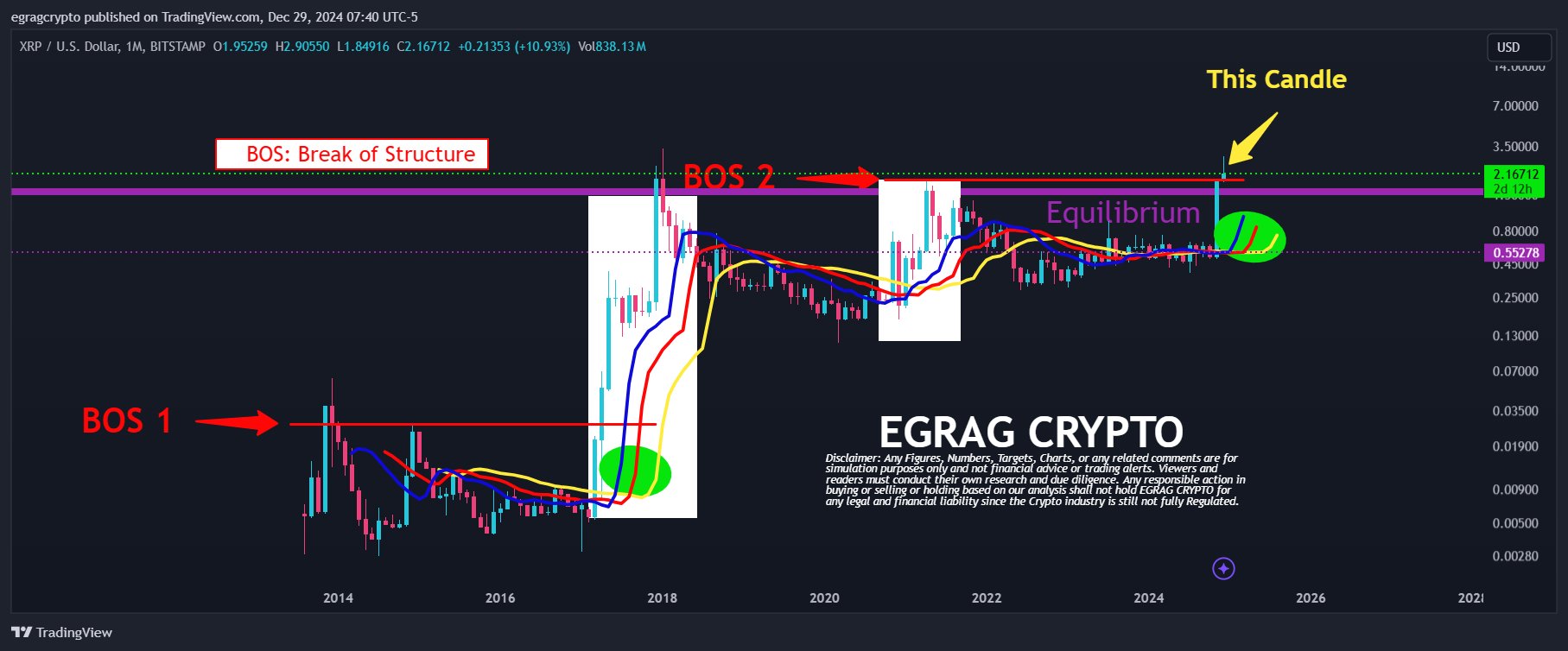
In a post on X, analyst Egrag shared a detailed analysis, emphasizing the importance of the Williams Alligator Indicator for XRP’s bull run. This tool uses three moving averages (Jaw, Teeth, and Lips) to identify market trends.

According to Egrag, XRP’s current alignment of these moving averages suggests bullish momentum, provided XRP maintains its position above the equilibrium zone without retracing.

What the Charts Reveal

Egrag’s chart highlighted two critical “Break of Structure” (BOS) points in XRP’s long-term chart. The first instance occurred in the first week of 2018 when XRP broke its all-time high. A similar attempt happened in 2021, but it failed to send XRP to a new all-time high.

Currently, a new break of structure is developing, with XRP trading above the equilibrium level of $2. The Williams Alligator Indicator shows alignment, suggesting a possible continuation of XRP’s bullish trend. 

For context, a similar alignment appeared in late 2017, and by January 2018, XRP was trading at an all-time high of over $3.80.

Image
XRP long-term chart with Williams Alligator Indicator

While the current observation is promising, Egrag warns that confirmation depends on the upcoming monthly candles. He noted that the current monthly candle appears bearish.

However, the opening and closing of the subsequent candle will help solidify XRP’s trajectory. Egrag mentions that two-candle formations often provide a stronger signal for traders.

The $2 Threshold Remains a Key Support Level for XRP

Meanwhile, Egrag stressed that investors have no immediate concern as long as XRP remains above $2. Numerous commentators have previously highlighted the need for XRP to maintain this psychological and technical support level for maintaining bullish sentiment.

A sustained push above this level, combined with a favorable Alligator Indicator setup, could propel XRP further into bullish territory.

At press time, XRP is trading at $2.08, down by 5% in the last 24 hours. XRP has continued to witness consecutive days of downturns, putting the $2 price point at risk. 

XRP breached this level twice earlier this month, but a strong rebound followed each breach. Yet, XRP lost momentum shortly after.

Bitcoin in Bullish “Hump Slump” Pattern but Needs a Deeper Correction: Brandt

0

Amid broad market uncertainty over the past two weeks, there have been lingering questions over Bitcoin‘s price trajectory.

Following the Federal Reserve’s projections of fewer than previously expected interest rate cuts in 2025, the asset has dropped from highs above the $106,000 price point to lows around the $92,000 price point, raising questions among some about the continuation of its bull run.

Recently, one prominent market analyst has suggested that despite the growing uncertainty, Bitcoin could be replicating a pattern that it often has in parabolic runs while noting that a deeper correction may be required before a rally to new highs.

“Hump Slump Bump Dump Pump”

According to Veteran trader Peter Brandt, Bitcoin could currently be replicating its “hump slump bump dump pump” pattern. 

The hump slump bump dump pump pattern is a unique bullish continuation pattern that Brandt has continuously highlighted on Bitcoin’s chart. The pattern shows the asset’s price pushing up slightly, only to correct sharply, then push up slightly again, before dumping to around the low of the initial hump or lower and then surging to new highs.

Brandt appears to have first observed the pattern in Bitcoin’s 2017 bull run. To be sure, he came up with the quirky name for this pattern himself.

Per a Bitcoin daily candle chart shared on Sunday, December 29, the veteran commodities trader suggested that the target for the current pattern could be above the $110,000 price point. However, according to the analyst, something may need to happen first.

BTCUSDT daily candle chart showing hump slump pattern
BTCUSDT daily candle chart showing hump slump pattern. Source: Peter Brandt

In a separate post, Brandt noted that Bitcoin needed to drop lower to fulfill the pattern. One possible scenario for this would be if the asset fulfilled a head-and-shoulders pattern he observed within the same chart. According to the analyst, the target for this pattern is $78,000.

BTCUSD daily candle chart showing head and shoulder pattern
BTCUSD daily candle chart showing head and shoulder pattern. Source: Peter Brandt

At the time of writing, Bitcoin is trading just below the $94,000 price point.

Here are Key Demand Walls Cardano Needs to Hold to Hedge Against Drop Below $0.65

0

As the Cardano downward spiral persists, data shows crucial demand zones the asset needs to hold to avoid steeper price declines.

Cardano (ADA) continues its trend below the psychological $1 price mark. The ninth-largest cryptocurrency by market cap dropped beneath the valuation in mid-December, capitulating further to an intra-month low of $0.7620.

Meanwhile, bears continue to dominate proceedings in the crypto market, with Cardano recording its third consecutive weekly downtrend last week. Amidst the correction, data has shown Cardano’s crucial support levels.

Critical Levels for Cardano

IntoTheBlock’s analytical insight has indicated a strong demand wall that could prevent further downtrend for Cardano. Data shows that 223,070 wallets acquired 1.97 billion ADA between the prices of $0.8366 and $0.6683, creating the first major support for Cardano should the bearish pressure persist. The bulls can leverage this region to hedge against steeper drops to $0.65.

Furthermore, another support wall exists between $0.5353 and $0.6683, where 405,660 addresses bought 5.39 billion ADA at an average price of $0.5973. This second demand wall could provide additional support should the initial wall break.

Cardano Demand Block

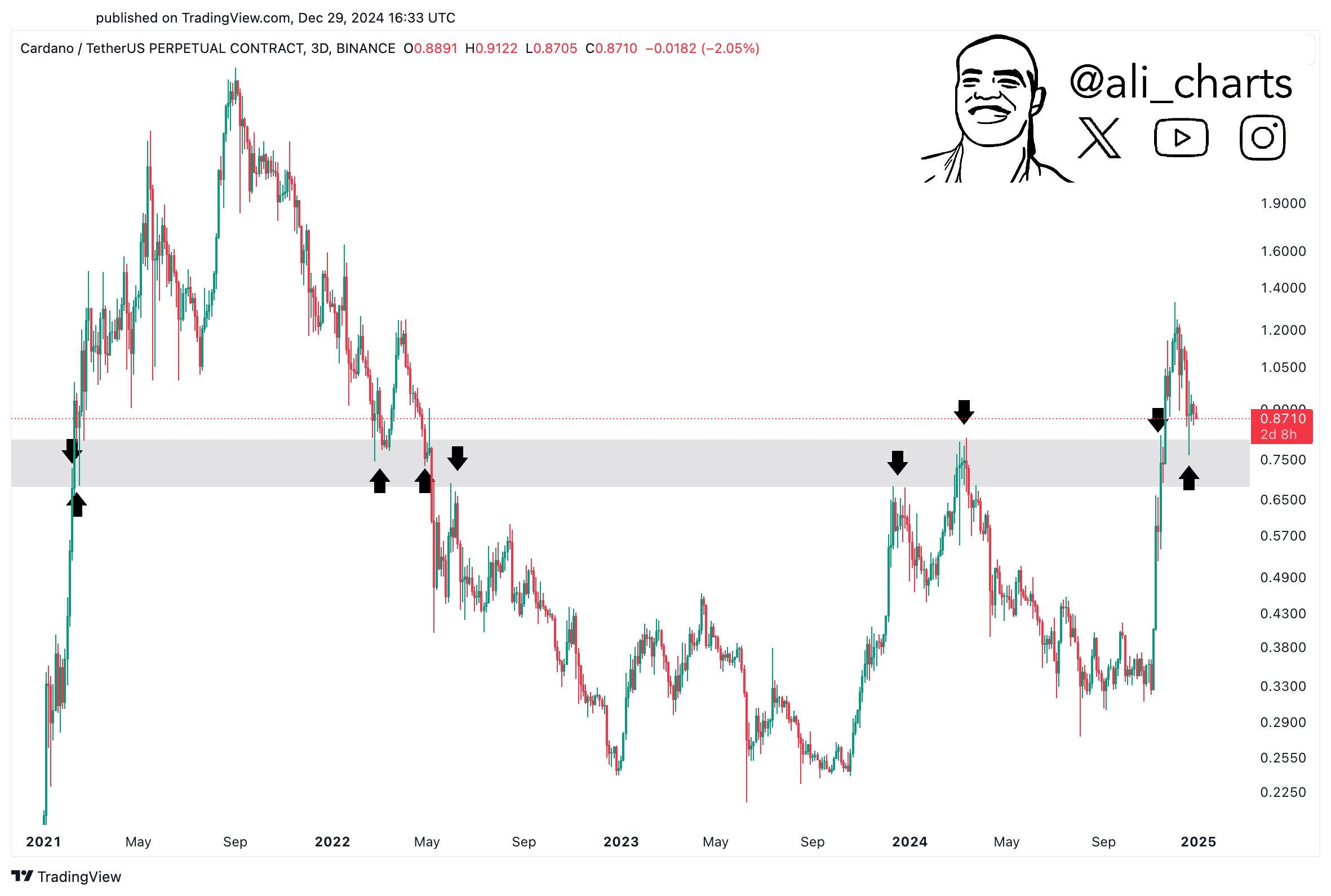
In addition, market data shows that Cardano boasts another support level between $0.68 and $0.77. According to trend analysis, the demand zone has detected Cardano’s historical price action on several occasions.

Cardano Support Ali Martinez
Cardano Support | Ali Martinez

Price Action Confirms Level’s Importance

Meanwhile, Cardano’s price action between the $0.5973 and $0.7556 demand zone further confirms the level’s importance for a price rebound. For context, the upper demand wall cushioned a further downtrend for ADA on December 20, when the asset capitulated to an intra-day low of $0.7620.

However, the area’s detection of Cardano’s next price action dates back to 2022. The demand zone served as support for ADA during the 2022 price correction, providing a short-lived rebound before the downtrend persisted.

Furthermore, when the marked flipped this area to resistance, the region impeded Cardano’s upward drive in December 2023 and March, spurring a considerable correction with each rejection. Finally, ADA broke through the zone with a bullish upsurge in November, turning it into a significant support zone.

If Cardano loses the support between $0.5973 and $0.7556, it could correct a staggering 46% to the next support around $0.4600, which served as support during the January price correction. Notably, 432,150 addresses bought 3.5 billion ADA at the level, at an average price of $0.4852.

In the meantime, ADA trades at $0.8715, up 1.37% in the past 24 hours.