NMKR founder and CEO Patrick Tobler believes Cardano has a rare opportunity to partner with a globally recognized marketing powerhouse capable of attracting users.
Notably, Patrick Tobler has reignited discussion within the Cardano community by arguing that the blockchain’s next major challenge is no longer technological development but user adoption and marketing.
Key Points
NMKR founder and CEO Patrick Tobler believes Cardano has a rare opportunity to partner with a globally recognized marketing powerhouse.
Serviceplan Group released a 56-page proposal focused on Cardano branding and enterprise adoption.
The agency is known for working with major multinational companies, including Uber, Lufthansa, and BMW.
Serviceplan described the marketing as the missing layer connecting Cardano’s technology to real-world adoption.
NMKR Founder Says Cardano Needs Marketing
In a recent commentary, Tobler stated that Cardano offers strong technology but still lacks the visibility to attract users.
“Tech is good. But Cardano needs users. We need marketing,” Tobler said.
His comments followed the release of a proposal from Serviceplan Group, a leading marketing agency network. The organization released a 56-page proposal detailing how Cardano could strengthen its branding and accelerate enterprise adoption.
According to Tobler, the opportunity is significant because Serviceplan regularly works with multinational corporations such as Uber, Lufthansa, and BMW. Consequently, he described the proposal as a rare chance for Cardano to expand mainstream awareness and warned the ecosystem not to overlook it.
Serviceplan Calls Marketing the Missing Layer for Cardano
Serviceplan reinforced Tobler’s argument by describing marketing as the missing layer connecting Cardano’s technological strengths to real-world implementation.
The agency argued that enterprise organizations require more than technical promises. Instead, they need clear communication, practical evidence, and confidence that the infrastructure can reliably support mission-critical operations.
Furthermore, Serviceplan distinguished itself from conventional marketing firms by highlighting its direct involvement within the Cardano ecosystem. The company stated that it had already deployed production-level infrastructure on Cardano through the Masumi Network, positioning itself not only as a marketing agency but also as an active ecosystem builder.
The proposal repeatedly emphasized that this combination of enterprise marketing expertise and hands-on blockchain deployment experience makes the potential partnership uniquely valuable for Cardano.
Cardano’s Push for Greater User Adoption
For years, Cardano has built its reputation on academic rigor, peer-reviewed development, and security-focused engineering. Nonetheless, critics have argued that competing networks have surpassed Cardano in user growth, ecosystem activity, and public visibility.
Addressing these concerns, Cardano founder Charles Hoskinson has outlined plans to attract users and liquidity from other ecosystems such as Bitcoin and XRP through DeFi initiatives. In his view, these efforts could channel billions of dollars into the Cardano ecosystem.
In addition, Hoskinson has stressed the importance of creating permanent community hubs capable of fostering developer collaboration and incubating new blockchain projects. Moreover, he has repeatedly argued that the crypto industry must return to its foundational principles to attract mainstream users and rebuild long-term trust.
Although the Cardano community has largely supported these proposals, Tobler believes the ecosystem also requires a full-scale marketing strategy capable of driving user growth.
Ethereum has dropped below $2,000, and a recent market analysis highlighted the ideal time to start buying the current dip.
The Santiment analysis identified possible reactions to this drop among retail traders, each providing a different timeline for DCAing or gaining fresh exposure to Ethereum (ETH). The outlook focuses on their behavior amid the dip and playing contrarian to it.
Key Points
Ethereum fell below the psychological $2,000 price level for the first time since March 29th.
Santiment has analyzed two different ways that market traders react to such a dip.
In the first case, FUD dominates market sentiments, signaling a possible bottom signal.
In the other case, FOMO and optimism kick in, possibly pushing Ether further lower.
The best opportunities come when the FOMO has cooled down.
Crypto bears have taken full control of the market again. Earlier on Thursday, they pushed Ethereum below the psychological $2,000 price level for the first time since March 29th.
Today alone, the coin is down 2.5%, bringing its weekly decline to 6%. The pullback to $1,970 further extends Ether’s year-to-date loss to 30%, the worst in the top 10 cryptocurrency ranking by market cap.
Amid the drop, Santiment has analyzed two different ways that market traders react to such a dip. In the first case, fear, uncertainty, and doubt (FUD) dominate market sentiments, with negative social media comments outpacing the positive ones.
In the other case, fear of missing out (FOMO) kicks in, with retail traders sharing views that the dip is an opportunity to buy at a discounted price. This keeps optimism of a rebound alive and social media comments positive.
How Each Sentiment Will Affect the Market
Santiment suggested that the FUD path is more common. Retail traders are more likely to panic and turn bearish on Ethereum. Meanwhile, as the platform has always preached, it is best to bet against the crowd. In this case, it sees Ether most likely rebounding.
However, retailers could still take the lesser common path and remain optimistic. Here, calls of “buy the dip” dominate social conversations, and they see the drop below $2,000 as an opportunity.
In this scenario, Santiment suggests the market might fall further as the crowd always get their calls wrong. Moreover, market makers aim to shake out as many weak hands as possible to grab sufficient liquidity for a strong reversal. As such, prices could continue dropping until retail traders give up.
Ideal Time to Buy Ethereum
When the FOMO cools down, Santiment suggests it is time to start buying Ethereum. According to the analysis, the best opportunities come when “there is true blood in the streets.” In this environment, negative social comments have far outweighed positive comments.
An accompanying chart shows that on May 27th, Ethereum retail traders had a month-high FOMO of a 2.4 bullish to 1.0 bearish comment ratio. This pushed the sentiment above the “FOMO zone,” with Santrimet suggesting the dip might not be over yet.
Ethereum Buy the Dip FOMO/Santiment
Until Ether’s crowd sentiment drops back to the FUD zone, dominated by crowd fear, the market intelligence platform advises patience.
XRP price has moved sideways for months, but institutional activity around the asset and Ripple continues to grow, according to Jake Claver, chairman of Digital Ascension Group.
In a thread on X, Claver said several key indicators tied to XRP adoption, ETFs, whale accumulation, and Ripple’s institutional expansion have reached record levels despite weak price movement.
Key Points
XRP price stayed flat for months, but institutional adoption and ETF growth kept hitting records.
U.S. spot XRP ETFs reportedly reached $1.37B in inflows, becoming a top crypto ETF category.
XRP whale wallets and large holder accumulation surged to record highs during 2026 consolidation.
Ripple expanded deeper into institutional finance after completing its $1.25B Hidden Road acquisition.
Ripple Appears on Major Institutional Rankings
One major development was Ripple’s inclusion in CNBC’s 2026 Disruptor 50 list, where it ranked No. 16. Claver noted that Ripple was the only crypto-native company on the list.
He also highlighted Ripple’s entry into the top 10 of the Prime Unicorn Index with a valuation above $26 billion. The index tracks large private companies similarly to how the S&P 500 tracks public firms.
According to Claver, institutional investors and compliance teams often use these rankings during due diligence before investing.
XRP ETF Inflows Continue Growing
Claver also pointed to strong growth in U.S. spot XRP ETFs since they launched in November 2025.
On May 11, spot XRP ETFs recorded $25.8 million in inflows, the highest single-day total since January 5. Franklin Templeton’s XRPZ fund led with $13.6 million, its best day of 2026.
Between May 11 and May 15, total inflows across all U.S. spot XRP ETFs reached $60.5 million, making it the strongest week of the year so far.
XRP ETF data
Claver claimed XRP ETFs are now the third-largest crypto ETF category behind Bitcoin and Ethereum products.
Total inflows since launch have climbed to $1.41 billion. He also said XRP ETFs became the second-fastest crypto ETF category to cross $1 billion in inflows, behind only Bitcoin ETFs.
XRP Whale Wallets Hit Record Highs
Claver also highlighted growing whale accumulation on the XRP Ledger. Data showed that as of May 12, around 332,230 wallets held at least 10,000 XRP, an all-time high.
Meanwhile, wallets holding 1 million XRP or more reportedly increased by 42 addresses since the start of 2026. Claver said this was the first increase in that whale category since September 2025.
These large wallets reportedly accumulated 1.2 billion XRP during the first quarter of 2026, the biggest quarterly accumulation since 2023. One wallet alone added 250 million XRP during the recent consolidation period.
That same group of million-plus XRP wallets accumulated 1.2 billion tokens in Q1 2026 Highest quarterly accumulation figure since 2023 One single address added 250 million XRP during the consolidation 9/15🧵
Another metric showed XRP whale outflow dominance on Binance rising to 91.4%, the highest level since 2024. This suggests more XRP is leaving exchanges than entering them, often viewed as a sign of long-term holding.
Ripple Expands Institutional Infrastructure
Claver also pointed to Ripple’s growing institutional presence after completing its $1.25 billion acquisition of prime brokerage firm Hidden Road.
Following the acquisition, Ripple appeared on DTCC and NSCC broker directories, bringing the company closer to the settlement infrastructure used in traditional finance.
Other developments included Ripple Custody expanding through partnerships with Securosys and Figment, along with the integration of Chainalysis transaction screening tools. Ripple Payments has also continued expanding across more than 60 global markets.
Standard Chartered Still Sees Bigger ETF Potential
Despite revising parts of its XRP outlook earlier this year, Standard Chartered still expects XRP ETFs to attract between $4 billion and $8 billion in inflows during 2026 if the proposed CLARITY Act becomes law.
According to Claver, that forecast remains much higher than the current cumulative ETF inflows already recorded.
He concluded that institutional infrastructure, ETF demand, and whale accumulation all appear to be strengthening before any major XRP price breakout happens.
Cardano founder Charles Hoskinson has defended Stellar following criticism surrounding its newly announced collaboration with the Depository Trust & Clearing Corporation (DTCC).
The controversy emerged after DTCC announced plans to enable the tokenization of DTC-custodied assets on the Stellar network by the first half of 2027.
While many participants across the crypto and traditional finance sectors welcomed the development, critics questioned Stellar’s blockchain architecture and whether it provides the same security guarantees as proof-of-stake or proof-of-work networks. In response, Hoskinson publicly defended the network.
Key Points
Cardano founder Charles Hoskinson defended Stellar after critics questioned its legitimacy as a blockchain.
The debate began following DTCC’s announcement about tokenizing assets on Stellar.
Hoskinson has consistently maintained a positive view of Stellar and its founder, Jed McCaleb, over the years.
XLM token, which surged more than 100% in weeks to $0.5194, is now trading at $0.1702.
Critics Slam Stellar Following Its Collaboration with DTCC
The debate started after DTCC and the Stellar Development Foundation (SDF) announced plans to support the tokenization of traditional financial assets on the Stellar network.
According to the announcement, the initiative aims to strengthen DTCC’s multi-chain strategy while improving interoperability between traditional finance and blockchain infrastructure. DTC-tokenized assets are expected to launch on Stellar in 2027.
However, the announcement quickly sparked criticism from crypto commentator Omid Malekan, who argued that Stellar is “not a legitimate blockchain.” Malekan claimed that Stellar lacks economic security. He also criticized Stellar’s consensus model, which relies on the Stellar Consensus Protocol (SCP), arguing that it depends on trusted validator relationships instead of open economic competition.
Meanwhile, Stellar protocol developer Garand Tyson responded sarcastically by agreeing with several of the criticisms. Tyson pointed out that Stellar validators are publicly known, cannot perform MEV extraction, cannot manipulate transaction ordering, and rely on community trust rather than token-based economic incentives.
Cardano Founder Defends Stellar
Amid the growing criticism, Hoskinson stepped in to defend Stellar and questioned the hostility directed toward the network. He argued that Stellar remains a perfectly legitimate technology. His comments suggested that blockchain systems do not all need to follow the same model to be considered valid or useful.
Did Stellar kill this guy's dog? It's prefectly legitimate technology
Notably, Hoskinson has maintained a respectful relationship with Stellar and its founder, Jed McCaleb, for years. In 2024, Hoskinson revealed that he had communicated with McCaleb and described the Stellar team as “good people.” He also disclosed that Stellar participates in several industry initiatives alongside Cardano.
Hoskinson’s positive stance toward Stellar dates back several years. In 2017, he publicly stated that he wanted the Stellar ecosystem to succeed. He also praised the Stellar whitepaper, describing it as an interesting and worthwhile study.
More recently, in July 2025, Hoskinson congratulated Stellar’s XLM token and Hedera after both assets recorded major rallies. At the time, XLM surged more than 100% within weeks to $0.5194. Hoskinson described the rally as evidence that both ecosystems had survived difficult market cycles and continued to grow.
Since then, however, XLM has declined sharply alongside the broader crypto market and currently trades at $0.1702. Despite the broader market downturn, the token has still gained 15.59% over the past 24 hours, even as most major cryptocurrencies remain in the red during the same period.
Crypto trading firm Rand Group recently highlighted a pattern that has appeared several times between Bitcoin and the S&P 500 index.
According to the firm, whenever Bitcoin ended a year performing worse than the S&P 500, it usually bounced back strongly the following year. This has continued to play out since 2014.
Key Points
Bitcoin historically rebounds after every yearly underperformance against the S&P 500.
After underperforming in 2014, BTC gained 3,270% against the SPX from 2015 to 2017.
Bitcoin dropped 19% against the S&P 500 last year, and analysts believe it could recover this year.
Kalshi estimates a 15% chance that Bitcoin outperforms the S&P 500 in 2026, and the odds have continued to drop.
Bitcoin is down 24.35% against the SPX this year, as investors flock to traditional markets.
Bitcoin Rebounds After Underperforming the S&P 500
Rand Group shared the observation in a post on X, calling attention to how Bitcoin recovered after major periods of weakness.
The firm noted that Bitcoin lagged behind the S&P 500 by 90-percentage points in 2014 before beating it by 68-percentage points in 2015. A similar move happened after 2018, when Bitcoin underperformed by 68-percentage points and then recovered by 58-percentage points in 2019.
Bitcoin vs SPX | Rand Group Research
The pattern played out again after the 2022 bear market, as Bitcoin fell behind the S&P 500 by 47-percentage points before bouncing back with a 130-percentage point lead in 2023.
Historical Data
Chart data confirms Rand Group’s claims. In January 2014, Bitcoin went through a difficult period and lost significant ground against the S&P 500. During that year, BTC fell 60.63% against the index as the crypto market struggled.
The following year brought a major turnaround. In 2015, Bitcoin recovered by 35% against the S&P 500. The recovery continued for the next three years, from 2015 to 2017, as Bitcoin consistently outperformed the index. During that period, Bitcoin gained 3,270% against the S&P 500.
However, the premier crypto asset faced another major drop during the 2018 bear market. As selling pressure spread across the crypto sector, Bitcoin fell 71% against the S&P 500 that year.
Following the decline, a recovery push appeared in the following year. In 2019, Bitcoin climbed 50.6% against the S&P 500. The cryptocurrency then continued to outperform the index between 2019 and 2021. Over those three years, Bitcoin recorded gains of 556% against the S&P 500.
Bitcoin Recovery After the Terra and FTX Implosions
The crypto market entered another difficult phase in 2022 after the implosions of Terra and FTX shook investor confidence. During this phase, Bitcoin dropped 55% against the S&P 500.
Still, Bitcoin managed to recover once again in the years that followed. Over the next two years, the asset gained 267% against the S&P 500. Bitcoin also reached a new all-time high against the index in 2025 and looked set to complete a third straight year of outperformance.
However, the streak came to an end after the market downturn that started in the fourth quarter of 2025. By the end of 2025, Bitcoin had fallen 19.5% against the S&P 500, unable to complete a third consecutive yearly gain for the first time.
Can Bitcoin Recover Against the S&P 500 in 2026?
Several industry leaders and firms, including Rand Group, now believe Bitcoin could recover against the S&P 500 again in 2026. Rand Group’s comments followed a statement from prediction market Kalshi, which estimated that Bitcoin had a 15% chance of outperforming the S&P 500 this year.
Will Bitcoin outperform S&P 500 this year | Kalshi
However, recent market data showed those odds continuing to weaken. Bitcoin has kept falling against the S&P 500 in 2026 and is already down 24.35% against the index this year. If the trend continues, Bitcoin could record its first-ever back-to-back yearly decline against the S&P 500.
The weakness comes as the crypto market continues to slow while traditional markets keep moving higher. Bitcoin has already dropped 16.89% against the U.S. dollar on a year-to-date basis. Meanwhile, the S&P 500 has gained 9.96% and recently reached a new all-time high of 7,539 points.
Current Weakness Could Create Opportunity
Speaking on the current situation, Joao Wedson, founder and CEO of Alphractal, pointed out that the S&P 500 has continued to outperform Bitcoin along an uptrend line that started back in 2017.
The S&P 500 managed to outperform Bitcoin along the uptrend line that started in 2017.
Recently, the BTCUSD/S&P 500 ratio rejected or tested the lower part of this trendline.
In other words, market makers seem to be more attracted to equities than crypto right now.
Wedson highlighted that the BTCUSD/S&P 500 ratio recently tested or rejected the lower part of that trendline. He believes market makers currently appear more interested in equities than cryptocurrencies.
Despite this, Wedson sees a possible opportunity in the current market conditions. According to him, Bitcoin’s weakness compared to stocks could allow investors to buy the cryptocurrency at relatively cheaper levels.
Staking on Solana has long been a baseline strategy for anyone holding SOL. The premise is simple enough: delegate your tokens to a validator, earn rewards over time, and let your assets work passively in the background. For a long time, that was enough.
But if you take a closer look at how most delegators still stake today — stake → wait → collect, you’ll notice something is missing. That model is starting to show its age. Not because it’s broken, but because it doesn’t account for what matters most in a fast-moving market: capital flexibility.
Where Classic Staking Falls Short
Traditional staking is straightforward, and that’s both its strength and its weakness.
Here’s what the classic model gives you:
A predictable reward stream
Long-term exposure to the network
A relatively “set it and forget it” experience
And here’s what it takes away:
Your funds are locked. Once staked, your SOL isn’t going anywhere fast.
Unstaking takes time. On Solana, exiting a stake position requires waiting through an unbonding period — one epoch.
Your capital can’t do anything else. While your SOL sits staked, it’s not available for DeFi strategies, liquidity provision, or responding to market opportunities.
If you never plan to touch your assets, this might be fine. But if you want to react to market conditions, participate in DeFi, or simply retain access to your funds without sacrificing yield — classic staking starts to feel like a constraint rather than a strategy.
The New Approach: Staking Without Sacrificing Liquidity
This is where solutions like JPool come in — and why they represent a meaningful shift in how experienced stakers think about their SOL.
You stake your SOL. But you don’t give up your liquidity.
When you stake through JPool, you receive JSOL — a liquid staking token that:
Represents your staked position in full
Continues to accrue staking rewards automatically
Remains freely usable (you can trade it, deploy it in DeFi protocols, or hold it as you would any other token)
In other words, your capital doesn’t just “sit in staking”, it keeps moving. Your stake earns rewards while JSOL gives you options. This is the fundamental difference between locking your SOL away and putting it to work on two fronts at once.
Where Things Become Even More Interesting
For stakers who want to go beyond the standard approach, JPool also offers a leverage staking feature — a way to amplify your position and potentially increase your yield.
Here’s the concept: you use your JSOL as collateral to borrow additional SOL, stake that SOL to receive more JSOL, and repeat — building a larger leveraged position than you could with your original capital alone.
This is not a passive strategy. It demands active management.
You need to monitor:
Health Factor (if it drops too low, your position can be liquidated)
LTV Loan-to-Value (the ratio of your borrowed amount to your collateral)
Market conditions (sudden price swings can shift your position quickly)
Leverage staking is a tool for stakers who genuinely understand what they’re doing. Used thoughtfully, it can be powerful. Used carelessly, it introduces real risk. Know which category you’re in before you proceed.
Why This Isn’t Just “Another DeFi Tool”
The key distinction here is control.
In a direct staking model, you:
Choose your own validator (not a protocol’s algorithm)
Manage your own risk (you understand exactly where your stake is going)
Don’t rely on black-box distribution logic (the decision stays yours)
Why does this matter? Because not all validators are created equal, and that gap doesn’t disappear just because a protocol wraps things in a liquid token. The real performance differences between validators come down to:
Uptime (how consistently they produce blocks and vote)
Skip rate (how often they miss their assigned slots)
Infrastructure quality and geography (hardware, data center reliability, latency)
These factors directly affect how much you actually earn — not just the APY number displayed on a dashboard.
Not All APY Numbers Mean the Same Thing
One of the most common points of confusion in Solana staking is the APY figure. The same validator node can display different APY numbers across different platforms. The reasons:
Different calculation methodologies (trailing epochs, projections, annualization assumptions)
Different inclusion or exclusion of MEV rewards
Marketing-adjusted figures that favor best-case scenarios over real performance
Chasing the highest APY on screen without understanding what’s behind it can significantly reduce long-term returns.
What actually matters:
Historical performance of the validator (how consistent have rewards been over time?)
Reward stability across epochs (not just peak performance, but average and worst-case)
Zero or minimal downtime (even brief outages can meaningfully reduce your annualized return)
When you’re evaluating where to stake, look for validators who publish transparent data and have verifiable track records — not just the ones with the boldest APY displayed.
The Validator’s Role Has Changed
In this evolving ecosystem, the validator you choose is a part of your strategy.
A reliable, high-performing validator contributes to:
Consistent reward flow (fewer missed blocks, fewer lost epochs)
Reduced risk (you’re not dependent on validators who cut corners on infrastructure)
Predictable outcomes (you can plan around your staking returns rather than being surprised by yield volatility)
The validators who are succeeding in this environment aren’t just maintaining nodes — they’re investing in their relationship with delegators. That means:
Prioritizing uptime and consistency above all else
Being transparent about performance metrics
Educating their community about staking mechanics, risks, and options
Vladika is an example of this approach in practice. Vladika operates with 0% commission and passes 100% of MEV rewards to delegators — meaning every lamport of staking income goes directly to you, not to validator fees. Their infrastructure is designed around stable performance, including geographic diversification with nodes positioned to minimize latency and maximize availability.
Vladika
Validators like Vladika are also making it easy to participate in liquid staking strategies. You canstake SOL to Vladika directly through JPool and receive JSOL — getting the security of a trusted, transparent validator combined with the flexibility of liquid staking in a single step.
This combination (a proven validator plus liquid staking tokens) is what makes a modern staking strategy genuinely powerful.
What This Means for Delegators in Practice
The days of “pick a validator and forget it” aren’t over, but they’re no longer enough on their own. A realistic, modern staking approach looks more like this:
Choose a validator with a verifiable track record — look at uptime, skip rate, reward history, and transparency, not just APY
Use a tool that gives you liquidity — so your staked capital remains available for other strategies if opportunities arise
Preserve optionality — the ability to shift your position, respond to market changes, or exit without waiting through long unbonding periods
This doesn’t mean you need to actively manage your stake every day. It means building your staking setup in a way that doesn’t close doors , because the market moves fast, and flexibility has real value.
Conclusion: The Question Has Shifted
Staking on Solana is evolving. The question is no longer whether you should stake — it almost certainly makes sense if you’re holding SOL long-term.
The question is: how efficiently is your capital working while it’s staked?
If the answer is “it’s locked and waiting,” that’s worth reconsidering. The infrastructure exists today to stake SOL, earn rewards, and keep your capital flexible — all at the same time.
For stakers who understand how to balance control, validator selection, and risk management, this opens up a significantly more powerful way to participate in the Solana network.
The old way still works. But the smarter way works harder.
Stake SOL to Vladika through JPool and receive JSOL — a liquid token that keeps your funds flexible while still earning staking rewards.
Disclaimer: This Press release article is provided by the Client. The Client is solely responsible for this page’s content, quality, accuracy, products, advertising, or other materials. Readers should conduct their own research before taking any actions related to the material available on this page. The Crypto Basic is not responsible for the accuracy of info and any damage or loss caused or alleged to be caused by the use of or reliance on any content, goods, or services mentioned in this press release article.
Please note that The Crypto Basic does not endorse or support any content or product on this page. We strongly advise readers to conduct their own research before acting on any information presented here and assume full responsibility for their decisions. This article should not be considered investment advice.
SoFi Technologies has launched SoFiUSD, becoming the first U.S. national bank to offer its own stablecoin directly inside a banking app.
The stablecoin allows SoFi’s nearly 15 million users to buy, sell, hold, and convert the token within the SoFi app.
The company said SoFiUSD is issued by SoFi Bank, N.A. It will remain equal in value to the U.S. dollar at a 1:1 ratio. Every token is backed by liquid assets, and users can redeem it directly through SoFi Bank.
CEO Anthony Noto said the goal is to combine the speed of blockchain technology with the trust and regulation of traditional banking. Users can now manage crypto alongside savings, loans, spending, and investments in one app.
Key Points
SoFi launched SoFiUSD, the first bank-issued stablecoin available directly inside a U.S. banking app.
SoFiUSD runs on Ethereum and Solana, with more blockchain network support planned later.
Users can buy, sell, hold, and convert SoFiUSD alongside savings and investments in the app.
SoFi plans to expand SoFiUSD into tokenized deposits and cheaper cross-border payments.
SoFiUSD Runs on Ethereum and Solana
Notably, SoFiUSD is currently available on Ethereum and Solana, two major blockchain networks. However, the company said it will add support for more blockchains later.
The token uses the ticker SOFID on-chain and will receive regular audits from an independent U.S.-licensed CPA firm. SoFi said these attestations are to provide transparency for users.
The rollout starts immediately, with full access by early June after users update the SoFi app.
SoFi Plans More Stablecoin Features
The launch is the first step in SoFi’s larger stablecoin strategy. The company plans to introduce tokenized deposits linked to SoFiUSD, allowing users to earn interest while keeping eligible FDIC insurance protections.
SoFi also wants to use the stablecoin for cross-border payments, helping users send money globally at lower costs and with faster settlement than traditional bank wires.
The company also announced a partnership with Bullish to list SoFiUSD for institutional trading. SoFi said this should improve liquidity and pricing for large trades.
SoFi Expands Ahead of Traditional Banks
The launch makes SoFi one of the first major U.S. financial institutions to integrate a regulated stablecoin directly into consumer banking services.
The move comes as U.S. lawmakers continue discussing stablecoin regulations and broader crypto laws.
SoFi currently serves around 14.7 million users and also owns Galileo Financial Technologies, which provides fintech infrastructure for more than 133 million accounts worldwide.
The company noted that while SoFiUSD can be redeemed for U.S. dollars, the token itself is not a bank deposit, is not legal tender, and is not insured by the FDIC or SIPC. Blockchain transactions may also face delays or irreversible losses depending on network conditions.
CoinRabbit – Best institutional crypto lending platform with secure and flexible loan management
Ledn – Best for Bitcoin-focused institutional lending
Nexo – Best institutional crypto lending platform for structured credit with ecosystem perks
Aave – Best DeFi protocol for on-chain treasuries with real-world asset collateral
Unchained – Best institutional crypto lending platform where the borrower holds one of the multisig keys
Institutional crypto lending has moved well past its speculative early years. Hedge funds, family offices, mining operations, and corporate treasuries now routinely borrow against digital assets to access working capital without selling the underlying position or triggering a taxable event.
The 2022 collapse of Celsius, Voyager, and BlockFi left a mark on how institutions evaluate lenders. Each of those platforms rehypothecated client collateral, lending or investing the very assets borrowers had pledged. Grayscale’s 2026 outlook (CoinDesk, December 2025) describes the current period as “the dawn of the institutional era,” driven by macro demand for alternative stores of value and improving regulatory clarity.
For any treasury manager comparing providers today, the question that matters most is about custody: where does the collateral sit, and can anyone else touch it? The five platforms below approach that question differently.
5 Best Crypto Loan Platforms Comparison Table
Platform
Founded
Max LTV
Collateral types
Rehypothecation
Best for
CoinRabbit
2020
90%
350+ cryptocurrencies
No
Multi-asset collateral, Private Program
Ledn
2018
50%
BTC only
Limited
Bitcoin-focused treasuries
Nexo
2018
~50%
BTC, ETH, 40+ assets
Yes
Zero-interest credit, U.S. market
Aave
2017
Varies
ETH-based, RWAs
No
On-chain treasuries
Unchained
2016
~40%
BTC only
No
Self-custody institutions
CoinRabbit
CoinRabbit – Best Institutional Crypto Lending Platform With Secure And Flexible Loan Management
CoinRabbit positions itself as a security-first crypto asset management platform designed to preserve and manage digital capital. The crypto loan product serves as a tool for capital preservation: institutions access liquidity without selling their holdings. It can also be tested on a smaller scale, with loan amounts starting from $25–100 depending on the asset.
CoinRabbit accepts 350+ cryptocurrencies as collateral. LTV (loan-to-value ratio) ranges from 50% to 90%, and APR (annual percentage rate) starts from 11.95%, paid at repayment rather than monthly. Loan terms are unlimited, so there is no maturity date forcing a refinancing cycle. Since 2020, CoinRabbit has ensured 100% capital reserve, keeping clients’ funds safe and never reused.
Beyond loans, the platform enables flexible management of that liquidity through a stablecoin yield product (5% APY on USDT and USDC, daily accrual, no lock-up), a swap engine for 240+ tokens, and a secure wallet. The white-glove Private Program for larger balances (500,000$ +) brings all of these products together into a single premium service.
Funds, treasuries, and individual investors can access the Private Program, which assigns a personal account manager, enables cross-collateralization across multiple assets, and reduces the rates. The program also includes loan recovery option, cross-collateralization, OTC trading, and direct transfers to bank accounts.
CoinRabbit loan details at a glance:
Collateral stored in cold wallets with multisig; zero rehypothecation
350+ accepted cryptocurrencies, from BTC and ETH to altcoins
LTV range: 50% to 90%
APR from 11.95%, paid at repayment
No fixed loan term, no monthly installments
Funds disbursed in 10 minutes
24/7 live human support
Ledn
Ledn – Best For Bitcoin-Focused Institutional Lending
Toronto-based Ledn was founded in 2018 by Adam Reeds and Mauricio Di Bartolomeo. The company dropped ETH support in mid-2025 (effective July 1, 2025) to concentrate exclusively on BTC-backed credit and eliminate third-party credit risk from its balance sheet.
When evaluating any CeFi (centralized finance) lending platform, the first question is always about collateral safety. In Ledn’s case, the answer depends on which loan plan you choose. The Custodied plan stores Bitcoin collateral with BitGo and prohibits rehypothecation. The Standard plan, however, carries a lower APR (approximately 12.4%) but allows Ledn to lend your collateral to institutional funding partners. It introduces counterparty risk that the borrower does not control.
In February 2026, Ledn completed a $188 million Bitcoin-backed ABS (asset-backed security) securitization (TheStreet, May 2026), the first crypto deal of its kind to earn an investment-grade BBB- rating from S&P Global. The underlying pool contained 5,441 short-term loans secured by over 4,000 BTC (CrowdFundInsider, February 2026).
The trade-offs: BTC-only collateral, fixed 12-month terms, and a 50% LTV ceiling, which requires twice as much collateral per dollar borrowed compared to platforms with higher LTV caps.
Ledn loan details at a glance:
BTC only collateral
Up to 50% LTV
4% to 13.9% APR depending on loan type
Loan term: fixed 12 months
Proof-of-Reserves attestations since January 2021
Nexo Crypto Lending
Nexo – Best Institutional Crypto Lending Platform For Structured Credit With Ecosystem Perks
Nexo returned to the U.S. market in February 2026 after a period of absence. At the time of relaunch, the platform had $11 billion in assets under management and partnered with Bakkt for its digital asset infrastructure (CoinDesk, February 2026).
The platform offers a comprehensive CeFi solution that includes crypto-backed loans, a credit card, savings products, and trading. Its Nexo Card provides a flexible credit line backed by cryptocurrency collateral and delivers up to 2% crypto rewards on transactions. Users can also benefit from loyalty tiers by holding NEXO tokens, which unlock higher loan-to-value (LTV) ratios and reduced borrowing rates. Nexo accepts over 100 assets as collateral, including Bitcoin and Ethereum.
Collateral is held by BitGo, which provides up to $375 million in insurance. However, custody and rehypothecation terms vary depending on the loan type and loyalty tier. In some cases, borrowers’ collateral may be reused by the platform. This variability represents a notable risk for institutions and conservative users who prefer fully ring-fenced assets, and such details should be confirmed in writing before committing significant funds.
In addition to borrowing, Nexo provides flexible savings products with competitive yields and hourly interest accrual on loans, allowing greater repayment flexibility. The platform also features integrated spot trading. New accounts require a $5,000 minimum balance, targeting more experienced and affluent users.
Nexo loan details at a glance:
Zero-Interest Credit: 0% APR, up to $5 million, fixed-term for BTC and ETH holders
Standard credit lines: APR from 2.9% for Platinum-tier members
Supports 40+ digital assets as collateral
Loyalty tier system based on NEXO token holdings
S. operations resumed in February 2026
Aave – Best DeFi Protocol
Aave – Best DeFi Protocol For On-Chain Institutional Crypto Lending
Most platforms on this list are centralized. Aave takes a fundamentally different approach. Founded in 2017 by Stani Kulechov, the protocol runs entirely on-chain. By April 2026, Aave held roughly $25 billion in TVL (total value locked) and generated an estimated $140 million in annualized revenue (CoinDesk, April 2026), making it the largest DeFi lending protocol by both metrics.
The mechanics are different from CeFi. Borrowers deposit crypto into on-chain liquidity pools and receive loans through automated smart contracts. Rates adjust algorithmically based on pool utilization. No credit check, no intermediary involved. Liquidation triggers automatically if collateral drops below the protocol threshold. Because collateral sits in a smart contract rather than with a company, the rehypothecation question does not apply in the traditional sense, but smart contract exploits introduce a different category of risk.
What makes Aave relevant for institutions in 2026:
Aave Horizon: a permissioned lending market on Ethereum for traditional finance firms to borrow against tokenized real-world assets such as U.S. Treasuries
V4 protocol upgrade planned, with a Hub and Spoke architecture to reduce liquidity fragmentation
82% market share (The Block, October 2025) of all outstanding debt on Ethereum
The trade-offs: variable rates can spike during volatile periods, and gas fees add friction. Smart contract risk remains real. The April 2026 KelpDAO exploit (CoinDesk, April 2026) resulted in approximately $292 million in losses. Aave works best for institutions already operating on-chain.
Unchained – Best For Self Custody
Unchained – Best For Self-Custody Institutional Bitcoin Lending
The other four platforms on this list require borrowers to hand over full custody of their collateral. Unchained does not. Founded in 2016 in Austin, Texas, the company built its lending product around a collaborative custody model: borrowers hold one key in a 2-of-3 multisig wallet, Unchained holds another, and a third-party custodian holds the last. No single party can move the collateral alone.
Because the multisig design physically prevents the platform from moving collateral without the borrower’s key, rehypothecation is architecturally impossible. In 2023, Unchained reported 170% growth in loan activity (BusinessWire, August 2023) during H1, with business accounts up 88% in the same period.
The conservative LTV (roughly 40%) means you need substantially more collateral per dollar of loan compared to CoinRabbit (up to 90%) or Ledn (50%). For corporate treasuries that value custody control above all else, Unchained solves a trust problem that Proof-of-Reserves reporting alone cannot address.
Unchained loan details at a glance:
BTC-only collateral
LTV: approximately 40%
Loan terms: 90 to 360 days
Business loans up to $3 million; institutional loans above $3 million
Collaborative multisig custody; no rehypothecation by design
How to choose the right crypto lending platform for your fund or treasury
The right platform depends on what your fund holds, how fast you need capital, and how much custody control you require. Five questions are worth asking:
Where is my collateral, and can it be rehypothecated? CoinRabbit and Unchained enforce no-rehypothecation by design. Ledn’s Custodied plan does the same, though its Standard plan allows lending to partners.
Does the provider support my asset mix? Bitcoin-only lenders (Ledn, Unchained) serve BTC-heavy portfolios. CoinRabbit’s 350+ accepted assets cover multi-asset treasuries.
What LTV do I need? CoinRabbit offers up to 90%, Ledn caps at 50%, Unchained at roughly 40%.
Do I need a dedicated manager? CoinRabbit Private Program ($500k+) and Unchained Signature provide personal support. Aave is fully automated.
Am I comfortable with DeFi? Aave requires on-chain wallet management. CeFi platforms (CoinRabbit, Ledn, Nexo) handle custody through a traditional interface.
How Institutions Use Crypto-Backed Loans To Improve Capital Efficiency
A crypto-backed loan works like a margin loan in traditional finance: an institution pledges digital assets as collateral and borrows funds (typically stablecoins) against them, without selling the position.
Take a practical scenario: a mining company holds 500 BTC, worth approximately $38.3 million with Bitcoin around $76,600 in late May 2026 (Coinbase, May 2026). The CFO needs working capital for new equipment but does not want to sell BTC and lock in a taxable event. Instead, the company deposits its Bitcoin as collateral at 80% LTV and receives roughly $30.6 million in stablecoins. The equipment gets purchased, Bitcoin exposure remains unchanged, and no taxable sale occurs.
Institutional borrowers typically use crypto-backed loans for three purposes:
Treasury liquidity: access working capital without selling the underlying position
Bridge financing: cover short-term funding gaps between fundraising rounds or asset exits
Yield arbitrage: borrow at one rate and deploy proceeds into opportunities above the cost of capital
Risks Of Crypto-Backed Lending For Institutions
Three categories of risk apply to institutional crypto lending:
Market and collateral risk is the most visible. Bitcoin dropped from its October 2025 high near $126,198 (CoinMarketCap, October 2025) to below $77,000 by May 2026. A portfolio that borrowed at 80% LTV near the peak would have faced a margin call. Stress-test your LTV against 30% to 50% drawdowns before committing collateral.
Counterparty and custody risk depends on the lender’s architecture. Platforms that rehypothecate collateral create credit exposure to third parties whose default could make the borrower’s assets unrecoverable. CoinRabbit’s cold-storage multisig and Unchained’s collaborative custody eliminate this vector.
Smart contract risk applies to DeFi lending. The April 2026 KelpDAO exploit showed that even audited protocols can suffer losses from bridge vulnerabilities. Aave has a strong security track record, but no on-chain protocol is fully immune.
Bitcoin is exhibiting a diverging market trend that bulls would not want to see, with prices relying heavily on bullish derivatives momentum.
Bitcoin (BTC) dropped below $75,000 today, building on the bearish momentum from the previous day. Amid this, a report has highlighted a concerning mismatch between demand and derivatives sentiment, adding to the current market uncertainty.
Key Points
Bitcoin’s latest market structure shows a growing disconnect between sentiment and actual demand.
Binance funding rates have moved back into positive territory, signaling that leveraged long positioning is increasing.
However, the Binance taker buy volume has trended lower for several months as spot buying pressure depreciates.
Unless aggressive spot buying recovers meaningfully, the current divergence may continue to weigh on price stability in the near term.
Bitcoin Demand-Optimism Decoupling
This report came from CryptoQuant’s verified analyst, Moreno. Per the analysis, Bitcoin’s latest market structure shows a growing disconnect between sentiment and actual demand, with multiple market indicators moving in opposite directions.
While derivatives appetite has turned increasingly optimistic again, aggressive spot participation is dwindling rapidly beneath the surface.
The divergence became more noticeable following the recent BTC recovery attempt. The asset pushed above $82,000 earlier in the month, but the selling pressure around the area stalled the bullish momentum. Bitcoin has since started drifting lower, while key demand metrics continue weakening.
Funding Rates Rise While Spot Demand Weakens
Moreno cited the funding rate as one of the clearest signals of this “dangerous” divergence. Binance funding rates have moved back into positive territory, signaling that leveraged long positioning is increasing. Bitcoin long traders are willing to pay funding fees to short traders, highlighting their conviction that the coin will increase in price in the near to mid-term.
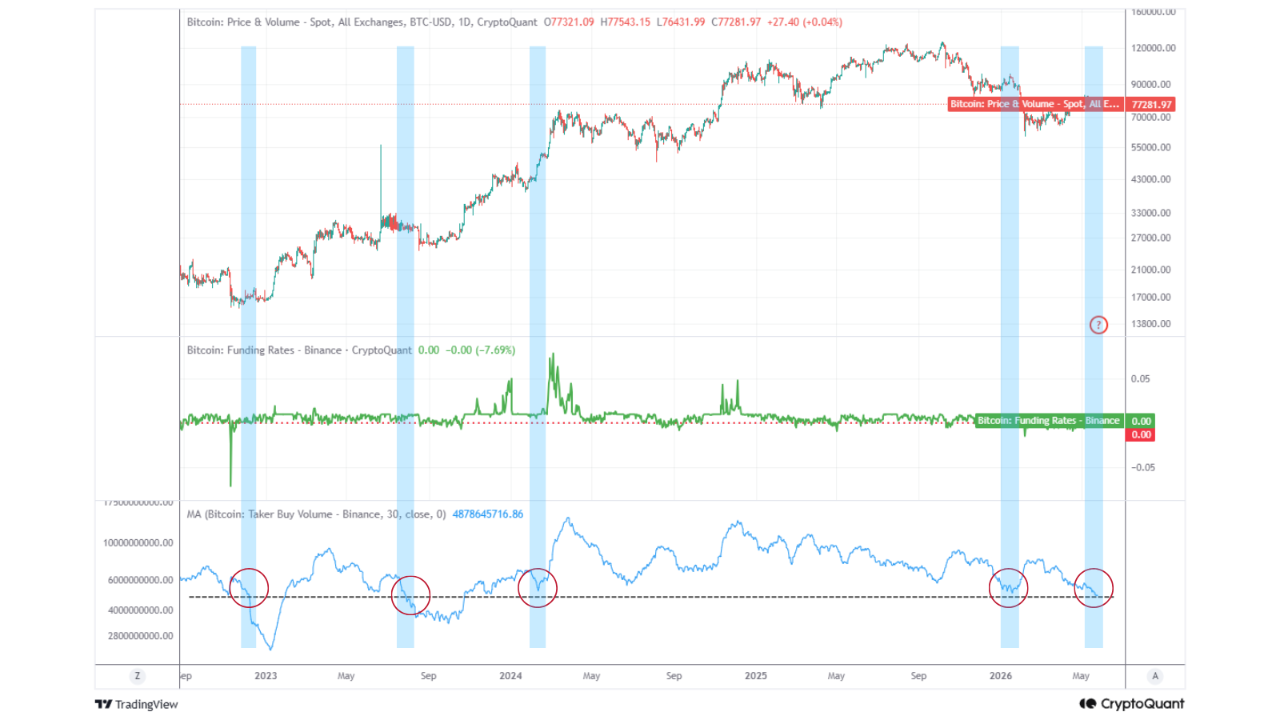
However, spot demand is going in the opposite direction. The Binance taker buy volume has trended lower for several months as spot buying pressure depreciates. An accompanying chart shows that the metric has been making lower highs and lower lows since early 2024 and is now sitting near a historical base.
Bitcoin Taker Buy Volume Decline/CryptoQuant
Notably, a recent The Crypto Basic report shows that apparent demand is also falling. The metric has dropped to -147,000 BTC, the most bearish reading since December 2025.
This divergence creates an important imbalance in market structure. Historically, stronger rallies tend to occur alongside growing spot demand and rising buyer participation. In the current setup, however, leveraged optimism is increasing while actual buying activity is declining.
What Does It Mean for Bitcoin
Moreno noted that the combination of rising funding rates and declining taker buy volume often signals that the market is becoming increasingly dependent on leverage rather than on actual spot demand. Such a condition leaves price action more vulnerable, especially if spot demand continues to decline.
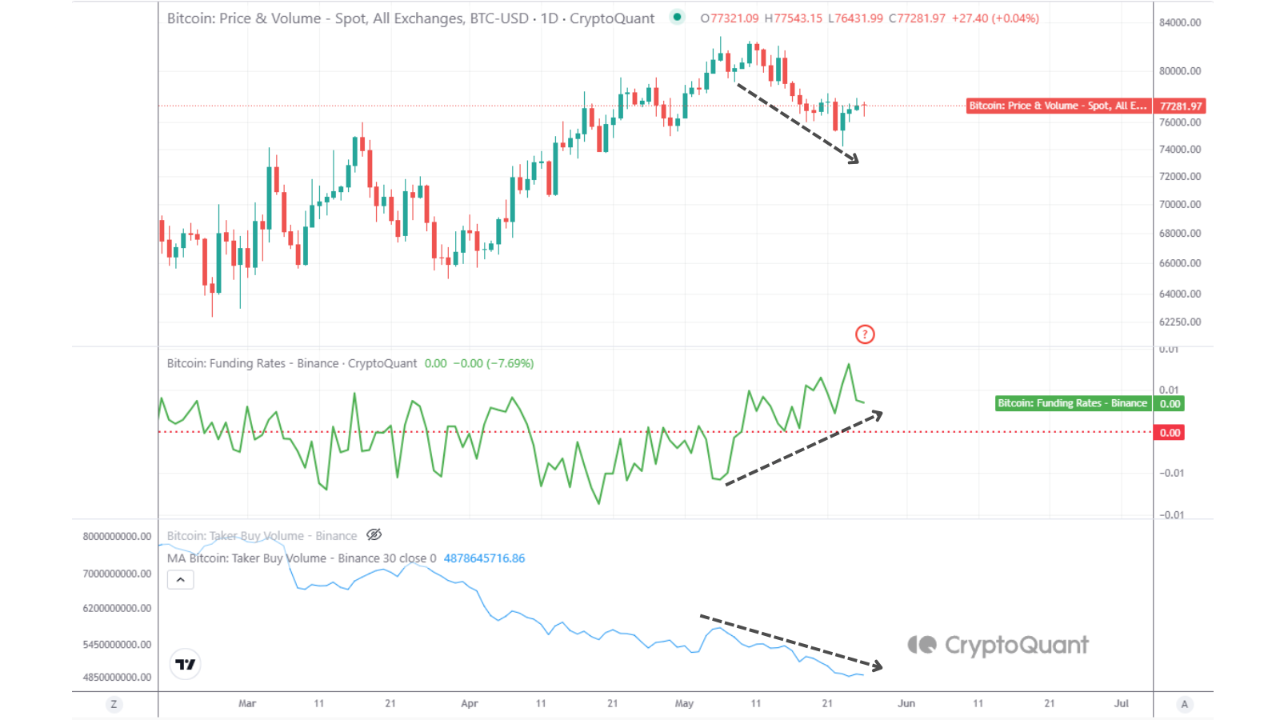
It also shows that the BTC market is in the late stage of a speculative-led rally. The recent market trend already suggests that earlier momentum is fading. A shared daily chart showed that Bitcoin has since begun printing lower highs while the funding rates on Binance continue to climb. Meanwhile, the taker buy volume has also continued to trend downward.
Bitcoin Price Divergence with Taker Buy Volume/CryptoQuant
The analyst noted that unless aggressive spot buying recovers meaningfully, the current divergence may continue to weigh on price stability in the near term.
Ripple has filed two new trademark applications linked to its well-known Triskelion logo and brand name.
XRP community figure Eri drew attention to the development in a post on X on Tuesday. Notably, the filings have attracted attention because they go far beyond Ripple’s traditional payments business.
Specifically, the applications mention services related to treasury management, investment products, brokerage, lending, and digital asset financial infrastructure.
Eri said the filings appear to be a standard trademark expansion, which companies often use to protect possible future products and business areas.
Key Points
Ripple filed new trademarks covering treasury, brokerage, lending, and investment-related services.
The filings suggest Ripple is expanding beyond payments into broader institutional finance markets.
XRP supporters believe the trademarks hint at future products tied to brokerage and liquidity services.
Ripple previously filed the RLUSD trademark before launching its dollar-backed stablecoin.
Trademark Filings Suggest Bigger Financial Plans
The trademark applications include software and financial services connected to:
Treasury management
Fund transfers
Digital asset management
Cash management
Investment management
Risk management
The filings also mention downloadable software for treasury operations and financial workflows, along with electronic storage services for financial data. In addition, Ripple listed several financial services, including:
Financial brokerage services
Financial clearinghouse services
Prime brokerage services
Securities brokerage services
Financing and lending services
Hedge fund management
Securities lending services
Debt financing services
Futures and fixed-income trade execution
Some XRP supporters believe the inclusion of securities lending, margin financing, derivatives trading, and repurchase agreements could mean Ripple wants to expand deeper into institutional finance.
XRP Community Sees Institutional Growth
Members of the XRP community believe the filings show Ripple is moving beyond cross-border payments and toward broader institutional financial services.
The applications mention services tied to brokerage, fixed-income products, commodities, foreign exchange, and portfolio management. References to digital asset settlement and post-trade brokerage services could potentially become important for XRP-related liquidity products in the future.
However, trademark filings do not guarantee that new products will launch soon. Companies often file broad trademarks to secure legal protection for future business ideas. Meanwhile, this is not the first time a Ripple trademark filing has preceded a major product launch.
Ripple’s Stablecoin Trademark
In May 2024, Ripple filed a trademark for “RLUSD,” which later became the ticker for its U.S. dollar-backed stablecoin that launched in December 2024. The filing covered digital payment and virtual currency services. The move followed Ripple’s April announcement that it planned to launch the stablecoin in 2024.
Meanwhile, the name divided the crypto community, with some calling RLUSD a weak choice compared to alternatives like USDX or USDR. However, both names were already in use. Notably, USDX is part of Flare Networks’ stablecoin project, while USDR is tied to Real USD.
Ripple’s move into stablecoins followed expectations that the sector could grow into a multi-trillion-dollar market in the coming years.