Home Blog Page 1156

Can XRP Hit $10, $100 or $500 with $100B Market Cap

0

XRP could clinch higher price levels if its market cap approached the $100 billion mark, but most remain uncertain of the price implication of such a milestone.

Notably, XRP was, for a time, the second-largest cryptocurrency in the market, after Bitcoin (BTC). The altcoin battled with Ethereum (ETH) for this spot for several years but eventually succumbed to bearish pressure, with contributions from the ongoing SEC lawsuit.

XRP’s Historical Market Cap Movements

XRP’s best performance came up during the 2017 bull run, impacting its market cap significantly. This allowed it to push for the battle for top 2 on the market. For instance, from May to November 2017, XRP had a market valuation that ranged from $1.8 billion to $10 billion.

However, as its price skyrocketed in December of that year, XRP’s market cap surged to a record $95 billion. At this figure, XRP’s market dominance rallied to 16.36%, making it the second-largest cryptocurrency. For context, within this period, Ethereum had a peak market dominance of 15.08%.

Interestingly, the next month, XRP saw its market cap soar further to cross the $100 billion mark for the first time ever. The altcoin’s valuation reached a top of $128.49 billion. It reached this market height when its price rallied to a new all-time high of $3.317 in January 2018. At this point, there were about 38.7 billion XRP tokens in circulation.

With XRP now rid of the legal pressure from the Ripple v. SEC lawsuit, multiple market watchers predict ambitious targets, with audacious ones like $27 and $200+ featuring prominently. Meanwhile, most skeptics who doubt the feasibility of such price targets point to the possible resulting market cap for XRP.

Can XRP Hit $10, $100 or $500 with $100B Market Cap

Notably, XRP’s peak valuation is $128.49 billion, suggesting it is well capable of recovering this level. However, what would its price be at such a market cap today? 

For context, XRP now has a circulating supply of 56.8 billion tokens, an increase of 18.1 billion tokens since January 2018 due in large part to Ripple’s periodic escrow releases. At the 56.8 billion token supply, a $100 billion valuation would translate to a price of $1.76 per XRP, way below its ATH.

Meanwhile, if XRP recovers the peak market valuation of $128.49 billion, its price will have increased to $2.26, still below the all-time high price. This lower price is due to the inflation that has plagued the market over the past seven years.

This assessment confirms that XRP will not even reach a new all-time high even if its market cap reaches $100 billion, much less $10, $100 or $500. For XRP to claim a $10 price, its market cap will spike to $568.1 billion. While this valuation is ambitious, it remains in the realm of possibility.

However, a price of $100 for XRP, as predicted by market commentator Levi Rietveld, would translate to a market cap of $5.6 trillion. Also, XRPH Head of Social Adoption Edoardo Farina suggested in June that XRP at $500 could be a bargain in the future. 

This $500 price would result in a $28.4 trillion market cap. Notably, this evaluation suggests that while the $10 price could be within reach for XRP, the more ambitious targets of $100 and $500 could prove highly difficult to clinch due to the amount of money required. However, nothing is certain in the market.

Here are Projected Timelines for Shiba Inu to Hit $0.0006 and $0.005

0

Market watchers have projected timelines for Shiba Inu to reach $0.0006 and $0.005, with varying forecasts from crypto analysts and enthusiasts.

Shiba Inu has continued to struggle with four leading zeros, trading around $0.000017. Although Shiba Inu deleted a zero in February, it has been unable to make significant progress in price over the last eight months.

However, this lackluster performance has not deterred the ambitions of Shiba Inu proponents, with various price forecasts for SHIB circulating in the crypto community. This article examines the popular projections for Shiba Inu to cancel more zeros and trade at $0.0006 and $0.005.

Varying Timelines for Shiba Inu to Hit $0.0006

At the current market price of $0.00001723, reaching $0.0006 would require a growth of 3,382% for Shiba Inu. According to analysts at prediction platform Telegaon, it would take Shiba Inu six years to achieve this growth and attain an average price of $0.0006446.

Meanwhile, researchers at the Changelly crypto exchange estimate that it could take Shiba Inu at least eight years to break the $0.0006 level. However, analysts at CoinCodex suggest it might take until 2050 for Shiba Inu to reach even $0.0005.

Conversely, some analysts in the crypto community disagree with these extended timelines from prominent entities. According to Davie Satoshi, a widely followed meme coin analyst, Shiba Inu could register a 30X rally this bull season, implying a price of $0.0006 by 2025.

At the $0.0006 price point, Shiba Inu would command a market cap of $353.4 billion, surpassing the current valuation of Ethereum, the second-largest cryptocurrency.

Timelines for Shiba Inu to Hit $0.005

For Shiba Inu to cancel another zero and trade at $0.005, it would need to increase by 28,919% from its current level of $0.00001723. Notably, at this elevated price, Shiba Inu could command a market cap of approximately $3 trillion, comparable to the current valuation of Apple.

According to Changelly, this threshold may be achievable for SHIB by May 2040. However, Telegaon analysts set a more immediate timeline of 2035.

DePINS In Detail: Understanding The Matchmaking Process At The Heart Of Node Selection

0

Decentralized Physical Infrastructure Networks are getting a lot of attention thanks to the huge interest in artificial intelligence-powered applications. These days, almost every company believes there are big business advantages to be had from harnessing generative AI and related technologies, giving rise to what some have likened to an “AI arms race”.

Much of the focus is on the underlying AI Models, such as OpenAI’s GPT family, Google’s Gemini and Anthropic’s Claude, but there’s an equally interesting battle shaking up in the infrastructure space, as cloud providers scramble to provide the resources companies need to run those models.

The likes of Amazon Web Services, Google Cloud and Microsoft Azure currently dominate the AI Infrastructure space, but DePin provides businesses with a novel alternative to hosting their models on centralized cloud infrastructure.

As the name suggests, DePins provide access to decentralized computing infrastructure that’s not located in corporate-owned data centers. Instead, the resources are crowdsourced from vast networks of users who are willing to donate their underutilized GPUs to third-parties, in return for financial compensation. The basic idea is that, if you have a laptop with a GPU that you’re not using 24/7, you can outsource your computing power to a DePin network so others can use it when you’re not doing so yourself. It’s a win-win for everyone involved, with GPU owners earning a passive income, and GPU users getting access to a lower-cost alternative to traditional cloud-based GPUs.

How do DePins work?

Numerous DePin networks have emerged in the past few years, and although they operate quite different models, there are certain similarities they all share. For instance, every DePin network relies on blockchain, using the distributed ledger technology as the backbone of their operations. Blockchain does the job of collecting and categorizing all of the information about the available hardware nodes, making it available to potential users. It facilitates the connections between DePin participants, recording all contributions and distributing the financial rewards in the form of tokens.

Smart contracts also play a key role, automating DePin transactions. Smart contracts are self-executing agreements that trigger actions when certain, predetermined conditions are met, such as payments being made or a service being provisioned. The use of smart contracts means there’s no need for an intermediary to handle things in the background. As a result, processes can be streamlined with lower costs.

Cryptocurrency is used to power the DePin economy. Customers who want to access DePin resources are required to pay using digital tokens, which are then distributed to those who provide resources as a financial reward.

The matchmaking process

Most DePin protocols implement an algorithmic matchmaking process in order to connect consumers with suppliers.

Spheron Network operates one of the most comprehensive and open matchmaking models within its DePin network, known as the Decentralized Compute Network. Spheron’s goal is to connect high-performance computing users with the computing power they need to perform tasks such as AI training, machine learning, scientific simulations and CGI rendering, without having to resort to expensive, centralized cloud providers.

The DCN network operates a transparent, on-chain Supply Market which facilitates the transparent trading and allocation of GPU resources, with key elements being the Matchmaking Engine for allocating resources to users, and a crypto-based Payment System to facilitate transactions.

Spheron’s matchmaking engine does the job of processing user’s orders in order to pair their request with the most optimal GPU provider/s, based on the specific requirements of the user. It’s a complex algorithm that evaluates a number of parameters to ensure the best possible match, including the region or availability zone, prioritizing those nodes with the closest proximity to the customer to minimize latency and ensure adherence to any data residency obligations.

The price delta helps to ensure economic efficiency by matching the user’s deployment budget with competitive provider bids, while the uptime/availability parameter gives priority to those nodes that have a track record of reliability. Each node’s reputation, such as its historical performance and standing among network participants, is also factored into the equation, as is resource availability, which considers the node’s capacity to meet the deployment requirements. Slashes, which are the penalties applied to nodes for past contract violations, are another factor that goes into the calculations, and there’s also an element of randomness and unpredictability, which helps to safeguard against any deterministic bias in the node selection process.

Spheron explains that each of these parameters is crunched through a robust algorithm that’s designed to select the most optimal resource provider for each deployment, taking into account the user’s predetermined criteria. Once the best possible node has been selected, the Matchmaker Node executes an on-chain transaction using smart contracts to officially document the allocation, so deployment can begin.

A rival DePin network called Akash Network, uses a somewhat different mechanism that combines a similar set of parameters with a novel, reverse-auction process to match user’s requests with resource providers.

The process begins with the customer (tenant) who defines their application or workload requirements, specifying the amount of GPUs, CPUs, RAM and storage they require, along with network bandwidth and other details. These requests are compared with the available resources of the network.

Once suitable resource providers have been identified, a reverse auction model is employed, where tenants set the price and terms of their deployment, and providers bid to facilitate their work. To ensure that providers are serious, they are required to place a refundable deposit with their bid. The tenant then selects what they consider to be the most advantageous bid, and a lease is created between them and the winning resource provider.

The two matchmaking models are notably quite different, geared towards different advantages. In the case of Spheron, its matching engine is designed to allocate the most optimal resources to each deployment, ensuring the best possible performance for end users. Meanwhile, Akash uses its reverse auction process primarily to ensure the lowest possible costs for end users, while providing optionality and flexibility of choice.

Disrupting Cloud Infrastructure

DePIN networks are emerging as a disruptive force in the high-performance computing infrastructure market, providing companies and individuals alike with a viable alternative to traditional cloud infrastructure.

With its emphasis on decentralization, community engagement and resource sharing, DePIN looks well-placed to meet the growing demand for sustainable and efficient infrastructure solutions.

As the demand for AI computing power increases, the novel match making processes utilized by DePIN networks will play a significant role in catering to user’s infrastructure resource needs, while expanding privacy and the reducing costs of cloud infrastructure resources.


Ripple CEO and Other Crypto Leaders Discuss Election’s Impact on U.S. Crypto Regulation

0

Ripple CEO Brad Garlinghouse and other crypto leaders recently shared insights into how the presidential election could influence U.S. crypto regulation.

As the U.S. presidential race enters its final days, Kamala Harris has gained substantial support from Silicon Valley leaders. According to Bloomberg, recent Federal Election Commission records show a growing alignment with the Democratic candidate. Facebook co-founder Dustin Moskovitz has contributed $30 million, while Netflix co-founder Reed Hastings has donated nearly $7 million.

Ben Horowitz, co-founder of Andreessen Horowitz, who previously supported Donald Trump, has shifted his backing with a $2.5 million donation to a pro-Harris super PAC. As a result, Harris has outpaced Trump in both fundraising and spending, building a significant war chest for the crucial final stretch.

In light of this, Bloomberg interviewed Brad Garlinghouse, CEO of Ripple, and Paul Grewal, Chief Legal Officer of Coinbase, to gain insights on how the presidential election might impact U.S. crypto regulation.

Ripple CEO on Election Impacts

Garlinghouse believes that the current administration’s regulatory approach is nearing its end, with hopes of more constructive engagement under the next president, whether Harris or Trump. 

He notes bipartisan momentum in Congress for crypto-friendly legislation, emphasizing the U.S.’s need to catch up with nations like the U.K. and Singapore, which have clearer crypto frameworks. Garlinghouse remains neutral on the presidential candidates but expresses confidence that the “reign of terror” over crypto regulation, led by SEC Chairman Gary Gensler, will conclude soon. 

Garlinghouse also predicts a rise in crypto ETFs, including XRP, which could bolster institutional involvement and drive broader market adoption. He also sees the stablecoin market as poised for growth, aligning with Ripple’s plans for its own stablecoin.

Coinbase CLO: 52M Americans in Crypto Need Clear Rules

Meanwhile, Paul Grewal comments on the Harris campaign’s recognition of crypto’s role in the lives of 52 million Americans, mirroring sentiments similar to those of Trump’s camp. Grewal highlights the need for clearer legislation to meet voter demands and notes that 1.7 million Americans have registered as crypto advocates, making it a key issue in the election. 

He emphasizes that Coinbase’s political contributions aim to support candidates who favor pro-innovation policies. Grewal also anticipates significant progress on pending legislation, such as the FIT 21 Bill and stablecoin regulation, in the next administration, with hopes for a clearer regulatory landscape. He sees stablecoin legislation as a bipartisan opportunity, poised to increase investment in stablecoins once clear standards are set.

Chris Brummer’s Take on Fintech, Stablecoins

In the interview, Chris Brummer, a noted fintech policy expert and Georgetown Law professor, provides an insightful perspective on stablecoins and the future of fintech.

He emphasizes that stablecoins have an often-misunderstood potential to reshape payment systems by reducing settlement times, offering a more efficient value transfer solution than alternatives like a U.S. Central Bank Digital Currency (CBDC).

Brummer points out that while CBDCs frequently dominate discussions, this focus has sometimes sidelined other productive debates around digital assets. He advocates for informed, clear-headed discussions in Washington that can guide effective regulation.

Reflecting on the fintech industry’s evolution, Brummer envisions mainstream acceptance growing in the coming years, largely through engagement with regulators, policymakers, and consumers. He also notes that the complexity of crypto regulation is frequently politicized, making it challenging to foster open, constructive dialogue.

Though he has contributed to policy discussions, Brummer clarified that he is not currently pursuing a role in the Harris administration. His priority remains supporting a regulatory environment that balances innovation with consumer protection.

BlackRock Bitcoin ETF Hits $30 Billion Peak, Breaking JPMorgan’s Record Amid BTC Surge to $73K

0

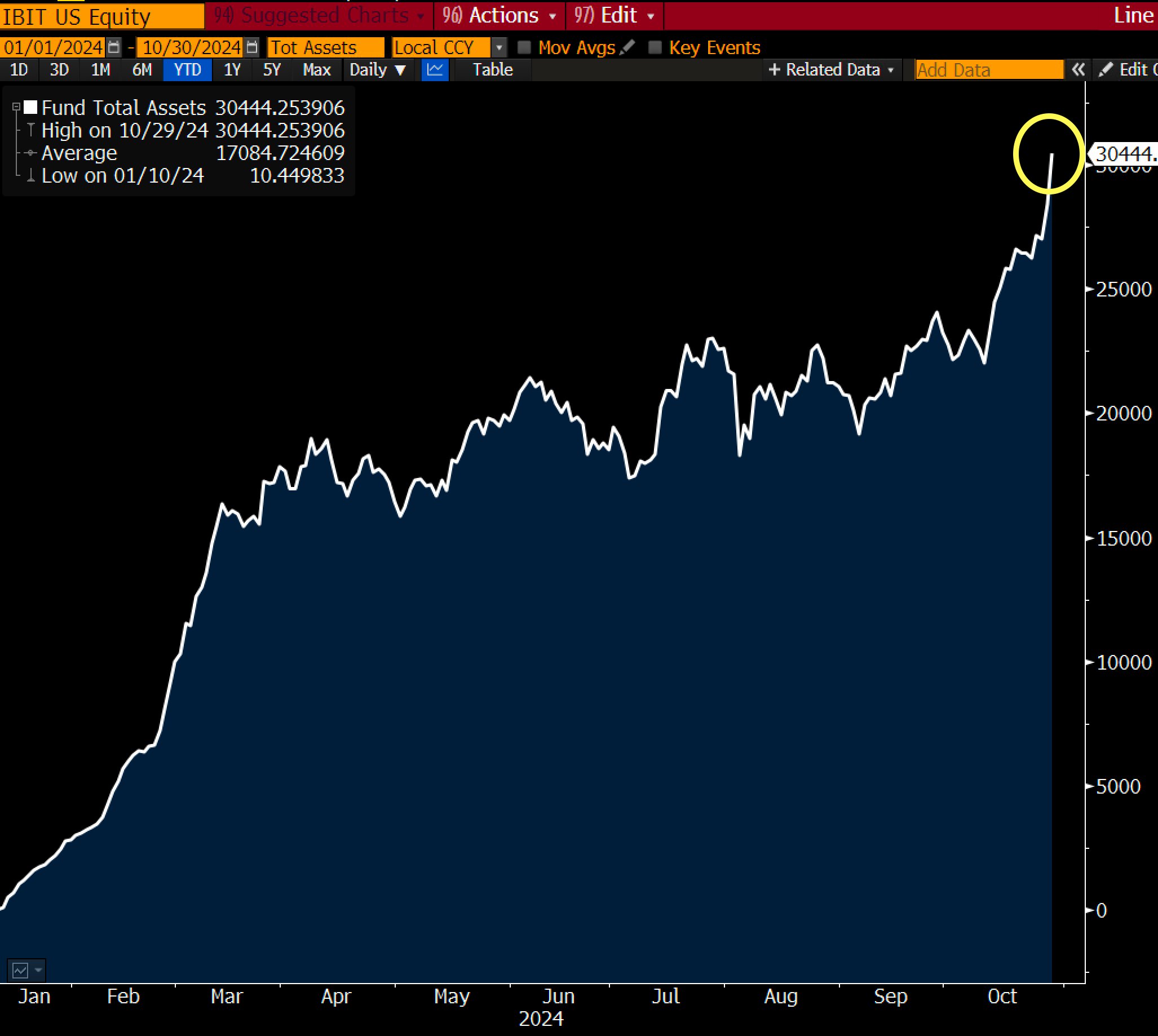
Bitcoin tokens held by BlackRock, particularly through its exchange-traded fund IBIT, have crossed the $30 billion mark, marking a historic record.

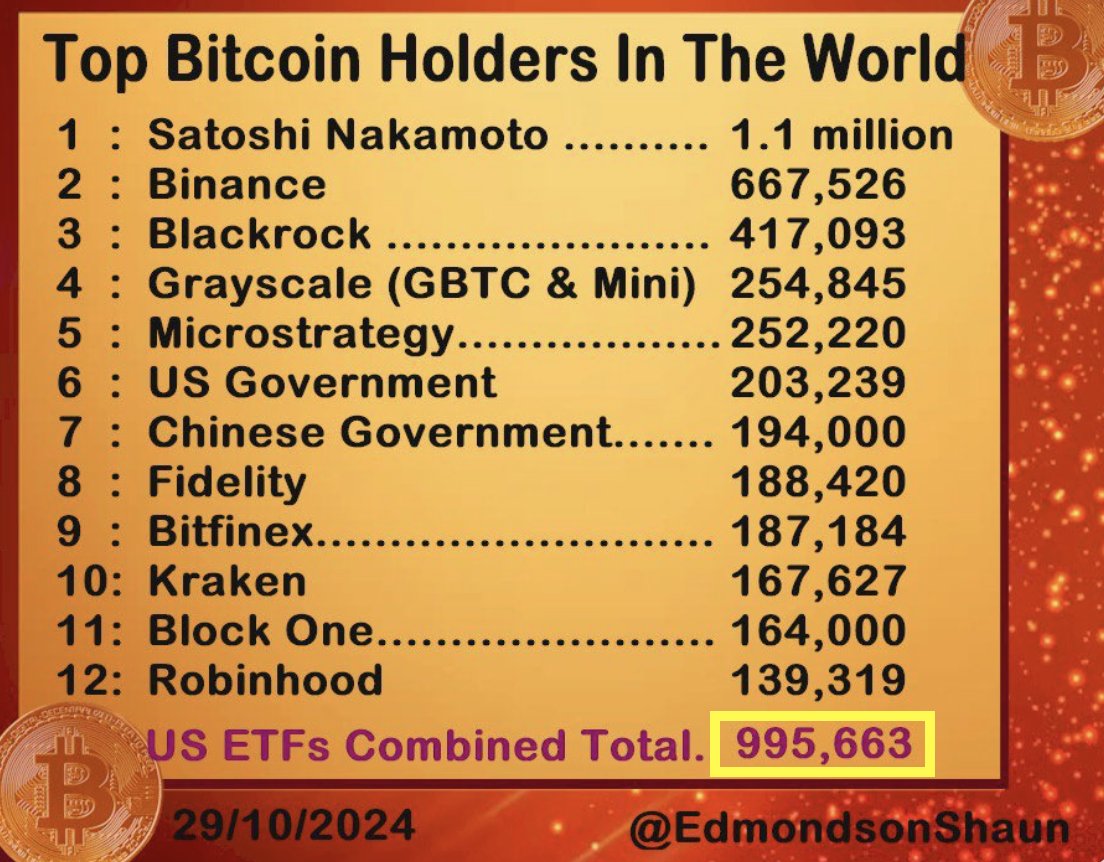
Eric Balchunas, Bloomberg’s senior ETF analyst, drew public attention to this record in a post on X today. He compared BlackRock’s holdings with those of the largest Bitcoin holders, placing BlackRock among the top three.

The analysis disclosed that BlackRock now holds 417,093 BTC. At Bitcoin’s current value of $72,000, BlackRock’s holdings amount to about $30 billion. The company, led by Larry Fink, now trails only Binance and Satoshi Nakamoto in Bitcoin holdings.

While Binance’s portfolio sits at 667,526 BTC, Satoshi Nakamoto is far ahead with 1.1 million tokens. Following closely behind BlackRock is Grayscale, through its GBTC and Mini ETF shares, and MicroStrategy, both of which hold Bitcoin valued over $18 billion.

Image

BlackRock Breaks JPMorgan’s Record

Commenting on BlackRock ETF’s latest record, Balchunas described the achievement as “unreal,” considering the growth trajectory and timeline it took older ETFs to reach the same milestone. For context, BlackRock’s ETF launched just ten months ago—293 days—and has already reached $30 billion in value, an all-time record.

Image
IBIT US Equity Bloomberg

Balchunas highlighted that the previous record holder was JPMorgan’s Equity Premium Income ETF (JEPI), which took 1,272 days, or over three years, to achieve this milestone. Before JEPI, the SPDR Gold Trust (GLD) took 1,790 days to reach the same benchmark.

Notably, BlackRock crossed the $30 billion mark after welcoming inflows of $642.9 million on Tuesday, maintaining a streak of 12 consecutive trading days with positive inflows. This Tuesday’s inflow coincided with Bitcoin’s surge, which traded at $73,600 earlier today, its highest point in seven months.

U.S. ETFs Targeting 1 Million Bitcoin in Holdings

Other U.S. Bitcoin ETFs have also seen significant inflows in recent days as Bitcoin prices surged. The net inflow for yesterday reached a record $870 million, the highest since June. Aside from BlackRock and Grayscale, notable holders include Fidelity’s FBTC, which holds 186,577 BTC, ranking it ninth among the top Bitcoin holders.

Currently, U.S. ETFs collectively hold 995,663 BTC, valued at over $71.68 billion. Balchunas believes this figure will exceed the 1 million mark after the close of business today. He argues that, with the current momentum, they could aim to surpass Satoshi’s holdings by next month, just two months before their first birthday.

Shiba Inu To Its Rival: “SHIB Ready to Conquer the Virtual World”

0

The official X account of the Shiba Inu ecosystem has reacted to a post from dog-themed meme coin Neiro on Ethereum (NEIRO), teasing the metaverse.

In an October 29 tweet, the Neiro on Ethereum team poated a picture showing Neiro, its Shiba Inu mascot, on a virtual reality headset with the caption “NEIRO: The Future Unleashed.” Notably, the post sparked speculations among the crypto community, drawing attention from rival Shiba Inu.

Shib Says Shiba Inus Ready to Conquer the Metaverse

Responding to the Neiro on Ethereum post, the Shiba Inu team welcomed the project to the metaverse, stating that the “Shiba Inus are ready to conquer the virtual world.”

It bears mentioning that the reason behind the NEIRO metaverse tweet remains unknown at press time due to limited information. However, popular consensus believes that the Neiro on Ethereum team might be teasing a venture into the metaverse, but this remains highly speculative.

Although rivalries, the Shiba Inu team seems to welcome the idea of NEIRO venturing into the metaverse. The team behind the ecosystem housing the 12th-largest crypto asset by market cap has long teased the launch of Shib the Metaverse, a virtual playground for the community and beyond.

Shiba Inu Team to Launch Shib the Metaverse Soon

The Shiba Inu team started planning the virtual playground years back, teasing the project as a community-driven, interactive world in the metaverse. The team noted that the Shiba community could buy portions of land in the playground, collect in-game rewards, and earn passive income by participating in activities in the virtual world.

In an update last month, Shiba Inu’s marketing lead, Lucie, noted that Shib the Metaverse was like “the ultimate HQ for SHIB holders” that allows the community to share innovations, interact effectively, and vote on proposals without geographical barriers.

Meanwhile, the virtual world is one of the many projects the Shiba Inu team plans to launch soon. Despite recently debuting ShibSwap 2.0, the team has teased that the Shiba decentralized autonomous organization (DAO) will launch sooner than expected, ushering in a participatory governance model.

Analyst Says November to Spark Dogecoin Run, Notes Crucial Level to Watch for Breakout

0

Market veteran Ali Martinez believes November will introduce a parabolic run for Dogecoin, identifying an important level to watch for possible breakout.

Martinez disclosed this in his latest analysis, suggesting that Dogecoin could enter a parabolic rally in the coming weeks. His analysis focuses on a historical pattern on the 1-month Dogecoin (DOGE) price chart.

Data from the chart reveals repeating setups and breakout signals. Martinez noted that November could be the month to watch, marking an important price level as a potential breakout point.

Dogecoin Historical Descending Triangles

Per the chart, Dogecoin has entered into descending triangle patterns on three different occasions since January 2014. Each of the two past patterns preceded a major breakout, pointing to a potential repetition in Dogecoin’s price trajectory as the third one sets up.

Dogecoin 1M Chart Ali Charts
Dogecoin 1M Chart | Ali Charts

The first descending triangle started forming after DOGE collapsed from the $0.00232 peak in January 2014. The pattern continued for 38 months, about 1,155 days, until Dogecoin launched a breakout in March 2017. The breakout led to a rally of 8,933%, reaching a peak of $0.01877 in January 2018.

The second descending triangle began taking shape as Dogecoin slumped from the $0.01877 peak in January 2018. The correction lasted for 36 months, equating to 1,096 days. However, when a breakout occurred in January 2021, DOGE spiked 15,524% to reach its all-time high of $0.7390 by May 2021.

A Possible Repetition 

Martinez has identified that Dogecoin’s price action in 2024 is showing a similar setup to these past rallies, as it formed a third triangle following the drop from $0.7390. Having consolidated for 42 months, or 1,280 days, Dogecoin has started testing the upper boundary of this descending structure. 

Notably, the current price level sits just above $0.17, close to a critical resistance at $0.20. Martinez identified the $0.20 price level as the important zone to watch. Should DOGE decisively breach this area, it could trigger a new bull run, potentially mirroring the explosive moves seen in the previous breakouts.

Dogecoin is already setting the stage for this upsurge, having recorded an impressive run this month. For context, the meme king is up 48% this October despite the turbulence it faced earlier in the month. 

With DOGE currently changing hands at $0.1690 as of press time, it would need to overcome two major resistance points to record a decisive close above $0.20. The first resistance lies at the $0.1775 level, while the second sits at $0.2003. Beyond this, Dogecoin could aim for $0.2231.

Coinbase Taps Visa Direct to Enable Real-Time Account Funding and Instant Crypto Purchase

0

San Francisco-based crypto exchange Coinbase partners with card payment giant Visa to enable real-time deposit and withdrawal of funds for eligible customers.  

The development, announced in a recent press release, looks to offer more flexibility to Coinbase users in the European Union and the United States. 

According to the announcement, the partnership led to Coinbase’s integration of Visa Direct, which enables real-time account funding and cashouts with eligible Visa cards. 

Features of the Latest Partnership 

The press release acknowledged that millions of Coinbase users have already connected their Visa debit cards to the exchange. Notably, the newly introduced feature will allow eligible customers to move funds to and from their accounts instantly using a Visa debit card.  

With Visa Direct, Coinbase users can quickly top up their funds, instantly purchase their favorite crypto assets, and withdraw their funds to a bank account. Interestingly, Coinbase users in the U.S. and EU can initiate any of these services using an eligible Visa debit card. 

The initiative is part of efforts to bridge the gap between crypto and traditional finance (TradFi). It also aims to reduce the waiting period for moving funds between exchanges and bank accounts.  

Coinbase and Visa Execs React 

Gonzalez Ore, the head of North America’s Visa Direct, expressed excitement about the partnership, indicating that the initiative will enable Coinbase users to quickly explore trading opportunities round the clock. 

Coinbase’s senior director of product management also commented on the recent partnership with Visa. He suggested that the exchange’s integration of Visa Direct supports its financial freedom mission by giving users quick and secure access to funds. 

Previous Coinbase and Visa Partnerships 

This is not the first time Coinbase and Visa have collaborated on a project. In 2019, Coinbase released its Visa-powered crypto debit cards, dubbed Coinbase Card. The payment card initially launched in the U.K. allows users to spend several crypto assets, including Bitcoin, across various merchants on Visa’s global network. 

A year later, the exchange became a Visa principal member, making it the first pure crypto firm to receive the approval. The integration of Visa Direct on Coinbase will further expand the companies’ partnership. 

BitBoy Says XRP Going to $10 “No Matter What,” Calls for “Massive Run”

0

Ben “BitBoy” Armstrong has emphasized his belief that XRP will reach $10, citing a clear regulatory path and potential for significant growth.

Amid the ongoing market-wide rebound push, XRP remains stable around $0.5200, maintaining the same range it traded in a week ago. In contrast, Bitcoin has advanced over 9% in the past week, reclaiming a seven-month high above $73K. This upswing has elevated the broader market to nearly $2.5 trillion, pushing overall sentiment into “greed” territory.

Despite Bitcoin’s gains, XRP’s trajectory has remained flat, with no notable gains or declines, keeping steady around $0.52. This trend has caught the attention of market participants, particularly XRP holders, who are disappointed by the lack of movement.

However, community commentators like Ben Armstrong (BitBoy) and Edoardo Farina have reassured XRP investors, arguing that XRP’s bull case remains intact.

XRP to $10 “No Matter What” 

In a post on X, Farina called attention to a recent statement from BitBoy, who boldly asserted that XRP would reach a price of $10 “no matter what.” For context, $10 represents a significant growth of 1,806% from XRP’s current price of $0.5245, potentially marking a new all-time high.

Armstrong’s optimism stems from the fact that XRP is no longer a subject of the ongoing SEC Ripple case, which has recently entered an appeal phase. BitBoy noted that, in the last bull run, the SEC case influenced XRP’s trajectory, but that is no longer the case.

He pointed out that investors were previously hesitant to enter the XRP market due to the SEC’s initial classification of the asset as a security, leading many to believe XRP would never take off. With the court later ruling that XRP is not a security, BitBoy believes there are no longer regulatory obstacles hindering XRP.

“The case is over. It doesn’t matter if there’s an appeal,” he emphasized. Furthermore, he argued that with a clear regulatory path, “XRP is the chosen institutional vehicle,” suggesting that deep-pocketed investors would feel confident investing in XRP without fear of legal implications.

XRP Will Not Hit $10 in One Go

Meanwhile, in a separate commentary, Farina expressed his disagreement with the view that XRP could surge to $10 in one fell swoop. He believes XRP will first approach $10, then “instantly dump” to around $5.

According to Farina, this drop would shake out retail investors and potentially create a supply shock before rebounding aggressively.

XRP “Will” Massively Outperform Bitcoin and Ethereum

Armstrong went further to assert that XRP will outperform both Bitcoin and Ethereum, emphasizing that it will significantly surpass Ethereum. This perspective aligns with his earlier commentary this month. Then, BitBoy claimed XRP would overtake Ethereum to become the second-largest crypto asset, with a price target between $16 and $22.

He attributes XRP’s potential rise to its unique role in the market, particularly in cross-border liquidity. Conversely, BitBoy asserted that Ethereum would face intense competition in the smart contract space, supposedly hindering its bull run.

Armstrong recalled that XRP had flipped Ethereum in the past and argued that current market dynamics favor XRP for substantial growth, bolstered by factors such as banking partnerships and potential ETFs.

Cardano Bull Gambardello Agrees DOG on Bitcoin Will Outperform ADA This Season

0

Popular Cardano pundit Dan Gambardello has expressed that the DOG meme coin in the Bitcoin ecosystem will outperform ADA in this market cycle.

Bitcoin (BTC) and Cardano (ADA) are drawing attention as they post notable daily gains, sparking interest in their ecosystem tokens. Today, Bitcoin reached $73,600, narrowly missing its all-time high of $73,750 by just $150. 

This performance follows Bitcoin’s strong weekly growth of 9.4%, highlighting its ongoing momentum in the market. Cardano also experienced gains, rising by 3% today to $0.3563, though it still sits 1.4% below its weekly peak.

Now, analyst Dan Gambardello has called Bitcoin and Cardano “the power duo.” Meanwhile, Gambardello highlighted the DOG meme token as a potential power player against Cardano. Notably, the token is minted on top of Bitcoin via the Runes Protocol. 

Gambardello disclosed that he is an investor in DOG and ADA, considering them his primary plays for this cycle. However, he expects DOG to outperform ADA in percentage gains this season, though he sees potential for both assets to achieve significant growth.

DOG Records Steady Price Gains

DOG has recently demonstrated steady growth, trading at $0.004815 at press time. This reflects a 1.43% increase in the past 24 hours and a 1.93% rise over the past week. Moreover, the token has increased by 18% over the last 30 days.

Leonidas, the host of The Ordinal Show, also commented on the meme coin landscape, noting that meme coins have been outpacing utility tokens. He emphasized that DOG’s current market setup could propel it toward new all-time highs. 

Looking at Cardano

On the other hand, Cardano has been showing signs of a potential comeback, as Gambardello predicts the end of its “boring” phase in a separate report. Gambardello’s latest analysis recognized that Cardano’s sideways movement, which he described as “doing nothing,” contrasts sharply with Bitcoin’s trajectory, which is nearing its all-time high. 

Gambardello reassured that Cardano’s current chart behavior is not unusual, implying that the recent stagnation aligns with typical patterns observed before significant upward moves.