Home Blog Page 117

Glassnode Research Shows 6M+ Bitcoin Worth $452B+ Currently Vulnerable to Quantum Attack

Crypto analytics firm Glassnode has found that 6.04 million Bitcoin, equal to 30.2% of the circulating supply, currently faces potential quantum-related risk.

According to its recent report, this potential risk exists because the public keys tied to those coins are already visible on-chain. Based on current market prices, the exposed Bitcoin is worth more than $452 billion.

Key Points

  • Glassnode found that 30.2% of Bitcoin’s issued supply, or about 6.04 million BTC, currently faces at-rest quantum exposure.
  • Of this figure, structural exposure accounts for 1.92 million BTC, while operational exposure reaches 4.12 million BTC.
  • Exchange-related balances represent about 1.66 million BTC, or roughly 40% of operationally exposed Bitcoin.
  • The report estimates 13.99 million BTC remains protected because related public keys are still hidden on-chain.

Bitcoin Supply Exposed to Quantum Risk

The report comes as concerns around quantum computing grow within the crypto industry. Notably, blockchain experts have continued to discuss whether future quantum machines could eventually break parts of Bitcoin’s security model. 

Glassnode said its research does not predict when such attacks could become possible. The company instead focused on measuring which coins already have visible public keys and could therefore face exposure under a future quantum attack scenario.

The company found that 6.04 million BTC, worth $452 billion, faces exposure to quantum risks. Of this figure, Glassnode divided the exposed supply into two main categories. 

Bitcoin Supply by Quantum Safety Glassnode

Specifically, structural exposure makes up 1.92 million BTC, representing 9.6% of the issued supply, while operational exposure accounts for the larger share at 4.12 million BTC, or 20.6%. Further, exchange-related balances alone contribute 1.63 million BTC, equal to 8.1% of all issued Bitcoin.

Meanwhile, according to the report, 13.99 million BTC, or 69.8% of the issued supply, does not currently face this type of at-rest exposure because the related public keys remain hidden on-chain.

Bitcoin Supply by Quantum Safety Glassnode
Bitcoin Supply Share by Quantum Safety | Glassnode

Why Public-Key Visibility is Important 

Glassnode explained that under current computing systems, attackers cannot realistically derive Bitcoin private keys from public keys. However, a sufficiently advanced quantum computer using Shor’s algorithm could theoretically reverse the process.

As a result, the main issue is whether a public key already appears on-chain. If the public key remains hidden, the coin stays protected under this specific at-rest model. If the public key is already public, an attacker would not need to wait for the owner to move the coins before attempting to target them.

The report then separated at-rest exposure from on-spend exposure. Glassnode focused on “at-rest” exposure, which involves coins sitting in outputs where public keys are already visible. In contrast, on-spend exposure happens when a transaction temporarily reveals a public key during the spending process.

Glassnode stressed that coins that are “safe” in the current context simply mean the public key is not currently exposed on-chain. It does not mean the coins are fully protected against every possible future quantum threat.

Bitcoin Under Structural Exposure

The analytical firm noted that structural exposure involves vulnerability tied to Bitcoin’s script design. In these cases, certain output types reveal public keys by default, even when users follow proper wallet-management practices.

The structurally exposed category includes early Pay-to-Public-Key outputs connected to Satoshi-era coins, legacy bare multisig structures such as P2MS, and modern Taproot outputs known as P2TR. 

Although these formats serve different purposes and come from different periods in Bitcoin’s history, they all expose public keys or similar data directly on-chain.

The report estimates that structurally unsafe Bitcoin totals 1.92 million BTC, or 9.6% of the issued supply. Glassnode said Satoshi-era holdings represent the most lasting form of structural exposure because lost or inactive coins cannot easily move into safer address structures.

Structurally Unsafe Bitcoin by Source Glassnode
Structurally Unsafe Bitcoin by Source | Glassnode

The company also called attention to Taproot. Notably, while this model improves privacy, efficiency, and scripting flexibility, output keys remain visible on-chain. 

Bitcoin Under Operational Exposure

Glassnode said operational exposure comes mainly from wallet behavior, not script design. In these situations, coins may begin in safer address formats, but practices such as address reuse, partial spending, or custody management later expose the public keys.

The report explained that address types, including P2PKH, P2SH, P2WPKH, and P2WSH, normally keep public keys hidden while coins remain at rest. However, once a transaction reveals the public key, any remaining balance tied to that same address loses its protection.

Operationally Unsafe Bitcoin Supply Share Glassnode

Glassnode found that operationally unsafe Bitcoin totals 4.12 million BTC, or 20.6% of the issued supply. This figure is 2.1 times larger than the structurally exposed balance. 

Specifically, exchange-related holdings alone account for 1.66 million BTC, equal to 8.3% of the total supply, representing roughly 40% of all operationally exposed Bitcoin.


Australian Government Bond Tokenized on XRP Ledger With Settlement in RLUSD Stablecoin

Australia’s Project Acacia tested tokenized government bonds on the XRP Ledger, using Ripple’s RLUSD stablecoin for settlement.

XRP community member Eri highlighted details from the Reserve Bank of Australia’s final Project Acacia report. Remarkably, the report said an Australian government bond was fully tokenized on the XRP Ledger. The settlement was completed using RLUSD, Ripple’s stablecoin, while JPMorgan was involved in custody services.

Key Points

  • Australia’s Project Acacia tested tokenized government bonds on the XRP Ledger using RLUSD for settlement.
  • The Reserve Bank of Australia said the trials explored faster settlement and lower operational risk in markets.
  • Project Acacia included pilots across Ethereum, Hedera, Redbelly, and XRP Ledger, involving real assets.
  • Officials say there is still more work before tokenized finance infrastructure can scale across wholesale markets.

XRP Ledger Among Selected Networks

Notably, Project Acacia involved experimentation from August 2025 to February 2026 across 20 use cases. These include 12 pilot programs involving real money and real assets.

The initiative brought together banks, fintech firms, custodians, exchanges, stablecoin issuers, fund managers, and financial market infrastructure providers to explore tokenization in wholesale markets.

The Reserve Bank of Australia and Digital Finance CRC said pilot programs were conducted across several blockchain platforms, including Ethereum, Hedera, Redbelly Network, and the XRP Ledger.

The experiments covered tokenized government bonds, corporate bonds, private credit, repos, carbon credits, structured products, and tokenized receivables. Settlement assets included stablecoins, commercial bank deposit tokens, pilot wholesale CBDCs, and applications involving central bank balances.

Tokenization is More Efficient and Scalable

The report outlined several potential benefits observed during the trials. They include lower issuance costs, automated lifecycle management, streamlined settlement, and reduced operational risk.

Project Acacia participants also tested features tied to programmability, composability, fractional ownership, and decentralized infrastructure. The report noted that decentralized systems could improve resilience by reducing reliance on a single operator or infrastructure provider.

While discussing network decentralization, the report stated that Ethereum has thousands of nodes, while the XRP Ledger has hundreds.

The report further emphasized that tokenization could improve transparency by creating a shared source of truth for multiple assets and enabling investors to access verifiable, real-time information.

Further Work Ahead, Reserve Bank of Australia Says

In remarks accompanying the release of the final report, chairman Brad Jones said the project demonstrated “significant and growing industry interest in tokenization.”

Jones stated that industry participants and regulators were particularly interested in the potential of tokenized markets to improve the efficiency of issuance, trading, and settlement, reduce settlement risk, and expand liquidity access.

He added that further work is still required to address scaling challenges surrounding tokenized asset markets and new forms of digital money.

According to Jones, the Reserve Bank of Australia, the Digital Finance CRC, and partner agencies plan to continue developing initiatives to support experimentation and the adoption of tokenized finance infrastructure.

Cardano Community Approves 4 Key IOG Treasury Proposals as Hoskinson Says “Keep Pushing” 

0

Cardano founder Charles Hoskinson has urged the ADA community to continue supporting Input Output Global’s nine treasury proposals.

His remarks came after prominent Cardano stake pool operator Stake With Pride revealed that four IOG treasury proposals had officially secured enough community backing to pass.

Key Points 

  • The Cardano community has passed four of the nine IOG’s treasury proposals. 
  • Charles Hoskinson urged the ADA community to continue to support Input Output Global’s treasury proposals. 
  • Despite the progress, five IOG treasury proposals remain below the approval threshold ahead of the May 24 deadline. 
  • IOG’s separate research proposal continues to face strong opposition from DReps. 

Hoskinson Urges Cardano Community to Support IOG Treasury Proposal 

Taking to X, Stake With Pride announced that the Cardano community had approved four out of nine IOG treasury proposals aimed at strengthening the broader ecosystem. Notably, the proposals reached the required 67% approval threshold needed for adoption under Cardano’s governance framework.

The approved proposals focus on Cardano upgrades, technical collaboration, system maintenance, and consensus research. Collectively, these initiatives aim to improve the network’s long-term scalability, reliability, and ecosystem growth. 

Image

In response to the update, Hoskinson encouraged the community, particularly DReps, to “keep pushing.” Through this statement, Hoskinson appeared to rally continued community participation as the governance process approaches its final phase. 

Five Treasury Proposals Remain Pending 

Although IOG has already secured approval for four treasury proposals, five additional proposals remain below the required threshold. These include initiatives related to Developer Experience, Layer-2 Scalability, Plutus, Pogun, and Blockfrost. 

Meanwhile, the governance voting deadline is set for May 24, 2025. As the deadline draws closer, Hoskinson’s message aims to boost morale and encourage continued support for the remaining proposals.

Cardano Community Still Split on IOG Research Proposal 

While IOG’s treasury proposals continue gaining traction, its separate research proposal, titled “Cardano Vision 2026: Human Centred, Scalable, Post Quantum Secure – IO Research,” is facing growing resistance from DReps.

Currently, 83.73% of votes oppose the proposal, while only 16.2% support it. Several DReps, including YUTA, have argued that some of the proposed research initiatives represent unnecessary or wasteful spending. In addition, Iagon CEO Navjit Dhaliwal stated that Cardano has already funded extensive research efforts and should instead prioritize only the most important initiatives.

Furthermore, YUTA urged IOG to split the research proposal into smaller initiatives and resubmit them separately so DReps could selectively support the most valuable components. However, Hoskinson rejected that suggestion, stressing that IOG would not resubmit the proposal if it fails.

He also warned that rejecting the proposal could negatively impact ADA’s long-term price performance. Beyond that, Hoskinson cautioned that some research labs could shut down and that Cardano could ultimately lose its reputation as a “science coin” if the proposal fails. 

Oldest Bitcoin Holders Now Moving Coins at Record Rates: What’s Happening?

The oldest Bitcoin holders, those who have held for more than 10 years, have begun moving their coins at an unusual rate.

As Bitcoin crashes from its May 10 high of $82,000 to the current price of $75,400, data shows that some of the network’s oldest holders have started moving coins at unusually high levels. 

Key Points

  • Bitcoin’s oldest holders have begun moving coins at historically high levels.
  • 10-year-plus Bitcoin holders reached the 97th percentile in spending activity across the past decade.
  • This group moved 51,350 BTC over 30 days, but their balances remained near record highs.
  • Matthew Sigel says quantum migration may be responsible for the recent unusual activity.
  • Around 6.9 million BTC remain quantum vulnerable because their public keys already appear on-chain.

Bitcoin’s Oldest Holders Awaken

Matthew Sigel, Head of Digital Assets Research at VanEck, recently discussed the trend in a post on X. Sigel said Bitcoin holders who have kept coins for more than 10 years are now moving them at record levels, even though the total balances held by this group still remain close to all-time highs. 

According to him, large-scale quantum migration and the gradual aging of Bitcoin supply may be the factors behind these movements, which explains why the activity has not led to a major drop in long-term holdings.

Sigel also highlighted weakness among holders who bought Bitcoin between one and three years ago. According to him, balances in that group have dropped to between the second and tenth percentiles compared to historical levels. 

Data Confirms Activity Spike From 10-Year Holders

An accompanying chart from VanEck confirms this high activity. The report groups holders based on when they originally bought Bitcoin and compares current spending activity against past behavior across 1-year, 2-year, 4-year, and 10-year periods.

Notably, the 10-year-plus group reached the 89th percentile over 1 year, 91.6th over 2 years, 94th over 4 years, and 97th over 10 years. This cohort moved 51,350 BTC during the 30-day period, marking the smallest in the chart.

Bitcoin LTH Spent Percentile VanEck
Bitcoin LTH Spent Percentile | VanEck

For context, the 97th percentile reading over 10 years means these holders are currently moving coins more actively than during 97% of similar 30-day periods over the past decade. 

While the transfer volume looks smaller than that of other groups, the recent readings are still important because very few coins from that era remain untouched. 

The data shows that wallets that sat dormant through the 2017 peak, the 2018 collapse, the 2021 highs, the FTX crash of 2022, and every cycle in between are now reactivating at a historically extraordinary rate.

Quantum Migration May Explain the Sudden Moves

However, it remains unlikely that the activity comes from large-scale selling. Notably, Sigel noted that quantum migration appears to be one of the main reasons behind the recent spike in movements from old wallets.

For the uninitiated, quantum migration involves moving very old Bitcoin, especially coins held for more than 10 years, from older wallet formats that could become vulnerable to future quantum computers. 

Many early holders now move funds into newer and safer address formats like Taproot and SegWit as concerns about future security risks continue to grow.

Current estimates show that about 6.9 million BTC may still be vulnerable because their public keys have already appeared on-chain. This figure includes around 1.7 million BTC stored in older Pay-to-Public-Key formats. 

In April, Jameson Lopp and other contributors introduced BIP-361, a proposal that presents a gradual move toward quantum-resistant signature systems. The proposal could also include deadlines that would force holders to move older coins before they become frozen or unusable.

Concerns around quantum computing have increased after NIST finalized post-quantum cryptography standards. At the same time, fears continue to grow that future quantum computers could eventually break ECDSA encryption using Shor’s algorithm.

Other Bitcoin Holding Cohorts

While the oldest holders drew the most attention, the 1-to-3-year groups recorded the largest transfer volumes in the data. 

Holders who bought Bitcoin 1 to 2 years ago reached the 84.5th percentile over 1 year, 85.1st over 2 years, 80th over 4 years, and 76th over 10 years. These investors moved 848,895 BTC, the highest volume among all groups.

Meanwhile, holders from the 3-to-5-year group remained mostly inactive. Their readings came in at 19.7 over one year, 21.6 over 2 years, 41 over 4 years, and 45 over 10 years, with 197,995 BTC moved. The 5-to-7-year group showed similar inactivity.

However, the seven-to-10-year group saw renewed activity. Specifically, these holders recorded 57.6 over one year, 73 over 2 years, 85 over 4 years, and 86 over 10 years, with 111,445 BTC moved over the 30-day period.

Shiba Inu Approaches Critical Breakout Zone With 14 Key Support and Resistance Levels: Analyst 

0

Crypto analyst GainMuse suggests that Shiba Inu is approaching a decisive technical level after forming a tightly compressed structure on the 2-hour timeframe. 

GainMuse’s analysis indicates that Shiba Inu is entering a high-pressure zone where the market could determine its next major direction.

Key Points

  • Crypto analyst GainMuse believes Shiba Inu is approaching a pivotal technical level on the 2-hour timeframe.
  • SHIB could slide toward $0.0000052 if sellers continue rejecting bullish recovery attempts.
  • Despite the bearish pressure, bulls still have a chance to reclaim momentum and defend the current structure.
  • Another analyst projects that SHIB may be preparing for a fresh rally, with an upside target of $0.000008. 

Shiba Inu Forms Clean Decision Setup: Analyst  

According to GainMuse, Shiba Inu’s two-hour chart features 14 active levels, including nine support zones and five resistance levels. As a result, the structure forms what the analyst described as a “clean decision setup.”

Furthermore, GainMuse explained that the large number of active pivots shows SHIB trading within a genuine pressure area. The analyst also identified two major formations on the chart, featuring a wedge pattern and a broader descending channel. 

Initially, SHIB traded within the wedge before eventually losing support and sliding lower into the descending channel below the $0.000006 range.

Next Moves?

Notably, the chart shows SHIB approaching another critical reaction zone near the lower boundary of the descending channel. Meanwhile, the chart’s projected path suggests Shiba Inu could decline further to $0.0000052 if sellers continue rejecting recovery attempts.

However, GainMuse emphasized that buyers still have an opportunity to regain control. If bulls defend the current support region and successfully break above nearby resistance levels, SHIB could quickly shift into a stronger momentum phase.

For now, traders are closely watching the next interaction between support and resistance, as it could determine whether SHIB stages a recovery or extends its ongoing downtrend. 

image

Analyst Says SHIB Is Gearing Up for ‘Round 2’ 

In the meantime, Shiba Inu continues to trade below $0.000006 while mirroring the broader market’s bearish performance. At the current price of $0.000005839, SHIB has fallen 8.42% over the past month and 6.93% in the last seven days, although it has gained a modest 0.39% in the past 24 hours. 

Notably, the bullish momentum seen earlier this month has faded. SHIB previously rallied strongly and appears poised to revisit the $0.000007 level. However, after climbing to $0.0000067 on May 11, the token reversed course and dropped back below $0.000006.

Meanwhile, popular analyst SHIB KNIGHT remains optimistic about a rebound. According to the analyst, SHIB is preparing for “round two” of its recent rally, with a projected move toward $0.0000080. 

If achieved, that target would represent a roughly 37% increase from current levels. Nevertheless, uncertainty still surrounds the possibility of another major short-term rally for SHIB.  

Image

Top Cardano DRep Threatens to Sell His ADA and Leave Ecosystem if This Happens

0

Prominent Cardano Chris O warned that he could leave the network if Input Output Global’s research proposal fails to pass. 

The Cardano community has faced rising tensions in recent weeks after IOG submitted a research proposal requesting nearly 33 million ADA. The proposal seeks funding for multiple initiatives, including Leios-related development and research to strengthen Cardano’s defenses against future quantum threats.

As several major DReps continue to oppose the proposal, Chris O, a leading Cardano DRep and Midnight Ambassador, stated on X that he has mentally prepared himself to sell his ADA and exit the ecosystem entirely if the proposal fails. 

Key Points

  • Cardano DRep Chris O warned he may exit the ecosystem and liquidate his ADA holdings if IOG’s research funding proposal is rejected.
  • His comments came in direct response to fellow DRep YUTA’s decision to abstain from voting on the proposal.
  • Chris argued that DReps opposing the proposal could ultimately be blamed for killing Cardano.
  • Cardano founder Charles Hoskinson confirmed that IOG will not resubmit the proposal if the community votes it down.

Top DRep Plans to Sell His ADA Holdings and Leave Cardano 

Chris O revealed his intention to leave the Cardano ecosystem while responding to fellow DRep YUTA’s decision to cast an abstention vote on the IOG proposal.

As reported earlier, YUTA argued that although parts of the proposal contain valuable research, other sections appear to represent an inefficient use of treasury funds. He also suggested that IOG divide the proposal into separate submissions so the community can evaluate each research category independently, rather than approving the package as a whole.

However, Chris O strongly rejected that argument in a public response on X, describing the reasoning as ridiculous. He reiterated that he could sell his ADA holdings and leave the Cardano ecosystem if the proposal ultimately fails because of his colleague’s incompetence.

In addition, he urged YUTA to reconsider the abstention vote and warned that those blocking the proposal could bear responsibility for “killing Cardano.”

Cardano Founder Outlines Risks of Proposal Failure 

Meanwhile, the proposal appears to be moving closer toward potential rejection as several major DReps continue voting against it. Although 13.28% of votes currently support the proposal, more than 86% of the votes cast so far oppose it. DReps have until June 8 to submit their votes and determine the proposal’s outcome. 

At the same time, Charles Hoskinson confirmed that IOG will not resubmit the proposal if the community rejects it. He warned that failure to pass the proposal could force the closure of certain research labs and lead to some engineers leaving the project.

Hoskinson further cautioned that ADA’s current downturn could become permanent if Cardano loses its research-driven development model following the failure of the proposal. 

Ripple Mints 200M RLUSD on XRPL, the Largest in History, While Burning 100M on Ethereum

Ripple recently minted $200 million worth of its RLUSD stablecoin on the XRP Ledger, while burning $100 million on Ethereum.

The recent transactions, which have renewed conversations within the XRP community, resulted in a massive supply shift for the Ripple USD (RLUSD) stablecoin on both the XRPL and Ethereum.

Key Points

  • Ripple recently minted $200 million worth of its RLUSD stablecoin on the XRP Ledger.
  • This marked the largest RLUSD mint transaction on the XRPL in history.
  • On the same day, Ripple burned $100 million worth of RLUSD on Ethereum.
  • The recent transactions pushed RLUSD’s supply on the XRPL to $690 million, but reduced the supply on Ethereum to $1.06 billion.
  • RLUSD now has a total cap of $1.75 billion, having had a net supply change of $190 million in the last week.

Ripple Mints $200M in RLUSD on XRPL

This is according to on-chain data sourced by the XRP community-driven RLUSD tracker. Specifically, at exactly 12:42 PM (UTC) on May 20, Ripple minted $200 million worth of RLUSD in a single transaction on the XRP Ledger. 

This development marked an important milestone because it represented the largest single RLUSD mint transaction on the XRPL, surpassing the previous record of $92.3 million from April 1.

Shortly after the latest move, Ripple triggered a series of smaller mint transactions on the same day, with some of the most significant ones involving 30 million RLUSD at 12:45 PM, 5 million RLUSD at 5:51 PM, and 1.9 million RLUSD at 7:32 PM. 

Overall, the payment firm, through its Standard Custody subsidiary, minted $245 million in RLUSD on the XRP Ledger on May 20, marking the largest RLUSD intraday mint in the network’s history. In contrast, it burned $57.9 million, bringing the net supply change to $187.3 million on that day.

Ethereum Sees 100M RLUSD Burn

In contrast, the Ethereum ecosystem witnessed an opposite trend on the same day. For context, at 8:01 PM on May 20, Ripple burned $100 million worth of RLUSD on Ethereum. 

Interestingly, this marked the largest single RLUSD burn transaction on Ethereum, marginally surpassing the 99.9 million RLUSD burn recorded on April 1. 

Notably, the transaction followed a series of smaller mints triggered by Ripple on the same day, including $1.99 million at 3:25 AM, another $1.99 million at 3:41 AM, $1 million at 07:06 AM, and $10.28 million at 10:15 AM. Overall, on May 20, Ripple minted 16.4 million RLUSD on Ethereum, but burned $107.2 million.

RLUSD Supply Change on XRPL and Ethereum

These transactions resulted in a massive supply shift for the RLUSD across its two native networks: XRPL and Ethereum. Specifically, on May 20, the XRP Ledger saw an addition of $187.3 million in RLUSD supply, while Ethereum recorded $90.8 million in outflows.

As a result, the RLUSD supply on the XRPL has expanded to $690 million, according to on-chain data. For context, this figure stood at around $300 million exactly two months ago, as of March 22. This means the RLUSD supply on XRPL has more than doubled in the last 60 days.

However, on Ethereum, the supply has shrunk. Notably, the RLUSD supply on Ethereum has dropped to $1.063 billion at press time. Some of the most notable intraday changes since April involve -$89.3 million on April 1, -$50.7 million on April 17, +$71.7 million on April 24, and now -$90.8 million on May 20.

Meanwhile, the overall RLUSD market cap has continued to increase over the past few days, jumping to the current figure of $1.753 billion across both networks. Over the past week, the Ripple stablecoin has seen a supply change of +$190 million, with most of this coming to the XRPL.

XRP Futures on CME Cross $62B Notional Volume After a Year

0

CME Group has announced that its XRP futures market has passed $62 billion in total notional trading volume just one year after launch. 

The company recently shared the update, shortly after the product marked its first anniversary on May 19, 2025. Combined trading across the standard and micro XRP futures contracts reached $62.87 billion during that period.

Key Points

  • CME Group announced XRP futures crossed $62.87 billion in notional volume after launching on May 19, 2025.
  • Traders executed 1.32 million XRP futures contracts, representing 28.6 billion XRP traded within one year.
  • XRP futures averaged $238 million in daily notional volume across 250 trading days.
  • Futures open interest for XRP surpassed $1 billion by August 2025, the fastest for a CME crypto product.
  • CME launched XRP options in October 2025 and spot-quoted XRP futures in December 2025.

XRP Futures on CME Cross $62B Volume in a Year

According to CME, traders handled 1.32 million contracts across the XRP futures market over the past year. This volume equals roughly 28.6 billion XRP tokens. 

Based on around 250 trading days, the contracts averaged close to $238 million in daily notional volume. Notably, CME calculated the $62.87 billion figure using data collected up to May 15, 2026.

CME Group XRP Futures Overview

The milestone includes activity from the full XRP derivatives lineup, including products CME added later in the year. These additions included XRP options and spot-quoted XRP futures, both of which helped attract more traders and improve liquidity in the market.

The rise in XRP futures activity shows growing demand for regulated XRP products under the oversight of the U.S. CFTC. Institutions have used the contracts to manage risk in cross-border payments and diversify portfolios without directly holding spot XRP.

XRP Futures Continue to Grow Inside CME’s Crypto Market

Within CME’s wider crypto derivatives business, XRP futures have seen massive growth and gained strong traction among institutional traders. Notably, the contracts regularly ranked among the fastest-growing altcoin products on the exchange in terms of open interest. 

Around August 2025, CME’s combined crypto open interest across Bitcoin, Ether, Solana, and XRP moved above $30 billion for the first time, with XRP playing a major role in that growth.

Even though XRP futures still record lower trading volumes than Bitcoin and Ether products, the contracts have performed better than many expected for a newer altcoin offering. 

Bitcoin and Ether futures still dominate the market with annual volumes that often reach hundreds of billions of dollars. Nonetheless, XRP has secured a place among the top regulated altcoin derivatives products available to institutional investors.

CME’s XRP Futures Launch

For context, CME Group officially launched XRP futures on May 19, 2025, making XRP the exchange’s fourth major cryptocurrency derivatives product after Bitcoin, Ether, and Solana futures. The launch gave institutions another regulated way to gain exposure to XRP.

The exchange introduced two contract sizes. Specifically, standard XRP futures represented 50,000 XRP per contract, while Micro XRP futures covered 2,500 XRP per contract, which gave smaller traders easier access to the market. 

CME cash-settled both products using the CME CF XRP-Dollar Reference Rate, which updates daily at 4 PM London time. Traders access the contracts through CME Globex and ClearPort.

CME Expands Product Line Amid Impressive Milestones

XRP futures posted impressive numbers almost immediately after launch. During the first trading session, the contracts generated more than $19 million in notional volume. This opening performance came in ahead of Solana futures’ first-day trading results.

By late August 2025, only about three months after launch, XRP futures open interest had already crossed $1 billion. CME said the product reached that level faster than any other crypto contract on the exchange. 

The momentum spilled  into the third quarter of 2025. By October, the XRP and Micro XRP futures market had recorded 476,000 traded contracts and $23.7 billion in total notional volume. Also, open interest climbed to $1.4 billion in September.

Amid the milestones, CME expanded the XRP derivatives lineup again in October 2025, when it launched options on XRP and Micro XRP futures alongside Solana options. Later, in December 2025, the exchange launched spot-quoted XRP futures.

XRP Withdrawals from Binance Hit Highest Level in Over a Month

XRP withdrawals from Binance have reached their highest level in over a month despite the latest market pullback.

After soaring to a high of $1.54 on May 14, XRP faced resistance and pulled back alongside the rest of the crypto market, dropping to $1.37.

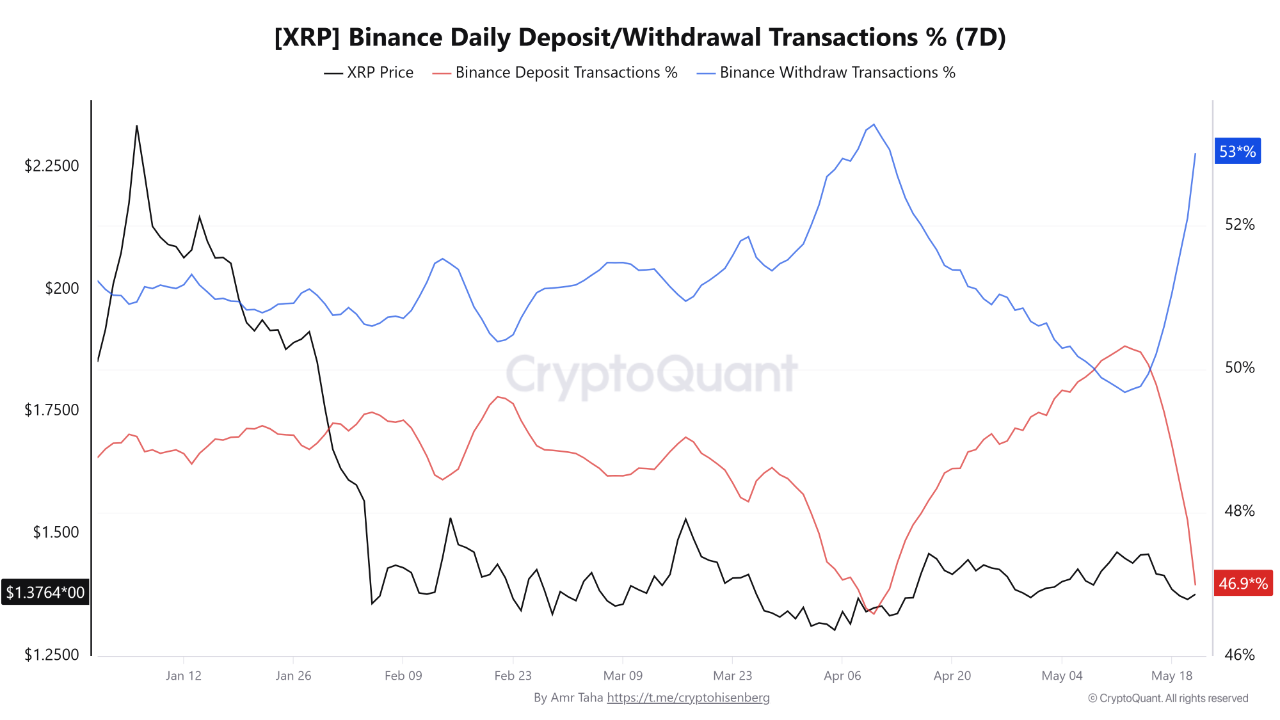
Amid the correction, verified CryptoQuant analyst Amr Taha recently revealed that XRP withdrawals from Binance have climbed to their highest level in more than a month. This indicates that investors are making more withdrawal transactions than deposits on Binance.

Key Points

  • XRP climbed to $1.54 on May 14 before pulling back to $1.37 as market momentum weakened.
  • Binance XRP withdrawals reached 53%, exceeding deposits at 47% for the first time since April 10.
  • Similar withdrawal dominance appeared on April 10 when XRP traded near $1.34.
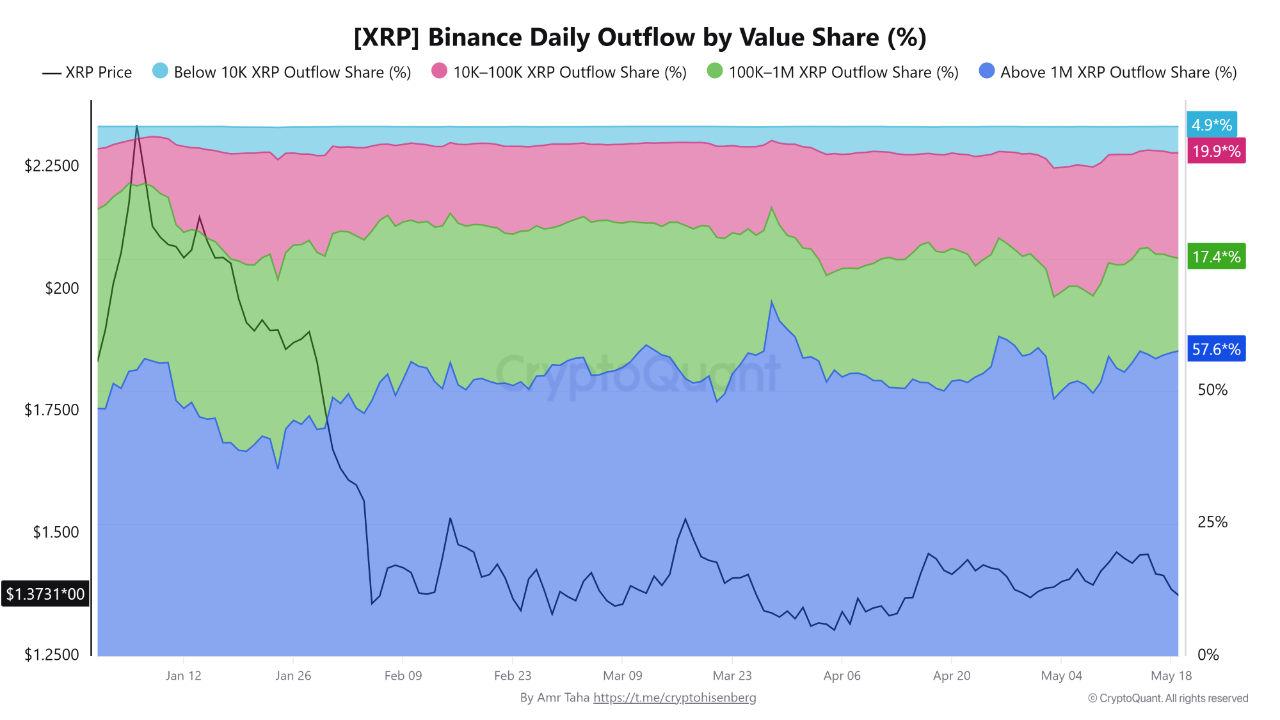
  • Binance whale outflows above 1 million XRP rose to 57.6%, the highest level since March 28.

XRP Withdrawals from Binance Reach 1-Month Peak

In his latest analysis, Taha pointed out that withdrawal transactions once again exceeded deposit transactions on Binance. He presented this with data from the seven-day transaction-share chart.

Data confirms that withdrawal transactions made up 53% of Binance XRP activity, while deposits accounted for 47%. He noted that this was one of the strongest withdrawal readings since April 10, 2026, when withdrawals reached 53.4%, and deposits dropped to 46.5% while XRP traded near $1.34.

XRP Transactions on Binance CryptoQuant
XRP Transactions on Binance | CryptoQuant

Notably, XRP currently trades close to the same area, around $1.37, and Taha says this makes the recent reading important for traders watching exchange flows. He explained that the market is now showing a pattern similar to the one from April.

What Does This Mean for XRP?

According to Taha, a higher withdrawal share means more XRP moves away from Binance instead of into the exchange. This does not automatically point to a price increase, but it indicates lower selling pressure on the exchange or a stronger move by holders to keep XRP in external wallets.

The market pundit also stressed that the current signal is important because it matches the structure from April 10. At that time, withdrawals also stayed ahead of deposits while XRP traded near the same levels. The latest 53% reading now suggests that the same withdrawal-heavy trend has returned.

XRP Whale Activity Spikes on Binance

Meanwhile, in an earlier report, Taha highlighted a difference between XRP whale activity on Binance and Coinbase. Specifically, he revealed that Binance has seen a sharp increase in large-wallet withdrawals, while Coinbase has shown a very different trend.

Taha reported that the share of Binance’s daily XRP outflows above 1 million XRP climbed to 57.6%. This marked the highest level since the 66% spike recorded on March 28. He also mentioned another elevated reading close to 60% that appeared in late April.

XRP Daily Outflow Value Share on Binance CryptoQuant

According to him, all of these whale-outflow spikes happened while XRP traded within a relatively narrow range between $1.33 and $1.42.

The current situation shows that large holders once again appear to be moving XRP away from Binance while the asset trades within the same price zone during earlier spikes in whale activity. This aligns with the latest analysis surrounding withdrawal transactions on Binance.

Coinbase Shows a Different Trend

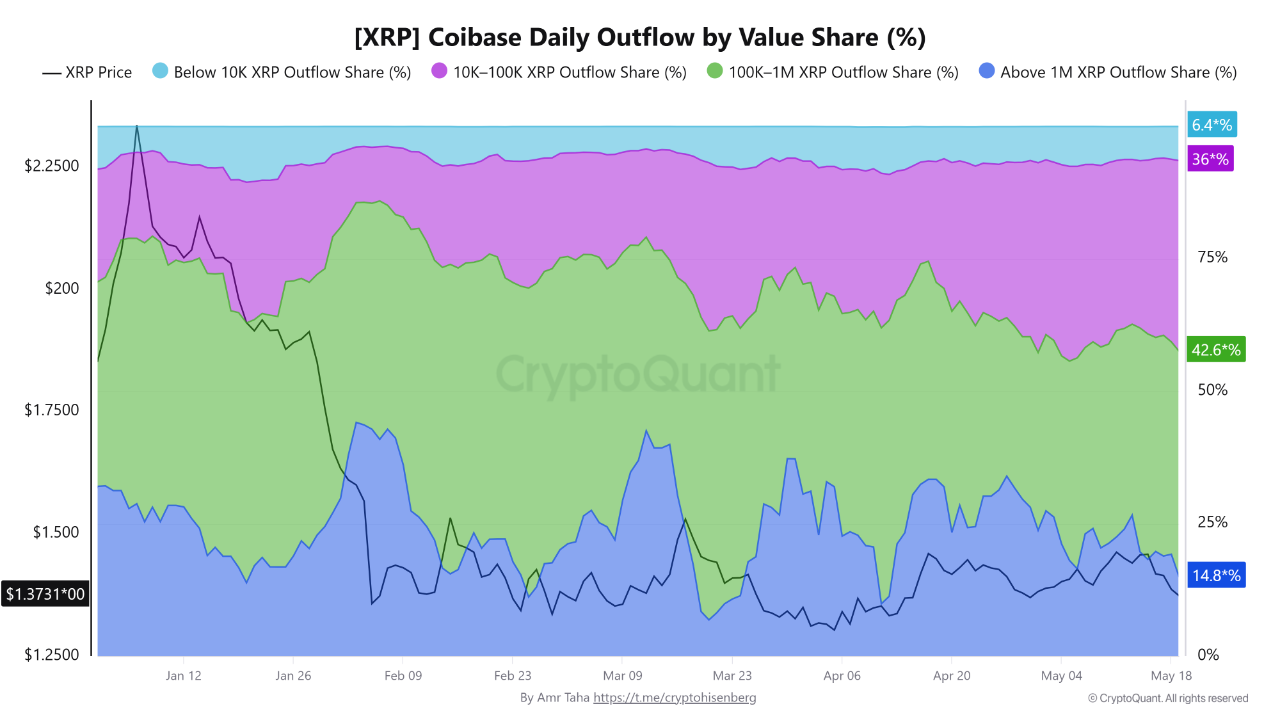
Taha said the Binance data becomes more interesting when compared with Coinbase activity. Specifically, on Coinbase, the outflow category above 1 million XRP dropped to 14.8%, its lowest level since April 11.

XRP Daily Outflow Value Share on Coinbase CryptoQuant
XRP Daily Outflow Value Share on Coinbase | CryptoQuant

However, smaller wallet groups became more active on Coinbase. Taha revealed that the 10,000 to 100,000 XRP outflow category rose from 19% to 36% between April 11 and May 19. This confirms growing activity from mid-sized wallets instead of the largest holders.

Cardano Founder Says IOG Won’t Resubmit Research Proposal if Rejected

0

Cardano founder Charles Hoskinson has warned that Input Output Global (IOG) will not resubmit its research proposal if delegated representatives (DReps) reject it.

Hoskinson made the remarks after DRep YUTA announced an abstention, citing concerns about wasteful treasury spending while acknowledging the potential risks of rejecting the proposal outright.

Key Points 

  • Charles Hoskinson warned that Input Output will not resubmit its research proposal if DReps reject it. 
  • Cardano DRep YUTA announced an abstention vote on the proposal, citing concerns about wasteful treasury spending. 
  • Hoskinson warned that proposal failures could lead to layoffs and permanently weaken ADA if Cardano loses its research-driven advantage. 
  • With voting slated to end on June 8, the current results show 86.72% of votes are “No,” while only 13.28% support the proposal. 

Top DRep Casts Abstention Vote on Input Output’s Research Proposal 

For context, the controversy centers on the “Cardano Vision 2026: Human Centred, Scalable, Post Quantum Secure – IO Research” proposal, which seeks 32.9 million ADA in treasury funding for advanced research initiatives, including Leios scaling technology and quantum-resistant cryptography.

After casting an abstention vote, DRep YUTA argued that the proposal mixes valuable research with what he considers unnecessary treasury spending. Consequently, he said the ideal outcome would have been to split the proposal into separate submissions.

However, YUTA claimed that Input Output’s research division indicated it would not resubmit the proposal if voters rejected it. He also warned that several research labs could shut down entirely under that scenario.

Input Output Won’t Resubmit Research Proposal: Hoskinson 

In response, Hoskinson reaffirmed that Input Output would not submit the proposal again if it failed to pass.

“We will not resubmit if it fails,” Hoskinson stated.

In a separate commentary, Hoskinson criticized DReps opposing the proposal. He argued that concerns over ADA’s temporary price downturn could undermine years of technological progress. Furthermore, he warned that layoffs could follow if proposals fail and suggested that ADA’s downturn could become permanent if Cardano loses its research-driven edge.

According to him, Cardano’s research-focused development model remains one of the ecosystem’s strongest competitive advantages. Therefore, he warned that weakening that foundation could permanently damage the network. 

Meanwhile, voting on the proposal is still ongoing. The voting process began on May 7, 2026, and is scheduled to conclude on June 8, 2026. Currently, the proposal appears headed toward failure, with 86.72% of votes cast as “No” and only 13.28% supporting it.

Potential Implications of Not Resubmitting the Proposal 

Meanwhile, YUTA described the governance decision as a high-risk calculation between approving imperfect spending and risking the loss of critical research infrastructure.

The DRep further warned that rejecting and failing to resubmit the proposal could trigger broader market concerns. According to him, ADA could potentially crash by more than 50% if investors interpret the closure of research labs as a sign that Cardano is abandoning its peer-reviewed development philosophy.

In the meantime, investors are closely monitoring the proposal’s outcome and its potential impact on ADA’s price if it fails.