Home Blog Page 1179

Shiba Inu All Set to Welcome Decentralized Governance

0

Shiba Inu hints at the imminent launch of Shib Doggy DAO and its foundation, marking a transformative shift in the ecosystem’s governance from centralized to decentralized model. 

In a lengthy X post yesterday, Shiba Inu’s marketing lead Lucie said the new governance model is expected to launch by 2024/2025.  

According to her, the DAO will empower holders of Shiba Inu ecosystem tokens, such as SHIB, LEASH, BONE, and TREAT, to make crucial decisions regarding the cryptocurrency. 

These holders will vote on important initiatives, ranging from technological advancements to community projects. The DAO will ensure token holders determine Shiba Inu’s future rather than short-term speculators or external actors.  

Functions of Shib Doggy DAO Foundation 

Notably, Lucie emphasized that the upcoming Doggy DAO Foundation will legally oversee the DAO. The foundation will ensure that the ecosystem team executes the community’s decision, expressed through the DAO voting exercises. 

Furthermore, the marketing specialist said the foundation will also perform other functions, such as managing assets within the Doggy Treasury, preventing misallocations, and providing security as well as transparency.  

Shiba Inu’s potential shift to decentralized governance portrays the cryptocurrency as a serious project with a long-term vision. 

Roles of Shiba Inu Tokens in Governance  

Per Lucie, the Doggy DAO will be split into four key areas, with SHIB, LEASH, TREAT, and BONE serving as governance tokens for each sector. 

Notably, SHIB will govern the community, while BONE will power Shiba Inu’s technology, including Shibarium. The upcoming TREAT token will fund and empower all community projects. Lastly, LEASH will offer protection and exclusivity to Shiba Inu community members. 

Token Holders, Not Naysayers Will Shape Shiba Inu’s Future

Lucie noted that it might take a while before the Doggy DAO attains perfection upon its initial launch. Once operational, Lucie expects the system to create an autonomous structure, allowing real holders to shape Shiba Inu’s future. 

Interestingly, she said trolls and naysayers across Telegram groups will no longer be influential within the cryptocurrency as they do not possess the ecosystem keys. 

She indicated that the launch of Doggy DAO and its foundation is on the horizon, emphasizing that the move will give the community control over Shiba Inu’s future direction. 

“The Shib Doggy DAO Foundation is proof that [Shiba Inu] is more than just hype—it’s a serious movement ready to lead the way into the future,” she remarked.  

Donald Trump Crypto Assets Surge by $6.1M in 2024 With Memecoins Dominating

0

In the lead-up to the November 2024 U.S. presidential election, Republican nominee Donald Trump’s crypto holdings have seen an impressive surge in worth. 

According to Arkham, a crypto intelligence platform, Trump’s crypto assets have increased by $6.1 million since the beginning of the year.

His portfolio, currently valued at $7.71 million, shows a shift in his financial interests at a time when he even launched his own project, especially considering his past skepticism towards crypto. Interestingly, over 65% of his current holdings consist of memecoins.

Trump’s Crypto Portfolio

Trump’s crypto portfolio includes a diverse range of assets, with memecoins making up the majority. His largest asset, MAGA (TRUMP), holds a value of $3.12 million, an increase of $191,170 in the last 24 hours.

Other major assets include Ethereum (ETH), valued at $1.29 million, and Wrapped ETH (WETH), worth $1.25 million. Both Ethereum-based tokens have seen minor losses, with ETH and WETH down by $9,280 and $9,860 over the past 24 hours.

Additionally, Trump’s portfolio features substantial holdings in memecoins such as TROG, valued at $959,170, and GUA, worth $433,650. Smaller assets include the FIGHT token, valued at $144,050, and USD Coin (USDC), a stablecoin with a balance of $137,808. 

Trump’s Growing Engagement

Arkham’s data shows that Trump’s address has received $3.01 million, all through Coinbase, with deposit activity spiking after September 2023 and stabilizing in early 2024. 

However, his withdrawal activity has been minimal, totaling just $160.08. These withdrawals were distributed across four exchanges, with MEXC handling 86% of the total. The disparity between Trump’s deposits and withdrawals indicates a strong inclination towards holding, rather than liquidation.

Crypto Leaders Donate Millions

Adding to the stir, the political action committee (PAC) supporting Donald Trump’s presidential campaign, Trump 47, has received $7.5 million worth of cryptocurrency donations.

A filing with the Federal Election Commission revealed that contributions for the third quarter of 2024 were made in various cryptocurrencies, including Bitcoin (BTC), XRP, and stablecoins like USDC and Tether (USDT). Notably, the largest donations came from Bitcoin, with crypto executives contributing around $5.5 million in total.

Several prominent figures in the crypto space were among the contributors, including David Bailey of BTC Inc., who donated $500,000. Gary Cardone contributed $840,000, while Mike Belshe, CEO of BitGo, and Bruce Fenton of Chainstone Labs, donated $100,000 and $60,000, respectively. 

XRP Community Explores Native Staking on XRPL, with Contributions from Flare and Ripple

0

The XRP community is discussing the potential introduction of native staking or lending functionalities on the XRP Ledger (XRPL). 

Despite being over a decade old, XRPL lacks these features, forcing XRP holders to rely on third-party platforms for yield-earning opportunities. This conversation is now gaining traction, with key voices from the XRP ecosystem making contributions.

Introducing Native Staking on the XRP Ledger

Most recently, Mickle, an XRP community figure, proposed the idea of XRP staking, suggesting someone take up the challenge of making it a reality. 

He pointed to Babylon Labs, a Bitcoin staking protocol, as an example of how a staking system could work for XRP. Babylon Labs allows Bitcoin holders to earn yields on their holdings without relying on third-party trust or bridging assets to other chains.

In response to Mickle’s challenge, Hugo Philion, co-founder and CEO of Flare Networks, mentioned that development of the necessary tools to achieve staking on the XRPL is ongoing. According to Philion, Flare is building staking mechanisms using Flare XRP (FXRP).

He said the protocol would leverage the Flare Data Connector (FDC) for slashing of the services from the providers or staked nodes, such as when relaying oracle data between platforms like Flare and XRPL. 

XLS Proposals for XRP Staking 

Vet, an XRPL dUNL validator, also submitted an idea. He presented the XLS-65 and XLS-66, two upcoming protocols, for bringing native yield farming to XRPL. 

According to Vet, these standards will likely undergo rigorous testing soon, with a devnet release anticipated to give developers a chance to explore their capabilities.

The XLS-65 proposal introduces the “Single Asset Vault,” an on-chain mechanism that combines assets from multiple depositors and makes these assets available to other on-chain protocols. 

This vault system will facilitate a wide range of functions, including lending, yield generation, and asset management. XLS-65 looks to provide flexibility for different use cases, including native staking, by decoupling liquidity provision from specific protocol logic.

The other piece, XLS-66, focuses on decentralized lending. Notably, the protocol aims to create a lending system on the XRPL, where users can offer and receive loans without the need for intermediaries like banks. 

The proposal simplifies lending by skipping complex on-chain collateral and liquidation processes. Instead, it allows for uncollateralized fixed-term loans with pre-defined interest rates, relying on off-chain mechanisms for credit risk assessment. 

Interestingly, the XLS-66 protocol would use the asset vaults defined in XLS-65 to pool depositor funds and facilitate lending.

Both XLS-65 and XLS-66 were authored by Vytautas Vito Tumas, a software engineer at Ripple, and Aanchal Malhotra, the Head of Research at RippleX, demonstrating that Ripple itself is actively involved in advancing native yield and lending functionalities on the XRPL. They submitted the proposals simultaneously in April.

XRP Status as Non-Security Confirmed as SEC Provides New Details About Its Appeal Against Ripple

0

The U.S. SEC officially files its civil appeal pre-argument (a.k.a. Form C) alongside relevant attachments in its lawsuit against Ripple. 

Famous defense lawyer James K. Filan brought the public’s attention to the new filing in a tweet yesterday. 

SEC Files Form C 

According to the filing, the SEC provided relevant details of the lawsuit, including the date of the final judgment and appeal notice, the district court ruling judge, and the docket number. 

Furthermore, the SEC summarized the district court’s decision, emphasizing that it denied and granted its motion for summary judgment in part. 

Specifically, the agency noted that the court declared that Ripple’s offers and sales on digital exchanges and the company’s use of XRP as a payment method do not constitute investment contracts. However, the court held that Ripple violated securities laws by offering and selling XRP to institutional clients. 

It pointed out that the decision prompted the court to impose a penalty of $125.03 million against Ripple and an injunction to prevent the company from future violation of section 5 of the 1933 Securities Act. 

SEC Appeal Pre-Argument 

Expectedly, the SEC Form C filing provided insights into the aspect of the case the regulator seeks to appeal. The commission’s appeal raises the question of whether the New York district court erred in ruling that Ripple’s XRP sales on digital exchanges, including those by the company’s executives Brad Garlinghouse and Chris Larsen, do not constitute investment contracts. 

Notably, these transactions were categorized as programmatic sales deemed non-securities on July 13, 2023. 

Additionally, the securities regulator seeks to appeal the aiding and abetting charges it initially filed against Garlinghouse and Larsen. Recall that the SEC dropped this case when it was scheduled for a jury trial in 2023. Over a year after dropping the charges, the regulator seeks to revive the case against Ripple’s executives. 

Lastly, the SEC is challenging the district court’s verdict on Ripple’s use of XRP as a kind of payment method. The agency classified these transactions as Ripple’s other distributions of XRP. 

Notably, the SEC wants the Second Circuit to review these issues “de novo.” This suggests that the SEC wants the appellate court to review the issues from scratch without deferring to the trial court’s previous decisions. 

Ripple CLO Reacts, Reiterates XRP Remains Law of the Land 

Reacting, Ripple’s CLO Stuart Alderoty said the SEC’s Form C filing does not surprise him, as he previously predicted that the regulator would challenge these issues on appeal. 

Nonetheless, he emphasized that the regulator is not appealing Judge Analisa Torres’ declaration, indicating that “XRP is not a security.” Consequently, he reiterated that XRP’s non-security status remains the law of the land. 

Meanwhile, the CLO disclosed that Ripple will file its Form C next week. This filing relates to the company’s cross-appeal introduced on October 10. Ripple believes the district court erred in its institutional sales ruling, which was declared in SEC’s favor. 

SEC Form C Filing Excites Attorney Hogan  

In the meantime, legal experts like Attorney Jeremy Hogan expressed excitement about the SEC’s Form C filing. Attorney Hogan stated that the SEC’s appeal mainly focuses on money, suggesting that the commission hopes to increase Ripple’s fine through its appeal. 

He speculated that if Ripple loses the appeal, the injunction imposed on its future institutional sales of XRP might change, indirectly affecting order compliance. 

In addition, the lawyer criticized the SEC, characterizing the commission’s revival of aiding and abetting charges against Ripple’s execs as a “chicken move.” 

Analyst Sets XRP Price Target if BTC Hits $80K in Next 3 Months

0

Crypto analyst Anu has presented price targets for major cryptocurrencies, including XRP, over the next two to three months. 

He predicts that Bitcoin (BTC), the largest crypto asset, could rise to a new peak of $80,000 within this period. With BTC potentially reaching an all-time high, XRP could see a surge, and other major assets are likely to follow similar upward trajectories.

XRP Price Target

Anu expects XRP to breach multiple resistance levels, potentially hitting the $1 mark within the next three months. This price would represent an 81.7% increase from its current price of $0.55. 

The last time XRP saw these levels was in December 2021, after a rapid decline from its April 2021 high of $1.96. Notably, if Bitcoin reaches the predicted $80,000, this bullish momentum could carry XRP along with it.

However, XRP must first overcome a few hurdles. After collapsing by more than 20% from Sept. 30 to Oct. 3 on the back of the SEC appeal notice in the Ripple lawsuit, XRP has largely consolidated throughout this month of October. However, the past two days have shown strength.

The Pivot indicator shows that XRP, currently trading around the $0.55 mark, is below the crucial Pivot level. To flip momentum to bullish, the price needs to breach the pivot point at $0.5930. After clearing that, key resistance levels lie at $0.6550, $0.6933, and ultimately $0.7553 before any attempts at $1.

XRP 1D Chart
XRP 1D Chart

Nonetheless, should the market turn bearish, XRP has its first support level at $0.5310, marking the last line of defense above the $0.50 psychological mark. Meanwhile, if this gives in, further support levels lie at $0.4927 and $0.4307.

The recent slight uptick in momentum suggest XRP is showing early signs of recovery. The Relative Strength Index (RSI), currently at 51.34, indicates that XRP still has room to grow, supporting a potential rally towards $1 if market conditions are favorable.

Other Cryptocurrencies to Watch

The market analyst also set optimistic targets for several other key assets, predicting Ethereum (ETH) to climb 13.6% to $3,000. Further, he forecasted Binance Coin (BNB) is forecasted to rise 15.9% to $700.

Also, he believes Solana (SOL) may see a stronger surge, seeing a 29.8% increase to $200. Dogecoin (DOGE) could rally to $1, an ambitious target of over 700% from its current price.

Meanwhile, Anu’s most ambitious targets were for the Terra ecosystem tokens. He expects Terra Classic (LUNC) to potentially surge by over 22,000%, Terra (LUNA) by 2,677%, and TerraClassicUSD (USTC) by 4,508%.

XRP to $1,000: Expert Calls on Community to “Manifest” This Ambitious Price 

0

Recently, notable crypto commentator Drewski encouraged the XRP community to “manifest” a $1,000 price for XRP.

This reflects his desire and hopes that XRP could reach this ambitious target. XRP, the seventh-largest cryptocurrency, is currently worth $0.5587. Drewski’s statement urges enthusiasts to remain optimistic about the possibility of a triple-digit price.

Popular Talks About XRP Reaching $1,000

Notably, discussions about a $1,000 price for XRP have long been a theme within the crypto community. Prominent entities, including the Uphold crypto exchange and the pro-IPO investment platform Linqto, have recently joined this trend, stirring the imaginations of XRP community members about a future where their beloved asset is worth $1,000.

These conversations often seek input from XRP investors about how they would react if XRP were to reach $1,000.

What XRP at $1,000 Means for Investors

To put this into perspective, with XRP’s current value of $0.5587, reaching the $1,000 level would represent an approximately 1,800-fold return on investment. 

In this scenario, a $100 investment in XRP today would be worth about $178,986 if the altcoin hits this hypothetical milestone. Similarly, a $10,000 investment today could grow to over $17.9 million. 

Such a realization would effectively transform many retail investors into millionaires, while current millionaires could become multi-billionaires. As a result, when he received inquiries about his potential reaction to XRP reaching $1,000, investor Mighty Mike said he would “cry happy tears” before taking further action.

In response to Drewski’s call for community members to manifest a $1,000 price for XRP, one commenter suggested creating an educational channel to help people understand XRP better to enable them to genuinely believe in this ambitious target.

Conversely, X user BluePhoenix encouraged enthusiasts to envision the possibilities—not just for individual gain, but for the entire XRP community—if such a price materialized.

It is worth noting that at a $1,000 price per coin, XRP would have a market cap of $99.99 trillion. This extraordinary cap has led many to dismiss the prospects of a triple-digit price level for XRP.

Bitcoin Sees Highest Gains in Liquidity Booms, Outperforming NASDAQ and Gold, Will it Happen This Time?

0

Bitcoin outperformed traditional assets during the 2020 monetary expansion and may outperform again with potential liquidity increases.

Bitcoin’s ability to thrive during periods of monetary expansion has been highlighted by insights from Ecoinometrics, a provider of crypto-related data. As major economies face potential fiscal challenges, the spotlight returns to how Bitcoin responds when fiat currencies experience debasement. 

The most significant example of this phenomenon can be traced back to 2020 when the U.S. and global governments injected massive liquidity into their economies in response to the COVID-19 pandemic. 

During this period, Bitcoin outperformed traditional assets, demonstrating its potential as a hedge against inflation and currency debasement.

BTC Growth Amid Liquidity Expansion

In the aftermath of the pandemic, central banks worldwide responded with large-scale monetary expansion. Notably, in the U.S., the M2 money supply increased by a staggering $6 trillion, a direct response to the economic fallout from COVID-19. 

Ecoinometrics’ analysis indicates that Bitcoin, unlike traditional assets, benefited disproportionately from this liquidity influx. During this time, the cryptocurrency achieved an impressive compound annual growth rate (CAGR) of approximately 150%. 

This performance dwarfed that of the NASDAQ, which saw a CAGR below 50%, and gold, which lagged considerably behind. Bitcoin’s CAGR particularly outpaced the NASDAQ by nearly four times and surpassed gold by about 20 times.

Current Economic Conditions

Currently, the economic landscape has shifted from the aggressive monetary expansion seen in 2020. Governments are not printing money at the same scale as during the pandemic, and as a result, Bitcoin’s price has not been erratic in recent months. 

Ecoinometrics notes that without significant monetary growth, Bitcoin tends to stabilize, as its strongest performances often align with periods of fiat debasement. Despite this calm, looming global fiscal challenges, including mounting deficits and rising debt levels, suggest that another period of liquidity injection could be on the horizon. 

Should this occur, Bitcoin could see another significant price surge, outperforming traditional stocks and asset classes as well.

Another Likely Trigger for Bitcoin

Another factor that could propel Bitcoin to new heights is the upcoming U.S. presidential election. According to research from Bernstein, Bitcoin could break its current all-time high of $73,949 if Donald Trump becomes the next president. 

The analysts argue that Trump’s favorable stance towards digital assets could further accelerate Bitcoin’s adoption and growth. Standard Chartered has also weighed in, forecasting Bitcoin to potentially reach $150,000 in the event of a Trump victory and predicting it may hit $200,000 by 2025, regardless of the election outcome.

Veteran Investor Reveals Simple 500-Day Bitcoin Strategy for Optimal Gains

0

Mags, a technical analyst with a decade of experience in Bitcoin, recently shared what he describes as a simple strategy for consistent success in the Bitcoin market.

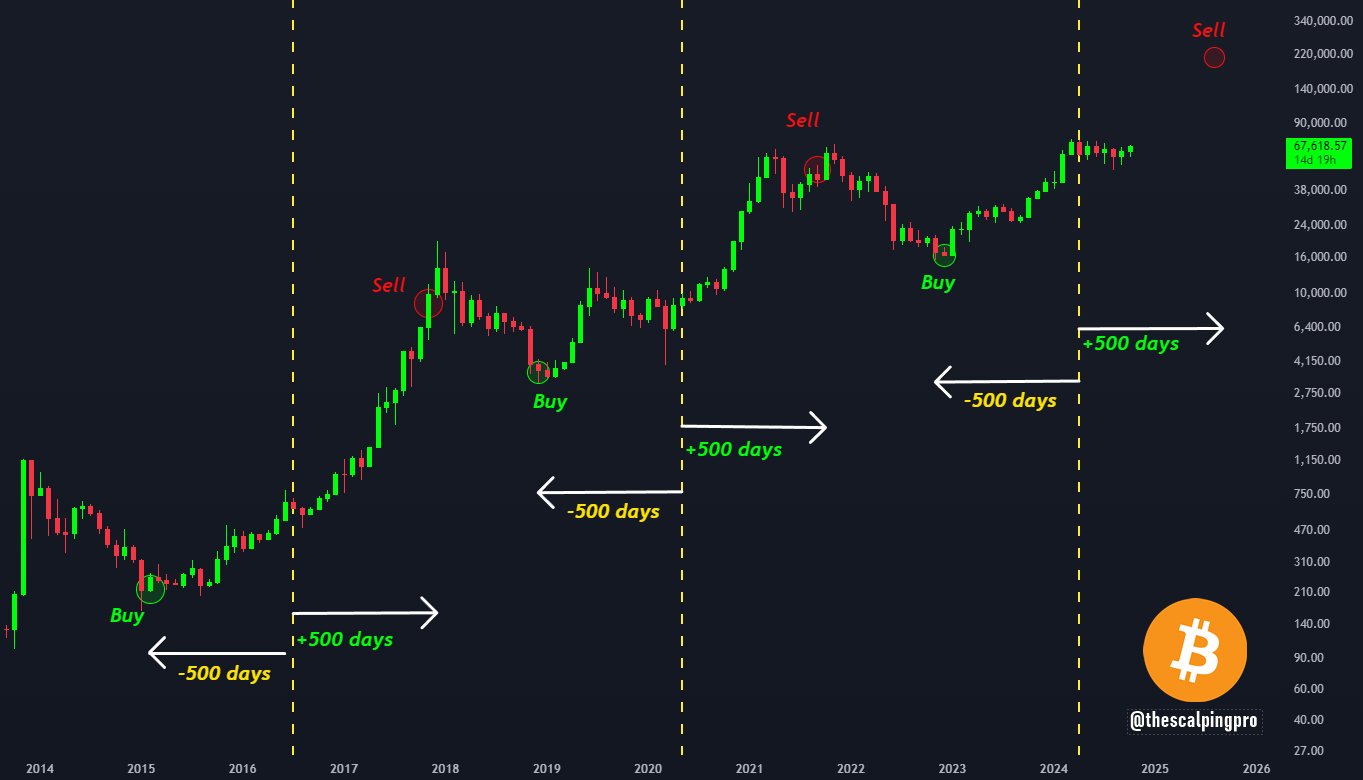
According to the seasoned analyst, the key action is to enter the Bitcoin market 500 days before a halving cycle. This timeline provides investors with a suitable window to purchase Bitcoin at lower prices, as the market is expected to be at a bottom by then.

Holding Through the Storms and When to Sell

Mags’s second strategy recommends holding onto the investment during the periods that follow, without getting shaken out. This is important because Bitcoin’s trajectory often experiences volatility in the lead-up to a halving event. Essentially, a shakeout would undermine the benefits of the earlier entry.

Thirdly, the analyst suggests selling the Bitcoin acquired 500 days after the halving event has occurred. This indicates that the market will likely be overheated during this nearly two-year window post-halving. Hence, capitalizing on accrued gains at this stage may be the savvy move, preparing investors for the next pre-halving buying strategy.

Mags based his thesis on Bitcoin’s historical trends, and he emphasizes that this pattern is repeatable. He posted a chart illustrating how 500 days before and after each halving cycle has proven to be an opportune window for entering and exiting the market since 2015.

Image
Bitcoin historical halving patterns

Applying the Strategy for this Present Cycle

In the current cycle, the window to buy Bitcoin 500 days before the halving has elapsed. The focus now shifts to the days counting down for the Bitcoin post-halving sale. Specifically, 500 days from the fourth Bitcoin halving, which occurred on April 19, 2024, will land on September 1, 2025.

Mags projects that Bitcoin could reach a price of at least $220,000 by this time. Notably, according to the chart, while Bitcoin’s market price 500 days after a halving may not be its highest value for that cycle, it is likely to be high enough to exit before the onset of a bear market.

Expert Analyst Predicts 4,324% VeChain Rise to $1 After Hitting Key Channel Low

0

VeChain (VET) drops 2.5%, nearing key technical levels that have triggered past rallies.

VeChain (VET) experienced a notable 2.5% decline over the last 24 hours, marking a critical moment as it touched the lower end of a price rally channel. This downward shift now positions VET near a key technical level that has historically signaled the onset of significant price increases.

According to expert analyst Egrag Crypto, the current pattern resembles earlier movements that led to massive gains in the token’s value. The analyst refers to this phase as the “Turbo Trigger,” highlighting its potential to push VET toward new highs.

VeChain Historical Patterns 

Egrag Crypto points to VET’s past performance as a basis for current expectations. He notes that the token has previously seen explosive growth after reaching similar technical positions.

One marker identified by Egrag is the “Ignition Stage,” during which VET has consistently rebounded from the lower ends of its price channels. In one notable cycle beginning in 2020, VET surged by 6,538%, adding $0.19888 to its price before reaching a peak.

The analyst’s current projection comes from him factoring this historical price cycle and applying it to the June 2023 low. By using Fibonacci retracement levels, Egrag identifies a potential price target around the $1 mark. 

Notably, if VeChain (VET) reaches $1 from its current price of $0.0226, it would represent a percentage increase of approximately 4,324%.

Risk Management Strategy

While a member of the crypto community has proposed selling VET at intermediate price levels, such as $0.50, and re-entering the market after a retracement, Egrag presented a cautious response. 

The analyst advises that while such a strategy might succeed, it carries the risk of missing out on a continued price surge. He suggests considering holding a larger portion of their VET investment while engaging in smaller trades to mitigate potential losses from unexpected market moves.

Previous Prediction

This is not the first time VET has been predicted to reach higher price levels. In September 21, the same analyst suggested that VeChain was positioned to enter a new impulsive wave, based on Elliott Wave Theory. The theory, which tracks market cycles in five-wave patterns, indicated that VET was nearing the critical third wave. 

Historically, this phase has been followed by a corrective fourth wave and then a final fifth wave, leading to a significant price increase. During that period, potential price targets ranged from $0.91 to $2.26, almost similar to the current outlook. However, as of today, VET is trading at $0.0226, reflecting a 3.76% increase over the past week.

Bitcoin Spot ETF Crosses $20B Net Inflow Driven by Pent-up Demand

0

The cumulative inflows into the Bitcoin spot exchange-traded funds (ETFs) surged past $20 billion on Wednesday after a combined net inflow of $1.5 billion in the past four days.

Data from Sosovalue confirms the latest milestone, which was achieved after just ten months of market debut. For context, 11 spot Bitcoin ETFs started trading on January 11 after the Securities and Exchange Commission approved the funds.

Bloomberg’s senior analyst Eric Balchunas also highlighted the landmark inflow, stating in a tweet on Thursday that the cumulative flows were one of the most important metrics for an ETF. Notably, this was the first time the funds reached $20 billion. It is also one of the fastest ETFs to breach the inflow mark.

Bitcoin Spot ETFs’ Journey to $20B Cumulative Inflow

The Bitcoin products had a swift start after their market debut, recording a staggering $628 million inflow on the first day. The funds continued in this trajectory as statistics pointed to pent-up demand for alternative exposure to Bitcoin.

Interestingly, these inflows came despite massive outflows from the Grayscale Bitcoin Trust (GBTC). For context, GBTC has seen a cumulative net outflow of $20 billion since it converted its trust fund to an ETF in January.

Notably, the BlackRock iShare Bitcoin Trust (IBIT) has been a major source of inflows, recording a cumulative net inflow of $22.46 billion. These giant strides saw the asset manager overtake Grayscale to become the largest holder of Bitcoin and Ethereum.

The spot Bitcoin ETFs now hold Bitcoin worth $64.46 billion, representing 4.82% of the asset’s circulating supply. Meanwhile, the issuers would have an impressive cumulative net asset of $49.55 billion if the funds Grayscale transferred from its trust fund were removed from the equation.

Bitcoin Outperforms Gold in ETF Inflows

Despite having an asset under management of $122 billion, the 20-year gold ETFs had a worse start than Bitcoin. Balchunas noted that it took gold ETFs about five years to attain a cumulative net inflow of $20 billion.

Putting that into perspective, it means that gold ETFs saw an average of $4 billion cumulative inflow every year. It also signals that Bitcoin ETFs grew more than five times faster than gold’s.

Furthermore, if Bitcoin spot ETFs continue to grow at this pace, they will match gold’s $122 billion net asset in less than three years. At the current pace, they would also produce a $1.29 trillion fund in the next 20 years.

Meanwhile, market pundits have predicted that Bitcoin would match gold’s market cap. For instance, SkyBridge’s managing partner, Anthony Scaramucci, asserted that Bitcoin will trade closely or even reach gold’s market cap in the coming years.

At the time of writing, Bitcoin was trading at $66,952 with a market cap of $1.32 trillion.