Home Blog Page 1206

Expert Predicts Bitcoin Final Major Dip as Crucial Indicator Emerges

0

The current Bitcoin market conditions have taken center stage recently, with expert analysts weighing in on important developments. 

Among them, Dam Gambardello, an expert analyst, has highlighted a key indicator suggesting Bitcoin may be experiencing its last major dip. This comes as Bitcoin struggles to recover from weekly lows.

Testing Key Support Levels and MA

For instance, Bitcoin is currently testing a crucial support level on the daily chart, which Gambardello believes is important for its short-term trajectory. A focal point of this analysis is Bitcoin’s ability to hold above the 50-day moving average, a well-established support zone. 

In addition to this, Gambardello notes the importance of the lower trend line in the falling wedge on the overall Bitcoin chart. Even if Bitcoin touches this trend line, Gambardello believes this would likely be the last time, given the consolidation phase over the past six months. 

Further backing this bullish perspective, the analyst notes the crossover of the 20-day moving average above the 50-day moving average, a signal of a bullish trend. 

Indicators and Fibonacci Support 

Meanwhile, according to Gambardello, the RSI on the 6-hour chart is indicating oversold conditions, often seen as a bullish signal. This suggests that Bitcoin may be nearing a potential bottom, with short-term declines likely to be followed by a significant price bounce.

However, the possibility of a dip into a key Fibonacci support zone, ranging between $58,000 and $55,500, remains on the table. 

If Bitcoin continues to drop, analysts point to the $50,000 level as a potential area for a final capitulation event. Such a scenario would align with Bitcoin becoming oversold on shorter-term charts, signaling a possible market bottom and subsequent recovery.

Bullish Long-Term Outlook

Notably, the ongoing Bitcoin halving cycle in 2024 is being closely compared to previous halving periods, which have often led to bullish price movements. Despite current short-term market fears, the expert suggests that Bitcoin may close October positively, supported by its broader macro bullish trend.

Projections following Bitcoin’s positive September close further support this optimistic outlook. Historical data suggests that Bitcoin could exceed $100,000 by year-end, with potential price points of $80,518 in October and $106,718 in December.

As XRP Falls Ripple CEO Comments on XRP Price Chart

0

Ripple CEO Brad Garlinghouse has commented on the XRP price chart, which shows a significant decline in XRP that contrasts with the broader market trend.

XRP is presently trading at $0.5352 after shredding over 10.75% of its value over the last 24 hours. This double-digit percentage loss is only observable with XRP among the top-ranking crypto assets.

While the overall market is experiencing a downturn, most tokens have seen only a decline of just over 3% today.

XRP Crashing Amid SEC Appeal

Notably, XRP is experiencing a massive dump as the U.S. SEC has finally signaled that it is filing an appeal in the recently concluded lawsuit involving Ripple. 

Before this official announcement on Tuesday, SEC legal representatives had informed journalists that everyone at the SEC “truly” believes the July 2023 decision is incorrect, not a good interpretation of the law.

Notably, the part of the ruling that the SEC seeks to appeal concerns Ripple’s programmatic sales of XRP, which Judge Analisa Torres ruled in favor of Ripple. The appeal does not include the conclusion that XRP is not a security, as the SEC agrees.

With the agency officially moving to appeal the rulings ahead of the October 7 deadline, XRP’s price is taking a hit.

Crypto enthusiast Carlos Miguel shared a graph on X showing the dramatic collapse of XRP’s price following this development. Ripple CEO Garlinghouse sarcastically remarked that the XRP chart illustrates how the SEC is “protecting” investors.

His comment underscores how XRP holders are once again facing losses due to the SEC’s actions, suggesting that the agency is causing more harm than protection.

Ripple CEO Frustrated by SEC Appeal

While Ripple executives have stated that the SEC’s decision to file an appeal is not surprising, they find it disappointing. Garlinghouse expressed his frustration that the SEC continues to use taxpayer money on what he considers a losing battle.

“I’m pissed that they are able to act without recourse or consequence,” he said. Nonetheless, he emphasized that Ripple will continue to fight vigorously and ultimately prevail.

In a similar vein, Ripple’s Chief Legal Officer, Stuart Alderoty, stated that the SEC is merely prolonging what has already become a significant embarrassment for the agency. He lamented that rather than applying the law faithfully, the agency, under its current chair, continues to wage a litigation war against the crypto industry.

“We are evaluating whether to file a cross-appeal,” he added.

SEC Files Notice of Appeal in Ripple and XRP Case as Lawsuit Drags On

0

The US SEC has filed a notice of appeal to the Second Circuit Court of Appeals, confirming plans to appeal Judge Analisa Torres’s rulings.

In this Ripple XRP news today, a court filing on Wednesday revealed that the US top regulator notified the Appeals Court of its intention four days before the deadline. Notably, the SEC did not state what part of the ruling it was appealing, as the application was just a declaration of its consent.

The SEC vs. Ripple Case Drags On

Notably, the appeal was widely expected as the SEC attempted to contend Judge Torres’ ruling in 2023. However, the court tossed the interlocutory filing, stating the regulator could only appeal after the final judgment.

After yesterday’s court filing, an SEC representative noted that the regulator’s appeal wants to contend Judge Torres’ August 7 ruling. The spokesperson stated that the judgment conflicted with the Supreme Court’s decision, and the regulator intends to defend the long-standing securities law with the appeal.

When they the securities watchdog files the actual appeal, it will disclose the part of the ruling it seeks to contest.

XRP’s Security Status Not in Contention: Ripple CEO

While the crypto community waits to see the appeal’s specifics, Ripple CEO Brad Garlinghouse has reiterated that XRP’s security status is not up for contention.

In a tweet late Wednesday, Garlinghouse assured proponents that XRP was not a security and that the SEC agreed with that narrative. He noted that after the failed interlocutory appeal last year, the regulator revealed it does not intend to contend the ruling that the XRPL native token was a security.

“While we’ll fight in court for as long as we need, let’s be clear: XRP’s status as a non-security is the law of the land today,” the Ripple boss stated.


Ripple Considering a Counter-Lawsuit

Reacting to the appeal, Ripple’s Chief Legal Officer, Stuart Alderoty, expressed his disappointment with the latest twist. He noted that instead of accepting the final judgment, the SEC has continued to drag on the four-year-long case, which has been a “complete embarrassment for the agency.”

Alderoty further noted that Ripple was considering its options, including filing a counter-appeal. It bears mentioning that the case’s outcome was a partial victory for Ripple. As a result, the firm could also appeal part of the judgment that it found unfavorable.

Notably, the filing came a few hours after Bitwise filed with the SEC for an XRP exchange-traded fund. The asset manager confirmed its push for the investment vehicle after it was seen on Delaware’s website.

Meanwhile, XRP reacted to the latest twist, falling over 10% in the past 24 hours. At the time of writing, the asset was trading at 53.5 cents, maintaining a market cap above $30 billion.

Brandt Identifies Bitcoin “3 Blind Mice” Pattern Amid Drop: Here’s What It Means for BTC Prices

0

Bitcoin has recently taken a dip after reaching a two-month high, with market veteran Peter Brandt pointing out an unusual trading pattern.

As the leading cryptocurrency struggles to regain its footing following a sharp correction, Brandt recently presented the investing public with a pattern he calls the “Three Blind Mice and a Piece of Cheese.” 

Bitcoin Faces Sharp Retracement

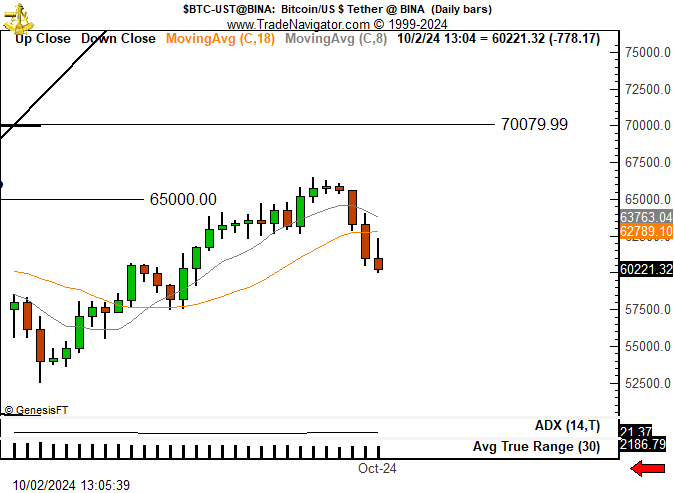
Toward the end of September, Bitcoin hit a high of $66,508, marking its best performance in two months. However, the excitement was short-lived, as the firstborn crypto retraced by more than 7.7% over the following days, dropping to around $60,221 yesterday.

Brandt’s 1-day chart shows three consecutive bearish daily candles, with prices sliding below important technical levels. Amid the correction, analysts wonder if the worst is yet to come or if Bitcoin is preparing for another breakout.

Bitcoin 1D Chart Peter Brandt
Bitcoin 1D Chart | Peter Brandt

This downturn coincides with growing global uncertainty, especially surrounding tensions in the Middle East, which has led investors to shy away from riskier assets like cryptocurrencies. The bearish resolve has neutralized the bullish momentum expected in “Uptober.”

Brandt’s “three blind mice” pattern has further bolstered concerns around Bitcoin’s price action. Although he has not fully explained this term, some analysts suggest it may refer to a continuation pattern, where the price is likely to follow the established bearish trend from the three bearish candles. 

Analysts refer to similar setups, such as the “Three Black Crows” pattern, as a bearish signal that a market is losing steam and could face continued selling pressure. With Bitcoin now trading below two key moving averages, the short-term outlook appears dim.

Bitcoin’s Technicals Look Dim

Brandt’s chart shows that Bitcoin’s current price sits below the 8-day and 18-day moving averages. This signals weakness in the short term, implying that sellers have gained control. If Bitcoin does not recover above these levels soon, further losses could spring up.

Meanwhile, the ADX is hovering around 21.37. This number suggests that the current trend lacks strength. The positioning indicates that the market is in a consolidation phase, but the risk of further downward movement remains high. Brandt previously suggested BTC is still in the bearish phase. 

Despite the recent downturn, Bitcoin’s psychological and technical support at $60,000 remains intact for now. If the price breaks below this level, it could lead to another wave of selling. This new wave could push Bitcoin towards the $58,000 mark.

However, the ATR shows rising volatility, which means traders should expect larger price swings in the coming days. Despite the difficulty in predicting Bitcoin’s next direction, indicators suggest that a deeper correction is still possible.

While Bitcoin’s decline has disappointed bulls, the market could still experience a reversal. Historically, October has been a strong month for crypto, and if Bitcoin can hold above $60,000, there’s potential for a rebound toward $65,000.

Ripple CEO Says He is Not Surprised But Pissed By SEC Appeal Decision, Vows to Fight As Long As Needed

0

Ripple CEO Brad Garlinghouse expresses frustration over the SEC’s decision to continue its legal battle against the company via an appeal. 

SEC Files Notice of Appeal 

The SEC sent shockwaves to the crypto community yesterday after it filed a notice of appeal to the Second Circuit. Per the notice, the regulatory agency revealed its intentions to contest a federal judge’s verdict in its case against Ripple. 

For context, Judge Analisa Torres issued her summary judgment decision in the lawsuit in July 2023. In the ruling, she declared that both Ripple’s programmatic sales and other distributions of XRP were not securities transactions. 

Conversely, she found that Ripple sold XRP as a security to institutional clients. Unsatisfied with the decision, the SEC attempted to file an immediate appeal to overturn the ruling on programmatic sales and other distribution. 

However, Judge Torres denied the request last year, ordering the SEC to wait until she resolves other aspects of the case, especially the remedies litigation. The judge issued the final verdict in August, which ended in a partial victory for the parties. 

Following the issuance of the final verdict, the parties were required to file a notice of appeal before October 7. With just a few days left before the October 7 appeal deadline, the SEC filed a notice of appeal yesterday.

Ripple CEO Reacts 

Reacting to the development, Garlinghouse expressed frustration with the SEC and its chairman, Gary Gensler, for choosing to continue the multi-year legal battle. 

The Ripple CEO suggested that the SEC should have ended the Ripple case earlier, emphasizing that the lawsuit has done more harm than good. 

In particular, Garlinghouse argued that the SEC has failed to protect U.S. investors and has tarnished its reputation. He emphatically stated that the securities regulator lost on everything that matters, adding that the industry and Ripple prevailed. 

XRP Non-Security Status Remains Unchanged 

Notably, the Ripple exec clarified that certain decisions, like XRP’s non-security status, cannot be undone irrespective of the SEC’s appeal. According to him, the court’s declaration of XRP as a non-security remains the law of the land, and the company will continue to fight as long as necessary to protect this decision.  

Interestingly, Garlinghouse recounted the SEC’s unsuccessful attempt to file an interlocutory appeal last year, saying the regulator clearly stated it was not interested in “challenging XRP’s status as a non-security.” 

Ripple CEO Isn’t Surprised but Pissed  

In a follow-up statement, Garlinghouse noted that he is not surprised by the SEC’s decision to appeal. However, the Ripple CEO is pissed that the SEC is wasting taxpayers’ money to fund the case he characterized as a “losing battle.” 

He is also upset that the SEC continues to act without facing any recourse or consequence for its actions. Nonetheless, Garlinghouse expressed confidence that Ripple would prevail in the appeal. He suggested that the victory would benefit not only Ripple but also the XRP community and the broader crypto industry. 

Ripple CLO Reacts 

Notably, Ripple CLO Stuart Alderoty echoed a similar sentiment, noting that the appeal decision is not surprising but disappointing. He said the appeal will only prolong the SEC’s embarrassment in court. 

He highlighted that the court had already found that Ripple was not reckless in its distribution of XRP. In addition, Alderoty said the court also found that the case had no allegations of fraud nor victims who suffered losses. The Ripple CLO slammed the SEC for engaging the crypto industry in warfare rather than faithfully applying the law. 

Meanwhile, the SEC has only filed its notice of appeal but has yet to file the brief. According to Attorney Jeremy Hogan, the SEC has about 70 days to file the appeal brief. 

Here’s Shiba Inu Price if Solana Reaches $1,000

0

Shiba Inu could erase one leading zero from its price if the impact of a Solana rise to $1,000 stretches to the meme coin market.

Notably, the broader cryptocurrency market is facing resistance after a previous rebound push that helped most assets recover lost values. For instance, Solana surged from a low of $142 on Sept. 23 to recover the $157 price territory at press time.

Crypto Markets Correlation

Moreover, Shiba Inu also leveraged the uptrend to record a massive 43% price spike, making it one of the biggest gainers in the latest market recovery. This rally allowed SHIB to retest the $0.00002 price region for the first time since June. 

However, as the markets witness a roadblock, Shiba Inu has failed to decisively breach the $0.00002 level. In addition, Solana has also hit a state of flux, unable to push toward the $160 psychological level. 

Interestingly, multiple analysts believe the latest push is a precursor of what’s to come. Some expect this recovery to eventually trigger the second leg of the ongoing bull run. For context, during the first leg of this bull run, Solana witnessed a rally to $210, while SHIB spiked to $0.000045 in March.

Shiba Inu Price if Solana Hits $1,000

While there is a consensus of an imminent market-wide surge, price targets vary across different analyses. For example, market veteran Ali Martinez predicted in July that Solana is eyeing the $1,000 price mark. Also, last month, Conor Kenny, a notable trader, projected a $1,000+ price for SOL, calling it a “realistic prediction.”

For Solana to hit this $1,000 price, the bulls will require sufficient support from the broader crypto market. Notably, this would require an uptrend recorded by Bitcoin (BTC), the largest crypto asset, and a subsequent bullish response from the rest of the market, which SOL could leverage.

In such a situation, other altcoins like Shiba Inu could also record bullish surges. For instance, during the first leg of the bull run, assets like Solana and SHIB benefited from the market rally. Moreover, data from CoinMarketCap confirms that SOL and SHIB had moved along each other before SHIB recently skyrocketed.

Shiba Inu and Solana Comparison

Solana would need to spike by as much as 536% to reach the $1,000 level. If this materializes and SHIB follows the direction of the broader market, its price could soar by a similar 536% or more.

Should Shiba Inu rally 536% from its current value, it would hit $0.0001226, essentially erasing one leading zero. However, it is important to note that SHIB could potentially surge higher in such a scenario, given its higher volatility. Despite this, there is also the possibility of the dog-themed token witnessing a less impressive growth than the 563% rise.

Crypto Shake-Up: 2025’s Game-Changing Trends And How They’ll Revolutionize Your Trading Game

0

You’re about to dive into the future of crypto trading. By 2025, the landscape will be unrecognizable. New technologies, regulations and market dynamics will reshape how you invest and trade. This article explores the key trends that’ll transform your crypto strategy, from AI-driven analytics to decentralized finance innovations. Get ready to stay ahead of the curve and maximize your profits in this brave new world of digital assets.

The crypto world is evolving at breakneck speed and 2025 promises to be a pivotal year for traders and investors alike. As we stand on the brink of this new era, it’s crucial to understand the forces that will shape the market and influence our trading decisions. From cutting-edge technologies to shifting regulatory landscapes, the changes coming our way are both exciting and challenging.

Let’s explore the game-changing trends that will revolutionize your crypto trading game and how you can prepare for this new frontier.

AI and Machine Learning: The New Trading Superpowers

Artificial Intelligence and Machine Learning are set to become indispensable tools for crypto traders in 2025. These technologies will analyze vast amounts of data in real-time, identifying patterns and trends that human traders might miss.

Advanced algorithms will predict market movements with unprecedented accuracy, allowing traders to make more informed decisions. And with platforms like MT5 integrating AI-powered features, even novice traders will have access to sophisticated analysis tools.

But it’s not just about number crunching. AI will also revolutionize risk management, automatically adjusting trading strategies based on market conditions and individual risk profiles. This level of personalization will help traders maximize profits while minimizing potential losses.

Decentralized Finance (DeFi) 2.0: The Next Evolution

By 2025, DeFi will have undergone a significant transformation. The current limitations of scalability and interoperability will be largely resolved, paving the way for more complex financial products and services. We’ll see the rise of decentralized derivatives markets, prediction markets and even AI-powered robo-advisors operating entirely on blockchain networks.

This evolution will blur the lines between traditional finance and crypto, attracting institutional investors and bringing unprecedented liquidity to the market. For traders, this means more opportunities to diversify portfolios and access sophisticated financial instruments previously reserved for Wall Street elites.

Regulatory Clarity: A Double-Edged Sword

The regulatory landscape for cryptocurrencies will be much clearer by 2025. While this might seem like a dampener on the Wild West of crypto trading, it’s actually a boon for serious investors. Clearer regulations will bring legitimacy to the market, attracting more institutional investors and stabilizing prices.

However, this new regulatory environment will also require traders to be more diligent in their compliance efforts. Platforms like easyMarkets will play a crucial role in helping traders navigate these new rules while still providing access to a wide range of trading options.

The Rise of Tokenized Assets

As Larry Fink of BlackRock said previously, we’ll see a surge in tokenized real-world assets going forward. Everything from real estate to fine art will be represented on blockchain networks as tradable tokens. This trend will open up new investment opportunities and allow for unprecedented liquidity in traditionally illiquid markets.

For traders, this means the ability to create more diverse and balanced portfolios. You’ll be able to trade fractions of high-value assets, making sophisticated investment strategies accessible to a broader range of investors.

Quantum Computing: The Wild Card

While still in its infancy, quantum computing could have a significant impact on crypto trading by 2025. These super-powerful computers have the potential to break current encryption methods, posing a threat to blockchain security. However, they also offer the promise of ultra-fast trading algorithms and complex market simulations.

Traders who stay informed about quantum developments and their potential impacts will be better positioned to adapt their strategies and protect their assets in this new technological landscape.

Looking Ahead

The crypto trading landscape of 2025 will be a far cry from what we know today. AI and machine learning will provide unprecedented market insights, DeFi 2.0 will offer new financial products and clearer regulations will bring stability and legitimacy to the market. Tokenized assets will diversify investment options, while quantum computing looms as both a threat and an opportunity.

As traditional and crypto markets merge, traders will need to adapt to a more complex, interconnected financial world. By staying ahead of these trends, you’ll be well-positioned to thrive in this new era. Embrace the changes, stay informed and be ready to adapt your strategies.

The future of crypto trading is bright, complex and full of opportunities for those who are prepared. So gear up, stay curious and get ready to ride the wave of innovation that’ll define the crypto world in 2025 and beyond.

Disclaimer: This article is provided by the Client. The Client is solely responsible for this page’s content, quality, accuracy, products, advertising, or other materials. Readers should conduct their own research before taking any actions related to the material available on this page. The Crypto Basic is not responsible for the accuracy of info and any damage or loss caused or alleged to be caused by the use of or reliance on any content, goods, or services mentioned in this article.

Please note that The Crypto Basic does not endorse or support any content or product on this page. We strongly advise readers to conduct their own research before acting on any information presented here and assume full responsibility for their decisions. This article should not be considered investment advice.


Unlocking Liquidity For A New Generation of Assets

0

Liquidity.  In the world of DeFi, the word elicits both excitement and concern:  Excitement when you have it, concern when you’re running low.

Liquidity is what powers the DeFi protocols of Web3, ensuring that trading is fast, efficient, and minimizes slippage among other negative consequences.  Exchanges are always looking for ways to build up a strong community, and part of what makes a strong community is the willingness to provide liquidity, support the protocol, and create a beneficial situation for all.

So how are DeFi platforms working to manage their liquidity, and what best practices are on the horizon?  Let’s take a look to see how the power of liquidity is helping to drive Web3’s future.

Before You Can Manage It, You Have to Get It

Finding advanced ways to optimize liquidity is well and good, but if you don’t have any to begin with it makes it difficult to operate.  One of the biggest challenges platforms face is building up a critical mass of community members willing to participate as liquidity providers (LPs).  While some platform visions are truly inspiring, what really inspires the majority of people in Web3 is the ability to turn your holdings into more holdings.  As a result, liquidity providers don’t just lock in their funds out of the goodness of their hearts.  Liquidity mining, or offering rewards to LPs, is a must for platforms building up liquidity pools for trading to occur.  The LP structure can occur in different ways, offering providers different levels of commitment, risk, and rewards to offset what they are putting into the system.  Having this balance of liquidity ensures that trades can be made more efficiently, creating a higher quality trading environment for participants and reducing problems with delayed transactions.

Assuming a platform can find enough liquidity, balancing out the risks, rewards, and costs can be a delicate dance.  The keys to optimizing this are creating a strong tokenomics doctrine that is clear on how the token is treated, how rewards are delivered, and how other elements like inflation and distribution are handled on the platform; and building up a strong and capable DAO that can collectively adapt and make wise decisions that maximize liquidity and keep trading activity strong and efficient.

Let’s say, though, that even if you have a strong DAO, good tokenomics, and a good LP rewards system in place, the required liquidity just isn’t coming through.  What options do Web3 platforms have?  With Web3 growing, the industry is building and attracting more people who are adopting it.  However, it also means that many new Web3 companies are building up, and are competing for a limited supply over overall liquidity in the market.  For those platforms who are working hard to incentivize LPs but still falling short, there are other alternatives available.  Some platforms can find partners that either have complimentary business models, or may even be competitors but are forced to merge in order to make the most of the collective liquidity found in both communities.  Other platforms may not want to merge completely, but might use existing technology to create interoperability with other platforms and exchanges, allowing users to dip into other platforms’ liquidity.  This can also take the form of full cross-chain bridging, preventing the effects of liquidity dilution as the Web3 industry grows.

Working Smarter, Not Harder

The brute force of simply adding more liquidity in order to operate a platform isn’t a bad idea.  If you can simply force more liquidity into the platform and it helps to boost the quality, speed, and minimize ill effects, then by all means, let’s do it!  However, this doesn’t always get the job done, and platforms need to make the most of what they have.  Consolidating how they use that liquidity is critical, making sure that the liquidity is exactly where it is needed most, dynamically adjusting to fit what the community needs.  To this end, shifting the way that markets are handled can greatly improve how liquidity is optimized.  A key adopter of this method has been dYdX with its MegaVault concept. As part of their planned dYdX Unlimited release in the fall, and different from a typical liquidity pool, the platform has set up the MegaVault as a supercharged, collective liquidity battery that drives its unique “permissionless market listings” feature.  With this, a user can set up nearly any new market without governance approval, and launch the market on the platform by depositing a certain amount of USDC into the MegaVault in order to provide liquidity.  Because the listings are completely community driven, they have a proven demand, but will also vary quite a bit in popularity.  However, each will help to provide additional liquidity to the MegaVault as a whole, which collectively provides liquidity as the various markets need it.  It also uses various incentives to encourage and reward additional depositing, staking, etc.

Near Future Trends

Given the industry’s continued growth, it’s likely that new participants in the Web3 community can help provide more liquidity if they become active in Web3 trading, but at the same time, there continues to be a growth of new Web3 platforms looking for liquidity.  Platforms across the industry must work harder in general, but smarter in particular.  Finding the right mix of incentives without losing too much as a result is important.  However, ensuring that operations are smooth, fast, and minimize negative effects will continue to be a high priority.  Innovations like the permissionless market and the MegaVault concept from dYdX provide a lot to consider in terms of how to maximize whatever liquidity you have to work with.  Being able to intelligently leverage liquidity to its max, and to use whatever other best practices that might give the platform’s liquidity a boost; this activity will see a growing amount of attention in the next 1-2 years.  Liquidity has always been a key focus area in Web3, but we can expect that focus to become an obsession between now and a much greater level of Web3 adoption worldwide.

Experts Say Bitcoin Surge to $100K Likely as It Breaks September Jinx

0

While Bitcoin struggled historically in September, recent development points to a shift in this pattern. 

According to CoinGlass, Bitcoin closed in September with positive returns only four times in 12 years. Despite this negative history, Bitcoin has experienced a notable shift in the past two years, closing September on a positive note in both instances. 

Notably, in 2023 and 2024, Bitcoin recorded a 3.91% and 7.29% gain for September, respectively. This recent strength has sparked optimism among analysts and experts regarding Bitcoin’s future price action.

Projections Following a Green September

Following Bitcoin’s positive September close, a Bitcoin insight and commentary provider shared price projections based on historical patterns. It indicated that Bitcoin could surpass $100,000 by the end of the year if it follows the average gains made after a green September.

The projection suggests an October price of $80,518.40, rising to $89,727.02 in November and hitting $106,718.33 by December.

Image
Image from https://twitter.com/BTC_Archive/status/1841102401891106816

Historically, October has been one of the most profitable months for Bitcoin, with significant average returns of 20.66% over the past decade. While November boasts the highest average of 46.81%, December follows with more moderate gains of 5.45%.

Bitcoin monthly average return

These figures highlight the potential for continued upward movement, as Bitcoin has traditionally performed well in the last quarters of the year.

Market Experts Weigh In

In addition to these projections, market analyst Ali Martinez recently emphasized the significance of Bitcoin’s green September close. Martinez pointed out that previous positive Septembers, such as in 2015 and 2016, led to even more significant gains in October, with Bitcoin increasing by 33.49% and 14.71%, respectively. 

Martinez noted that Bitcoin’s recent 3.91% gain in September 2023 could similarly precede a substantial rally, as evidenced by past performances. This pattern suggests that Bitcoin may see another strong October, potentially setting the stage for further gains throughout the rest of the year.

Veteran Analyst Doubts Bitcoin Uptrend

However, not all experts share the same optimism. Veteran trader Peter Brandt highlighted concerns about Bitcoin’s longer-term trend, stating that the recent rally did not break the established bearish structure.

According to Brandt, Bitcoin has been exhibiting a pattern of lower highs and lower lows for over seven months. For Bitcoin to confirm a significant bullish reversal, Brandt stressed the need for the asset to close above $71,000 and establish a new all-time high.

Brandt also identified two critical resistance levels, at $70,602 and $73,808, which have repeatedly blocked Bitcoin’s upward momentum. Without surpassing these levels, Bitcoin is expected to remain in a consolidation phase with periodic massive declines.

Solana Drops 9% But Looks to Leverage On-Chain Activity Surge for Rally to $186

0

Solana declines with the rest of the crypto market but looks to leverage a surge in on-chain activity for a rally to late July highs.

Solana (SOL) recently experienced a 9% decline over the past two days after reaching a seven-week peak of $161.80 on Sept. 29. This drop came on the back of a broader crypto market downturn, which saw the altcoin market cap fall from $800 billion to $739 billion. 

However, with strong on-chain activity data and positive market sentiment, Solana could be poised for a rally toward its next pivotal resistance level of $186.

Rising On-Chain Activity Amid Correction

Despite the price dip, the Solana ecosystem is witnessing a surge in on-chain activity across various decentralized finance (DeFi) protocols.

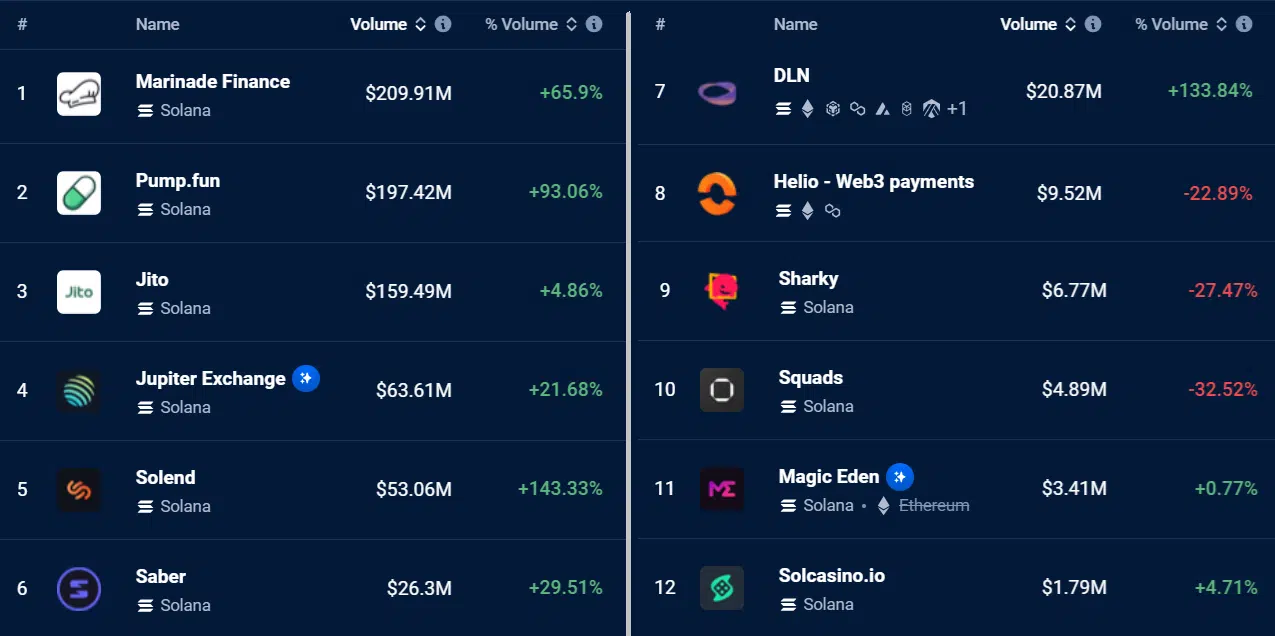
Data from dAppRader shows Solana DeFi staking protocol Marinade Finance recording $209.91 million in volume, up by a substantial 65.9%. Pump.fun is also seeing massive growth with a 93.06% surge in volume, reaching $197.42 million. 

Top Solana dApps dAppRadar
Top Solana dApps | dAppRadar

Another project seeing steady growth is Jito, with $159.49 million in volume, marking a 4.86% increase. Jupiter Exchange, Solana’s leading decentralized exchange aggregator, witnessed a 21.68% increase in volume to $63.61 million.

On the lending and borrowing side, Solend saw a notable 143.33% increase, bringing its total volume to $53.06 million. Meanwhile, Saber, a stablecoin swapping platform, recorded a 29.51% increase in volume, with total transactions reaching $26.3 million.

However, not all protocols are seeing the same level of success. Helio saw a 22.89% decline in volume to $9.52 million, and Sharky, a lending protocol, experienced a 27.47% drop. Despite these setbacks, overall Solana activity remains strong.

Solana Shows Rebound Potential 

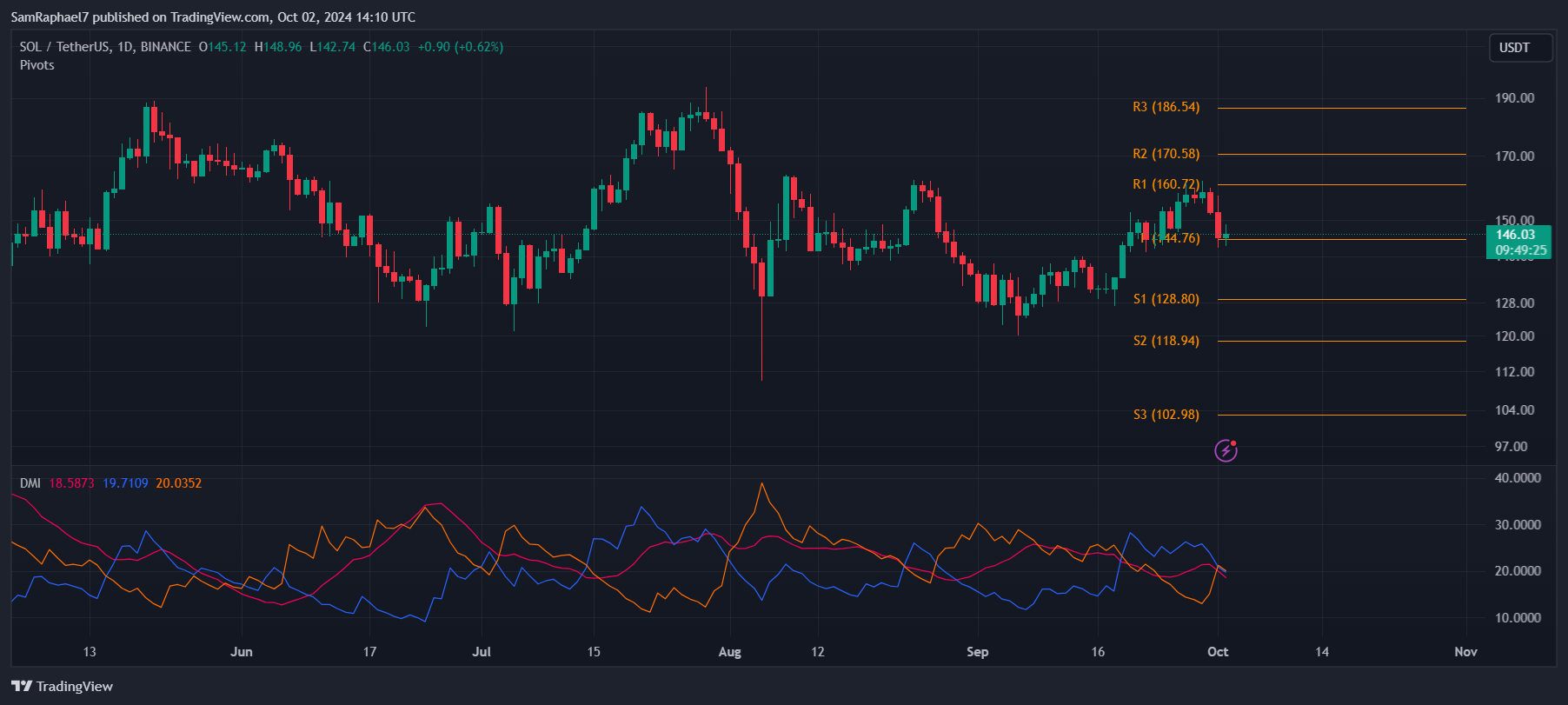
Solana’s price movements show a period of consolidation following the recent correction. At the time of writing, SOL is trading around $146.03, with the nearest support level at $144.76, as indicated by the pivot point. 

This pivot position indicates that Solana could stabilize in the short term before making another upward move. Further support levels lie at $128.80 (S1) and $118.94 (S2), providing additional safety nets should the price experience further declines. 

Solana 1D Chart
Solana 1D Chart

Meanwhile, the first resistance (R1) is at $160.72, a level it previously failed to hold during the late-September rally. If Solana breaks through this level, it could aim for $170.58 (R2), with a longer-term target at $186.54 (R3), which corresponds to a late July high.

Currently the +DI within the Directional Moving Index is at 19.7, trending downward, while the -DI sits at 18.5, also sloping downward, but at a slower rate. The Average Directional Index (ADX), at 20, shows that the market is in a consolidation phase with no strong trend direction yet.