Home Blog Page 1226

Ripple Performs RLUSD Tokens Biggest Mint on XRPL

0

Ripple advances RLUSD beta testing on Ethereum and the XRP Ledger (XRPL) with more tokens issued.

Ripple has continued to advance the beta testing of its proprietary Ripple USD (RLUSD), its upcoming stablecoin, on both the Ethereum network and the XRP Ledger (XRPL).

Particularly, on September 24, Ripple issued 485 RLUSD tokens at 12:28 AM UTC, marking the largest release during the stablecoin’s testing phase. This recent issuance has increased RLUSD’s maximum total supply to 563 tokens.

Largest Issuance 

This issuance has caught the attention of several XRPL community members, including Vet, an XRPL dUNL Validator.

Notably, one user questioned whether transaction fees associated with RLUSD could enhance XRP liquidity if large volumes of RLUSD were utilized. 

Vet responded, clarifying that while the fees are minimal and mainly for spam prevention, RLUSD’s presence on-chain could still drive liquidity into XRP and other assets on the decentralized exchange (DEX). 

The issuance also follows a previous release of 185 RLUSD on August 22, which had similarly stirred discussions within the community. 

Community Speculation

The latest RLUSD issuance has sparked speculative discussions within the XRP community about potential price movements. Some community members have humorously speculated that XRP’s value could surge dramatically if it were to match the value of RLUSD, pegged at $1. 

Vet recently joked on social media that RLUSD reaching $1 would be a “major” development, poking fun at how some community influencers exaggerate routine reports. Since RLUSD is pegged to the dollar, it is expected to always maintain a value of $1. 

Ripple’s Strategic Decisions 

Ripple’s stablecoin initiative comes amid broader changes in the company’s strategic direction. Earlier this month, Ripple’s CTO, David Schwartz,expressed a preference for XRP over RLUSD for payment purposes on the XRPL.  

This comment followed questions about Ripple’s evolving business strategies, including its shift towards Ethereum, smart contracts, and its recent pre-IPO stock buyback.

Grayscale Says XRP Trust Will Give Investors Exposure to a Protocol with Real-World Use Case 

0

Leading crypto asset manager Grayscale Investments highlights a major benefit of its recently launched XRP Trust.

Recall that Grayscale re-launched the XRP Trust earlier this month, allowing only accredited investors to gain direct exposure to XRP. Since its inception, Grayscale has been highlighting numerous benefits of the product, including detailing a four-phase growth cycle that could eventually transform the product into a spot-based crypto ETF. 


XRP’s Real-World Use Case 

In a recent statement, Grayscale’s Head of Product & Research, Rayhaneh Sharif-Askary, stated that the XRP Trust would give accredited investors direct exposure to a protocol that has a significant real-world use case.

According to Sharif-Askary, XRP can transform the global financial infrastructure by facilitating cross-border payments that are completed in seconds. 

Although Sharif-Ashkary made this known immediately after Grayscale launched the XRP Trust, the asset manager recently brought the public’s notice to the statement in a tweet. 

XRP Use in Cross-Border Payments 

XRP has demonstrated its prowess in facilitating cheap, faster, and efficient cross-border settlements. Prominent San Francisco-based company Ripple has been leveraging the token to facilitate real-time settlements between nations. 

Notably, XRP is at the core of Ripple’s payment ecosystem. In particular, Ripple’s On-Demand Liquidity (ODL) product (now Ripple Payments) uses XRP for faster and low-cost transnational settlements. 

Through this solution, Ripple successfully reduced the settlement period for cross-border payments to mere seconds from the usual three business days obtainable within the traditional financial sector. 

Ripple’s ODL also eliminates the need for pre-funding, making the product suitable for instant cross-border settlements. Interestingly, several financial institutions have also adopted the XRP-powered payments solution.  

For instance, Malaysian payment company Tranglo incorporated Ripple’s ODL into all its payment routes in 2022. A year later, the company disclosed that it had processed over $1 billion worth of transactions using ODL, underscoring the product’s relevance in cross-border settlements.  

XRP Trust NAV Soars 0.77% in 24 Hours 

With Grayscale’s XRP Trust, accredited investors will now gain exposure to XRP, which has continuously demonstrated its significance in global payments. 

In the meantime, Grayscale’s XRP Trust’s net asset value (NAV) has increased slightly by 0.77% over the past 24 hours to $11.74. So far, the product has $733,532 worth of assets under management (AUM). 

Ripple Shuffles 200,000,000 XRP As XRP Stays Below $0.60

0

An address tied to payment giant Ripple shuffled 200,000,000 XRP amidst a wider market correction.

Per a report from market tracking resource Whale Alert, Ripple moved 200 million XRP to an unknown address on Monday. The funds were worth $117.6 million, moved at the rate of $0.588 per XRP.


Transaction Details

Data from Bithomp reveals further details of the transaction, which occurred at 15:41 UTC on Monday. The sending address “rBg2F…fo91m” transferred 200 million XRP to the receiving address “rP4X…Kvx3.”

Although Whale Alert labeled the receiving address unknown, an investigation from The Crypto Basic revealed that it is affiliated with Ripple. In fact, the receiving address has been at the core of most on-chain transactions from the payment giant.

For context, the wallet received another set of XRP tokens from the sending address (rBg2F…fo91m) days before the latest transaction. On September 13, it received 150 million XRP from the address, valued at $85.3 million.

Notably, on-chain data shows that the receiving address has been a major channel through which Ripple moves funds to exchanges. The Crypto Basic reported a recent transaction in which the address moved 100 million XRP ($19.7 million) to Bitso. 

Also, on September 20, the same address moved 500 million XRP, valued at $289.7 million, to Bitso at 19:35 UTC. At the time of writing, the wallet, activated in October 2023, held 249 million XRP.

XRP Down 1% Amid Market Correction

The recent on-chain XRP shuffle coincided with a wider market correction, which saw XRP fall 1% to $0.586 in the last 24 hours. The market seems to be cooling off after a bullish uptrend over the weekend.

XRP surged to $0.6075 on Saturday, a price last seen in late August. However, the asset has corrected 3.5% since then.

Despite the slight correction, analysts remain bullish on XRP. Market speculator Steph has tipped the XRPL native token to surge to $0.7 if it breaks the $0.6 resistance.

Top FinTech Experts See XRP Hitting $6.45: Here’s When

0

Recent research from leading fintech platform Finder indicates that XRP may experience substantial price increases over the next few years. 

According to the Finder research, a panel of fintech specialists forecasts that XRP will end 2024 with an average price of $0.66. However, they see its value rising above $6 by 2030, offering long-term investors significant potential gains.

The opinions among experts vary, with some displaying optimism and others exercising caution due to potential hurdles.

XRP Price Targets by Year-End

Unocoin Technologies CEO Sathvik Vishwanath is among the most bullish. He anticipates that XRP could surge to $1.50 by the close of 2024, representing a substantial 215% rise from XRP’s value at the time of the research and a 162% increase from the current price at press time.

Vishwanath attributes this potential growth to XRP’s role in the financial scene, especially in cross-border payments, and Ripple’s collaborations with major financial institutions. Despite this optimism, he acknowledges that regulatory challenges might still pose a risk to XRP’s long-term trajectory.

On the other hand, a University of Canberra lecturer, John Hawkins, offers a much more conservative outlook, with Finder noting that he presented the most negative prediction. Hawkins projects XRP will close 2024 at a meager $0.30, representing a 47% drop from current levels.

He argues that the legal issues Ripple faced, particularly its battle with the U.S. SEC, had hampered XRP’s price. Although the case concluded this month, with Judge Analisa Torres ruling in July 2023 that XRP is not a security, Hawkins remains cautious. 

Moreover, he suggests that if Bitcoin’s price were to fall, it could create a “contagion” effect, negatively impacting XRP and other digital currencies. This trend is currently ongoing as XRP and the rest of the market face turbulence amid Bitcoin’s inability to rebound.

XRP Reaching $6.45

Looking further into the future, Shubham Munde, head of research at Indian-based research firm Market Research Future, is the most optimistic about XRP’s long-term prospects. 

Munde envisions XRP reaching $6.45 by 2030 due to its relatively low price compared to other cryptocurrencies, which could attract new investors. Additionally, he believes that the increasing adoption of XRP by banks, financial institutions, and payment systems will further propel its value.

Paul Levy, a University of Brighton lecturer, also holds a positive long-term view. He predicts XRP will reach $6.10 by 2030, slightly below Munde’s estimate. 

Levy points out that XRP could ride on the latest Bitcoin halving event, which came up in April. Several analysts have projected an imminent increase in Bitcoin’s price, citing patterns observed from previous halving events. A surge in Bitcoin’s price could greatly benefit XRP due to their close correlation.

In addition, Levy believes the growing potential regulatory clarity around XRP now that the legal uncertainties have been resolved could also help its price action in the future. However, he cautions that short-term volatility could still be a concern.

While some experts foresee significant growth, others are more restrained. Nevertheless, the general consensus suggests that XRP holds substantial upside potential. At press time, XRP currently trades for $0.5712.

Here’s Where Ripple Chairman Larsen Ultimately Moved His 20M XRP

0

Part of the XRP tokens moved by the Ripple chairman appears to be heading to centralized exchanges, for possible sales.

Chris Larsen has continued to move millions in XRP from one of his addresses, with the ultimate purpose of liquidating them. Recall that The Crypto Basic confirmed last week that the Ripple co-founder moved 50 million XRP from his account to a new unidentified wallet. 

Ripple Chairman Moves 5M XRP to Binance

Notably, this new wallet held onto the tokens for four days before eventually transferring 20 million XRP to another address rHo…Spm in four batches of 5 million XRP each, as reported by The Crypto Basic three days ago.

Following an investigation of the behavioral patterns of rHo…Spm, The Crypto Basic suggested that these 20 million XRP tokens could be heading to the centralized exchange Binance. The address has persistently offloaded millions of XRP to Binance in recent months.

Now, in the most recent development, this has materialized. Barely 24 hours after receiving the 20 million XRP, rHo…Spm transferred out the assets to another address rJY…kA2, as speculated. This address has now moved 5 million XRP to Binance, and the remaining 15 million XRP to an address activated by Bittrex.

However, given the behavior consistent with this Bittrex-activated address, on-chain data suggests the leftover 15 million XRP would also be heading to Binance. The address also persistently moves millions of XRP to Binance shortly after receiving them.

Bithomp
Bithomp

Larsen’s XRP Movements

For context, this flow of funds is especially noteworthy, as it marked the first time Larsen moved XRP from the genesis address in 11 years. Upon its activation in 2013, the address received 500 million XRP, part of the allocation to Larsen. 

It retained these tokens until the recent 50 million outflow, leaving it with a balance of 450 million XRP. Shortly after the transaction occurred, a camp of speculators suggested that the movement could be the product of a hack. This was due to a similar situation observed with one of Larsen’s wallets in February.

However, The Crypto Basic noted this was unlikely to be the case, as the first recipient address had links with the primary address. It has been over a week since the 50 million XRP movement, and the Ripple chairman has not raised any alarms despite the transaction generating press time. This confirms his authorization of the fund flow.

At the reporting time, the first recipient address rao…gzS has held onto the leftover 30 million XRP, with only 20 million on the move. Nonetheless, preliminary observation suggests this remaining 30 million XRP could also make its way to Binance as well.

Speculation Suggests XRP Could Hit $1M if 1 XRP Drop Equals 1 RLUSD

0

XRP community pundits speculate that the XRP price could clinch $1 million if a drop of XRP ever equals the value of 1 RLUSD, the upcoming Ripple stablecoin.

These speculations emerged on the back of an attempt at satire by Vet, an outspoken dUNL validator on the XRP Ledger (XRPL). With Ripple confirming that the RLUSD stablecoin is only weeks from launching, Vet recently took to social media to humorously suggest that its value equaling $1 would be a “big” development.

Being pegged to the dollar, the RLUSD is expected to be worth $1 at all times. Vet’s sarcastic commentary was a satire depicting the manner in which some influencers in the community discuss ordinary developments with tags as explosive news.

XRP’s 1 Million Drops

Interestingly, Crypto Tank, an XRP community member and self-acclaimed researcher, jumped on this commentary to propagate theories of a possible XRP price surge. Notably, XRP as a token is divided into smaller units called “drops,” much like Bitcoin has satoshis.

Each XRP token consists of 1 million drops. Before now, some areas of the XRP Ledger calculated XRP fees in units. However, an amendment from last year completely changed this fee structure to drops, essentially allowing all areas of fees to be calculated in drops of XRP, for easier calculations.

Besides calculating the fee structure on the XRPL, the XRP drop units rarely make it to everyday discussions. This is largely due to XRP’s low price, which remains below $1, as XRP currently trades for $0.5857. For context, the last time XRP saw the $1 mark was in November 2021.

Crypto Tank believes when XRP price reaches greater heights, possibly surpassing $1, market participants would see a need to start calculating XRP in units of drops.

1 XRP Drop Equaling 1 RLUSD

He then speculated that if, in the future, one drop of XRP equals the value of 1 RLUSD, then that would translate to an XRP price of $1 million, seeing as there are 1 million drops in 1 XRP. While Crypto Tank suggested that this is “100% possible,” the speculation remains audacious.

In a subsequent comment, the community figure doubled down on his speculation. He agreed that RLUSD will always be $1, but argued that XRP’s price could be much higher in the future. According to him, when XRP price becomes too high, most market participants will resort to moving drops instead of one whole XRP.

It bears mentioning that XRP Healthcare’s Head of Social Adoption, Edward Farina, made similar assertions back in March. However, Farina never projected a possible $1 million price for XRP. Instead, the Alpha Lions Academy CEO suggested that XRP could become so unaffordable in the future that traders would have to resort to moving it in drops.

What Is The Best Bitcoin Wallet In 2024?

0

When it comes to storing Bitcoin, selecting the right Bitcoin wallet is essential for ensuring the security and ease of access to your funds. With so many options available, it can be challenging to determine which Bitcoin wallet is the best for you. In this article, we’ll explore the different types of Bitcoin wallets and explain why the Ledger Bitcoin wallet stands out as the best Bitcoin wallet for securely storing your cryptocurrency such as Bitcoin.

What is a Bitcoin Wallet?

A Bitcoin wallet is a digital tool that allows you to store, send, and receive Bitcoin. Think of it as your personal bank account for your digital assets. The Bitcoin wallet doesn’t actually store your Bitcoin physically; instead, it stores the private keys needed to access and manage your Bitcoin on the blockchain. Without these private keys, you wouldn’t be able to access your funds, making the security of your wallet paramount.
Bitcoin wallets are designed to offer varying levels of security, convenience, and accessibility depending on the type of Bitcoin wallet you choose.

Types of Bitcoin Wallets

There are different types of Bitcoin wallets, each with its own advantages and drawbacks. These can be broadly classified into software wallets, hardware wallets, and paper wallets.

Bitcoin Software Wallets

Bitcoin software wallets are applications that can be installed on your mobile phone or desktop computer. These wallets are typically free, easy to set up, and allow for quick access to your Bitcoin. However, they are more vulnerable to hacking and malware because they are connected to the internet.

Bitcoin Mobile Wallets

Mobile wallets are software-based wallets designed for smartphones. They are convenient for day-to-day transactions, allowing users to send or receive Bitcoin with ease. Many Bitcoin mobile wallets include QR code scanning for faster payments, making them ideal for those who regularly use Bitcoin in their daily life.

Bitcoin Desktop Wallets

Desktop wallets, on the other hand, are designed to be used on a computer. These Bitcoin wallets offer the same functionality and features as mobile wallets and can store an equivalent amount of Bitcoin. However, desktop Bitcoin wallets are still connected to the internet, which leaves them vulnerable to security threats like malware or hacking.

Bitcoin Hardware Wallets

Hardware wallets are physical devices that store your private keys offline, making them one of the most secure ways to store Bitcoin. These Bitcoin wallets are immune to online hacks, malware, and other internet-based attacks since they are not connected to the web. They’re often regarded as the safest option for long-term Bitcoin storage.

Bitcoin Paper Wallets

Paper wallets involve printing your Bitcoin private keys and public addresses on a piece of paper. While they offer offline storage, they can be fragile. If the paper is lost or damaged, you could permanently lose access to your Bitcoin. Paper wallets can be more complex to set up and use compared to other wallet types.

Our Top Bitcoin Wallet Pick: Ledger

When it comes to safeguarding your Bitcoin, the Ledger Bitcoin wallet is our top pick for its exceptional blend of security, ease of use, and reputation. Ledger is widely regarded as the best Bitcoin wallet for users who prioritize protecting their assets while still maintaining accessibility.

The Ledger Bitcoin wallet provides an unparalleled level of security by storing your private keys offline, shielding your assets from online threats. At the same time, it offers seamless functionality with an intuitive interface, making it simple to manage your Bitcoin.

Self-Custody of Private Keys with Ledger Bitcoin Wallet

One of the standout features of the Ledger Bitcoin wallet is its commitment to self-custody. When using the Ledger wallet, you are in full control of your private keys. Unlike custodial wallets where a third party holds the keys for you, Ledger ensures that only you have access to your Bitcoin. This means you are the true owner of your assets, and no third party can interfere or limit your control.

Self-custody is a key principle in the cryptocurrency world, allowing users to fully embrace the decentralized nature of Bitcoin. With the Ledger Bitcoin wallet, your private keys remain securely stored within the device, never exposed to the internet, giving you total ownership of your funds.

Security of Ledger Bitcoin Wallet

Security is the defining feature of the Ledger Bitcoin wallet. It uses advanced technology, including a secure element chip, to keep your private keys safe. This chip is specifically designed to resist attacks, making it nearly impossible for hackers to access your Bitcoin.

Moreover, the Ledger Bitcoin wallet uses a PIN code for additional security, ensuring that even if your device is lost or stolen, it remains protected. Ledger also offers a recovery phrase backup, which can be used to restore your funds if your wallet is ever compromised.

The combination of offline storage, secure hardware, and backup systems makes the Ledger Bitcoin wallet a top choice for anyone serious about securing their Bitcoin.

Ledger Bitcoin Wallet Reputation

Ledger is one of the most trusted names in the cryptocurrency wallet space. Since its inception in 2014, Ledger has earned a stellar reputation for producing secure, reliable wallets that meet the needs of both beginners and advanced users.

The company’s commitment to transparency and innovation has made it a leader in the Bitcoin wallet industry. Regular software updates, comprehensive customer support, and a large community of users all contribute to Ledger’s outstanding reputation. Users can feel confident knowing they are using a wallet developed by a company that is highly respected in the industry.

User-friendliness of Ledger Bitcoin Wallet

Despite its advanced security features, the Ledger Bitcoin wallet is designed to be user-friendly. Whether you’re a seasoned cryptocurrency investor or new to the world of Bitcoin, the Ledger Bitcoin wallet offers a smooth, easy-to-understand experience.

The Ledger Live app, available on both desktop and mobile, allows users to easily manage their Bitcoin, track balances, and execute transactions with just a few clicks. The app’s intuitive interface makes it simple to navigate, while the wallet’s robust functionality ensures that users can safely and conveniently access their Bitcoin at any time.

How to Get a Ledger Bitcoin Wallet?

Step-by-step guide on how to get started:

Step 1: Buy a Ledger Bitcoin Wallet

First, you’ll need to purchase a Ledger Bitcoin wallet. Visit Ledger’s official website or an authorized retailer to buy a genuine Ledger device. It’s crucial to buy directly from a trusted source to ensure that your wallet is safe and free from tampering.

Step 2: Download the Ledger Live Bitcoin Wallet App for Desktop or Mobile

Once you’ve received your Ledger Bitcoin wallet, download the Ledger Live app. This app will be your main interface for managing your Bitcoin. Ledger Live is available for both desktop and mobile devices, so choose the one that best suits your needs.

Step 3: Create a Ledger Bitcoin Account

After downloading the Ledger Live app, set up your Ledger Bitcoin account. This involves connecting your Ledger wallet to the app and creating a new account. Follow the on-screen instructions to set up your wallet, including generating and securely storing your recovery phrase.

Step 4: Fund Your Bitcoin Ledger Wallet with BTC

Now that your Ledger Bitcoin account is set up, you can transfer Bitcoin to your wallet. If you already own Bitcoin, simply send it from your existing wallet to your Ledger wallet’s Bitcoin address. If you’re new to Bitcoin, you can purchase Bitcoin on an exchange and transfer it to your Ledger wallet for safekeeping.

In conclusion, when choosing the best Bitcoin wallet, it’s important to consider factors like security, user control, and ease of use. The Ledger Bitcoin wallet excels in all these areas, making it our top recommendation for securely managing your Bitcoin. Whether you’re just getting started or are an experienced Bitcoin user, Ledger Bitcoin wallet provides a robust, reliable, and user-friendly solution to safeguard your cryptocurrency such as Bitcoin.


Chinese Bitcoin Mining Pools Lose Ground as U.S. Hashrate Grows to 40%

0

Bitcoin’s global mining landscape is undergoing a notable shift as U.S. mining companies gain dominance. 

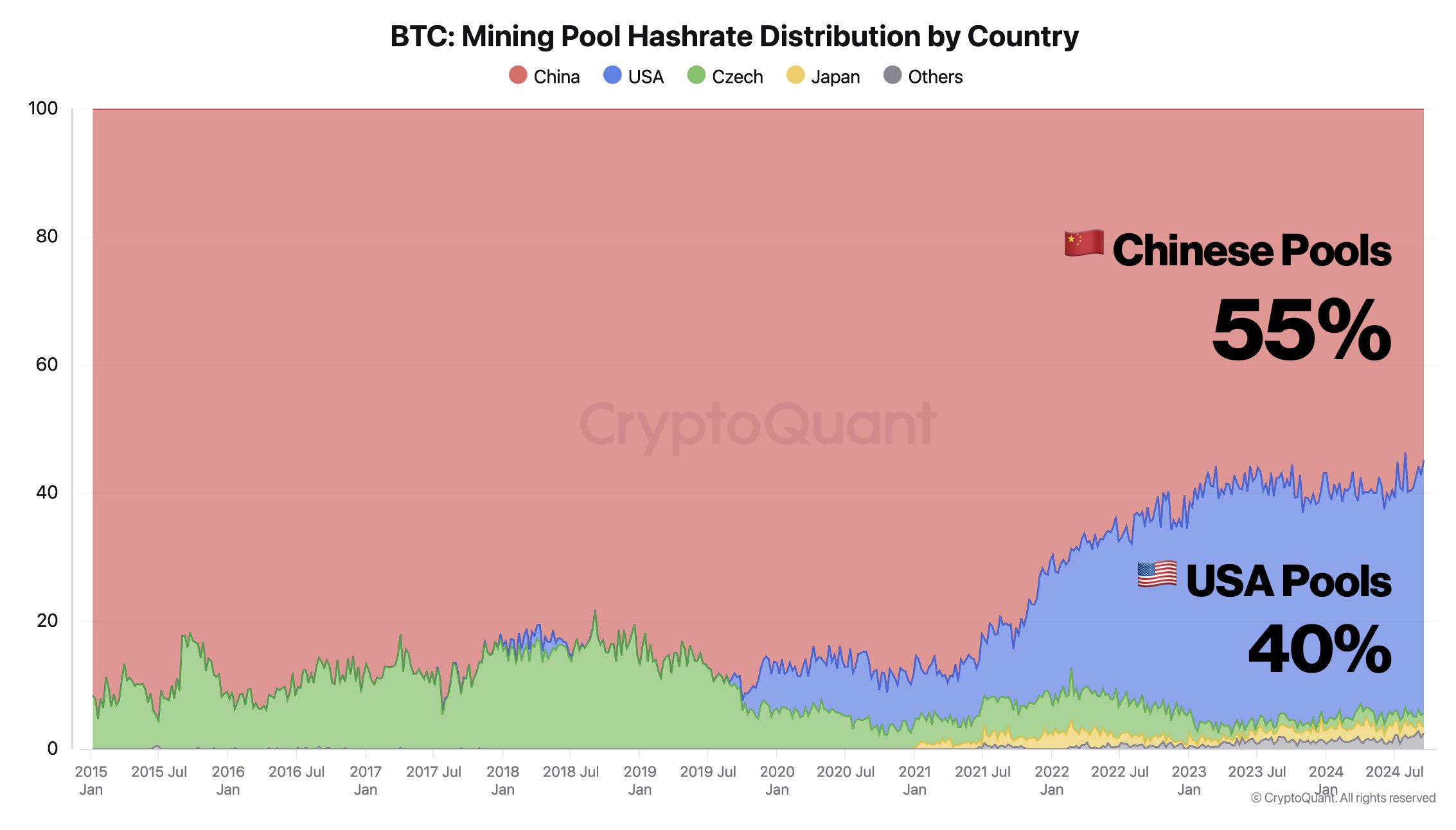
A recent chart shared by CryptoQuant’s founder, Ki Young Ju, highlights this evolving trend. The chart shows the geographical distribution of Bitcoin mining pools from 2015 to 2024. It illustrates how mining power has recently shifted from China to the U.S., with other countries playing a minor role.

Decline of Chinese Mining Pools

As seen from Young Ju’s chart, from 2015 to 2021, Chinese mining pools held a dominant position, controlling nearly all of the Bitcoin network’s hashrate. This era of overwhelming Chinese dominance is visibly represented on the chart as a broad red area, signaling a near-monopoly by Chinese miners. 

Despite China maintaining a significant share at 55% today, its dominance has gradually declined since 2020. This decline began when the Chinese government imposed regulatory changes on the crypto-mining sector, prompting many operations to migrate abroad.

Rise of U.S. Mining Pools

Amid China’s regulatory crackdown, U.S. mining pools began to expand rapidly, accounting for 40% of the Bitcoin network’s hashrate as of now. The U.S. saw its mining share grow significantly from mid-2021, driven by the relocation of Chinese miners seeking more favorable conditions. 

The chart’s blue area, representing U.S. mining pools, shows steady growth, highlighting the increasing influence of American institutional miners. This growth marks a drastic shift, as the U.S. had a minimal presence in the mining sector before 2021.

Energy Use and Emerging Mining Markets

The surge in U.S. mining activity has also impacted energy consumption. A report from the U.S. Energy Information Administration (EIA) disclosed that Bitcoin mining accounted for 0.6% to 2.3% of the U.S. total energy demand in 2023.

This electricity usage is comparable to the annual power consumption of several states, including Utah and West Virginia, and equates to the needs of three to six million homes. 

While the U.S. continues to grow, other regions, such as Russia, are also making regulatory strides. In August, Russian President Vladimir Putin signed a law recognizing cryptocurrency mining as a legitimate business, establishing a formal framework for mining activities within the country.

Crypto Investment Products Attract $321M in New Capital as Bitcoin Soars to $64K

0

For the second week in a row, crypto asset investment products have seen a significant net influx of capital, with a total of $321 million pouring in.

According to CoinShares’ latest weekly report on the crypto ETP market, this sustained growth is likely due to the Federal Open Market Committee’s surprisingly dovish tone last Wednesday, which included a 50 basis point interest rate cut.

Consequently, total assets under management (AuM) for crypto investment products have increased 9% over the past week. Moreover, the total volumes reached $9.5 billion, also a 9% rise from the previous week.

Bitcoin Leads The Way

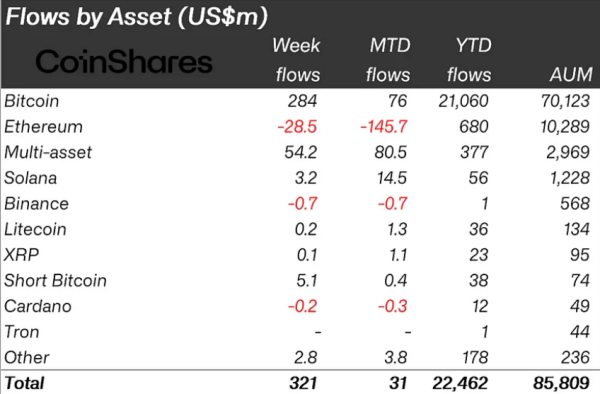
The report highlighted that Bitcoin was the main driver of the inflows, attracting $284 million in investments last week. This influx is also reflected in the spot market, where Bitcoin hit $64,000 and later closed above $63,000 for the first time in four weeks.

Bitcoin has continued to maintain its gains, trading at $63,230 at press time, having briefly reached $64,600 earlier today.

However, CoinShares observed that recent price volatility led to a surge in interest in short-Bitcoin investment products, which saw inflows of $5.1 million. Notably, this trend suggests some investors are cautious, hedging their bets against potential downward price movements in the cryptocurrency.

Solana Investments Performing Better than Ethereum

In contrast to Bitcoin’s strong performance, Ethereum-based products continue to struggle, with outflows reaching $29 million last week. This marks the fifth consecutive week of declines, bringing the total outflows for the month to a significant $145.7 million.

According to CoinShares, the persistent outflows from the Grayscale Trust and limited inflows from newly launched ETFs contribute to Ethereum’s woes.

On a more positive note, Solana investment products have seen steady, albeit modest, inflows, with $3.2 million entering the market last week.

Other cryptocurrencies, such as XRP and Litecoin, also experienced positive inflows at much smaller scales, with $200,000 and $100,000, respectively. Investment products for BNB and Cardano also registered a notable capital drain last week.

Crypto investment products weekly inflows chart CoinShares

Inflows Per Region

From a regional perspective, the inflows into crypto assets were unevenly distributed. The United States led the way, with substantial inflows of $277 million. Switzerland followed closely, with its second-largest weekly inflows this year, totaling $63 million.

However, Sweden, Germany, and Canada experienced outflows, with a combined total of $19.6 million.

VeChain Bears Dominate but Analyst Sees Breakout to $1 or $2

0

VeChain faces prolonged bearish pressure, but analysts see a potential reversal to the upside.

VeChain (VET) has faced a challenging six-month period, consistently posting red on its monthly charts. VET dropped to $0.018 in August and, as of September 20, traded at $0.023.

This level is a 91% slump from its all-time high, reflecting the prolonged bearish sentiment surrounding the altcoin. However, recent analysis suggests a potential turning point could be on the horizon.

Possible Bullish Vechain Move

An analysis from EGRAG, a prominent analyst on X, points to a possible game-changing move for VeChain based on Elliott Wave Theory. The analysis focuses on impulsive and corrective wave patterns, which have influenced VET’s price movements. 

According to EGRAG, VET is positioned to enter an impulsive Wave 3, a key phase within the Elliott Wave structure characterized by five sub-waves. This phase is often followed by a corrective Wave 4 and then a final Wave 5, which could lead to an explosive price surge, commonly referred to as a blow-off top.

The analysis suggests that the expected price movements could occur rapidly, with historical data indicating similar waves completing within approximately 150 days. Potential targets include $0.91 if VET follows what EGRAG calls Move A, and a more ambitious $2.26 if it trails Move B.

Indicators Signal Mixed Momentum

Meanwhile, indicators from TradingView provide additional insights into VET’s current market conditions. The Bollinger Bands reveal that VET has been trading near its lower band, indicating sustained bearish pressure with minimal bullish attempts.

A slight narrowing of the bands hints at reduced volatility, suggesting a consolidation phase that might precede a significant price move once volatility picks up.

VETUSDT 1-Week Chart / TradingView

The Relative Strength Index (RSI), currently reading around 43.53, shows weak bullish momentum. Having recently crossed above the 40-level, the RSI indicates a transition from bearish to neutral sentiment, which could signal an emerging shift in the market.