Home Blog Page 1230

Ripple CEO Issues New Warning, Asks XRP Holders to ‘Stop, Spot, and Avoid’

0

Ripple CEO Brad Garlinghouse expresses frustration over the rapid growth of scams targeting XRP community members. 

In a tweet yesterday, Garlinghouse criticized the rate at which scammers prey on unwary XRP users. The Ripple CEO also highlighted the failure of social media platforms to prevent these fraudulent activities. 

Scammers Promote XRP on Indian Supreme Court’s YouTube Channel 

Garlinghouse issued the comment yesterday in response to reports of scammers hacking India’s Supreme Court YouTube channel to promote XRP. Notably, India’s Supreme Court suffered a devastating blow recently after scammers took over its YouTube channel to livestream a promotional video for XRP. 

Prior to the incident, the apex court used the channel to broadcast major cases of public interest, including the rape and murder case of an Indian trainee doctor. 

However, bad actors briefly took over the YouTube channel yesterday to stream a promotional video for XRP. The video featured an XRP forecast, projecting that the Ripple-affiliated token could hit $2 this month. The scammers attached a photo of Garlinghouse to the video thumbnail to give the forecast credibility. 

The court regained control of the channel shortly and took down the XRP promotional video. 

Garlinghouse Issues New Warning to XRP Holders 

Despite this, Garlinghouse issued a new warning to XRP holders to guarantee their safety. He emphasized that the company and its executives will never ask the community to send XRP. 

This is a common scam tactic that scammers utilize to exploit unsuspecting investors. They ask users to send XRP to designated wallets with the false promise of doubling their funds. 

These malefactors sometimes promote the giveaway using deepfake videos of Garlinghouse or other Ripple executives. Notably, Garlinghouse and other executives, like Ripple CTO David Schwartz, have previously warned users to be cautious. 

In the recent X post, Garlinghouse stated that this warning feels like his annual PSA (Public Service Announcement). Nonetheless, he encouraged users to be cautious and warned them to protect themselves using three tactics: “stop, spot, and avoid.” 

Ripple Relentless Efforts to Tackle Scams 

Meanwhile, Ripple has made significant efforts to curtail scams targeting the XRP community, ranging from warning investors to publicly criticizing social media platforms for failing to remove these ads. 

The company also took legal action against YouTube in 2020 due to its failure to prevent scams that impersonate its CEO via deepfake videos. Although the parties agreed to jointly remove the content on YouTube, scammers have continued to publish more deepfake videos on the media platform. 

Ripple CTO Says He Holds XRP and Would Raise XRP Price if He Could

0

Ripple CTO David Schwartz recently reaffirmed that he holds XRP and would increase its price if possible, as he responds to fresh price suppression claims.

The confirmation came as part of a larger discussion within the XRP community regarding XRP’s value, where Schwartz again dismissed allegations that Ripple actively suppresses XRP’s price.

XRP Cannot be “Dirt Cheap”

The Ripple CTO’s remarks emerged after a community member revisited a statement he made back in 2017. At the time, Schwartz argued that XRP’s price couldn’t remain “dirt cheap” due to its utility in cross-border payments. 

He explained that if XRP were valued at $1, a transaction worth $1 million would require 1 million XRP. However, if XRP were to rise to $1 million per coin, only 1 XRP would be needed for the same payment. He further emphasized that higher prices make transactions more cost-effective.

Now, as XRP struggles to maintain its price around $0.58, the community member sarcastically commented that, despite Schwartz’s previous prediction, XRP remained “dirt cheap” seven years later. 

In response, Schwartz clarified that the cost to make a $1 million payment in XRP is still exactly $1 million, regardless of the price. His statement indicated that, even with fluctuations in XRP’s value, the overall cost of payments remains tied to the amount being transacted.

A Motivation to See XRP Prices High

However, another community member reignited the long-standing conspiracy that Ripple may be suppressing XRP’s price using trading bots, despite repeated rebuttals from the company and its executives. The user urged Ripple to stop keeping the price low. 

Schwartz again dismissed these claims, reiterating that he personally holds XRP and that if there were any way he could influence its price to rise, he would certainly take that action. His response was a direct rebuttal to the idea that Ripple is manipulating the market to keep prices down.

The Ripple CTO’s exact XRP holdings remain private, but he previously disclosed that at one point, he owned as much as 26 million XRP. Additionally, he has never traded his XRP for other cryptocurrencies, indicating his long-term commitment to the asset. 

Notably, with Schwartz and other Ripple executives holding large amounts of XRP, it makes no sense for them to actively attempt to suppress the price of the asset. In addition, Ripple as a company also holds nearly 39 billion XRP in escrow, meaning it would benefit from an increase in value as well.

Meanwhile, another community member pointed to a reference in court documents from Ripple’s case with the U.S. Securities and Exchange Commission (SEC). 

The user cited a remark where Ripple admitted to “letting XRP breathe,” implying that the company could be involved in managing its price. Schwartz responded by stating that Ripple has actively searched for evidence of its actions influencing XRP’s price but found none. 

He further noted that XRP’s price closely tracks that of Stellar Lumens (XLM) over the past eight years, suggesting that external market forces, not internal company actions, are the main drivers of XRP’s price.

XRP Current Setup is a Technical Time Bomb Awaiting Explosion, Expert

0

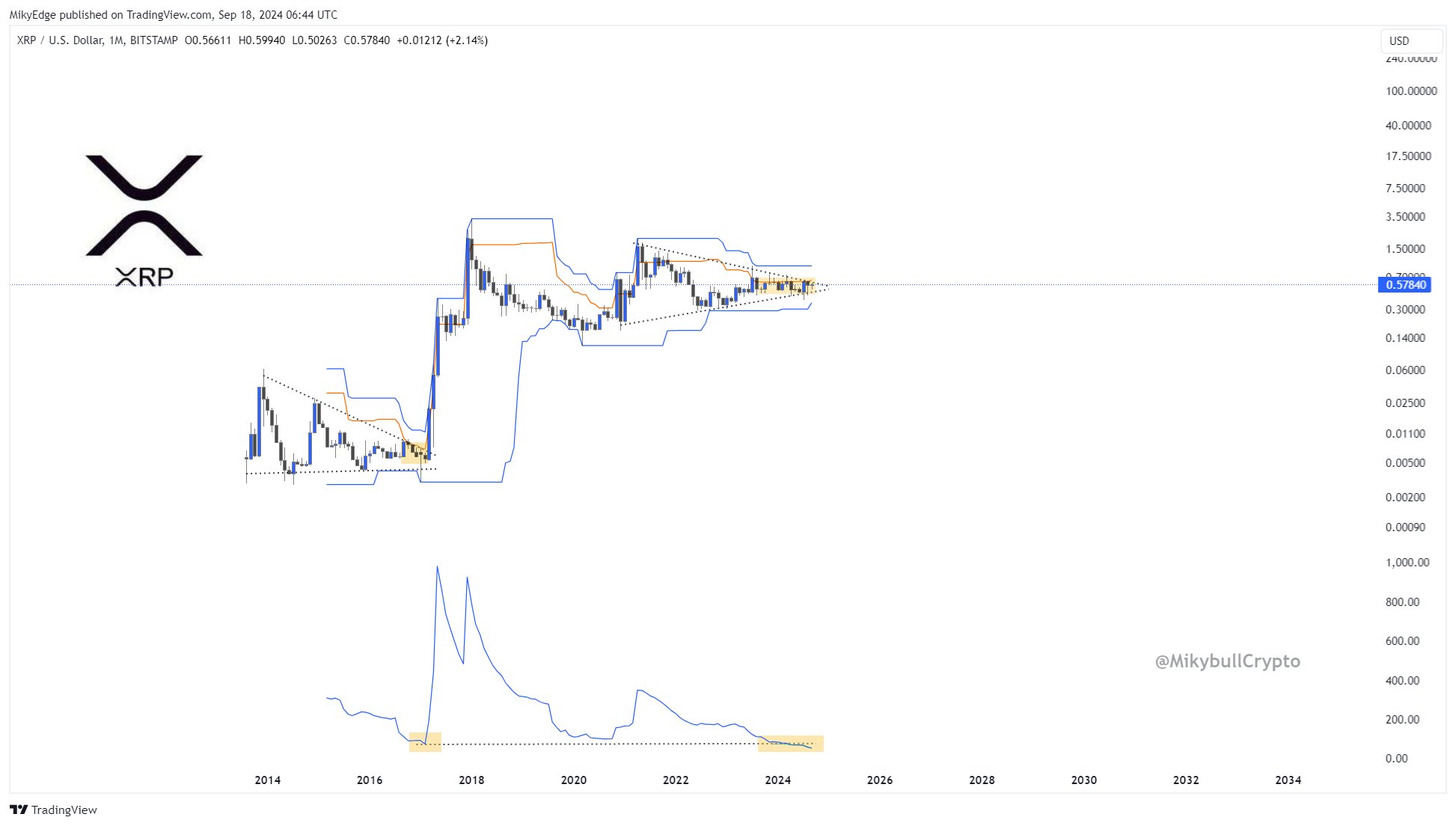
Crypto market strategist Mikybull recently ignited excitement among XRP enthusiasts by referring to the current price structure of XRP as a “technical time bomb waiting for an explosion.”

The seasoned analyst compared XRP’s present price action to the market behavior seen in 2017, suggesting a massive rally is imminent. Specifically, Mikybull shared a long-term chart of XRP showing a classic pattern forming with price consolidating in a tight range.

XRP chart by Mikybull

XRP on a “Technical Time Bomb”

This current setup has historically preceded significant bullish volatility for XRP, leading many in the crypto community to anticipate a breakout. “It’s looking like a 2017 kind of price action formation,” Mikybull commented, referencing the parabolic surge XRP experienced after a similar period of consolidation seven years ago.

This was specifically in 2017 when XRP’s price action exhibited a period of consolidation characterized by compressed candlestick patterns in the early months. Following this tightening range, the XRP price suddenly surged and began a strong upward trend, eventually reaching an all-time high.

However, this trend reversed to bearish in 2018, and XRP’s price action formed another classical pattern. In particular, the chart stretching over several years now depicts a compression of the Bollinger Bands, an indicator that measures volatility.

As with the 2017 formation, when these bands tighten, it’s a sign that the asset is gearing up for a powerful price move.

Meanwhile, looking at XRP’s seven-year candlestick chart through a different indicator shows that the asset has been trading within a massive triangle and is currently nearing a breaking point. 

While a breakout could be either to the upside or downside, the popular consensus among market watchers is that XRP is likely to explode upwards, as seen before. Even some skeptics have shared this sentiment, noting that XRP’s downside risk is low when looking at multiple indicators.

XRP Potential Targets

As a result, analysts like Mikybull believe XRP is on a technical time bomb, set to explode as seen about seven years ago. While confident in XRP’s bull run, Mikybull failed to mention potential targets XRP could attain in this latest analysis.

However, in an earlier analysis, he set his outlook at $4, which he considers realistic. This is unlike some other analysts who believe that when XRP finally breaks out, it will calibrate the same rally as in 2017, when XRP soared by over 75,000%. The more ambitious analysts have projected up to $300 for XRP.

At press time, XRP is worth $0.58, which reflects an 84.75% drop from its all-time high.

Ethereum Foundation Dumps $763,000 ETH as Price Pumps to $2,550

0

The Ethereum Foundation has continued to gradually offload its ETH holdings throughout September, raising questions about its strategic moves as the market reacts.

According to on-chain data, the Foundation sold 300 ETH today, valued at approximately $763,000, with an average price of $2,543 per ETH. Remarkably, the 300 ETH tokens were sold in exchange for DAI stablecoin.

This sale is part of a broader pattern of regular ETH liquidations by the Foundation in recent times.

Historical ETH Sales by Ethereum Foundation 

Just last Monday, the Foundation liquidated $226,868 in ETH tokens for DAI stablecoins. On September 9, it exchanged a more substantial $1.029 million in Ethereum for stablecoins.

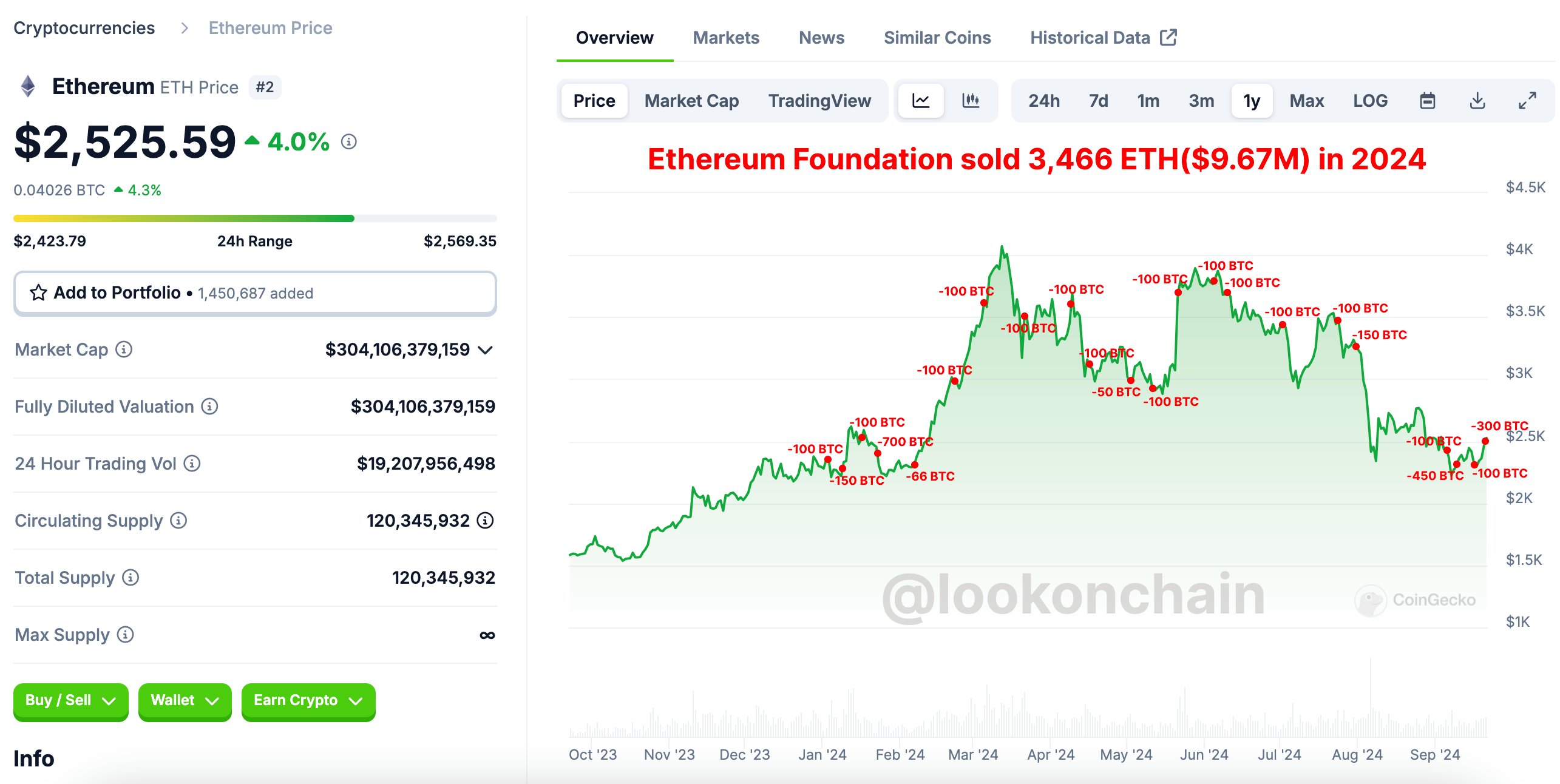
In total, the Ethereum Foundation has sold 950 ETH since the start of September, amounting to $2.27 million. Market watchers have observed that these sales occur every four to seven days.

Meanwhile, the figure becomes even more substantial when observing the Foundation’s activities since this year. On-chain analyst Lookonchain highlighted that since January 1, the Ethereum Foundation has offloaded 3,466 ETH tokens worth approximately $9.67 million. These sales are estimated to be on an average of liquidating $421,000 in ETH every 11 days.

Ethereum Foundation sales since January | Lookonchain

According to data from Arkham Intelligence, one of the publicly known wallets of the Ethereum Foundation still holds 271,652 ETH tokens worth $683.83 million.

Selling Ethereum Amid Price Pump

Interestingly, the latest sale comes at a time when sentiment around Ethereum has turned significantly bullish after heightened pessimism in the past weeks amid its underperformance during those periods.

Today, Ethereum has reclaimed the $2,500 region after pumping by over 5%. The altcoin king has rallied up to $2,572 at press time, closing in on the $2,600 threshold, a level last seen four weeks ago.

Vitalik Buterin Also Dumping ETH Continuously

Notably, the Foundation is not the only prominent entity from the Ethereum community that has continuously liquidated ETH tokens in recent times, particularly during uptrends.

Ethereum founder Vitalik Buterin has been caught in this trend as well. Just yesterday, Buterin’s wallet offloaded over $3.1 million in ETH tokens as the asset’s price reclaimed $2,400.

Meanwhile, Buterin has offered solace that his continuous ETH sales are related to some charity offerings.

Crypto Exchanges Battle Against Scams

0

Are you worried about the safety of your cryptocurrency investments? Have you ever wondered what happens when a suspicious transaction is detected? Crypto exchanges are stepping up their efforts to protect users from scams, especially targeting groups most at risk. Let’s take a closer look at how exchanges work hard to keep their users safe and what actions they are taking to prevent scams.

Increased Vigilance Against Suspicious Transactions

Cryptocurrency exchanges are becoming more vigilant in spotting potential scams. Many exchanges now actively monitor transactions for unusual activity. If they notice something odd—such as a large withdrawal or a sudden spike in small deposits—they may contact the user to confirm the transaction is legitimate. This proactive approach aims to catch suspicious activity before any money is lost and to educate users about possible scams.

Some exchanges like Independent Reserve have set up dedicated teams to handle potential scams. These teams spend their time contacting users when they see transactions that look unusual. They ask questions like, “Did someone else ask you to open an account on our platform?” or “Can you tell us more about this withdrawal?” These conversations often help customers realize they might be dealing with a scam.

Older Users Are Often More Vulnerable

Data from various financial and consumer protection agencies suggest that older people—those over 65—are more likely to fall for scams, including crypto scams. This may be due to a lack of familiarity with digital technology, which can make them more vulnerable to online fraud. As a result, crypto exchanges often take extra precautions when they see older users making transactions that seem out of the ordinary. They want to ensure that the person understands the risks involved and that they are not being manipulated by scammers.

However, it’s not just older people who are at risk. Reports from the UK, for example, have shown that younger users—particularly those between 25 and 34—are also frequent victims of crypto scams. This suggests that while older people may be less tech-savvy, younger users might fall for scams due to overconfidence or a lack of awareness about the risks.

What Do Exchanges Do When They Suspect a Scam?

When a crypto exchange suspects a user is being scammed, they often take immediate action. If they are fairly certain that a scam is happening, they may freeze the user’s account to prevent further transactions. The exchange might then advise the customer to move their funds back to their bank account for safety. These measures are sometimes necessary to protect users from losing their money to fraudsters.

It can be challenging to convince some users that they are being scammed. People caught up in scams might believe they have found a great investment opportunity, making them defensive when the exchange intervenes. Because of this, customer service teams at exchanges are trained to ask questions that help users recognize the warning signs of a scam on their own. However, if there is strong evidence of fraud, exchanges may act quickly without waiting for the user to come to this realization.

Users can also take steps to protect themselves. For instance, using tools like VPN Chrome extensions can help enhance online privacy and security. A VPN can shield personal information and browsing activity, making it harder for scammers to access sensitive details. This added layer of protection, along with being cautious of suspicious offers, can help users stay safe in the crypto space.

Who is Most Likely to Get Scammed?

Scammers often target individuals who may be more susceptible to their tactics. People from lower-income areas, for example, might be more likely to fall for scams due to the appeal of quick and easy money. Scammers exploit this by promising high returns with little risk, knowing that the offer may seem too good to pass up.

While there is always a chance that someone might be wrongly flagged as a potential scam victim, these instances are relatively rare. Most exchanges believe that taking these precautions is necessary to protect their users from significant financial loss.

Crypto Scams are Becoming More Sophisticated

Crypto scams are a growing problem worldwide. In Australia, for example, the federal police reported that over $269 million was lost to investment scams last year, nearly half of which were related to cryptocurrencies. Scammers use more advanced techniques than ever, like creating fake identities or using deepfake technology, to convince people to invest.

Experts warn that scammers often lure people in by promising high returns with minimal risk. They use convincing marketing tactics and new technologies to make their schemes appear legitimate. This is why it is more important than ever for exchanges to have robust systems in place to detect suspicious activity and protect their users.

How to Stay Safe in the Crypto Space

The fight against crypto scams is ongoing, and crypto exchanges are implementing various measures to protect their users. From contacting users about suspicious transactions to freezing accounts when they suspect fraud, these steps are meant to prevent financial losses and keep customers safe. As scams become more advanced, both exchanges and users need to stay vigilant. Being aware of the risks and taking steps to protect yourself is essential in the world of cryptocurrency.

Security In The Decentralized World: How Homnifi Protects Your Digital Assets

0

In traditional financial systems, banks and financial institutions are responsible for securing funds and personal data. However, in the decentralized world of Web3, the responsibility of security shifts to the individual. With great power comes great responsibility—as users gain control over their assets, they also face the challenge of protecting them from cyber threats such as hacking, phishing, and unauthorized access.

Championing the Importance of Security

Homnifi is committed to providing a secure environment for users to interact with the blockchain and manage their digital assets. They know that slow and steady wins the race, so they’ve designed products protected by security features that set Homnifi apart:

Dedicated Hardware Solutions 

One of Homnifi’s standout features is its dedicated hardware, known as Computing Devices. These devices are designed to enhance minting power and provide a secure gateway for interacting with the blockchain. By allowing users to install and manage their minting systems at home, Homnifi gives them full control over their digital assets.

Each device is equipped with advanced security features, such as hardware-based encryption, secure boot processes, and tamper-resistant designs. Homnifi isn’t cutting any corners here—these measures ensure that even if a device is physically compromised, the data and assets it contains remain protected. Homnifi’s devices, such as the Homnifi AirStream, Breeze, and Dynamo, are tailored to meet various security needs, from basic protection to enterprise-level security.

Comprehensive Support and Education 

Security is not just about technology; it’s also about knowing how to wrap your head around the decentralized world of Web3. Homnifi recognizes that navigating the world of Web3 can be daunting, especially for those new to the space. That’s why the platform offers extensive support and educational resources to guide users in securing their digital assets. From step-by-step guides to dedicated customer support, Homnifi ensures that users are well-equipped to protect their investments.

Why Security is Crucial in Web3 

The decentralized nature of Web3 presents both opportunities and challenges. While it empowers users by giving them direct control over their digital assets, it also places the burden of security on their shoulders. Without the right security measures in place, users are vulnerable to attacks that can result in the loss of valuable assets. After all, actions speak louder than words, and Homnifi’s commitment to security speaks volumes.

In a world where digital assets can hold significant financial value, losing access due to a security breach can be devastating. To make matters worse, the decentralized nature of these assets often means that there’s no central authority to turn to for recovery. Therefore, choosing a platform like Homnifi, which prioritizes security at every level, is crucial for anyone looking to safely explore the opportunities offered by blockchain technology.

Enter the World of Web3 Safely with Homnifi

As the world continues to move towards decentralization, the importance of security cannot be overstated. Homnifi has built a platform that not only simplifies access to Web3 but also provides advanced security features to protect users’ digital assets. It is committed to ensuring that users can confidently and securely navigate the decentralized world.

By choosing Homnifi, you’re not just gaining access to the future of digital interaction; you’re also ensuring that your digital assets are protected by some of the most advanced security measures available in the decentralized world. 

About Homnifi

Homnifi is a dynamic and secure digital platform that enables a 360-degree experience of the world of web3. It provides easy access to the evolving digital space through its wide spectrum of solutions, simplifying the user journey and making web3 available to everyone.

Discover Homnifi’s full suite of hardware and software solutions by visiting their website. You can also follow them on social media to keep up with their latest product and news updates.

Facebook | Instagram | LinkedIn | YouTube | X

Disclaimer: This article is provided by the Client. The Client is solely responsible for this page’s content, quality, accuracy, products, advertising, or other materials. Readers should conduct their own research before taking any actions related to the material available on this page. The Crypto Basic is not responsible for the accuracy of info and any damage or loss caused or alleged to be caused by the use of or reliance on any content, goods, or services mentioned in this article.

Please note that The Crypto Basic does not endorse or support any content or product on this page. We strongly advise readers to conduct their own research before acting on any information presented here and assume full responsibility for their decisions. This article should not be considered investment advice.

MicroStrategy Buys 7,420 BTC for $458M+ After Raising $1.01B in Convertible Notes

0

MicroStrategy used $458.2 million from the $1 billion convertible note offering to acquire Bitcoin.

MicroStrategy, a pro-Bitcoin and software firm, used part of the raised $1.01 billion from its 0.65% convertible note offering to buy Bitcoin. According to a Friday announcement, the firm stated it has acquired 7,420 BTC at an average price of $61,750.

The pro-Bitcoin firm’s recent acquisition increased its total stash to 252,220 BTC ($15.8 billion), acquired at an average price of $39,226. It bears mentioning that the firm acquired its Bitcoin with $9.9 billion, an almost $6 billion unrealized gain at the current market price.

The new purchase also means that MicroStrategy holds 1.27% of Bitcoin’s circulating supply and 1.20% of the asset’s total supply. MicroStrategy has further established itself as the second largest holder of Bitcoin, only toppled by BlackRock’s 357,550 BTC.

Notably, the September 19 acquisition was the firm’s second for the month. This increased its Bitcoin yield to 17.8% year-to-date. The Bitcoin yield was a key performance indicator that showed the relationship between MicroStrategy’s Bitcoin holding and assumed diluted shares outstanding.

MicroStrategy Raises $1.1B to Fuel Purchase

Recall that on August 16, MicroStrategy announced it intends to raise $700 million to acquire more Bitcoin. A few days later, the firm raised its offering to $875 million. 

However, on Friday, it announced it has raised $1.01 billion, an excess of $135 million. This signals increased investor traction towards MicroStrategy’s Bitcoin strategy.

MicroStrategy noted that it would employ the raised funds to fully offset the $500 million outstanding convertible 6.125% senior secured notes due on September 26. The software firm will use any outstanding balance after the settlement to buy more Bitcoin.

Notably, MicroStrategy stated that its net realized funds were $997.4 million. It came to this figure after deducting the former purchaser’s discount and other offering expenses. The total funds realized were also more than the $875 million it announced it was looking to raise.

Convertible Note Details

Per the press release, the convertible notes were MicroStrategy’s unsecured obligations, offering a yearly return of 0.65%. The notes will mature in September 2028, but investors can start redeeming their claims on December 20, 2027.

MicroStrategy stated that it sold the notes to accredited investors according to Rule 144A under the Securities Act. At the debt’s maturity, holders can convert their notes at the rate of 5.4589 shares of MicroStrategy’s class A common shares per $1,000 of the debt note. Notably, investors can opt for a cash settlement or a combination of both.

Bitcoin Demand Shifts to Binance as Coinbase Premium Turns Negative

0

Notable shifts in market dynamics have catalyzed the recent recovery push from Bitcoin.

Indicators such as the Coinbase Premium Index highlight increased demand, particularly in the U.S. market. Recent data from CryptoQuant reveals that despite a negative Coinbase Premium, Bitcoin’s price remains stable, suggesting strong buying pressure on Binance rather than U.S.-based exchanges.

Buying Pressure on Binance

The Coinbase Premium Index measures the price difference of Bitcoin between Coinbase and Binance, reflecting shifts in demand between these exchanges. Currently, the index shows a significant negative value, indicating that Bitcoin is trading lower on Coinbase compared to Binance. 

This situation suggests that buying activity is stronger on Binance. Notably, the presence of strong buying pressure on Binance amid Bitcoin’s upward trend indicates that investors are driving the market outside the U.S., potentially setting the stage for further price increases.

Per CryptoQuant, for Bitcoin’s price to see sustained growth, buying pressure needs to spread globally, driven by FOMO (Fear of Missing Out) across markets outside the U.S. 

MicroStrategy’s Aggressive Bitcoin Purchases

Supporting this surge in demand, MicroStrategy recently bolstered its Bitcoin holdings, acquiring 7,420 BTC for approximately $458.2 million at an average price of $61,750 per Bitcoin. This addition pushes MicroStrategy’s total Bitcoin holdings to 252,220 BTC, acquired at an average price of $39,266 per Bitcoin, totaling around $9.9 billion.

Earlier, on September 13, MicroStrategy Chairman Michael Saylor revealed a previous acquisition, where the company injected fresh capital of $1.11 billion into the Bitcoin market.

This aggressive acquisition strategy comes after the firm announced plans to raise $2 billion from its shares, partly for purchasing Bitcoin. Such large-scale purchases by institutional investors contribute to the ongoing demand and stability in the market, further supporting the upward trajectory of Bitcoin’s price.

Movement in Bitcoin Miner Wallets 

In related news, miner wallets that have been inactive for over 15.5 years have recorded movement, suggesting potential profit-taking by early Bitcoin adopters. Five such wallets transferred a total of 250 BTC, valued at approximately $15.9 million.

These wallets, which originally received 50 BTC each as mining rewards back in 2009, had seen the value of their holdings appreciate substantially due to market price changes.

India Supreme Court Promotes XRP in Live YouTube Video, But There’s a Catch

0

Malicious actors take over the YouTube channel of India’s Supreme Court to promote XRP, the native token of the XRP Ledger (XRPL). 

According to popular XRP community figure Crypto Eri, the hackers took control of the channel today and used it to promote Ripple and XRP. In a follow-up tweet, Eri attached a screenshot showing evidence of the hack. 

Per the screenshot, the attackers ran a live stream using a video thumbnail titled “RIPPLE WILL HIT $2 IN THIS MONTH.” Notably, they added a picture of Ripple’s CEO, Brad Garlinghouse. 

Economic Times Confirms Attack 

Meanwhile, several local media outlets, including the Economic Times, also confirmed the development in different reports. Economic Times confirmed that the attackers titled the livestream “Brad Garlinghouse: Ripple Responds To The SEC’s $2 Billion Fine! XRP Price Prediction.” 

Furthermore, the attackers made several modifications to the channel, including changing its name to ‘Ripple’ and using the company’s logo as the official cover and profile photos. 

India Supreme Court Shuts Down YouTube Channel

The live stream ran for hours before the Indian Supreme Court’s technical team shut down the YouTube channel. It took the measure to prevent the attackers from using the channel to promote cryptocurrencies. Notably, the apex court promised to reopen the channel shortly. 

Before the hack, India’s apex court used the channel to livestream legal cases of public interest. A few days ago, the channel was used to live stream the case involving the rape and murder of a trainee doctor. 

However, the channel was compromised today to promote XRP, prompting the Supreme Court legal team to shut down the service temporarily. 

Ripple Sued YouTube Over Consistent Scams 

This is not the first time Ripple and XRP have become victims of various hack scandals. Over the years, malicious actors have used deepfake videos of Garlinghouse to promote fraudulent XRP airdrops on different platforms, especially YouTube. 

In 2020, Ripple sued YouTube, accusing the company of failing to prevent scammers from impersonating Garlinghouse in crypto giveaway scams. A year later, the parties settled the lawsuit, with Garlinghouse announcing that both companies would collaborate to take down these scam videos.

However, these scam-related videos have persisted across these platforms. Reacting, Garlinghouse slammed YouTube and X for refusing to take action about scams targeting XRP community members. 

Economist Peter Schiff Urged to Invest in Shiba Inu After Missing Bitcoin Opportunity

0

Shiba Inu community figure Lola challenges economist Peter Schiff to invest in SHIB after he missed the Bitcoin boom.

Recently, Schiff, a renowned Bitcoin critic, reiterated his stance on gold as a safe-haven investment. He expressed that the current strength of technology stocks and cryptocurrencies is diminishing interest in gold mining stocks.

Meanwhile, he noted that rising concerns over inflation and increasing bond yields are dampening the appeal of riskier assets. According to Schiff, this scenario will likely prompt investors to shift their focus toward gold as a safer investment.

He suggests that stagflation, characterized by stagnant economic growth and rising inflation, could negatively impact technology stocks but be favorable for gold.

Schiff’s comments have sparked reactions from crypto enthusiasts, including prominent Shiba Inu community figure Lola, who leveraged the opportunity to invite Schiff to the SHIB Army.

Peter Schiff Urged to Buy Shiba Inu After Missing Bitcoin

Lola humorously suggested that Schiff still has time to invest in Shiba Inu, noting that while he missed the opportunity with Bitcoin, he could still buy SHIB and potentially benefit later.

“You missed BTC, but you have time to get Shiba Inu. You’ll be laughing with us later,” Lola remarked.

Gold Not Used for Day-to-Day Transactions

Furthermore, the Shiba Inu community figure emphasized the practicality of crypto assets like SHIB compared to gold. She noted that using a block of gold to buy groceries, like milk, is impractical, whereas SHIB is tenable in certain areas.

Lola’s response aimed to highlight the usability of digital assets compared to traditional commodities like gold. She explained that while gold has served as a store of value for centuries, its practical application in everyday transactions is limited.

Accordingly, she suggested that cryptocurrencies hold more value in today’s digital economy due to their usability and potential to generate greater value.

Community Reacts

The clash between Lola and Schiff sparked further engagement, with other commentators weighing in on the debate between gold and digital currencies.

One user noted that Bitcoin had outperformed traditional assets during previous inflationary periods, challenging the notion that gold would be the ultimate safe haven in a turbulent economy. 

Jim, another commenter, stressed that while gold has historically been a hedge, the financial landscape has evolved, and cryptocurrencies are emerging as viable alternatives. He acknowledged gold’s longstanding role in the financial system but suggested that the future might favor digital currencies, especially those built on proof-of-work models.

Schiff’s Continued Criticism of Bitcoin

Peter Schiff has long expressed skepticism about Bitcoin, often drawing comparisons to precious metals like gold and silver. In a recent post, Schiff contrasted Bitcoin’s sideways trading near the $58,000 mark with silver’s surge above $31, using it as an example of Bitcoin’s perceived limitations. 

Schiff maintained that Bitcoin is neither digital gold nor digital silver, stressing that gold’s continued rise solidified its position as a reliable store of value.