Home Blog Page 128

Philippine Blockchain Week 2026 Marks Shift From Web3 Potential To Real World Deployment

The next phase of the digital economy will not be announced after the fact—it will take shape in real time at Philippine Blockchain Week (PBW) 2026.

From June 19 to 21 at the SMX Convention Center Manila, PBW 2026 returns with the theme “Decoded: Deployed.” This year’s event moves beyond theory to showcase how blockchain is already being used to power real systems—from finance and gaming to public infrastructure and digital identity.

If you have ever used a digital wallet, played an online game to earn, or questioned how public funds are tracked, you are already part of this shift. PBW 2026 is where you see where it goes next—and who is building it.

From “Decoded” to “Deployed”

PBW 2026 reflects the country’s transition from understanding blockchain to actively implementing it. What was once experimental is now being deployed—with growing relevance in transparency, accountability, and economic participation.

The event is expected to draw over 15,000 attendees, surpassing last year’s 11,000 participants and marking its largest gathering since its launch in 2022.

“PBW 2026 brings together the energy of a festival with the depth of a world-class conference. We’re creating a full-spectrum experience, where business, culture, and community come together in one space,” said PBW President and Co-Founder Janelle Barretto.

Designed to be the most expansive PBW yet, the event brings together decision-makers, builders, creators, and communities across multiple touchpoints:

Here’s what to expect at PBW 2026:

Philippine Blockchain Leadership Forum

An invitation-only summit co-presented by the Blockchain Council of the Philippines (BCP), aligning leaders from government, finance, and global industry to shape policy, accelerate collaboration, and define blockchain’s role alongside AI and cybersecurity.

Alt+Tab Gaming & Music Festival

A high-energy cultural platform connecting blockchain to the next generation through gaming, esports, P-Pop, cosplay, and fandom-driven experiences.

Decoded: Deployed Main Conference

Where global thought leaders present real-world applications of blockchain—from financial inclusion to secure data ownership and beyond.

Innovation Expo

A hands-on look at Web3 in action, featuring fintech platforms, gaming ecosystems, and enterprise solutions already being deployed across the Philippines.

Also featured: Celebrity Bazaar, PBW Fight Night, hackathon, VC–startup matchmaking, after-parties, and curated networking events designed to turn conversations into partnerships.

The Philippines’ young, mobile-first population and deeply embedded gaming culture continue to position it as a key Web3 market. From play-to-earn ecosystems to digital asset platforms and emerging fintech solutions, blockchain is no longer niche—it is becoming part of everyday life.

Blockchain: A New Era of Digital Trust

As the Philippine digital economy accelerates, blockchain is moving from exploration to execution.

From transparency initiatives to policy proposals like the Citizen Access and Disclosure of Expenditures for National Accountability (CADENA) Act, both industry and government are beginning to operationalize the technology. Programs such as the BCP’s Integrity Chain further reflect this shift—exploring how blockchain can strengthen accountability in real-world settings.

At PBW 2026, this momentum converges—bringing together the people, platforms, and policies shaping what comes next.

“Blockchain is no longer just about potential—it’s about execution,” said BCP Chairman and Management Association of the Philippines (MAP) President, Donald Lim. “What matters now is how we align efforts across industry and government to turn early use cases into systems that deliver real, lasting impact.”

This is not just another industry event—it is where the next wave of partnerships, products, and policies begins. If you are serious about being part of the digital economy, this is where you need to be—not after, but while it is happening.

Since its inception, PBW has evolved into a platform where ideas turn into action. For tickets and more information, visit or email info@pbw.ph

Disclaimer: This Press release article is provided by the Client. The Client is solely responsible for this page’s content, quality, accuracy, products, advertising, or other materials. Readers should conduct their own research before taking any actions related to the material available on this page. The Crypto Basic is not responsible for the accuracy of info and any damage or loss caused or alleged to be caused by the use of or reliance on any content, goods, or services mentioned in this press release article.

Please note that The Crypto Basic does not endorse or support any content or product on this page. We strongly advise readers to conduct their own research before acting on any information presented here and assume full responsibility for their decisions. This article should not be considered investment advice.

TRUMP Token Team Moves $12M to Fireblocks

Blockchain analytics platform Arkham Intelligence reported that the team behind the TRUMP meme coin moved roughly $12.09 million worth of tokens on Monday.

According to Arkham, the transfer originated from a wallet holding approximately $1.86 billion worth of TRUMP tokens. The funds were first sent to the institutional custody platform Fireblocks before being deposited into wallets linked to crypto custodian BitGo.

Key Points

  • The Trump team moved $12.09M tokens via Fireblocks and BitGo, sparking new selloff concerns in the market.
  • Arkham says funds came from a $1.86 billion wallet, fueling speculation of possible future exchange transfers.
  • Earlier transfers include $19.87M and $31M+ moves, raising questions over repeated large token routing.
  • TRUMP trades near $2.41, down 97% from peak, amid political scrutiny and weak market performance.

Historical Movements on TRUMP Tokens

Notably, the latest movement is not the first major transfer from the TRUMP token team. Just two weeks ago, the team moved 6.667 million tokens worth $19.87 million to an anonymous wallet.

Notably, prior to this transaction, the Trump crypto wallet received a similar volume of tokens from Meteora.

TRUMP Token wallet history

Earlier this year, in January, wallets associated with the project reportedly moved about 9 million TRUMP tokens worth over $31 million to BitGo-linked wallets, followed by another 6.97 million TRUMP worth more than $23 million shortly after.

Some interpret the transfers to custodians as a signal that a selloff may be imminent. BitGo is widely used by institutional investors, exchanges, and crypto projects for cold storage and multi-signature custody solutions.

However, repeated routing of large TRUMP allocations through institutional channels has fueled speculation that some of the tokens could eventually reach trading venues.

TRUMP Price Remains Under Pressure

Notably, these recent transactions come as the token continues to struggle to regain momentum. Market data shows TRUMP trading around $2.41 following the latest transfers, down about 2.5% over the previous 24 hours.

Longer-term performance has remained weak. The meme coin has dropped more than 15% over the past month and over 69% during the last six months. Notably, TRUMP’s price has collapsed roughly 97% from its early 2025 peak of $75.35.

The decline has continued even after promotional efforts by U.S. President Donald Trump, including events involving TRUMP token holders.

The token has also drawn political scrutiny in the United States. Senators Adam Schiff, Elizabeth Warren, and Richard Blumenthal have previously raised concerns over the TRUMP token’s ownership structure and potential risks to retail investors.

Reports indicate that Trump-affiliated entities control roughly 80% of the token’s supply under a three-year vesting arrangement.

Recent Bitcoin Uptrend Not Backed by Large USDT Mints

Bitcoin has risen above the $80K mark amid an 8% price increase, but the latest uptrend lacks strong USDT minting.

The recent Bitcoin (BTC) recovery shows a change in market structure, with price gains continuing despite weaker USDT minting. This suggests stronger real demand from existing liquidity, though it may limit rapid price spikes.

Key Points:

  • Bitcoin has climbed 8.22% in 12 days from $74,912, holding above $80K.
  • Data shows these recent price gains occurred without major USDT minting, unlike earlier rallies.
  • Earlier cycles relied on liquidity injections, while the current move appears driven by spot demand from existing liquidity.
  • This suggests a healthier structure but may lead to slower, less explosive price increases.
  • Key levels include $80K support and resistance around $82K-$85K.

Bitcoin Holds Above $80K After April Rebound

Verified CryptoQuant analyst Maartunn was first to highlight this trend as BTC extends its gains. For context, Bitcoin has made a steady comeback after dropping to $74,912 on April 29, moving into an uptrend defined by higher highs and higher lows.

Over the past 12 days, the asset has risen 8.22% from those April 29 lows, even though a recent pullback caused a 1.58% drop today. Despite this slight dip, Bitcoin remains above the $80,000 mark, trading at around $81,070 at press time.

Bitcoin 1D Chart
Bitcoin 1D Chart

Amid the uptrend, Maartunn observed that earlier rallies over the past two weeks were supported by large USDT minting events, but the price gains from the last few days have happened without similar levels of minting.

“Something’s different this time,” Maartunn said. He pointed out that earlier price increases relied on strong USDT issuance, while recent activity shows much lower minting.

What the Data Shows About the Current Rally

Data from the chart shows that from late 2024 through much of 2025, strong price increases often matched large spikes in USDT minting. These minting events usually happened just before or during price jumps, suggesting that fresh liquidity helped push prices higher.

USDT Mints CryptoQuant
USDT Mints | CryptoQuant

In contrast, the recent period shows a different situation. Notably, as Bitcoin rose from $75,000, this upsurge occurred with large USDT minting seen at the beginning of the rally two weeks ago. 

Essentially, in earlier rallies, price growth depended heavily on liquidity. Newly minted USDT would enter exchanges and be used to buy Bitcoin, pushing prices up. Now, the rally is continuing without that strong inflow of new stablecoins.

This suggests that the current move is being driven by other factors, such as existing capital within the market, stronger spot buying, and possibly less selling pressure. 

Why This Change Is Important

This could be a positive sign for the market. When prices rise without heavy reliance on USDT minting, it often means the demand is more natural and stable. This can support a stronger and more lasting trend because the market is not dependent on constant liquidity injections.

At the same time, there is a downside. Specifically, without strong minting activity, it may be harder for Bitcoin to make sharp, fast moves upward. Instead, the market may continue to rise slowly, with regular pullbacks like the current 1.58% decline.

Key Levels and Analyst Views

From a technical view, $80K remains an important support level, while the $82K-$85K range acts as a key resistance zone. A move above this range would confirm that the uptrend is continuing. Events like new USDT minting, exchange inflows, and stablecoin balances could also influence the market direction.

Analyst Javon Marks believes the market still has room to grow. He says Bitcoin has shown strong performance since its breakout and may still be in the early stages of a bigger rally. He expects a possible 53% rise to about $124,697.

Another analyst, Ali Martinez, points to the 200-day simple moving average at $82,500 as an important level to watch. If Bitcoin breaks above it, the price could move toward $94,000. If it fails to break through, the price may drop back to test the 50-day SMA at $75,000.

Institutions Invest $858M in Bitcoin, XRP, and Crypto Funds This Week

Investment products tied to Bitcoin, XRP, and other digital assets attracted strong institutional demand last week, driven by improving regulatory sentiment across the market. 

According to a report from CoinShares, crypto investment products recorded more than $850 million in inflows over the past week. Notably, the latest figures marked the sixth consecutive week of positive momentum for the sector. 

The report highlighted strong investor demand for Bitcoin and XRP investment products as improving regulatory sentiment and rising market confidence fueled broader inflows across digital assets.

Key Points 

  • Crypto investment products extended their inflow streak to six consecutive weeks, attracting $857.9 million over the past week.
  • Bitcoin investment products accounted for the bulk of activity, with $706.1 million in inflows.
  • Ethereum, Solana, and XRP products also posted inflows of $77 million, $47 million, and $39 million, respectively.
  • CoinShares identified improving regulatory sentiment in the United States, particularly optimism surrounding the Clarity Act, as a key driver of the positive flows.

Bitcoin, XRP, and Other Cryptos Record $857M in Inflows 

According to the report, crypto investment products maintained strong momentum last week, with total weekly inflows reaching $857.9 million. Consequently, total assets under management (AUM) across crypto investment products climbed to nearly $160 billion.

Notably, Bitcoin investment products led the market with $706.1 million in inflows, pushing year-to-date flows to approximately $4.9 billion. Meanwhile, Ethereum reversed the bearish trend recorded the previous week, as ETH-linked products attracted around $77.1 million in inflows. Similarly, investment products tied to Solana and XRP posted inflows of $47.6 million and $39.6 million, respectively.

In addition, funds linked to Chainlink, Sui, and Litecoin attracted inflows of $1.4 million, $1 million, and $0.1 million, respectively. By contrast, only short-bitcoin and multi-asset products recorded outflows of approximately $14 million and $5.5 million. 

Crypto investment products see $858 million in inflows

US and Germany Lead Regional Flows

Regionally, the United States accounted for the majority of inflows, attracting $776.6 million in fresh capital. Germany followed with $50.6 million, while Switzerland and the Netherlands recorded inflows of $21.1 million and $5 million, respectively.

CoinShares attributed part of the positive market momentum to improving regulatory sentiment in the United States, particularly rising optimism surrounding the Clarity Act. Notably, the legislation is now advancing, with the Senate Banking Committee scheduling a markup session for May 14. 

As a result, investors view regulatory clarity as a major factor that could encourage broader institutional participation in digital assets. The improving sentiment has also supported crypto prices. At press time, Bitcoin traded at approximately $81,152, while XRP and Ethereum changed hands at around $1.45 and $2,321, respectively. 

Shiba Inu Upward Momentum Increasing Explosively as OI Spikes with Price

Shiba Inu shows strong bullish momentum as price spikes alongside Open Interest and a sharp increase in net long positions.

Chart data indicate a consistent price uptrend since May 10, coinciding with increasing leverage and market participation. With OI and net longs rising alongside price, Shiba Inu currently shows strength, but the heavy positioning may increase the risk of volatility if momentum slows.

Key Points

  • The Shiba Inu price has reclaimed the $0.0000066 level, gaining 7% in the past few days.
  • The price formed consistent higher highs and higher lows from May 10.
  • Open Interest increased to above 6 billion, indicating fresh leveraged positions entering the market.
  • Net positions in the derivatives market shifted from around -200 million to over +400 million.
  • SHIB’s upside depends on holding above $0.00000665-$0.00000670, but high leverage raises the risk of sharp pullbacks.

Shiba Inu Builds Strength into May 11 Breakout

This is according to a recent analysis from CW, a prominent market watcher. Data from the accompanying chart confirms how Shiba Inu’s derivatives market is showing signs of growing bullish momentum as the price pushes higher into May 11. 

On the 1-hour chart, the price has been rising steadily from the $0.00000615 level, up about 7% in the past week. From May 10, SHIB has formed a pattern of higher lows and higher highs, which shows that buyers have remained in control. 

The price has climbed in a more controlled way instead of delivering sharp and unstable moves, which often suggests the market is experiencing continued demand, not a short-lived rally.

SHIB’s momentum became stronger between May 10 and May 11, when the price jumped from around $0.00000632 to above $0.00000660 in a quick upward move. Trading volume also increased during this period, and the latest candle appears as a strong bullish push.

Commenting on the latest price action, CW pointed out that the pace of the move has picked up sharply, noting that buying pressure has grown massively, currently dominating the market. “The upward momentum of $SHIB is increasing explosively,” he said.

Open Interest and Net Positions Flip Bullish

Meanwhile, Shiba Inu’s Open Interest (OI) also supports this bullish trend, showing that new money is entering the market. According to the chart, OI rose from about a little above 5 billion on May 5 to over 6 billion at press time. This is a large increase in a short time and shows that more traders are opening positions.

When OI rises along with price, it usually means traders are adding new positions instead of closing old ones. This is important because rallies driven by new positions tend to last longer than those caused only by short covering.

Shiba Inu 1h Chart CW
Shiba Inu 1h Chart | CW

In addition, the Net Positions indicator confirms that trader sentiment has flipped bullish. A week ago, net positions were negative, falling to about -200 million, which means more traders were holding short positions.

This began to change on May 6, when net positions started to rise. Three days later, the indicator turned positive, with net long positions moving above +400 million at press time. This represents a full switch from bearish to bullish positioning.

The fact that the Shiba Inu price has spiked alongside OI and bullish positions shows that traders are increasing their exposure as the trend develops. This can be bullish in the long term. 

What Next for Shiba Inu?

SHIB’s current position suggests that the upward trend could continue. The trend of higher highs and higher lows, along with rising volume and increasing participation in the derivatives market, supports this.

If SHIB holds above the recent breakout area near $0.00000665-$0.00000670, buyers may try to push the price even higher.

However, there are also risks to consider. The sharp rise in OI and net long positions shows that many traders are using leverage. While this can help drive prices up, it can also lead to quick drops if the trend slows down.

If the price struggles to move higher while OI stays above 6 billion, the market could see a wave of liquidations from over-leveraged long positions. This could cause a sudden drop, even if the overall trend remains positive.

XRP Wave 5 Could Target $14 or $42 Depending on Its Elliott Wave Path

XRP currently trades within two Elliott Wave structures, and its ultimate price target would depend on which structure it actually follows.

This comes as the XRP price recovers above the $1.45 amid a broader market-wide upward push. Notably, after dropping to $1.34 on April 29, XRP engineered a rebound push which has since taken the price to $1.455 at press time, hinting at possible further upside to new highs.

Key Points

  • XRP has recovered more than 8% from the April 29 lows of $1.34, now on an upward path.
  • In this upward path, XRP trades within two distinct Elliott Wave structures on the weekly chart. 
  • XRP’s ultimate target in the upward path depends heavily on which of the Elliott Wave structures it eventually follows.
  • The first structure began in June 2022, and Wave 5 could end during this cycle at $14.
  • The second structure started in late 2024, and Wave 5 could conclude years later at $42.

XRP Within Two Elliott Wave Structures Amid Recovery

CryptoInsightUK, a well-known market technician, discussed XRP’s current position in a recent analysis on the back of the latest recovery push. Specifically, the XRP price has rebounded alongside the broader crypto market, which has added $200 billion in market cap since the April lows.

Riding on this wave, XRP has reclaimed the $1.45 mark, up 8.2% from the April 29 low of $1.34. Due to this uptrend, XRP recorded a 6.13% gain last week, marking its largest weekly rise in two months. Despite a mild 1.08% pullback this new week, XRP has maintained the $1.45 mark, currently trading for $1.4573.

Interestingly, CryptoInsightUK’s chart shows that, amid the uptrend, XRP currently trades within two different Elliott Wave structures. According to him, there is the possibility that either of the two structures would guide XRP’s price action. However, uncertainty remains.

XRP Targets for Each Structure

For context, the first Elliott Wave structure began after XRP started recovering from the 2022 bear market lows in June of that year. 

Specifically, Wave 1 ended when XRP hit a high of $0.93 in July 2023, while Wave 2 concluded at a low of $0.3834 in July 2024. Meanwhile, Wave 3 pushed prices to $2.9 by December 2024, and Wave 4 resulted in a pullback to the current position.

XRP 1W Chart CryptoInsightUK
XRP 1W Chart | CryptoInsightUK

If XRP follows this structure, it is on the verge of entering an impulsive Wave 5 upsurge once the current Wave 4 concludes. Data from the chart shows that this Wave 5 could take XRP to a range of $12 to $14.5, marking the end of the structure.

However, the second structure began when XRP rallied from $0.5 in November 2024 to $3.4 by January 2025. This upsurge marked Wave 1. Meanwhile, Wave 2 began as XRP corrected from the $3.4 peak and has continued till now.

If XRP is following the second structure, then the anticipated recovery from the current correction would mark its Wave 3 push, potentially leading to $14. However, after this, XRP could pull back during Wave 4 to just above $5 before rebounding toward $42 in Wave 5. 

Essentially, for the short term, XRP could target $12 to $14 either in Wave 3 or Wave 5, depending on the structure it follows. As a result, CryptoInsightUK confirmed he would likely reduce his exposure once XRP hits the $8 to $12 range. 

Ethereum Derivatives Cool, Analyst Says ETH Eyes Fresh Breakout

A new market analysis from CryptoQuant contributor Darkfost suggests that the overheated derivatives market in Ethereum may finally be cooling down.

This could set the stage for a more stable move higher if spot demand returns.

Key Points

  • Ethereum derivatives are cooling; leverage dropped, which may stabilize price action near the $2,450 resistance level.
  • ETH has traded between $2,250–$2,450 after a 33% rebound, with open interest rising about $4.5B during the rally.
  • Funding rates have flipped positive, showing traders are now more bullish after a period of bearish positioning.
  • Analysts say the market needs spot demand for a breakout, while Bitcoin leads with stronger institutional inflows than ETH.

ETH Price Rebounds 33%

According to Darkfost, Ethereum has spent nearly a month trading between $2,250 and $2,450 after rebounding roughly 33% from its February lows. During that recovery, derivatives activity surged aggressively, with open interest climbing by around $4.5 billion.

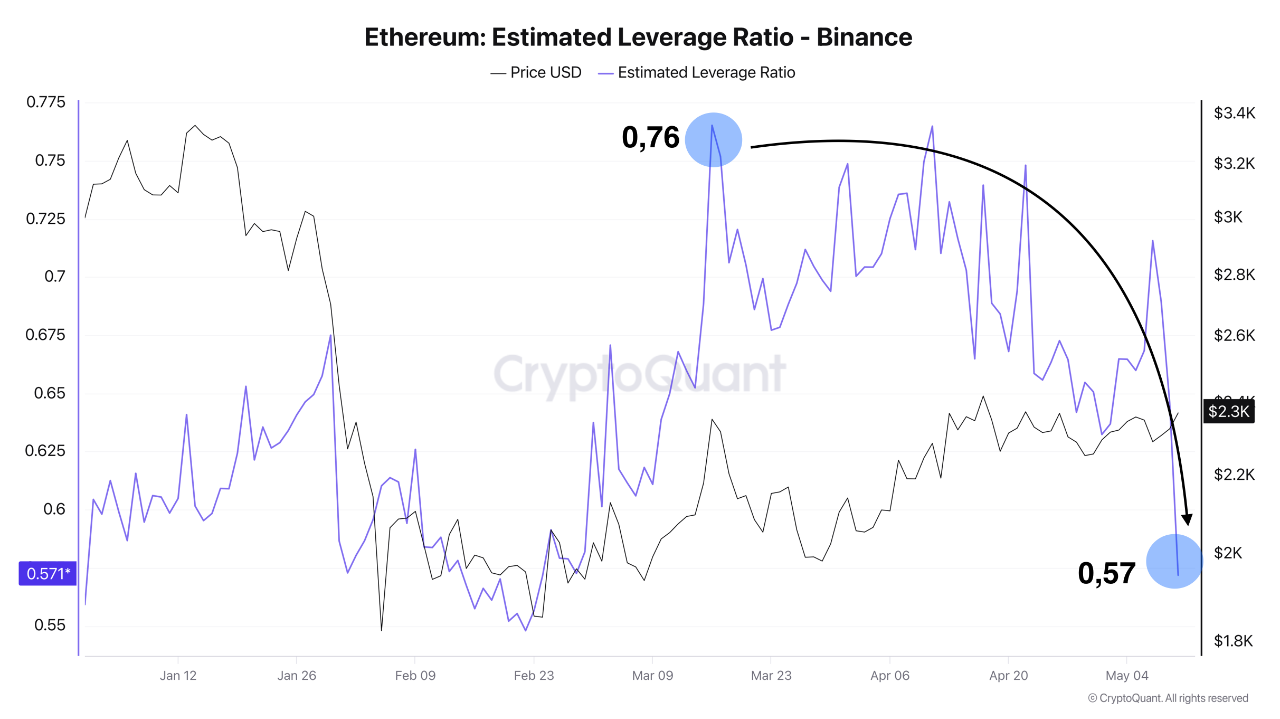
One of the clearest signs of that speculation buildup came from Binance’s Estimated Leverage Ratio, which peaked at 0.76 on March 16. The metric tracks how much leverage traders are using relative to exchange reserves. Rising levels often signal elevated risk and volatility.

However, Darkfost noted that the leverage ratio has now dropped sharply to 0.57, just as ETH again tests the important $2,450 resistance level.

Leverage Decline May Reduce Market Volatility

The analyst argued that the decline in leverage is not necessarily bearish for Ethereum. Instead, it may help stabilize the market during a crucial phase for price action.

Two major factors contributed to the drop in leverage usage on Binance. First, many long positions opened in anticipation of a breakout were quickly closed after ETH pulled back toward $2,350. Second, short positions that had accumulated earlier were either closed voluntarily or liquidated during the rally.

Interestingly, the earlier rally occurred while funding rates stayed mostly negative. This implies that many traders remained bearish despite ETH climbing higher.

That trend has now changed. Funding rates have recently turned largely positive, indicating that long traders have regained control of positioning across the derivatives market.

Spot Demand as Key to Ethereum Breakout

Despite improving conditions in the futures market, Darkfost emphasized that derivatives alone may not be enough to push Ethereum into a sustained breakout.

The analyst said spot demand will likely need to take over for ETH to decisively break above its month-long range and move beyond the $2,450 resistance zone.

In other words, Ethereum’s current structure suggests traders remain cautious. Yet the reduction in excessive leverage could create a healthier environment for a larger directional move if buying pressure strengthens.

Bitcoin Leading Market Moves Now

Notably, an analysis by XWIN Research last week found that Bitcoin’s recovery since April was based on strong institutional demand. It posted over 11% gains, while Ethereum lagged with a 7.28% gain.

XWIN Research noted that Bitcoin’s rally from U.S. institutional buying, including over $4 billion from Strategy and $1.197 billion in ETF inflows led by BlackRock. However, Ethereum saw weaker demand, such as $356 million in ETF inflows compared to Bitcoin’s nearly $3 billion.

The report suggests that capital is becoming more selective, favoring assets with strong demand like Bitcoin, while Ethereum and altcoins may need sustained inflows to keep pace.

Expert Dismisses Warnings Targeting New Shiba Inu Investors

Market commentator LuckSide Crypto has pushed back against recent warnings targeting new Shiba Inu investors, arguing that the concerns ignore the project’s improving fundamentals and growing market resilience. 

LuckSide issued the rebuttal while discussing SHIB’s recent price performance. According to him, the altcoin market recently climbed to its highest level since February 3, signaling renewed investor confidence across the broader crypto sector.

In particular, he noted that Shiba Inu could experience a larger bullish reversal if momentum remains strong.

Furthermore, LuckSide noted that SHIB has steadily gained value in recent weeks, rising more than 4% at the time of his commentary. He added that the meme coin could potentially eliminate one zero from its price if the current bullish trend continues.

Key Points

  • LuckSide dismissed recent warnings directed at new Shiba Inu investors.
  • He argued that the warnings oversimplified the regulatory discussion surrounding meme coins such as Shiba Inu.
  • Addressing criticism of SHIB’s potential rise to $0.01, LuckSide emphasized that speculation is widespread across the crypto market and is not unique to SHIB.
  • He also warned that upcoming events, including the CPI report and Clarity Act markup, could trigger higher market volatility this week.

LuckSide Dismisses Warnings to New Shiba Inu Investors 

Meanwhile, LuckSide addressed a recent Watcher Guru article warning new SHIB investors about the risks associated with meme coins. The article highlighted SHIB’s speculative nature and volatility while also referencing regulatory concerns surrounding meme-based cryptocurrencies.

Responding to the article’s characterization of Shiba Inu as a digital collectible outside securities laws, LuckSide argued that the report oversimplified the regulatory landscape. Referring to recent guidance from the U.S. SEC, he argued that no cryptocurrency falls under securities law merely because it has been deemed a digital commodity. As previously reported, the SEC mentioned Shiba Inu, Cardano, and XRP among examples of digital commodities. 

SHIB Isn’t the Only Speculative Crypto 

In addition, LuckSide rejected concerns that SHIB investors are uniquely driven by unrealistic price expectations, such as $0.01 or even $1. According to him, speculative targets exist throughout the crypto market, including among XRP supporters who anticipate much higher future valuations.

“There’s always a speculative nature when it comes to the crypto market, and that’s because it’s been a market that is in its infancy,” LuckSide stated.

He further argued that the article failed to address SHIB’s underlying fundamentals. According to him, the project has demonstrated stronger stability since February through rising holder counts, declining exchange supply, and improving long-term market structure.

Despite his bullish outlook, LuckSide acknowledged that SHIB still faces broader market risks. He noted that Bitcoin continues showing a bearish technical formation. In addition, he warned that upcoming events, including the CPI report and the Clarity Act markup, could introduce additional volatility across the crypto market.

Ripple Prime CEO Says XRP Will Be Used as Collateral Alongside Bitcoin in Institutional Finance

Ripple Prime CEO Mike Higgins says XRP is set to play a bigger role in institutional finance.

He noted that the digital asset will be used as collateral alongside Bitcoin, Ethereum, stablecoins, and tokenized money market funds.

The comments were highlighted by community figure Eri, who shared excerpts from a recent podcast featuring Higgins.

Key Points

  • XRP may serve as collateral alongside Bitcoin, Ethereum, stablecoins, and tokenized money funds in institutions.
  • Ripple Prime CEO says markets are shifting toward a traditional finance structure with separate trading and custody roles.
  • Institutions prefer custodians and triparty systems, avoiding direct asset storage on exchanges for better security.
  • Tokenization could enable instant settlement, with assets like XRP serving trading, liquidity, and margin needs.

Institutions Moving Toward Traditional Finance Structure

During the discussion, Higgins explained how the crypto market is gradually evolving toward a structure that resembles traditional financial markets. Instead of exchanges handling everything themselves, different companies will manage trading, custody, brokerage, and settlement separately.

He said many institutions no longer want to hold their assets directly on exchanges. Instead, they prefer custodians and triparty systems that allow assets to be used as collateral without transferring ownership to the exchange.

XRP Mentioned Alongside Bitcoin and Ethereum

One of the key moments in the discussion came when Higgins described the types of assets institutions may use in future collateral and settlement systems. He stated:

“No, it’s Bitcoin, it’s Ethereum, it’s XRP, it’s stablecoins, it’s tokenized money market funds.”

According to Higgins, almost any valuable asset could eventually be tokenized and used for settlement, financing, and margin trading.

This means XRP may be used for more than speculation. Institutions could use it as collateral for margin requirements, settlement payments, and liquidity management.

Meanwhile, he added that the industry is still developing, but tokenization is expanding rapidly across global finance.

Ripple Sees Tokenization Reshaping Markets

Higgins also described a future in which tokenized assets can be used instantly in everyday transactions.

As an example, he said someone could someday buy a cappuccino at Starbucks using tokenized shares of NVIDIA stock, even on a Sunday when traditional markets are closed.

He explained that this would require instant settlement systems, real-time pricing, and advanced risk management tools.

Unlike traditional banking systems, blockchain networks and stablecoins can operate 24/7 without waiting for banking hours.

RLUSD Stablecoin Highlighted

Higgins also highlighted Ripple’s RLUSD stablecoin and how it could improve capital efficiency.

He said traders could use stablecoins to meet collateral calls instantly instead of waiting for banks to process transfers. This could lower risks and reduce the amount of upfront margin brokers require.

According to Higgins, faster settlement allows financial firms to move from “business days to calendar days.”

Ripple’s Hidden Road Deal

Higgins connected these ideas to Ripple’s acquisition of Hidden Road, which now operates as Ripple Prime. The company focuses on cross-margining between crypto spot markets, ETFs, futures, and options.

He noted that institutions are already using strategies involving spot Bitcoin, Bitcoin ETFs, and CME futures contracts, but better infrastructure is still needed to support efficient cross-market trading.

“Things Are Coming Together” on XRP Ledger, Says XRPLF Director

XRP Ledger Foundation Director of Community Hussein Zangana says the XRPL is steadily becoming a more advanced financial network.

In a recent post on X, Zangana, widely known as Vet, said, “Things are coming together on the XRP Ledger”. Meanwhile, he explained that XRP’s role on the network is much bigger than just paying transaction fees.

Key Points

  • XRPLF’s Vet says the XRP Ledger is evolving into a strong financial infrastructure network.
  • XRP remains central to XRPL as a neutral bridge asset for liquidity and settlements.
  • Vet highlighted XRPL features like AMMs, MPTs, payment channels, and permissioned DEXs.
  • The XRP community is debating whether growth on XRPL will directly boost XRP demand and price.

XRP Has More Uses Than Just Fees

According to Vet, the XRPL now has many built-in features that could help attract institutions and everyday users over time.

Specifically, he highlighted the network’s decentralized exchange (DEX), which supports traditional order books and automated market makers (AMMs). He also mentioned compliance tools like Credentials and Permissioned Domains.

Vet also discussed private transfer features for Multi-Purpose Tokens (MPTs), which offer privacy while still meeting on-chain compliance requirements. Meanwhile, he added that the XRPL supports different types of tokens, including IOUs, NFTs, and semi-fungible MPTs.

XRP as the Main Bridge Asset

A key part of Zangana’s comments focused on XRP’s role as a bridge asset across the network.

He explained that XRP is the only native asset on the XRPL that does not rely on another issuer or counterparty. Because of this, it could become the preferred asset for moving liquidity between different tokens and financial products on the ledger.

Vet also highlighted features like built-in escrow and payment channels. He said payment channels, combined with zero-knowledge proofs, could open the door to more use cases in the future.

He also said a permissioned decentralized exchange could help create trading environments that meet regulatory requirements. At the same time, an upcoming lending protocol may offer institutional and consumer lending services directly on the XRP Ledger.

The validator added that planned upgrades, including Smart Escrows, could make the network more flexible without turning the XRPL into a full smart contract platform.

Community Questions Whether XRPL Growth Will Boost XRP Price

Meanwhile, the discussion led to a debate about whether growth on the XRPL will directly increase demand for XRP.

X user CryptoCeej argued that while new infrastructure is important. Yet investors mainly want to know whether increased activity on the XRPL will actually drive XRP usage and value.

According to CryptoCeej, the biggest question is how much future trading, lending, settlement, and liquidity activity will use XRP as the primary bridge currency.

Zangana agreed that the network first needs more real on-chain activity before the market can fully evaluate XRP’s role in the ecosystem.

He added that if the XRPL develops as planned, the growing number of assets on the network could indirectly increase the need for a neutral bridge asset like XRP.

Overall, the comments reflect how the XRP Ledger is expanding beyond payments into areas like tokenization, decentralized finance, institutional settlement, and compliant blockchain-based finance.