Former Ripple CTO David Schwartz claims blockchain systems may work better without incentives, arguing against reward-based models.
Schwartz believes incentives like mining and staking introduce unnecessary costs and misaligned interests. According to him, users already have a natural motivation to keep systems working, and removing artificial rewards can lead to cheaper and fairer blockchain networks.
Key Points
David Schwartz recently revisited a March 2020 talk based on ideas he first developed in 2012.
He said blockchains need agreement on transaction order, not costly incentives, to solve the double-spend problem.
According to him, mining and staking make participants seek higher rewards when users want lower fees.
Incentive systems drive centralization, as participants with lower costs or higher capital gain dominance.
The XRP Ledger removes incentives, relying on simple rules and user interest to maintain fairness and low costs.
Solving the Double-Spend Problem
Notably, Schwartz discussed these ideas during a March 2020 presentation, which he recently revisited, imploring the crypto community to watch. In that talk, he explained that blockchain systems may work better when they remove artificial incentives entirely.
If I had one wish, it would be that everyone in crypto would watch this video I made six years ago.https://t.co/7DXpGaddN5
— David 'JoelKatz' Schwartz (@JoelKatz) May 12, 2026
His argument centered around the need to solve the double-spend problem. Notably, for any network like Bitcoin to function, users must reach a point where everyone agrees that a transaction has happened. Without this shared agreement, people cannot safely exchange goods or services for digital assets.
Schwartz pointed out that blockchains already have three important features: a public record of all data, clear rules for what makes a transaction valid, and a shared understanding of what each transaction does.
However, he said these are not enough on their own, especially when there are multiple valid ways to move forward, such as sending the same asset to different people.
Natural and Artificial Stakeholders
Speaking further, the former Ripple CTO suggested that blockchain ecosystems have two types of stakeholders: the natural and forced ones.
According to him, natural stakeholders are users who depend on the system for real needs, such as making payments or storing value. Forced stakeholders, like miners, exist only because the system design requires them.
He argued that forced stakeholders take value from natural users, creating extra cost in the system. For example, Bitcoin miners earn rewards and fees, but the money comes from users who want their transactions processed. This creates a conflict: users want low fees, while miners benefit from higher ones.
He compared this to platforms like eBay, where the company charges fees to buyers and sellers. To him, blockchain systems were meant to reduce this kind of friction, not repeat it in a different form.
The Cost of Proof of Work
Building on this premise, Schwartz raised concerns about proof-of-work systems, especially their high cost.He explained that Bitcoin needs to generate millions of dollars every day just to keep mining running, which ties the network’s security to its market value.
According to him, honest participants must spend more to protect the system than attackers might need to break it. He sees this as a weakness. Schwartz also noted that much of this money leaves the ecosystem and goes to electricity providers and hardware makers.
He added that mining creates a “race to the bottom,” where miners must cut costs to survive. This pushes them to focus on short-term profit instead of improving the network. Over time, mining also becomes concentrated in areas with cheap power, which weakens decentralization.
Staking and Similar Incentive Models
Schwartz also questioned staking and slashing systems, which networks like Ethereum have explored. He said locking up a volatile asset comes with risk, so participants expect high rewards in return. This limits how much cheaper these systems can be compared to proof of work.
He pointed out that staking depends on native tokens, and this creates challenges for networks that handle large amounts of other assets, such as ERC20 tokens. Just like mining, staking can lead to competition that pushes the system toward centralization.
He also mentioned tax issues, since some countries treat staking rewards as income. Notably, this adds another cost for users and supports his view that incentive-based systems place extra burdens on participants.
The XRP Ledger Approach
Pointing out the decisions made in 2012, Schwartz explained how the XRP Ledger takes a different path. Specifically, it reduces the power of any single participant and removes features like transaction reordering that could be abused.
Instead, the system uses rules to decide which transactions to include and focuses on simply agreeing on their order. Schwartz said this process does not need expensive incentives because users already want the system to work properly.
He also explained that the XRP network limits the influence of bad actors and allows users to ignore them without losing anything. Since no one can profit from controlling the system, there is less reason to try to attack it.
Why “No Incentive” May Work Better
Schwartz concluded that artificial incentives bring more problems than benefits. Specifically, they can lead to centralization, create conflicts of interest, and increase costs for users.
On the other hand, systems based on natural incentives rely on users who already want the network to succeed. He called attention to Bitcoin full nodes as an example, where people support the network without direct payment.
He believes networks can offer lower fees, faster transactions, and better fairness by just removing incentives. In the end, he argued that users want systems that are reliable and affordable, not ones plagued by competition for rewards.
Ripple ex-CTO David Schwartz has clarified that the XRP Ledger’s consensus model was never designed around XRP staking or validator rewards.
Instead, XRPL relies on what he described as “shareholder choice” to maintain consensus and prevent double spending.
The comments came after Schwartz resurfaced a six-year-old presentation titled The Best Incentive is No Incentive. In it, he explained why the XRP Ledger was built without mining or staking incentives.
Key Points
David Schwartz said XRPL consensus was built on user trust choices, not XRP staking or validator rewards.
XRPL users maintain consensus by voluntarily choosing trusted validators and software implementations.
Schwartz argued that mining and staking rewards can increase centralization and profit-driven behavior.
XRPL avoids mining and staking to support low fees, fast payments, and reduced validator power.
XRPL’s “Stakeholder-Chosen Scarcity”
Responding to the video, an X user asked Schwartz about his statement that XRPL uses “stakeholder-chosen scarcity” instead of proof-of-work or proof-of-stake. The user asked whether XRP itself was the scarce resource being chosen, especially since XRPL does not use staking.
Schwartz responded that XRPL’s consensus is not based on locking up XRP or financially rewarding validators. Instead, the network depends on users voluntarily agreeing on which validators they trust to order transactions and prevent double spending.
He added that, in practice, this mostly happens “invisibly” through users choosing software implementations and validator lists maintained by groups they trust.
Why Schwartz Opposes Artificial Incentives
In his Stanford presentation, Schwartz argued that blockchain systems work best when they minimize artificial incentives like mining rewards or staking yields.
He described Bitcoin miners and proof-of-stake validators as “artificial stakeholders”. In his view, their main motivation is to maximize profits rather than to protect the network itself.
Schwartz stressed that these incentives can create centralization pressures as participants naturally compete to reduce costs, gain scale, and extract higher rewards.
He compared these participants to what he called “natural stakeholders” — users who actually depend on the network for payments, trading, liquidity, or storing value.
Schwartz believes these users already share the same goal: keeping the network secure, fast, cheap, and reliable.
XRP Ledger Was Designed to Minimize Validator Power
Meanwhile, Schwartz said the XRP Ledger was specifically designed to reduce the operational power of validators. It also removes many of the incentives that commonly exist in other blockchain systems.
Unlike proof-of-work networks, XRPL does not have mining competition, block reorganizations, or large pools of unconfirmed transactions waiting to be prioritized for profit. Validators mainly focus on agreeing on transaction order using fixed rules.
According to Schwartz, this design reduces the chances of censorship or manipulation because validators have fewer ways to profit from attacking the network.
He also said that avoiding mining and staking rewards helps XRPL maintain low fees, fast transaction speeds, decentralized exchange features, multisigning, payment channels, and pathfinding payments.
Debate Around Consensus Continues
Schwartz’s comments come as debates in the crypto industry continue over decentralization, validator rewards, and blockchain governance. Many newer blockchains now use proof-of-stake systems, while Bitcoin still relies on proof-of-work mining.
XRPL remains one of the few major blockchain networks that operates without mining or staking rewards. Instead, it relies on trusted validators and community coordination.
Blockchain analytics platform Santiment has confirmed that XRP wallets holding at least 10,000 coins have reached a new all-time high above 332,000.
The milestone comes despite XRP’s current price struggles amid a weak crypto market. Specifically, the XRP price has declined by more than 20% this year alone, building on the downtrend that began in Q4 2025, but large holders continue to add to their positions.
Key Points
XRP wallets holding at least 10,000 coins reached a record 332,230 addresses.
Wallets holding between 10,000 and 100,000 XRP formed the largest group with 300,260 holders and drove most of the growth.
XRP addresses with 10 million to 100 million coins increased from 285 to 311 addresses.
Whale wallets added 920 million XRP, raising combined holdings to 11.79 billion XRP.
XRP Wallet Count Climbs to New Record
Santiment confirmed this in a recent analysis shared on X. Specifically, the market intelligence platform revealed that the XRP Ledger had reached a record 332,230 wallets holding at least 10,000 XRP. The firm noted that this growth trend has continued since June 2024.
According to Santiment, the rise in these larger wallets is an important long-term sign because it shows that bigger holders have continued buying XRP despite the current market uncertainty and price swings.
XRP Wallets Holding At Least 10K Coins | Santiment
Santiment explained that growing numbers of mid-sized and large wallets typically indicate stronger investor confidence. Notably, these holders usually focus more on long-term positioning instead of reacting to short-term price movements.
Santiment also pointed out the sharp drop in XRP wallets holding at least 10,000 coins between Feb. 6 and Feb. 8. During this period, the network lost more than 4,500 wallets from this category. However, the firm said it did not find any confirmed XRP-specific event directly linked to the decline.
Instead, Santiment mentioned the broader crypto market crash and liquidation wave that hit the market on Feb. 5 as the possible culprit. Wallet growth has since recovered and moved beyond the losses recorded during that correction.
Retail Holders and Whales Lead Wallet Growth
Meanwhile, chart data shows that only a few hours after Santiment released its analysis, the number of qualifying wallets increased again. At press time, the total had risen from 332,230 to 332,253 wallets, adding another 23 addresses.
The chart also confirms that wallets holding at least 10,000 XRP fall into six separate categories. The largest group includes wallets holding between 10,000 and 100,000 XRP, with 300,260 holders. Addresses with 100,000 to 1 million XRP rank second with 29,985 holders. Meanwhile, wallets containing between 1 million and 10 million XRP total 1,498 addresses.
Breakdown of Wallets Holding At Least 10K XRP
Data from the chart further reveals that three additional whale categories contain wallets with at least 10 million XRP. Together, these three groups account for just 507 wallets despite holding much larger XRP balances.
Among the six wallet categories, two groups drove most of the recent increase that pushed the total wallet count to a new all-time high. These included retail wallets holding between 10,000 and 100,000 XRP and whale wallets holding between 10 million and 100 million XRP. However, the retail holders contributed the most.
Specifically, wallets holding between 10,000 and 100,000 XRP grew from 294,690 in early February 2026 to 300,260 at press time. This increase added over 5,500 new addresses within three months.
Meanwhile, wallets holding between 10 million and 100 million XRP increased by only 26 addresses, rising from 285 wallets in mid-February to 311 today. The remaining wallet groups either declined slightly or stayed unchanged during the same period.
XRP Whale Balances Grow Faster Than Retail Holdings
Although retail holders accounted for most of the wallet growth, whales accumulated much more XRP in total value. Data from the chart shows that wallets holding between 10 million and 100 million XRP increased their combined balance from 10.87 billion XRP in mid-February to 11.79 billion XRP today.
This increase represents an additional 920 million XRP accumulated over the period. The sharp rise in balances suggests that large holders continued building positions despite ongoing market uncertainty and XRP’s weaker price performance throughout early 2026.
XRP Wallet Balance | Santiment
Retail wallets holding between 10,000 and 100,000 XRP also increased their balances, though at a slower pace. Their combined holdings rose from 7.78 billion XRP in early February to 7.9 billion XRP at press time. Essentially, these wallets accumulated another 120 million XRP during the same timeframe.
Bitcoin has entered a pause phase after its recent rally, with derivatives data showing traders pulling back while spot demand remains weak.
According to CryptoQuant verified analyst Carmelo Alemán, BTC has spent nearly 24 hours moving sideways around the $82,000 level without a strong breakout in either direction.
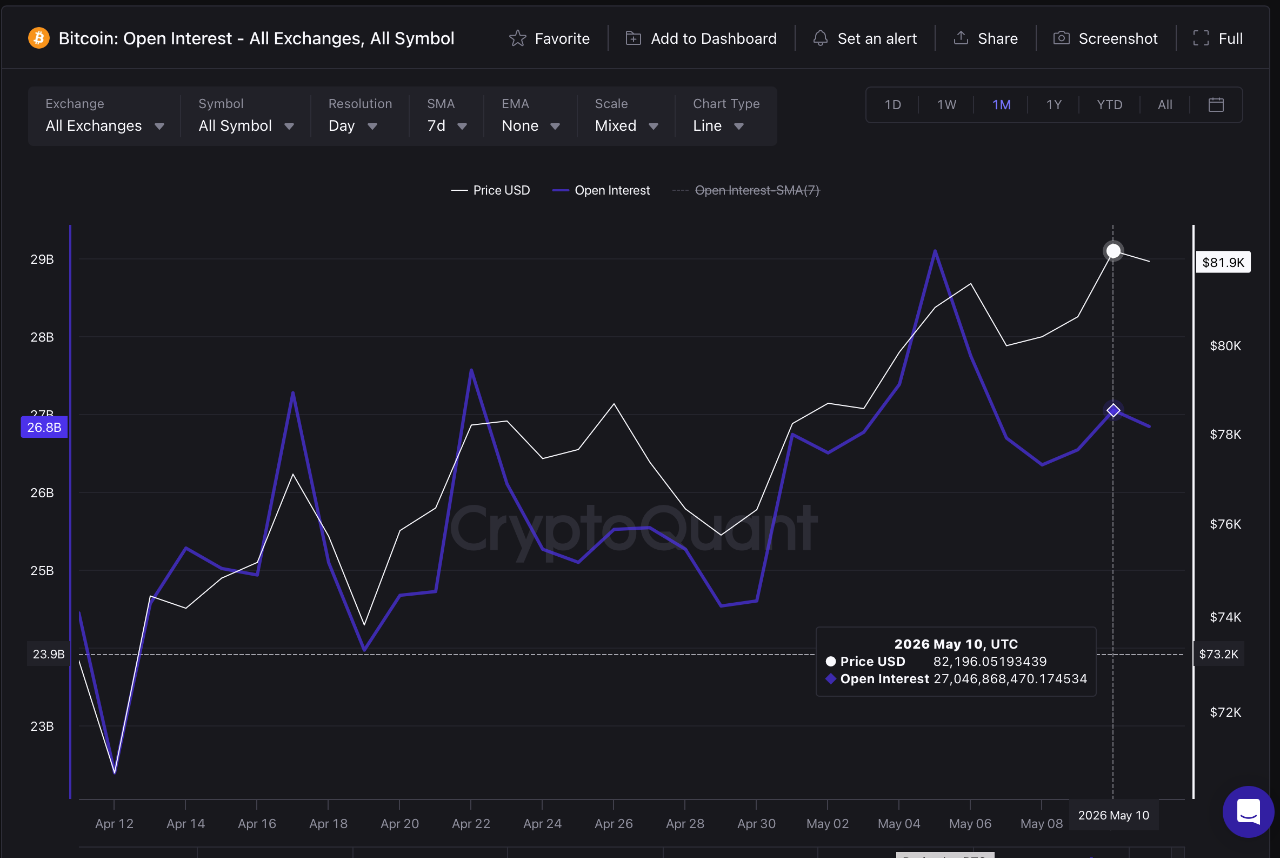
On May 10, Bitcoin closed at $82,196 before slipping slightly to around $81,928 on May 11, marking a modest 0.33% decline. While the price move itself appears small, the underlying market structure suggests momentum has weakened.
Key Point
Bitcoin hovered near $82K as Open Interest dropped $2.2B, signaling weaker trader confidence.
Funding rates turned negative, showing rising bearish bets that could trigger a short squeeze rebound.
Spot demand stayed weak, with BTC volume rising only 2.75% as volatility cooled sharply.
Analysts say Bitcoin needs stronger demand and a break above $82.3K to restart bullish momentum.
Open Interest Falls by Over $2.2 Billion
One of the biggest signals came from Bitcoin’s derivatives market. Open Interest, which tracks the total value of active futures contracts, dropped sharply from $29.09 billion on May 5 to $26.84 billion on May 11.
That represents a decline of roughly $2.255 billion, or 7.75%, showing traders are reducing exposure instead of adding aggressive new positions. Between May 10 and May 11 alone, Open Interest fell another $207 million.
According to the analysis, Open Interest has not shown signs of recovery yet, which explains why Bitcoin has struggled to regain strong upward momentum.
At the same time, the Estimated Leverage Ratio stayed relatively stable near 0.2358. This indicates the market has not entered a fresh wave of risky leveraged trading, but it also has not experienced a major leverage flush that could reset conditions for a stronger move.
Negative Funding Rate Could Support Bitcoin Price
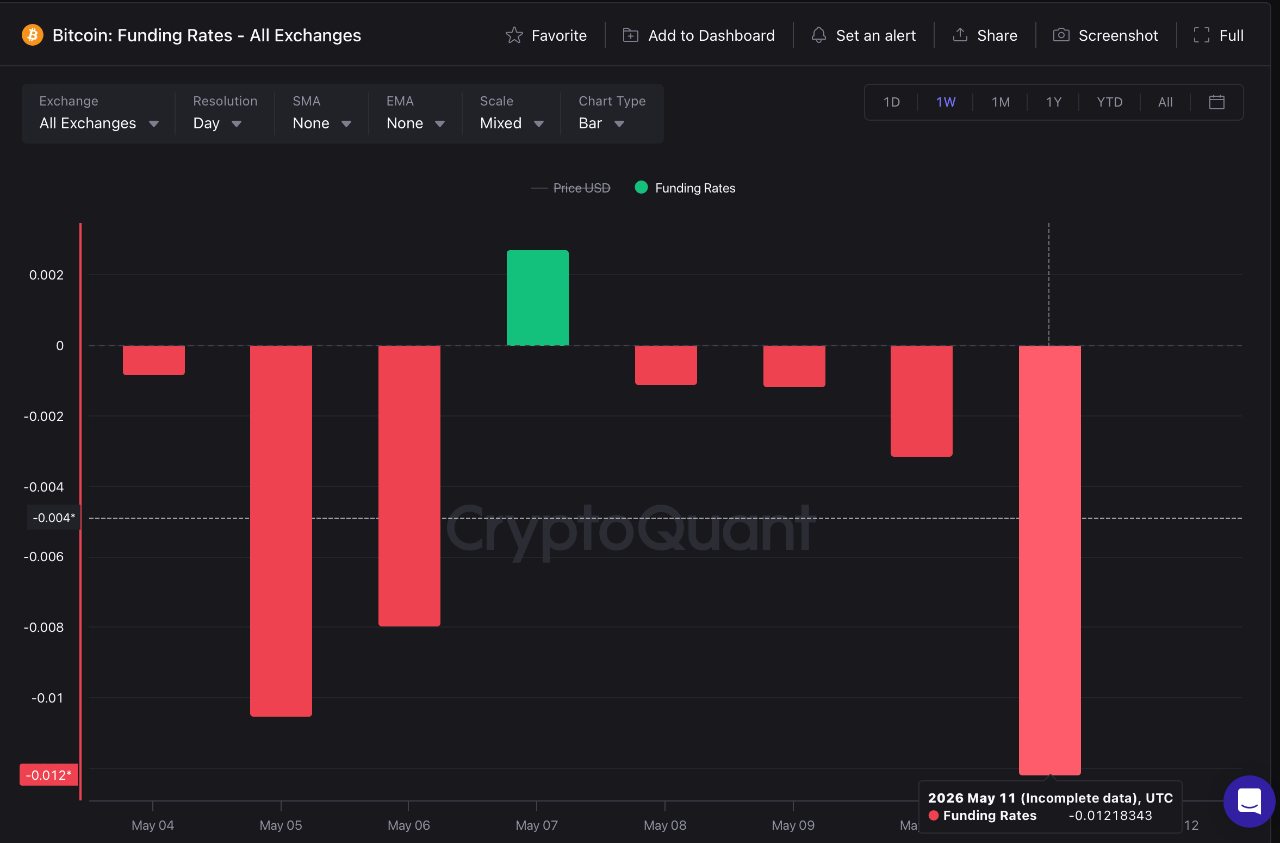
Another important development is that the Funding Rate has been turning increasingly negative since Monday afternoon UTC.
The latest reading reached -0.01218343, signaling that short traders are becoming more dominant in the derivatives market. Negative funding means short sellers are paying long traders, reflecting growing bearish positioning.
However, Carmelo Alemán noted that this could also create conditions for a rebound if spot selling remains limited. In such cases, Bitcoin can rise unexpectedly, forcing short sellers to close positions and creating a short squeeze.
Spot Demand and Volatility Remain Weak
Spot market activity also failed to provide a bullish catalyst. Trading volume increased only slightly from 20,117 BTC to 20,670 BTC, a gain of just 2.75%.
The analyst described this as sideways movement rather than meaningful demand growth.
Meanwhile, market volatility continued to cool. Garman-Klass volatility dropped to 2.79% after previously sitting above 5%, showing that Bitcoin’s trading range has narrowed considerably.
Heatmap data from TradingDifferent also showed no major liquidity clusters below the current price on shorter timeframes, while larger liquidity zones remain above BTC on the 4-hour chart.
What Comes Next for Bitcoin?
According to the analysis, Bitcoin’s next major move depends on whether traders return to the derivatives market while spot demand strengthens.
If Open Interest begins expanding again, funding stays negative, and BTC breaks above $82,300, bullish continuation could become the dominant scenario.
If not, the analyst expects Bitcoin to remain stuck in sideways trading for several more days as the market waits for stronger momentum to emerge.
Every time money moves from one country to another—whether you’re sending a salary abroad, paying an overseas supplier, or receiving funds from a client on another continent—it travels through a system built for that exact purpose.
For decades, that system has been SWIFT. But a newer contender, XRP and the Ripple network, is challenging the old order. So how do they compare, and could one replace the other?
What Is SWIFT?
SWIFT stands for the Society for Worldwide Interbank Financial Telecommunication. Founded in 1973 and headquartered in Belgium, it is essentially a messaging network that banks use to securely send and receive instructions about money transfers.
SWIFT is like a very secure postal service, but instead of letters, it carries payment instructions between banks. When a bank in Lagos, Nigeria sends money to a bank in London, SWIFT is the network that tells the London bank:
“This amount is coming from this sender for this recipient.” The actual money moves separately, through a chain of correspondent banks that hold accounts with each other.
Notably, SWIFT does not move money itself—it moves information. That distinction matters a great deal.
What Is XRP and Ripple?
Ripple is a U.S.-based fintech company founded in 2012. Its goal was simple but ambitious: make international payments faster, cheaper, and more transparent. To do this, Ripple built a payments network called RippleNet, based on the digital asset XRP.
XRP was specifically designed to act as a bridge currency—a neutral asset that can sit between two different currencies during a transaction.
Instead of converting US dollars to Nigerian naira through a chain of banks and waiting days, XRP can serve as the middle step, completing the conversion in seconds: USD → XRP → NGN.
Ripple uses XRP through a product called On-Demand Liquidity (ODL), now known as Ripple Payments. It allows financial institutions to send money across borders without needing to pre-fund accounts in the destination country.
How SWIFT Has Powered Global Payments for 50+ Years
SWIFT connects over 11,000 financial institutions across more than 200 countries. It processes roughly 45 million messages per day, making it the backbone of global finance. Central banks, commercial banks, and large corporations all rely on it.
Because it only sends messages, not money, banks need to hold funds in accounts (called nostro accounts) all over the world just to be ready to process incoming payments. This locks up trillions of dollars in capital globally, sitting idle.
A typical SWIFT transaction takes 1 to 5 business days to settle and costs anywhere from $15 to $50 per transfer, sometimes more when multiple correspondent banks are involved. Each bank in the chain takes a small cut, and currency conversions add further costs.
SWIFT has made improvements over the years. Its GPI (Global Payments Innovation) system now tracks payments in real time and has improved speed for many corridors. However, the underlying architecture remains largely unchanged.
How Ripple and XRP Work in Cross-Border Transactions
Ripple’s approach is fundamentally different. Rather than sending a message and waiting for banks to settle through a chain of intermediaries, RippleNet settles transactions directly and almost instantly.
Here’s how it works in practice: A money transfer company in the US wants to send $10,000 to a recipient in Mexico. Using Ripple’s ODL, the company converts the dollars into XRP on a crypto exchange.
Those XRP tokens move through the XRP Ledger in 3 to 5 seconds. On the other side, a Mexican exchange converts the XRP into pesos, which are then delivered to the recipient.
No pre-funded accounts. No correspondent banks taking fees. No waiting days for settlement.
The XRP Ledger can theoretically handle up to 1,500 transactions per second, with transaction fees that are a fraction of a cent.
XRP vs SWIFT: Detailed Overview
Feature
SWIFT
XRP / RippleNet
Founded
1973
2012
Settlement Time
1–5 business days
3–5 seconds
Transaction Cost
$15–$50+
Fractions of a cent
Network Size
11,000+ institutions
300+ financial institutions
Technology
Messaging system
Blockchain / digital asset
Asset Movement
Messages only
Moves value directly
Pre-funded Accounts
Required
Not required (with ODL)
Transparency
Limited
High (blockchain-based)
Regulatory Status
Fully regulated globally
Evolving
Can XRP Replace SWIFT, or Are They Solving Different Problems?
SWIFT is a messaging layer. It does not actually hold or transfer money. XRP and RippleNet are settlement layers; they move value directly. In that sense, they are solving different parts of the same problem.
To fully replace SWIFT, Ripple would need to convince thousands of large banks and institutions—with decades-long investments in the existing system—to shift their entire infrastructure.
That is an enormous task. Many large banks are also SWIFT shareholders and have little incentive to abandon it.
However, for specific corridors—particularly in emerging markets where banking infrastructure is weaker and SWIFT costs are highest—XRP and RippleNet are already winning business. Smaller banks, money transfer operators, and fintech companies have been quicker to adopt the technology.
XRP vs SWIFT: Regulatory Risk and Compliance
SWIFT operates within a fully established regulatory framework accepted by governments and central banks worldwide. It has decades of built-in trust.
Ripple and XRP’s journey has been bumpier. In 2020, the U.S. SEC sued Ripple, alleging that XRP was an unregistered security. This created significant uncertainty.
In 2023, a court ruled that XRP was not a security, a major win for Ripple. However, regulatory frameworks for crypto assets are still evolving in many jurisdictions. For banks that must operate under strict compliance rules, regulatory uncertainty remains a serious concern.
Meanwhile, as of February 2026, Ripple publicly states it holds 75+ regulatory licenses and registrations worldwide. This makes it one of the most licensed companies in the digital asset industry.
These include Major Payment Institution (MPI) approval from Singapore, a license from the Dubai Financial Services Authority (DFSA) in the UAE, and Electronic Money Institution (EMI) authorizations in the United Kingdom and the European Union.
Will XRP and SWIFT Compete or Converge?
Interestingly, the future may not be a direct battle. SWIFT itself has been exploring blockchain technology and has run experiments connecting its network with blockchain platforms.
Specifically, since 2025, banks in North America, Europe, and Asia have been conducting live trials of digital asset settlement. These transactions include tokenized assets and digital currencies, moving toward 24/7 financial operations.
Meanwhile, one of the most important developments is SWIFT building its own shared ledger infrastructure based on blockchain concepts.
On the other hand, Ripple has consistently positioned RippleNet as complementary to existing banking infrastructure, not as a replacement for it. It continues to pursue partnerships and secure money transmitter licenses across various continents to facilitate faster settlement and value movement.
In sum, the most likely outcome is gradual evolution. SWIFT modernizes its rails with faster settlement technology, while XRP and Ripple continue capturing market share in corridors where they offer a clear advantage.
For everyday users and businesses, that competition is good news. It means the era of waiting five days and paying $50 to send money abroad is slowly coming to an end. In either case, technology wins.
The global payments industry is changing fast. As SWIFT adapts and XRP scales, the goal remains the same: money that moves as freely and instantly as information already does.
Shiba Inu price depends on how well it grows from its current position and continues to maintain relevance in the crypto market.
Having begun as a meme coin inspired by Dogecoin, SHIB has turned into a much broader ecosystem with infrastructure, consistent development, and a loyal user base. Over time, the token has managed to stay relevant amid changing market cycles and new trends.
Here we looks at Shiba Inu price predictions between 2026 and 2030, extending to a longer-term outlook for 2040. It considers important factors such as supply trends, Shibarium’s activity, burn mechanisms, and ecosystem growth in areas like privacy, the metaverse, and AI.
About Shiba Inu
Shiba Inu launched in August 2020 as an ERC-20 token on Ethereum, created by an anonymous developer known as Ryoshi. The project set itself up as a community-led experiment around the idea of decentralized participation.
From the start, it had a fixed supply of exactly 1 quadrillion tokens. Half of this, 500 trillion tokens, went into Uniswap liquidity, with ownership fully renounced.
The remaining 500 trillion tokens were sent to Vitalik Buterin. The Ethereum founder later burned around 410 trillion SHIB, roughly 90% of his allocation, and donated the rest. This move reduced supply sharply and helped distribute the token more widely.
Tokenomics and Supply
Today, SHIB’s circulating supply stands at about 589 trillion tokens. So far, more than 410 trillion tokens have been permanently removed, representing about 41% of the original supply.
The ecosystem itself runs on three tokens. Specifically, SHIB remains the main token, serving as a meme asset and a utility token with deflationary features. LEASH operates as a much more limited token, while BONE functions as the governance token and the gas token for Shibarium.
Market Performance
SHIB reached its peak price of about $0.00008845 in October 2021, during the height of the meme coin boom. From its early near-zero value, this marked a rise of several million percent.
Currently, SHIB trades around $0.0000066, with a market of $3.8 billion, placing it 28th among the largest cryptocurrencies. While it remains well below its peak, it still holds its place as a major meme coin, currently the third largest in the sector.
Ecosystem Developments
The project has grown way beyond its original concept. For instance, Shibarium, the ecosystem’s Layer-2 network which launched in 2023, has processed more than 1.56 billion transactions at press time and supports over 269 million wallet addresses.
An important feature of this network is its burn system, where 70% of base transaction fees are converted into SHIB and burned. This creates steady, though gradual, deflation.
However, despite strong transaction activity, total value locked across the ecosystem remains low, with Shibarium TVL currently at just $179K while ShibaSwap, its ecosystem DEX, has a TVL of $6.2 million. This shows that activity has not yet translated into deep capital inflow.
Community and Adoption
Shiba Inu continues to benefit from a large and active community of about 1.58 million holders. Its ecosystem includes ShibaSwap, NFT collections, metaverse plans, and ongoing work around privacy and AI, particularly through tokens like TREAT.
Like many high-beta assets, SHIB’s price follows broader crypto trends, especially Bitcoin (BTC) price movements and changes in retail sentiment. While its supply remains a major challenge, its strong brand and ongoing burn efforts have helped to maintain interest.
Shiba Inu Price Prediction for 2026
Looking toward 2026, SHIB’s price outlook depends on internal progress and broader market conditions. Token burns tied to Shibarium and community activity continue to reduce supply, although daily burns remain small compared to the overall 589 trillion supply.
Shibarium has already processed over 1.5 billion transactions, and its fee structure continues to support gradual deflation. In addition, exchange data points to growing accumulation, with around 374 billion SHIB leaving exchanges and reserves falling to about 82 trillion.
Meanwhile, the Shiba Inu holder base has seen substantial growth toward 1.58 million, while platforms such as Rakuten Wallet have expanded access to SHIB in Japan. Greater regulatory clarity could also make it easier for institutions to participate.
Market conditions will also play an important role. If Bitcoin stabilizes and liquidity improves, altcoins like SHIB could benefit, especially given their tendency to amplify upward moves during risk-on periods.
However, there are still some challenges. For instance, the size of the circulating supply could limit how quickly the price can move. Burn activity, while consistent, is not enough on its own. Meanwhile, competition and changing sentiment may also slow progress.
For 2026, the projected range places the lower bound around $0.000004, the base case near $0.000008, and the upper scenario around $0.000018. The base case assumes steady progress without major breakthroughs, while the higher range depends on stronger activity and favorable market conditions.
Shiba Inu Price Prediction for 2027
By 2027, SHIB could begin to build on earlier gains. Shibarium’s total value locked may grow from its current low levels into the hundreds of millions or even low billions if DeFi and application activity expand.
With cumulative transactions already above 1 billion at press time, higher usage could support larger burns, potentially removing trillions of tokens each year.
At the same time, broader ecosystem growth, such as increased merchant adoption and upgrades like LEASH v2, could provide additional support. A favorable altcoin environment would further strengthen this outlook.
However, the supply overhang remains a major limitation. Even with higher burn rates, the large number of tokens in circulation continues to weigh on price potential. Current TVL levels also show ongoing challenges with capital efficiency.
For 2027, the projected range sits at about $0.000005 on the low end, $0.000012 as the base case, and $0.000028 at the high end.
Shiba Inu Price Prediction for 2028
In 2028, the focus may change more toward technology. Planned upgrades for the Shiba Inu ecosystem include improved privacy through advanced encryption and potential Layer-3 developments that could expand functionality.
By this stage, cumulative burns could remove tens of trillions of tokens, especially if the Shibarium TVL grows from under $1 million to higher levels driven by developer activity.
However, the competition from faster and more advanced networks could limit growth. Also, changes in market trends, including reduced interest in meme coins, may affect demand if utility does not keep pace.
For 2028, the projected range includes a low of $0.000006, a base case of $0.000015, and a high of $0.000035.
Shiba Inu Price Prediction for 2029
By 2029, institutional involvement could have an important role to play. This might include ETF developments or integration into traditional financial platforms due to clearer regulation.
AI-related applications within the ecosystem, especially those linked to TREAT, could also help drive consistent usage and token burns.
Meanwhile, newer AI-focused blockchains may present strong competition. Further, ongoing issues with low capital inflow relative to activity could continue to limit price growth.
For 2029, the projected range stands at $0.000007 at the low end, $0.000018 as the base case, and $0.000042 at the high end.
Shiba Inu Price Prediction for 2030
Looking ahead to 2030, SHIB’s progress may depend on how well its metaverse evolves. If it develops into a functional digital economy, it could support steady transaction activity and ongoing burns.
There is also potential for adoption in areas such as cross-border payments, particularly in emerging markets.
The Shiba Inu price predictions for 2030 place the lower bound at $0.000008, the base case at $0.000022, and the higher scenario at $0.000052.
Shiba Inu Price Prediction for 2040
By 2040, SHIB could take on a much larger role within digital infrastructure. Specifically, the ecosystem may integrate into global payment systems or support machine-to-machine transactions within IoT networks if it continues to grow.
Over time, continued burn activity could reduce supply to below 500 trillion tokens, increasing scarcity. However, newer technologies, such as quantum-resistant or AI-native systems, could challenge its position if it does not evolve at a suitable pace.
The Shiba Inu price predictions for 2040 set a projected range that includes a low of $0.000010, a base case of $0.000035, and a high of $0.000095.
Overview of Shiba Inu Price Predictions
shiba inu price prediction
What Affects the Price of Shiba Inu?
First, SHIB’s large supply of around 589 trillion tokens remains its biggest structural challenge. Even with more than 410 trillion already burned, strong and sustained demand is still required for meaningful price growth.
Secondly, Shibarium could play an important role in supporting Shiba Inu’s price, having processed over 1.5 billion transactions and boasting around 175 million addresses, though TVL remains low at about $179K.
Also, burn mechanisms continue to remove tokens gradually, but the scale remains small relative to total supply. The strong community of over 1.58 million holders currently provides support, though price movements still depend heavily on market sentiment.
Broader crypto trends, including Bitcoin dominance and overall liquidity, continue to act as major drivers. At the same time, ecosystem expansion and competition both shape long-term relevance.
AI Projections
Google Gemini
A projection from Google Gemini provides a broad idea of where Shiba Inu could head over time, based on its ongoing development and typical crypto market cycles.
For 2026, the range sits between $0.0000052 and $0.0000270. In 2027, the AI chatbot predicts a price of $0.0000065 to $0.0001100, followed by 2028 at $0.0000045 to $0.0002200.
The projection expects SHIB to reach between $0.0000051 and $0.0003500 in 2029 and soar to the $0.0000150 to $0.0007500 range by 2030. For 2040, Gemini believes Shiba Inu could grow to a range of $0.0000450 to $0.0176500.
According to Google Gemini, these ranges will be influenced by changing market conditions, with lower levels tied to weak demand and higher levels coming from strong bull cycles. The chatbot noted that the outlook depends mainly on supply and utility.
Grok AI
Meanwhile, a projection from Grok AI presents a more conservative outlook for Shiba Inu, built around its meme-driven history, large supply, ongoing burns through Shibarium, and broader market trends.
The estimates begin with 2026 at $0.000004 to $0.000012, followed by 2027 at $0.000005 to $0.000018. According to the AI chatbot, Shiba Inu could reach a price range of $0.000006 to $0.000025 by 2028.
Grok’s 2029 Shiba Inu price predictions set a range of $0.000007 to $0.000035, with the chatbot predicting a possible rally to a price between $0.000008 and $0.00005 by 2030. For 2040, Grok’s projections for SHIB sit between $0.00001 and $0.0002.
Can Shiba Inu Reach $0.1?
Some optimistic investors have continued to eye the prospect of a SHIB rally to $0.1. At its current price of $0.0000066, SHIB would need to rise by about 1,515,051% to reach $0.1.
This would imply a market cap of around $58 trillion, which would exceed gold’s value of $32.7 trillion and even the U.S. GDP of $31.8 trillion. Given these numbers, such a scenario is not realistic under current conditions.
Meanwhile, if Shiba Inu witnessed a 99% reduction in supply, bringing it down to around 5.9 trillion tokens, a rally to the same $0.1 would result in a market cap of about $590 billion. This puts it within reachable range, but the prospect of a 99% drop in supply remains unattainable.
When Will Shiba Inu Reach $1?
Reaching $1 would require an increase of about 15,151,415% from current levels. To put this into perspective, a $100 investment in Shiba Inu would grow to more than $15 million under such a scenario.
Notably, with a supply of 589 trillion tokens, SHIB reaching $1 would result in a market cap of about $589 trillion, which is more than 18 times the U.S. GDP. Because of this, such a target remains highly unlikely within any realistic timeframe.
FAQs
Is Shiba Inu a good buy in 2026?
Shiba Inu may appeal to investors who are comfortable with high risk in 2026, especially if Shibarium continues growing beyond 1.5 billion total transactions and token burns increase.
With its market cap sitting around $3.8 billion and more SHIB leaving exchanges, steady ecosystem growth and stronger altcoin market activity could help push the price toward $0.000008 by the end of the year, compared to current levels.
However, SHIB faces major challenges. Its massive circulating supply of about 589 trillion tokens and relatively low total value locked make large price jumps difficult without major adoption.
SHIB also remains a highly speculative meme coin that closely follows Bitcoin market cycles, which can lead to sharp price swings. Because of this, it may suit speculative investors, not conservative individuals.
Will Shiba Inu go back up?
Yes, Shiba Inu has the potential to recover from current levels, supported by ongoing token burns, a holder count approaching 1.58 million, and ecosystem developments such as privacy features and metaverse projects.
Its past market performance also shows that the token can rebound strongly during bullish altcoin periods, with the 2026 base outlook pointing to gradual growth if broader market conditions remain favorable.
However, lasting price growth will depend on whether SHIB can turn its high transaction activity into stronger capital inflows, higher TVL, and meaningful supply reduction.
Notably, weak market sentiment toward meme coins, rising competition, or difficult macroeconomic conditions could slow recovery and keep prices moving sideways for long periods.
How can Shiba Inu make you rich by 2030?
For SHIB to generate major returns by 2030, both its ecosystem and the broader crypto market would need to grow significantly. In a strong bullish scenario, the price could climb to around $0.000052, representing roughly an 8x increase from current levels.
This would likely require continued token burns, successful metaverse and utility expansion, and wider adoption that pushes its market value into the tens of billions. Investors who accumulate during market dips and hold long term could benefit the most.
Even so, the large token supply and intense competition mean life-changing profits are far from guaranteed for most investors. SHIB remains a volatile and speculative asset, and bearish conditions could still push prices lower. Anyone investing should approach it with patience, careful position sizing, and proper diversification.
Conclusion
Shiba Inu has grown well beyond its origins as a meme coin. It now has an expanding ecosystem, ongoing development, and a strong community backing it.
At the same time, its large supply and relatively low capital inflow remain key challenges. Between 2026 and 2040, its performance will depend on how well it can grow its utility, attract demand, and adapt to changing market conditions. While steady progress is possible, extreme price targets remain difficult to justify based on current fundamentals.
Analysts expect one final XRP price retest before it will mirror the massive expansion recorded by the Amazon stock in its early days.
XRP has once again entered a critical zone, and some market observers now believe its long-term chart structure closely resembles Amazon’s (AMZN) setup before the stock entered a major repricing phase.
The comparison focuses on the close similarities between the current XRP price trend and Amazon in 2009, and how this would impact XRP if it fully followed the trajectory of the tech company’s stock.
Key Points
XRP’s long-term chart structure closely resembles AMZN’s setup before it entered a major repricing phase.
XRP has spent years respecting a rising support trendline while repeatedly struggling to break through a major resistance ceiling.
Amazon showed a nearly identical structure between 1998 and 2009 before eventually breaking above the decade-long resistance level.
XRP could experience one final retest of support before a larger breakout attempt develops in 2026.
If XRP mirrors the exact scale of growth and rallies 5,660% from the 8-year resistance near $3.50, the asset will reach $202 per coin.
XRP vs. Amazon Chart Highlights Similarities
According to market analyst Chart Nerd, XRP has spent years respecting a rising support trendline while repeatedly struggling to break through a major resistance ceiling. This structure began forming from the 2018 peak near $3.50, with the asset consistently making higher lows, but it has not sustainably broken above an 8-year horizontal supply trendline.
XRP vs Amazon Chart/Chart Nerd
Amazon showed a nearly identical structure between 1998 and 2009 before eventually breaking above the decade-long resistance level. AMZN made similar higher lows but failed to breach the resistance near $4.70 before eventually doing so in October 2009. What followed was a powerful move higher.
XRP Holds Long-Term Higher-Low Support
The analysis points to the ascending trendline as the most important part of the setup. Every major correction on XRP’s higher timeframe has respected this support line, creating a pattern of higher lows over several market cycles.
Amazon displayed the same behavior before its breakout, and XRP now appears to be following a similar path. The chart shows the asset consolidating near resistance while still holding above the rising support trendline. Chart Nerd believes XRP could experience one final retest of support before a larger breakout attempt develops in 2026.
Meanwhile, the analysis builds on a prediction from Austin that XRP will move like Amazon over the next 10 years. The outlook also highlighted the similarity between XRP’s 2018 to 2026 price action and the development in AMZN’s 1998 to 2009 price.
What This Means for XRP Price
Interestingly, AMZN opened at $4.67 in October 2009 and finally broke above the 10.5-year resistance near $4.70, reaching $6.28 before closing at $5.94. In subsequent months and years, the stock has continued to expand parabolically, reaching its current price of $269.
From the October 2009 opening price of $4.67 to today’s price of $269, Amazon has grown a staggering 5,660% over 17 years. It currently has a market cap of $2.893 trillion, making it the seventh-largest asset by market cap.
If XRP mirrors the exact scale of growth and rallies 5,660% from the 8-year resistance near $3.50, the asset will reach $202 per coin. The magnitude of such an uptick is still very appealing at its current price of $1.45, as it culminates in a price of $84.
Notably, the comparison does not suggest XRP will mirror Amazon’s exact price action. Instead, analysts focus on the structural similarities between the two charts. Historically, these formations tend to appear before major repricing events
For XRP, the long-term structure still remains bullish as long as the ascending support trendline holds. Currently, this level stands just below the $1 mark.
XRP adoption around real-world transactions continues to expand considerably, with the monthly count growing over 65% in the past 12 months.
Recent data reinforces XRP’s growing utility, as more retail and institutional players continue to enter the scene. The crypto asset’s use for transactional activities globally has increased over the past year, as reflected in the monthly count.
Key Points
The number of monthly transactions on the XRP Ledger has increased 65% in 12 months.
These transactions grew from 43 million in May 2025 to 71 million per month in April, highlighting increased usage.
The top transaction drivers include Bitstamp, RLUSD, Justoken, Braza Bank, and VERT Capital.
XRP Transactions Per Month Grows 65%
“Utility is rare in digital assets. On XRP, it’s measurable,” Evernorth, the leading XRP treasury company, stated in a Monday tweet. While other ecosystems struggle to convince users of their utility, the XRP ecosystem is effortlessly attracting the crowd due to its established role in the settlement industry.
The company cited the growing number of monthly transactions on the XRP Ledger as evidence of this. In May 2025, users processed about 43 million XRP transactions per month. This figure has increased by an impressive 65% a year later to 71 million XRP transactions per month.
XRP Transactions Per Month Increase/Evernorth
Evernorth highlighted that this was a clear sign of real utility. According to the firm, speculative transactional volumes on a network typically experience short bursts and fade quickly.
However, those with real-world use cases and growing adoption experience steady and programmatic growth. For XRP, the growth in monthly transaction count reflects this and confirms that real businesses are moving money using the cryptocurrency.
Top Transaction Drivers
Meanwhile, the data further highlights the top companies that have driven this increase, one of which is the global crypto exchange Bitstamp by Robinhood. The exchange has long supported XRP and is a major platform that major players use to move their XRP.
Another major transaction driver is the DeFi platform Justoken. Recall that a recent report shows that XRP alone accounts for 67% of Justoken’s $2.63 billion tokenized real-world asset value.
Other top XRP transaction drivers include the Ripple USD (RLUSD) stablecoin, Brazil’s commercial bank Braza Bank, and VERT Capital, a capital market infrastructure firm.
XRP Utility Continues to Build
Beyond transaction count, XRP ecosystem adoption is expanding aggressively. For instance, Ripple recently revealed connections with 13,000 banks globally and $12.5 trillion in payment volume through its settlement infrastructure, underscoring its widespread utility.
The XRP Ledger is also thriving in other areas, such as RWA tokenization. For context, tokenized US Treasuries on XRP have surged 8x year-over-year from $50 million to $418 million, reflecting growing institutional confidence in the network.
XRP ETFs recently recorded their largest single-day net inflow since early January, representing the second-largest figure for the year.
The latest performance comes on the back of an XRP price rebound effort, as the altcoin leverages the broader market recovery push to reclaim and hold above the $1.45 mark, up 6.87% this month.
Key Points
XRP ETFs saw $25.8 million worth of net inflow on May 11.
This figure marks the products’ largest single-day capital inflows since Jan. 5, and the second largest this year.
Funds from Bitwise, Franklin, and Grayscale were responsible for the impressive showing.
The latest performance brought total monthly net inflow to $60 million for May.
XRP ETFs now boast total cumulative net inflows of $1.35 billion, pulling in $184 million this year alone.
XRP ETFs Record $25M in Intraday Flow
Data from market analytics platform Sosovalue confirms the recent bullish performance, as XRP ETFs begin the new week strong after pulling in $34.21 million last week.Specifically, these funds saw $25.8 million worth of capital inflows on May 11.
XRP ETFs Daily Performance | Sosovalue
This figure marked their highest single-day net inflow since January, confirming that interest in the ETF products has returned in a strong way after their underperformance in March 2026.
In addition, the recent performance represents their second-largest intraday net inflow figure this year, only behind the $46.1 million posted by the funds on Jan. 5. Interestingly, this Jan. 5 performance came on the back of XRP’s initial price upsurge at the start of this year, which led to the $2.41 yearly peak.
On Track to Surpass April Record
The May 11 figure builds on an impressive momentum that began in April and spilled into May. Notably, after seeing $31.16 million worth of net outflows in March 2026, marking their first bearish month, the XRP ETFs began a rebound campaign in April.
In April, these products saw $81.59 million in capital inflows, recovering the losses from March and posting an additional $50 million rise. This marked the ETFs’ best monthly performance for this year, surpassing the previous record of $58.09 million from February 2026.
With just two weeks into May, the XRP ETFs have already recorded $60 million in capital inflows, led by the recent $25.8 million figure from May 11. If the funds continue with the current pace, they could be on track to surpass the April record of $81 million, with just $21 million left across two weeks.
XRP ETFs Monthly Performance
Bitwise, Franklin, and Grayscale Lead the Charge
Meanwhile, further data confirms that the latest intraday milestone was driven by three of the five existing spot XRP ETFs. Specifically, the Franklin XRP ETF (XRPZ) pulled in the largest figure at around $13.62 million, its best intraday performance this year.
The Bitwise XRP ETF (XRP) came second with $7.59 million worth of capital inflows on May 11. As for the Grayscale XRP ETF (GXRP), the product saw $4.59 million in net inflows. The other two products, Canary Capital’s XRP ETF (XRPC) and 21Shares XRP ETF (TOXR), recorded zero flows.
Following the latest performance, the XRP ETF products now boast $1.35 billion worth of total cumulative net inflows, having pulled in $184 million this year alone despite XRP’s price struggles. This figure initially dropped to $1.21 billion in March but has since continued to recover.
The next phase of the digital economy will not be announced after the fact—it will take shape in real time at Philippine Blockchain Week (PBW) 2026.
From June 19 to 21 at the SMX Convention Center Manila, PBW 2026 returns with the theme “Decoded: Deployed.” This year’s event moves beyond theory to showcase how blockchain is already being used to power real systems—from finance and gaming to public infrastructure and digital identity.
If you have ever used a digital wallet, played an online game to earn, or questioned how public funds are tracked, you are already part of this shift. PBW 2026 is where you see where it goes next—and who is building it.
From “Decoded” to “Deployed”
PBW 2026 reflects the country’s transition from understanding blockchain to actively implementing it. What was once experimental is now being deployed—with growing relevance in transparency, accountability, and economic participation.
The event is expected to draw over 15,000 attendees, surpassing last year’s 11,000 participants and marking its largest gathering since its launch in 2022.
“PBW 2026 brings together the energy of a festival with the depth of a world-class conference. We’re creating a full-spectrum experience, where business, culture, and community come together in one space,” said PBW President and Co-Founder Janelle Barretto.
Designed to be the most expansive PBW yet, the event brings together decision-makers, builders, creators, and communities across multiple touchpoints:
Here’s what to expect at PBW 2026:
Philippine Blockchain Leadership Forum
An invitation-only summit co-presented by the Blockchain Council of the Philippines (BCP), aligning leaders from government, finance, and global industry to shape policy, accelerate collaboration, and define blockchain’s role alongside AI and cybersecurity.
Alt+Tab Gaming & Music Festival
A high-energy cultural platform connecting blockchain to the next generation through gaming, esports, P-Pop, cosplay, and fandom-driven experiences.
Decoded: Deployed Main Conference
Where global thought leaders present real-world applications of blockchain—from financial inclusion to secure data ownership and beyond.
Innovation Expo
A hands-on look at Web3 in action, featuring fintech platforms, gaming ecosystems, and enterprise solutions already being deployed across the Philippines.
Also featured: Celebrity Bazaar, PBW Fight Night, hackathon, VC–startup matchmaking, after-parties, and curated networking events designed to turn conversations into partnerships.
The Philippines’ young, mobile-first population and deeply embedded gaming culture continue to position it as a key Web3 market. From play-to-earn ecosystems to digital asset platforms and emerging fintech solutions, blockchain is no longer niche—it is becoming part of everyday life.
Blockchain: A New Era of Digital Trust
As the Philippine digital economy accelerates, blockchain is moving from exploration to execution.
From transparency initiatives to policy proposals like the Citizen Access and Disclosure of Expenditures for National Accountability (CADENA) Act, both industry and government are beginning to operationalize the technology. Programs such as the BCP’s Integrity Chain further reflect this shift—exploring how blockchain can strengthen accountability in real-world settings.
At PBW 2026, this momentum converges—bringing together the people, platforms, and policies shaping what comes next.
“Blockchain is no longer just about potential—it’s about execution,” said BCP Chairman and Management Association of the Philippines (MAP) President, Donald Lim. “What matters now is how we align efforts across industry and government to turn early use cases into systems that deliver real, lasting impact.”
This is not just another industry event—it is where the next wave of partnerships, products, and policies begins. If you are serious about being part of the digital economy, this is where you need to be—not after, but while it is happening.
Since its inception, PBW has evolved into a platform where ideas turn into action. For tickets and more information, visit or email info@pbw.ph
Disclaimer: This Press release article is provided by the Client. The Client is solely responsible for this page’s content, quality, accuracy, products, advertising, or other materials. Readers should conduct their own research before taking any actions related to the material available on this page. The Crypto Basic is not responsible for the accuracy of info and any damage or loss caused or alleged to be caused by the use of or reliance on any content, goods, or services mentioned in this press release article.
Please note that The Crypto Basic does not endorse or support any content or product on this page. We strongly advise readers to conduct their own research before acting on any information presented here and assume full responsibility for their decisions. This article should not be considered investment advice.