Veteran trader Michael XBT has doubled down on his bullish outlook for XRP, saying the asset could be on the verge of its biggest breakout move of the year.
In a new post on X, Michael told followers that “XRP’s parabola will begin any day now.”
He went on to add that the potential move could become the biggest breakout of the year. “I hope you’re ready,” Michael added.
The statement comes just days after the analyst declared that the “XRP bottom is in” and that a “major bullish rally” was imminent.
Key Points
Michael XBT says XRP’s “parabola” could begin any day, predicting the biggest breakout move of the year.
The trader believes XRP may hit a new all-time high in 2026, pointing to nearly 3X upside from current levels.
XRP has spent weeks consolidating near $1.30 as analysts watch the key resistance zone between $1.80 and $2.
Michael previously called Bitcoin’s bottom near $15K and predicted XRP’s breakout before its rally to $3.40.
Compression Signals Imminent Breakout
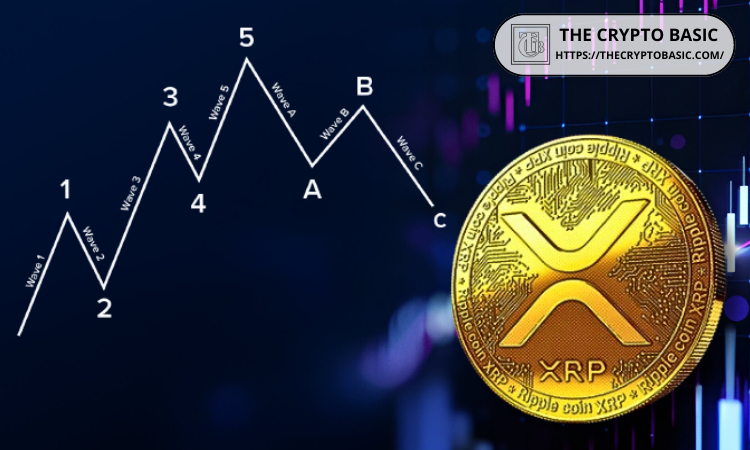
Michael accompanied his latest comments with a technical chart showing XRP trading within a tightening pattern as it tests a key resistance line. The chart suggests XRP could break out and climb toward $2 first before possibly moving even higher later in the market cycle.
At the time of the post, XRP was trading around $1.41 after spending weeks consolidating in the $1.30 range.
New XRP All-Time High Is Likely
One X user, Honey Nutcherri, responded to Michael’s prediction by saying that a move back to $1.80 would not be particularly exciting, given that XRP previously reached $3.65.
Meanwhile, Michael replied with an even bolder prediction, saying a new XRP ATH is likely this year.
This comment points to an XRP price in the $4 range, which, from today’s level, would represent nearly 3X upside for holders.
Earlier this week, Michael said many traders were too focused on Bitcoin and overlooking XRP. He believes XRP has finished its correction after dropping from earlier highs and spending months stabilizing around $1.30.
According to him, the main resistance area is between $1.80 and $2. If XRP breaks above that range, it could rise toward $3 and possibly enter a new price discovery phase.
Previous Successful Crypto Calls
Michael XBT has built a following in crypto circles after several high-profile market calls over the past few years.
In early 2023, he predicted Bitcoin had bottomed near $15,000 while forecasting an eventual rally toward $100,000. Bitcoin later crossed the six-figure mark in late 2024.
He also gained attention for an XRP prediction made when the token traded near $0.50. At the time, he forecasted a breakout from XRP’s long-standing seven-year structure.
XRP later rallied to roughly $3.40 by January 2025, marking gains of nearly 7X from those levels.
With XRP already cooling off from that historic run, the analyst believes another leg higher is about to begin.
Meanwhile, Michael is not alone in expecting higher prices for XRP. Some bullish forecasts now place XRP targets between $8 and $12 during the next major expansion cycle.
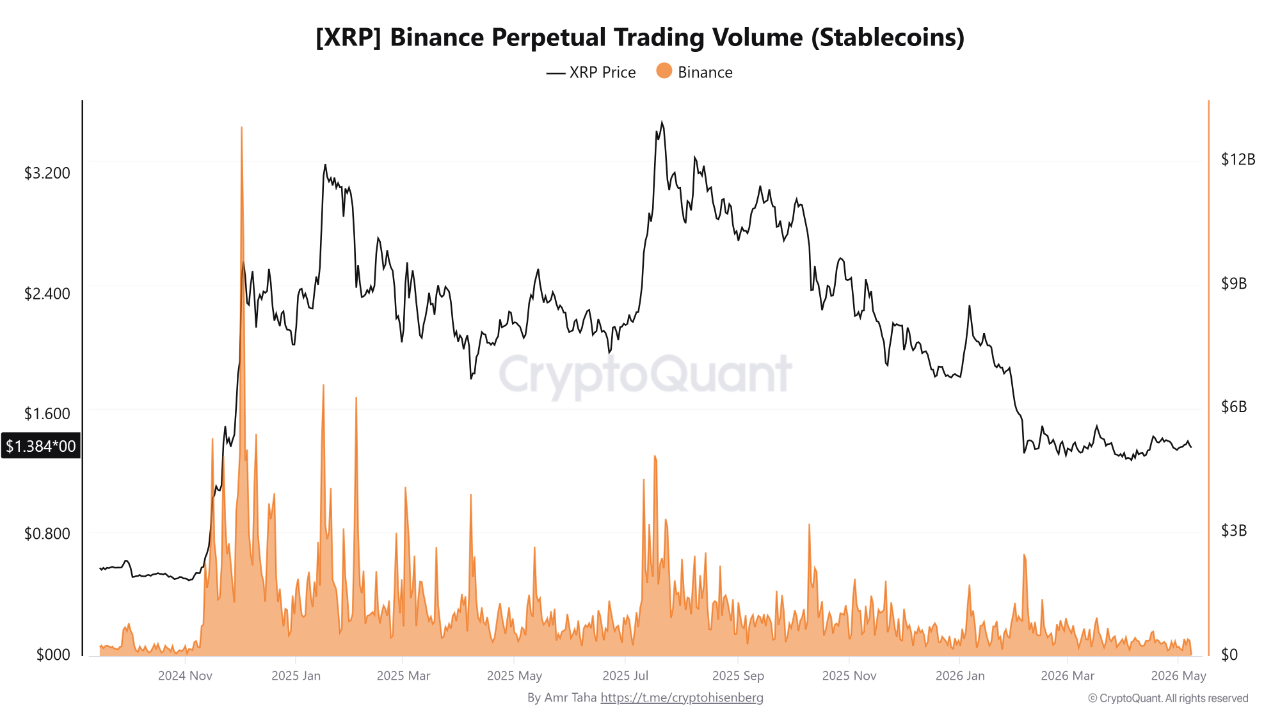
XRP derivatives activity on Binance has dropped to levels last seen in October 2024, just before the November 2024 surge.
Following the October 2024 lows, the XRP price moved from about $0.5 and later climbed to $3.4 by January 2025. Interestingly, XRP has recently recorded a buy signal on the short-term 4-hour chart.
Key Points
XRP derivatives volume on Binance sits near October 2024 lows, with $372M recorded on May 7.
This is lower than previous peaks in which derivatives volume exceeded $2 billion.
The October 2024 lows preceded a major rally, which saw XRP surge 580% from $0.50 to $3.4.
The XRP Sequential has now flashed a buy signal, suggesting a potential trend reversal.
XRP Derivatives Volume Returns to Quiet Levels
This is according to a recent analysisfrom verified CryptoQuant author Amr Taha. He revealed that activity on Binance remains low, with perpetual trading volume still close to the quiet levels seen in October 2024.
According to him, XRP perpetual volume reached around $372 million on May 7, compared to about $242 million on October 25, 2024. Even though the current number is higher, it still falls within a low range, showing that speculative trading has not fully returned.
XRP Perpetual Volume on Binance | CryptoQuant
For context, sometime around February 2026, XRP derivatives volume rose above an intraday high of $2 billion. During 2025, the market saw several spikes above $2 billion, and some in July 2025 even went past $3 billion. Compared to those levels, current activity is clearly much lower.
Taha explained that Binance perpetual volume often shows short-term trader interest. When volume rises, it usually means more speculation, higher use of leverage, and stronger interest in price swings. On the other hand, when volume stays low, it often shows caution, weaker confidence, and a lower appetite for risk.
Right now, XRP does not show the kind of strong derivatives activity seen during past high-volatility periods.Taha stressed that the comparison to October 2024 matters because that period came just before a major increase in trading activity.
The 580% Rally from XRP
Notably, when derivatives activity reached these lows in October 2024, XRP traded within a tight range between $0.48 and $0.53, with an average price of about $0.50.
However, things changed in early November 2024, when the XRP price surged after Donald Trump’s election victory. The price jumped from $0.50 in November 2024 to $3.4 in January 2025, marking a 580% gain in three months.
Taha pointed out that due to the current situation, the remains calm at press time, not overheated. He noted that XRP is not showing signs of heavy leverage on Binance, which suggests the market is still in a low-activity phase rather than a crowded trading environment.
XRP Showing Early Recovery Signs
Taha shared his analysis at a time when XRP was struggling along with the broader crypto market. The price had fallen below $1.40 and touched $1.37. Soon after the assessment, XRP bounced back, gaining more than 3.6% to reach $1.42.
Meanwhile, market analyst Ali Martinez recently called attention to a new signal from the TD Sequential indicator. He said the indicator has now shown a buy signal on the XRP 4-hour chart, which he often follows because it has recently predicted major trend changes.
The TD Sequential indicator is currently flashing a buy signal on the XRP 4-hour chart. I pay close attention to this setup because it has accurately anticipated every major trend shift in XRP recently.
Martinez also noted that on May 6, the indicator gave a sell signal at $1.46, correctly marking a local top. This was followed by a 5.5% drop over 48 hours. He believes that with the signal now turning positive, the recent pullback may be over and XRP could move higher.
The analyst is now watching for a move back toward the $1.45 resistance level, with a possible next target of $1.80 if the price breaks above key levels. Martinez added that he will pay close attention to the 4-hour candle close to confirm whether the current rebound has enough strength to continue.
Cardano has climbed to the second position among Layer 1 blockchains by validator count.
According to Token Terminal, Cardano has emerged as the second-largest Layer 1 blockchain by validator count. The milestone strengthens Cardano’s reputation as one of the most decentralized proof-of-stake networks in the crypto industry.
Key Points
Cardano has become the second-largest Layer 1 blockchain by validator count.
Data from Token Terminal shows Cardano currently operates with approximately 2,900 validators.
Cardano surpassed several major Layer 1 blockchains in validator participation, including Algorand, Solana, and Polkadot.
Popular staking provider Everstake stated that Cardano’s distributed validator structure could help drive the next major wave of Web3 adoption.
Cardano Ranks as Second-Largest Blockchain by Validation Count
Notably, popular Cardano community figure Mintern shared data from Token Terminal showing that Cardano currently operates with approximately 2,900 validators securing the network. This places the blockchain behind only Ethereum, which leads the sector with 895,200 validators.
Although Ethereum maintains a massive lead, Cardano still surpasses several major Layer-1 networks in validator participation. These include Algorand (1,600 validators), Solana (775), Polkadot (600), and Near Protocol (472).
Cardano ranks as the second-biggest blockchain by validator count
What This Means for Cardano
The ranking highlights Cardano’s growing decentralization and the increasing number of participants helping secure the network. In proof-of-stake systems, validators play a central role in confirming transactions, maintaining consensus, and protecting the integrity of the blockchain.
Moreover, a higher validator count often signals stronger decentralization because network control is distributed across a broader group of independent participants rather than remaining concentrated among a few entities.
Everstake Says Validator Growth Could Drive Next Web3 Adoption
Reacting to the milestone, Everstake defended Cardano against criticism that the network is slow, arguing that its validator growth demonstrates the network’s decentralized structure.
The staking provider described Cardano’s validator ecosystem as enormous, emphasizing that building a blockchain supported by nearly 3,000 validators requires significant dedication from participants in the ecosystem.
Furthermore, Everstake stressed that this level of distributed participation represents the type of decentralized infrastructure needed to drive the next wave of Web3 adoption.
The XRP Ledger Foundation has introduced a new leadership team that will help guide the future of the XRP Ledger ecosystem.
In a statement shared with the community, the Foundation said the new executives will focus on engineering, partnerships, validator relations, operations, and community growth. At the same time, they will be working with developers and stakeholders across the network.
Key Points
XRP Ledger Foundation unveiled a new leadership team to guide XRPL growth, engineering, and operations.
Brett Mollin is Executive Director, while Denis Angell became the Foundation’s new CTO.
Former Ripple executive Rene Huijsen joined operations as the Foundation expands ecosystem support.
XRP community figure Vet called his new Director of Community role a major “big life update.”
Brett Mollin Named Executive Director
Leading the new structure is Brett Mollin, who has been appointed Executive Director of the XRP Ledger Foundation. Mollin will oversee the Foundation’s long-term strategy, including engineering, partnerships, operations, and community programs.
He brings more than 10 years of crypto industry experience and will help support the growth of the XRPL ecosystem. The Foundation noted that many XRP community members had already seen Mollin become more active in XRPL discussions earlier this year.
Denis Angell Becomes CTO
Another major appointment is Denis Angell as Chief Technology Officer.
Angell is famous in the XRP Ledger developer community for his work on the XRPL codebase. He is moving from XRPL Labs to the XRP Ledger Foundation and will now lead technical development efforts.
His role includes overseeing protocol upgrades, technical standards, and engineering contributions while helping maintain the network’s core principles. The Foundation described him as one of the most active contributors to the XRPL protocol over the years.
Former Ripple Executive Joins Operations Team
The Foundation also announced Rene Huijsen as Director of Operations. Huijsen previously worked at Ripple as Director of Payment Operations. Moreover, he participated in a Bank for International Settlements task force focused on cross-border payments.
According to the Foundation, he will manage operational and financial coordination to support ecosystem growth.
Vet Calls New Role a “Big Life Update”
Meanwhile, one of the most discussed appointments in the XRP community was Hussein Zangana, better known as Vet, who was named Director of Community.
Vet has long been recognized within XRP circles for validator operations, educational content, amendment proposals, X Spaces, livestreams, and co-founding projects such as XRP Cafe.
Reacting to the announcement, Zangana described the move as a “big life update”. He said he is excited to help grow the XRP ecosystem alongside the new leadership team.
He also hinted that “a lot” is currently in development behind the scenes and said the timing for the transition was “perfect.”
The appointment drew reactions from the XRP community, with many users congratulating the new leadership team.
Among them was Mayukha Vadari, a Staff Software Engineer at RippleX. She publicly congratulated Vet and said she was looking forward to seeing great accomplishments in the role.
Congrats!! 🎉 Looking forward to what you will do in the role!
XRP Ledger Foundation Signals More Ecosystem Collaboration
The XRP Ledger Foundation said the new leadership team will work more closely with developers, validators, projects, and community members across the XRPL ecosystem.
It added that future efforts will focus on transparency, collaboration, and strengthening the XRP Ledger community.
Cardano may be approaching another decisive moment as crypto analyst Ali Martinez highlights a major support level that has historically sparked strong rallies.
In his latest Cardano analysis, Martinez argues that the $0.25 level continues to serve as both a psychological and technical foundation for ADA’s price action. According to him, this zone has fueled major recoveries in the past, and Cardano’s latest rebound from the area could signal that another structural rally is beginning to form.
Key Points
The crypto analyst identified the $0.25 price zone as a critical psychological and technical support level for ADA.
This support area has historically acted as a launchpad for major ADA rallies, including in January 2023 and September 2023.
Maintaining support above $0.25 could pave the way for a short-term move toward $0.36 or $0.53 if bullish momentum persists.
A sustained breakdown below $0.25 could invalidate the bullish setup.
Cardano Historic Performance Around $0.25 Support Level
To support his outlook, Martinez pointed to two previous rebounds that followed successful defenses of the $0.25 support level. In January 2023, Cardano rebounded from $0.25 and surged more than 88% in the following weeks. Later, in September 2023, ADA defended the same level again before rallying by an even larger 243%.
Now, ADA is once again reacting positively around the same price floor, prompting Martinez to suggest that another significant move higher could be developing. For context, Cardano has remained above the $0.2501 support level since May 5 and currently trades around $0.2746, slightly above the critical zone.
ADA Next Move?
As long as Cardano holds above $0.25, Martinez expects ADA to climb toward $0.36 in the near term. Furthermore, he believes sustained bullish momentum could eventually push the asset toward a broader macro target of $0.53.
However, Martinez also warned that losing the $0.25 support would significantly weaken the bullish outlook. According to him, a sustained breakdown below the level could invalidate the current setup, trigger a shift in market structure, and open the door for a deeper correction.
Meanwhile, ADA has delivered a strong performance in recent days. Over the past week, the token has gained 10.93%, including a 5.6% increase in the last 24 hours alone. In addition, Cardano’s 30-day performance now stands at 9.82%, although the asset is down 17.48% since the start of the year.
Ripple CEO Brad Garlinghouse says every acquisition and major project Ripple has pursued seeks to improve XRP adoption, utility, liquidity, and trust.
He made the remarks during the opening day of Consensus 2026 in Miami. Speaking at the event, Garlinghouse said Ripple has always been one of the strongest supporters of the XRP ecosystem.
Key Points
Brad Garlinghouse said Ripple’s acquisitions focus on improving XRP adoption, utility, liquidity, and trust.
Ripple has spent around $3 billion on acquisitions since 2023 to expand its institutional reach.
Garlinghouse said he is not an XRP maximalist, as he supports a multi-chain crypto industry.
XRP remains down over 25% this year despite Ripple’s continued business expansion and partnerships.
Ripple CEO Says Company Growth Still Centers on XRP
During Day 1 of Consensus 2026, Garlinghouse noted that Ripple still owns a large amount of XRP, but pointed out that this does not give the company control over the asset because XRP does not run on a proof-of-stake system.
According to him, Ripple continues to focus on actions that benefit the XRP ecosystem, including acquisitions and new infrastructure designed to increase XRP adoption, improve liquidity, expand its utility, and build more trust around the token.
His comments come as Ripple continues an expansion push that has reportedly cost the company around $3 billion in acquisitions since 2023.
Garlinghouse has often described XRP as Ripple’s “North Star,” saying that the company’s efforts ultimately lead back to the token. He has also maintained that Ripple remains deeply invested in XRP’s future success.
Despite this, Garlinghouse made it clear during the Consensus 2026 discussion that he does not consider himself an XRP maximalist. Instead, he said he wants the entire crypto industry to succeed instead of different blockchain communities competing against one another.
XRP Price Struggles Despite Ripple’s Progress
While Ripple has continued to expand its business and institutional reach, XRP has still struggled alongside the broader crypto market. The token is currently down more than 25% this year.
Crypto analyst Chart Nerd recently discussed this current situation. According to him, XRP price action may not be where investors want it to be, but Ripple has achieved major milestones over the past two years.
Chart Nerd said Ripple has spent much of the current market downturn building the foundation for future growth. He stressed that the company’s acquisitions and partnerships are important steps that could help TradFi firms move on-chain.
The analyst also referred to comments Garlinghouse made during Consensus 2026 about Ripple Treasury. For context, Garlinghouse projected that Ripple Treasury could move 30% of its $13 trillion yearly volume on-chain within the next five years.
Analyst Says Ripple Is Building for the Long Term
Chart Nerd said Garlinghouse continues to acknowledge that the crypto market is still in a difficult period. He pointed out that Bitcoin remains below its all-time high, while XRP has fallen roughly 60% from its peak.
According to the analyst, Garlinghouse understands that market downturns are part of crypto cycles. However, Chart Nerd argued that Ripple has used this period of weaker prices to expand its network, improve partnerships, and strengthen institutional connections.
He highlighted several developments that he believes show Ripple’s long-term direction. These include confirmation of Ripple Treasury’s integration with SWIFT, as well as growth in Ripple’s partnership program.
Chart Nerd also noted that Ripple Prime became listed on the NSCC as a netting participant under the DTCC framework. In addition, Ripple Prime was confirmed as a participant in the DTCC tokenization service in July 2026.
The analyst called these developments major building blocks for Ripple’s future. He argued that many traders focus too heavily on short-term price swings instead of the bigger picture. Even if XRP drops further in the near term, Chart Nerd believes the token’s long-term direction still points upward.
Cardano appears to be repeating a familiar breakout pattern, sparking renewed speculation that it could soon reclaim the $1 level.
This follows a period of renewed price momentum in the past seven days. Cardano (ADA) has increased by over 5% during this period, spurred by broader positive market conditions. Now, analysts are betting on this momentum to continue to much higher prices.
Key Points
A setup on the daily timeframe shows that ADA is nearing a breakout from a prolonged consolidation range.
The pattern closely resembles a similar price range that preceded its explosive rally in late 2024.
Momentum indicators on the chart also show improving conditions.
ADA continues to hold above key support levels around $0.24.
ADA could eventually retest the psychological $1 level if it breaks out and mirrors the previous price trajectory.
Cardano Nears Breakout From Price Consolidation Range
Mintern, the self-acclaimed CMO of Minswap, highlighted a setup on the daily timeframe that shows ADA nearing a breakout from a prolonged consolidation range near historical support. This is notable, as a similar event had occurred before and posed bullish implications for the coin.
Cardano Range Consolidation/Mintern
The pattern closely resembles a similar price range that preceded its explosive rally in late 2024. Cardano consolidated around the mid-$0.30 level between August and early November 2024 within a tight descending channel before eventually breaking higher to the cycle’s high of $1.32.
Notably, the market seems to be forming a nearly identical pattern. Cardano has spent months consolidating near the $0.24-$0.30 range while repeatedly defending a major support. During that period, sellers gradually lost momentum, allowing the market structure to tighten further.
Now, ADA is nearing the upper resistance trendline of this price range, strengthening the prospect of a breakout.
Market Indicators Signal Growing Momentum
Momentum indicators on the chart also show improving conditions. The relative strength index (RSI) has trended upward to 60.49, suggesting buying pressure is strengthening as traders rotate back into Cardano.
The RSI 14 also recently broke above the RSI-based MA line, confirming that momentum is shifting upwards. At the same time, the MACD histogram continues to print large green bars, adding another layer to bullish prospects.
Additionally, ADA continues to hold above key support levels around $0.24. As long as the price remains above that region, bulls maintain control of the short-term structure.
Potential Cardano Breakout Targets $1
Mintern suggested that if Cardano breaks out and follows the same trajectory as the previous setup, ADA could eventually retest the psychological $1 level. From the current price near $0.264, such a move would represent a gain of more than 278%.
However, broader market conditions still matter. Bitcoin’s direction will likely continue influencing whether Cardano sustains enough momentum for a larger rally. Analysis suggests that BTC hitting $86,000 opens the way for a massive ADA pump.
In the meantime, the market remains uncertain. Trading volume has dropped 24%, and open interest has declined by 7% in the past 24 hours, supporting this narrative.
AI chatbot Grok has explained how valuable XRP could become if major banks start using the XRP Ledger instead of SWIFT for cross-border payments.
The conversation began when XRP community member Diana asked Grok how much transaction volume the XRP Ledger could handle if large banks adopted XRP for 24/7 real-time settlements.
Grok said that if adoption grows worldwide, the XRP Ledger could eventually process between $30 trillion and $150 trillion in transactions every year.
Key Points
Grok says XRP could process up to $150T yearly if major banks adopt it for real-time global payments.
The AI estimates XRP could trade between $5 and $243 depending on adoption and transaction volume.
Grok believes XRP could gain market share if banks move from SWIFT to blockchain settlement systems.
XRP’s fast settlement speed and low fees were highlighted as key advantages for institutional use.
XRP Tapping into the Huge Global Payments Market
Grok pointed to the global cross-border payments market as XRP’s biggest opportunity. The AI noted that the industry handled around $195 trillion in 2024 and could grow to about $320 trillion by 2032.
Today, SWIFT dominates international bank transfers. However, Grok suggested that XRP could participate in this market if banks move toward faster, blockchain-based payment systems.
The AI also said adoption would likely happen slowly. Banks may first use XRP in certain payment corridors or liquidity hubs before expanding usage over time.
Still, Grok believes XRP Ledger transaction volume could reach between $30 trillion and $150 trillion annually if major banks start using XRP as a bridge asset for global settlements.
Grok’s XRP Price Estimates
To estimate XRP’s possible value, Grok used a utility-based model that compares transaction volume with token velocity. The model assumes that the faster XRP moves through the system, the lower the price needed to support payment activity.
If institutions hold larger XRP reserves, the price will need to be higher. For a hypothetical scenario where the XRP Ledger processes $100 trillion annually, Grok estimated:
XRP could reach about $162 if token velocity remains low.
It could trade near $32 under a moderate institutional usage model.
XRP could be worth around $16 if the system operates very efficiently.
XRP Could Range Between $5 and $240+
Grok also explored other adoption scenarios. If annual XRPL transaction volume reaches a smaller $30 trillion, the AI estimated XRP could trade between roughly $5 and $49.
In a more aggressive scenario involving $150 trillion in yearly settlements, Grok estimated XRP could range from about $24 to as high as $243.
Grok Estimates XRP Price
However, the AI stressed that these figures are not actual predictions. Instead, they are examples showing how XRP’s value could change depending on adoption levels and liquidity demand.
XRP’s Utility Narrative Keeps Growing
Grok concluded that XRP’s long-term value story is different from Bitcoin’s. According to the AI, XRP’s growth potential depends more on its usefulness for payments and liquidity rather than simply being a store of value.
Grok also highlighted XRP Ledger features such as near-instant settlement times and very low transaction fees as key advantages for banks and financial institutions.
Market data indicates that XRP may now be sitting on a critical level that usually leads to strong rebounds.
According to Mikkybull, a prominent market watcher, this imminent rebound could push the XRP price to $12, marking a new all-time high for the asset. For perspective, this would represent a 769% increase from XRP’s current price.
Key Points.
Market data indicates that XRP sits on a critical level that usually triggers strong rebounds.
This level represents the lower trendline of a multi-year ascending parallel channel.
The last time XRP retested this level in November 2024, it rallied 580% in two months.
When XRP dropped to this trendline in 2017, the rally that followed led to a 65,900% increase.
XRP could target $12 this time if the recovery pattern plays out again.
XRP Slips Amid Market Pullback
Mikkybull shared his latest insights on the back of the recent market-wide pullback that has since dealt a blow to asset prices. Specifically, after reaching $80,000 earlier this month for the first time since January, BTC claimed $82,000 but has since pulled back to $79,700.
Altcoins followed suit, with XRP dropping from a high of $1.4567 to the current price around $1.38, effectively losing the $1.40 mark. This drop followed a 2.66% decline on Thursday, May 7, representing XRP’s largest intraday drop in nearly three weeks.
XRP Remains in a Critical Position
Despite the recent decline, Mikkybull pointed out that XRP remains at a critical level that has often led to massive upside for the cryptocurrency. For context, this level represents the lower trendline of a multi-year ascending channel that has dictated XRP’s price action since inception.
XRP 1M Chart | Mikkybull
Notably, this channel features three trendlines: the lower, middle, and upper, all ascending in a parallel manner. The analyst calls the lower trendline a “critical level” because retesting it has preceded most of XRP’s explosive rallies.XRP has only dropped to this critical level twice in its history, with the latest retest marking the third one.
Historical Context
The first time XRP dropped toward the lower level was during the 2017 market cycle, when prices declined to a low of $0.0050 in February of that year. After retesting the lower ascending trendline, the XRP price spiked, eventually reaching $3.31 by January 2018. This marked a 65,900% rise within a year.
XRP dropped to retest the trendline again in November 2024, as the price declined toward $0.5. From here, XRP staged another rebound push, spurred by Donald Trump’s election victory. The ensuing rally pushed XRP’s price from $0.5 in November 2024 to $3.4 by January 2025, representing a 580% rise in three months.
XRP Targets $12
Considering the historical context, Mikkybull suggested that XRP could follow a similar upward push from the current position. Data from his chart shows that XRP has also been trading below a descending trendline within the channel since it dropped from the $3.6 all-time high in January, indicating the ongoing downtrend.
For XRP to replicate the previous uptrends, it must first break above this descending trendline. According to Mikkybull, XRP could target the $12 price level during the uptrend, which represents a midpoint value. For perspective, XRP would have to rise 769% to reach this level.
Complementing this outlook, market analyst Myles G also pointed out that XRP has continued to trade within a multi-month symmetrical triangle throughout this year. According to him, the token is “about to launch,” alluding to a potential breakout above the triangle. This may kickstart XRP’s uptrend from the lower ascending trendline identified by Mikkybull.
Amid the growing popularity of Ripple USD (RLUSD), we’ve outlined everything you need to know about the stablecoin.
Over the past few years, stablecoins have emerged as one of the most important segments of the cryptocurrency industry. They combine the speed and flexibility of blockchain with the price stability of traditional assets such as fiat currencies.
Unlike volatile cryptocurrencies like XRP or Bitcoin, stablecoins maintain a peg to assets such as the U.S. dollar. As a result, they are better suited for trading, payments, remittances, and institutional settlement.
Although Ripple USD (RLUSD) launched more than a year ago, many market participants still regard it as one of the newest entrants in the stablecoin sector. Since launch, RLUSD has continued to gain traction across the crypto market, securing multiple exchange listings and attracting institutional adoption. As momentum around the stablecoin grows, here is everything you need to know about RLUSD.
What Is RLUSD Stablecoin?
RLUSD is a U.S. dollar-backed stablecoin created by Ripple and issued through its subsidiary, Standard Custody & Trust Company, LLC. The stablecoin maintains a stable value of one U.S. dollar per token. Consequently, users and institutions can move funds across blockchain networks without exposure to the volatility commonly associated with cryptocurrencies.
Ripple developed RLUSD to enhance its payment solution and improve the efficiency of moving money globally. Notably, the stablecoin acts as a bridge between traditional banking infrastructure and blockchain-based settlement systems.
One of the key problems RLUSD seeks to solve is the inefficiency of international payments. Traditional cross-border transfers often rely on multiple intermediaries, delayed settlement times, high transaction costs, and limited transparency. RLUSD addresses these issues by enabling near-instant settlement on blockchain networks.
Why RLUSD Matters: Bridging Banking and Blockchain
RLUSD represents Ripple’s broader effort to connect traditional finance with blockchain infrastructure in a compliant and institution-friendly manner.
Over the years, Ripple has built payment technology for banks, fintech firms, remittance providers, and enterprise payment companies. With the introduction of RLUSD, the company has expanded its blockchain-based settlement tools to better align with the needs of regulated financial institutions.
The stablecoin offers several benefits for banks and payment providers, including:
Regulatory compliance remains another major focus for Ripple. Institutional users often prioritize transparency, reserve backing, and legal clarity before adopting stablecoins. Therefore, Ripple has positioned RLUSD as a compliance-focused stablecoin by emphasizing reserve quality, regulatory standards, and enterprise integration.
How RLUSD Works
RLUSD operates through several core mechanisms, including its dollar peg, reserve backing, minting and redemption processes, and blockchain support.
Dollar Peg Mechanism
The stablecoin has a 1:1 peg to the U.S. dollar. In other words, each RLUSD token is intended to remain redeemable for one U.S. dollar, helping preserve price stability across markets and payment systems.
Supported Networks
Currently, RLUSD operates on two major blockchain networks: the XRP Ledger and Ethereum. In addition, Ripple is testing deployments on multiple Layer-2 networks, including Optimism, Base, Ink, and Unichain.
Reserve Backing
Ripple backs RLUSD with reserves that include:
Cash deposits
Cash equivalents
Short-term U.S. Treasury instruments
This reserve structure ensures that sufficient liquid assets exist to support all circulating RLUSD tokens. As a result, reserve management and custodial arrangements play a critical role in maintaining trust in the stablecoin.
Transparency and Audits
To strengthen transparency and compliance, Ripple publishes monthly independent third-party attestations of RLUSD reserves. The company currently works with Deloitte, one of the Big Four accounting firms.
Notably, Deloitte recently confirmed that RLUSD’s reserves exceed its circulating supply. According to the March 30, 2026, attestation, RLUSD’s 1.237 billion tokens were backed by reserves valued at $1.31 billion.
RLUSD Reserve Report
Regulatory Compliance
RLUSD currently operates under both state and federal oversight. Ripple secured approval from the New York Department of Financial Services (NYDFS) in December 2024, shortly before launch. The company later obtained conditional approval from the Office of the Comptroller of the Currency (OCC) to issue the stablecoin under a federal charter.
Minting and Redemption
Ripple issues RLUSD through a minting process in which users or institutions deposit an equivalent amount of dollars into the reserve system. In return, Ripple creates and distributes new RLUSD tokens.
When users redeem RLUSD, Ripple removes the tokens from circulation through token burns and returns the equivalent fiat value. This mechanism helps maintain the stablecoin’s peg and circulating supply balance.
Issuer:Ripple through its subsidiary, Standard Custody & Trust
Type:U.S. dollar-backed stablecoin
Peg:1 RLUSD = $1
Reserve Backing:Cash and cash equivalents
Supported Networks:XRPL and Ethereum
Launch Date:December 2024
Main Use Cases:Payments, settlement, liquidity
What Makes RLUSD Different From USDT and USDC?
Since launch, analysts have frequently compared RLUSD with leading stablecoins such as USDT and USDC.
RLUSD vs USDT
USDT remains the world’s largest stablecoin by market capitalization, currently valued at $189.64 billion. In comparison, RLUSD has a market valuation of $1.55 billion, ranking eighth among stablecoins.
Despite the large gap, RLUSD differentiates itself in several ways. Ripple designed RLUSD primarily for enterprise and institutional payment flows rather than retail crypto trading activity.
The company has aligned RLUSD with regulated financial infrastructure and a compliance-focused adoption approach. This approach reflects the company’s state and federal regulatory approvals.
RLUSD vs USDC
USDC, issued by Circle, ranks as the second-largest stablecoin with a market valuation of $78.37 billion. While RLUSD shares similar compliance ambitions, Ripple focuses more directly on enterprise payments through the Ripple Payments Infrastructure. Meanwhile, USDC remains heavily integrated into DeFi protocols and crypto trading markets.
RLUSD Key Competitive Advantage
RLUSD’s primary advantage lies in its direct integration with Ripple’s payment infrastructure and the XRP Ledger ecosystem. Consequently, institutions can access blockchain-based liquidity and settlement tools through Ripple’s already established enterprise payment network.
What Does RLUSD Mean for XRP?
Since RLUSD launched, many community members have questioned its significance for XRP.
Notably, RLUSD could increase activity on the XRP Ledger by driving more transactions, liquidity, and institutional usage to the network. Every RLUSD transaction on XRPL relies on XRP for network fees, which are automatically burned and contribute to XRP’s deflationary mechanism.
In addition, Ripple executives have repeatedly emphasized that XRP and RLUSD play complementary roles. Under this structure, XRP continues to function as a bridge asset for liquidity and settlement optimization, while RLUSD provides a stable-value option for dollar-denominated transfers.
Rather than competing directly with XRP, RLUSD could strengthen the broader XRPL ecosystem by attracting new enterprise users and financial applications.
RLUSD Use Case
RLUSD supports multiple use cases across payments, settlement, trading, and tokenization.
Cross-Border Payments
RLUSD can improve international payments by enabling faster, cheaper transfers than traditional banking systems. Businesses and remittance providers may use the stablecoin to reduce settlement delays and foreign exchange friction.
Institutional Settlement
Financial institutions can also use RLUSD for real-time settlement, treasury operations, and corporate payment flows. Moreover, institutions view stablecoins as tools for improving settlement efficiency across capital markets and enterprise finance.
DeFi and Tokenization
In addition, RLUSD could play an important role in decentralized finance and tokenized asset markets. Potential applications include liquidity pools, lending and borrowing services, and tokenized securities settlement.
Merchant and Payment Integration
Merchants, fintech applications, and payment platforms may also integrate RLUSD for digital payments and e-commerce transactions. Since RLUSD maintains a stable value, it is more practical for everyday payments than highly volatile crypto assets.
Is RLUSD Safe?
Like other regulated stablecoins, RLUSD’s safety depends on several important factors.
Regulatory Oversight
Ripple’s compliance-focused strategy could strengthen institutional confidence and reduce regulatory uncertainty. Currently, RLUSD operates under both NYDFS and OCC oversight.
Transparency and Audits
Stablecoin users generally expect transparent reserve reporting, independent attestations, and reliable custodial management. Ripple addresses these expectations through monthly reserve attestations conducted by Deloitte.
Most recently, Deloitte confirmed that RLUSD’s reserves exceeded its circulating supply during the March 31 attestation.
Risks Tied to Stablecoins
Despite their stability goals, stablecoins still carry risks, and RLUSD is no exception. Potential concerns include depegging events, regulatory changes, and liquidity pressures. The collapse of Terra’s UST stablecoin remains one of the most notable examples of stablecoin failure.
Therefore, despite Ripple’s reputation and regulatory approvals, users should still approach RLUSD with caution and proper risk awareness.
Where to Buy RLUSD
RLUSD is currently available on several cryptocurrency exchanges, including Binance, Bitget, Kraken, Bybit, Bitmart, and Bitstamp. Last month, the stablecoin launched on OKX with support for 280 trading pairs.
In addition, wallets compatible with XRPL and Ethereum, such as Xaman and MetaMask, allow users to store and transfer RLUSD. As adoption grows, more exchanges and payment providers are expected to integrate support for the stablecoin.
Future Outlook for RLUSD
RLUSD reflects Ripple’s broader ambition to expand beyond payments infrastructure and into the rapidly growing stablecoin and tokenized finance market. Going forward, adoption could accelerate as institutional demand for blockchain settlement and real-time global payments continues to grow.
However, RLUSD also faces intense competition from dominant stablecoins such as USDT and USDC. Nonetheless, its long-term success may depend on Ripple’s ability to leverage its enterprise relationships, payment network, and XRP Ledger infrastructure to deliver meaningful real-world utility.
To stay updated on the latest RLUSD developments, The Crypto Basic provides extensive coverage of key events, partnerships, market trends, and the latest support for the stablecoin.