Cardano founder Charles Hoskinson argued that the cryptocurrency industry’s ultimate mission is to transform society rather than enrich powerful financial institutions.
Hoskinson shared this perspective during a keynote speech at Consensus 2026, where he emphasized self-sovereignty, decentralization, and the need for blockchain technology to empower individuals rather than strengthen traditional financial systems.
Key Points
Cardano founder Charles Hoskinson argues that the cryptocurrency industry’s core mission should focus on changing the world, rather than enriching large financial institutions.
Hoskinson believes blockchain technology should empower individuals to become their own bank by giving them full control over their wallets, assets, and digital identities.
He stresses that it does not matter whether this transformation is driven through XRP Ledger, Solana, Bitcoin, or Cardano.
Hoskinson highlighted JPMorgan Chase as an example of how traditional financial institutions have shifted from aggressively criticizing crypto to actively operating blockchain-based products and services.
Hoskinson Says Crypto Is Here to Change the World
During his speech, Hoskinson presented a vision for the future of the cryptocurrency industry. He stressed that the sector should not focus on making large financial institutions wealthier, particularly those he believes contributed to the 2008 global financial crisis.
Instead, he argued that the industry should prioritize empowering individuals through financial sovereignty, digital identity ownership, and decentralized infrastructure.
According to Hoskinson, crypto exists to change the world by enabling people to become their own bank, control their own wallets, and manage their own identities.
I Don’t Care If Change Comes Through Cardano, XRP, or Bitcoin: Hoskinson
Despite leading the Cardano ecosystem, he rejected blockchain maximalism. He emphasized that it does not matter whether this transformation comes through the XRP Ledger (XRPL), Solana, or the Bitcoin network.
Furthermore, Hoskinson urged the industry to focus on the “connecting tissue” between blockchain ecosystems rather than fueling rivalries between networks.
Notably, Hoskinson has consistently advocated for interoperability across the crypto sector. In late 2024, he attempted to build alliances with Ripple and Stellar. Additionally, Cardano’s partner chain, Midnight, distributed some of its tokens to users across seven different blockchains, including Bitcoin and XRP.
Cardano Founder Reflects on Crypto’s Survival
Hoskinson also reflected on the cryptocurrency industry’s resilience despite years of regulatory scrutiny, skepticism, and repeated market downturns.
“It’s been a wild time. The industry is still here. We’re not dead, and we’re not in jail, and the president likes it,”Hoskinson remarked.
Moreover, he contrasted the industry’s difficult early years with today’s increasing institutional acceptance, specifically referencing JPMorgan Chase. According to Hoskinson, the bank once shut down accounts linked to crypto-related activities.
However, JPMorgan has since changed its stance and now offers blockchain-related products and crypto exposure to wealthy clients. The bank also operates a private blockchain network and has its own stablecoin.
Hoskinson argued that this shift demonstrates how far the crypto industry has progressed and serves as evidence that the sector is “doing something right.”
David Schwartz, the former chief technology officer of Ripple, says he is hesitant to openly share his optimism about XRP.
He noted that market watchers could view such a move as self-serving or even market manipulation. The comments came after a community member encouraged him to use his influence to speak more positively about XRP and its future role in global finance.
Key Points
David Schwartz says he avoids openly hyping XRP to prevent appearing self-serving or manipulative.
Schwartz describes himself as a cautious investor willing to miss huge gains rather than take extreme risks.
Ripple’s former CTO revealed he once held 26M XRP, 1,000+ BTC, and 40,000 ETH before selling most of them.
Schwartz argues investors should freely decide when to buy or sell crypto without pressure from communities.
Schwartz Says He Prefers Lower Risk
The latest exchange followed an earlier conversation this week where Schwartz discussed his cautious investment style despite being an early crypto adopter.
According to Schwartz, he recognizes crypto could still be a “once-in-a-generation” opportunity. However, he admitted he has never been comfortable taking extreme financial risks.
He explained that while many investors pride themselves on having “diamond hands,” he sees himself differently.
“I’m the smart, sensible investment guy who might miss the big opportunities. And I’m okay with that.”
Schwartz also reflected on how avoiding excessive risk likely prevented him from becoming significantly wealthier, even though many of his crypto bets turned out successful.
Debate Over His Early Ethereum Sale
The discussion began after XRP community figure Diana joked about Schwartz previously selling his Ethereum holdings at around $1.05.
She argued that if Schwartz had believed there was even a small chance ETH could eventually reach thousands of dollars, he would not have sold.
Responding to the remark, Schwartz clarified that at the time he sold, he was not convinced the odds of Ethereum reaching such levels were high enough to justify holding.
His comments referenced an earlier statement where he questioned why major investors were not aggressively accumulating XRP if they genuinely believed it had a realistic chance of reaching $10,000 in the future.
According to Schwartz, if wealthy investors truly believed there was even a 1% chance of XRP reaching that level within a decade, the asset would already be trading significantly higher today.
Schwartz Reveals He Reduced Most XRP Holdings
During the exchange, X user Tom Toman asked Schwartz whether he was still holding XRP.
Schwartz replied that he no longer has large crypto exposure and has gradually shifted most of his assets away from digital currencies, except for his Ripple stock holdings.
He revealed that he once owned 26 million XRP, over 1,000 Bitcoin, and 40,000 Ethereum. According to Schwartz, those holdings have now been reduced dramatically, with less than one Bitcoin and fewer than two ETH remaining.
However, he noted that his definition of “not much” XRP still amounts to more than one million tokens.
Meanwhile, Schwartz defended his decision to sell portions of his holdings over the years. He argues that investors should prioritize their own financial interests rather than feel pressured to hold assets indefinitely for the benefit of others.
Everyone had the same opportunity to buy and sell XRP that I did. I did the same thing with bitcoin and ETH and nobody seems to have a problem with that. I utterly reject the idea that selling is somehow morally inferior to buying and have advocated that everyone sell when it's…
— David 'JoelKatz' Schwartz (@JoelKatz) May 5, 2026
He added that the belief people should freely decide when to buy or sell was one of the ideas that originally attracted him to the early Bitcoin community.
Cardano founder Charles Hoskinson has dismissed recent criticism from Hugo Philion, describing the remarks as an outdated attempt to attract attention by targeting Cardano.
The controversy emerged hours after Philion argued that Cardano had failed to match Flare’s DeFi growth despite launching years earlier. Responding, Hoskinson focused on what he described as a recurring trend of using Cardano as a publicity target.
Key Points
Charles Hoskinson dismissed Hugo Philion’s criticism as an outdated publicity stunt aimed at drawing attention to Cardano.
Hoskinson mockingly suggested that Philion should switch to newer promotional strategies, including creating TikTok reaction videos.
Philion argued that Cardano has faced similar criticism since 2022 while making limited progress in the DeFi sector.
Both Cardano and Flare Network are competing to become the leading platform for Bitcoin-based DeFi.
Cardano Founder Dismisses Flare CEO Criticism as an Outdated Publicity Tactic
Earlier this week, Philion criticized Cardano’s decentralized finance performance, noting that Flare’s total value locked (TVL) had climbed to approximately $159 million. In comparison, Cardano’s TVL stood at $131 million, even though Cardano launched in 2017 and Flare debuted several years later.
In response, Hoskinson emphasized that attacking Cardano had become an outdated marketing strategy dating back to 2022 and no longer generated the same level of attention. He further mocked the approach, suggesting that Philion try a new strategy, such as making TikTok reaction videos, to promote his project.
Notably, Hoskinson’s remarks frame Philion’s criticism as an effort to gain visibility by targeting one of the crypto industry’s most recognized blockchain ecosystems.
Not a Publicity Stunt
Following Hoskinson’s remarks, Philion clarified that he based his comments on publicly available DeFi metrics rather than hostility toward Cardano.
Nonetheless, he continued the exchange by arguing that if Cardano faced heavy criticism in 2022 and “little has materially changed,” then the concerns may remain valid today.
He also sarcastically asked Hoskinson whether he wanted an advance copy of Flare’s 2027 strategy so Cardano could imitate it ahead of time. However, Hoskinson ended the back-and-forth by stating that he did not have time for Philion’s “emotional damage.”
Competition for Bitcoin DeFi Intensifies
The dispute further highlights the growing competition among blockchain networks seeking dominance in Bitcoin-based DeFi. Unlike ecosystems such as Ethereum and Solana, Bitcoin historically lacks a strong native DeFi infrastructure.
Therefore, projects like Flare and Cardano are working to change that by developing interoperability-focused solutions that allow Bitcoin liquidity to participate in smart contract ecosystems.
Philion has repeatedly positioned Flare as a direct competitor in this emerging sector. In particular, he recently insisted that Flare, not Cardano, would dominate Bitcoin DeFi because of its plan to create a unified DeFi layer featuring multiple FAssets, including FBTC, FXRP, and FXLM.
Meanwhile, Cardano continues expanding its own DeFi ambitions through scaling upgrades, sidechains, interoperability tools, and Bitcoin integration initiatives. Earlier this year, Fluid Tokens completed the first atomic swap between Bitcoin and Cardano. Additionally, Cardano previously introduced its first Bitcoin DeFi protocol, Cardinal, enabling BTC holders to bridge and stake their assets without selling them first.
The New Standard for Web3 Management: Walletverse Users Gain Access to the Limitless Liquidity and Ironclad Privacy of StealthEX.
The boundaries between decentralized storage and high-frequency trading are blurring. In a move that signals a major leap forward for self-custodial finance, Walletverse, the burgeoning powerhouse of multi-chain asset management, has officially announced its integration with StealthEX, a premier non-custodial instant crypto exchange. This partnership effectively transforms the Walletverse interface into an all-in-one digital command center, allowing users to exchange more cryptocurrencies without ever leaving the security of their private vault.
The Evolution of Web3 and the Demand for Seamless Sovereignty
The cryptocurrency industry is currently navigating a period of profound transformation. Following the high-profile collapses of several centralized entities over the past few years, the global user base has undergone a collective “awakening” regarding the importance of self-custody. However, for a long time, choosing self-custody meant sacrificing the convenience of centralized exchanges. Users were forced to jump between multiple platforms, bridge assets across fragmented layers, and navigate complex KYC hurdles just to swap one token for another.
As the Web3 ecosystem matures, the demand for “Seamless Sovereignty”, the ability to maintain total control over one’s keys while enjoying the fluid liquidity of a professional exchange, has reached a fever pitch. The integration of StealthEX into Walletverse is a direct response to this demand. By bridging the gap between a high-security wallet and a limitless exchange engine, this partnership offers a glimpse into the future of decentralized finance (DeFi): a world where speed, variety, and security are no longer mutually exclusive.
Breaking Down the Walletverse x StealthEX Partnership
At its core, the integration of the StealthEX API into the Walletverse mobile and desktop application is designed to eliminate friction. For the end-user, the process of trading is no longer an external “event” that requires moving funds; it is an integrated feature of their daily asset management.
Access to 2,000+ Cryptocurrencies
The most immediate benefit of this partnership is the sheer breadth of the market now available to Walletverse users. While many wallet-based swaps are restricted to popular assets like BTC, ETH, and stablecoins, the StealthEX engine provides access to over 2,000 assets:
Layer-1 and Layer-2 Protocols: From Ethereum and Solana to the latest scaling solutions like Arbitrum and Optimism.
Privacy Coins: Securely trade assets like Monero (XMR) and Zcash (ZEC).
Emerging Altcoins: Access “gem” tokens and niche projects that have yet to hit major centralized exchanges.
How the Magic Happens
The technical synergy between the two platforms ensures that swaps are executed with maximum efficiency. When a user initiates a swap within Walletverse, the StealthEX algorithm instantly scans a network of liquidity providers to find the best possible rate. Because StealthEX is an instant crypto exchange, there are no order books to manage and no waiting for a “buyer” on the other side.
StealthEX: Limitless and Private Exchanges
StealthEX has established itself as a cornerstone of the privacy-centric trading community since its inception in 2018. As a non-custodial instant exchange, it operates on a philosophy of “minimal interference,” providing the plumbing for the crypto economy without overstepping into user privacy.
Privacy Without Compromise
In an era of increasing surveillance, StealthEX stands out by offering a no-registration model. Users do not need to create accounts, remember passwords, or share personal emails to perform a swap. For the majority of standard transactions, there is no mandatory KYC, making it the go-to choice for users who value the original cypherpunk ethos of the blockchain.
Key Features of StealthEX:
Self-Custodial Integrity: At no point during the exchange does StealthEX hold your funds. The assets move from your wallet to the exchange provider and back to your wallet in one fluid motion controlled by smart logic, ensuring you remain the sole owner of your private keys.
Limitless Trading: Unlike centralized platforms that impose tiered withdrawal limits based on identity verification, StealthEX allows for limitless exchange amounts, catering to both retail hobbyists and large-scale “whales.”
Cross-Chain Mastery: StealthEX excels at cross-chain swaps, allowing users to move from BTC on its native chain to ETH on ERC-20 (or vice versa) without needing a third-party bridge or a centralized intermediary.
Walletverse: The Ultimate Crypto Companion
While StealthEX provides the engine, Walletverse provides the vessel. Walletverse is designed to be much more than a simple storage tool; it is a sophisticated portal into the decentralized world.
Top-Tier Security and Self-Custody
Walletverse is built on the foundation of uncompromising security. As a self-custody crypto wallet, it ensures that users are the absolute masters of their financial destiny. Private keys are encrypted and stored locally on the user’s device, never touching a centralized server. This “Air-Gap” philosophy protects users from the systemic risks associated with exchange hacks or platform insolvencies.
Strengths of the Walletverse Ecosystem:
Intuitive UI/UX: One of the primary barriers to crypto adoption is complexity. Walletverse counters this with a sleek, minimalist interface that makes managing thousands of tokens as easy as using a traditional banking app.
Multi-Chain Support: Walletverse is a truly multi-chain crypto wallet, supporting a vast array of blockchains. This allows users to view their entire portfolio across different ecosystems in a single, unified dashboard.
Web3 dApp Integration: Beyond storage and swapping, Walletverse acts as a browser for the decentralized web. Users can connect to NFT marketplaces, yield farming protocols, and decentralized social networks directly through the app.
By integrating StealthEX, Walletverse reinforces its position as the best multi-chain crypto wallet for users who want to stay active in the market while keeping their assets safe.
The Future of Self-Custody and Decentralized Swaps
The partnership between Walletverse and StealthEX arrives at a critical juncture for the industry. The “Not Your Keys, Not Your Coins” movement is no longer just a slogan—it is a survival strategy. However, for decentralized finance to achieve mass adoption, it must match the user experience of the centralized systems it aims to replace.
This integration represents the “Third Way” of crypto management:
Centralized (CEX): Fast and Easy, but Risky and Invasive.
Pure Decentralized (DEX): Secure and Private, but often complex and limited to a single chain.
The Walletverse x StealthEX Way: The security of a private wallet, the privacy of a no-KYC exchange, and the liquidity to swap 2,000+ cryptocurrencies across different chains instantly.
As we look toward the next bull cycle, the winners in the space will be the platforms that empower the user without restricting them. By removing the walls around the wallet, Walletverse and StealthEX are fostering a more open, resilient, and liquid crypto economy.
Join the Revolution in Your Pocket
The integration of StealthEX into Walletverse is a milestone for both projects, but more importantly, it is a win for the global crypto community. It provides a robust, private, and incredibly diverse trading environment that fits right in your pocket.
Whether you are a seasoned DeFi degen looking to swap into the latest altcoin or a newcomer seeking a safe way to diversify your first Bitcoin purchase, the combination of Walletverse’s secure architecture and StealthEX’s massive asset library provides everything you need to navigate the Web3 landscape with confidence.
Ready to explore the limitless world of crypto?
Download Walletverse: Start your journey with the ultimate self-custody tool at Walletverse.
Discover StealthEX: Learn more about the engine behind the swaps and view their full list of 2,000+ supported assets at io.
Don’t just hold your crypto—command it. Update your Walletverse app today and experience the power of the StealthEX instant exchange integration.
Bitcoin could cross the $136,000 price milestone if it followed the path set by the Nasdaq 100 index since its October 2025 all-time high.
For context, Bitcoin (BTC) and the Nasdaq 100 index (^IXIC) both attained new all-time highs in October 2025 before facing a downtrend amid unfavorable macro and geopolitical factors. The Nasdaq-100 has since recovered its 2025 ATH and pushed 8% above it.
Key Points
Bitcoin and the Nasdaq 100 index hit their respective all-time highs in October 2025 and entered a bear phase shortly after.
The Nasdaq-100 has since reclaimed its previous peak and soared 8% above it.
Bitcoin still trades 35% below its $126,000 peak from October 2025.
If BTC followed the path set by the Nasdaq-100, its price could soar to beyond $136,000.
Correlation Between Bitcoin and the NASDAQ
Notably, this assessment comes on the back of discussions surrounding what appears to be a price correlation between the Nasdaq 100 index, which tracks the 100 largest non-financial firms listed on Nasdaq, and Bitcoin since Q4 2024.
Specifically, the index and BTC have continued to move side-by-side since they both dropped to new lows in late 2024. Both assets benefited from the market upsurge triggered by Donald Trump’s election victory in November 2024. The Nasdaq-100 eventually climbed to 22,222 points in mid-February, while BTC rose above $109,000 in late January.
Interestingly, they both collapsed from these highs, recording local floors in April 2025 before recovering alongside each other as April progressed. Amid this rebound, they eventually claimed new all-time highs in October 2025, with the Nasdaq-100 hitting 26,182, while BTC claimed $126,272.
Bitcoin Remains Down as Nasdaq-100 Recovers
Expectedly, when the Nasdaq-100 collapsed from its high, Bitcoin dropped alongside. Data from the chart indicates that the downturn spilled into this year, as Bitcoin and the Nasdaq index saw massive losses. The Nasdaq-100 eventually dropped to 22,841 last month, marking a 12.76% decline from its 2025 peak.
Nasdaq 100 1W Chart
However, since hitting this floor, the Nasdaq index has continued to recover, posting five consecutive weekly gains. From this low, the Nasdaq-100 has gained 23.9%, recovering its 2025 ATH and surpassing it by 8%.
As for Bitcoin, the crypto firstborn has also been on a recovery path, but it is still 35% below the October 2025 all-time high.BTC has rebounded 25.7% from its March 2026 lows, but still needs to surge by about 55% more before it can reclaim the all-time high.
Bitcoin Price if It Follows the Nasdaq-100
Due to their close price correlation, multiple analysts believe Bitcoin remains on track to follow the path set by the Nasdaq-100 index. For instance, Michaël van de Poppe suggested that during a market rebound, the Nasdaq-100 recovers first, then BTC follows the trend 1 to 3 weeks later.
If Bitcoin ever reclaimed its 2025 peak and soared 8% above it as the index did, the price would reach a high of around $136,700.
However, it remains to be seen if BTC can replicate this momentum. For context, Bitcoin has actually recovered more than the Nasdaq-100 index since March 2026, but it remains more than 35% below its ATH due to the steeper decline during the downturn.
The Ripple executives with the largest XRP holdings could see their combined wealth cross $4.2 trillion if XRP ever hypothetically claimed a $1,000 price.
While XRP currently changes hands at $1.41, up 1% in the last week, the most optimistic community figures have maintained long-term targets like $1,000.A recent assessment of how much this would impact the largest individual holders shows the scale of the projection.
Key Points
XRP continues to trade below $2 amid the market-wide downturn, changing hands for $1.41.
EasyA co-founders Phil and Dom Kwok argue that XRP could reach $1,000 in the next five years.
The XRP market cap would hit $100 trillion at that price, which Dom Kwok says is possible.
If XRP ever claimed $1,000, the Ripple executives with the largest holdings would have a combined balance of $4.2 trillion.
Ripple Executives’ Worth if XRP Hits $1,000
The XRP community remains the most optimistic bunch in crypto circles, and this optimism has played out in their long-term forecasts surrounding XRP.One prediction that has stuck around during bear and bull markets is the XRP to $1,000 projection, with EasyA founders Phil and Dom Kwok recently rejuvenating it.
This prediction has drawn in supporters and critics alike from within the XRP community. Amid the discussions, the community recently shared a graphic featuring how much theRipple executives with the largest XRP holdings would be worth if XRP does reach $1,000.Per the report, the top 4 executives would hold a combined wealth of $4.2 trillion.
Individual XRP Holdings
Specifically, the graphic presents Ripple Chairman Chris Larsen as the largest individual holder. For context, while the report puts Larsen’s holdings at 2.7 billion XRP, the figure has since dropped to 2.534 billion XRP across eight wallets following recent sales.
Despite this, Larsen still holds the largest XRP balance, which would hit $2.5 trillion if XRP claimed $1,000 per token.This would make Larsen the richest man in the world and the first confirmed trillionaire, indicating how extreme the XRP to $1,000 forecast is.
Meanwhile, Gregg Kidd, who joined Ripple as Chief Risk Officer in its earliest days, is said to hold about 1% of XRP’s total supply, sitting at 1 billion tokens. At $1,000 per token, this holding rises to $1 trillion, enough to make Kidd richer than Elon Musk, the world’s current richest man.
Worth of Ripple Executives if XRP Hit $1000
For theRipple CEO, Brad Garlinghouse, estimatesput his total XRP holdings at 500 million tokens. However, this remains unconfirmed, as he has not openly disclosed his exact position. Also, former Ripple CTO David Schwartz confirmed that at its peak, his XRP balance stood at 26 million tokens.
If XRP ever hit $1,000, Garlinghouse’s 500 million XRP would be worth $500 billion, making him the second-richest man in the world. For Schwartz, his peak balance, which has since declined, would be worth $26 billion.
The XRP to $1,000 Projection
These figures put some perspective on the idea of XRP reaching $1,000, confirming how ambitious such a target would be. Despite this context, community figures like the Kwok brothers have continued to promote the target.
Appearing in a recent Rollup podcast episode, the brothers shared a consensus that XRP could reach $1,000 in the next four to five years, aligning with 2030 to 2031.This forecast emerged despite short-term struggles, as XRP saw six consecutive monthly losses.
For perspective, with XRP changing hands at $1.41, it would have to increase 70,821% within five years to reach $1,000 by 2031, translating to a CAGR of 272% per year for five consistent years. Considering the current situation of the global crypto and financial markets, this remains highly speculative. As such, investors should not consider it investment advice.
Tokenized U.S. Treasuries on Ethereum have surged to a new all-time high of around $8 billion in market capitalization, according to data shared by Token Terminal.
Notably, the figure marks a 100% increase over the past six months. The rapid growth highlights rising demand for blockchain-based exposure to traditional safe-yield assets, with several key products driving the expansion.
These include offerings from Securitize, Centrifuge, Franklin Templeton, WisdomTree, Ondo Finance, and Superstate.
Key Points
Tokenized U.S. Treasuries on Ethereum hit a record $8B, doubling in six months as demand for on-chain yield grows.
Growth is driven by major players like BlackRock’s BUIDL, Ondo, and Franklin Templeton products.
Ethereum leads the sector by a wide margin, while BNB Chain and others trail far behind in total value.
Rising ETH and BTC prices, alongside neutral sentiment, helped support the surge in tokenized Treasury adoption.
Growing On-Chain Safe Haven
The sector has evolved into a multi-billion-dollar liquidity layer on Ethereum, increasingly serving as a destination for idle on-chain capital. Tokenized Treasuries are now competing directly with stablecoin reserves, money market funds, and short-term ETFs for yield.
Much of the supply is concentrated in a handful of products, particularly those linked to BlackRock’s BUIDL fund, alongside Ondo’s OUSG and USDY, Superstate’s USTB, and Franklin Templeton’s BENJI.
Cross-Chain Landscape Still Led by Ethereum
Data from rwa.xyz shows that Ethereum continues to dominate the tokenized Treasury space by a wide margin. BNB Chain, which comes closest, holds $3.4 billion in tokenized Treasury value.
Other networks, such as Solana, Stellar, and XRP Ledger, trail significantly behind, each holding under $1 billion in tokenized Treasury value.
The latest figures reinforce Ethereum’s position as the primary hub for real-world asset (RWA) tokenization, particularly for institutional-grade financial products.
Source: https://app.rwa.xyz/treasuries
Market Context Remains Neutral
The milestone comes amid an improving crypto market, shifting from cautious to more bullish sentiment. For instance, the price of Ethereum reached $2,464 today, one of its strongest levels since February. Notably, ETH has rebounded by over 40% from its February low of $1,748.
This bullish performance may have contributed to the new record in tokenizations on the Ethereum network as sentiment improves.
Similarly, Bitcoin also touched $82,850 for the first time since January. Meanwhile, the Crypto Fear & Greed Index has risen to 50, indicating neutral market sentiment.
The crypto market moves fast. Prices change every second, new narratives appear overnight, whales move millions across blockchains, and investors need reliable tools to stay informed.
For years, The Crypto Basic has helped the crypto community stay updated with news, analysis, market developments, and important blockchain updates. Now, we are taking the next step.
We are excited to introduce The Crypto Basic Web App, a free crypto market platform built to help users track prices, monitor coins, compare assets, follow market sentiment, receive alerts, connect portfolios, and stay updated with exclusive crypto market insights.
The app is currently in its beta phase, which means users can start using it now while we continue improving the platform and preparing many more features for the bigger upcoming launch.
A Free Crypto Platform Built for Everyday Market Tracking
Crypto users often need multiple tools to follow the market properly. One platform for prices, another for charts, another for alerts, another for whale movements, another for portfolio tracking, and another for news.
The Crypto Basic Web App brings many of these tools together in one place.
Whether you are tracking Bitcoin, Ethereum, XRP, Solana, Cardano, meme coins, DeFi tokens, AI tokens, gaming tokens, or emerging altcoins, the app is designed to make crypto market tracking easier, faster, and more useful.
The goal is simple: give our community access to powerful crypto tools without requiring paid subscriptions.
Users can check the latest price, all-time high, all-time low, price movements, market performance, and other key data points for thousands of coins.
This makes it easier to follow both major crypto assets and smaller altcoins from one platform. Instead of jumping between different websites, users can quickly search for a coin and view important market data inside The Crypto Basic Web App.
For active crypto users, this creates a more convenient way to stay connected to the market.
View the Latest Crypto Price Charts
The Crypto Basic Web App BTC Chart
Price charts are essential for understanding market movement.
The app allows users to view the latest price charts for supported cryptocurrencies, helping them monitor trends, volatility, breakouts, corrections, and longer-term performance.
Charts can help users understand whether a coin is gaining momentum, losing strength, consolidating, or reacting to broader market conditions.
By combining price data with charts, The Crypto Basic Web App gives users a clearer view of how different cryptocurrencies are performing.
Add Favorite Coins to Your Watchlist
The Crypto Basic Web App Add Coins To Favorites List
Every crypto user follows different coins.
Some users focus on Bitcoin and Ethereum. Others track XRP, Solana, Cardano, Shiba Inu, Dogecoin, Chainlink, BNB, Avalanche, or newer altcoins.
The Favorites feature allows users to add selected coins to their personal watchlist. This makes it easier to follow the assets they care about most without searching for them again and again.
With Favorites, users can create a personalized crypto tracking experience inside the app.
Set Price Change Alerts
The Crypto Basic Web App Set Price Alerts
Crypto markets move quickly, and important opportunities or risks can appear within minutes.
The Crypto Basic Web App includes price change alerts, allowing users to stay informed when major price movements happen.
These alerts can help users monitor sudden gains, sharp declines, breakouts, or important movements in coins they are tracking.
Instead of watching charts all day, users can use alerts to stay updated when the market moves.
Track Top Gainers and Top Losers
The crypto market always has coins moving faster than others.
The Top Gainers and Top Losers feature helps users quickly identify which cryptocurrencies are rising the most and which are falling the most.
This can help users spot market momentum, trending coins, sudden sell-offs, and sectors gaining attention.
For users who follow short-term market activity, this feature provides a quick snapshot of where the strongest and weakest moves are happening.
Follow the Altcoin Season Index
The Crypot Basic Web App Altcoin Season Index
One of the biggest questions in every crypto cycle is whether the market is entering Altcoin Season.
The Crypto Basic Web App includes an Altcoin Season Index designed to help users understand whether altcoins are outperforming Bitcoin.
The Altcoin Season Index page provides real-time insights based on the performance of the top 100 altcoins relative to Bitcoin over the past 90 days. It also includes detailed charts and metrics to help users track market trends, altcoin dominance, and shifts in crypto market behavior.
This tool can help users better understand whether the market is currently favoring Bitcoin or whether altcoins are gaining strength.
Monitor Market Sentiment With the Fear and Greed Index
The Crypto Basic Web App Fear And Greed Index
Crypto is heavily influenced by emotion.
When the market becomes too greedy, prices can become overheated. When fear dominates, investors often become cautious, and opportunities may appear for long-term participants.
The Crypto Basic Web App includes a Fear and Greed Index, a tool designed to help users track market sentiment.
The index analyzes sentiment signals and provides real-time and historical data to help users understand whether the market is currently driven by fear, caution, optimism, or extreme greed.
This gives users another important layer of market awareness beyond price alone.
Track Crypto Market Dominance
The Crypto Basic Web App Crypto Market Dominance
Crypto market dominance shows how much influence each cryptocurrency holds in the overall market.
The Crypto Market Dominance feature helps users track the share of the total crypto market controlled by major assets such as Bitcoin, Ethereum, stablecoins, and other leading cryptocurrencies.
Dominance data can be important because it often shows where capital is flowing.
For example, rising Bitcoin dominance may suggest that investors are moving toward Bitcoin instead of altcoins. Falling Bitcoin dominance may suggest that altcoins are gaining more attention.
By tracking dominance, users can better understand broader market trends.
Read Exclusive Market Updates on the App
The Crypot Basic Web App Market Updates
The Crypto Basic Web App is not only about tools and data. It also includes Market Updates published exclusively on the app.
These updates are designed to help users stay aware of important market movements, crypto trends, major developments, and key updates that matter to the community.
Instead of relying only on social media noise, users can access focused market updates directly inside the app.
This adds another layer of value for users who want both data and context.
Compare Up to 5 Coins Side by Side
The Cryppto Basic Web App Compare Coins
Choosing between different cryptocurrencies can be difficult.
The Compare Coins feature allows users to compare up to five cryptocurrencies side by side.
Users can compare important data points such as market cap, real-time price, 24-hour price change, 7-day performance, 30-day performance, and 1-year performance.
This feature helps users evaluate different assets more clearly.
For example, users can compare Bitcoin, Ethereum, XRP, Solana, and Cardano in one view. Instead of opening multiple pages, they can see how different coins are performing across different timeframes.
This can help users make better-informed investment decisions.
Use Compare Market Cap to Understand Potential Valuations
The Crypto Basic Web App Market Cap And Price Simulation
The Compare Market Cap tool allows users to calculate what the price of one cryptocurrency could be if it reached the market cap of another cryptocurrency.
For example, users can calculate what Coin A’s price would be if it had the same market capitalization as Coin B.
This is useful because many crypto users focus only on price, but price alone does not tell the full story. Market cap gives better context when comparing different coins.
A coin priced at $0.10 is not automatically cheaper than a coin priced at $100. Supply and market capitalization matter.
The Compare Market Cap tool helps users understand valuation more clearly and think in terms of market size instead of price alone.
Monitor Whale Activity Across the Market
The Crypto Basic Web App Whale Alerts
Large crypto holders, often called whales, can have a major impact on market activity.
The Crypto Basic Web App includes Whale Alerts, helping users monitor major moves by large holders across the market.
With instant alerts and detailed transaction insights, users can stay informed when significant crypto transfers happen.
Whale movements can sometimes indicate exchange deposits, withdrawals, accumulation, distribution, or major market activity. While whale activity should not be used alone to make investment decisions, it can provide useful insight into what large holders may be doing.
For users who want to follow major crypto flows, Whale Alerts can be a valuable feature.
Track Upcoming Crypto Events
Crypto events can influence market attention, project development, community growth, and investor interest.
The Crypto Basic Web App includes an Upcoming Events section where users can get updates on upcoming crypto events, blockchain conferences, Web3 gatherings, and ticket availability.
This feature is useful for investors, builders, developers, founders, community members, and anyone who wants to stay connected with major crypto industry events.
As the crypto industry grows, events continue to play an important role in networking, product launches, ecosystem updates, and market narratives.
Connect Your Crypto Portfolio
The Crypto Basic Web App Ai Portfolio Tracking
One of the most exciting features of The Crypto Basic Web App is portfolio connectivity.
Users can connect their portfolio across 30+ exchanges, wallets, and blockchains.
This allows users to monitor their holdings from one place instead of checking multiple exchanges, wallets, and blockchain addresses separately.
The connected portfolio feature is designed to make portfolio tracking easier and more useful for users who hold assets across different platforms.
AI-Powered Portfolio Diversification and Health Scores
The Crypto Basic Web App also includes AI-powered portfolio insights.
Once users connect their portfolios, the app can provide a diversification score and a health score.
The Crypto Basic Web App Potfolio Diversification and Health Score
The diversification score helps users understand how spread out their portfolio is across different assets. A more diversified portfolio may reduce concentration risk compared to holding only one or two assets.
The health score helps users evaluate the overall structure and condition of their portfolio. It is designed to give users a better understanding of whether their portfolio is balanced, too concentrated, too risky, or positioned more effectively.
These scores are not financial advice, but they can help users better understand their portfolio and make more informed decisions.
Users can convert one cryptocurrency into another or convert crypto values into local currencies.
This makes it easier to calculate values, compare assets, understand holdings, and check how much a crypto asset is worth in a preferred currency.
Whether users want to convert Bitcoin to Ethereum, XRP to USD, or another crypto asset to a local currency, the Crypto Converter provides a simple way to check values quickly.
The Web App Is Currently in Beta
The Crypto Basic Web App is currently in its beta phase.
This means the platform is live for early users, but we are still improving the experience, refining existing tools, and preparing many more features for the bigger upcoming launch.
During this beta phase, our community can explore the app for free, test the tools, connect portfolios, track prices, set alerts, compare coins, follow market sentiment, monitor whale movements, and experience what we are building.
This beta release is only the beginning.
Many more features, deeper market intelligence tools, improved portfolio insights, and additional community-focused updates are planned for the full launch.
More Features Are Coming in the Big Upcoming Launch
The Crypto Basic Web App is built with a long-term vision.
Our goal is not only to create another crypto price tracker. Our goal is to build a complete crypto market platform for our community.
The upcoming full launch will bring more tools, more data, more intelligence, and a stronger user experience.
We are building The Crypto Basic Web App for users who want to follow the crypto market more seriously, whether they are beginners, long-term holders, active traders, researchers, or community members who simply want better access to market information.
The beta version gives users early access. The bigger launch will take the platform even further.
Built for The Crypto Basic Community
The Crypto Basic has always been focused on helping the crypto community stay informed.
With The Crypto Basic Web App, we are expanding that mission beyond news.
We want to give our users access to tools, data, alerts, market updates, sentiment indicators, whale tracking, coin comparison, portfolio insights, and crypto conversion features in one platform.
The crypto market is becoming more competitive and more data-driven. Users need tools that help them understand what is happening faster and more clearly.
The Crypto Basic Web App is built to support that need.
Start Using The Crypto Basic Web App for Free
The Crypto Basic Web App brings together many important crypto tools in one place, including:
Prices and market data for 7,500+ coins, latest price charts, Favorites, price change alerts, top gainers and top losers, Altcoin Season Index, Fear and Greed Index, Crypto Market Dominance, exclusive Market Updates, Compare Coins, Compare Market Cap, Whale Alerts, Upcoming Events, connected portfolio tracking, AI-powered portfolio scores, and a Crypto Converter.
The app is currently in beta, and this is only the beginning. More features are coming in the bigger upcoming launch as we continue building a smarter crypto platform for The Crypto Basic community.
Start exploring The Crypto Basic Web App today and experience a free, smarter way to track the crypto market.
The $93,000 mark is a key Bitcoin upside target, according to an analysis from XWIN Research, a verified CryptoQuant market analyst.
The research firm’s recent analysis highlighted that Bitcoin (BTC) continues to trade within a structure shaped by both spot demand and futures market dynamics. Amid this, one of the most closely watched elements that could influence the asset’s price movement is the CME gap.
Key Points
The $93,000 mark is a key Bitcoin upside target, according to an analysis from XWIN Research.
The analysis cited the CME gap around the area as a major price magnet that could draw Bitcoin to it.
The path to $93,000 may not be straightforward, as building leverage positions without sufficient spot demand can initially push Bitcoin lower.
Why $93,000 Stands Out As A Key Bitcoin Upside Target
The report explained that the CME Bitcoin futures market operates only on weekdays, unlike crypto exchanges, which run continuously. Notably, this is set to change, as the CME Group will launch 24/7 trading for its Bitcoin futures and options products on May 29.
Meanwhile, because of the current setup, price gaps form between the Friday close and the Sunday evening open if the weekend sees a large swing. These gaps indicate areas where no trading activity occurred, leaving behind zones with relatively strong liquidity. As a result, the market often revisits these levels over time.
At the moment, the next unfilled CME gap sits near $93,000, 13% above the current market price of $81,800. This places that level on the radar as a potential upside target in the medium term, assuming conditions align.
How CME Gaps Influence Asset Prices
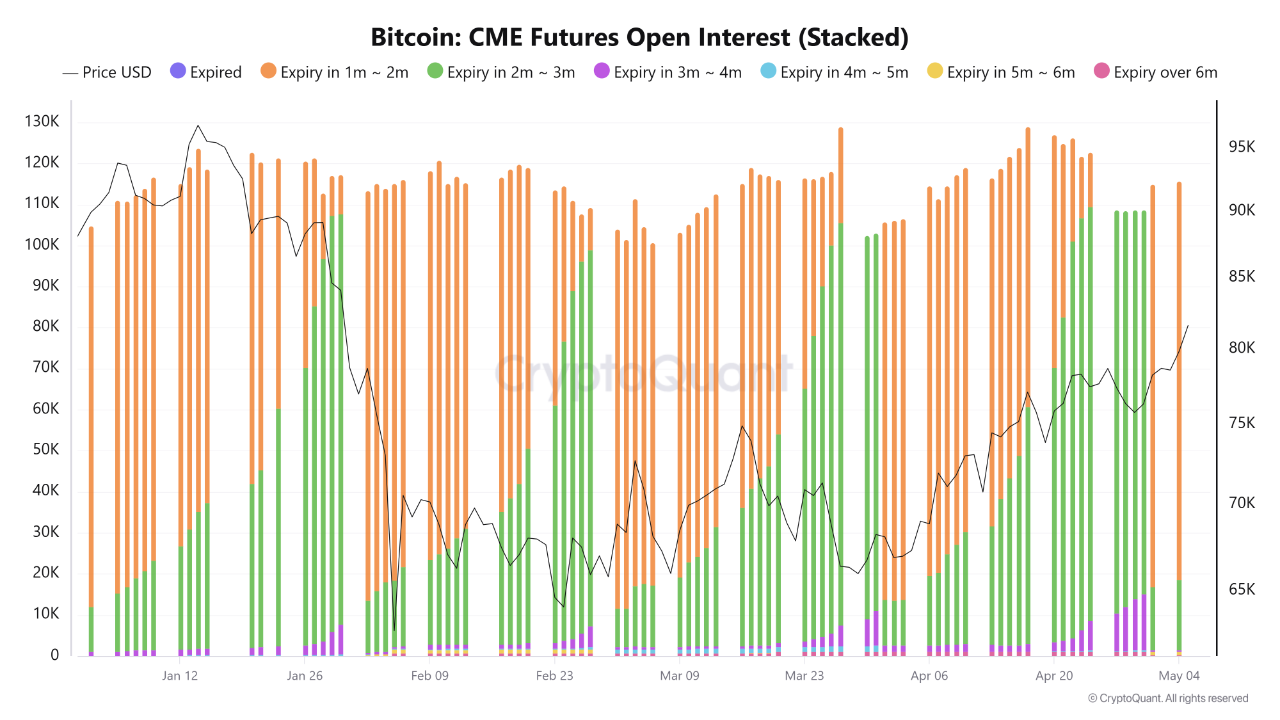
To understand why these gaps matter, it helps to look at positioning in the futures market. The analysis noted that traders hold contracts that eventually need to close, whether through profit-taking or forced liquidations. Here, open interest plays a central role, as it reflects the total number of active contracts and, by extension, the amount of leverage in the system.
When open interest rises, it signals that pressure is building. Eventually, the market releases that pressure, often through position unwinding and sharp price movements. Notably, these moves tend to move toward areas of liquidity, and CME gaps frequently fall into that category.
Bitcoin CME Futures OI/CryptoQuant
Bitcoin May Not Move Straight To This Gap
However, XWIN Research noted that the path to $93,000 may not be straight. If leverage builds too quickly without sufficient support from spot demand, the market can first move lower. This type of move typically clears out over-leveraged positions before allowing more stable price growth.
Only after that reset does price usually attempt to push toward higher-liquidity zones, including unfilled CME gaps. Therefore, while $93,000 stands out as a logical upside target, timing depends heavily on how leveraged positioning evolves.
In the meantime, the closest target for Bitcoin, according to analyst Michael van de Poppe, is $88,000. His analysis highlighted that the price level is the next area of major resistance for BTC before it targets $100,000.
Leading global investment bank Morgan Stanley is accelerating its entry into the crypto market by integrating digital asset trading into its E*Trade platform.
Through the offering, Morgan Stanley is positioning itself as a strong competitor to established retail crypto platforms such as Coinbase and Robinhood.
Key Points
Morgan Stanley is currently piloting crypto trading on its E*Trade platform.
The pilot charges a 0.50% transaction fee, undercutting Coinbase and Robinhood, which charge around 0.60%.
The bank plans to expand the service to all 8.6 million E*Trade users later this year.
It is developing a full-scale crypto ecosystem, including trading, investment products, and custodial services.
Morgan Stanley Pilots Crypto Trading on Its E*Trade Platform
Morgan Stanley is moving closer to a full-scale rollout of crypto trading on E*Trade, with the service already in an active pilot phase, according to Bloomberg. The initiative has been in development for over a year, and the current testing phase marks a critical step in the bank’s broader digital asset strategy.
Notably, the pilot introduces a highly competitive pricing model. The bank charges 0.50% per transaction, which undercuts rivals such as Coinbase, Robinhood, and Charles Schwab, whose fees range from 0.60% to 0.95%. Consequently, Morgan Stanley is positioning itself as a lower-cost alternative for retail crypto investors.
Following the pilot, the bank plans to expand the service to its entire base of 8.6 million E*Trade users later this year. In response to the development, Jed Finn, Morgan Stanley’s Head of Wealth Management, emphasized that the initiative goes beyond pricing. Instead, he framed it as part of a broader effort to reshape how clients access digital assets.
Morgan Stanley Developing Comprehensive Crypto Ecosystem
Meanwhile, Morgan Stanley continues to build a comprehensive crypto ecosystem. For instance, the firm recently launched a spot Bitcoin exchange-traded fund (ETF), which debuted with a 0.14% fee and attracted $30.6 million in net inflows on its first day. Building on this momentum, the bank is now preparing similar ETF products tied to Ethereum and Solana.
In addition, Morgan Stanley is strengthening its infrastructure capabilities. It has applied for a national trust bank charter, which would allow it to directly custody digital assets rather than relying on third-party providers.
Furthermore, Bloomberg reports that the bank is exploring advanced crypto features. These include enabling customers to convert their crypto holdings into ETF shares without first selling the underlying assets.