The $93,000 mark is a key Bitcoin upside target, according to an analysis from XWIN Research, a verified CryptoQuant market analyst.
The research firm’s recent analysis highlighted that Bitcoin (BTC) continues to trade within a structure shaped by both spot demand and futures market dynamics. Amid this, one of the most closely watched elements that could influence the asset’s price movement is the CME gap.
Key Points
The $93,000 mark is a key Bitcoin upside target, according to an analysis from XWIN Research.
The analysis cited the CME gap around the area as a major price magnet that could draw Bitcoin to it.
The path to $93,000 may not be straightforward, as building leverage positions without sufficient spot demand can initially push Bitcoin lower.
Why $93,000 Stands Out As A Key Bitcoin Upside Target
The report explained that the CME Bitcoin futures market operates only on weekdays, unlike crypto exchanges, which run continuously. Notably, this is set to change, as the CME Group will launch 24/7 trading for its Bitcoin futures and options products on May 29.
Meanwhile, because of the current setup, price gaps form between the Friday close and the Sunday evening open if the weekend sees a large swing. These gaps indicate areas where no trading activity occurred, leaving behind zones with relatively strong liquidity. As a result, the market often revisits these levels over time.
At the moment, the next unfilled CME gap sits near $93,000, 13% above the current market price of $81,800. This places that level on the radar as a potential upside target in the medium term, assuming conditions align.
How CME Gaps Influence Asset Prices
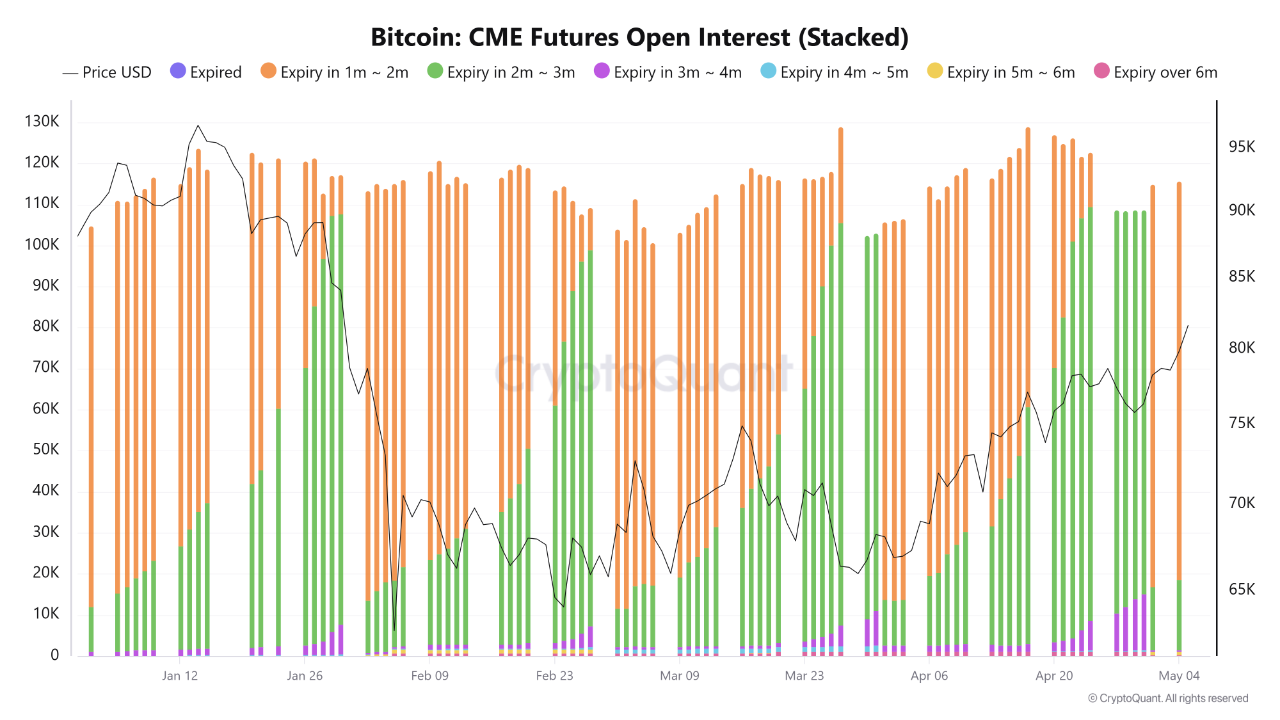
To understand why these gaps matter, it helps to look at positioning in the futures market. The analysis noted that traders hold contracts that eventually need to close, whether through profit-taking or forced liquidations. Here, open interest plays a central role, as it reflects the total number of active contracts and, by extension, the amount of leverage in the system.
When open interest rises, it signals that pressure is building. Eventually, the market releases that pressure, often through position unwinding and sharp price movements. Notably, these moves tend to move toward areas of liquidity, and CME gaps frequently fall into that category.
Bitcoin CME Futures OI/CryptoQuant
Bitcoin May Not Move Straight To This Gap
However, XWIN Research noted that the path to $93,000 may not be straight. If leverage builds too quickly without sufficient support from spot demand, the market can first move lower. This type of move typically clears out over-leveraged positions before allowing more stable price growth.
Only after that reset does price usually attempt to push toward higher-liquidity zones, including unfilled CME gaps. Therefore, while $93,000 stands out as a logical upside target, timing depends heavily on how leveraged positioning evolves.
In the meantime, the closest target for Bitcoin, according to analyst Michael van de Poppe, is $88,000. His analysis highlighted that the price level is the next area of major resistance for BTC before it targets $100,000.
Leading global investment bank Morgan Stanley is accelerating its entry into the crypto market by integrating digital asset trading into its E*Trade platform.
Through the offering, Morgan Stanley is positioning itself as a strong competitor to established retail crypto platforms such as Coinbase and Robinhood.
Key Points
Morgan Stanley is currently piloting crypto trading on its E*Trade platform.
The pilot charges a 0.50% transaction fee, undercutting Coinbase and Robinhood, which charge around 0.60%.
The bank plans to expand the service to all 8.6 million E*Trade users later this year.
It is developing a full-scale crypto ecosystem, including trading, investment products, and custodial services.
Morgan Stanley Pilots Crypto Trading on Its E*Trade Platform
Morgan Stanley is moving closer to a full-scale rollout of crypto trading on E*Trade, with the service already in an active pilot phase, according to Bloomberg. The initiative has been in development for over a year, and the current testing phase marks a critical step in the bank’s broader digital asset strategy.
Notably, the pilot introduces a highly competitive pricing model. The bank charges 0.50% per transaction, which undercuts rivals such as Coinbase, Robinhood, and Charles Schwab, whose fees range from 0.60% to 0.95%. Consequently, Morgan Stanley is positioning itself as a lower-cost alternative for retail crypto investors.
Following the pilot, the bank plans to expand the service to its entire base of 8.6 million E*Trade users later this year. In response to the development, Jed Finn, Morgan Stanley’s Head of Wealth Management, emphasized that the initiative goes beyond pricing. Instead, he framed it as part of a broader effort to reshape how clients access digital assets.
Morgan Stanley Developing Comprehensive Crypto Ecosystem
Meanwhile, Morgan Stanley continues to build a comprehensive crypto ecosystem. For instance, the firm recently launched a spot Bitcoin exchange-traded fund (ETF), which debuted with a 0.14% fee and attracted $30.6 million in net inflows on its first day. Building on this momentum, the bank is now preparing similar ETF products tied to Ethereum and Solana.
In addition, Morgan Stanley is strengthening its infrastructure capabilities. It has applied for a national trust bank charter, which would allow it to directly custody digital assets rather than relying on third-party providers.
Furthermore, Bloomberg reports that the bank is exploring advanced crypto features. These include enabling customers to convert their crypto holdings into ETF shares without first selling the underlying assets.
Ripple CEO Brad Garlinghouse stated that Ripple Prime is helping position XRP as collateral across various institutional platforms.
Garlinghouse disclosed this while discussing crypto institutional adoption at the ongoing Consensus 2026 in Miami, pointing out that large institutions have now started seeing more use cases for crypto assets.
Key Points
Garlinghouse stated at Consensus 2026 in Miami that, through Ripple Prime, XRP is becoming usable as collateral across multiple institutional platforms.
Ripple acquired Hidden Road for $1.25 billion in April 2025, later rebranding it as Ripple Prime.
RLUSD was confirmed as the primary collateral asset across services handling over $3 trillion in annual clearing volume.
DTCC recently named Ripple Prime as a participant in its tokenization initiative.
Ripple Prime Making XRP Good Collateral
While speaking at Consensus, Garlinghouse pointed out that Bitcoin had moved back above the $80,000 mark for the first time since January. However, he expressed surprise that the broader market still seemed slow despite many positive signals.
The Ripple CEO noted that the space is gradually reaching a point where crypto becomes more practical, especially when it comes to using it as collateral and for leverage. To him, institutions are starting to see more real-world use for these assets.
Speaking further, he referenced Ripple’s own efforts, including its recent acquisitions and focus on prime brokerage services.
Garlinghouse pointed out that acquiring Hidden Road plays an important role in this strategy, as it helps make XRP usable as collateral across different institutional platforms. He called this development “a big deal.”
In his words: “Our company, Hidden Road, the prime brokerage business making XRP good collateral across lots of different institutional platforms is a big deal.”
Interestingly, earlier this year, in March, Mike Higgins, the CEO of Ripple Prime, also confirmed that the company was leveraging XRP as collateral for institutional trades, challenging the narrative that XRP had absolutely no utility on the platform.
Ripple Prime’s Use of RLUSD Collateral
This is particularly important for the XRP community because previous discussions had suggested that Ripple Prime (formerly Hidden Road) only leverages RLUSD, the Ripple stablecoin, as collateral, with no use case for XRP.
Notably, in April 2025, Ripple announced a $1.25 billion deal to acquire Hidden Road. At the time, the company confirmed that Hidden Road planned to use RLUSD as collateral across its prime brokerage services, which handle over $3 trillion in annual clearing volume.
By July 2025, Garlinghouse revealed that RLUSD had been approved as collateral for all Hidden Road services. This showed that the stablecoin was becoming central to the platform’s operations. Some derivatives clients also began holding balances in RLUSD.
XRP’s Absence as Collateral
Amid these developments, most discussions focused on the fact that XRP was not being used as the main collateral asset within Ripple Prime. Several recent conversations pointed out that RLUSD, not XRP, served as the primary collateral and margin asset in Ripple Prime and in related DTCC pilot programs.
Critics argued that XRP was not required for any Ripple Prime services and that there was no role for it within the system.They raised concerns about volatility, noting that XRP can move between 5% and 10% in a single day.Because of this, many institutions prefer RLUSD, which offers more stability for collateral purposes.
Ripple Prime in DTCC Tokenization Initiative
These concerns recently re-emerged after the Depository Trust & Clearing Corporation (DTCC) mentioned Ripple Prime as a participant in its tokenization initiative. On May 4, 2026, the DTCC announced progress on its DTC tokenization service.
This project aims to bring tokenized assets like equities, ETFs, and U.S. Treasuries into existing post-trade systems.DTCC currently holds about $114 trillion in assets and is working with over 50 financial firms on this effort.
Ripple Prime is part of the DTCC Industry Working Group, alongside major names such as BlackRock, Goldman Sachs, HSBC, JPMorgan, Citadel, Bank of America, Nasdaq, Robinhood, Ondo Finance, Circle, BitGo, and Anchorage Digital.
XRP price predictions have dominated crypto circles in recent times, with multiple analysts and institutions trying to estimate where the asset’s price could go over the next few years.
However, there is no single clear outlook. While some forecasts expect strong growth due to wider adoption and improving regulations, others call attention to risks such as market volatility and supply pressure as reasons for a bearish phase.
A Quick Overview of XRP
XRP is the native digital asset of the XRP Ledger, a blockchain built specifically for fast and low-cost cross-border transactions.
The network processes payments in seconds and charges negligible fees, setting itself up as a direct alternative to the SWIFT system that banks and financial institutions rely on for international wire transfers.
Fintech company Ripple is closely associated with the XRP Ledger and has an enterprise payment platform that uses XRP as a bridge currency, allowing money to move across borders without the delays and layered fees that typically come with traditional banking channels.
The token has had an eventful 2026. After soaring from $0.5 in November 2024 to a local peak of $3.4 in January 2025, XRP fell to $1.6 by April 2025 before recovering to the all-time high of $3.6 in July of the same year. However, it has been downhill from here.
Spot XRP ETFs launched in November 2025, generating over $1 billion in net inflows since their debut. Despite this milestone, the new year brought renewed pressure. In January 2026, XRP climbed to $2.41 on positive market expectations, but dropped back to $1.6 by month-end.
Since then, XRP has struggled to build on any meaningful recovery. Despite the availability of spot ETFs, the price has declined roughly 23% in 2026 and 61% from the $3.6 ATH, currently trading for $1.40.
History of XRP
The project began in 2011 when engineers David Schwartz, Jed McCaleb, and Arthur Britto started working on an alternative to Bitcoin. They admired Bitcoin’s core ideas but wanted to avoid the high energy use and scalability problems tied to mining. As a result, they created a system that relies on a consensus process rather than mining.
The XRP Ledger officially launched in June 2012, together with XRP, first known as “ripples.” Unlike Bitcoin, all 100 billion XRP tokens were created at launch. The founders later gave 80 billion XRP to OpenCoin to help fund development and expand use cases. Chris Larsen later joined as a co-founder.
By 2013, the company adopted the Ripple Labs name and focused more heavily on partnerships with banks and financial institutions. The project also built on concepts introduced by Ryan Fugger through the RipplePay protocol of 2004.
Technically, the XRPL uses Federated Consensus, which is a form of Byzantine Fault Tolerance.Notably, validator nodes and Unique Node Lists help the network confirm transactions quickly without using proof-of-work mining. More than 150 validators currently operate around the world.
XRP Price Predictions for 2026
XRP price prediction for 2026 have a wide range, which confirms the uncertainty of the current market situation.
Standard Chartered
In February, Standard Chartered revised its 2026 XRP forecast to $2.80, cutting its earlier $8 target from December 2025 by 65%.
This comes amid the broader market decline, during which XRP has dropped about 43%, trading around $1.40, compared to roughly $1.86 when the earlier $8 estimate suggested a 330% increase. The bank’s crypto research team, led by Geoffrey Kendrick, mentioned weaker near-term conditions as the reason for the review.
CoinCodex and Changelly
Other platforms have a more neutral stance. Notably, CoinCodex places its XRP price prediction for 2026 between $1.36 and $2.00, highlighting mixed technical signals. Crypto resource Changelly gives a similar range of $1.36 to $2.18, with an average around $1.66.
DigitalCoinPrice and PricePrediction.net
However, some forecasts remain bearish. DigitalCoinPrice expects XRP to reach about $1.41 in May 2026, then fall below $1, and eventually drop to around $0.57 by September 2026.
On the other hand, PricePrediction.net has a more positive 2026 outlook, placing XRP between $5.51 and $7.11 for this year, which would mean gains of 310% to 430% from early 2026 levels.
Motley Fool and The Crypto Basic
Interestingly, some individual analysts take a more optimistic view. Chris Macdonald, who writes for Motley Fool and Yahoo Finance, expects XRP to reach $10 in 2026, pointing to rising institutional demand and better regulatory conditions.
Meanwhile, analysts at The Crypto Basic expect the downtrend to continue through much of the year. They believe XRP could rise gradually toward $2, but repeated pullbacks may bring it back down, ending the year below $1.5.
XRP Price Predictions for 2027
XRP price predictions for 2027project some improvement for next year, although not all forecasts point to strong growth.
Standard Chartered and Changelly
Standard Chartered lowered its projection to $7.00, down from about $10.40, following its updated view after the early 2026 market decline.
Changelly expects steady growth, projecting XRP to trade between $1.47 and $2.26 in 2027. According to the crypto resource, prices may stay between $1.40 and $1.60 in the first half of the year, then rise later, reaching $2.26 in Q4, still below the ATH of $3.6.
CoinCodex and DigitalCoinPrice
CoinCodex predicts a similar pattern for 2027, placing XRP between $1.47 and $2.27, with a peak of $2.27 in August 2027 and a low of $1.47 in May 2027.
DigitalCoinPrice remains the most bearish, forecasting a range of $0.23 to $1.64. It expects prices to staybelow $0.50 early in the year, then climb to $1.04 by July and reach $1.64 by December 2027, showing some recovery but still weak overall performance.
PricePrediction.net, Telegaon, and The Crypto Basic
PricePrediction.net expects XRP to start high at $6.21 in January, then fall steadily to $2.61 by December 2027. Telegaon has a more bullish 2027 outlook, predicting XRP to trade between $5.23 and $8.71, with an average of $7.16, making it one of the most optimistic forecasts.
However, analysts at The Crypto Basic expect the crypto scene to witness a moderate recovery in 2027 but not a full bull market.They believe XRP could rise to $3.15, then drop to $2.2, averaging around $2.6 for the year.
XRP Price Predictions for 2028
By 2028, several forecasts suggest a stronger upward trend for XRP.
Standard Chartered and DigitalCoinPrice
Standard Chartered slightly raised its target to $12.60, up from $12.50, even after lowering its shorter-term outlook. Geoffrey Kendrick noted that reaching $10 could be possible during the next major cycle, especially if ETF inflows increase and institutional demand grows.
However, DigitalCoinPrice still expects weakness even in 2028, projecting a range of $0.44 to $1.89. It sees XRP falling from $1.89 in Q1 2028 to $0.44 by the end of the year.
Changelly, CoinCodex, and PricePrediction.net
Meanwhile, Changelly presents a more positive view, forecasting steady growth between $1.97 and $3.30, with XRP potentially moving above $3 by December 2028.
CoinCodex expects XRP to reach $3.31 in the first quarter of 2028, then decline gradually to about $2.11 by December.Further, analysts PricePrediction.net believe XRP will see strong growth in 2028, placing the price between $3.03 and $7.43 during the year.
Telegaon and The Crypto Basic
Telegaon has more bullish XRP price predictions for 2028, with a minimum of $8.78, an average of $10.29, and a maximum of $12.84.
Meanwhile, according to experts at The Crypto Basic, 2028 could mark the start of a full bull cycle. They expect XRP to break its previous all-time high of $3.66, possibly reaching $6.45, before settling between $3 and $5 for the rest of the year.
XRP Price Predictions for 2029
XRP price predictions for 2029 feature optimistic and cautious tones.
Standard Chartered and CoinCodex
For one, Standard Chartered raised its target to $19.60, up from $12.25, highlighting confidence in the post-halving cycle and expected ETF inflows.
CoinCodex is more cautious, projecting XRP to trade between $1.78 and $2.86 in 2029. It expects prices to rise to $2.86 by February 2029, then fall to $1.78 by August, and close the year between $2.21 and $2.62.
PricePrediction.net and Telegaon
Meanwhile, PricePrediction.net remains optimistic, forecasting a range between $8.75 and $20.92 for its 2029 XRP price predictions, as it suggests strong growth throughout the year.
Telegaon places XRP between $13.06 and $16.79 for 2029, with an average of $15.35. In contrast, Changelly’s aggregate ranges from $1.78 to $2.85, with an average near $2.30.
DigitalCoinPrice and The Crypto Basic
DigitalCoinPrice continues to project the most bearish figures, as it forecasts XRP to trade within a range of $0.57 to $1.59. It expects XRP to fall to $0.57 by February 2029, rise to $1.59 in July, and then drop below $1.5 by the end of the year.
Further, The Crypto Basic believes the broader market rally will slow down in 2029. Their analysts expect XRP to find support around $3.12, while staying below $6 throughout the year.
XRP Price Predictions for 2030
XRP price predictions for 2030, representing the end of the current decade, confirm the varying degrees of optimism and pessimism shared by multiple analysts.
Standard Chartered and Finder
Standard Chartered keeps its long-term target for 2030 at $28.00, which aligns with Fibonacci extension levels near $27 at the 161.8% retracement highlighted by Elliott Wave analyst Chart Nerd as a possible long-term target.
However, Finder’s panel has one of the most bearish 2030 XRP price predictions at $2.49, calling attention to concerns about XRP’s large circulating supply and ongoing escrow releases, as well as doubts about stronger adoption scenarios.
Telegaon, and DigitalCoinPrice
Telegaon expects continued growth, placing XRP between $16.86 and $20.03 for 2030, as the analysts suggest prices could move above the 2029 highs.
DigitalCoinPrice maintains its bearish stance, forecasting a range of $0.70 to $1.13, and indicating XRP may still stay below its 2025 all-time high and remain under $2 even in 2030, four years from now.
PricePrediction.net, Changelly, and The Crypto Basic
As for PricePrediction.net, the crypto resource expects XRP to remain in double digits in 2030 but trend downward as the year progresses. According to them, XRP could start at $19.42 in January 2030 and then fall to $9.21 by December.
Meanwhile, Changelly’s aggregate estimate sits between $2.11 and $5.69, with an average of $5.00.This suggests only a moderate growth without reaching double-digit levels.
Finally, analysts at The Crypto Basic expect another bear market in 2030. They believe XRP could fall below $3, possibly reaching $2.2 in 2030, while support may hold above $1.5.
XRP Price Predictions Table for 2026 to 2030
XRP Price Predictions 2026 to 2030
What Factors Affect XRP Price in 2026 and Beyond
No price prediction exists in a vacuum, and understanding the factors behind them can be helpful to the average investor. Some of these factors could push XRP much higher, while others could keep it under pressure for longer than many expect.
ETF Inflows
Spot XRP ETFs have raised over $1.3 billion so far, and continued ETF growth remains the most reliable indicator for XRP’s price strength, with every billion-dollar increase in inflows translating into buying pressure on the token.
Cross-Border Payment Adoption
Meanwhile, multiple financial institutions already use XRP for cross-border settlements, instant payments, and liquidity management.
Notably, XRP’s future price could also depend on how many of Ripple’s messaging-only banking clients convert to full On-Demand Liquidity users, since token demand has a direct link to transaction volume.
Essentially, broader adoption across payment corridors remains the strongest fundamental argument for long-term price growth.
Ripple’s Banking Charter and Regulatory Clarity
Ripple received conditional approval for a US national trust bank charter in December 2025, and full approval would expand its ability to operate within the regulated US banking framework.
The CLARITY Act, still pending, could eliminate years of remaining legal uncertainty and lead to broader institutional participation in XRP. Any delays or setbacks on either front would likely weigh on sentiment and cap near-term price gains. However, most community experts believe XRP is already on the right side of regulation.
RLUSD Growth and Ecosystem Expansion
Ripple’s dollar-backed stablecoin RLUSD reached approximately $1.3 billion in market capitalization within its first year.
If RLUSD scales into banking rails and remittance corridors, particularly in Japan and South Korea, where regulatory frameworks support pilot integrations, it could generate recurring demand for XRP as a bridge asset.
However, how directly RLUSD’s growth benefits the XRP token itself remains a major question investors are still working through.
Competition from Stablecoins and CBDCs
Stablecoins like USDC and USDT already handle instant cross-border payments, and if SWIFT’s new blockchain-based settlement system gains broader traction, XRP’s use case could narrow and limit price growth.
On the other hand, some analysts argue XRP could act as a neutral bridge for central bank digital currencies given its transaction speed, low costs, and existing infrastructure. If this narrative gains further traction, it could materially improve the long-term price outlook.
Macroeconomic Conditions
Like most high-risk assets, XRP is sensitive to broader liquidity conditions. A scenario where the Federal Reserve cuts rates at a meaningful pace would lower the opportunity cost of holding risk assets and give XRP meaningful room to recover.
Conversely, a risk-off environment driven by equity market declines or global economic stress tends to hit crypto assets hard regardless of project-specific fundamentals.
FAQs: Frequently Asked Questions
What is the current outlook for XRP price from 2026 to 2030?
XRP is projected to potentially reach double digits, with price predictions for 2026 ranging from $2.00 to $3.50 in a base-case scenario, and possibly higher in bullish conditions. By 2027, prices could range from $3.50 to $11.00, and by 2028, the price might be between $5.50 and $18 or higher under strong growth conditions. The outlook for 2029 and 2030 suggests XRP could trade between $4.00 and $6.00 in bearish cases and up to $28 or more in bullish scenarios.
What key factors could influence XRP market performance over the coming years?
Major factors include regulatory clarity, ETF inflows, real-world utility, tokenization growth, technological upgrades like the post-quantum roadmap, macroeconomic trends, and supply conditions such as escrow releases and transaction burns. These elements could either support or hinder XRP’s performance from 2026 to 2030.
How has XRP legal situation affected its market perception and potential growth?
The resolution of the SEC lawsuit confirmed that XRP is not considered a security in secondary sales, removing a significant legal obstacle and boosting market confidence, which could positively influence its growth and adoption in the coming years.
What impact might technological upgrades and innovations have on XRP future?
Technological advancements such as Ripple’s post-quantum security plan and upgrades to the XRPL to make it quantum-resistant could enhance its security, foster institutional trust, and support longer-term network stability, potentially driving higher prices and broader adoption.
What are the main risks that could slow down XRP growth between 2026 and 2030?
Risks include economic uncertainty, recession fears, geopolitical tensions, delays in technological upgrades, regulatory challenges, and increased competition from other blockchain and payment networks, all of which could limit XRP’s price appreciation and market penetration.
The XRP on-chain activity has taken a notable turn, with large holders now driving the majority of token outflows from exchanges.
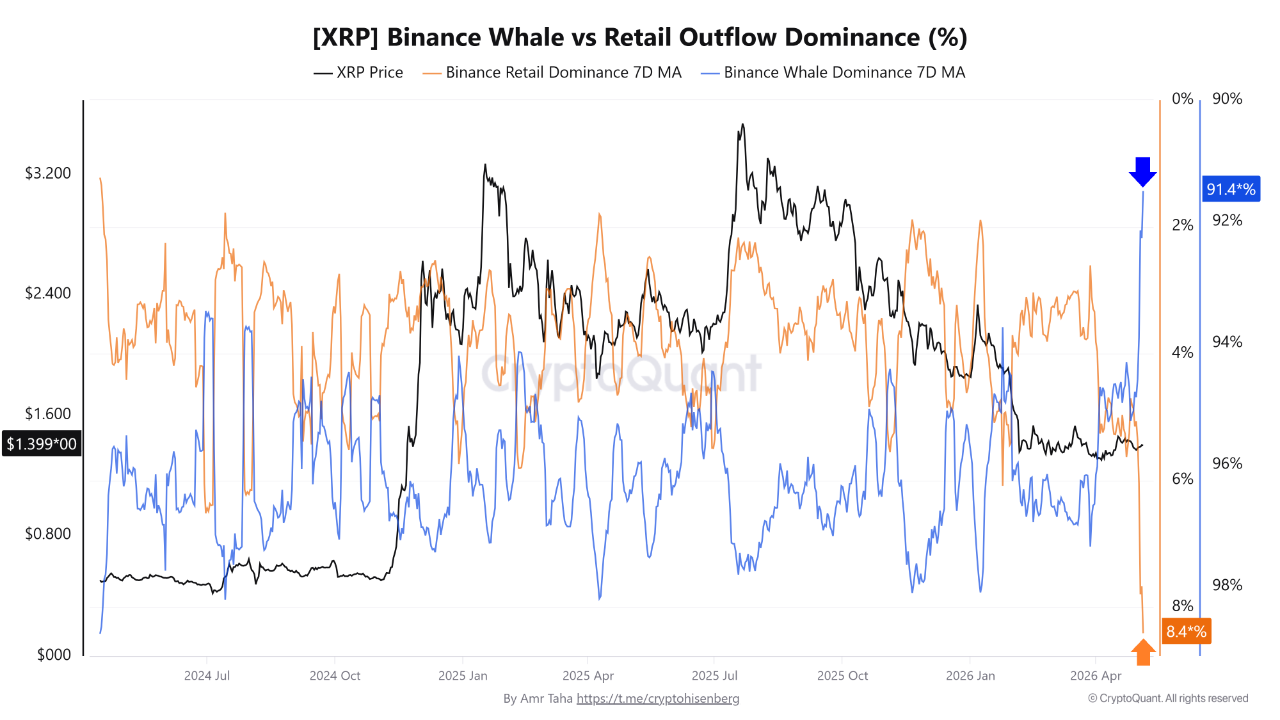
Recent data shared by verified CryptoQuant analyst, Amr Taha, shows that whale outflow dominance is climbing sharply across centralized platforms, while retail participants continue to fade from the picture. XRP is not just leaving exchanges, but whales are responsible for almost all of them, reinforcing growing institutional interest.
Key Points
On Binance, whale-driven outflows now account for 91.4% of total XRP leaving the platform.
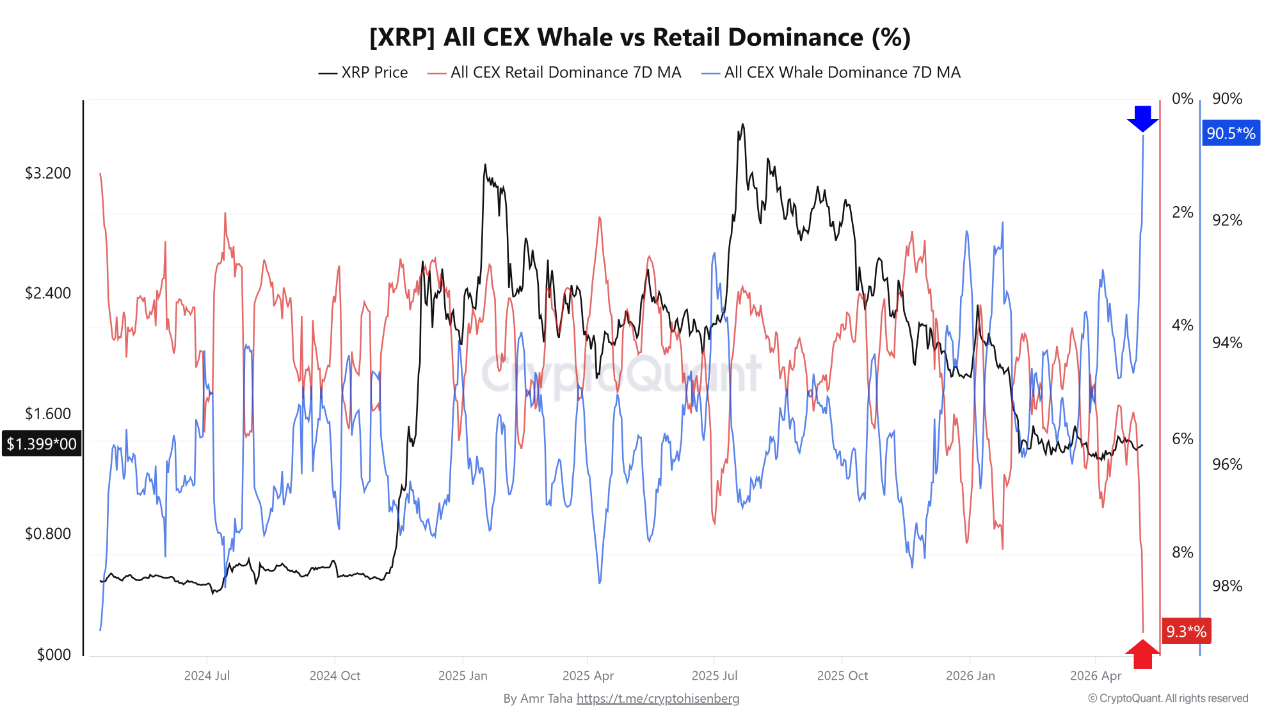
Across all centralized exchanges, whale dominance has reached 90.5%, marking its highest level since 2024.
While it does not directly translate to purchases, the dominance of whales in current on-chain activity remains a massive positive.
XRP is leaving exchanges at a rapid pace, specifically at levels last seen since March.
XRP Whale Dominance Crosses 90% Across Exchanges
On Binance, whale-driven outflows now account for 91.4% of total XRP leaving the platform. In contrast, retail-related flows have dropped to just 8.4%. This shift highlights a clear change in behavior, with large transactions dominating activity rather than smaller, fragmented movements by retail players.
XRP Whale vs Retail Dominance on Binance/CryptoQuant
At the same time, the broader market reflects a similar pattern. Across all centralized exchanges, whale dominance has reached 90.5%, marking its highest level since 2024.
Meanwhile, retail participation has slipped to around 9%, its lowest point in the same period. The data shows that this trend is not isolated to a single platform but instead signals a broader structural shift.
XRP Whale vs Retail Dominance on All CEX/CryptoQuant
Retail Participation Declines as Market Structure Shifts
To better understand the current setup, the analysis cited previous setups. In mid-2025, retail activity surged to its strongest level around 2%, coinciding with XRP approaching its current all-time high around $3.66.
The retail dominance left XRP vulnerable to market sentiment, ultimately leading to a steep decline of over 61%.
Now, the structure looks very different. Instead of retail flows increasing near higher price levels, large holders control most of the movement. This contrast brings greater price stability, as whales’ reputation for holding long precedes them.
Even so, the analysis emphasized that exchange outflows alone do not necessarily point to XRP accumulation. Whale activities can signal a range of intentions, from repositioning funds to shifting assets into private storage. However, the dominance of large market participants in current activity remains a massive positive.
XRP Exchange Reserve Shrinking Rapidly
In a parallel post, market watcher Xaif Crypto highlighted another positive for XRP: its exchange reserve on Binance is shrinking rapidly. Data show that the XRP deposit against withdrawal transactions on the 30-day timeframe hit a reversal. This suggests that XRP is leaving exchanges at a rapid pace, specifically at levels last seen since March.
XRP Leaving Exchanges Rapidly/CryptoQuant
The rekindling of inflows into US XRP spot ETFs bolsters bullish sentiment. The funds saw net inflows of $11.28 million on Tuesday, their second consecutive net positive flow. Such accumulation conditions push XRP closer to a supply shock and a consequent price reaction.
Charles Hoskinson, founder and CEO of Input Output Global, has pushed back against claims that Cardano abandoned scalability in favor of governance.
In a statement on X, he reaffirmed that scaling has always remained a core priority, arguing that Cardano’s research-driven approach is necessary to advance the initiative.
Key Points
Cardano founder Charles Hoskinson rejects claims that Cardano abandoned scalability for governance, emphasizing that scaling remains a core priority.
He emphasized that scaling requires adequate research, not speed, adding that this effort began even before the Shelley era in 2020.
He explained that the Voltaire governance system was introduced alongside scaling research to empower the community.
Hoskinson suggests Cardano now has the best scaling strategy in the crypto industry.
Cardano Maintains Long-Term Focus on Scaling
Charles Hoskinson dismissed the narrative that Cardano sidelined scalability for governance. Instead, he emphasized that development work on scaling began long before the Shelley era and has continued consistently since then.
From the outset, he noted that the project invested heavily in foundational research papers and ongoing scientific work to address the network’s scalability challenges.
As a result, Cardano explored multiple technical pathways. These include Layer-2 solutions, zero-knowledge technologies, and the Extended UTXO (eUTXO) accounting model, all designed to improve performance and flexibility.
Scaling Requires Research, Not Speed
Notably, Hoskinson stressed that scalability cannot be rushed. He argued that, unlike conventional software development, blockchain scaling requires deep research.
Furthermore, he dismissed the idea that adding more developers would accelerate scaling progress. Instead, he maintained that scientific challenges require time rather than massive staffing.
He also insisted that no resources were diverted away from scaling efforts. According to him, dozens of engineers and scientists have worked for years on scaling solutions, continuously testing and refining new approaches.
As a result, he claimed that Cardano now has the best scaling strategy in the industry. He pointed to ongoing developments such as Leios and Peras as key components of this long-term roadmap. Last year, Hoskinson announced a 24/7 development model for Leios, with the protocol expected to launch later this year.
Voltaire Strengthens Governance During Scaling Development
With scaling efforts ongoing, Hoskinson noted that Cardano introduced the Voltaire governance system. Hoskinson clarified that this was not a shift away from scalability, but rather a complementary step to strengthen the network.
Through Voltaire, Cardano enabled community participation in governance decisions by unlocking the treasury for decentralized development and funding.
Additionally, he highlighted that the system allows the community to shape the network’s direction, including decisions about upgrades and ecosystem priorities. Consequently, governance has become an active part of Cardano’s evolution rather than a separate initiative.
Hoskinson further argued that prioritizing scaling over governance would have weakened the ecosystem. In his view, such an approach would have removed community voting power and centralized decision-making, leaving users without influence over upgrades or treasury allocation.
He also noted that the treasury holds over 1 billion ADA, emphasizing that governance ensures these resources remain under community control.
Contrasting the Cardno Governance Model and Bitcoin’s
Furthermore, Hoskinson contrasted Cardano’s governance structure with ongoing debates in Bitcoin, including discussions around proposals such as BIP-360 and BIP-361.
He argued that Bitcoin’s governance challenges demonstrate the risks of limited decision-making frameworks. In contrast, he maintained that Cardano’s model reduces fragmentation by ensuring structured, community-driven coordination.
Ripple CEO Brad Garlinghouse said he expects 30% of Ripple Treasury’s $13 trillion yearly payment volume to move on-chain within the next five years.
He made this statement during a conversation with Bullish CEO Tom Farley at the ongoing Consensus 2026 conference in Miami.
Key Points
Brad Garlinghouse said 30% of Ripple Treasury’s yearly volume could shift on-chain within five years.
GTreasury, now Ripple Treasury, processed $13 trillion in 2025, with zero payments conducted on-chain.
Ripple acquired GTreasury for $1 billion in October 2025 to expand its presence in the global corporate treasury market.
The platform serves over 1,000 clients across 160 countries, including major firms like American Airlines.
Ripple is targeting non-crypto companies through acquisitions to drive broader blockchain adoption.
Ripple Bringing TradFi On-Chain Gradually
During the recent interview, Farley asked Garlinghouse to explain Ripple’s acquisition strategy. He noted that the company has used inorganic growth through mergers and acquisitions to expand its business. The Bullish CEO asked for an overview of how that strategy has been working so far.
In response, Garlinghouse explained that Ripple, like Bullish, has taken a different path compared to many crypto firms.
He said many companies in the space focus on buying other crypto companies, which keeps them operating within the same circle. However, Ripple has chosen to look outside that space and bring in companies that are not originally part of the digital asset industry.
Potential in Ripple Treasury
Garlinghouse mentioned Ripple Treasury (formerly GTreasury) as an example. He said the platform handled about $13 trillion in payments last year.
However, he noted that none of those payments used stablecoins or any digital assets in 2025. According to him, this shows how much room there is to move these transactions onto blockchain systems over time.
Meanwhile, Garlinghouse clarified that Ripple does not want to rush its customers into change. Instead, the company plans to guide them step by step.
He mentioned large companies likeAmerican Airlines, along with other firms ranging from Fortune 50 to mid-sized businesses, as key users.These companies already use the platform to manage liquidity and handle banking activities across different countries through one dashboard.
About 30% of Annual Payments Could Shift Onchain
To explain the benefits, Garlinghouse highlighted how a company like American Airlines might make a fuel payment in Peruvian sol. Right now, the process can take four days and cost a lot because it depends on a single correspondent bank.
He said Ripple Treasury can offer a better option directly in its interface. Specifically, it can show users how to complete the same payment in real time and at a lower cost. This allows treasury managers to compare options and choose what works best for them without changing their entire system.
Garlinghouse stressed that the change will be gradual. He said adoption will move in stages, starting slowly and then growing over time. Looking ahead, the Ripple CEO said he believes 30% of the $13 trillion payment flow will be onchain within five years.
GTreasury, based in Chicago, has more than 40 years of experience and serves over 1,000 customers in 160 countries, including major companies like American Airlines, Goodyear, and Volvo. The deal was completed by early December 2025.
Ripple introduced Ripple Treasury in late January 2026 as its first major step after the acquisition. The platform combines GTreasury’s treasury management system with Ripple’s digital asset technology. It allows users to manage traditional cash, stablecoins such as RLUSD, and tokenized assets in one place.
Earlier this year, Garlinghouse confirmed that GTreasury processed $13 trillion in payments in 2025, and none of that volume was onchain. With Ripple now adding digital asset features to the platform, the company plans to shift a large part of that volume to blockchain-based transactions over the next few years.
An unidentified XRP whale has withdrawn millions worth of the token from South Korean exchange Upbit, coinciding with the recent price recovery.
The recent transaction further reduced XRP’s available supply on trading platforms. Meanwhile, the timing of this move and the anonymity of this address are raising eyebrows among the XRP community.
Key Points
An XRP whale withdrew 6.3 million XRP from Upbit on Tuesday.
Current data show that the wallet holds 119,800 XRP tokens, worth $171,800, well below the amount it received from Upbit yesterday.
This wallet has been active since receiving these 6.3 million tokens, broadly distributing them across multiple addresses.
XRPScan shows that the address was activated by “rEdP7w,” an account that links back to bankrupt crypto exchange Bittrex.
Someone Moved Millions of XRP Off Exchanges
Data from Bithomp shows that this transaction happened on Tuesday, at around 13:23 UTC. The address “r3bqvUf” received 6.3 million XRP, worth $8.8 million at the time, from South Korea’s leading centralized exchange, Upbit.
Whale Withdraws XRP from Upbit/Bithomp
Bithomp marked the address as unknown, adding a layer of curiosity about the move. Whether it is an institutional user or a crypto millionaire accumulating XRP remains unclear at this time, but such a large move suggests that XRP is gaining attention.
However, there is a catch. Current data show that the wallet now holds 119,800 XRP tokens, worth $171,800, well below the amount it received from Upbit yesterday.
Wallet Disperses Received XRP Tokens
Further on-chain analysis shows that this whale wallet has been active since receiving these 6.3 million tokens, broadly distributing them across multiple addresses. Some of the identified beneficiaries include Binance, Bybit, Bitget, and Gate.io. Several other unknown wallets received shares of the stash.
This suggests that the account was a mere funnel through which the owner moved tokens to other addresses. Earlier transactions proved this too.
Meanwhile, XRPScan shows that the address was activated by “rEdP7w,” an account that links back to bankrupt crypto exchange Bittrex. The platform filed for bankruptcy in 2023 and supported XRP while it was functional.
As such, the series of transactions related to the 6.3 million XRP withdrawal from Upbit and its distribution could simply be an exchange move to reshuffle its holdings. However, this remains speculative.
XRP Price Resurgence
The transaction followed a price rebound from XRP, mirroring the broader market trend. The coin has increased by 1.95% in the past 24 hours, extending its growth since the start of this week to 3.4%. XRP now trades at $1.43, up 27% from its February 6 low of $1.12.
Despite this strong rebound, it has not yet matched Bitcoin’s recent performance, as capital seems to remain in the crypto leader rather than rotate into other large caps.
Meanwhile, recent analysis suggests this could change as XRP has printed its tightest Bollinger band in years. Citing this, the commentary predicted a big move is on the horizon.
Ripple CEO Brad Garlinghouse has reaffirmed his long-standing opposition to crypto tribalism, emphasizing that he has never been an XRP maxi.
His remarks highlight a broader vision for the crypto industry—one that prioritizes interoperability, collaboration, and regulatory clarity over competition between individual blockchains.
Key Points
Ripple CEO Brad Garlinghouse reaffirmed that he is not an XRP maximalist.
He expects the crypto market to evolve into a multi-chain ecosystem and rejects the idea of single-chain dominance.
He expressed strong support for Bitcoin, stating that he wants it to succeed.
Despite his close ties to XRP, he confirmed holding both Bitcoin and Ethereum.
“I’m Not an XRP Maxi,” Ripple CEO Says
During an interview with CoinDesk at Consensus 2026, the Ripple CEO addressed the issue of maximalism. He emphasized that he is not an XRP maximalist.
“I’ve never been an XRP maxi,” Garlinghouse stated, reinforcing his consistent stance.
Furthermore, he argued that the crypto industry will not revolve around a single dominant blockchain. Instead, it will evolve into a multi-chain ecosystem where different networks coexist and serve distinct purposes.
Additionally, Garlinghouse voiced strong support for Bitcoin, stressing that he wants the leading cryptocurrency to succeed. Nonetheless, he reaffirmed his confidence in the continued growth and innovation within the XRP ecosystem.
Garlinghouse Pushes Back Against Crypto Tribalism
Notably, this position aligns with Garlinghouse’s long-standing criticism of crypto tribalism, which he views as a major obstacle to industry-wide progress. While he remains closely associated with XRP, he has confirmed holding Bitcoin and Ethereum.
Moreover, Garlinghouse has engaged in policy discussions in support of a multi-asset initiative. For instance, during debates over a proposed U.S. crypto reserve, he advocated for a multi-asset framework rather than a Bitcoin-only model.
Initially, Donald Trump considered establishing a reserve centered solely on Bitcoin, a move widely supported by BTC proponents. However, Garlinghouse and other industry stakeholders pushed policymakers to adopt a more inclusive approach.
Meanwhile, Garlinghouse continues to advocate for clearer and more comprehensive regulatory frameworks across the crypto sector. Although he acknowledged that XRP achieved legal clarity following a 2023 court ruling, he stressed that the broader industry still lacks consistent guidelines.
He maintains that establishing a regulatory foundation is essential to unlocking the full potential of the crypto market and supporting its long-term growth. Therefore, he continues to urge industry participants to move beyond tribalism and work collectively to advance the ecosystem.
Shiba Inu is currently stuck around support on higher timeframes, but the prospect of a breakout remains well in the picture.
Looking at the weekly chart, Shiba Inu (SHIB) has been consolidating for weeks, as the price tightens within a range. Volatility has declined, with the pattern suggesting momentum is building toward the next directional move.
Meanwhile, with conditions beginning to improve, the crypto market seems poised for an upward move. But at which price will SHIB finally break free?
Key Points
Looking at the weekly chart, Shiba Inu (SHIB) has been consolidating for weeks, with price tightening within a range.
The asset has held steadily above the $0.0000060 support as it slowly builds a base for an upward move.
However, SHIB has been stuck under a descending trendline on the 8-day timeframe since 2021.
With recent consolidation and brightening market conditions, a huge breakout could be imminent.
The first level at which Shiba Inu will finally be free is $0.00002, with chart data showing the possibility of a $0.0001 price.
Shiba Inu Shows Positive Signs
Analyst and prominent community voice SHIB KNIGHT has identified the levels Shiba Inu would need to reach to be considered free amid weeks of price consolidation. This comes as the meme coin has begun to show signs of life, reacting positively to the broader market trend.
For context, SHIB is up 4% since this week and 3.3% in the past 24 hours, as Bitcoin reclaimed $81,000. While its performance still trails that of large caps like Bitcoin and Ethereum, recent price action is positive, marking a deviation from the earlier downtrend.
Again, the asset has held steadily above the $0.0000060 support as it slowly builds a base for an upward move. These factors continue to influence sentiment about a sustained recovery push by Shiba Inu in the near future.
Descending Triangle Breakout Is Key
Meanwhile, a separate analysis from “Pepa” shows SHIB stuck under a descending trendline on the 8-day timeframe. This downward-facing resistance has capped the token’s price since its 2021 all-time high of $0.0000885, with prices forming lower highs under this trendline.
Shiba Inu Descending Trendline per Pepa
However, the dynamic resistance has now trended close to the current price levels. With recent consolidation and brightening market conditions, the analyst noted that Shiba Inu could be up for a huge breakout. This supports SHIB KNIGHT’s outlook of the meme coin finally breaking free from price barriers.
Notably, such breakouts are notable, as the asset has remained suppressed for several years. Typically, the longer the consolidation lasts, the stronger the breakout and the longer the subsequent move.
Levels Where Shiba Inu Will Finally Be Free
According to SHIB KNIGHT’s chart, the first level at which Shiba Inu will finally be free is $0.00002. The 212% rise from the current market price of $0.0000064 would not only see it reclaim psychological support levels but also revisit prices last seen since January 2025.
Shiba Inu Targets per SHIB KNIGHT
Further, the chart shows that a free SHIB can cancel two zeros to reach $0.0001, marking a 15,500% rise from the current price. Notably, this level has been a long-standing aspiration within the Shiba Inu community, but its possibility is up for debate for several reasons.
In the meantime, SHIB is receiving increased market attention, supporting bullish outlooks. Trading volume has surged by 20% in the past 24 hours, with open interest (OI) growing 7% in the same timeframe to confirm the rising market participation.