Home Blog Page 1376

Shiba Inu Looks to Leverage 4.29T SHIB Whale Volume for a Rebound

Shiba Inu recently witnessed a whale transaction volume spike to 4.29 trillion SHIB, looking to leverage this for a rebound from the recent price drop. 

With the bearish pressure slowing down, several crypto assets seek an avenue for a recovery. On Shiba Inu’s part, the token is observing an impressive increase in whale transactions across the board. Interestingly, this spike in whale transactions has coincided with a rapid surge in large buys.

SHIB Sees Increased Whale Buys

SHIB could be looking to ride on this trend to engineer its own recovery push. According to data from IntoTheBlock, Shiba Inu saw a rise in transactions worth at least $100,000 on July 6. These transactions amounted to a daily high of 4.29 trillion SHIB, the largest in nearly two weeks. 

SHIB Large Transactions Volume IntoTheBlock
SHIB Large Transactions Volume | IntoTheBlock

While such a cluster of whale transactions could either indicate a surge in buying or selling activity, further data confirms that the overall trend was generally bullish. Notably, on-chain data shows that bulls procured up to 4.24 trillion SHIB on July 6. Meanwhile, bears sold 4.18 trillion SHIB, leading to an excess demand of 48.67 billion tokens.

Shiba Inu Bulls and Bears
Shiba Inu Bulls and Bears | IntoTheBlock

In addition, over the past week, the Shiba Inu market has witnessed trading activities from 127 bears (investors who sold over 1% of the 24-hour trade volume). However, the market has recorded activities from 133 bulls (investors who bought more than 1% of the 24-hour volume). 

This increased buying pressure is bolstered by a reduction in Shiba Inu reserves on exchanges. Notably, Shiba Inu exchange reserve stood at 146.231 trillion tokens on July 1. This figure has since dropped to 143.714 trillion SHIB, indicating that investors have pulled out 2.517 trillion SHIB from exchanges in July.

SHIB Exchange Reserves
SHIB Exchange Reserves | CryptoQuant

Shiba Inu Levels to Watch

Moreover, complementing this bullish trend is the crossover of the MACD line above the Signal line. Notably, this phenomenon, which occurred on July 5, indicates a flip in momentum from bearish to bullish. As a result, Shiba Inu has since recovered Fibonacci 0.236 currently at $0.00001650.

SHIB currently trades for $0.00001660 at the reporting time. Its next target is the 38.2% Fibonacci retracement aligning with $0.00001897. This serves as the last roadblock to a recovery of the $0.000019 price territory. If Shiba Inu clinches this territory, increased demand could trigger a rally to Fibonacci 0.5 at $0.00002096.

Shiba Inu MACD and Fibonacci Retracements

Interestingly, multiple analysts expect Shiba Inu to eventually reclaim the $0.000045 yearly high in the recovery phase. Crypto Sheriff predicted last week that SHIB’s accumulation is close to an end, with an eventual rise to $0.000045. WebTrend Analytics also projected a return to $0.000045.

How Learn-To-Earn Is Helping To Ease The Crypto Industry’s Onboarding Headaches

0

Crypto is a dynamic industry that’s increasingly characterized by the concept of incentives. Crypto users can earn rewards in a myriad of ways, whether it’s providing liquidity to a DeFi protocol, lending money, “staking” crypto to act as a validator, mining to secure a decentralized network, or playing video games — a practice that’s known as “play-to-earn”.

Crypto enthusiasts can earn rewards for participating in the crypto economy in many ways, and with the rise of “learn-to-earn”, they are now being incentivized to simply learn about how the crypto industry works.

Learn-to-earn tackles one of the most pressing challenges that’s holding back crypto adoption. The need for education. With learn-to-earn, projects have created an incentivized onboarding model, with the rewards usually coming in the shape of cryptocurrency tokens or NFTs.

Most learn-to-earn initiatives incorporate gamification into the learning process, incentivizing people to familiarize themselves with blockchain technology, terminology, various projects in crypto and more. It’s possible to earn between $1 and $5 worth of crypto, simply by performing a small learning task such as answering questions after watching a video tutorial or reading an article.

The projects that offer learn-to-earn programs are motivated by a desire to give people the knowledge they need to interact with their products and services, and though they’re essentially giving away their funds, they hope to retain those learners within their ecosystems. The idea is that learn-to-earn programs can transform the curious into committed users and investors, while fostering engagement.

Users who complete learn-to-earn programs will be transformed into informed investors. It’s both a smart and socially responsible customer acquisition strategy, because those new investors will, hopefully, acquire the knowledge they need to invest in a careful and considered way.

Crypto’s Education Gap

While mainstream interest in crypto is clearly growing, there remains a serious knowledge gap. For instance, a recent survey by Coinme and Coindesk showed that more than 90% of respondents do not know the maximum number of Bitcoins that will ever be minted, while 98% failed a basic crypto literacy test.

This education gap needs to be filled, and it could be argued that the industry has a moral duty to do so. With Bitcoin making some sharp gains and reaching a new all-time high value earlier this year, throngs of new users are taking a much closer look at digital assets, wondering if it’s time to invest. But a lack of understanding often results in poor investment decisions and increases the chance of new users being scammed. And that ultimately hinders crypto’s mainstream adoption.

Early efforts to overcome the education gap have had little success. Resources such as technical documentation and whitepapers are often too dense and too intimidating for new users. With learn-to-earn, crypto projects are offering a newer, more user-friendly way to explain strange concepts such as “proof-of-stake consensus mechanisms” and “distributed ledger technology”. They break down complex topics into smaller, bite-sized lessons that are easier to digest, and they pay users to go ahead and complete them.

Gamified Learning

In an industry with so many overwhelming terms as crypto, new users can easily be scared away, which is why it’s so important to provide an incentivized and fun learning experience. Gamification is key, and through interactive quizzes, simulated trading experiences and fun “quests” that encourage people to complete a series of simple tasks on social media, learning is transformed from a daunting task into an enjoyable experience.

Exinity Group’s Boxwind is a new cryptocurrency exchange that’s working to attract new users from developing countries in places such as Africa, South America and Southeast Asia. To attract these users, it provides a range of gamified educational resources that encourage them to learn about the basics of blockchain, the purpose of different cryptocurrency tokens, and understand what drives the crypto market’s ups and downs. By educating its users about how crypto works, it gives them more confidence to trade on its platform.

Taking things up a notch is PiP World, a new and immersive gaming platform that provides a fun entry into the decentralized financial world. In the game, players are placed in real-world trading scenarios, and they can form their own trading teams and set up virtual offices on a global scale. It provides an enthralling and immersive experience that aims to demystify the complexities of financial trading and make the experience more enjoyable.

PiP World is a game at heart, but it’s also a financial education tool, with its novel earn-and-learn model teaching users the basics of financial trading, investing and management. As they learn these concepts, they’ll be rewarded with PiP tokens, which incentivize their continued progress. Players can also buy or win NFTs that provide significant enhancements and advantages, and as the popularity of the game increases, it’s likely that demand for these assets will grow, driving up their value.

Proven Success

Learn-to-earn platforms all follow a basic model, in which every completed activity pays in the shape of user points, badges and platform tokens. Those rewards can be used in many ways, for example to upgrade an NFT, unlock more rewarding educational content, provide access to exclusive events, or simply be sold on a crypto exchange.

The effectiveness of such educational methods has been well documented in studies. They tap into our competitive nature and our desire for rewards, and these become a strong motivator for people to press ahead, picking up new skills and knowledge along the way. It’s an active process that can strengthen memory pathways, resulting in better long-term recollection.

Some learn-to-earn platforms have already demonstrated significant success. For instance, Mogaland, which offers a gamified metaverse, allows learners to mint an entire collection of NFTs as trophies of their learning journeys. It’s a popular approach to crypto education, with Mogaland being downloaded more than 50,000 times on Android just months after its launch.

A Promising Path Forward

Learn-to-earn is one of the most promising solutions to bridging the crypto education gap, but it’s not without its challenges. One of the major issues is that some users might try to game the system, by gathering rewards without taking in the educational content. There’s a risk of bots being used to create multiple accounts and “farm” for rewards. This is an ongoing solution that has not adequately been addressed.

In addition, learn-to-earn platforms must ensure their long-term sustainability. They need to strike the right balance between rewards and maintaining a healthy token economy. Designing a tokenomics model that incentivizes genuine learning without weakening a project’s ecosystem requires careful consideration.

Fortunately, projects such as Boxwind, PiP World and Mogaland show a lot of promise, giving us lots of reason to be optimistic that learn-to-earn models can help bring crypto adoption to the next level.

Disclaimer: This article is provided by the Client. The Client is solely responsible for this page’s content, quality, accuracy, products, advertising, or other materials. Readers should conduct their own research before taking any actions related to the material available on this page. The Crypto Basic is not responsible for the accuracy of info and any damage or loss caused or alleged to be caused by the use of or reliance on any content, goods, or services mentioned in this article.

Please note that The Crypto Basic does not endorse or support any content or product on this page. We strongly advise readers to conduct their own research before acting on any information presented here and assume full responsibility for their decisions. This article should not be considered investment advice.


Polygon (MATIC) Traders Could Spark 20% Price Dip With this $129M Move

MATIC price recovery stalled at $0.49 on July 8, after a 14% rebound over the weekend, derivatives markets data trends shows that majority of MATIC traders are opting to close out their positions amid rising volatility. 

MATIC Price Nears $0.50 Retest as Bulls Show Resilience

MATIC price action mirrored that crypto market trend as it descended into a downward spiral in the first week of July 2024. But following the positive Non-Farm Payrolls reports released on Friday, Polygon (MATIC) has flashed strong recovery signals.

Built as a scaling solution to Ethereum, Polygon (MATIC) has struggled for traction since Ethereum migrated to the Proof-of-Stake (PoS) consensus. This has led to an accelerated downswings as the crypto market sell-off intensifies. 


MATIC Price Action | TradingView

During an intense crypto market sell-off, MATIC price tumbled below $0.43 mark. Notably, this is its lowest in over 2 years dating back to July 2022. But in comparison, most of the other altcoins in the top 20 crypto market rankings are still holding on to sizable yearly time frame gains. 

This highlights how much MATIC has underperformed amid fears of obsolescence since Ethereum completed the PoS migration in September 2023, and the expected migration to a new ‘POL’ token. 

In recent months, the Polygon team has taken major steps to spur investor confidence. Landmark partnerships with trending projects like Chainlink could open new markets and expand the MATIC token utility in the coming months. 

But, recent trends observed in the MATIC derivatives markets suggest that investors are not buying into these new initiatives. 

The Coinglass chart below tracks changes in total capital invested in futures contracts for a specific crypto asset. When analyzed in comparison to the current price trends, it reveals insights to the direction of investors’ sentiment. 

MATIC Price vs. Open Interest | Coinglass

As depicted in the chart above, MATIC open interest stood at $176.9 million as of July 1. But since frenetic spot market sell-offs which has led to 24% price dip, MATIC derivatives traders have shown weak resilience. 

At the time of writing on July 8, MATIC’s open interest had dipped to $129 million. This decline of $47.9 million accounts for a 27% decline in capital invested in MATIC derivatives markets. 

When an asset’s open interest declines faster than its price during a market dip, it signals increasing bearish momentum for a number of reasons. 

Firstly, it indicates that traders are closing their positions, either voluntarily due to loss-cutting strategies or through forced liquidations, which exacerbates the downward price pressure. 

This behaviour suggests a lack of confidence among traders in the asset’s near-term recovery potential, leading to a reduction in both speculative buying and hedging activities in the derivatives market.

Secondly, the significant drop in open interest, as observed in MATIC, implies that new capital is not entering the market to support the asset. 

This lack of new investment indicates that traders are either reallocating their capital to other assets with more promising short-term prospects or remaining on the sidelines due to uncertainty. 

Consequently, this decrease in open interest, coupled with the recent price dip, reinforces a bearish outlook for MATIC unless there is a notable shift in market sentiment or a resurgence of buying interest in both the spot and derivatives markets.

MATIC Price Forecast: $0.40 Retest Imminent?

MATIC has been experiencing a significant downtrend, as evidenced by the series of lower highs and lower lows on the daily chart. The price is currently trading at $0.4978, just above the ALMA (Arnaud Legoux Moving Average) at $0.4899, which is acting as a short-term support level. However, the broader bearish sentiment remains dominant, and the potential for further downside is considerable.

The recent price action has seen MATIC recovering slightly from a low of $0.4602, gaining approximately 4.19% in the process. Despite this short-term bounce, the overall trend remains bearish. 


MATIC Price Forecast | TradingView


The Auto Fibonacci Retracement levels indicate that the price is struggling to break above the 23.6% retracement level, which aligns with the $0.5143 resistance. If MATIC fails to sustain above this level, it could lead to another wave of selling pressure.

Key support levels to watch are at $0.45 and the psychological level of $0.40. The $0.45 level has previously acted as support, and a break below this could signal a retest of the $0.40 level, which would mark a significant decline. 

On the upside, the $0.5143 level acts as immediate resistance, followed by $0.55, which aligns with the 38.2% Fibonacci retracement level. A break above these levels would be required to invalidate the bearish outlook and signal a potential reversal.

Solana Price Analysis: After 16% Weekend Gains, Can SOL Reclaim $150?

Solana price rebounded 16% over the weekend, to reclaim the $140 territory on Monday, July 8, a divergent trend between SOL price and Open Interest suggest more upside potential in the week ahead. 

Solana Price Hits $140 After 16% Weekend Gains

The crypto market experienced intense downward volatility in the first week of July, with mega cap altcoin like Solana booking double-digit losses.

However, following the recent non-farm jobs reports released by the US Bureau of Labor Statistics on Friday, July 5, investors’ sentiment surrounding the crypto market has improved considerably. 

Combined with bullish headwinds from VanEck’s recent Solana ETF filing, this shift in market momentum lifted SOL price significantly over the weekend. 

 Solana’s price had tumbled to $121 on July 5, its  lowest in 35 days dating back to May 2024. But since the US authority released the dovish NFP data on Friday, buyers returned to the crypto markets, in hopes that the US economy is inching towards the much anticipated interest rate cuts. 

Since reaching a 35-day low of $121 on July 5, Solana price has rebounded 16% over the weekend, to reclaim the $140 level at the time of writing on Monday July 8, while the likes of BTC and ETH have only managed 9% uptick during that period. 

This suggests that positive developments surrounding Van Eck’s Solana ETF approval may have attracted investors attention towards SOL in recent days. If this rising demand persists, Solana price could be on the verge of reclaiming the critical $150 resistance level in the week ahead. 

Solana Price Forecast: SOL Could Reach $150 this Week

Solana (SOL) has demonstrated a notable recovery over the past few days, as indicated by the recent price action and technical indicators on the daily chart. The price has rebounded from the recent low of $120, showing a strong bullish momentum.

The recent close at $136.98, combined with a 4.08% increase, suggests that buyers are gaining control. The ALMA (Arnaud Legoux Moving Average) at 136.15 is also being respected as a dynamic support level, which further reinforces the bullish sentiment.

The Commodity Channel Index (CCI) is currently at -33.64, which, although still below the 0 level, indicates a move towards the neutral zone from a previously oversold condition. This transition typically suggests that selling pressure is waning and a potential shift to upward momentum is imminent. Traders should watch for the CCI to cross above the 0 level, as this would provide a stronger bullish confirmation.


Solana Price Forecast (SOL/USD) | TradingView


Key resistance levels to watch are at $140 and $150. The $140 level is a psychological barrier and has previously acted as a resistance point. If the price manages to break and sustain above this level, it could open the path towards $150, which is another significant resistance zone. On the downside, immediate support is found at the ALMA of 136.15, followed by the recent low of $120. A break below $120 could signal a bearish reversal and a retest of lower support levels around $110.

In conclusion, the technical indicators and recent price action suggest that Solana has the potential to reach $150 this week, provided it maintains the current bullish momentum and breaks through key resistance levels. Traders should monitor the CCI and ALMA for additional confirmation of the trend’s strength and be mindful of the support levels to manage potential downside risks. 

Whales Amass 6.2M LINK as Prices Dip, Signaling Market Confidence

0

Chainlink whales have increased their holdings by 6.2M LINK ($76.88M) amid market volatility, suggesting confidence in LINK’s future performance.

Chainlink whales have significantly increased their holdings, accumulating over 6.2 million LINK, worth approximately $76.88 million, in the past week. This activity, recently reported by Ali Martinez, highlights the notable behavior of large holders amidst fluctuating market conditions.

According to Ali’s chart, the price of LINK has shown volatility, with sharp drops, fluctuations, a significant rise in mid-May, and subsequent declines. Despite this, the whale holdings have shown a clear upward trend, especially in the last week. This suggests that whales are taking advantage of lower prices to increase their holdings.

Interestingly, the accumulation of LINK by whales has occurred despite the downward trend in price. This inverse relationship might indicate that whales are confident in LINK’s future performance, using the lower prices as an opportunity to strengthen their positions. 

Ownership Distribution and Market Sentiment

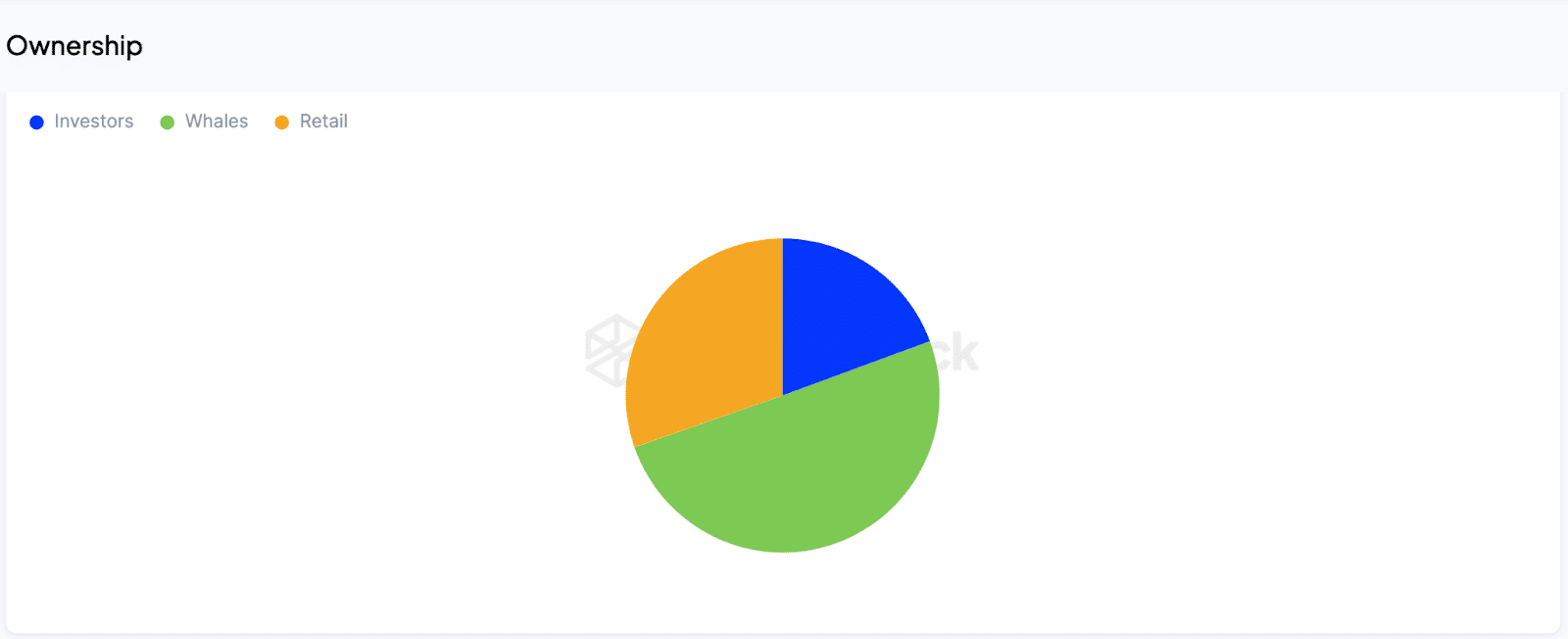
The ownership distribution of LINK reveals that whales hold approximately 50.29% of the total supply, equivalent to about 502.89 million LINK. Notably, this high concentration among a small number of addresses can lead to higher market volatility, as their actions can significantly impact the price.

Chainlink Ownership Stats IntoTheBlock
Chainlink Ownership Stats | IntoTheBlock

The chart illustrates the distribution among different holders: whales, investors, and retail. Although exact percentages for investors and retail are not provided, the significant portion held by whales indicates their dominant influence on the market dynamics. 

Shorter Term Volume and Accumulation Trends

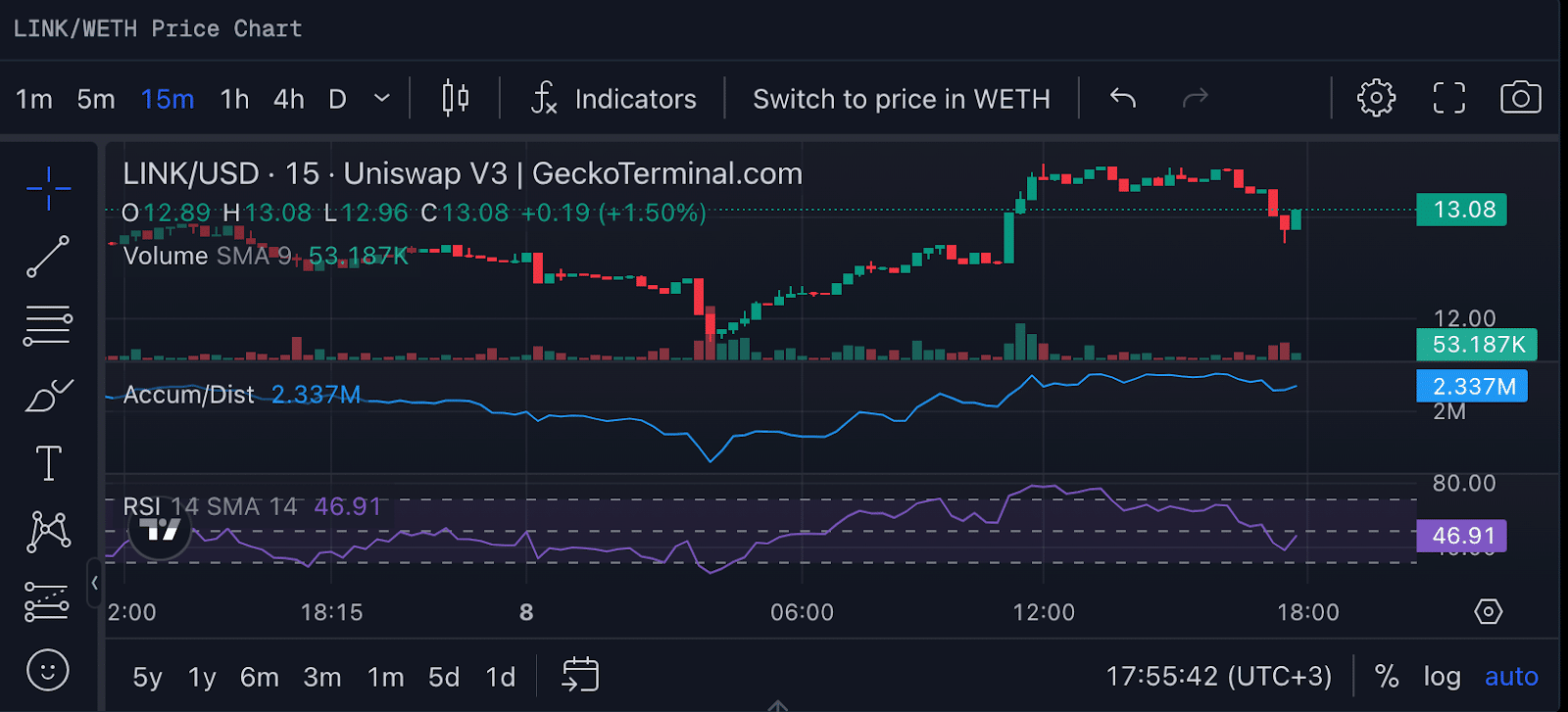
LINK’s Volume over a 15-minute timeframe stands at 53.187K, reflecting the average short-term volume. Increased trading volume often accompanies significant price movements. The Accumulation/Distribution indicator, at 2.337M, suggests balanced buying and selling activities, as the metric maintains stability.

LINK Short Term Performance
LINK Short-Term Performance

The Relative Strength Index (RSI) at 46.91 indicates a neutral market, with no significant momentum in either direction. 

It is crucial to remember in June; Chainlink whales took advantage of a brief market recovery to offload some of their holdings. The Santiment chart shows that as of June 16, the top 100 whale wallets held 704.47 million LINK tokens. 

However, following Ethereum’s landmark legal clearance from the SEC on June 17, these whales sold off about 2.25 million LINK tokens by June 20, worth approximately $40 million.

Dormant Bitcoin Address with $2.74M BTC Wakes Up After 13 Years of Inactivity   

0

A Bitcoin address holding 48 BTC worth $2.74 million has been activated after 13 years of dormancy. 

Leading crypto tracking service Whale Alert called attention to the development in a post today. 

On-chain data from Arkham Intelligence shows that the whale behind the wallet transferred 2.949 BTC to two different addresses today. 

The first address received 1.949 BTC ($111,450), while the second address received 1 BTC. At press time, the wallet held 45.051 BTC, worth $2.57 million. 

More Dormant Addresses Reactivated 

The activation marks the latest instance involving the reawakening of a Bitcoin wallet after years of dormancy. This month alone, Whale Alert has indexed several of such wallets. On July 2, an anonymous user activated a 13-year-old dormant Bitcoin wallet containing $2.1 million worth of BTC. 

Another dormant address, which had been idle for over 10 years, was reactivated the following day. This address contained 43 BTC valued at $2.6 million at the time. 

On July 4, a dormant Bitcoin address holding 119 BTC woke up after 12.4 years of hibernation. 

Investors React 

Expectedly, the reactivation of multiple dormant Bitcoin wallets this month triggered reactions from crypto enthusiasts. Some users questioned whether the activation was carried out by scammers, given the number of cases that have been reported within a short period. 

Additionally, an X user characterized the latest activation as another cracked wallet. 

It bears mentioning that the majority of these dormant wallets were created when Bitcoin’s pseudonymous founder, Satoshi Nakamoto, was still active. During this period, people could acquire BTC at significantly lower rates compared to its current value. 

Also, some of these funds might belong to miners who were lucky to accumulate large amounts of BTC when mining rewards were still high. At the moment, the identity of the wallet’s owner remains unknown.

Over 1.75 Million BTC Dormant for Over a Decade 

Meanwhile, data from Fortune reveals that over 1.75 million addresses have been inactive for more than 10 years, with 1.73 million of these wallets holding less than 50 BTC. 

In addition, 12,070 wallets hold 50 to 51 BTC, 2,616 dormant wallets contain between 51 and 1,000 BTC, and the remaining 192 dormant wallets hold between 1,000 and 10,000 BTC.  

At press time, Bitcoin has seen a daily increase of 0.67% to $57,194. According to CoinMarketCap data, the top asset is respectively down 8.84% and 17.62% in the weekly and monthly charts. 

Shiba Inu Makes the Cut, Coinbase Names It a Top Asset

0

Shiba Inu ranks just below USDC on Coinbase, surpassing Bitcoin and Ethereum.

Shiba Inu (SHIB) has again captured the attention of the crypto community. A recent post by community figure Lola highlighted Shiba Inu’s standing on Coinbase, where it was listed as a top asset. 

According to the image shared by Lola, Shiba Inu ranks just below USDC on the list. Although some might argue that this also places SHIB ahead of well-established cryptos like Bitcoin and Ethereum in Coinbase’s asset listing, the parameter for the ranking remains unclear. As such, while the list spotlights top assets on the exchange, it could be in no particular order.


Coinbase and Shiba Inu’s Position

Nonetheless, Coinbase’s recognition reflects SHIB’s increasing acceptance and interest among traders. Despite SHIB’s recent price drop of 9.03% at the time of Lola’s post, its position speaks volumes about its market presence. 

Alongside SHIB, cryptocurrencies such as Solana, XRP, and Litecoin are also featured, each reflecting varying degrees of market fluctuation. According to the community figure, this prominence challenges the skepticism of Crypto Twitter, which has often underestimated SHIB’s potential.

Shiba Inu in the Broader Crypto Market

Shiba Inu’s prominence isn’t confined to Coinbase alone. The altcoin has also been featured prominently in Grayscale’s crypto asset spotlight. In a June 28 post, Grayscale recognized Shiba Inu among the largest crypto projects by market capitalization, alongside giants like Bitcoin and Ethereum. 

This recognition came despite SHIB experiencing a significant monthly loss of 34.8% between May 26 and June 26. Such losses, however, have not deterred SHIB from maintaining a strong market presence.

Technical Overview and Market Performance

From a technical perspective, Shiba Inu continues to show resilience. According to data from IntoTheBlock, its market cap stands at $9.11 billion, with a current price of $0.000017, marking a 7.45% increase in the last 24 hours.

Shiba Inu on Coinbase Data from IntoTheBlock
Data from IntoTheBlock

Notably, 52% of SHIB holders are in profit at the current price, indicating positive sentiment. Shiba Inu also boasts a high concentration of large holders (73%). Additionally, SHIB’s high price correlation with Bitcoin (0.9) implies that it may closely follow Bitcoin’s market trends.

German Government Dumped $419,286,862 in Bitcoin Today, But Prices Surge Instead

The German government is showing no signs of relaxing its ongoing Bitcoin selloffs via crypto exchanges, market makers, and some anonymous entities.

Earlier today, the Bitcoin address associated with the German government unloaded 1,000 BTC tokens, valued at $55.8 million at the time of the transaction, to external wallets. Among the beneficiaries were leading exchanges Bitstamp and Coinbase and an anonymous wallet suspected to be an over-the-counter (OTC) entity.

At the time of the Bitcoin offload, the premier asset was battling bearish volatility, trading at around $55K. Following the early morning round of sales, the German government’s Bitcoin portfolio dropped to 38,826 BTC worth $2.17 billion.

However, data from market tracking platform Arkham Intelligence shows that the government has a larger plan to liquidate more Bitcoin today. Their Bitcoin address has since moved an additional 1,738.7 BTC to more external wallets over the past few hours. In the subsequent transactions, it interacted with newer entities for the first time since the selling spree commenced in June.

The new entities include the institutional market maker Cumberland and an anonymous wallet with the initials “bc1qu,” as Arkham noted. At the time of the disclosure, the German government has moved 2,738.7 BTC worth $155 million.

German Government Dumped $419M Bitcoin, But Market is Bullish

However, more recent data shows the government address has offloaded even more Bitcoin assets, with some transactions as recent as 17 minutes ago at the time of reporting. 

At the last check, their Bitcoin holding has crashed to 32,488 BTC worth $1.86 billion. Essentially, the German government has offloaded as much as 7,338 BTC tokens today at press time worth $419,286,862, per Bitcoin’s current value. 

As of June, their wallet had a balance of 45,609 BTC. The latest figure of 32,488 implies that the authorities have liquidated 13,121 Bitcoins since last month.

Interestingly, their most recent sales occur at a time when Bitcoin is witnessing a recovery in value, opposing the usual bearish momentum that trails the government’s Bitcoin movement. Specifically, Bitcoin currently trades at $57,139.12, a significant uptick from the earlier low of $54,321. Notably, Bitcoin hit an intraday high of $58,100 before settling around $57K.

Before now, the German government’s unyielding Bitcoin liquidation had stirred the crypto scene, causing panic. However, the fear surrounding the development appears to be subsiding as the market today is bullish rather than bearish.

Bybit Extends Shiba Inu Support with Euro Trading Pair

Top cryptocurrency exchange Bybit introduces a new Shiba Inu trading pair with the Euro (EUR) as it looks to expand trading options for SHIB investors.

Bybit announced the new trading pair on X today. In the disclosure, the platform confirmed plans to list 12 new EUR pairs against various cryptocurrencies in the spot market, embedding a link to the official announcement for further details on the development.

Bybit Adds New Shiba Inu Pair

Information from the release indicates that the platform plans to list four new EUR trading pairs on three different days. Specifically, these EUR pairs will be available against other crypto assets on July 8, 10 and 12. Shiba Inu Inu features prominently among the trading pairs for today, July 8.

Notably, besides Shiba Inu, the exchange also disclosed intentions to launch EUR trading pairs against Pepe, Near Protocol and dogwifhat today. A quick look at the platform confirms that Bybit has already added support for these trading pairs at press time.

Bybit SHIBEUR Trading Pair

The SHIB/EUR pair has spiked 54.95% upon its introduction, with Shiba Inu currently trading for €0.00001534. The asset initially spiked to a peak of €0.00001572 but has since corrected to the current level. Five hours after listing, the pair now boasts a trading volume exceeding 511.2 million SHIB.

Bybit’s Extensive Support for SHIB

Following the latest development, Bybit now supports three Shiba Inu trading pairs on the spot market. The other two pairs are SHIB/USDT and SHIB/USDC. Also, the exchange grants its customers exposure to SHIB1000USDT and SHIB1000USDC perpetual futures trading pairs.

Data confirms that the SHIB/USDT trading pair on Bybit commands 1.97% of the global Shiba Inu trading volume. Notably, this pair has a 24-hour trade volume of $10.14 million, much lower than the $106 million figure recorded by the SHIB/KRW pair on Korean excavator Upbit.

Shiba Inu Markets CoinMarketCap 3
Shiba Inu Markets | CoinMarketCap

Bybit first listed Shiba Inu in December 2021, two months after the meme coin reached its all-time high. Since then, the platform has continued to expand support for SHIB and introduce campaigns aimed at fostering engagements. They then went on to introduce the SHIB/USDC pair in August 2022. 

The platform announced in April its integration of Google Pay for seamless crypto purchases. This development allowed investors to procure assets such as SHIB with their Google Pay accounts. Bybit currently holds 2.26 trillion SHIB worth $36.38 million in its Proof of Reserve (PoR). 

Atomic Wallet Takes a Jab at XRP: “Any Idea Why Nobody Uses XRP?”

0

Atomic Wallet’s critique of XRP on X (formerly Twitter) ignites community backlash, linking the wallet to past hacks.

Atomic Wallet, a non-custodial crypto wallet, recently stirred up the crypto community by questioning the utility of XRP on X, asking why nobody uses it. 


The remark has incited a wide array of responses from the community, particularly among those who are invested in XRP. Amid this criticism, XRP is trading at $0.4351, posting an 87.25% decrease from its all-time high of $3.40.

Community Reactions and Accusations

The community’s reactions to Atomic Wallet’s comments have been varied and intense. Several individuals have accused Atomic Wallet of fraud, linking it to the infamous hack that resulted in the loss of $35 million in various cryptocurrencies, including Bitcoin, Ethereum, and XRP.

Criticisms also targeted the wallet’s policy of requiring a 10 XRP reserve to activate a wallet, which has been described as a deterrent for users. This commenter said,

“Well when you steal 10XRP reserve when you create a wallet to activate it, it’s already a no go.”

Despite the negative backlash, numerous community members have defended XRP, citing its frequent use for international transactions. Some highlighted XRP as their primary method for transferring funds, emphasizing its practicality and efficiency.

Supporters believe that while XRP may not be widely used yet, its potential for institutional adoption could significantly increase its behind-the-scenes utility in the future.

Historical Criticisms and Changing Perceptions

Recall that XRP has faced substantial criticism in the past. Former Goldman Sachs analyst Murad Mahmudov previously labeled XRP and Cardano (ADA) as “cult meme coins,” suggesting their value is heavily reliant on community acceptance rather than intrinsic worth. 


In September 2023, Bitcoin maximalist Max Keiser reignited debates by claiming XRP is centralized, referencing a 1991 patent that listed Ripple’s CTO, David Schwartz, as an inventor.

However, as time passes, perceptions about XRP have evolved. Investor Virtual Bacon, who once criticized XRP for its centralization and poor price performance, later expressed belief in its potential for the next bull run. 

Ongoing Legal Battle Influences XRP Price

This criticism of XRP notably comes at a time when the ongoing lawsuit between the SEC and Ripple continues to be a significant factor influencing XRP’s price, contributing to its volatility and underperformance. Filed in December 2020, the lawsuit alleges Ripple violated securities laws. Since then, XRP has struggled to surpass its January 2018 high. 

Speculations suggest XRP’s adverse price action may persist until the lawsuit concludes favorably for Ripple. In July 2023, XRP briefly spiked to $0.93 following a partial court victory. This legal battle remains a critical element in XRP’s market performance, with eyes on the imminent final verdict.