Home Blog Page 1424

Bitcoin Spot ETFs Net Inflow Hits $886.75M on June 4, Second-Highest Ever

0

On June 4, Bitcoin spot ETFs saw a net inflow of $886.75 million, the second-highest intraday netflow in history, led by Fidelity’s $379 million and BlackRock’s $274 million.

According to data from sosovalue, several top-performing Bitcoin spot ETFs contributed to this capital flow. Leading the pack was the Fidelity Wise Origin Bitcoin Fund (FBTC), which attracted a substantial $379 million. FBTC reported a slight premium/discount of +0.14% and holds a net asset value (NAV) of $12.01 billion.

BlackRock’s iShares Bitcoin Trust (IBIT) recorded an inflow of $274 million. Meanwhile, the Grayscale Bitcoin Trust (GBTC) saw an inflow of $28.20 million. This marked GBTC’s first net inflow since May 20. The ETF had been witnessing outflows and zero flows since May 20, especially seeing a massive $134 million outflow on May 31. 

Other significant ETFs include the Ark 21Shares Bitcoin ETF (ARKB) and the Bitwise Bitcoin ETF (BITB). ARKB had an inflow of $139 million, while BITB attracted $61 million. Other Bitcoin spot ETFs saw negligible capital inflows, with no product recording an outflow. The last time this occurred was on May 24.

Cumulative Net Assets and Market Participation

The cumulative net assets of all Bitcoin spot ETFs reached $61.46 billion as of June 4, reflecting a 4.43% increase. The total value traded amounted to $2.78 billion, demonstrating active participation and confidence in the market.

The market prices of the top ETFs showed positive daily changes due to Bitcoin’s recent recovery, as it pushed above $70,000. GBTC closed at $62.62 with a daily change of +1.80%. IBIT saw a market price of $40.17, reflecting a daily change of +1.85%. FBTC was priced at $61.67, also showing a daily change of +1.85%.

The crypto community remains engaged in discussions about which cryptocurrency will next secure an ETF spot, following the U.S. SEC’s approval of Ethereum-based ETFs. A recent survey revealed that 63% of participants believe XRP is the most likely candidate, followed by 25.9% supporting Solana, and 11.1% voting for other cryptocurrencies.

It is crucial to note that the BlackRock’s IBIT product had briefly surpassed the Grayscale’s GBTC as the largest Bitcoin ETF, as highlighted by Arkham Intelligence on May 29. 

Here are Top 8 Altcoins That are Potential Solana Killers

0

Prominent market watcher Altcoin Daily highlights a list of altcoins that are potential Solana Killers in 2024, including Cardano, Polkadot, Toncoin, and Near Protocol.

Solana has recorded a remarkable performance this year, with the price of SOL skyrocketing by a whopping 69.6% year-to-date (YTD). The asset has achieved this feat despite the numerous downturns recorded across the broader market since the beginning of the year. 

At its current price of $172.94, SOL has witnessed a 4% spike over the past 24 hours and a seven-day growth of 2%. In addition, Solana’s price has soared 175.9% over the past six months. 

The surge in SOL’s price can be attributed to the influx of new tokens, particularly memecoins, on the Solana network. These new tokens have bolstered Solana’s network usage, thus driving the demand for SOL. Despite its remarkable performance, Solana has faced significant issues, like major network outages. 

Expert Identifies 8 Solana Killers

This has birthed speculations that other top decentralized crypto projects could rise to the occasion and pose a major threat to Solana’s dominance. The crypto community refers to these projects as “Solana Killers,” a bold statement indicating rivalry.  

Interestingly, prominent crypto analyst Altcoin Daily is among the market experts who share this sentiment. According to an X post yesterday, the analyst highlighted eight altcoins that are potential Solana Killers in 2024. 

Altcoin Daily’s list of potential Solana Killers includes Near Protocol (NEAR), Toncoin (TON), Aptos (APT), Polkadot (DOT), Mina (MINA), Cardano (ADA), Sui (SUI), and Cosmos (ATOM). 

Also, the top market watcher included Injective (INJ) in the list as a bonus while urging other crypto enthusiasts to propose other projects that are potential Solana Killers    

Possible Reasons Behind the Selection 

Although Altcoin Daily did not indicate the reason behind the selection, a common trait among these projects is their decentralized nature. Additionally, the crypto assets Altcoin Daily, tagged as Solana Killers, have also made major impacts in the crypto industry. 

Some have even outperformed Solana in certain aspects, like optimal performance. In particular, Cardano has not witnessed any major network outage since its launch in 2017. The team behind Cardano is focused on technological advancement, which has seen Cardano rank ahead of other crypto projects in terms of development activity. 

Meanwhile, most altcoins in the list, including Toncoin and Near Protocol, have witnessed more gains than Solana this year. Data from CryptoRank shows that the prices of NEAR and TON have surged 218.2% and 106.9% YTD, respectively, compared to SOL’s 69.6%. 

Nonetheless, SOL ranks among the top 5 crypto assets, with a market cap of $79.84 billion. Of the eight Solana Killers Altcoin Daily mentioned, Toncoin is the closest to Solana in terms of valuation. TON boasts a market cap of $17.89 billion, sitting as the ninth-biggest cryptocurrency. 

Cardano follows TON closely as the 10th-biggest asset with a market cap of $16.5 billion. It remains to be seen whether these cryptos could eventually threaten Solana’s dominance and outperform the asset in the long term. 

Ripple CEO Finally Issues Timeline for XRP ETFs to Launch 

Ripple CEO Brad Garlinghouse has confidently issued a timeline for the launch of an XRP spot exchange-traded fund (ETF).

Garlinghouse’s latest commentary on the subject came up during an interview yesterday with FOX Business. He emphasized the significance of other crypto spot ETFs besides Bitcoin, noting they are necessary for diversification.

Moreover, he noted that interest in crypto ETFs is high, as evidenced by U.S. Bitcoin spot ETFs reaching multi-billion dollar valuations in two months—which took comparable investments for gold years to attain. 

Also, Garlinghouse commented on the U.S. SEC’s now open arms to crypto spot ETFs amid the approvals for Ethereum ETFs. He suggested this shift stemmed from the regulator’s previous court losses and setbacks.

Considering these factors, the Ripple CEO conveyed confidence that ETFs for XRP, Solana, and Cardano are inevitable. Meanwhile, FOX correspondent Liz Claman questioned whether the SEC might show particular resistance to an XRP ETF, given its history with Ripple.

In response, the Ripple CEO stated that the SEC would have a hard time winning such an argument. He reinforced XRP’s potential by recalling its past position just behind Bitcoin in market ranking, strengthening the argument for an XRP ETF as investors look for diversification options.

XRP ETF by 2025, “Not Too Far Away”

When pressed by the host for a timeline on when an XRP ETF might become a reality, Garlinghouse optimistically stated it is “not too far away.” Specifically, the Ripple CEO suggested that an XRP ETF could launch by next year, 2025.

XRP community-driven account XRP DROPZ called attention to this new commentary from Garlinghouse in a post on X.

This timeline aligns with the sentiment expressed by other industry commentators, including Sean McBride, Ripple’s former director. However, ETF analysts like James Seyffart of Bloomberg Intelligence have a more conservative outlook. 

Seyffart argues that the earliest timeline for the next crypto spot ETF in the U.S. after Ethereum is 2026. He even issued this timeline for a Solana ETF, suggesting that the prospect of an XRP ETF is farther off due to several factors.

These factors include Ripple’s ongoing lawsuit, the current leadership of the SEC, and the absence of a CFTC-regulated futures market for XRP. 

Notably, Solana also requires a futures market, which is part of the reason Seyffart suggested a 2026 timeline.

Shiba Inu Investor Buys Over 323,100,274,666 SHIB Following Two-Year Silence

An early Shiba Inu whale address reawakens after 2.6 years of inactivity, purchasing over 323 billion SHIB with wrapped Ethereum (WETH) in three hours.

Blockchain surveillance platform Spot on Chain first called attention to this whale’s latest activities. Notably, the address initially received 167 billion SHIB in April 2021, eight months after Shiba Inu launched. These tokens were sent from one of the earliest whales that interacted with SHIB upon launch.

Three months after receiving the 167 billion SHIB, the address then staked all the tokens in July 2021. After an additional three months, he unstaked the tokens on Oct. 24, 2021, securing an extra 12.9 million SHIB. The whale proceeded to sell off all 167.012 billion tokens on the same day.

Recent Shiba Inu Accumulation

After these selloffs, the whale address went to slumber. Now, with the bull market looking to get into full gear, this address has now reawakened. This time, the whale carried out an astonishing 156 transactions involving millions to billions of Shiba Inu today from 01:43 to 03:48 UTC.

At the time of Spot on Chain’s disclosure, the whale had procured 149.3 billion SHIB with about 1,000 wrapped Ethereum (WETH) valued at $3.83 million. Following the platform’s report, this whale address persisted in the purchasing spree, procuring additional 173 billion SHIB.

By the end of the wave of transfers, the address had swapped 2,188 WETH for 323 billion Shiba Inu tokens worth $8.29 million in three hours. As of press time, the whale has not distributed nor sold any of these tokens, with his SHIB balance currently sitting at 323 billion tokens.

Post-Accumulation Activities 

Interestingly, Shiba Inu represents the only significant holding on his portfolio, as other assets are in negligible quantities. For instance, the whale only holds 0.4 Ethereum (ETH) worth $1,587 and 8,433 Cellframe (CELL) valued at $5,611. 

It remains to be seen if the whale will repeat the same trading activity from 2021, where he staked the Shiba Inu tokens for 3 months before unstaking and selling them off. Notably, his earlier foray into the Shiba Inu market in 2021 saw him procure the 167 billion tokens at a price of $604,540. 

However, he sold them for $5.6 million in October 2021, when Shiba Inu had begun its historic rally. This smart play allowed the whale address to walk off with an impressive $5 million profit in a mere three months. A similar move would see him HODL the recently acquired 323 billion tokens until the market sees a resurgence.

Meanwhile, Shiba Inu is already on a path to recovery, having spiked 8% over the past 24 hours to reclaim the pivotal $0.00025 price territory. Currently changing hands at $0.00002577, SHIB has towered above the 50-day exponential moving average (EMA), but would need to transform this level to support if it wishes to retain these gains.

Shiba Inu to Reach $0.000128 if Ethereum Hits $20,000

Shiba Inu may establish a new historical high with a proportional value rise if Ethereum attains $20,000.

In recent days, Shiba Inu has faced challenges in gaining momentum. It reached a low of $0.00002343 in the past 24 hours, erasing all gains picked up in the previous week. Currently, SHIB is trading with an 8% decline in its overall performance over the past seven days.

Regardless of Shiba Inu’s current underperformance, enthusiasts are ever confident in SHIB’s prospects in this bull market. Moreover, Shiba Inu proved its bullish capability two months ago when it rose by 373% in under ten days.

This analysis weighs in on Shiba Inu’s potential market value in a scenario where the altcoin market leader, Ethereum (ETH), attains unprecedented prices like the $20,000 threshold.

Shiba Price with Ethereum at $20K

At press time, Ethereum sells for $3,795, reflecting 30-day gains exceeding 21%. For ETH to attain the $20K threshold, the altcoin leader must increase by 427%. Notably, this price point puts Ethereum’s market above $2.4 trillion.

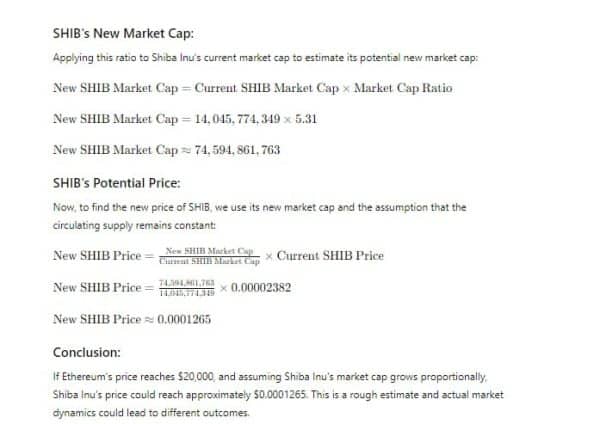
If Shiba Inu mirrors Ethereum’s growth and achieves a 427% increase from its current price of $0.00002433, its value could reach $0.0001282. This price level would be a record high for Shiba Inu, surpassing its all-time high of $0.00008845.

Remarkably, OpenAI’s ChatGPT attested to this potential value for Shiba Inu’s supposed Ethereum reaching $20K.

Shiba Inu prices estimate ChatGPT
Shiba Inu price estimate | ChatGPT

Meanwhile, at the hypothetical price of $0.0001282, Shiba Inu’s market cap would be $75.56 billion, still six times smaller than Ethereum’s current market cap of $457 billion.

According to IntoTheBlock stats, Shiba Inu has a 69% correlation with the price of ETH. This shows that there is a 69% chance that SHIB will follow ETH if it rises to $20,000.

Can Ethereum and Shiba Inu Soar by 427%?

Ethereum established an ATH at $4,891 three years ago and is currently trading at 22.34% below that peak. Ethereum nearly revisited this high in March when it crossed the $4,000 mark but subsequently retreated from that price point.

While a 427% increase would drive ETH to the $20,000 mark, market analysts generally anticipate a more modest peak for the crypto in the current bull market. 

For instance, Geoff Kendrick, who leads Digital Assets Research at Standard Chartered, suggests that Ethereum could reach $8,000 this year and potentially $14,000 by 2025. These more modest outlooks are despite Kendrick’s consideration of the likely influence of ETFs investing in ETH.

Meanwhile, the prospect of Shiba Inu reaching a price of $0.0001282 is a sentiment echoed by various analysts.

Historically, lower-tier altcoins, especially meme tokens such as SHIB, have a tendency to outpace the performance of established market leaders. Therefore, in a hypothetical situation where Ethereum experiences a 427% increase to hit the $20,000 mark, it is conceivable that Shiba Inu could see an even more significant price jump. 

Essentially, while a 427% surge might seem ambitious for Ethereum, it is considered a more achievable target for Shiba Inu. This is further confirmed by the impressive 373% rally SHIB engineered between February 27 and March 5.

XRP Upholds Weekly Support, Targets $1.33 Upon Cup and Handle Formation

XRP continues to defend its weekly support, looking to engineer a rally toward $1.33 upon the formation of a reliable cup and handle pattern.

The crypto market has not followed a decisive trend over the past few days, with prices largely trading within a range. This consolidation has reverberated across the entire market, impacting XRP’s potential to breach the $0.5 territory.

XRP Defends Weekly Support Despite Downtrend

Amid the ongoing market uncertainty, XRP closed May below the pivotal 50-day exponential moving average (EMA) and has since remained underneath this pivotal level. Despite the downtrend, market analyst Cryptoes recently confirmed that XRP has continued to defend its support on the weekly timeframe. 

Data from Cryptoes’ chart shows that the downward pressure pushed XRP below a crucial upper trendline in early April when it collapsed 15% within seven days to $0.5037. Despite recovering from the $0.50 region, XRP has failed to reclaim the $0.60 territory. This has resulted in an inability to again break above the upper trendline.

Nonetheless, the bulls have fiercely defended any drops below the significant weekly support at the lower spectrum of the $0.5 zone. Cryptoes suggests that XRP maintains a solid position on the weekly chart despite the market volatility, projecting a big move upward to occur soon.

A Potential Spike to $1.33

Another market watcher Dark Defender further confirms the bullish structure on XRP’s weekly chart. According to him, the Fisher Indicator suggests that XRP has slipped into oversold territories. The Fisher Indicator converts price movements into a normal distribution, highlighting extreme levels to help identify potential turning points in the market.

Interestingly, the oversold signal from the Fisher Indicator is only one of multiple pointers fueling Dark Defender’s optimism. He further revealed that XRP has formed a cup and handle structure on the weekly timeframe. A cup and handle pattern signifies a potential bullish breakout, indicating a possible continuation of an upward trend after a period of consolidation.

Dark Defender expects XRP to eventually push above its previous highs below $1. The analyst believes a spike to $1.33 could materialize once XRP secures a breakout above the handle. Notably, the last time XRP saw the $1.33 price level was during the previous bull run in November 2021. 

Data from Dark Defender’s chart indicates that XRP’s breakout could push it to the November 2023 highs at $0.7476. From this level, he projects a possible 77% spike to the $1.33 price. Meanwhile, XRP currently trades for $0.5253, up 2.20% on the current weekly candle. Its RSI currently sits at 46, suggesting room for expansion.

The Ultimate Guide To Crypto Presales – How To Choose And How To Invest

0

Crypto presales allow developers to gauge interest, raise funds, and increase demand for their projects within the crypto community. The involvement and financial support from investors and early supporters during the presale phase validate the project’s idea, functionality, and potential market reception.

A successful crypto presale can spark enthusiasm and anticipation around a project, igniting conversation in the community and drawing attention from potential investors, influencers, and media platforms.

What Is a Crypto Presale?

A crypto presale happens before the official launch or Initial Coin Offering (ICO) of a new cryptocurrency. During this phase, early supporters and investors are allowed to purchase the cryptocurrencies at a discounted rate. This usually happens before the cryptocurrencies and tokens are made available to the general public and are listed on crypto exchanges.

Key points of a crypto presale include:

  • Exclusive access: Early-stage investors are allowed to invest in a cryptocurrency project before it hits the mainstream market. During upcoming crypto presales, access is limited to selected investors. Alan Draper from Crypto News explains that investing in the presale stage fosters a sense of exclusivity with like-minded individuals, allowing investors to become a part of the core community.
  • Discounted prices: Tokens and coins in a presale are usually offered at discounted prices compared to the public sale. This provides early investors with the potential for high returns if the project is successful.
  • Fundraising for projects: Presales are crucial for raising funds for the crypto project’s development, operational expenses, and marketing. Presales also raise funds for testing the market and measuring investor interest before launching publicly.
  • Building community: Presales help in building a community of backers committed to the crypto project’s growth and success. It’s an opportunity for investors to not only provide financial support but also provide feedback on the project.
  • Potential for high returns: If the project is successful, the value of the tokens increases significantly, leading to potentially high profits for early investors.
  • Potential risks: Crypto presales also come with their fair share of risks, such as market volatility, security risks, and uncertain project viability.

Understand the Difference Between Crypto Private Sale, Presale and ICO

Understanding the difference between a crypto presale, private sale, and initial coin offering is crucial. Each sale has a different investment structure, risk profile, potential rewards, and different regulations. Understanding these differences helps investors make informed decisions, align their risk tolerance for the project, and ensure compliance with regulations.

Private Sale

Private sales take place before the crypto presale, mostly before the project is fully developed. Private sales are usually for a specific group of investors who may be required to invest a higher minimum amount. Private sales are often much riskier than public sales since they may lack a certain level of transparency, making it challenging for investors to assess the project’s viability.

Presale

After private sales, the next stage in the process is the presales. This is a strategic phase of the project to boost early investments to meet fundraising goals and engage the community. During this phase, developers can identify potential challenges, set their fundraising targets, and refine their marketing strategies.

Sealana, for instance, has a unique presale model that sets it apart from traditional crypto presales. Investors can purchase Sealana tokens by directly transferring Solana to specific wallet addresses before receiving an airdrop of Sealana tokens to their wallet. This user-friendly and streamlined method eliminates the need for investors to claim their holdings. Alternatively, investors can purchase Sealana using an over-the-counter widget on their website to invest in the token. This presale model has been successful, raising over $200,000 within the first four days of the launch.

ICO

The ICO is the final stage of the token sales, which are made available to the general public. ICOs often have higher prices than presales and generally carry lower risks since the project is more developed in the final stages.

Main Types of Crypto Presales

Crypto presales can be categorized into different types, each designed to target different investors. The main types of presales are:

  • Private presale: This presale type is targeted to institutional or accredited investors with higher minimum requirements.
  • Whitelist presale: Whitelist presales focus more on a limited participant group that meets certain criteria and can only be accessed through a specific list or application process.
  • Public presale: This is open to the general public and used to attract more investors and to reach different investor profiles.
  • Strategic Partner presale: This type of presale is for business partners, providing investors the opportunity to collaborate on a project.
  • Community presales: These are exclusively for members of the project’s community and act as a presale reward that has specific terms and conditions.

How Do Crypto Presales Work?

Announcing the Presale

Crypto presales start when the project’s team publicly announces the presale with the details about the token, including the total token supply, its utility and use cases, and the terms of the presale. The presale terms typically include the pricing, discounts, bonuses, and any lock-up or vesting periods. Investors interested in the token are required to register for the presale, which often includes Know Your Customer (KYC) procedures to comply with specific regulatory requirements.

Additionally, the announcement will include the accepted payment methods (for example, using cryptocurrencies like Bitcoin or Ethereum), the minimum or maximum amount that can be invested, and the start and end dates of the presale. Some presales may limit the amount of investors by implementing a whitelist. This could require investors to apply for whitelisting and meet specific criteria. Whitelisting is often used for targeting institutional or accredited investors.

Purchase Process

To participate in crypto presales, investors would typically connect a wallet to the presale platform. The wallet must be funded with a supported crypto asset like Ethereum or Bitcoin. Once investors select the payment currency and the number of presale tokens to buy, the investment will be confirmed.

Presale Close and Exchange Listings

Crypto presales usually close when the hard cap target has been reached or the predetermined end date has been passed. After the presale concludes, the tokens are usually listed on various crypto exchanges within a few days. The listing price will be much higher than the presale price. Once a presale is over, investors can expect to use their cryptocurrencies within a few weeks or a month or after a specific lock-up period. Investors are free to sell, trade, transfer, and even use them at online casinos to play crypto poker.

The Risks and Benefits of Crypto Presales

Crypto presales can be beneficial and risky for investors. There is a chance the project might fail or the token’s value will not increase. Some tokens bought in presales may not be immediately traded which could be problematic for investors looking to liquidate quickly.

For example, the SLERF token presale failed miserably due to a technical error, resulting in the loss of $10 million worth of SOL tokens. The loss of funds was a significant financial blow for investors and the lack of liquidity resulted in a permanent loss of funds.

The benefits of presales, on the other hand, could mean significant high returns on their investment. Additionally, some presales offer exclusive bonuses and incentives that are not available on exchanges or publicly. For instance, Shiba Shootout offered a 35% bonus on tokens purchased during their presale. The success of the token’s presale attracted significant investor interest, raising over $230, 000 in the first few days.

How to Choose and Invest in Crypto Presale Tokens

Choosing and investing in crypto presales involves several steps and considerations to ensure that you are making an informed decision.

  • Research the project: Look for projects that have a whitepaper, a clear roadmap, and a competent team to assess the project’s potential and viability.
  • Vet the team: Always check the background of the team behind the project. Look into their experience, their background, and the previous experience they have been involved in.
  • Identify legitimate presale platforms: Select platforms that have a strong reputation, user-friendly interfaces, and security. This reduces the risk of scams and falling victim to fraudulent projects.
  • Understand the presale details: Analyze the token economics of the project, including the supply and distribution details, and what drives its value. Familiarize yourself with the listing plans after the presale concludes.
  • Manage your investment risk: Be aware of the risks involved, including the potential scams. Stay up-to-date with the project’s news and its progress.

Conclusion

Crypto presales are the cornerstone for successful project launches. This success can lead to sustainable growth when handled effectively. Crypto presales are mutually beneficial for both projects and their users, as projects use presales to raise capital while investors secure early access and potential bonuses and buy tokens at discounted prices.

Disclaimer: This article is provided by the Client. The Client is solely responsible for this page’s content, quality, accuracy, products, advertising, or other materials. Readers should conduct their own research before taking any actions related to the material available on this page. The Crypto Basic is not responsible for the accuracy of info and any damage or loss caused or alleged to be caused by the use of or reliance on any content, goods, or services mentioned in this article.

Please note that The Crypto Basic does not endorse or support any content or product on this page. We strongly advise readers to conduct their own research before acting on any information presented here and assume full responsibility for their decisions. This article should not be considered investment advice.


5 Of The Most Exciting Blockchain Projects To Watch In 2024

0

BlackRock’s launch of the first Bitcoin spot ETF in January has reignited interest in the wider blockchain industry, sparking more institutional investment and renewed enthusiasm for crypto industries such as DeFi, GameFi, NFTs and more. 

As crypto prices rise again, many believe that yet more growth is on the horizon as we approach summer 2024, so what better time to take a look at some of the most promising blockchains to watch out for right now?

1. Polygon

Polygon is perhaps the most recognizable Layer-2 scaling network for Ethereum, making it possible for EVM developers to rapidly scale their dApps. 

Its network is linked to the Ethereum blockchain and is compatible with any project built on that chain. Its primary purpose is to boost the scalability, flexibility and sovereignty of Ethereum dApps, while still providing strong security and full interoperability with the world’s top smart contract blockchain. 

Polygon’s native ERC-20 token is MATIC, which is compatible with other ERC-20 tokens, and provides utility such as paying gas fees, securing the network and governance. 

Polygon has emerged as one of the most prominent Ethereum scaling networks because of its rapid speed, which results from its carbon-neutral consensus mechanism that’s able to confirm transactions in a single block, with an average block processing time of just 39.7 seconds. It also offers consistently low gas fees and interoperability with Ethereum’s massive ecosystem. 

As the host network of thousands of dApps and also stablecoins such as Tether and USDC, Polygon has attracted interest from well known companies such as Meta Platforms, Stripe and banks like Deutsche Bank and Credit Suisse. Given its already strong foundation, it’s poised to grow immensely if and when the broader crypto industry takes off. 

2. Merlin Chain

Merlin Chain is a Layer-2 network that aims to bring the magic of DeFi, GameFi, community coins and more to the Bitcoin ecosystem. 

The project is being developed by Bitmap Tech and aims to shake up Bitcoin by introducing genuine utility for the world’s most famous crypto asset. It does this with a number of technical innovations, including its use of ZK-Rollups to boost the efficiency, security, and scalability of Bitcoin. Another component is its use of on-scale fraud-proof mechanisms that works by reverifying each transaction proof that has already been verified by its ZK-Rollups to ensure no mistakes. There’s also a segregated oracle network that runs in the background. Merlin leverages the Decentralized Oracle Network to fetch data from external sources, so its smart contracts can leverage this information to bring more utility to Bitcoin-native assets. 

Merlin’s native token is MERL, which is used for governance, transactions, and more, enabling users to interact with its growing ecosystem of dApps and vote on various issues up for discussion within the community. 

Most exciting is the rapid build-out of Merlin’s ecosystem, with many projects building on its platform that enable Bitcoin holders to utilize their BTC in exciting new ways. They include infrastructure projects such as GeniiData, which is a native script data platform, and UniCross, an engraving tool for Bitcoin ordinals. 

Others include the BTC-native stablecoin BitSmiley, the AMM trading protocol Surf Protocol, and community coin-focused projects such as VOYA and HUHU. Merlin is also making waves in SocialFi with Influpia and in GameFi with Bitmap War. 

3. Fetch.ai

A list of blockchains for 2024 wouldn’t be complete without a mention of AI, which is the hottest trend in tech today. Fetch.ai has created an AI blockchain that aims to take legacy systems and applications and help them to integrate AI capabilities and services. 

Besides hosting the infrastructure for AI, Fetch.ai also offers access to numerous AI agents that perform tasks such as connecting, searching, transacting and creating content, allowing them to help humans complete all kinds of work. Developers can build on these AI agents, customizing them to perform many different jobs.

The network is powered by the FET token, which is a sovereign Layer-1 coin that has seen its value grow enormously this year, among the best performing cryptocurrencies in 2024 to date. 

One reason for that recent growth may be the launch of DeltaV, which is described as an “open platform for the new AI economy”. It’s a search-based AI chat interface powered by Fetch.ai’s agents, and is capable of understanding written conversations, similar to ChatGPT, providing cohesive responses to almost any query. It’s primarily designed as a kind of virtual assistant for e-commerce platforms, enabling them to integrate a comprehensive chat experience that can help shoppers to find the items they’re looking for by describing them with natural language. 

The AI industry is accelerating fast and as the need for decentralized models becomes more apparent, Fetch.ai has a fantastic opportunity to increase its relevance. 

4. Nolus

Nolus is transforming DeFi with the concept of “leasing”, enabling users to secure more capital upfront than what they currently own, borrowing from the concept of “buy now, pay later” in the retail world. 

The Nolus DeFi lease allows users to get around the need to overcollateralize loans that’s common in traditional DeFi, which creates a barrier to access, not to mention inefficiencies such as locking up capital that could help to minimize counterparty risks. 

With Nolus, users still have to provide collateral, but they can obtain financing of up to 150% on that deposit, meaning it’s really an undercollateralized loan. In addition, the liquidation process is also more flexible with Nolus, as it will only liquidate a part of the user’s collateral if the asset price falls by more than 30%, meaning borrowers still have a chance to recover their position. It makes the claim that its liquidation rates are around 40% lower than average, compared to other protocols. As another benefit, Nolus also locks its interest rates into smart contracts as soon as they are created, meaning users don’t have to worry about variable interest, as they do with many other DeFi protocols. 

Unlike many other protocols, Nolus has built its very own Layer-1 proof-of-stake blockchain, using the Cosmos SDK. Smart contracts are written in Rust, and executed using the CosmWasm sandbox model. What this means is that it’s compatible with other chains within the Cosmos ecosystem, and extremely secure. 

Nolus’ alternative DeFi model has a lot going for it, and its total value locked has grown from just over $1 million at the start of the year to more than $3.1 million today. 

5. R3 Corda

R3’s Corda has attracted a lot of debate over whether it’s truly a blockchain or not, and the company itself adds to this ambiguity, referring to its as “both a blockchain and not a blockchain”. 

What Corda is, is a decentralized ledger that’s actually somewhat centralized. It’s aimed at large enterprises, banks, financial services providers and insurers, providing them with an alternative, blockchain-like experience. It relies on a novel consensus mechanism, where transactions are linked cryptographically, but not batched into blocks. Instead, every transaction is processed immediately, in real time. 

Corda has built up a loyal following, with some of its customers including HSBC, Bank of America, Intel and Microsoft, who use it to facilitate transactions and build smart contract-based dApps. It provides tools for automating business logic that can be executed across organizational boundaries, and a service called Corda Payments for companies that need to integrate distributed payment capabilities into their apps. 

Corda also supports a growing ecosystem of CorDapps, offering its very own launchpad to enable developers to get funding for their projects. 

Given the strong traction Corda has achieve so far, many believe that it’s destined to become a leading player in industries such as insurance, where it can facilitate rapid payouts to claimants, and also “central bank digital coins”, or CBDCs, which are a digital version of traditional fiat currencies that many countries are experimenting with. 

Disclaimer: This article is provided by the Client. The Client is solely responsible for this page’s content, quality, accuracy, products, advertising, or other materials. Readers should conduct their own research before taking any actions related to the material available on this page. The Crypto Basic is not responsible for the accuracy of info and any damage or loss caused or alleged to be caused by the use of or reliance on any content, goods, or services mentioned in this article.

Please note that The Crypto Basic does not endorse or support any content or product on this page. We strongly advise readers to conduct their own research before acting on any information presented here and assume full responsibility for their decisions. This article should not be considered investment advice.
Shiba Inu Needs to Breach this Crucial EMA to Secure an Uptrend

Shiba Inu must break above the 50-day exponential moving average (EMA) to flip its momentum from range-bound to bullish.

The crypto market is currently in an indecisive phase, where prices continue to move within a range. At this stage of the market, Bitcoin (BTC) and other notable assets fail to record any significant move up or down, as market forces struggle to find a prevalent trend.

Notably, The Crypto Basic confirmed today that Shiba Inu has a 79% correlation with Bitcoin over the last 30 days. This indicates that SHIB typically follows Bitcoin’s price movements within this period. As a result, the ongoing market consolidation has also impacted Shiba Inu. 

SHIB’s Trend Shifts from Bullish to Bearish

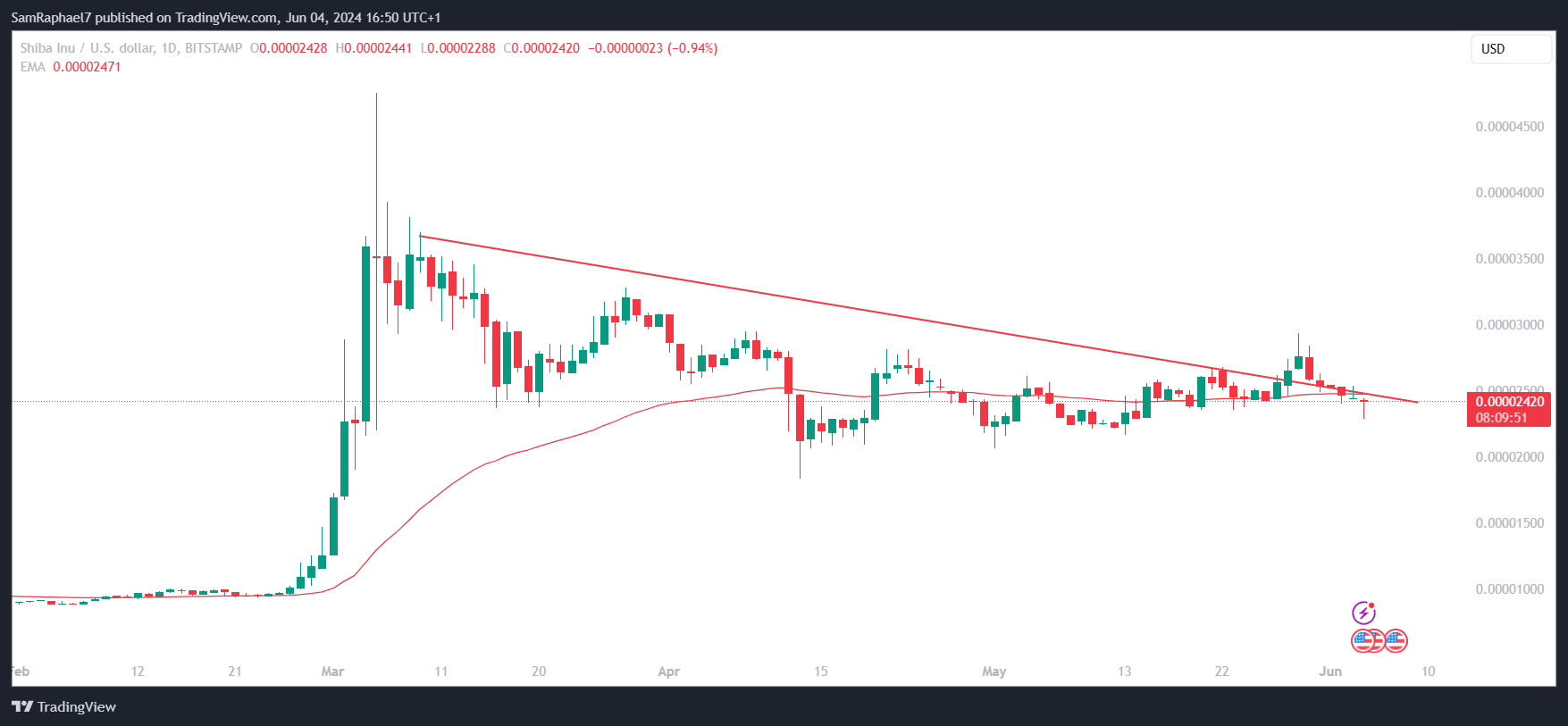
However, SHIB has leaned more into bearish territories, recently recording a price dip. This dip has pushed Shiba Inu below the pivotal 50-day EMA, indicating a shift in mid-term momentum from bullish to bearish. This slump underneath the 50-day EMA occurred yesterday, as SHIB closed the day at $0.00002427, below the $0.000025 support.

Shiba Inu 50D EMA 045926
Shiba Inu 50D EMA

This bearish trend began on May 30 after SHIB retested the resistance at the $0.00003 level. At its current price, Shiba Inu has now dropped 12% since May 30. However, optimistic projections have emerged, with market analysts expecting SHIB to flip the bearish trend. Nonetheless, market data suggests that this relies on SHIB’s ability to breach the 50-day EMA.

This pivotal level currently hovers around $0.00002471. Shiba Inu must confidently close above the price territory to successfully end the ongoing bearish trend. Essentially, a break into the $0.000025 psychological threshold might grant enough strength to the bulls to engineer a trend shift.

Shiba Inu Needs to Breach and Maintain the 50-Day EMA

However, a push above $0.000025 is not sufficient to maintain the uptrend, as observed in past movements. This is due to how fickle the support at $0.000025 currently is. SHIB must flip the $0.00003 price territory from resistance to support if it seeks to retain the uptrend. Otherwise, the bears could trigger another slip below the 50-day EMA.

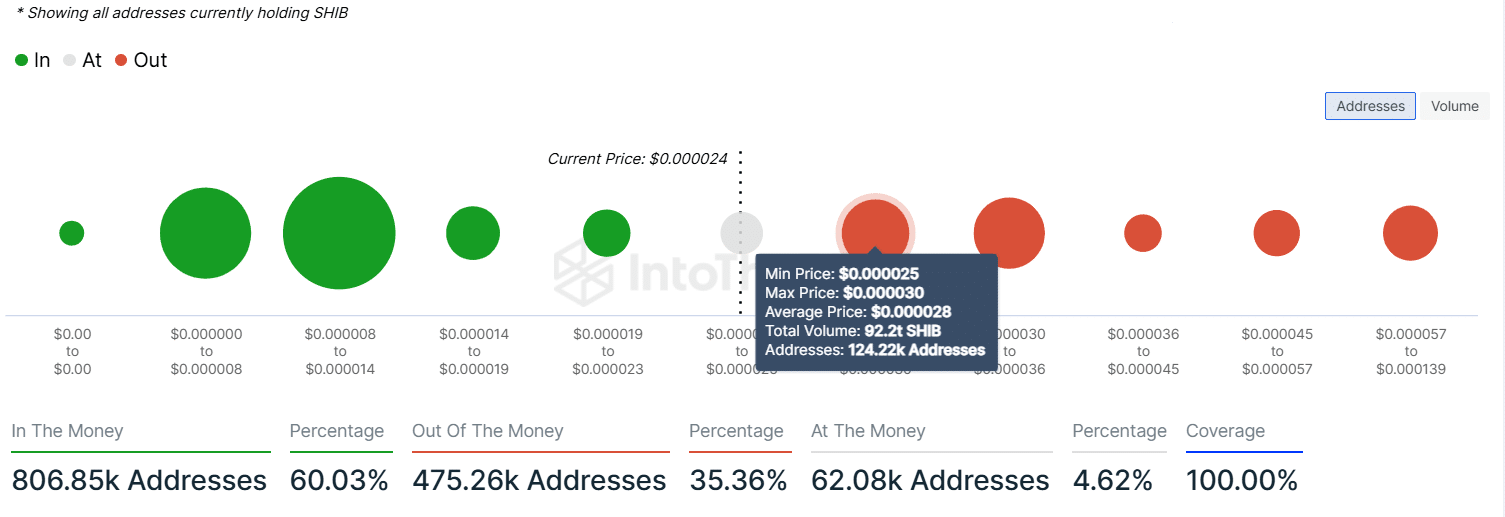
Nonetheless, Shiba Inu would continue to face a fierce battle on the path to recover $0.00003. IntoTheBlock data indicates that the dog-themed token faces a massive sell wall at this level, where 124,220 addresses procured 92.2 trillion SHIB tokens between $0.000025 and $0.00003. 

Shiba Inu GIOM IntoTheBlock 2 045840
Shiba Inu GIOM | IntoTheBlock

These addresses rush to offload their holdings at breakeven when SHIB attempts to breach this level, exerting more selling pressure and foiling the breakout attempt. Shiba Inu would need a resurgence of accumulation to counteract the impact of this selling pressure next time it retests $0.00003.

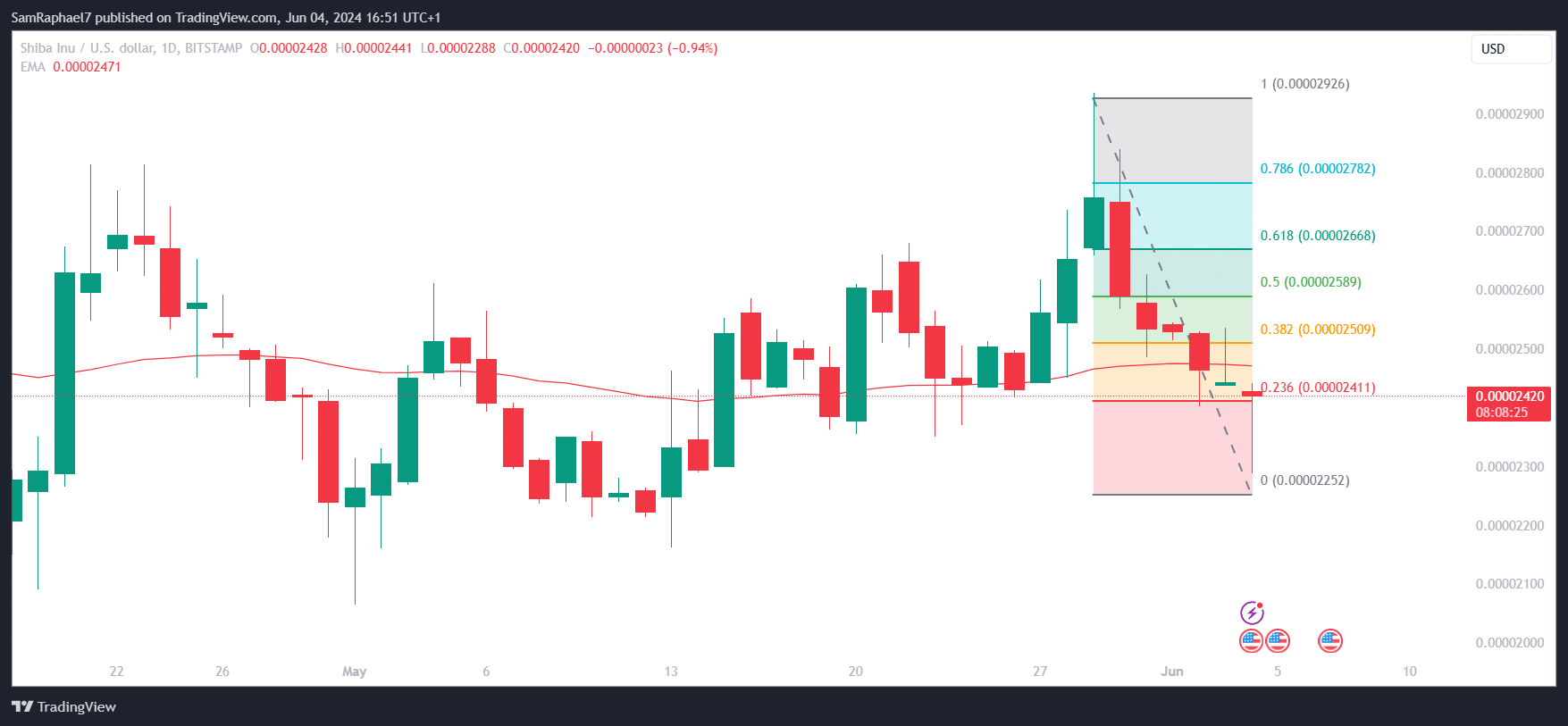
At the current price of $0.00002420, Shiba Inu’s most immediate resistance rests at the 38.2% Fibonacci retracement level ($0.00002509). After conquering this zone, SHIB faces four more resistance points from $0.00002589 to $0.00002926 on the journey to $0.00003.

Shiba Inu Resistance Levels 2 045928
Shiba Inu Resistance Levels

Analyst Van de Poppe Predicts Notcoin to Spike 2-5x Against Bitcoin 

0

Market veteran Michaël van de Poppe predicts a 2-5x surge for altcoins like Notcoin (NOT) against Bitcoin (BTC), as its market growth continues to ignite investor interest.

Michael van de Poppe, a seasoned market analyst, has recently highlighted the potential growth of altcoins, with a particular focus on Notcoin (NOT). According to van de Poppe, altcoins, including NOT, are expected to perform significantly well, potentially achieving a 2-5x increase against Bitcoin in the next four months. 

This optimistic outlook comes as Notcoin shows substantial market activity and volatility. Van de Poppe’s words point to the increasing interest in altcoins, suggesting a promising trend for investors in the market.

Notably, per another analyst, Rekt Capital, the Altcoin Market Cap is set to achieve its highest weekly close since early April 2024. This development is perfectly in line with the Ultimate Altcoin Market Cap Game Plan outlined by the market watcher months back.

Notcoin’s Market Performance 

Currently, Notcoin trades at $0.023676, with a 24-hour trading volume of $2,207,341,547. The cryptocurrency has seen a 3.22% increase in the last 24 hours. Currently ranked 49th on CoinMarketCap’s list of largest assets, Notcoin has a market cap of $2.4 billion.

A comparative performance chart highlights the distinct behaviors of Notcoin (NOT) and Bitcoin (BTC) from May 17 to June 4. The data shows that while BTC remained relatively stable around the 0.00% mark with minimal fluctuations, NOT exhibited considerable volatility.

Initially, NOT fluctuated around 0.00%, experienced a notable dip below -5.00%, and began a significant rise around May 30, peaking above 15.00% by June 1.

Though it declined afterward, it remained above the 5.00% mark by June 4. On the other hand, Bitcoin maintained a stable performance close to the 0.00% mark with very minimal fluctuations, indicating lower volatility compared to Notcoin.

Impressive Trading Volume and Market Activity

Recent data shared by IT Tech, a verified author at CryptoQuant, shows Notcoin’s trading volume was second only to Bitcoin. At the time of the disclosure, Notcoin recorded a 24-hour trading volume of $16.33 billion, surpassing Ethereum’s $11.71 billion.

On the other hand, Notcoin’s open interest stands at $227.47 million, which is considerably lower than Bitcoin’s $11.89 billion and Ethereum’s $8.88 billion. Open interest represents the total number of outstanding derivative contracts, indicating a smaller derivatives market or less leveraged trading for Notcoin. 

Additionally, Notcoin boasts a high 24-hour funding APR of 31.101%, suggesting strong incentives for traders to maintain positions in its perpetual futures contracts. This contrasts with BTC and ETH’s lower funding APRs of 12.481% and 14.835%, respectively, reflecting more balanced funding conditions.

Last month, The Crypto Basic reported a 600% rally in Notcoin’s price following its launch on May 16. This surge was driven by increased market liquidity and investor participation, triggered by its listings on Binance and OKX. 

Within 24 hours of being listed, Notcoin climbed into the top 10 cryptos by daily trading volume, attracting over $1.2 billion.