Home Blog Page 1476

The Web3 Revolution: Reshaping Real Estate Investment For The Masses

Rising costs and reduced affordability dominate the real estate market, particularly among younger generations. As complete property ownership becomes less available, fractionalized real estate is gaining popularity as an alternative. This strategy allows for smaller property investments.

Web3 technologies, noted for their transparency and security, are well-suited to supporting and improving these marketplaces. Using smart contracts and decentralized networks, Web3 assures global transactions are safe and fair. One good example is MANTRA, a compliance-driven platform that combines these technologies to make real estate investing more accessible to a wider audience.

The Issue: Rising Real Estate Prices and Limited Accessibility

Global property costs have skyrocketed in recent years, severely limiting access to the real estate market. This steady expansion is being driven by reasons such as urbanization, a demand-supply imbalance, and speculative investments. The effect is especially hard on younger generations and low-income groups, who are increasingly unable to afford homeownership owing to stagnating salaries and rising living expenses.

These people often lack access to the usual advantages of real estate investing, such as stability, inflation protection, and equity development. This lack of access not only inhibits financial growth but also expands wealth disparities and deepens socioeconomic inequalities, highlighting the long-term economic and social consequences of the present housing affordability problem.

The Growth of Fractionalized Investment Markets

Fractional ownership enables several investors to co-own high-value assets, such as real estate or art, with expenses and advantages proportionate to their ownership part. This investing strategy has gained popularity in real estate and fine art and luxury goods, providing access to areas once reserved for the wealthy.

The emergence of fractionalized investment platforms has been fueled by technical improvements and legislative reforms, which allow capital pooling to purchase and jointly manage properties or artworks. These platforms are growing in popularity because of the simplicity of Internet transactions and cheaper entry fees, enabling smaller investors to participate in markets formerly controlled by wealthy people or organizations.

The benefits of fractional ownership include financial accessibility, portfolio diversification, and a lower risk of single ownership. It also enables investing across asset classes and locations. Community-wise, it stimulates local economies by boosting property transactions, opening up new investment opportunities, democratizing wealth creation, and encouraging market stability and inclusion.

Looking at MANTRA: A Real-Life Example

MANTRA, a Layer 1 blockchain, prioritizes compliance in the fractionalized real estate market, driving regulatory innovation in Web3 technologies.

Recognizing the importance of regulatory compliance in blockchain, MANTRA is customizing its blockchain, the MANTRA Chain, to match these standards, which is critical for attracting crypto enthusiasts and institutional investors from regulated industries that value security and legal compliance.

The MANTRA Chain is designed to work seamlessly with international regulatory frameworks. Its modules adhere to strict regulations and licenses from recognized bodies such as SOMA.finance in the United States. There are also ongoing efforts to obtain additional certifications in the UAE and Latin America. This emphasis on compliance is critical for establishing a credible basis for fractional real estate ventures.

Furthermore, MANTRA prioritizes transparent operations and worldwide compliance requirements on its blockchain, combining on-chain identity and permissioned access to satisfy the demands of conventional financial institutions. Its infrastructure facilitates numerous regulated operations, creating a secure transaction environment for the fractionalized real estate market.

By emphasizing regulatory compliance, the MANTRA Chain aims to set the standard for compliant blockchain systems and prepares for any regulatory changes. This proactive strategy reduces compliance concerns, broadens its appeal, and ensures the long-term viability of its DeFi and real estate tokenization initiatives across many regulatory environments.

Web 3 as a Solution

Web3 is the internet’s next development, employing decentralized blockchain networks to improve transparency, security, and ownership verification. Transactions and ownership claims are recorded on a public ledger, which promotes openness and reduces fraud risk.

Cryptographic technologies improve security by protecting data from illegal access and alteration. Furthermore, Web3 offers irrefutable evidence of ownership, with each transaction immutably recorded and connected to the owner.

These traits are particularly relevant to the fractionalized real estate market. Web3’s openness enables all parties to examine transaction histories and ownership records, which is critical in shared ownership. Its security measures decrease the possibility of fraud, and precise evidence of ownership avoids conflicts by explicitly defining each party’s shares and rights.

Smart contracts, blockchain technology, and permissionless networks are key Web3 components for real estate. Smart contracts simplify transactions by automating agreements with predetermined conditions, eliminating middlemen, and lowering costs and time. Blockchain facilitates these contracts by providing a decentralized, secure database of all transactions.

Permissionless networks allow for open participation, increasing investment possibilities and perhaps improving market liquidity and stability. These advances transform real estate transactions, making them more efficient and safe for a broader investor base.

Advantages of Web3-Enabled Fractionalized Real Estate

Integrating Web3 technology with fractionalized real estate greatly benefits many stakeholder groups. One of the key benefits for investors is the lower entry points; Web3 platforms allow for smaller investments than conventional property purchases, increasing accessibility and spreading financial risk among a broader number of investors. This mitigates the effect of market volatility on people and enables worldwide involvement in varied real estate markets without conventional boundaries.

Web3 fractionalization broadens the market for sellers and real estate developers, drawing worldwide investment while possibly shortening sales cycles and raising property prices. This approach provides asset management flexibility, allowing sellers to liquidate sections of their ownership without selling the whole property. At the same time, developers may finance projects via a diverse investor base, allowing for bigger, more inventive ventures.

Societally, Web3 democratizes real estate investing by eliminating entry barriers and allowing previously financially excluded individuals to participate. This move helps to close the wealth gap by expanding options for wealth accumulation via real estate.

Furthermore, it boosts local economies by expanding investment beyond rich people and institutional investors, fostering fair economic development and stability. This increased involvement promotes financial inclusion and balanced economic growth, so spreading the advantages of real estate investment more broadly.

Looking Forward

The convergence between Web3 and fractionalized real estate is seeing rapid development. As blockchain technology evolves, we expect to see a surge in platforms that simplify and standardize fractional real estate investments throughout the globe. This standardization may increase openness and efficiency, making the industry more accessible worldwide.

Emerging technologies include artificial intelligence and blockchain to enhance decision-making and asset management, as well as predictive analytics for property assessment and investment risk. Virtual reality might play a role by providing virtual property tours to prospective investors worldwide, allowing them to make better informed selections.

These technological advancements promise to boost real estate liquidity, possibly making it a more readily traded asset class like equities or bonds. This might boost transaction rates, creating a more dynamic real estate market.

Stakeholders from all sectors, including investors, developers, regulators, and technology suppliers, must interact with and encourage using Web3 technologies in the real estate industry. This includes embracing new platforms, engaging in their governance to satisfy market needs while adhering to security and compliance requirements, understanding and designing enabling legislative frameworks, and continuing to innovate responsibly. This joint effort may result in a more inclusive, efficient, and profitable real estate market with far-reaching implications.

Disclaimer: This article is provided by the Client. The Client is solely responsible for this page’s content, quality, accuracy, products, advertising, or other materials. Readers should conduct their own research before taking any actions related to the material available on this page. The Crypto Basic is not responsible for the accuracy of info and any damage or loss caused or alleged to be caused by the use of or reliance on any content, goods, or services mentioned in this article.

Please note that The Crypto Basic does not endorse or support any content or product on this page. We strongly advise readers to conduct their own research before acting on any information presented here and assume full responsibility for their decisions. This article should not be considered investment advice.

Why Is QuantWise People’s First Choice?

0

The world of crypto and forex trading can be a complex and intimidating landscape. Deciphering charts, navigating market volatility, and making sound decisions require knowledge, skill, and, often, a significant amount of time. That’s where QuantWise steps in, aiming to be your one-stop shop for success in the ever-evolving world of trading. 

But what exactly makes QuantWise the platform of choice for so many? Let’s delve into the key features that set them apart.

Build a Strong Foundation with Education

QuantWise recognizes that successful trading starts with a solid understanding of the market. Their QuantWise Academy boasts over 200 hours of live training, led by experienced crypto and forex experts. Whether you’re a complete beginner or a seasoned trader looking to refine your skills, these interactive sessions cover everything from market fundamentals to advanced trading strategies.  Imagine having direct access to professionals, asking questions in real-time, and gaining valuable insights that empower you to navigate the markets with confidence.

Trading Made Simpler with the Power of AI

QuantWise doesn’t just equip you with knowledge; it provides the tools to put that knowledge into action. Enter CryptoGPT and ForexGPT, your AI-powered trading partners within the QuantWise platform. These intelligent tools utilize advanced algorithms to continuously analyze market data, identify trends and patterns, and execute trades based on predefined parameters.

Say goodbye to spending hours glued to charts, trying to decipher complex technical indicators. CryptoGPT and ForexGPT automate the analysis and execution process, freeing you up to focus on your overall trading strategy.  This is particularly beneficial for beginners who may not yet possess the expertise for in-depth analysis and for experienced traders who want to streamline their workflow and potentially improve their returns.

Market Insights at Your Fingertips

Staying informed in the fast-paced world of crypto and forex is crucial. QuantWise provides a comprehensive suite of Market Reports designed to keep you ahead of the curve. Weekly market updates deliver the latest trends and shifts, while monthly reports offer deeper dives into specific cryptocurrencies. Rounding out the package are quarterly reports that provide invaluable insights into broader market movements.

Imagine having access to expert analysis that goes beyond basic price charts.  QuantWise’s reports empower you to make informed decisions based on a thorough understanding of current trends, historical data, and expert commentary. This knowledge is invaluable for both short-term traders seeking to capitalize on market movements and long-term enthusiasts looking to build a well-diversified portfolio.

A Platform Built for Everyone

Regardless of your experience level, QuantWise caters to your needs. The user-friendly interface of both the platform and CryptoGPT make it accessible to beginners, while the customizable features and advanced tools cater to seasoned traders. Additionally, QuantWise offers various educational resources and support options, ensuring you have the guidance you need throughout your trading journey.

The QuantWise Advantage: More Than Just a Platform

QuantWise goes beyond simply offering trading tools. It empowers you to become a confident and informed trader. With a combination of exceptional educational resources, powerful AI-powered tools, and in-depth market reports, QuantWise equips you with everything you need to navigate the dynamic world of crypto and forex trading. So, if you’re looking for a platform that prioritizes your success, QuantWise might be your perfect trading partner.

–end–

About QuantWise

QuantWise equips you with AI-powered tools, market intelligence, and unparalleled learning resources to help you become a powerful trader. Sign up today and unleash your trading potential!

Disclaimer: This article is provided by the Client. The Client is solely responsible for this page’s content, quality, accuracy, products, advertising, or other materials. Readers should conduct their own research before taking any actions related to the material available on this page. The Crypto Basic is not responsible for the accuracy of info and any damage or loss caused or alleged to be caused by the use of or reliance on any content, goods, or services mentioned in this article.

Please note that The Crypto Basic does not endorse or support any content or product on this page. We strongly advise readers to conduct their own research before acting on any information presented here and assume full responsibility for their decisions. This article should not be considered investment advice.

Top Analysts Unanimous that Bitcoin Correction Ends at $56K

While bearish forces have dominated the Bitcoin market for the past month, causing a 22% price sink, many analysts are confident BTC’s bottom is in.

Over the past day, the crypto market has recorded a bloodbath. The Bitcoin bears forced the asset back to the $50K channel, price levels last seen two months ago before the March all-time high of $73,750.

In particular, Bitcoin registered an intra-day low of $56,555 at press time, plummeting by about 9% from the $60K range. In addition, Bitcoin’s further retracement in the last 24 hours dealt a significant blow to the altcoin market. Assets like Dogecoin (DOGE) and Toncoin (TON) have registered double-digit percentage losses.

Notably, this unyielding bleeding trend in the Bitcoin market has been ongoing for nearly five weeks already, and the asset has shredded 22.35% of its ATH value. Meanwhile, well-known analysts in the crypto space believe Bitcoin’s price may not crash significantly any further.

Analysts Say Bitcoin Bottom Is In

In an updated Bitcoin analysis, Rekt Capital pointed out that the drop to the $56K threshold now accounts for the most profound decline so far witnessed in this cycle. He presented a chart illustrating that after similar 20% declines in the past, there often follows a sustained relief rally to higher price thresholds.

In a separate conversation, renowned analyst Michaël van de Poppe voiced a similar sentiment. Van de Poppe argued that Bitcoin has reached the final junction of price consolidation. 

While noting the likelihood of further retracement, the analyst suggested that the $56K to $58K price points will be a crucial observation zone. Meanwhile, he proposed that the altcoin market would recover much earlier than the Bitcoin bulls.

Furthermore, crypto statistician Sergio Tesla also presented bullish sentiments comparable to Van de Poppe and Rekt Capital. 

Interestingly, during Bitcoin’s rally to the ATH in March, Sergio forecasted its subsequent crash to the $56K range, which has ultimately materialized. He had emphasized that the journey to $56K would be arrowing and emotionally taxing on investors.

Nonetheless, he considers the $56K threshold to be Bitcoin’s bottom before a significant takeoff. In particular, this analyst expects Bitcoin to rally back to the unprecedented $80K range much faster than the asset dipped to $56K.

At press time, Bitcoin trades at $57,495, recording a barely $1,000 gain after the landslide drop.

Binance Burns 1.7B Terra Classic While LUNC Drops Below $0.0001

Binance has conducted its Terra Classic burn for the month of May, incinerating over 1.7 billion LUNC in one fell sweep amid a price drop below the structurally significant $0.0001 level.

Data from Terra Classic block explorer Terra Finder confirms that the burn transaction involved exactly 1,404,956,147 LUNC tokens currently valued at $134,468 against prevailing rates. Binance executed the transaction today at 10:33 (UTC), consistent with its usual procedure regarding monthly LUNC burns.

Notably, these 1.4 billion Terra Classic tokens represent 50% of the LUNC trading fees collected by Binance throughout April. The figure marks a massive 66% drop from the amount incinerated by the exchange for March, but this is attributable to low LUNC trading active in the month of April.

Following the latest transaction, Binance has retained its position as the single largest Terra Classic burner. This recent incineration exercise has brought its total burns to 58.93 billion LUNC since it jumped on the burn campaign. These assets carry a monetary value of $5.6 million. 

Remarkably, Binance’s burns represent a massive 52.3% of all the Terra Classic tokens burned since the burn campaign went live in May 2022. For context, the community kicked off the campaign as part of the effort toward revitalizing the Terra Classic ecosystem, which went bust two years ago.

Binance Sustains Terra Classic Burns

Binance, under the leadership of former CEO and founder Changpeng “CZ” Zhao, decided to support the community by incinerating 100% of fees garnered from LUNC trades. However, the exchange reviewed this commitment to 50% following controversies surrounding the reminting of burned tokens.

Binance has sustained the 50% commitment despite its global regulatory challenges and the stepping down of Zhao as CEO. Prominent Terra Classic community figure and TerraCVita team lead Rexyz commended the exchange and its incumbent CEO Richard Teng for the sustenance following the latest burn.

The recent transaction comes a month after Binance incinerated 4.175 billion Terra Classic last month. The exchange also burned 2.21 billion tokens in March, 2.095 billion in February, and 5.57 billion in January. Despite the latest burn being the lowest for the year, it brings Binance’s total LUNC burns for this year to 15.75 billion.

Meanwhile, the transaction comes at a time when the broader crypto market is down, dragging down LUNC with it. Amid the downturn, Terra Classic dropped below the significant $0.0001 price level on April 30, currently trading for $0.00009590 amid a 3.92% drop over the last 24 hours.

Solana Price Forecast: Can SOL avoid $100 Reverse in May 2024?

0

Solana price wobbled below the $120 mark on May 1, SOL on-chain movements observed among node validators suggest further downside ahead after closing April with a 41% decline.

Solana Node Validators Withdrew SOL Worth $1.9B in 2-weeks

The crypto markets has continued on a downward trajectory this week, with Solana price reaching a 14-day bottom of $118.72 on May 1. Having posted a stellar performance in Q1 2024, lingering congestion woes and slowing market demand has seen SOL price plunge to 41% loss performance in April 2024.

However, recent on-chain data trends suggest that more downside could follow in the days ahead. StakingRewards chart below presents historical data of real-time swing in Solana’s staking deposits.

Solana Price vs SOL Staking Trends | May 2024 | StakingReward.com

As of April 15, investors held a total of 378.5 million SOL in staking contracts. But over the last two weeks, that figure has progressively dwindled, hitting 362.6 million SOL at the time of publication on May 1.

Essentially this implies that investors have withdrawn over 16 million SOL from staking contracts between April 15 and May 1. With SOL price currently trading at $119 per coin, the newly-unstaked coins are worth approximately $1.9 billion

While the market downturn has snowballed into double-digits, node validators reactions to the its network congestion woes appears to be a more pressing issue in the last few days.

Solana SOL Failed Transaction Rate | April 30, 2024 | Source: DuneAnalytics

Recent dev updates aimed at fixing bugs and have not delivered the promised decongestion on the Solana network.

As of April 30, Solana’s transaction failure rate remained worryingly high at over 60.5%. Congestion issues particularly have negative implications on projects like Solana, which are fundamentally geared toward Decentralized Finance (DeFi), Memes and Non-Fungible Tokens (NFTs), as they rely heavily on speed and reliable transactions.

The persistent network sluggishness observed in the recent weeks is a directly contradiction to Solana’s core value proposition of high transaction speed and efficiency.

Amid the market downtrends, node validators and Solana DeFi protocol investors could react by un-staking more SOL and possibly seek out alternatives in the week ahead.

Solana Price Forecast; Bears could target $100 Reverse in May 2024

Node validators flooding the markets with $1.9 billion in newly-unstaked coins has been a major catalyst behind the downward SOL price trend in the last weeks. However, with network congestion still driving up transaction failure rate, Solana appears poised for further price downswing towards $100 in May 2024.

The Bollinger bands and Relative strength index technical indicators also affirm this pessimistic Solana price outlook for May 2024.

Firstly, SOL price is now trading below the lower-limit Bollinger band at $124, signaling an overwhelming bearish sentiment within the SOL markets. Without a significant support cluster around the current prices, SOL is now at risk of tumbling toward $100.

Solana (SOL) Price Forcecast | Source: TradingView

On the bright side, Solana RSI is currently trending at 32.6, just whiskers away from enter oversold territory below the 30.0 threshold. If bulls on the sidelines consider this a perfect entry point, SOL could begin to witness some demand surge if prices fall toward $110.

If this scenario plays out, an early price rebound toward $150 could be on the cards.


Whale Deposits 101,068,376,968 Shiba Inu to Coinbase, Faces $560K Loss

0

On-chain analyst Data Nerd reports a crypto whale deposited over 101 billion Shiba Inu (SHIB) into Coinbase, facing a $560K loss amid a substantial market downturn.

A recent post on X from on-chain analyst Data Nerd reveals significant activity by a crypto whale involving the token Shiba Inu (SHIB). 

The whale, identified by the wallet address 0x9f5, has been notably active, engaging in substantial trades that could test market liquidity. Citing data sourced by Arkham Intelligence, Data Nerd noted that this individual deposited 101.068 billion SHIB, approximately $2.15 million, into a Coinbase account. 


This follows a series of acquisitions totaling $2.71 million a week prior. Notably, investors typically move their tokens to exchanges when there is an intent to sell. If this trader sold off his SHIB tokens at the prevailing market price, such trade would translate to a potential $560k loss.

The analysis further details the inflow of SHIB tokens to the whale’s wallet, all of which originated from a Coinbase hot wallet. These transactions included three separate deposits totaling over 89 billion SHIB.

Shiba Inu is currently experiencing a downturn, with a 4.99% decline in the last 24 hours and a more significant 22.19% drop over the past week. This price adjustment places it below the performance levels of both the global cryptocurrency market and similar Ethereum ecosystem cryptocurrencies, which are seeing varied results.

Address Analysis and Market Sentiment

Elsewhere, data from IntoTheBlock offers categorization of SHIB addresses based on their potential profitability at current market prices. The analysis reveals that 57.40% of holders could still profit from selling their holdings at the current price, while 39.15% would face losses, indicating they purchased at a price above the current market value.

The broader market conditions for SHIB have been mixed. While the Japanese arm of Binance has introduced a new trading pair, leading to a brief price surge, the overall market sentiment remains cautious. Analyst Ali Martinez suggests a potential entry point at $0.0000183 that could anticipate a significant rise in SHIB’s value to $0.00007232, proposing a bullish scenario amidst the current market setbacks.

Top Analyst Predicts Shiba Inu 294% Rise to $0.00007, Unveils SHIB Entry Price

Top crypto analyst Ali Martinez recently revealed an attractive Shiba Inu entry price amid the ongoing market collapse, projecting a 294% rise to $0.00007 as SHIB forms a bull flag on the daily chart.

The market downturn escalated further today amid reports of the sentencing of Binance founder and former CEO Changpeng Zhao. For context, a U.S. court slapped a 4-month jail term on Zhao for his role in permitting the use of Binance for violations of anti-money laundering protocols.

Shortly after the sentencing, the broader crypto market, which was already in a downtrend, suffered a bigger blow, with Bitcoin (BTC) collapsing below $58,000 today for the first time in two months. Shiba Inu has followed this downward path as well, recently falling to an 18-day low of $0.00002057 today.

Shiba Inu Forms Bull Flag

Despite a slight recovery from this drop, SHIB remains in the red along with the rest of the market, down 21% over the past week and trading below the 20-day EMA at $0.00002462. Amid the downward momentum, Martinez recently confirmed that Shiba Inu is forming a bull flag on the daily chart.

A Projected 295% Upsurge

This bull flag, which signals a looming continuation of the late February uptrend, formed as Shiba Inu dropped from $0.000045 on March 5 and faced a bearish consolidation, which has persisted until now. Martinez expects the downward push to continue until SHIB drops to the April 13 low of $0.0000183.

However, the analyst sees this low as the springboard that could help propel Shiba Inu above the bull flag, setting $0.0000183 as his entry point. Martinez believes SHIB could record a massive uptrend once a breakout above the bull flag occurs, eyeing the $0.00007232 price as the ultimate target.

Notably, Shiba Inu would need to skyrocket by 295% from the $0.0000183 low to clinch the $0.00007232 value, marking impressive returns for investors. Nonetheless, SHIB would need to conquer several resistance levels, including the pivotal $0.00002751, which aligns with the Fibonacci retracement 0.5 level.

This price level represents one of Shiba Inu’s most substantial roadblocks. IntoTheBlock data reveals that Shiba Inu is likely to face massive resistance between $0.000025 and $0.000030, marking a territory where 136,680 addresses hold 101.4 trillion SHIB. 

Shiba Inu Address Profitability IntoTheBlock
Shiba Inu Address Profitability | IntoTheBlock

A break above this level would bring the $0.00003182 resistance into play, with the subsequent $0.00003795 territory serving as the last roadblock below the March 5 high at $0.000045. Meanwhile, Shiba Inu currently trades for $0.00002142, firmly defending the $0.00002 territory.

Pundit Argues XRP Can Replace Japan’s Need for US Dollars

Widely followed crypto commentator Jack Straw has suggested that XRP could replace Japan’s need for U.S. dollars.

Straw expressed this view on X amid Ripple’s latest partnership with HashKey DX to introduce XRP Ledger-based solutions in the Japanese market, as recently reported by The Crypto Basic. 

Ripple is pushing this initiative alongside the Japanese financial giant SBI Group. This collaborative effort will first launch supply chain solutions for the finance industry powered by the XRPL blockchain.

XRP Ledger Growing Stronger In Japan

Notably, blockchain’s role in supply chain finance has gained traction over the years as firms tackle security issues. A recent research report forecasts a significant surge in blockchain’s impact on the market, projecting its growth from $360 million to $13.4 billion by 2030.

Ripple intends to penetrate this market by harnessing HashKey DX’s supply chain finance product. The product currently encompasses 4,300 suppliers and collaborates with about 23 banks. Moreover, it has surpassed $7 billion in trade volume since 2019.

Notably, this product has already gained traction in China. Now, Ripple, in alliance with HashKey DX, will facilitate its introduction to the Japanese market. Emphatically, XRPL will power this product, and SBI Group will be the pioneering firm in Japan in utilizing it.

Recall that last September, the Japanese payment giant introduced an XRP-based cross-border payment service.

XRP Replacing USD in Japan Exchanges

In light of this significant upcoming development, crypto pundit Jack Straw argued that XRPL mass adoption in Japan has commenced. He further suggested that this move would give Japan greater flexibility regarding the local currency, the Yen.

Furthermore, he speculated that XRP would serve as a liquidity source capable of replacing the dollar in Japan’s currency exchange moving forward. Straw believes this will apply to other countries engaging in trade with Japan through a new trading system.

In his view, such a move would reduce Japan’s dependence on Swift and increase reliance on the XRP Ledger. He added that the forthcoming XRP stablecoin will facilitate the digital movement of their funds.

“Now, we can expect the de-dollarization process to speed up in Japan as they begin the process of selling their dollars for gold,” Jack Straw submitted.

Market Volatility Hits Bitcoin Miners as Revenue Declines to Levels of Early 2023

0

Bitcoin miners experience a decline in revenue to early 2023 levels as market sentiment swings amid price drops.

Market data confirms that Bitcoin miners are currently facing a significant reduction in revenue, returning to levels last observed in early 2023, according to Ki Young Ju, the Founder & CEO of CryptoQuant.

This shift is attributed primarily to the recent halving event, decreasing miners’ potential earnings amid a lack of compensatory rise in Bitcoin’s price. Currently, miners have limited options: either capitulate and sell their holdings or hold onto them in anticipation of future price increases. However, observations indicate a lack of capitulation among miners thus far.


The Puell Multiple, a key indicator of the health of mining operations, mirrors this sentiment with the last value at 0.7329. This figure suggests a similarity with the revenue levels of early 2023, confirming the downturn in miner income. This metric also correlates with Bitcoin’s market price, which significantly influences mining profitability. 

Market Sentiment Swings

The market intelligence platform Santiment additionally reports a spike in discussions around Bitcoin and Ethereum amid their recent price drops, with Bitcoin dipping as low as $60K for the first time since April 18th.

This has led to increased trader engagement, with many viewing these price levels as optimal for buying opportunities. Santiment also notes a significant rise in mentions of Bitcoin in the context of U.S. inflation fears, contributing to a polarized trading atmosphere where sentiments swing between fear and opportunistic buying.


As of this press, Bitcoin is trading at $57,435.76, after a steep decline of 9.64% over the last day and 14.13% over the week.

Why is Bitcoin Falling?

According to Coinglass, a sudden surge in short positions on Bitcoin led to the recent sharp decline in Bitcoin’s price. This abrupt drop prompted a broader sell-off across the cryptocurrency market, resulting in losses as the total market capitalization of cryptocurrencies fell to $2.21 trillion.

Despite not facing a major sell-off like some of their peers, U.S. crypto mining firms such as Marathon Digital, and Riot Platforms all witnessed declines in their stock values today. Shares of Marathon Digital and Riot Platforms saw their stocks decrease by over 10.9% and 2.4%, respectively.

External factors have also allegedly played a role in the recent drop in Bitcoin’s price. Layah Heilpern, host of The Layah Heilpern Show, highlighted a tumultuous moment in the crypto sector marked by significant legal developments involving high-profile industry figures.

The arrest of early Bitcoin investor Roger Ver by the U.S. Department of Justice for tax evasion and the hefty fine and prison sentence handed down to Changpeng Zhao, the founder of Binance, have sparked a sharp decline in crypto values.

During a court hearing in Seattle, the judge described Zhao’s $4 billion fine and four-month prison sentence as both “appropriate” and “reasonable,” pointing out Zhao’s failure to comply with U.S. laws despite having ample resources to do so. 

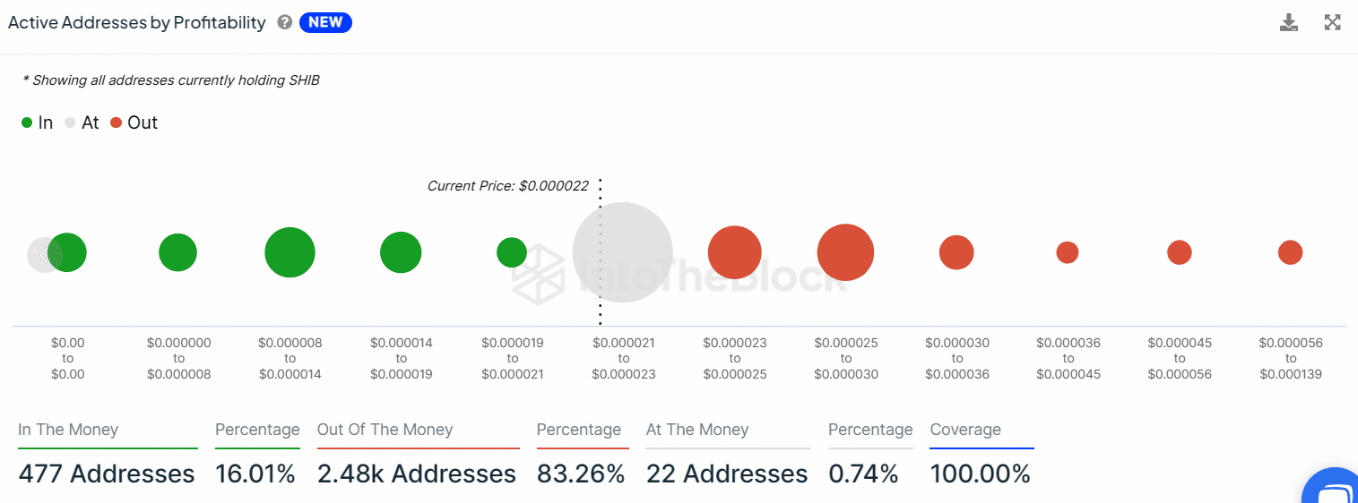
Here are Active Shiba Inu Addresses in Profit as SHIB Drops to $0.000021

Despite SHIB collapsing to the $0.000021 psychological support, over 16% of its active Shiba Inu addresses are still seeing profits on their holdings.

Shiba Inu is currently feeling the heat amid the recent market-wide collapse. Following reports of Binance founder Changpeng “CZ” Zhao receiving a 4-month prison sentence in the U.S., the global crypto market downturn deepened, with prices witnessing massive drops.

Bitcoin (BTC) breached below the $60,000 support, trading at the $57,000 territory amid an 8.85% drop in 24 hours. Moreover, Ethereum is also witnessing an 8.93% collapse, while Solana is down 10.85% within the same timeframe.

With the broader market down, Shiba Inu has not escaped the onslaught, equally witnessing a two-digit loss over the last 24 hours. SHIB has also slumped 22.23% in the past week, breaking below multiple support levels to now trade at $0.00002112.

Shiba Inu Active Address Profitability

However, despite this drop, Shiba Inu continues to change hands at a one-year high. As a result, active addresses currently seeing gains on their holdings have not seen substantial declines. Notably, data from IntoTheBlock suggests that Shiba Inu has about 2,980 active addresses over the past 24 hours.

SHIb Active adresses
SHIb Active addresses

Interestingly, of this figure, about 499 addresses, representing 16.74% of the total active addresses, are currently witnessing gains on their Shiba Inu balances. In addition, about 691 addresses are seeing losses, while 1,790 addresses are at breakeven. 

A high count of profitable addresses could signal potential selling pressure as holders decide to realize their gains. On the other hand, a significant number of addresses incurring losses could indicate bearish sentiment or represent potential buying opportunities, where holders might seek to lower their average costs by purchasing additional tokens.

Remarkably, active addresses in profit have continued to see an increase in recent times despite the drop in prices. The increase in active address profitability has prevailed following a major collapse in 2021. In addition, addresses at breakeven have also increased, leading to a subsequent drop in those seeing losses.

Shiba Inu Addresses Buying the Dip

This trend is likely due to a prevailing buy-the-dip campaign amid the sustained price declines. The Crypto Basic has called attention to multiple accumulation moves carried out by Shiba Inu addresses. In February, a whale procured 323 billion SHIB at $0.000009. Late last month, another address amassed 237 billion SHIB amid a price drop.

Data from Santiment also confirms an accumulation campaign among Shiba Inu shrimp, shark, and whale addresses this year. Notably, addresses holding between 10,000 and 10 million SHIB, as well as those holding at least 1 billion tokens, have continued to add to their balances since January.

Shiba Inu Addresses Increase Holdings Santiment
Shiba Inu Addresses Increase Holdings | Santiment

Remarkably, on-chain data shows that these tiers of addresses collectively procured over 4.55 trillion Shiba Inu tokens in March alone, as the price encountered a rollercoaster ride. Shiba Inu now trades for $0.00002122, awaiting a market resurgence to reclaim $0.00003 possibly.