Home Blog Page 15

Bitwise to Liquidate Dogecoin ETF, With Final Trading Expected Oct. 14

0

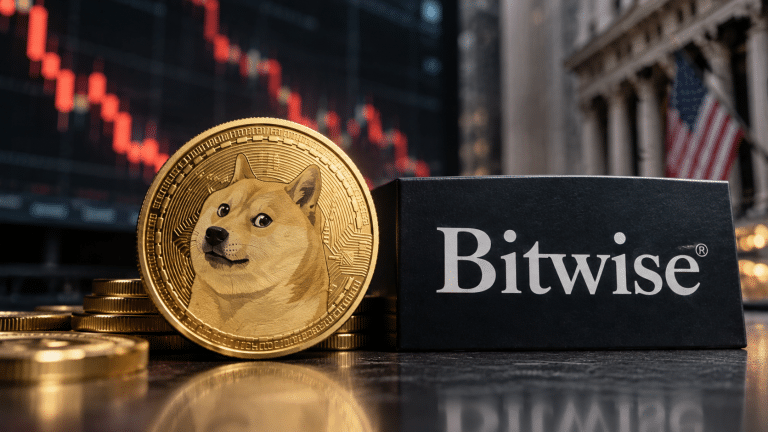
Bitwise will wind down its spot Dogecoin ETF roughly 10 months after its debut, marking an early end to the fund after limited uptake.

The fund, BWOW, is expected to have its final NYSE trading session on Oct. 14, Bitwise said Thursday. Investors can dispose of shares in the secondary market until the market closes that day.

Any shares still outstanding will be settled in cash on Oct. 22. The payout will be calculated using its Oct. 21 net asset value, and remaining shareholders will not be required to take any action.

BWOW Closure Follows Weak Dogecoin ETF Uptake

Dogecoin ETFs have attracted substantially less trading than several other altcoin ETFs. Their cumulative volume stands at about $300 million, compared with $2.1 billion for Hyperliquid products, $1.5 billion for Zcash and $680 million for Chainlink.

Net flows have also remained limited. Dogecoin ETFs brought in about $318,000 last month, according to SoSoValue, enough to reverse the small net outflows recorded in July.

BWOW’s strongest daily trading volume was about $3 million during its launch week.

The broader category dates to September 2025, when the first Dogecoin ETF debuted amid considerable hype over spot funds tied to the cryptocurrency.

Bitwise said it decided to liquidate BWOW as the company continues to optimize its product lineup to meet evolving investor needs.

Dogecoin Slips From Crypto’s Top 10

Bitwise’s decision also comes as Dogecoin has lost ground in the broader crypto market.

DOGE was priced at roughly $0.084 at the time of writing, corresponding to a market capitalization of about $13 billion. The token has fallen outside the top 10 largest cryptocurrencies over the past year amid the rise of HYPE and ZEC.

Despite the fund’s closure, Bitwise executives have previously spoken positively about Dogecoin’s staying power.

Bitwise CEO Hunter Horsley described Dogecoin last year as an asset that started as a joke before becoming an icon of the crypto movement. He said DOGE does not claim to transform global capital markets or present investors with fundamentals or utility.

Horsley also said that, despite those characteristics, Dogecoin had maintained its relevance and value longer than nearly anything else in crypto.
XRP Whale-Retail Spread Holds July Levels While Price Rises 30%: What Comes Next?

0

The XRP whale-retail spread has maintained the levels recorded in late July while the price now trades about 30% higher.

XRP has risen roughly 30% since late July, with the token trading near $1.38. However, exchange outflow data shows an important trend in whale and retail activity, which could help decide where XRP may head next.

For context, this relates to the Whale vs Retail Spread indicator. Notably, the metric compares the relative share of large and retail XRP transfers leaving cryptocurrency exchanges. 

A higher reading means whale activity has increased compared with retail activity. Recent data shows an important difference between activity on Binance and the broader centralized exchange market.

XRP Binance Whale-Retail Spread Remains Nearly Unchanged

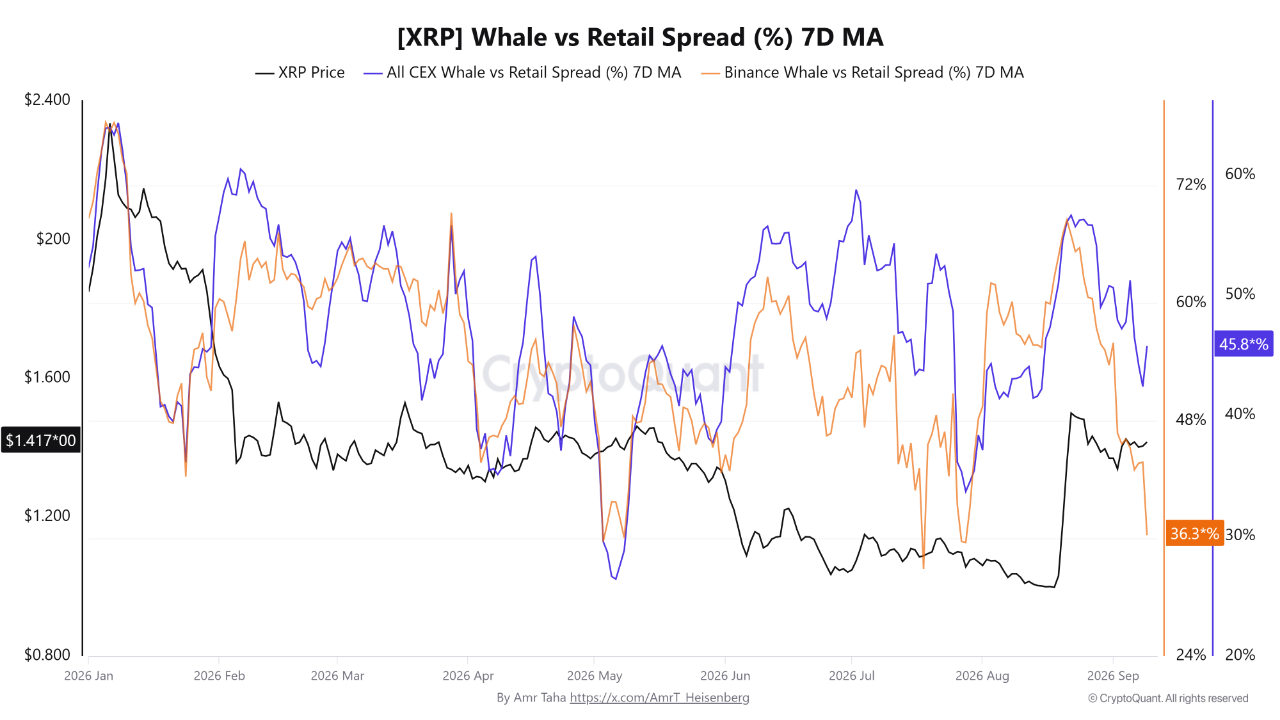
On Binance, the 7-day moving average Whale vs Retail Spread stood at 35.6% on July 28. At press time, the metric had risen to 36.3%, marking an increase of just 0.7 percentage points in more than six weeks.

This small change is relevant because XRP’s price rose roughly 30% during the same period. While the token rallied, the balance between whale and retail XRP outflows on Binance remained almost unchanged. 

This suggests that the rally did not bring a similar increase in whale activity compared with retail transfers on the exchange.

Interestingly, the broader exchange market shows a different trend. The All-CEX Whale vs Retail Spread increased from 33% on July 28 to 45.8% currently, a rise of 12.8 percentage points. This shows that whale-related XRP outflows have grown much faster than retail outflows across major centralized exchanges.

XRP Whale-Retail Spread | Source: CryptoQuant

All-CEX Spread Shows a Major Shift

The difference between Binance and the broader market has increased since late July. On July 28, Binance’s spread stood 2.6 percentage points above the 33% All-CEX reading. At that point, Binance had a higher whale-retail spread than the broader exchange market.

The situation has now reversed. Currently, the 45.8% All-CEX reading stands 9.5 percentage points above Binance’s 36.3%. This means the difference between Binance and the wider market has shifted by 12.1 percentage points in just over six weeks.

The change suggests that large XRP transfers have become more common on exchanges outside Binance. Platforms such as Coinbase, Kraken, and OKX could account for some of this activity.

However, the data cannot confirm where the transfers came from or why whales made them. Institutional clients using regulated platforms and OTC desks handling large trades could also lead to a spike in the metric.

What Could This Mean for XRP Price?

The rising whale-retail spread does not automatically mean XRP will rise or fall. The metric tracks the relative size of XRP transfers leaving exchanges, but it does not show whether whales plan to sell, accumulate, or simply move their holdings elsewhere.

For instance, a whale could withdraw XRP from an exchange and place it in cold storage. This could reduce the amount of XRP immediately available for sale and support the price if it reflects a long-term holding strategy. 

On the other hand, a whale could move XRP to another exchange before selling, which could increase selling pressure. As a result, the same increase in the spread can lead to different outcomes depending on what happens after the transfers.

Nonetheless, sudden spikes in whale-related exchange outflows during price rallies can sometimes come before periods of consolidation or higher volatility. Large transfers can change the amount of XRP available on exchanges, especially when whale activity rises much faster than retail activity.

However, the effect could be different if whales continue moving XRP away from exchanges for long-term storage. In this case, the amount of XRP available for immediate selling could fall across several platforms. Lower exchange supply could then provide more support for additional price gains.

XRP Could Be Turning Higher: Analysts Watch $1.48 and $1.55

0

XRP price is at an important point as analysts watch to see if it can move back above key moving averages and end its recent downtrend.

The coin is trading at $1.37 at press time, down 3% in the past 24 hours, according to CoinMarketCap.

ChartNerd Says XRP Price Needs to Reclaim $1.55

Analyst ChartNerd says XRP’s 20-month exponential moving average (EMA) is an important level to watch.

In August, XRP reached this level for the first time since January 2026. In the past, XRP has struggled around this moving average before falling sharply. Because of this, getting back above it could be a positive sign.

The 20-month EMA is currently around $1.55 and is close to the 50-week EMA. The 50-week EMA has been acting as resistance since XRP rose toward $1.70.

ChartNerd says XRP needs to move above both levels and stay above them as support before a strong move higher can be confirmed. If XRP fails to do this, the price may fall further.

The analyst’s long-term chart also shows that XRP has previously moved above the 20-month EMA before making major price gains.

XRP price chart
XRP price chart

Early Signs of Recovery

ChartNerd also looked at XRP’s recent price movement. The crypto had been making lower highs and lower lows, which is a sign of a downtrend.

However, things started to improve after XRP moved above $1.39. Since then, XRP has broken above several previous highs and may now be making higher lows. This could be a sign that the downtrend is starting to weaken.

Analyst Says XRP Needs to Break $1.48

Meanwhile, analyst Cryptoinsightuk says $1.48 is an important level for XRP. The analyst currently sees XRP’s trend as neutral. While XRP has moved above a previous high, it needs to rise further to confirm a stronger uptrend.

If XRP breaks above $1.48, the next target will be around $1.58. If the price keeps rising, the next major target would be between $1.70 and $1.85.

The analyst also said that comments from U.S. Treasury Secretary Scott Bessent about possibly buying more U.S. Treasury bonds could be positive for the crypto market.

Image

XRP Needs to Break Key Resistance

Both analysts agree that XRP is showing signs of recovery, but it still needs to prove that the uptrend is real. Breaking above $1.48 would be a positive sign. Moving above the $1.55 20-month EMA and the 50-week EMA would be an even stronger signal.

Until XRP moves above these levels and holds them as support, the price may still fall again. If XRP breaks higher, $1.58 could be the first target, followed by $1.70–$1.85.

Whale Accounts on Binance Showing “Extremely Bullish” Sentiment in XRP Futures

0

The XRP futures market is seeing increased bullishness despite the recent price drop, as whale accounts on Binance show “Extremely Bullish” sentiment.

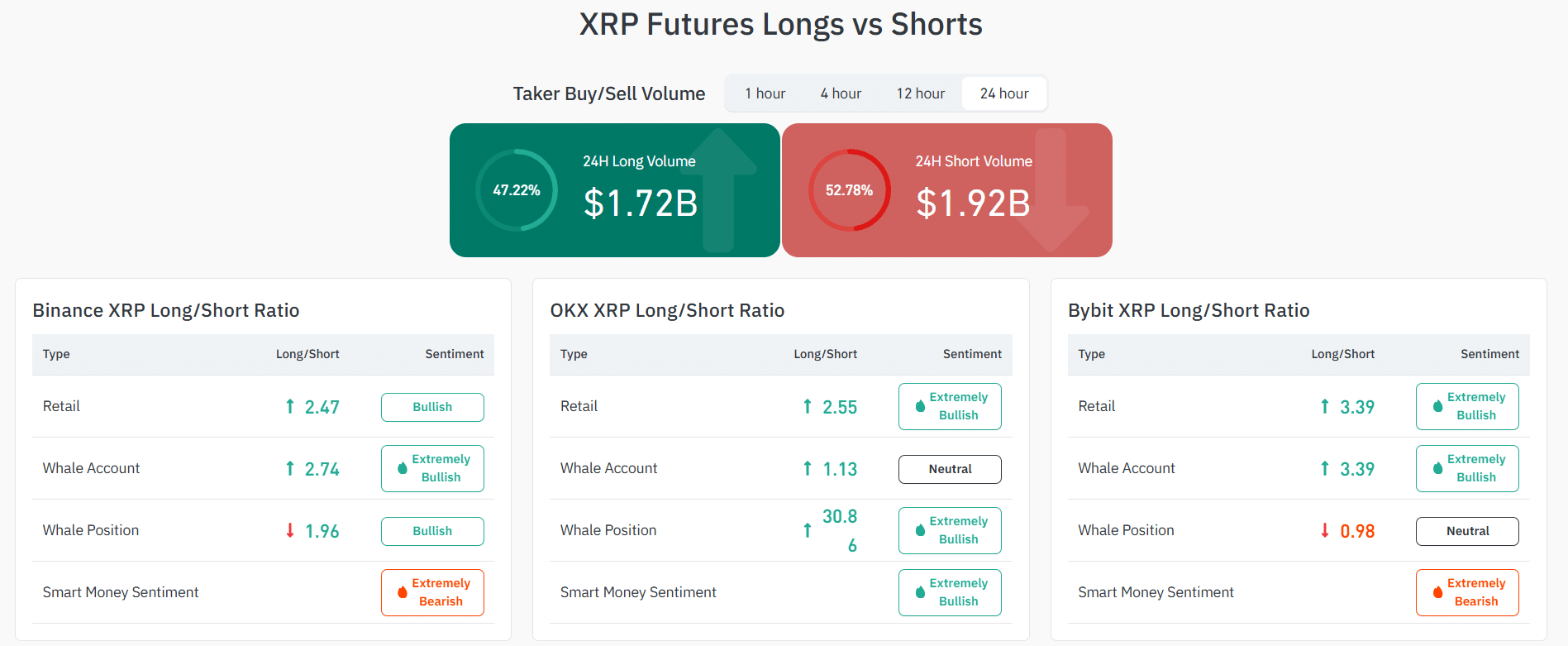
XRP closed the previous session down 1.55%, bringing its price to $1.38. Although the spot market shows short-term weakness, futures data from CoinGlass reveals a more bullish structure. Across Binance, OKX, and Bybit, most investor groups remain bullish despite the recent decline.

This leads to an important question: are traders treating the dip as a chance to buy, or could the large number of long positions face more liquidations if the decline continues?

Whale Accounts on Binance Flash “Extremely Bullish” Signal

Specifically, CoinGlass data shows that whale accounts on Binance have a long/short ratio of 2.74, placing their sentiment in the Extremely Bullish category.

Other major investor groups on the exchange also favor long positions. Retail traders have a 2.47 long/short ratio, which puts them in the Bullish category, while the whale position long/short ratio stands at 1.96, also giving it a Bullish reading.

XRP LongShort Ratio Coinglass
XRP Long/Short Ratio | Source: Coinglass

However, Smart Money takes a different position. This group records an Extremely Bearish reading on Binance, even as retail traders and whale accounts continue to favor long positions.

For context, Smart Money generally refers to more experienced market participants who may have access to better market tools and information. Its bearish position represents a warning for XRP bulls because it goes against the wider bullish trend on Binance.

OKX Shows Stronger Bullish Alignment for XRP

Meanwhile, OKX shows a more consistent bullish picture across its investor groups. Notably, retail traders have a 2.55 long/short ratio, which falls into the Extremely Bullish category. The whale position ratio reaches 30.86, also giving it an Extremely Bullish reading.

Smart Money on OKX also remains Extremely Bullish, unlike the same group on Binance. This suggests that sophisticated traders on OKX currently share the positive outlook held by retail traders and whale participants. The only neutral reading on OKX comes from the whale account long/short ratio, which stands at 1.13.

As for Bybit, the exchange shows a more divided picture. Retail traders and whale accounts both have a 3.39 long/short ratio, putting both groups in the Extremely Bullish category.

However, the whale position ratio stands at 0.98, which gives it a Neutral reading. Smart Money once again takes the opposite side, with an Extremely Bearish reading that matches its stance on Binance.

Long Liquidations Challenge the Bullish Outlook

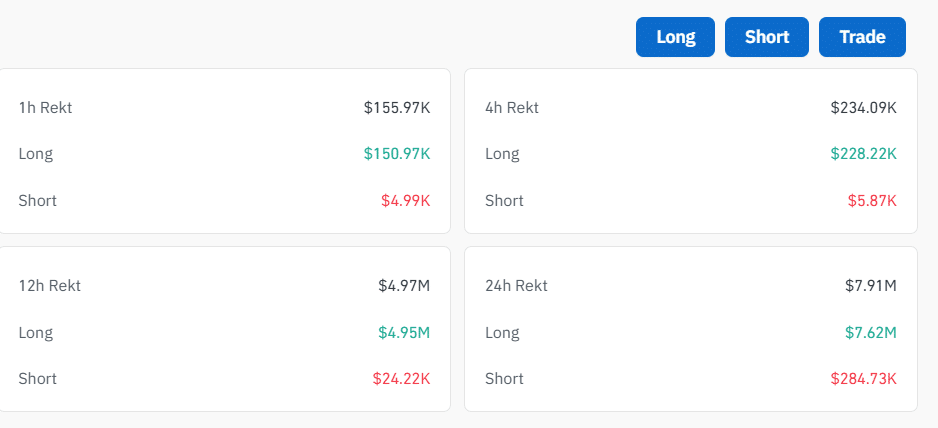
Interestingly, this overall bearish stance follows a string of long liquidations. Notably, XRP recorded $7.91 million in total futures liquidations over the past 24 hours, with long positions accounting for $7.62 million. This means longs made up roughly 96% of all forced closures during that period.

XRP Liquidations Data Coinglass
XRP Liquidations Data | Source: Coinglass

The 12-hour figures are even more bearish. XRP futures recorded $4.97 million in total liquidations, while long positions accounted for $4.95 million, or 99% of the total. These numbers show that bullish traders have taken most of the liquidation pressure as XRP fell toward $1.38.

Trading volume also gives sellers a slight advantage. Short volume reached $1.92 billion over the past 24 hours, accounting for 52.78% of total futures activity. Long volume stood at $1.72 billion, or 47.22%.

125,334,083,223 Shiba Inu Tokens Leave BitGo for Newly Created Wallet

0

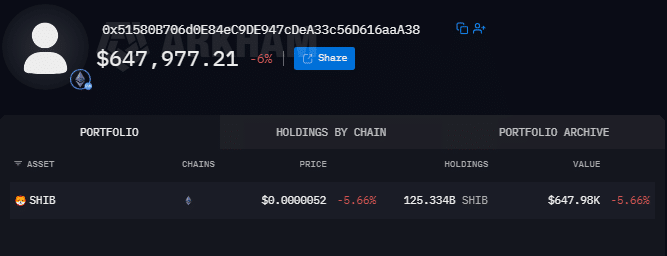
An unlabeled blockchain address has withdrawn more than 125 billion Shiba Inu from a wallet affiliated with BitGo.

According to Arkham data, 125,334,083,223 (125.33 billion) Shiba Inu tokens, worth $678,060 at the time of the transaction, moved from the BitGo-affiliated address to a newly created wallet. 

New Wallet Receives 125.33 Billion SHIB

Arkham data shows that the receiving address had no prior on-chain activity before the transfer, suggesting that the wallet was newly created before receiving the massive SHIB transaction.

The wallet still holds the entire 125.33 billion SHIB in the hours leading up to press time. Although the owner’s identity and intentions remain unknown, moving such a substantial amount of SHIB away from an exchange could suggest an intention to hold the tokens rather than sell them immediately.

However, the transfer alone does not confirm a long-term holding strategy, as the owner could move the tokens to another address or exchange at any time. 

Shiba Inu Whale Balance

Withdrawal Reverses Recent SHIB Deposits

The latest transaction stands out because BitGo has recently received several large SHIB transfers that fueled concerns about potential selling activity.

Earlier this month, an early Shiba Inu whale transferred 600 billion SHIB to the exchange. Several days later, another transfer involving 408 billion SHIB also reached BitGo.

Against this backdrop, the latest 125.33 billion SHIB withdrawal represents a reversal of the recent pattern of large SHIB transfers flowing into the exchange.

160 Billion SHIB Leaves Exchanges

Meanwhile, the latest withdrawal comes as Shiba Inu records broader exchange outflows.

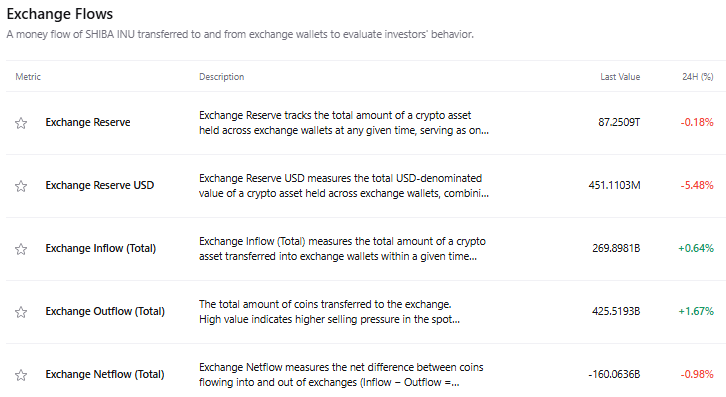
According to CryptoQuant data, 160.06 billion SHIB left exchanges over the past 24 hours. The figure reflects roughly 425.51 billion SHIB in withdrawals against 269.89 billion SHIB in deposits, resulting in a net outflow of about 160.06 billion SHIB.

Despite these recent withdrawals, exchanges still hold a substantial amount of SHIB. Approximately 87.25 trillion tokens remain on exchanges, representing around 14.8% of the cryptocurrency’s total supply. Consequently, a large amount of SHIB remains potentially available for trading or selling. 

Shiba Inu Exchange Reserve Shrinks
Shiba Inu Exchange Reserve Data

SHIB Faces Top-30 Ranking Risk

Meanwhile, Shiba Inu faces renewed pressure in the cryptocurrency rankings.

SHIB currently ranks 30th by market cap, with a market cap of approximately $3.04 billion. Bittensor (TAO), ranked 31st, has a market cap of about $2.86 billion, leaving only a relatively narrow gap between the two assets.

At press time, SHIB traded at $0.000005167, down 5.74% over the past 24 hours, while TAO has only fallen 2.91% in the same timeframe. Therefore, a continued decline in SHIB’s market value could put its position among the top 30 cryptocurrencies at risk.

Kraken Parent Valued at $21 Billion in $100 Million Nasdaq Investment, Bloomberg Reports

0

Nasdaq Ventures agreed to invest $100 million in Kraken parent Payward as the two companies broaden their collaboration around tokenized equities and digital-market infrastructure.

The investment values Payward at $21 billion, according to people familiar with the matter cited by Bloomberg. Nasdaq announced the investment agreement on Thursday.

Nasdaq and Payward Deepen Tokenized-Equities Partnership

The investment follows a partnership announced in March under which Nasdaq and Payward agreed to develop infrastructure linking regulated equity markets with blockchain networks. Under the agreement, Kraken will make digital representations of stocks traded on Nasdaq available to users on its platform.

Nasdaq has also been pursuing changes to its own market infrastructure. It filed a proposal with the U.S. Securities and Exchange Commission (SEC) in September 2025 seeking to enable securities to trade in tokenized form. 

In August, Nasdaq struck a deal to buy LeveL Markets, furthering its efforts to enable trading beyond conventional market hours.

Kraken Parent Expands Tokenized-Stock Partnerships

Meanwhile, Payward has expanded its ties with other major exchange operators. Deutsche Börse invested $200 million in the company in April, expanding the partnership as both companies pursue opportunities in tokenized investment products and blockchain-based securities.

Earlier in September, Payward and the London Stock Exchange (LSE) announced a partnership to bring tokenized UK equities to investors. The collaboration is expected to support tokenized exposure to leading UK-listed companies, with trading initiatives planned to begin in 2027.

The broader tokenized-equities market has also continued to expand. According to RWA.xyz, assets in this category now account for more than $2.9 billion, up 7.4% over the past month.

Coinbase CEO Armstrong Says Bitcoin Cycle Bottom Is In, Sees Uptrend Over Next Two Years

0

Coinbase Chief Executive Brian Armstrong expects Bitcoin to rise as the cryptocurrency approaches its next halving, saying he believes the market has already reached its low for the current cycle.

Armstrong outlined that view during a Bloomberg Television interview on Thursday, placing the potential improvement in Bitcoin’s trajectory within the next one to two years. The outlook represented his own market assessment rather than an established conclusion. 

Early Thursday, Bitcoin traded near $78,000, CoinGecko data showed. The cryptocurrency had fallen 1.7% over the previous 24 hours and remained roughly 38% below its record of about $126,000. Bitcoin had nevertheless climbed from its summer lows before Armstrong’s remarks. 

Glassnode Data Points to Lighter Selling 

Measures tracked by Glassnode showed that selling intensity eased as Bitcoin moved toward the $83,000-to-$86,000 resistance zone.

The firm’s seven-day Sell-Side Risk Ratio was running at 7 basis points a day, versus a peak of 16 basis points in August. Glassnode interpreted the decline to less than half the August level as evidence that selling pressure had weakened. 

Meanwhile, Bitcoin had separated sharply from major U.S. equity benchmarks in recent trading. A Glassnode research note released Wednesday calculated a 23% Bitcoin gain over the 21 trading sessions ending Sept. 9, while the S&P 500 and Nasdaq 100 were approximately flat during the same period.

Armstrong Highlights Coinbase’s 2027 Priorities

Armstrong’s comments also covered areas outside Bitcoin that he sees as important to Coinbase’s future growth.

For 2027, he singled out payments, prediction markets, tokenization and agentic finance as four areas of focus for the company. 

On payments, Armstrong said activity involving stablecoin payments on Base has increased 700% year over year. He also referred to a forecast that puts the stablecoin market at $3 trillion by 2030.

Cardano DeFi Platform Empowa Reports Unauthorized ADA and NIGHT Transfers From Its Treasury Wallets

0

Cardano-based DeFi platform Empowa has disclosed two connected incidents involving unauthorized transfers from three project-controlled wallets.

According to Empowa, the incidents involved its ADA treasury wallet and two wallets holding undistributed EMP tokens. The project said the activity indicates that an unauthorized party gained control of the affected wallets’ private keys.

Empowa’s ADA Treasury Wallet Compromised

The first incident involved Empowa’s Cardano treasury wallet, from which 143,710 ADA was moved between November 2025 and June 2026.

The wallet also held 48,219 NIGHT tokens claimed from Empowa’s Midnight airdrop allocation without the project’s knowledge. However, one-quarter of the NIGHT allocation remains locked and requires another signature from the treasury wallet’s keys before it can be withdrawn.

Empowa said the unauthorized activity indicates that someone gained control of the treasury wallet’s keys before the first ADA transfers. Although the wallet was initially considered locked, activity began on November 26, 2025.

Most of the transferred ADA passed through an intermediary wallet. That wallet deposited 100,000 ADA into the Liqwid lending protocol as collateral and borrowed USDCx against it. Subsequently, the wallet converted some of the funds into stablecoins and moved them off Cardano through transactions that appear consistent with cross-chain bridge redemptions.

Millions of EMP Tokens Also Moved

Notably, the second incident involved the $empowa. public and $empowa.ispo wallets, which held undistributed EMP tokens.

Between June and August 2026, 4.24 million EMP was transferred from the two wallets. Empowa said about 850,000 EMP moved during the first phase and was subsequently sold for ADA on Minswap and VyFi.

The resulting ADA was then converted into USDCx, with 4,810 USDCx sent to the same intermediary hub linked to the earlier treasury-wallet incident. Meanwhile, Empowa said part of the remaining EMP is still being sold on Minswap.

Empowa Rules Out Link to SecondFi Incident

Empowa emphasized that the unauthorized transfers were not connected to the SecondFi security incident disclosed in June 2026.

In that separate incident, hackers siphoned 16.1 million ADA from 374 user wallets after exploiting a flaw in SecondFi’s wallet-generation software. Empowa pointed out that its treasury wallet showed unauthorized activity as early as November 2025, several months before the SecondFi incident became public. 

Moreover, the affected Empowa wallets were enterprise addresses controlled by the project’s backend rather than consumer wallets generated through browser software.

According to Empowa, the activity instead points to deliberate and sustained control of the private keys. The same unauthorized key-holder registered the treasury wallet for Midnight’s Glacier Drop, claimed NIGHT as the tokens unlocked, and later moved both ADA and NIGHT through other wallets.

Investigation Underway

In the meantime, Empowa said it has engaged blockchain investigators and continues to monitor the affected wallets.

The project also plans to pursue KYC information through legal channels if the stolen funds eventually reach centralized exchanges. The incident has nevertheless raised questions within the Cardano community, particularly about how the unauthorized activity continued for months without detection or a public report.

Some community members have speculated that the transfers could involve an insider. However, there is currently no confirmed evidence publicly establishing insider involvement, making that possibility speculation rather than a verified conclusion.

Ripple’s David Schwartz Explains How XRP Will Overtake Bitcoin in Market Cap

0

Ripple’s former Chief Technology Officer David Schwartz believes XRP will eventually overtake Bitcoin as the world’s largest cryptocurrency.

He argued that this scenario would result from XRP growing faster than Bitcoin, not from BTC collapsing. Schwartz made the comments during an X Space, where he was asked whether XRP could flip Bitcoin and whether that would happen because Bitcoin loses value or XRP appreciates more rapidly.

“Yeah, I do,” Schwartz said. However, he clarified that the scenario would not involve Bitcoin shrinking.

“I think it would happen from XRP growing faster than Bitcoin,” Schwartz explained.

Schwartz Sees XRP Capturing More Growth

Schwartz suggested that a future in which XRP overtakes Bitcoin would involve the digital-asset market expanding substantially. He argued that most cryptocurrencies would grow in such an environment, while the XRP Ledger would capture a larger share because of its functionality and speed.

“The world where digital assets are just wildly successful. They all probably grow,” Schwartz said, adding that the XRP Ledger would benefit from features that Bitcoin does not support.

His comments therefore point to an XRP-led expansion in market capitalization rather than a Bitcoin collapse as the more likely path to a flip.

XRP Price When It Overtakes Bitcoin

At current levels, Bitcoin trades at around $78,200, with a market capitalization of about $1.56 trillion. Meanwhile, XRP trades at around $1.38, with a market capitalization of approximately $86.76 billion.

That leaves Bitcoin with a market capitalization roughly 18 times larger than XRP’s. If Bitcoin’s market capitalization soared to around $3 trillion, XRP would need to reach a similar valuation to overtake it.

Based on XRP’s current circulating supply of 62.74 billion tokens, a $3.1 trillion XRP market capitalization would put it at approximately $49.30 per XRP. That would represent a 3,470% increase from the current $1.38 level.

For comparison, Bitcoin’s current $1.56 trillion valuation would also need to double to reach $3 trillion. Moreover, Bitcoin’s previous all-time market-cap level was around $2.5 trillion, making the journey to $3 trillion relatively close by comparison. In particular, Bitcoin’s price would need to reach only about $150,000 to support a market capitalization above $3 trillion.

Meanwhile, for XRP, the journey from $1.38 to $50 would be far more formidable and take years. Essentially, even as XRP soars and enters the trillion-dollar valuation range, Bitcoin would still be miles ahead, and closing the gap would remain a significant challenge.

In Sum

Schwartz did not provide a price target or timeline for XRP overtaking Bitcoin. His argument was that XRP’s faster growth would allow it to surpass Bitcoin as the XRP Ledger captures a larger share of overall crypto-market growth.

Importantly, Schwartz’s comments reflect his view of what could happen under a particular future market scenario rather than confirming that XRP will flip Bitcoin.

New Research Finds Just 0.8% of XRP Ledger Traffic Came From Real Humans

0

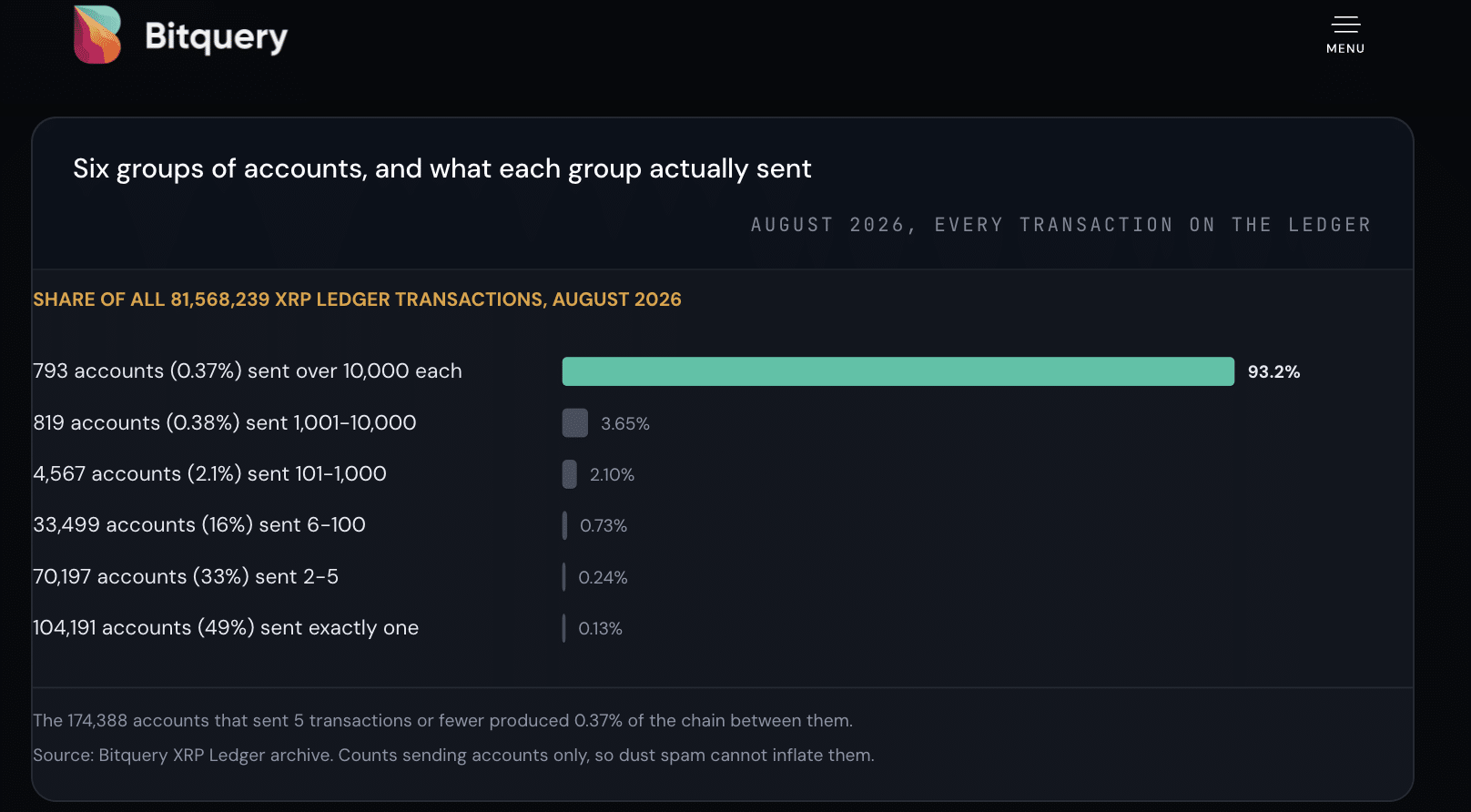
Ripple CTO emeritus David Schwartz defended the XRP Ledger after analytics firm Bitquery found that just 793 accounts were responsible for 93.2% of the network’s transaction activity in August 2026.

An XRP critic posted the findings on X, saying the accounts were “all bots and spammers” and that less than 1% of XRPL activity came from real human payments. The critic called XRPL a “ghost chain.”

Meanwhile, Schwartz disagreed. He said the XRP Ledger’s low fees naturally attract both useful and useless transactions.

His response was essentially that if the network is cheap to use, people will use it for all kinds of things. Making it more expensive just to reduce low-value activity wouldn’t necessarily make the network better.

Bitquery Finds Most XRPL Activity Comes From a Small Number of Accounts

Bitquery analyzed more than 5 billion XRP Ledger transactions from 2013 to September 2026.

In August 2026, the XRPL processed about 81.6 million transactions. But most of these transactions came from a small number of accounts.

Just 793 accounts were responsible for 93.2% of all August transactions. Of these, 767 were identified as automated accounts, including trading bots, NFT bots, and spam accounts. The other 26 were exchange wallets.

DEX trading bots made up 48.1% of all transactions, while dust-sending accounts made up another 23%. Bitquery said this shows that transaction numbers alone may not accurately reflect how many real people are using the XRP Ledger.

Real Human Payments Make Up Just 0.8%

Bitquery also looked at transactions that appeared to come from real people rather than bots or spam. It found that 89.6% of active accounts were considered real users, but their transactions made up just 0.8% of all XRPL activity in August.

Bitquery excluded accounts that made more than 100 payments during the month and looked for payments involving more than a tiny amount.

The company said this percentage has stayed almost the same since 2018, even as the XRP ecosystem has grown and added features like NFTs, stablecoins, and an automated market maker.

Bitquery also noted that its research only covers activity directly on the XRP Ledger. XRP trading on centralized exchanges usually isn’t recorded as individual transactions on the ledger.

XRP Ledger activity analyst by Bitquery

Bots and Spam Make Up Much of XRP Ledger Activity

Bitquery found that very small “dust” payments make up a large part of XRP Ledger activity.

So far in 2026, about 52.8 million XRP payments sent 10 drops or less. Just 10,549 accounts sent these payments to more than 2.4 million wallets.

Bitquery also found a phishing campaign that started on August 23 and reached 1.28 million wallets in 17 days. The campaign used only about 69.6 XRP in fees, worth around $96 at the time.

The report also found spam linked to phishing messages, token airdrops, and AI-agent payments. However, Bitquery said activity linked to x402 was one of the few growing areas that was not mainly caused by spam.

RLUSD Shows Real Growth

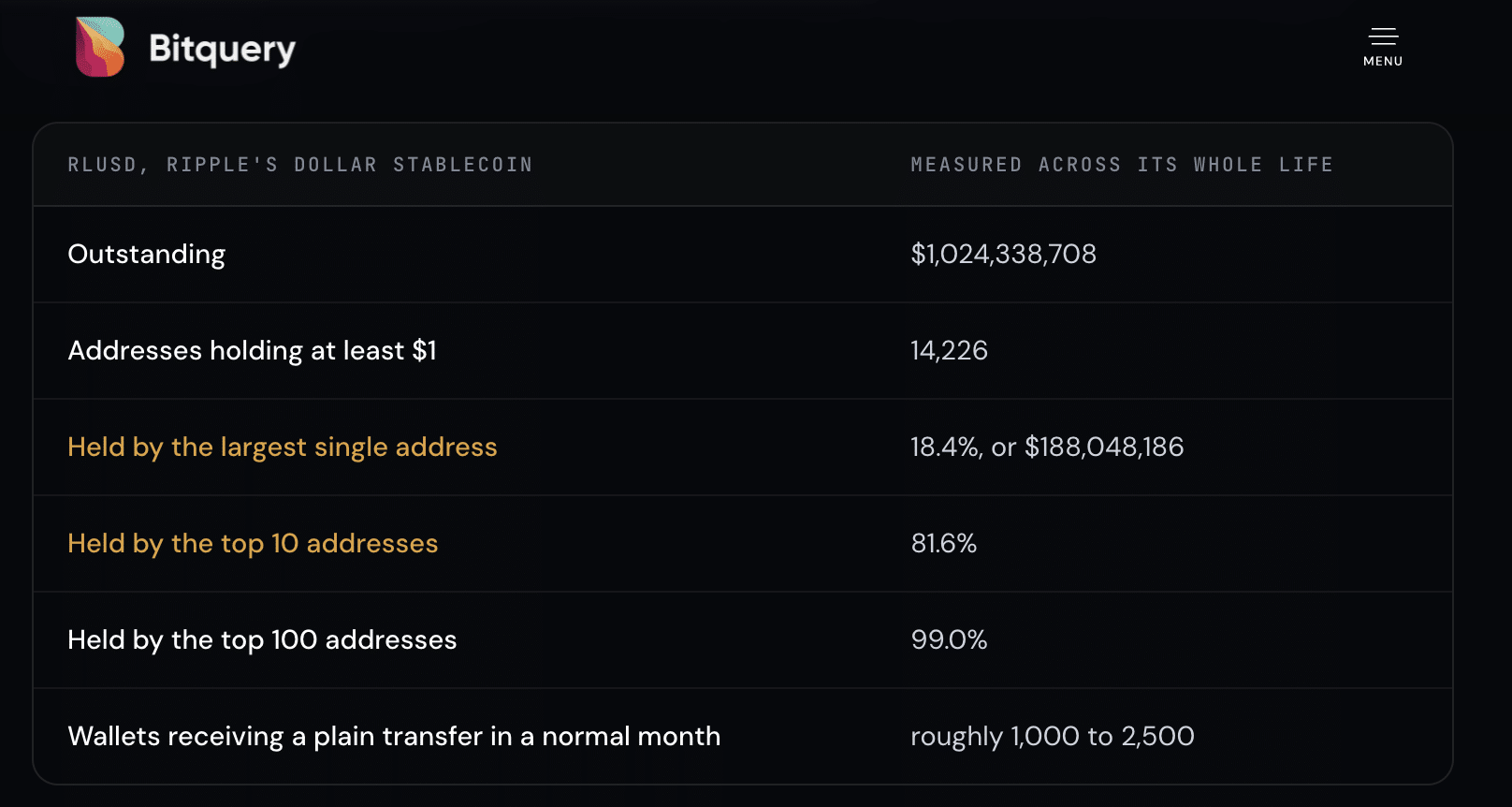
Bitquery also found some positive signs on the XRP Ledger. The company highlighted Ripple’s RLUSD stablecoin as one of the strongest signs of real growth. The amount of RLUSD being moved has increased more than 70 times since its launch.

Bitquery found more than $1.02 billion worth of RLUSD in circulation. However, ownership is still highly concentrated, with the top 10 wallets holding 81.6% of the supply.

RLUSD Analysis
RLUSD Analysis

The report also noted that the XRP Ledger has processed more transactions than Ethereum since its launch. However, Bitquery stressed that a high number of transactions does not necessarily mean many people are actively using the network.

Overall, the report paints a picture: XRPL handles a huge number of transactions, but much of that activity comes from bots, spam, and very small payments. Genuine human activity makes up a much smaller share.