
Home Blog Page 16

Consensys to Separate MetaMask From Institutional Ethereum Infrastructure Business

0

Consensys Software Inc. plans a two-company reorganization by year-end 2026. The current entity will be renamed MetaMask, while the Protocols Group will move into a newly created business that keeps the Consensys name, according to a Sept. 9 company announcement

Joe Lubin will chair MetaMask and serve as CEO. He will also become executive chairman of the new Consensys. Mike Kriak will lead the company as CEO, with David Cunningham as president.

MetaMask will retain its consumer self-custody business while expanding into payments, savings, investing, and traditional financial products.

Consensys Software said its consumer and institutional businesses are increasingly pursuing different priorities. The company also said financial firms are moving beyond blockchain trials and putting systems into production, alongside growing demand for stablecoins, tokenization, and infrastructure. 

Lubin said Consensys teams had spent more than a decade contributing to Ethereum through work spanning the protocol, tools, and infrastructure that supported self-custodial finance and sovereign networks. 

He described MetaMask as having emerged from those efforts to become the most widely used self-custodial wallet, while now developing into a platform for handling money in multiple forms. 

MetaMask Consumer Unit Extends Beyond the Wallet 

MetaMask dates to 2016, when it launched as an Ethereum browser extension that let users interact with decentralized applications and manage crypto assets, according to a Consensys history of MetaMask.

Company figures put MetaMask downloads above 100 million across about 190 countries. Consensys Software also says the platform has facilitated cumulative transaction volume measured in trillions of dollars. 

In February, eligible users outside the United States gained access to an Ondo Global Markets offering comprising 200 tokenized U.S. stocks, along with exchange-traded funds and commodities. 

The MetaMask card reached 49 U.S. states later that month after earlier availability in Europe, Canada, Mexico, Brazil and Argentina. The Mastercard-enabled product provides U.S. users with rewards in the mUSD stablecoin. 

MetaMask launched Money Account in June, giving eligible mUSD balances access to a variable annual percentage yield of up to 4%. The yield comes from DeFi lending strategies and does not constitute interest paid by MetaMask or the stablecoin issuer.

Money Account balances can also be used for MetaMask Card purchases, trading, perpetuals, and prediction markets.

Separately, Lubin said last year that MetaMask would get a MASK token and connected the plan with the wallet’s decentralization strategy. Fortune reported around the restructuring announcement that the company was not providing information about either a possible IPO or a token. 

Linea, Besu and Teku Move With Institutional Business

The new Consensys will take responsibility for Linea, the Besu and Teku clients, and its institutional infrastructure business.

Its mandate will center on Ethereum infrastructure for financial institutions deploying blockchain technology for tokenization, stablecoins, and other onchain financial services.

Linea is also positioned to attract institutional capital. Notably, Consensys’ Besu infrastructure is in use at Citi, DTC, and BNY Mellon.

Cunningham said tokenization is becoming central as financial institutions and market-infrastructure providers move toward round-the-clock operations. 

He added that Consensys Software’s open-source technology provides part of the technical base for that transition. The institutional business delivers interoperability infrastructure for the world’s largest financial marketplaces, where privacy, operational resilience and scalability are required, Cunningham said.

Trezor, BitBox Warn Users as Phishing Emails Target Hardware Wallet Customers

0

Trezor and BitBox issued fresh phishing warnings after customers received fraudulent emails that appeared to originate from the hardware wallet companies’ communication channels.

Both companies told users to avoid unexpected security messages, especially those that direct recipients to external links.

The incidents surfaced Wednesday and, based on the companies’ preliminary assessments, appear to involve outside email or newsletter infrastructure rather than compromises of the wallets themselves.

Trezor and BitBox Investigate Email-Service Incidents

Trezor attributed its campaign to a security incident affecting a company it uses for email delivery. The breach allowed attackers to send emails that appeared to come from Trezor.

Among the fake messages was an email carrying the subject “Critical Security Alert: STM32 Entropy Vulnerability.” Trezor identified the notice as fraudulent and warned customers not to click any links in the email.

BitBox disclosed comparable activity later that day, saying some customers had received messages crafted to resemble official company communications.

The company’s early findings focused on the service used to distribute its newsletter. BitBox said the same infrastructure may also have been involved in phishing aimed at other Bitcoin businesses, raising the possibility that several firms were being targeted through a common external vendor.

Neither company described the latest incidents as evidence that attackers had penetrated its hardware wallets.

Earlier Disclosures Add Context to Latest Warnings

The phishing alerts follow a series of unrelated security disclosures involving Trezor, BitBox, and companies that provide services for their products.

Trezor reported in August that information associated with close to 14,000 customers had been exposed through ShipMonk, a third-party fulfillment company. A subsequent disclosure in early September expanded the affected population by about 67,000 U.S. customers.

Those exposures concerned information stored by an outside service rather than data taken from Trezor hardware. The new email campaign likewise centers on infrastructure operated beyond the wallet itself.

BitBox has faced separate security concerns. In July, it responded to concerns over a Coldcard entropy-generation flaw, saying BitBox products were not affected by the vulnerability.

The following month, BitBox published fixes for two significant firmware weaknesses. At the time of the disclosure, the company said it was unaware of any exploitation of the vulnerabilities or any related loss of user funds.

However, the current Trezor and BitBox warnings are centered on social-engineering emails, not confirmed breaches of their wallet devices.

Customers are being advised to treat unexpected security messages cautiously and to verify unusual requests through official company channels before taking action.

Cardano Founder Mocks LAPTOP Crash as Hunter Biden Rejects Rug Pull Claims

0

Cardano founder Charles Hoskinson has sarcastically reacted to the sharp collapse of LAPTOP, a memecoin associated with Hunter Biden, the son of former US President Joe Biden.

Notably, LAPTOP surged to nearly $320 shortly after launching on Base before losing roughly 99% of its value within hours. The dramatic reversal left many buyers facing significant losses.

According to onchain data cited by Bubblemaps, more than 80% of wallets that purchased LAPTOP were in the red following the launch. Moreover, several of the token’s largest holders appear to be newly funded wallets.

Following the collapse, Hoskinson took to X and joked that LAPTOP’s “true purpose” was to eventually match the price of a used MacBook Pro.

Hunter Biden Rejects Rug Pull Claims

Hunter Biden rejected claims that LAPTOP was a rug pull. Instead, he attributed the extreme price swings to limited liquidity, technical issues, and predatory trading bots that contributed to the initial price spike.

Biden also maintained that the team’s allocation was locked, that nobody on his side sold tokens, and that he personally had not made any money from the launch. He added that the project remained focused on long-term community building and highlighted its distribution of free tokens to people who lost money on Trump’s memecoin.

However, on-chain data reported by Quartz has raised questions about that claim. According to the report, a project-affiliated multisig wallet received 100 million LAPTOP tokens, representing 10% of the total supply, before the launch. The wallet has since sold 42.5 million of those tokens.

LAPTOP Remains Deeply Below Its Peak

At press time, LAPTOP was trading at $0.7791, down over 99.75% from its all-time high of $401. Its market capitalization has also fallen sharply from the nearly $80 billion valuation reached during its brief surge, although the current figure of about $283.81 million would still place it among the world’s 250 largest cryptocurrencies. 

LAPTOP/USDC Price
LAPTOP/USDC Price

Meanwhile, Hoskinson has consistently criticized politicians and their close associates for launching cryptocurrency projects.

He has particularly targeted President Donald Trump and his family over politically themed tokens and decentralized finance ventures. Hoskinson has argued that such projects politicize an industry that should remain bipartisan, while offering limited utility and creating ethical concerns.

Therefore, while his LAPTOP comment was clearly sarcastic, it also fits his broader criticism of politically connected memecoins and their speculative nature.

Hunter Biden’s LAPTOP Crashes 99% as Team Points to Sniper Bots, Thin Liquidity

0

Hunter Biden’s LAPTOP memecoin lost more than 99% during a turbulent Wednesday debut, with the project saying automated sniper activity and insufficient liquidity in the launch pool drove the sharp price reversal.

The token rose above $300 following its airdrop and, during its first hour of trading, briefly carried a market capitalization of roughly $110 billion. Most of that advance quickly disappeared, leaving LAPTOP near $0.84 shortly after midnight Thursday, according to DexScreener.

The project said its original trading pool introduced LAPTOP at $0.05. According to a Wednesday Medium update from the team, strong buying interest emerged immediately, drawing sniper bots as the market maker lacked enough liquidity to meet demand. The team said the imbalance triggered the rapid surge and reversal before the pool could deepen.

To address that problem, the project plans to release 4 million tokens for Aerodrome liquidity incentives at midnight UTC on Sept. 10, increasing the amount available for liquidity support. The planned release equals 0.4% of LAPTOP’s total supply. The team said the move is designed to bring trading liquidity closer to market demand.

Bubblemaps separately estimated that roughly four in five people who traded LAPTOP ended up with losses. The blockchain analytics company identified two traders whose losses fell between $100,000 and $1 million, around 100 who lost between $10,000 and $100,000, and approximately 700 whose losses ranged from $1,000 to $10,000.

Prediction Outcomes Set Up 10 Million-Token Burn

Meanwhile, LAPTOP’s supply is being reduced under a mechanism linked to real-world predictions. The project said two of those events have produced “Yes” outcomes, requiring 10 million tokens to be destroyed and cutting circulating supply by an expected 1% during the first week after launch.

Biden had previously explained on X that 30 separate predictions account for 30% of the token supply. Each prediction is connected to a public, real-world event: tokens assigned to an outcome are burned when it resolves “Yes,” while the tokens are donated to charity if it does not.

One completed prediction involved 5 million LAPTOP and was fulfilled after digital artist Beeple mentioned the token, according to the project’s Medium update. The team did not disclose what triggered the other resolved prediction.

Project Addresses X Suspension and Token Distribution

Another issue emerged Wednesday when X suspended the LAPTOP Foundation’s official account. Biden said the project was seeking to regain access to the account and indicated that the suspension would not cause him to step away.

The team also provided further details about how the token reached users. It said LAPTOP was not sold through a presale, influencers received no special allocations, and buyers did not receive an opportunity to purchase the token before its wider availability. The project also said it had not paid crypto key opinion leaders (KOLs) to promote LAPTOP.

For the airdrop, subscribers who joined Hunter Biden’s Substack before Sept. 6 could claim 80 million LAPTOP tokens. The team characterized those recipients as genuine individuals rather than artificial or preferentially selected accounts.

Evernorth Set for Historic XRP Milestone With September 30 Vote Ahead

0

Evernorth Holdings is moving closer to becoming the first publicly traded company built around a strategy of increasing the value of its XRP treasury.

According to popular Web3 event organizer Wave of Innovation, Evernorth is expected to hold at least 473 million XRP when it begins trading on Nasdaq under the ticker XRPN.

The milestone now hinges on a key shareholder vote scheduled for September 30, 2026. Shareholders will vote on Evernorth’s proposed merger with Armada Acquisition Corp. II, a transaction that would pave the way for the XRP-focused treasury company to become publicly traded.

Evernorth recently moved another step closer to completing the deal after the U.S. SEC cleared its registration statement. However, shareholder approval and other closing conditions remain outstanding. If approved, the merger is expected to close in late Q3 or early Q4, followed by Evernorth’s Nasdaq debut.

Evernorth’s XRP Holdings

Evernorth initially accumulated 388 million XRP, with CryptoQuant reporting the holdings. A significant portion of those tokens came through transfers from contributors including Ripple and its chairman, Chris Larsen.

The company later expanded its position to 473 million XRP, using part of the $1 billion it raised from prominent investors, including Ripple, Pantera, GSR, Arrington Capital, and SBI Group.

Rather than simply hold XRP as a passive corporate asset, Evernorth plans to actively manage its treasury. Specifically, the company aims to generate income from its XRP holdings, support projects across the XRP ecosystem, and use financial markets to expand its treasury.

Moreover, the firm wants to increase the amount of XRP held per share over time. This strategy could give shareholders greater exposure to XRP while also aligning the company’s growth with the broader XRP ecosystem.

Potential Boost for XRP Ledger DeFi

Evernorth’s XRP treasury could also have implications beyond its corporate balance sheet. Proponents argued that the company’s substantial XRP holdings could become an important source of liquidity for DeFi activity on the XRP Ledger (XRPL).

Meanwhile, Evernorth plans to support infrastructure for tokenized assets, on-chain lending, and blockchain payments. Consequently, its large XRP position could provide additional liquidity as the XRPL ecosystem develops new financial applications, including lending products.

If the merger receives shareholder approval, Evernorth would give public-market investors a regulated vehicle for gaining exposure to an XRP-focused treasury strategy. With at least 473 million XRP expected at the time of its Nasdaq debut, the company could establish a significant corporate presence within the XRP ecosystem. 

Is XRP Setting a Trap? Elliott Wave Says One More Dip Before the Real Move

0

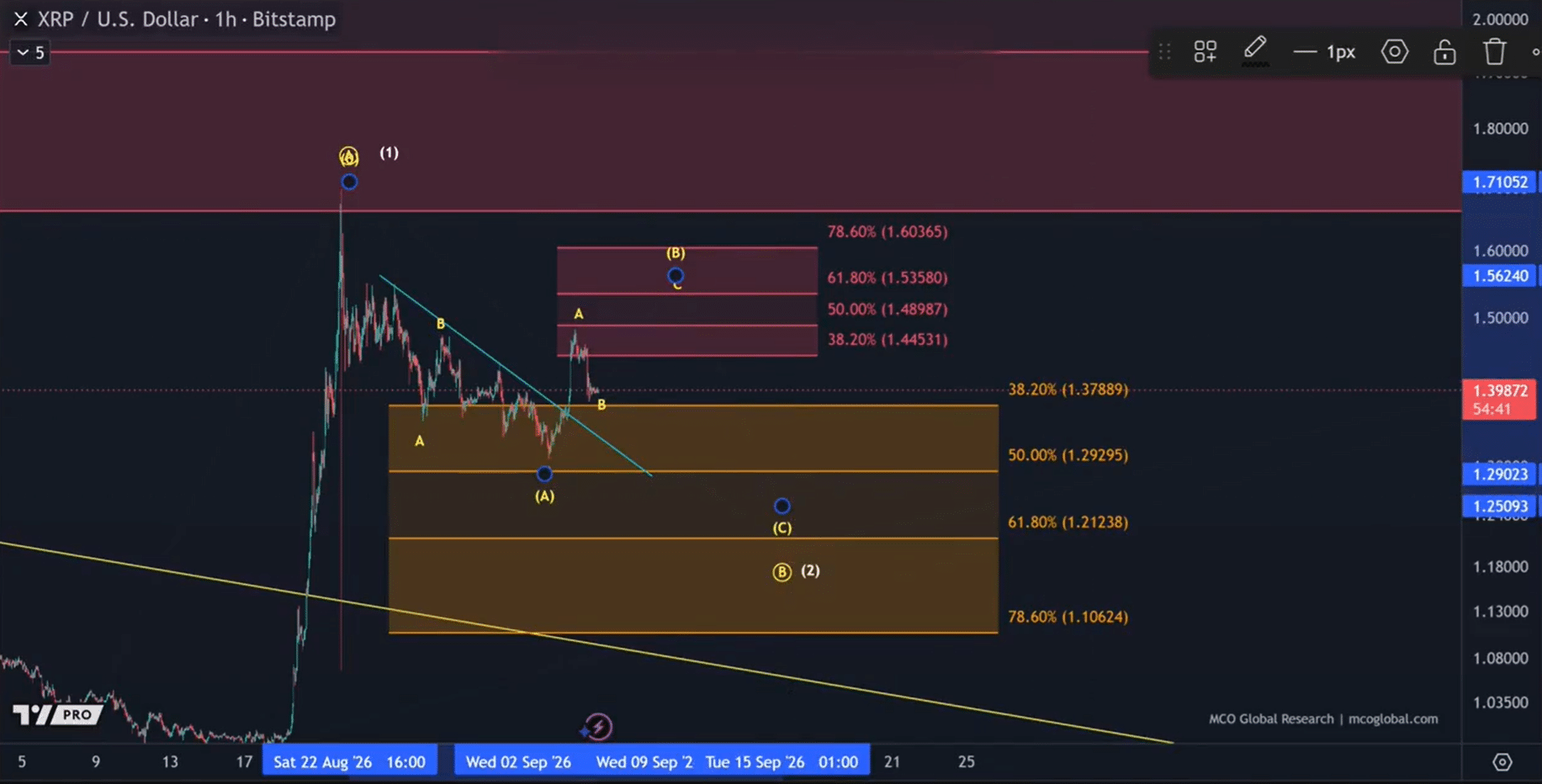
The recent relief bounce from XRP may not have ended the current pullback, as its Elliott Wave structure calls for one more dip.

Notably, the Elliott Wave theory on the 1-hour chart shows that the latest bounce has not yet formed the structure needed to confirm a lasting bottom. This suggests there is room for another drop into the support zone before XRP can begin a recovery.

XRP’s August Rally

The current structure started with XRP’s recovery from $0.99 in early August 2026. The price rose from around $0.99 on Aug. 11 to $1.70 by Aug. 22. This move gave the token a 28.5% gain for August, marking its strongest monthly performance for the month since 2021.

The hourly chart shows several features of an impulsive Elliott Wave move. Specifically, price climbed quickly and moved in a defined direction, which often indicates Wave 1 in a larger bullish sequence. 

If this holds, XRP could have more room to surge after completing its current correction. XRP has also shown a pattern of sudden rallies followed by longer periods of consolidation, and the current structure follows a similar path.

After reaching $1.70, XRP started dropping through overlapping price action instead of following a clear, impulsive decline. This pattern suggests that the market is trying to stabilize, not necessarily entering a fresh major downtrend.

The chart places the main support zone between $1.10 and $1.38. Importantly, four important Fibonacci retracement levels sit within this area at $1.38, $1.29, $1.21, and $1.10. At press time, XRP trades around $1.39, which puts it near the upper edge of this demand zone.

XRP Elliott Wave Structure

Why Three Waves Is Not Enough

XRP has started bouncing from its recent low, and the move may initially look like confirmation that the correction has ended. 

However, the current upward push contains only three waves. Elliott Wave theory generally requires a five-wave upward structure to confirm that a correction has ended and that buyers have regained control.

For now, the move fits better as a B wave within a larger A-B-C correction. Under this view, Wave A took XRP from the $1.70 high down into the support zone, while the current bounce represents Wave B. 

This leaves room for a potential Wave C decline before a sustained recovery begins. However, it is important to note that Wave B could still climb higher before sellers return. 

The chart places resistance between $1.44 and $1.60, with Fibonacci levels at $1.44, $1.49, $1.53, and $1.60. If sellers take control in that area, Wave C would become stronger, with $1.21 and potentially $1.10 coming up as downside targets.

What Macro Catalysts Could Influence the Picture

Meanwhile, the Elliott Wave structure is only one part of the setup. Notably, other market and regulatory developments could also affect XRP’s next move. 

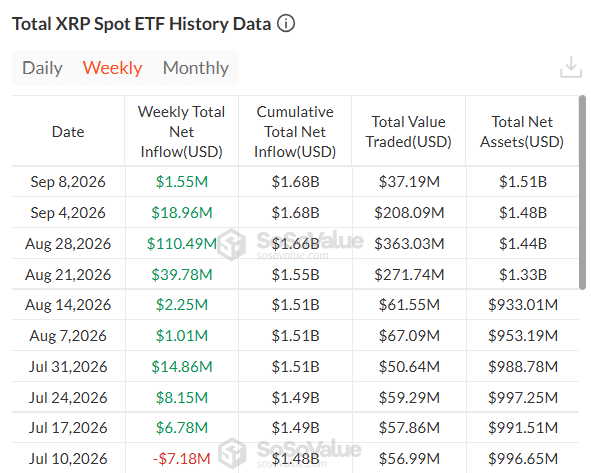
For one, US spot XRP ETFs recorded $18.96 million in fresh inflows over the past week, taking cumulative ETF inflows to $1.68 billion. The continued inflows show that institutional demand remains active around current price levels.

XRP also trades above its 20-day, 50-day, 100-day, and 200-day exponential moving averages. This has helped push the short-term trend from bearish to bullish and confirms that the broader bullish structure remains intact, even if XRP experiences another short-term decline.

For now, XRP’s $1.10 level remains the key floor for the bullish case. A move toward $1.21 or $1.10 would fit the potential Wave C scenario. Until XRP forms a complete five-wave rise, the current bounce may still be a temporary recovery.

XRP Has Entered Rare Zone Seen Just 7 Times in 13 Years, Analyst Says

0

XRP has entered a rare technical zone that has come before some of its biggest price moves, according to analyst ChartNerd.

In a recent post, ChartNerd said XRP has traded below its weekly Gaussian Channel only a few times in the past 13 years. He identified seven such periods, saying each was followed by a major change in XRP’s price.

He highlighted 2014, 2017, 2020, 2022, 2024, and the current 2026 setup as examples of times when XRP reached the lower end of the Gaussian Channel before a major price move.

XRP Price Still Below Key Gaussian Level

Analyst ChartNerd says the lower part of XRP’s weekly Gaussian Channel has historically been an important buying zone. XRP is still below this level, even after recovering from about $0.98 to around $1.38.

In the past, drops below this lower boundary have often been followed by periods where XRP formed a base before moving higher.

However, ChartNerd warned that the indicator should not be used to predict the exact market bottom. Instead, he sees the Gaussian Channel as a tool for identifying areas where XRP has historically built a base before making bigger price moves.

In his words, these ranges have historically been opportunities when XRP falls into them during a bear market.

ChartNerd also pointed to the scale of some historical moves after XRP swept beneath the Gaussian Channel. In one example, XRP eventually recovered by nearly 8x to 9x, while another historical setup was followed by a 100% recovery, highlighting the size of the moves that have followed these zones.

2026 Setup Looks Like Previous Cycles

ChartNerd compared XRP’s current price pattern with previous market cycles, especially the 2022 bottom. In 2022, XRP fell below the Gaussian Channel, recovered toward it, and then formed a higher low before starting a stronger recovery.

ChartNerd believes something similar could happen in 2026 if XRP fails to break above the lower Gaussian Channel. This may lead to another higher low or a double-bottom pattern in the coming months, although more confirmation is needed.

The analyst also looked at XRP’s two-week Gaussian Channel. He noted that XRP falling below the lower boundary has previously appeared around major bottoms and bullish signals, including in 2017, 2020, and 2022.

According to ChartNerd, the same signal is now appearing again in 2026.

Analyst Expects Accumulation Before a Bigger Move

Instead of expecting XRP to quickly reach new all-time highs, ChartNerd believes the cryptocurrency will spend more time building a strong base.

He pointed to XRP’s history of long accumulation periods before major price breakouts. For example, XRP spent several years consolidating between 2013 and 2017 before making a major price move. That price move led to XRP’s $3.84 peak by 2018.

ChartNerd believes another long accumulation period will make XRP’s next breakout even stronger, especially as institutional adoption grows.

His long-term outlook extends to 2028, when he believes XRP will reach $8 or higher. However, he said this would likely require XRP to spend more time building a base instead of immediately starting another sharp rally.

Ultimately, ChartNerd sees XRP’s current setup as bullish in the long term, but believes the price could still move sideways or consolidate before the next major move.

XRP ETFs Become Only Crypto Funds Attracting Inflows as BTC, ETH and SOL Bleed

0

XRP ETFs bucked the market’s bearish trend on Tuesday, standing out as the only crypto funds to record positive capital flows.

The crypto market extended its corrective move on Tuesday, Sept. 8, as the total market capitalization fell 0.33%, wiping out $8.88 billion in value.

XRP ETFs Buck the Trend

Bitcoin led the decline with a 0.81% drop, and the broader weakness pushed most crypto exchange-traded funds (ETFs) into outflows. However, XRP products moved against the trend as XRP’s price recovered during the session.

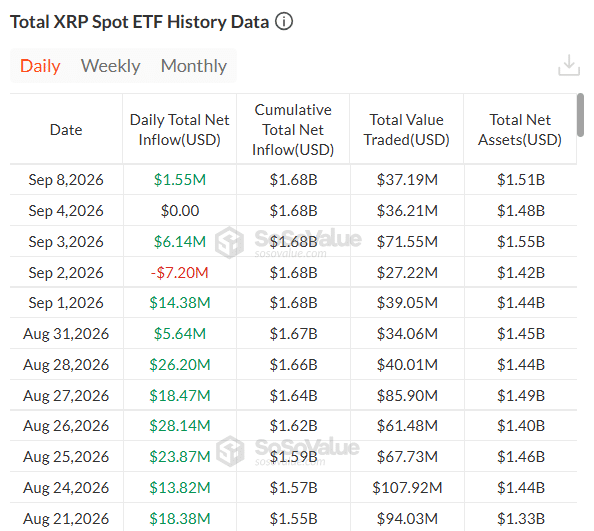
XRP ETFs recorded $1.55 million in inflows on Tuesday. While the amount was relatively small, it gave XRP ETFs a notable lead over other crypto spot funds. 

XRP ETFs Daily Flow Sosovalue
XRP ETFs Daily Flow | Source: Sosovalue

Notably, they were the only crypto spot ETFs to record positive flows that day, while all other crypto ETFs either recorded no flows or saw investors pull money out.

Specifically, Bitcoin ETFs recorded $46.65 million in outflows, ending a three-day inflow streak that started on Sept. 2. Ethereum ETFs also saw $24.29 million leave the funds. Meanwhile, Solana ETFs witnessed $667,000 in outflows, extending an outflow streak that began on Sept. 4.

Other crypto ETF products also struggled during the session. DOGE and BNB ETFs recorded zero flows, while HYPE ETFs recorded $12.96 million in outflows. This confirms that XRP ETFs stood alone among the listed crypto spot funds with positive flows on Tuesday.

XRPZ Accounts for All XRP ETF Inflows

Interestingly, Franklin Templeton’s XRP ETF (XRPZ) generated all $1.55 million in XRP ETF inflows recorded on Tuesday, while the other four XRP ETFs recorded zero flows. 

This new capital lifted XRPZ’s cumulative net inflows to $474.23 million, keeping it as the third-largest XRP ETF by total flows.

Bitwise’s XRP ETF (XRP) recorded no inflows on Tuesday but maintained its position as the largest XRP ETF by total flows and net assets. The fund has accumulated $599 million in net inflows and holds $516 million in net assets. Canary Capital’s XRP ETF (XRPC) remained in second place with $490 million in cumulative inflows.

Total XRP ETF Inflows Reach $1.68 Billion

Combined XRP ETF inflows have now reached $1.68 billion, setting a new peak. The latest weekly figure follows the $18.96 million in inflows recorded across all XRP ETF products through last week. 

XRP ETFs Weekly Flow Sosovalue
XRP ETFs Weekly Flow | Source: Sosovalue

This, in turn, came after XRP ETFs posted a record $110.49 million in weekly inflows for the week ending Aug. 28, making it the funds’ biggest weekly inflow of 2026 so far.

XRP ETFs have also continued to attract money in September. The products have recorded $14.86 million in inflows so far this month, following the $159.18 million they attracted in August. The August figure remains the largest monthly inflow recorded by XRP ETFs in 2026.

The steady inflows indicate that institutional investors continue to gain exposure to XRP through regulated investment products while the broader crypto market remains under correction.

Silvergate Ex-CEO Says Biden Pressure Pushed Bank Into 2023 Liquidation

0

Former Silvergate Bank CEO Alan Lane has challenged the regulatory narrative surrounding the crypto lender’s 2023 closure, saying the bank had the financial resources to continue operating but ultimately chose to shut down under pressure from the Biden administration.

Lane made the allegations Tuesday in his debut Substack article, accusing the Biden administration of orchestrating a campaign against Silvergate that ultimately contributed to its liquidation. He said political forces influenced the decision to close the bank even though it had already weathered an exceptional surge in customer withdrawals.

During the fourth quarter of 2022, Silvergate met withdrawals amounting to roughly 70% of its demand deposits, according to Lane. He argued that doing so without becoming insolvent demonstrated that the bank could have continued operating.

Silvergate disclosed the severity of the deposit exodus in an operational report released in early 2023. Deposits from digital-asset clients had fallen to $3.8 billion by Dec. 31, compared with $11.9 billion at the close of the previous quarter, representing a 68% decline.

Meeting withdrawal demands required Silvergate to draw heavily on its balance sheet. Asset disposals during the quarter generated a $718 million loss as the bank sold $5.2 billion from its debt-investment portfolio. By year-end, its liquidity position included $4.6 billion in cash and assets readily convertible to cash. Lane said additional liquid assets were available to either sell or pledge against borrowing when liquidity was needed.

His explanation for Silvergate’s demise conflicts with conclusions later reached by federal investigators, who identified vulnerabilities inside the bank itself rather than attributing its liquidation to government efforts against the crypto industry.

Regulatory Record Challenges Lane’s Account of Silvergate

In a report issued in September 2023, the Federal Reserve’s inspector general identified a combination of factors behind Silvergate’s decision to liquidate. The review pointed to the bank’s dependence on deposits from digital-asset businesses, its rapid growth, and vulnerabilities arising from several forms of funding exposure.

The report also identified weaknesses in the bank’s risk controls, corporate governance, and risk-management practices. It faulted regulators as well, concluding that supervisors could have intervened earlier and responded more forcefully as the bank’s vulnerabilities emerged.

Lane has also pushed back against criticism of Silvergate’s anti-money laundering controls, maintaining that regulators never proved the bank’s AML framework had failed. 

Regulatory enforcement nevertheless followed after the bank’s closure. In July 2024, the Securities and Exchange Commission accused Lane, Silvergate Capital, and former chief risk officer Kathleen Fraher of misleading investors about the effectiveness of the bank’s Bank Secrecy Act and AML compliance program and its oversight of crypto customers, including FTX.

The SEC alleged that Silvergate’s automated transaction-monitoring system failed to screen payments totaling more than $1 trillion on the bank’s payments network. The regulator also claimed that nearly $9 billion worth of potentially suspicious activity linked to FTX-affiliated entities went undetected.

Lane resolved the SEC case without admitting or denying the regulator’s allegations. The resolution required him to pay a $1 million civil penalty and barred him from serving as an officer or director for five years.

Silvergate separately faced action from the Federal Reserve, which imposed a $43 million penalty over deficiencies in the bank’s transaction-monitoring practices. The Fed later said Silvergate completed its liquidation, repaid all customer deposits and ceased operating as a bank.

Lane Points to 2023 Crypto Banking Warnings

Lane’s case for government pressure goes beyond Silvergate’s treatment by regulators. He cited joint guidance issued by federal banking agencies in early 2023 as evidence, in his view, of a broader effort to constrain the crypto sector.

The guidance warned banks about risks associated with crypto-related activities. The Federal Reserve, however, said banking organizations were neither prohibited nor discouraged from serving any particular customer category.

The agencies withdrew the statements in April 2025.

Block Applies for US National Trust Bank Focused on Bitcoin, Stablecoin Custody 

0

Jack Dorsey’s Block is pursuing a federal banking charter in the United States as it looks to bring Bitcoin and stablecoin custody operations into a nationally regulated trust institution.

Block announced the move Tuesday, saying the proposed institution will operate as Builders Bank & Trust, N.A. The company submitted its application to the Office of the Comptroller of the Currency (OCC). If granted, the charter would place the proposed bank under OCC supervision.

Builders Bank is not intended to operate as a conventional lender or deposit-taking institution. The proposed bank would focus on trust functions involving digital assets and would neither accept customer deposits nor issue loans.

For Block, the proposed charter would place certain existing custody and related services under a unified federal regulatory framework. The structure is designed to accommodate growth in those activities without expanding Builders Bank into the type of business typically associated with conventional lenders.

Block has selected digital asset strategy lead Lee Woolley to serve as the proposed institution’s president and chief executive. Woolley said the venture would draw on expertise from Block’s digital-asset operations and Square Financial Services, along with the banking experience of the team being assembled for Builders Bank.

Crypto Firms Pursue National Trust Charters

Block is entering a regulatory path already being pursued by several other companies across the crypto and financial-technology sectors.

Ripple is partway through that process after regulators conditionally cleared its planned trust institution. Circle and BitGo have already passed the final approval stage. Kraken owner Payward and digital-asset infrastructure provider Zerohash are earlier in the process, with their applications still awaiting a decision.