Home Blog Page 1506

Toncoin (TON) And Memecoin (MEME) To Lead Next Altcoin Surge — Investors Look To InQubeta (QUBE) For Massive Gains

0

After a remarkable market swing, a much-needed breather has set in, which is a build-up to the next move. Poised to lead the next altcoin surge are Toncoin (TON) and Memecoin (MEME), two top crypto coins.

At the same time, investors are looking to InQubeta (QUBE), a new and promising AI altcoin, for massive gains. On a bullish path—soaring past $12.9 million in presale—it is poised to skyrocket after its launch, making it one of the best cryptos to buy now.

InQubeta (QUBE): A Go-To Investment For Staggering Gains

InQubeta (QUBE) is the latest sensation in the crypto space, gearing up to explode after its market debut. Its fundraising has been nothing short of a remarkable $13 million. With most of the new ICOs doing catch-up, it has become the star of the ICO world and a new investor favorite.

As an emerging crypto at the crossroads between AI and blockchain, it aims to address critical challenges within the fast-rising AI sector. Taking a unique approach, it will build the world’s first crypto-based crowdfunding platform for AI tech startups.

In addition, thanks to its fractional investment model and the custom-built NFT marketplace, investors can fractionally invest in and own stakes in promising AI ventures.

In stage nine of the presale, a token is priced at $0.028 and is tipped for a mouthwatering 90x swing after its launch—a recommended presale by all accounts.

Toncoin (TON): Preparing For Next Jump

Toncoin (TON) had a first quarter to remember, soaring from a little above $2 to trading above $5. Its remarkable performance didn’t go unnoticed, turning heads as it demonstrated its potential. With more room for growth and further upsides anticipated, it is among the best coins to invest in.

While the crypto space might be buzzing with new cryptocurrencies like DYM, Starknet, or Pixels, Toncoin has been hailed as one to lead the next altcoin run. According to analysts, its performance this quarter will beat the first, making it a token to bet on.

To ride the market’s bullish wave and position yourself for significant gains, Toncoin is one of the tokens to consider amidst the sea of cryptocurrencies. Simply add it to your portfolio and HODL to avoid missing out.

Memecoin (MEME): Set to Lead the Next Meme Frenzy

The vital role meme tokens play in investment portfolios cannot be downplayed, with Memecoin (MEME) being one of the most compelling fun-inspired tokens. Its low entry point and massive growth potential make it a must-have crypto—perhaps a more compelling option than the trending Solana memecoins.

It had a fairly quiet first quarter but has been gathering momentum this month, raring to go. According to experts, Memecoin will flip its all-time high (ATH) in the coming weeks and go on price discovery, making it one of the altcoins to watch.

Given its low and cheap entry point and astounding growth prospects, Memecoin is fast becoming a favorite among meme enthusiasts and investors. It has been tipped to lead the next meme craze, positioning it as a token not to miss out on—WAGMI.

Conclusion

Toncoin and Memecoin, two of the most promising cryptocurrencies, are expected to lead the next altcoin rally. Meanwhile, InQubeta is on the verge of skyrocketing after its launch, making it a recommended presale. You can become an early bird by clicking the link below.

Visit InQubeta Presale

Join The InQubeta Communities

Disclaimer: This article is provided by the Client. The Client is solely responsible for this page’s content, quality, accuracy, products, advertising, or other materials. Readers should conduct their own research before taking any actions related to the material available on this page. The Crypto Basic is not responsible for the accuracy of info and any damage or loss caused or alleged to be caused by the use of or reliance on any content, goods, or services mentioned in this article.

Please note that The Crypto Basic does not endorse or support any content or product on this page. We strongly advise readers to conduct their own research before acting on any information presented here and assume full responsibility for their decisions. This article should not be considered investment advice.

Cardano Founder Says Not Holding ADA Now is a Major Red Flag

Cardano (ADA) founder Charles Hoskinson humorously claimed it is a red flag for any investor to not hold some amount of ADA tokens at this point.

Hoskinson conveyed this viewpoint in a recent post on X in reply to LILY Brodi, a pro-Cardano content creator. Brodi initiated a discussion within the Cardano community on the prospect of first date questions.

Specifically, the Cardano proponent explored the prospect of asking her date if he holds some ADA. Essentially, Brodi is hinting at her desire for a partner with similar interests and values in cryptocurrency.

In a light-hearted manner, Hoskinson remarked that a partner who is not holding ADA tokens at this stage of development might count as a major red flag. Hoskinson’s remark has since triggered reactions from community members.

Cardano Caught in Bearish Pressure

Meanwhile, the comment comes at a time when ADA has not been a good asset for market participants to hold. ADA has crashed over the last 30 days from its recently-attained yearly peak of $0.8011 to as low as $0.5651. This trajectory represents an approximately 30% price collapse in four weeks.

Emphatically, Cardano has battled significant bearish forces over the past month, registering no positive gain. Moreover, the asset has not shown signs of a comeback yet, declining by 3% over the last 24 hours.

However, it is worth mentioning that this discouraging performance has not been observed for Cardano alone. Rivals like Ethereum and XRP have witnessed similar double-digit percentage price crashes within the last four weeks. 

Yet, others like BNB and Solana (SOL) have shown remarkable resilience by recording over 30% positive gains in 30 days amid Bitcoin correction.

Cardano’s Outlook for April

Notably, some market participants have interpreted Hoskinson’s comment as a potential indication of significant developments on the horizon for Cardano, possibly leading to an increase in its price.

On the contrary, researchers at crypto exchange Changelly are not optimistic about ADA’s performance this month. In their April price forecast for Cardano, they suggested the likelihood of ADA re-entering the $0.6 range but predicted that it would decline by the month’s end.

Nonetheless, renowned independent analysts like Ali Martinez have projected that Cardano would resume its previous bullish momentum this month based on historical observation. Martinez’s ambitious target for ADA this season is $8.

Shiba Inu Finally Listed on Leading Global Exchange Nexo

0

Leading cryptocurrency trading platform Nexo has finally added support for Shiba Inu (SHIB).

Nexo made this known in an X post today, noting that its users can now buy, swap, and send SHIB via its platform. However, they confirmed that Shiba Inu trading is not available in the United Kingdom as of press time.

Supported Features For Shiba Inu 

According to the announcement, Nexo users can now purchase Shiba Inu with their bank cards and borrow other assets against SHIB. In addition, the recent development means users can send Shiba Inu tokens to other Nexo customers using only their phone numbers or emails. 

Additionally, the listing will grant customers the opportunity to swap Shiba Inu for other supported crypto assets, including Bitcoin (BTC), Arbitrum (ARB), Ethereum (ETH), and Litecoin (LTC). 

Nexo allows the purchase of as little as $1 worth of SHIB. To celebrate the Shiba Inu listing, the exchange introduced a 0.5% cashback in crypto rewards when users purchase SHIB with their cards or bank transfers. 

Nexo Bows to Pressure 

The development came a few years after Shiba Inu proponents launched a series of online campaigns to draw Nexo’s attention to SHIB. 

One of the online petitions raised on Change.org in 2021 amassed over 140 votes. Other enthusiasts also launched similar campaigns, especially on X, urging Nexo to list Shiba Inu. 

However, Nexo had ignored these demands until today, when it finally added support for the token. 

Launched in 2018, Nexo is a prominent crypto trading platform that allows over 6 million users to buy, sell, and swap multiple crypto assets. In addition to Shiba Inu, Nexo now supports 75 cryptocurrencies, including meme-based cryptocurrencies like Dogecoin (DOGE) and Bonk (BONK). 

Nexo claims to be licensed in multiple jurisdictions, including the United States, Canada, Hong Kong, Australia, Italy, Seychelles, Poland, and Lithuania. 

Top Platforms List SHIB Without Taking a Dime 

Its support for Shiba Inu adds to the growing list of trading platforms that have listed the canine-themed token. As of February 2024, Shiba Inu had already been listed across 130 crypto trading platforms, including Binance and Coinbase. 

At the time, Shiba Inu’s marketing lead, Lucie, disclosed that the token achieved the feat without paying a dime. The vibrant community behind Shiba Inu is instrumental in getting these trading platforms to list SHIB. 

These enthusiasts launched a series of online campaigns to call the attention of these platforms to the token. A case in point was Robinhood finally listing Shiba Inu after the petition created to achieve this purpose received thousands of votes.

Ripple CEO Hits Back at CoinDesk Criticism of Stablecoin Initiative

0

Ripple CEO Garlinghouse has responded to a critical piece from CoinDesk classifying Ripple’s push toward exploring the stablecoin market as a desperate move.

Notably, Ripple recently announced plans to launch a stablecoin on the XRP Ledger (XRPL) and Ethereum networks later this year. However, amid the generally bullish reception to this disclosure, concerns and criticisms have also emerged.

One case involved a critical report from leading crypto publisher CoinDesk. In its article, the crypto-focused media outlet claimed Ripple was failing at what it does, and the stablecoin venture was a desperate move to regain market relevance.

Nonetheless, this opinion has triggered a backlash from industry leaders, including Ripple CEO Brad Garlinghouse, who see it as a baseless attack. Garlinghouse’s comment came as a reply to remarks from Artur Kirjakulov, co-founder and CEO of XPMarkets.

XPMarkets Founder Bashes CoinDesk 

In recent post on X, Kirjakulov took aim at the CoinDesk article, contesting the narrative presented by the publisher. He provided insights into Ripple’s current standing and future prospects to counter the assertion that the company is losing relevance.

Firstly, Kirjakulov addressed the claim that Ripple has struggled to secure real enterprise clients. He pointed out Ripple’s extensive network of partnerships with over 300 financial institutions worldwide.

This substantial backing contradicts the notion of Ripple facing significant hurdles in securing partnerships. The firm has also continued to expand into the custody and tokenization industry with the acquisitions of Metaco and Standard Custody in less than a year. 

The CoinDesk article also alleged that XRP is losing relevance in the market. However, in response, Kirjakulov highlighted XRP’s continued prominence as one of the top cryptocurrencies by market capitalization. 

He emphasized its ongoing utilization in international transactions and liquidity management by various financial entities, especially within Ripple’s On-Demand Liquidity (ODL) service (now Ripple Payments).

Kirjakulov: Ripple Stablecoin Venture Not a Desperate Move

Kirjakulov also challenged the characterization of launching a stablecoin as a desperate move, comparing it to similar initiatives by other major firms like PayPal. He emphasized that such expansions are not signs of failure but rather adaptations to the evolving crypto scene.

He also addressed Ripple’s legal troubles with the SEC, which CoinDesk spotlighted as one of the reasons the company is looking for a new source of revenue. Kirjakulov stressed that Ripple is not unique in facing regulatory scrutiny within the industry. 

He suggested that the outcome of the SEC vs. Ripple legal dispute could have broader implications for crypto regulation, underscoring Ripple’s significance in shaping the industry’s future.

Furthermore, Kirjakulov questioned the portrayal of partnership fallouts without context, noting that shifts in partnerships are common in the dynamic fintech and crypto sectors. Notably, CoinDesk had highlighted the failed partnership between Ripple and MoneyGram.

Kirjakulov challenged the claim that Ripple’s services, particularly RippleNet and On-Demand Liquidity, were losing traction. He noted that numerous financial institutions have continued to leverage the services for cross-border payments.

Ripple CEO Reacts

In response, Ripple CEO Brad Garlinghouse echoed Kirjakulov’s sentiments, describing the piece as “embarrassing for the industry.” He criticized CoinDesk for allowing “childish antics” to overshadow its credibility as a leading source of crypto industry coverage.

Garlinghouse expressed concern over the prevalence of tribalism within the blockchain community, urging unity in the face of resistance from legacy financial systems. He emphasized the need for cooperation to overcome industry challenges and drive innovation forward.

Ripple Stablecoin Won’t Kill XRP, Expert Asserts

0

Krippenreiter, a crypto researcher, recently discussed the possibility of XRP becoming obsolete due to Ripple’s imminent launch of the USD-backed stablecoin.

For context, Ripple recently made waves with its announcement of introducing a new stablecoin pegged to the US dollar on the XRP Ledger (XRPL) and Ethereum networks later this year.

Concerns of XRP Doom 

This decision has sparked speculations and concerns within the crypto community regarding the potential impact on XRP’s relevance and utility for cross-border transactions. Notably, the payments firm largely depends on XRP for some transactions involving its cross-border payments service.

Recall that an on-chain sleuth, Mr. Huber, asked last month why Ripple had not introduced a liquid stablecoin on the XRPL after over a decade of development on the network. He theorized that the firm possibly wishes to continue leveraging XRP for its cross-border settlement service.

Now that Ripple seeks to launch a stablecoin, apprehensions about XRP’s abandonment have taken the spotlight. In response, Krippenreiter noted that the development does not particularly spell the end for XRP.

In an attempt to provide a basic overview of stablecoins, he noted that stablecoins are digital representations of real-world assets aimed at maintaining a stable value pegged to these assets. 

Differences between Stablecoins and XRP

The crypto researcher then highlighted major differences between stablecoins and XRP. This move shows that XRP boasts some unique features that are not inherent in stablecoins, making it difficult for the upcoming Ripple stablecoin to replace it.

Neutrality, Counterparty Risks and Transparency 

Unlike stablecoins, which inherently depend on issuers, institutions, or specific jurisdictions, XRP is a globally neutral token on the XRPL. This neutrality further underscores XRP’s resilience against counterparty risks, a looming concern plaguing stablecoin ecosystems.

Another factor Krippenreiter spotlighted is transparency. While stablecoin issuers undergo audits and attestations to validate off-chain reserve assets, the XRPL’s transparent ledger enables stakeholders to monitor XRP’s supply dynamics in real time.

Fragmentation, Dedollarization, and Adaptability 

In terms of fragmentation, there are lots of different stablecoins, each backed by different companies, and they operate on various chains and platforms. However, the XRP Ledger (XRPL) is different. It has its own unique currency, XRP, and a built-in DEX.

The researcher called attention to the growing de-dollarization scheme across the globe. For context, several nations, especially those in BRICS, are looking to cut off their reliance on the dollar. Last August, the President of Brazil, a member of BRICS, called on BRICS nations to launch a common currency in this regard.

Basically, every stablecoin tied to the US dollar is only as good as the real US dollars it represents. This means if people lose trust in the US dollar, it could affect the value of these stablecoins, especially with the nations looking to dump the dollar.

Krippenreiter also discussed adaptability as a key difference between XRP and stablecoins. Notably, stablecoins have rules set by their issuers, meaning those companies can create or destroy stablecoins without everyone knowing exactly what’s happening behind the scenes. 

On the other hand, XRP works differently. Since it is not a stablecoin and doesn’t rely on any backing, everyone using the XRP Ledger, represented by the DUNL validators, has to agree upon any changes in supply.

Ripple Stablecoin Would not Replace XRP

Contrary to concerns about XRP’s obsolescence, Krippenreiter’s analysis emphasizes its enduring relevance. Despite the imminent launch of Ripple’s stablecoin, XRP’s unique attributes, including speed and independence, ensure its continued prominence in the scene.

Citing on-chain data, Krippenreiter stressed the massive nature of the stablecoin market, which boasts a $153.5 billion valuation per DeFiLlama data. Stablecoins also dominate 51% of the Ethereum network and command over $875 million in volume on Uniswap.

Given stablecoins’ growing dominance in the crypto space, Krippenreiter believes Ripple’s stablecoin project could record success. He believes the new XRPL AMM functionality would lead to the launch of AMM with currency pairs involving XRP and the Ripple stablecoin.

Shiba Inu Partner Announces Date and Roadmap of Its Launch on Shibarium

0

Shiba Inu ecosystem partner, K9 Finance, highlights three key phases for the launch of its liquid staking platform on Shibarium.   

In an interesting development, Shiba Inu’s community-oriented SHIB Magazine recently shed light on K9 Finance DAO’s roadmap to enhance Shibarium’s decentralized finance (DeFi) landscape. 

K9 Finance Details 3 Steps of Its Launch 

According to the journal, the highly anticipated mainnet launch of K9 Finance’s decentralized application (dApp) will occur in three phases this year. 

The first stage, called “Hesper,” will be deployed in late Q2 2024. Hester is the foundational stage and beta version of K9’s dApp. The K9 ecosystem team derived its name from the ancient ancestors of modern dogs, “Hesperocyoninae.” 

Notably, this initial stage requires extensive testing and learning within the Shibarium network—an integral aspect of the project’s future functionality and scalability. 

Furthermore, K9 plans to deploy the second phase of its liquid staking platform on the Shibarium mainnet by Q3 2024.

The second stage, dubbed “Boro,” is a name derived from the formidable “bone-crushing dog” Borophaginae. It represents the release of the dynamic K9 staking dApp on the Shibarium mainnet. 

Upon the launch of Boro, Shibarium users can conveniently swap their staked Bone ShibaSwap (BONE) for K9’s liquid staking token knBONE. 

K9’s deployment on Shibarium will be finalized by Q4 2024 with the rollout of the Caninae stage. Caninae would showcase the adaptability and diversity of the present canine species. 

This stage aims to achieve K9 Finance’s overall vision of offering a complete decentralized liquid staking derivative product on Shiba Inu’s L2 blockchain. 

“This [Caninae] phase is not just the completion of a product; it’s the realization of a vision—a fully decentralized liquid-staking derivative product that stands as the epitome of innovation and functionality in the DeFi space,” K9 Finance said in a statement. 

First Sneak Peek of K9 dApp Unveiled 

As crypto enthusiasts anticipate K9’s mainnet launch, the project’s co-founder Buzz shared the first sneak peek of the dApp, explaining its dynamic staking model. 

According to the screenshots, Buzz explained that users who delegate their BONE tokens through the platform will be rewarded in two ways. 

Buzz noted that users will first receive esKNINE tokens, which they can convert to K9 Finance’s official governance token, KNINE. Secondly, the co-founder also mentioned that users will also earn K9 partner tokens through boosted campaigns. 

Recall that the Shiba Inu team unveiled K9 Finance as its official liquid staking derivative partner in February. Last month, K9 Finance extended its partnership with Shiba Inu by appointing two prominent SHIB developers, Shytoshi Kusama and Kaal Dhairya, as its technical advisors. 

The project’s governance token, which launched on Uniswap last month, was trading at $0.00008715 at press time, marking a 24-hour decline of 9.67%. 

Uphold Launches New Finance Basket for XRP

Leading American trading platform Uphold has unveiled a new crypto investment basket featuring XRP and other financial-based tokens. 

In a recent post on X, Uphold announced pushing out a new finance basket on its platform featuring six assets, including XRP.

For context, crypto Baskets on is a system that seeks to simplify the challenges of building a robust cryptocurrency portfolio. It cuts the process of navigating through thousands of crypto assets to pick worthy investment instruments.

Essentially, Uphold Baskets equip users with a one-click route for crypto portfolio diversification, containing carefully selected crypto assets within a “basket.” Uphold launched this service in February, categorizing assets in the basket solution based on diverse market sectors.

For instance, the product went live with initial baskets such as the “Big Three,” which contained XRP, Ethereum, and Bitcoin. Now, the exchange has expanded its basket options, establishing one focused on crypto projects with solutions tailored to the finance sector. 

New Finance Basket with XRP

This new basket, dubbed “Finance Basket,” encompasses XRP, Stellar (XLM), XDC Network (XDC), Hedera (HBAR), Casper (CSPR), and Adshares (ADS).

Uphold believes that this basket investment process mitigates risks and improves the potential for returns for users.

Other baskets the exchange offered at the February launch include crypto assets under the Future Blockchains and Infrastructure sectors. In the basket for infrastructural crypto tokens, Uphold added Chainlink (LINK), Ethereum (ETH), Quant (QNT), Cosmos (ATOM), Avalanche (AVAX), and Polkadot (DOT).

On the other hand, Solana (SOL), Kaspa (KAS), Aleph Zero (AZERO), Constellation (DAG), and Near (NEAR) featured in the “Future Blockchains” basket.

Uphold has emphasized that the tokens in each basket were vetted by its expert research team. Notably, this simplified crypto portfolio diversification service is open to all Uphold users except those in restricted regions. 

Buying and Selling Tokens In Uphold Baskets

It is worth noting that when using the baskets solution to buy assets, each purchased token appears individually in users’ portfolios. However, Uphold users are to initiate separate transactions for each asset when selling any token they acquired through the baskets.

Expert Predicts XRP to $12 as Ripple Targets Stablecoin Market

Rob Cunningham, the host of KUWL.show, has argued that Ripple’s venture into the stablecoin market, which is expected to reach $2.8 trillion, could make XRP a $12 asset.

Yesterday, crypto payment firm Ripple disclosed its intention to launch a USD-based stablecoin on the XRP Ledger (XRPL). Ripple emphasized that the stablecoin market is worth over $150 billion as of present. However, it cited projections that the market could expand to $2.8 trillion by 2028.

The $2.8 trillion projection has captured Ripple’s attention, prompting the firm to declare its intent to enter the market and launch its USD stablecoin on the XRPL later this year.

Ripple’s declaration sparked bullish commentaries from the crypto community, especially as the proposed stablecoin is coming to XRPL. Pundits examine the potential value of XRP with such pivotal utility coming to its native blockchain.

Among the leading commentators was Cunningham, founder of KWUL Research. Cunningham fixated his XRP price forecast on the cited $2.8 trillion by 2028.

The industry pundit estimated that the current stablecoin market may expand nearly 20-fold to hit the project $2.8 trillion in four years. On this basis, he speculated that XRP may grow by the same margin in four years. 

Specifically, Cunningham projected XRP to grow 20 times from about $0.6 in four years to a market value of $12 based on its incoming utility in the stablecoin landscape. His statement suggested XRP could be worth more by 2028, factoring in other utility services.

Moreover, Cunningham backed his outlook with Ripple’s dominant position in the global crypto payments arena, describing it as the 800-pound gorilla. 

Crypto Author Disagrees

Meanwhile, Panos Mekras, the author of “Understanding the Crypto Economy,” challenged Cunningham’s projection of $12 based on the anticipated market size of stablecoins by 2028. He argued that Cunningham’s approach to deriving this price is flawed. 

In particular, Mekras pointed out that the projected $2.8 trillion market size encompasses all stablecoins, not just Ripple’s. 

Additionally, Mekras stressed that whatever amount Ripple issues in stablecoins has no direct correlation with XRP itself. He emphasized that the funds associated with Ripple’s stablecoin initiative do not necessarily flow into XRP.

Shiba Inu Eyes $0.00014 As SHIB Repeats 2021 Pattern that Led to 1164% Surge in 1 Month

0

Shiba Inu is currently repeating a pattern it recorded during the 2021 bull run, which resulted in an impressive 1,164% rally in just one month.

Crypto market analyst and educationist Rafaela Ligo called attention to this pattern in a recent post on X, quoting a previous analysis she made on SHIB’s price movements when it demonstrated a similar trend in September 2021.

1,164% Upsurge

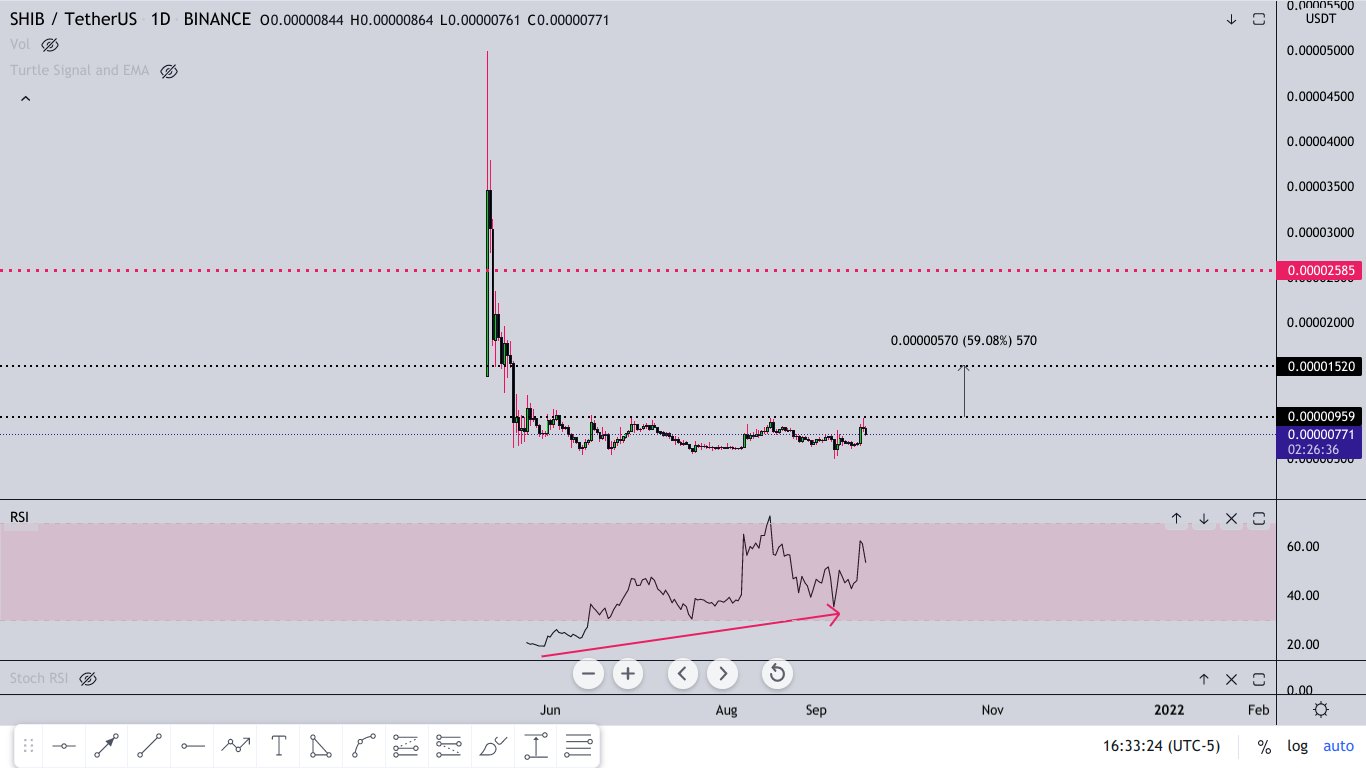
Notably, during that time, Rafaela confirmed that Shiba Inu faced a strong resistance level at the $0.0000095 price territory. Data from an accompanying chart indicated that Shiba Inu retested the resistance level seven times from May 2021 to September 2021.

Following the seventh retest on Sept. 17, 2021, Shiba Inu saw a price drop that saw it collapse to the $0.000007 level. Amid this drop in price, Rafaela identified a bullish divergence formed by Shiba Inu with respect to its relative strength index (RSI).

Image

For context, a bullish divergence typically occurs when a cryptocurrency records a drop in price, but its technical indicator witnesses an uptrend. Despite Shiba Inu collapsing to $0.000007, its RSI continued to record new highs, indicating growing strength.

Rafaela further confirmed that SHIB’s action was relatively stable in the five-day and weekly timeframe, suggesting that it could be on the verge of breaking the $0.0000095 resistance. 

Interestingly, Shiba Inu broke this resistance in October 2021, soaring from a low of $0.000007 on Sept. 30 to its ATH of $0.00008845 on Oct. 28, 2021. This rally marked a 1,164% increase in Shiba Inu’s price in less than a month, shortly after it followed this trend and breached the potent resistance.

Shiba Inu October 2021 Performance

Shiba Inu Repeats 2021 Pattern

Now, Rafaela believes SHIB is taking a similar path in this bull phase. In her latest analysis, she leveraged a weekly chart to point out that while Shiba Inu has continued to record price declines, its volume has seen remarkable surges.

Notably, since late February, Shiba Inu’s cumulative trading volume on Binance has exceeded 907 trillion tokens, marking a rapid growth in interest. While this trend does not particularly constitute a bearish divergence, it could signal increased accumulation or selling pressure.

Rafaela’s chart indicates that SHIB has been facing resistance at the $0.000032 territory, similar to what it observed in 2021. The market analyst expects Shiba Inu to eventually breach the resistance, projecting a 2,015% upsurge from the $0.0000066 level to $0.0001402.

Meanwhile, Shiba Inu currently trades for $0.00002682, down 3.4% today. Despite its low price, industry commentators are fully convinced the SHIB can reclaim the $0.0001 level. Lead developer Shytoshi Kusama asserted last month that a prediction of $0.00012 price for SHIB is an “underestimate.”

FedNow Enables XRP Transactions to US Bank Accounts, Uphold Confirms

Prominent American crypto exchange Uphold has confirmed that FedNow facilitates XRP transactions to select U.S. bank accounts.

This confirmation came in a recent post on X following The Crypto Basic’s report indicating that FedNow processed a deposit transaction involving XRP to a U.S. bank account. 

Notably, XRP enthusiast Crypto Value Hunter first called attention to the transaction on Monday after he observed that the payment description of his XRP withdrawal contained information suggesting that the U.S. Federal Reserve instant payment system, FedNow, processed the XRP funds.

The revelation had sparked skepticism among the broader community. Some claimed to have never observed a payment description bearing FedNow when they initiated a similar crypto withdrawal from Uphold. Others even thought it was a prank, as the insight came up on April Fool’s Day.

Uphold Confirms FedNow Processes XRP Txns

However, Uphold has entered the conversation, attesting that FedNow processes XRP withdrawals into U.S. bank accounts. In the post, Uphold noted that residents of the United States whose banks support FedNow or RTP can enjoy instant withdrawals in XRP to USD from Uphold. 

Moreover, the exchange urged users to look out for the lightning symbol in the app for transactions where instant withdrawal is feasible. These instant withdrawals from Uphold, processed either through FedNow or RTP, incur a variable fee of 1.75%. In particular, it attracts a minimum charge of $1 and a maximum cap of $150.

Notably, FedNow, which went live in July 2023, is managed by the U.S. Federal Reserve. Conversely, RTP, initially launched in 2017, is supervised by The Clearing House.

It is worth emphasizing that while users withdraw XRP from Uphold to their banks, the equivalent USD value hits the account. The process merely eliminates the need to first sell the crypto asset to USD. Additionally, this feature of direct crypto withdrawal to a USD account is not specific to XRP, as other cryptos are supported.

Significantly, some community members have pointed out that this feature from Uphold is not entirely new, as it has persisted for a while. However, some Uphold users are just catching up with the update.