Home Blog Page 1602

Research Puts XRP Price at $771 if It Captures 20% of Projected $50T XRPL Volume

0

The Athey and Mitchnick research calculator puts XRP at an ambitious $771 price if the crypto asset can capture 20% of the $50 trillion XRPL volume projected by the CEO of Archax.

Recall that Graham Rodford, the CEO of global securities exchange and custodian Archax, predicted that the XRP Ledger could process $50 trillion in volume by the fourth quarter of 2025. Rodford made this projection while speaking at last year’s Swell.

As The Crypto Basic reported, he noted that this would only be a fraction of the global $1.5 quadrillion. According to him, the XRPL could achieve this feat, considering the growing adoption of blockchain by institutions and the emergence of real-world asset tokenization.

Such an increase in the XRPL’s volume would immensely benefit XRP as its native token, leading to a surge in adoption and demand. As a result, the asset could witness the much-coveted price appreciation envisioned across the community. 

However, the magnitude of such a price appreciation remains uncertain. For this reason, The Crypto Basic leveraged the Athey and Mitchnick Calculator in an attempt to have an inkling. 

Parameters Surrounding the Value

It bears mentioning that the $50 trillion volume would not only be attributable to XRP. So, we assumed the asset captured only 20% of the total projected volume, amounting to $10 trillion. This would represent an 8,233% rise in XRP’s current average daily volume of $1.2 billion.

For the average time it takes for a new transaction to occur involving XRP, we considered an assumption of five days, which was the default value. This metric reflects the frequency of XRP transactions over a specified period, indicating the token’s activity level.

Considering XRP’s store of value, we kept it unchanged, using the current value of $27 billion (or $0.027 trillion). For the time it would take for XRP to hit the projected volume, we set up two years, reflecting Gordon’s projection of Q4 2025.

We assumed XRP’s circulating supply at that time to be 58.8 billion tokens. Currently, the asset has a circulating supply of 54.4 billion, per CMC data. Assuming the inflation of 200 million a month due to Ripple’s escrow releases, this would translate to an additional 4.4 billion in December 2025.

XRP at $771

As for the cost of converting future cash flows into their present value, we leveraged 5%, being the default rate. On the back of these metrics, the Athey and Mitchnick calculator puts XRP price at $771.70 at a volume of $10 trillion. XRP currently trades for $0.5072.

The asset would need to surge by 151,911% to clinch $771. It bears mentioning that this figure is purely speculative and there is no guarantee that XRP could attain even a tenth of it.

However, this evaluation helps to present an educational guess of where the XRP price could be heading if the $50 trillion XRPL volume projection materializes.

Ripple CTO Highlights 4 Things He’s Looking Forward to In 2024 

0

Ripple CTO David Schwartz has outlined four things he looks forward to for crypto this year. 

He made this known during a recent interview with Tony Edward of Thinking Crypto Podcast. 

Regulatory Clarity and Resolution of SEC V. Ripple Lawsuit 

According to Schwartz, getting regulatory clarity and the resolution of Ripple’s ongoing legal tussle with the Securities and Exchange Commission (SEC) tops the list of things he is looking forward to this year. 

The crypto community has been demanding regulatory clarity for years. This is majorly because they believe clear regulation for the industry could curb certain risks associated with cryptos while providing better protection for investors. 

With regulatory clarity, crypto-related entities get to understand the Dos and Don’ts of operating in the industry. However, the appropriate regulators have ignored all calls for regulatory clarity. 

Some agencies, like the SEC, believe the rules are clear. The absence of regulatory clarity has resulted in widespread enforcement action against crypto-related entities. 

The ongoing SEC v. Ripple lawsuit is one of the examples of the SEC’s enforcement actions. Despite the SEC introducing the lawsuit in December 2020, the legal tussle has lingered for over three years. In his interview with Edward, Ripple’s CTO speculated that the lawsuit could be resolved this year. 

“There is some reasonable chance that the lawsuit could be resolved in 2024,” Schwartz remarked. 

It bears mentioning that the lawsuit is in the remedies stage. Notably, the last brief with respect to remedies will be filed by April 29, 2024. Consequently, several legal experts, including Fred Rispoli, predicted the judge could issue the final ruling in early summer. 

Aside from getting regulatory clarity for crypto and expecting the SEC lawsuit to be resolved in 2024, Schwartz also highlighted other things he is looking forward to. 

Improved Scaling at the Blockchain Layer 

The Ripple CTO also pointed out that he is big on scaling at the blockchain layer. Per Schwartz, developers are currently faced with the issue of innovating properly at the blockchain layer. However, he believes this issue can be resolved with technologies like sidechains and zero-knowledge proof solutions. 

“[These technologies] will enable people to innovate more, sort of right at that lowest layer, and enable more scalability,” he added. 

Onboarding More Users into the Crypto Ecosystem 

Another major thing Schwartz envisions is getting more people into the crypto ecosystem. For this vision, Schwartz emphasized the need to create user experiences that are compelling to people, thus bolstering interest in crypto. 

For instance, he stated that people should be given access to tokenized securities and collateralized lending. 

On the part of XRP Ledger, the Ripple CTO hopes that AMM (Automated Market Maker) will activate a decentralized identity and not make it seem controversial. 

Boosting Institutional Adoption 

Furthermore, Schwartz noted that he is looking forward to a surge in institutional adoption of crypto this year. Many believe the recently approved Bitcoin spot exchange-traded funds (ETFs) will contribute immensely to bolstering institutional adoption. 

However, things have not been going as expected, with trading volume plunging below $1 billion in two consecutive days. 

Despite these shortcomings, Schwartz still thinks Bitcoin ETFs will be pivotal in luring more institutional investors into crypto. 

XRP Forms First Death Cross of the Year: Can Price Still Rebound?

0

XRP price has seen one of the most uncertain trends in recent times with the formation of a “Death Cross” spotted on the daily price chart.

Over the past 24 hours, XRP has grown from a low of $0.4982 to a high of $0.5101 before finally cresting at $0.5014 amid a slight uptick of 0.15% in the past 24 hours. The wavy motion of XRP has pushed the cryptocurrency to print its first Death Cross of the year.

Death Crosses are typically bearish and they are formed when a “short-term Moving Average (MA) crosses below a longer-term Moving Average.” 

The XRP Death Cross

Per the XRP/USD 1D Chart as shown below, the 50-Day Moving Average (in red) has slipped below the 200-Day Moving Average (in blue).

XRPUSD 2024 02 02 16 18 16
XRPUSD 1D Chart on TradingView

The cross-over was recorded around the $0.504 price mark, a level that has constantly been flagged by market analyst Crypto Rover.

Though XRP snapped back quickly from its freefall as it dropped below the 3-year consolidation pattern earlier this week, the Death Cross formation shows that the bearish sentiments are far from over.

The Death Cross depicts much information that shows the current drawdown in XRP’s price is not sudden, but has been in place for quite some time.

This fact cannot be dismissed considering the July 13 ruling from Judge Analisa Torres failed to produce a sustainable bullish rally for the digital currency.

Over the past year, XRP has managed to grow to a high of $0.93 following the legal victory. However, it has persistently traded below this level following a drop from this high.

Is All Hope Lost for XRP?

Despite its unimpressive price action, Xhas remained one of the most capitalized cryptocurrencies. While this is not the right judge of growth, it underscores how the coin is staying resilient in relation to the broader market.

Beyond the evolution of the XRP Ledger (XRPL) and the growth prospects associated with Ripple Labs, the general market sentiment ahead of the forthcoming Bitcoin halving event is likely to impact the digital currency positively.

$1,000 Shiba Inu Investment Could Turn $109K if SHIB Hits $0.001

0

If the price of Shiba Inu hits projected price targets in the coming years, then a $1,000 investment at current prices could skyrocket to unimaginable levels.

Shiba Inu was one of the biggest performers of the 2021 bull run, making many investors millionaires. While there is no guarantee that history will repeat itself, many are still banking on Shiba Inu’s potential success, with the coin having secured over 1.3 million holders.

For anyone considering an investment in SHIB, it is usually helpful to consider how much their assets will be worth when the price reaches a certain price level.

As a result, this article evaluates how much a $1,000 investment into Shiba Inu at current prices will be worth if the price goes to a widely predicted $0.001 level in the coming years. 

How Much Will $1,000 in SHIB be Worth at $0.001?

At its current price of $0.000009, $1,000 can purchase 111 million Shiba Inu tokens, putting an investor in the top class of SHIB millionaires.

If Shiba Inu recovers to its previous all-time high of $0.00008845, this investment will have increased by nearly 1,000% times, with its value around $9,826 at this price.

Meanwhile, if SHIB goes higher to eliminate two zeros from its previous all-time high and reaches $0.001, then a $1,000 investment will be worth $109,000.

This will represent a more than 10,000% increase from current prices, which underlines the considerable amount of time that might pass before Shiba Inu goes to those price levels.

Can Shiba Inu Reach $0.001?

Multiple predictions tip Shiba Inu to cross $0.001, the equivalent of eliminating three zeros from its current price. However, it is worth mentioning that reaching such a milestone, although possible, will involve considerable effort and possibly take a long time.

Shiba Inu has a supply of 589 trillion tokens, meaning that a $0.001 price puts its total market cap at $589 billion. This value is approximately 35% of the current crypto market cap, at $1.64 trillion. 

Hence, an investment backing SHIB to reach the $0.001 mark from its current price level and at the current supply dynamics assumes that the cryptocurrency’s market value will become almost as valuable as Bitcoin at this time and more valuable than the second-largest crypto, Ethereum.

The cryptocurrency market will have to grow into several trillions for Shiba Inu to stand any chance of reaching the $0.001 mark. Alternatively, the project will have to lower its supply significantly for this target to become remotely feasible.

BlackRock Bitcoin ETF Overtakes Grayscale’s GBTC in Trading Volume 

0

BlackRock’s Bitcoin exchange-traded fund (IBIT) has surpassed Grayscale’s converted BTC product (GBTC) in volume for the first time since trading commenced on January 11.  

BlackRock’s IBIT has become the first Bitcoin spot exchange-traded fund (ETF) to overtake Grayscale’s converted BTC product (GBTC) in terms of daily volume. 

February 1 Trading Volume 

According to data from The Block, BlackRock’s IBIT recorded $303.97 million in trading volume yesterday, while Grayscale’s GBTC saw only $292.37 million. 

Other notable funds in the list include Fidelity’s FBTC, which came third with $171.84 million worth of volume. The remaining Bitcoin funds, including ARK 21Shares, saw less than $100 million in trading volume. 

Notably, yesterday’s trading volume was valued at around $924 million. Commenting on the development, Bloomberg ETF analyst James Seyffart noted that yesterday was the first day the total ETF volume was below $1 billion. 

In addition, yesterday was also the first time that one of the newly approved Bitcoin funds surpassed Grayscale’s volume since January 11, when trading commenced. 

Grayscale’s Dominance in Bitcoin ETF Market Declines 

It bears mentioning that Grayscale’s GBTC has led other Bitcoin funds in both assets under management (AUM) and daily volume since their listing. 

GBTC’s enormous volume mostly came from the outflows as Grayscale’s investors were seen diverting their profits to other providers. The outflow is reflected in the huge amounts of BTC moved from Grayscale to San Francisco-based exchange Coinbase. 

Since January 11, Grayscale has moved hundreds of millions of dollars worth of BTC to the exchange. However, the outflow from GBTC has reduced significantly in the past few days. Yesterday, GBTC saw an outflow of $182 million, marking the lowest since January 11. 

Notably, Grayscale’s converted fund is still ranked as the largest Bitcoin ETF, boasting an astounding $20.55 billion. 

BlackRock and Fidelity Lead ETF Inlows 

Interestingly, BlackRock and Fidelity funds led in inflow on February 1. While  BlackRock’s IBIT registered a $163.9 million inflow, Fidelity’s FBTC added $35.8 million to its fund. 

After 15 days of trading, the total net inflows was around $1.4 billion. According to BitMEX Research data, BlackRock’s Bitcoin fund has $3.01 billion in assets under management, ranking behind GBTC. Furthermore, Fidelity’s ETF boasts a massive $2.58 billion in AUM.  

US Report Shows Bitcoin Mining Used 0.6% to 2.3% of US Energy

0

A report from the U.S. Energy Information Administration (EIA) has disclosed that Bitcoin mining consumed 0.6% to 2.3% of the total U.S. energy last year.

The report discloses the electricity consumption of Bitcoin mining in the United States, utilizing data sourced from the Cambridge Bitcoin Electricity Consumption Index (CBECI). This index monitors the power demands of Bitcoin mining globally.

Per the report, Bitcoin mining constituted 0.6% to 2.3% of the total energy demand for the U.S. in 2023. For context, the entire country’s energy demand amounted to 3,900 terawatthours (TWh).

This rate implies that Bitcoin mining in the U.S. consumed more electricity than states like Utah and West Virginia. It also equates to the annual power consumption of over three to six million homes in the country.

Significantly, data estimates place Bitcoin mining in the U.S. between 25 TWh and 91 TWh, with the assumption that the U.S. maintains a 38% share of global Bitcoin mining. This share has risen from 3.4% in January 2020 to 37.8% in January 2022, as reported by the CBECI.

Notably, China, which accounted for over 72.69% of all global Bitcoin mining in January 2020, saw its share hit 21.11% in January 2022, as it relinquished its spot at the top to the U.S. 

Recall that China banned Bitcoin mining in 2021, leading to a drop in share to 0% in July 2021. However, this metric picked up again, as individuals turned to underground mining. Despite the resurgence, China secures second in terms of global Bitcoin mining.

According to the CBECI, global Bitcoin mining accounted for 0.2% to 0.9% of the world’s electricity demand in 2023 of 27,400 TWh. This consumption is on par with countries like Australia or Greece. The CBECI reports that global Bitcoin mining used 67 TWh to 240 TWh of electricity.

Concerns Surrounding Bitcoin Mining

Reports such as this have been instrumental in assessing Bitcoin’s electricity demands across the world. This is due to emerging concerns about its environmental impact. Recall that Tesla stopped accepting payments in BTC due to these concerns.

Per the EIA report, the CBECI employs a comprehensive approach to gauge the electricity demand of Bitcoin mining. This method relies on the average power consumption of various mining hardware types and assumes miners act as economic agents.

The report notes that the CBECI-based estimates are only for Bitcoin and do not include other proof-of-work chains like Dogecoin. Notably, other networks like Dogecoin use way less electricity than Bitcoin. While a BTC transaction uses 707 kWh, a DOGE transaction only uses 0.12 kWh.

Some crypto enthusiasts have expressed their preference for other chains due to Bitcoin’s energy demand. Some of these networks include XRP, Cardano, and Solana. Ethereum also switched from PoW to PoS to address energy concerns.

Analyst Predicts Further 11% Surge for Chainlink (LINK) Amid 12% 24H Rally

0

Market analyst Ali Martinez argues Chainlink (LINK) is primed for more significant gains in the coming days as accumulation picks up.

Over the past day, Chainlink has emerged as a standout performer, marking impressive gains of over 12%. This significant growth comes amid the generally subdued activity in the broader crypto market. 

Moreover, Chainlink’s trajectory over the past seven days remains notably robust, with gains standing at over 28% despite leading contenders experiencing negative growth.

Yet, notable market watchers like Ali Martinez believe Chainlink’s bullish trajectory still has much in store for holders. 

Chainlink Poised for More 11% Gain

In a recent post on X, Martinez shed light on LINK’s potential for further price appreciation. According to the analyst, on-chain analytics point towards a significant resistance level at $20 for LINK.

He cited this target while pointing out that approximately 5,330 addresses collectively hold 8.59 million LINK tokens valued at over $154 million.

As of the latest update, LINK is trading at $17.90, with market participants trading $1,550,146,674 worth of the asset in the past 24 hours. This figure marks a notable 94.10% increase in trading volume compared to the previous day.

The analyst’s $20 resistance target suggests that Chainlink could experience an 11.74% increase in the coming hours or days. However, surpassing this threshold might pose a considerable challenge for the cryptocurrency.

LINK Holders Dynamics

Furthermore, the chart accompanying Martinez’s update highlighted the current trend of Chainlink holders. The insight was sourced from the market intelligence platform IntoTheBlock.

Chainlink
Chainlink

Per the information, the addresses holding 62.9 million LINK, equivalent to $1.12 billion, are currently “In The Money.” This category, constituting a staggering 76.91% of the total LINK holdings, reflects investors holding the assets at a profit at LINK’s current price.

However, the analysis also highlighted that wallets holding 18.56 million LINK, representing 22.69% of the tokens, are “Out of The Money.”

This reflects Chainlink investors who bought the coin at a much higher market value and are, therefore, at a loss. The last category, which holds 325,830 LINK, constituting merely 0.40%, are neither in profit nor incurring losses.

Shiba Inu Admin Issues Important Message Regarding SHIB Burns

0

With the sustained growth in the Shiba Inu (SHIB) burn rate, one of the ecosystem’s administrators has issued an important message to the community.

The Shiba Inu ecosystem is a community-driven one, with the majority of its achievements attributable to the efforts of community members.

To draw in more participation across the board, DaVinci, an admin in the community, has urged a uniform contribution to the burning campaign, especially as regards Shibarium adoption.

In the address he shared on Telegram, DaVinci noted that for the project to achieve its desired success, several checks need to be implemented.

The Counsel to the Community

DaVinci’s core message was to community members who hold back on their funds and choose not to utilize Shibarium while forcing others to burn their tokens.

DaVinci noted that this is an unwholesome practice that depicts the actions of scammers. Notably, the community admin emphasized that Shibarium utilization generates fees. This fee can be optimized when community members utilize Shibarium, and in the end, this can positively impact the burn campaign.

According to Davinci, if the community continues to utilize Shibarium, this increased adoption of Shibarium will increase the fees accumulated by Shibarium, and as the accumulated fees increase, more burns will come up.

Based on the design of Shibarium, the deflationary model is manual, and it features members sending SHIB to a designated burn address.

While this practice has helped maintain the token’s deflationary model thus far, DaVinci confirmed the imminent release of ShibaSwap and the doubling down on the burn rate overall.

According to DaVinci: “Regarding burns, it is important to acknowledge that every dollar contributing to SHIB burns originates from holders, including developers who acquire SHIB to facilitate burning… Your active participation is crucial to sustaining the burn initiative… If u are not currently utilizing Shibarium, requesting burns may be perceived as engaging in Scam-like behavior.”

With the religious usage of Shibarium, one of the primary ways to generate enough SHIB demand that can ultimately bolster the need to burn when the burn portal goes live, DaVinci advocates the use of the Ethereum-based Layer-2 scaling solution.

He also mentioned the need to back up the burning mechanism with the increased demand in order to achieve sustainability for the protocol. In essence, a reduction of supply becomes efficient when there is a rise in demand.

The Need for SHIB Burning – The $0.01 Race

Shiba Inu has a very massive supply, currently pegged at 589,290,063,896,090 SHIB, according to data from CoinMarketCap.

With the community setting sights on higher price targets, a significant deflation of Shiba Inu is necessary, a feat that might take decades before any appreciable gains can be recorded.

With Changelly and different AI models, including ChatGPT and Google Bard, predicting a possible return to the 1 cent mark in decades, DaVinci’s counsel is pivotal toward setting the right foundation now.

Popular Influencer Says He’s Selling His XRP For Three Major Reasons

0

Popular YouTuber Tim Warren has begun liquidating his XRP portfolio, citing three major concerns with the blockchain project.

The price of XRP has underperformed relative to other major crypto assets in the past few months. While analysts continue to predict an imminent breakout and the XRP community continues to exercise patience, a few former XRP faithfuls are already giving up on the project.

Famous YouTuber Tim Warren is one among such previous XRP devotees. In a recent video, the former XRP enthusiast revealed three core reasons why he is liquidating his position in XRP. 

Notably, Warren suggested that he will largely minimize his exposure to the cryptocurrency and will not ‘abandon it completely.’ He still believes there’s a chance that XRP will bounce back in the short term, although he remains bearish on the asset’s long-term prospects.

Three Reasons for Selling XRP

In the Tim Warren video, which has garnered over 38,000 views on X, the first reason why investors should consider selling XRP is because the cryptocurrency is losing an important race.

He outlined that XRP was previously viewed as the “banker’s coin” and looked set to be the rail for the banking system and institutional money flowing in the crypto space.

However, he argued that XRP is already losing this position to other projects like Chainlink, which already boasts a partnership with SWIFT and institutions managing over $600 billion in assets.

He tipped Chainlink to become the real banker’s coin, arguing that LINK could eventually become the third-largest crypto behind Bitcoin and Ethereum.

“As long as we see Chainlink making the convergence and relationship [with big institutions] that is doing, it looks like the future of what ties fiat currencies will have with crypto,” Warren remarked.

The YouTuber cites Ripple’s planned initial public offering (IPO) as another reason for being bearish on the asset. Precisely, he notes that if Ripple proceeds with its IPO, then it has little reason to protect the price of XRP from declining.

In fact, he argues that if Ripple had an IPO, then the company would have divided loyalty, and is more likely to favor shareholders over XRP holders. He predicts that anytime the “IPO [Ripple stock] starts to drop, [then the company will sell off] XRP to keep their business afloat.”

As he added, the coin could remain at a $0.5 price, and Ripple’s business would work well as its payment business does not depend on the value of the cryptocurrency.

Tim Warren provided a final reason why he is long-term bearish on XRP. He cited the company’s legal victory against the United States Securities and Exchange Commission (SEC) last July.

According to him, the victory means that XRP is the only coin that has legal clarity in the entire cryptocurrency space.

He asked, “Why isn’t the price doing anything? “There is no coin out there that should have a more bullish chart.” He believes that for the asset to continue underperforming despite having the best bullish narrative indicates a bleak future.

Meanwhile, it is worth noting, as mentioned earlier, that the YouTuber believes there will be an XRP rally in the short term as multiple indicators indicate that the asset is oversold. However, he maintains a bearish outlook for a longer timeframe while urging viewers to make their own investment decisions.

Three Crucial XRP Support Levels to Watch

0

The price of XRP has struggled in recent months, but investors can count on these three support levels going into February.

In the past few months, XRP has underperformed when compared to other top cryptocurrencies. For instance, the asset lost 18% of its value within a three-month period, whereas other coins saw positive returns.

The overall negative price action for XRP has led some investors to question the value of the asset. Others have continuously pondered when a relief rally will be on the cards.

Although there is no guaranteed way to forecast prices, the charts provide helpful insight on support levels to watch this month. Sustained support evidently provides a bedrock for price recovery.

Three Major XRP Support Levels to Watch

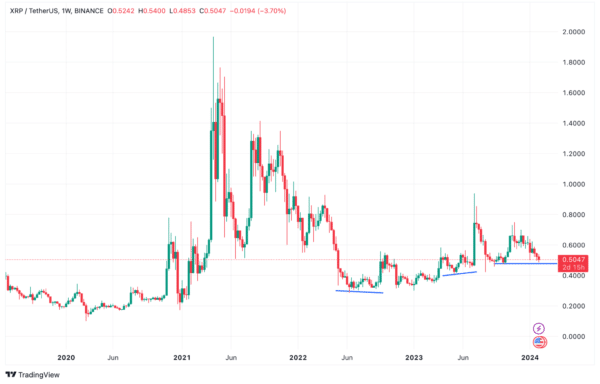
After losing certain support levels in the past month, the first level for XRP investors to keep an eye on is the range between $0.47 and $0.48. This range has already proven tough for the bears to overcome, having been tested in September and October 2023 and now in early February. 

XRP tends to see significant demand within the stated price zone, and as long as it holds, there is little reason for market panic. On the other hand, a break below could see things get ugly and call for a bearish test of the $0.43 support.  

Following the sell-off induced in the weeks following Ripple’s court victory in July 2023, the $0.43 level proved tough for the bears to break.

A more concerted effort would be required for bears to take XRP below this level. With the overall crypto market sentiment still cautiously bullish, it is hard to imagine a test of this lower range.

XRPUSDT 2024 02 02 10 09 15
XRP 1W Chart

Meanwhile, in the most possible event that a bearish trend overwhelms XRP and the crypto market, another critical support level is the $0.34 range.

This range was last tested in July 2022 following the meteoric bull run in the crypto market the year before. Ultimately, this range marked the market bottom and would be the ultimate end for bears to beat if things get extremely ugly for XRP.

As noted, it is hard to foresee such worst-case scenarios for XRP, given the overall bullish sentiment around the crypto market.

With the Bitcoin halving also around the corner and XRP historical rallies after a period of underperformance, the odds of visiting the lower support levels remain slim. XRP currently trades for $0.5047, up 1.76% over the past 24 hours.