Ripple has partnered with EasyA to introduce educational content aimed at helping individuals learn how to deploy smart contracts on the XRP Ledger (XRPL).
While the XRPL boasts several benefits that set it apart from other blockchains, the network does not support smart contracts, a feature intentionally sidelined during its development a decade ago to address potential security issues.
The XRPL EVM Sidechain
The XRPL now awaits the launch of Hooks, which will bring smart contract functionalities to the network. However, the Hooks protocol is currently delayed. At the moment, Ripple has partnered with Peersyst Technology to develop an EVM sidechain for the XRPL.
This EVM sidechain will help developers deploy XRPL smart contracts that are compatible with Ethereum but are not particularly native to the XRPL, as expected with Hooks.
It bears mentioning that XRPL Labs, the company behind the Xumm wallet, has already launched a sidechain with Hooks functionality called Xahau. The Ripple CTO Schwartz said Xahau is a good way to test Hooks before implementation on the XRPL.
Notably, the development of the EVM sidechain has reached the advanced stage, with the mainnet launch just around the corner. The latest update from Peersyst Technology revealed that work on the XChainBridge was close to finalization.
As the anticipation builds, Ripple recently partnered with Web3 educational resource EasyA to help individuals learn about the XRPL and how to deploy smart contracts on the network through the EVM sidechain with nothing but their smartphones.
EasyA Launches XRPL Challenge
EasyA has launched a learning module on this, comprising six challenges. The course, which spans Jan. 29 through July 31, begins with the history of the XRPL and ends with lessons on building an XRPL dApp and creating the front end of the application. The challenge is already open as of press time.
The collaboration between Ripple and EasyA, recently spotlighted by XRP community influencer Eri, holds significant importance for both the ecosystem and individuals aiming to implement dApps on the XRPL, providing a valuable starting point.
?The world’s first smart contract on XRP Ledger’s all-new EVM right from your phone. https://t.co/LYizTKAN5L
EasyA boasts a developer base encompassing over 750,000 individuals, featuring content for multiple blockchain networks like Solana, VeChain, Sui, and Polkadot. The XRPL learning course, tagged “60 Days of XRPL,” will introduce the XRPL to this network of developers and others.
EasyA reports that its developers have secured funding from prominent venture capital firms, including Andreessen Horowitz (a16z). Notably, the developer pool comprises founders of noteworthy startups and individuals associated with esteemed universities and leading companies.
EasyA has also announced plans to extend invitations to outstanding developers from the “60 Days of XRPL” challenge to a hackathon scheduled for April 2024 in London.
During this event, participants can pitch their startup ideas, vying for a chance to secure a $25,000 prize. Additionally, EasyA pledges to provide access to funding, grant opportunities, and mentorship for the most promising innovators.
Two prominent analysts have shared similar XRP price charts detailing a possible capitulation event right before an imminent XRP price surge that could replicate the 2017 uptrend.
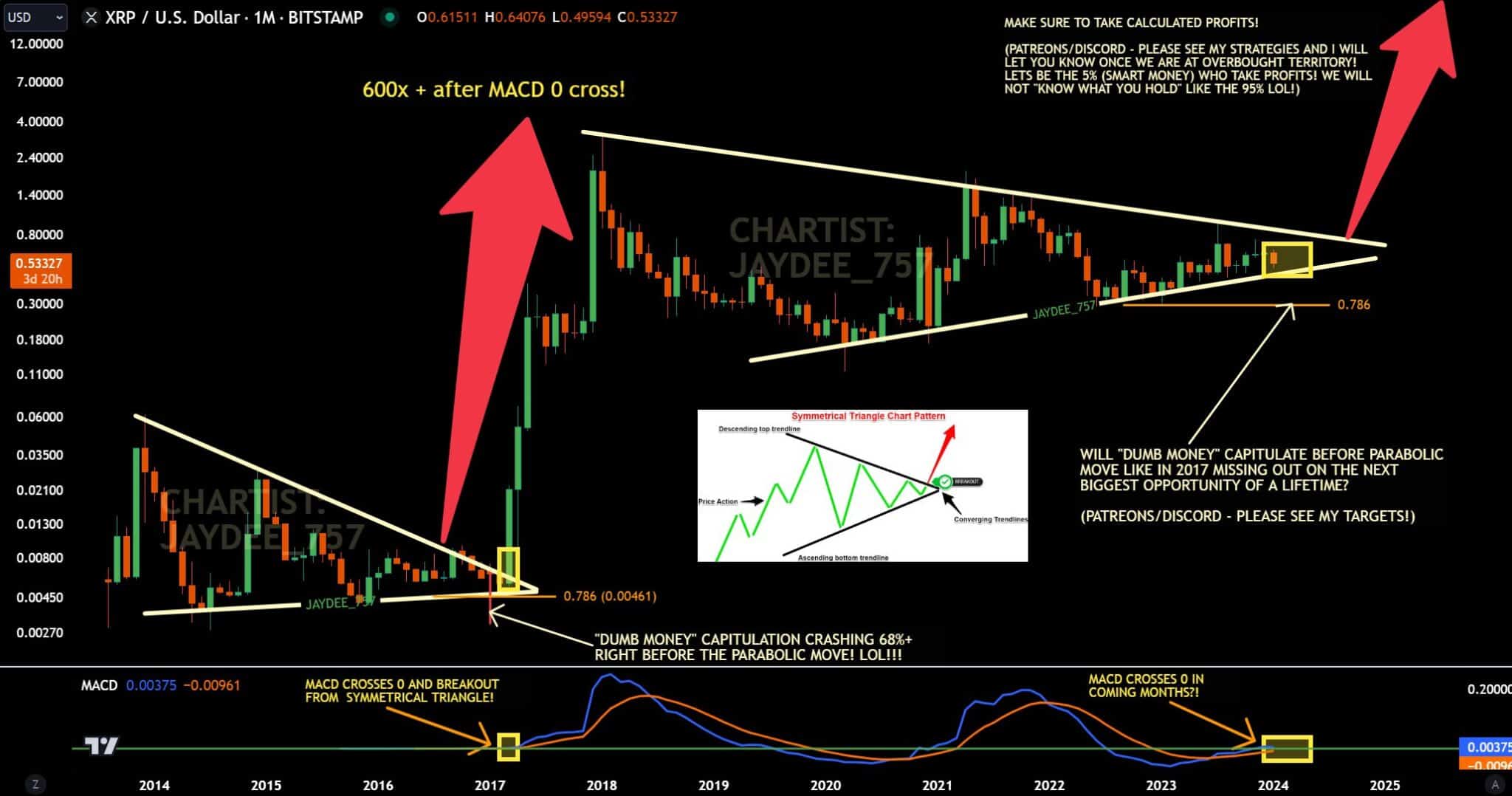
In a recent report, crypto market watcher JD disclosed that XRP could be on the verge of a meteoric surge. The analyst noted that XRP currently trades within a six-year symmetrical triangle. XRP formed the upper descending trendline of the triangle when it dropped from the $3.3 all-time high.
Historical Context
Data from JD’s chart confirms that XRP traded in a similar symmetrical triangle from late 2013 to early 2017 before its massive rally in 2017. Notably, XRP entered this symmetrical triangle following a collapse from a previous all-time high of $0.0614 in December 2013.
XRP Symmetrical Triangle | JD
The token continued to record lower highs from December 2013 to early 2017 due to the resistance mounted by the symmetrical triangle’s upper descending trendline. XRP recorded its breakout from the triangle in March 2017.
However, the XRP chart shows a massive wick down in January 2017. According to JD, this wick was due to some XRP investors selling off their holdings amid XRP’s underperformance at the time. Recall that XRP initially lagged Bitcoin (BTC) and the broader crypto market in the 2017 bull run.
Nonetheless, the token eventually recorded a massive surge shortly after this capitulation event. The surge came on the back of the breakout from the previous symmetrical triangle, with XRP soaring 66,100% from a low of $0.005 in February 2017 to $3.31 in January 2018.
XRP Looks to Repeat 2017 Upsurge
JD believes this pattern is about to repeat in the current cycle. Notably, XRP looks poised to break above the latest symmetrical triangle. However, JD says there is the possibility of another massive wick down similar to the one in January 2017.
According to the analyst, this would result in a similar capitulation event, as several investors have continued to lament XRP’s underperformance in the current pre-bull run phase. Interestingly, BTC is 62% up since September 2023, while XRP is only 2.6% up within the same timeframe. This reality has triggered investor angst.
The MACD indicator compounds JD’s confidence in another meteoric rise for XRP. In 2017, the breakout from the symmetrical triangle occurred alongside a cross above 0 for the monthly MACD. He expects this MACD cross to fuel the uptrend further.
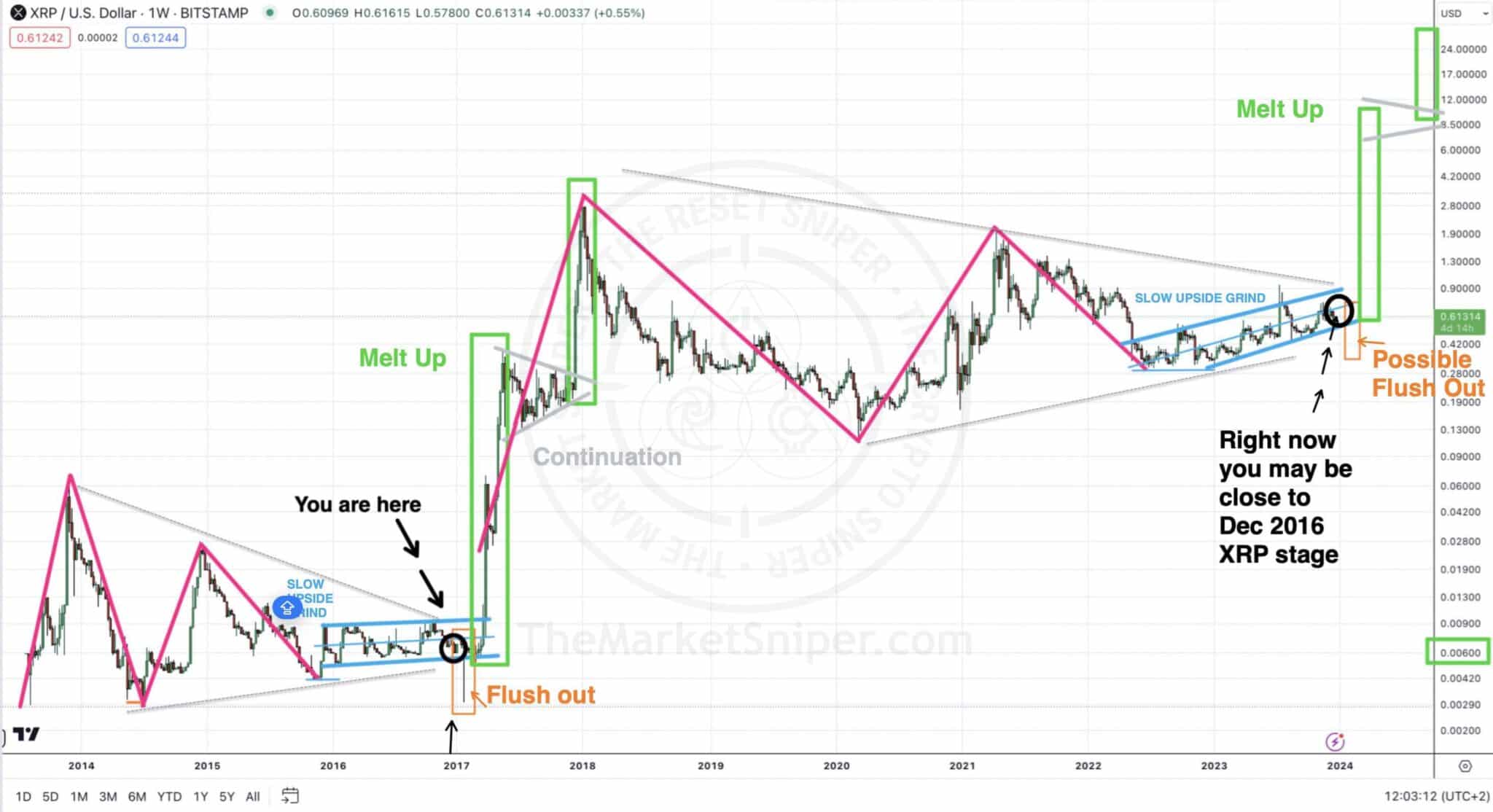
In an exciting turn of events, The Crypto Sniper, another prominent analyst, claimed JD copied this exact analysis from him. The Crypto Sniper shared a chart he made on this commentary.
XRP 1W Chart | The Crypto Sniper
However, The Crypto Sniper asserted that using MACD was inaccurate. While it is uncertain, who copied who, the fact that both analysts have the same setup further solidifies the narrative that XRP could be on the verge of an explosive rally.
Meanwhile, XRP currently changes hands at $0.5247, down 1.28% over the last 24 hours. The crypto asset has collapsed 15% this year amid the market downturn, while BTC is only down by a meager 0.68% within the same timeframe.
Yassin Mobarak, the founder of Dizer Capital, has voiced scathing criticism against Ripple and its handling of XRP, lamenting that XRP holders may have been sold a dream that may never materialize.
In response, prominent XRP figure Crypto Eri highlighted the rapid development of Evernode, a layer two smart contract platform. Evernode reportedly established a decentralized infrastructure that boasts 3440 nodes in less than 15 days.
Ripple’s Alleged Mishandling of XRP
Responding to Eri’s disclosure, Mobarak expressed dismay over the situation in the XRP ecosystem. Specifically, he accused Ripple of mishandling the incentive concepts within the XRP Ledger over the years.
He highlighted Ripple’s alleged failure to capitalize on the concept of programmable transfer of value, a concept predating Ethereum. Furthermore, Mobarak criticized Ripple’s utilization of the XRP escrow account. According to him, it is devoid of meaningful benefits to the ecosystem. In his words:
“It’s sad and shameful to see how they [Ripple] continued to milk the escrow account without any meaningful benefit to the ecosystem and public ledger.”
I've been involved in this ecosystem since the early days (2013). It's sad and shameful to see: – how Ripple mishandled the incentives concept in XRPL. – how they passed on the concept of programmable transfer of value before ETH even existed. – how they continued to milk the…
Meanwhile, an X user pointed out Ripple’s primary motive as a corporation: profit. The commenter argued that as a business entity, Ripple fundamentally prioritizes financial gain over noble aspirations.
In his response, Mobarak clarified that he harbored no opposition to Ripple’s pursuit of profit by disclosing his shareholder status within the company. “I want the company to succeed,” he remarked.
However, he emphasized his deep concern for retail XRP holders.
I am a Ripple shareholder. I want the company to succeed, but not at the expense of the retail XRP holders who were sold a dream that may never come true. https://t.co/NC7Ay2YeJ6
In particular, Mobarak expressed that Ripple’s success should not come at the expense of investors enticed into the XRP market with lofty dreams.
This includes sentiments that XRP could reach $10,000 per token, given Ripple’s effort in leveraging XRP for cross-border payment services, a dream that may ultimately remain unrealized.
XRP Army Urged to Diversify
In the broader context of the conversation, crypto podcaster Tony Edward advocated for diversification. He acknowledged his bullish stance on XRP but admitted uncertainty about the future.
As a result, Edward cautioned against overly emotional attachments to tokens, which he deemed detrimental. Essentially, the podcaster stressed the importance of embracing diversification instead of concentrating all investment hopes on a single project.
Although digital currencies represent a relatively new financial vehicle compared to traditional assets like equities and gold, their popularity has grown tremendously over the years and the fact that crypto provides unique investment opportunities is no secret to anyone. This has prompted many traders and investors to take the leap and add crypto to their portfolios.
According to Binance, one of the leading cryptocurrency exchanges, the majority of institutional investors are optimistic about crypto’s future, showing that the outlook for digital currencies and their potential as an investment venue remains positive despite the numerous ups and downs they’ve experienced over the years.
However, just because crypto is widely regarded as a profitable activity doesn’t mean one should jump straight into it without doing their due diligence. No one should overlook the challenges and risks that come with navigating the crypto landscape. It’s important to note that while some made fortunes by investing in crypto, others lost them. The extreme volatility of the crypto market coupled with the lack of regulatory clarity and the high degree of complexity that digital assets present can pose numerous problems for users, especially for those who don’t have a solid understanding of this novel asset class.
To make matters even more complicated, there are currently over 20,000 coins in the market, so it’s certainly not easy for newcomers to spot the winners and make sound investment decisions. That’s why it’s necessary to establish a few ground rules from the get-go so you can keep risks to a minimum and increase your chances of success in the highly unpredictable world of cryptocurrencies.
Do your research
Although not yet a mainstream asset class, crypto enjoys immense popularity all over the world which means everyone is familiar with the concept to some degree. What’s more, the majority of people who know a thing or two about digital currencies seem to consider themselves true crypto experts and don’t hesitate to offer unrequited advice to anyone who shows even the slightest interest in the topic.
However, having a rough idea about what crypto is does not make one a specialist in the field. This means that you should never ask for guidance or take investing advice from self-proclaimed experts who’ve done nothing more than read a couple of blogs on the subject. It’s extremely important to do your own research and learn as much as you can about crypto before you dive in. The crypto ecosystem is extremely complex and ever-evolving, so you need to know exactly what you’re getting yourself into.
You also need to keep in mind that not all crypto coins are created equal. Each project functions differently and has unique characteristics that you should be aware of. This means that if you plan to invest in various digital currencies, you should research each and every one thoroughly and adjust your investment strategy accordingly.
Don’t invest what you can’t afford to lose
This golden rule applies to all types of investments but is all the more important when it comes to crypto because of the high volatility it presents. While you might be able to earn massive returns, you can also lose a lot of money by investing in digital assets, so you have to be prepared for both scenarios.
That’s why you should only invest the exact amount of money that you can afford to lose. Putting all your life’s savings into crypto is not a smart move. Imagine what would happen if things don’t go according to plan and you lose all your capital in one fell swoop. You’d be left with nothing and unable to recover financially because of one reckless decision. It’s also generally recommended to keep your crypto investments under 5% of your total portfolio to minimize the impact of potential losses.
Mind the volatility
As we’ve already mentioned, extreme volatility is crypto’s chief characteristic and that can work for or against you, depending on circumstances. If you think it’s a good idea to invest in a certain coin because the prices have been going up for some time, don’t forget that things can take a 180-degree turn in a matter of seconds.
Crypto’s short history has taught us that a bull market can turn into a bear market and the other way around in a short period of time and mess up investors’ strategies. Given crypto’s unpredictable nature, you should never rely on current trends or past patterns to predict what might happen next. Instead, you should keep track of relevant market metrics such as market cap, the fear & greed index or the relative strength index (RSI) to determine which way the wind is blowing and prepare yourself to deal with surprises.
Don’t let emotions influence your decisions
It’s crucial to keep a clear head and maintain an objective perspective while investing in crypto. Since there’s a constant influx of crypto news on all channels, it can be difficult to process all the information coming your way and you might be tempted to follow the crowd, especially when there’s a lot of hype surrounding a specific crypto project.
However, hype cycles come and go all the time and you should never base your decisions on them, so FOMO and intense emotions are not good advisors. Once you’ve developed an investment strategy you should stick to it no matter what so-called experts and crypto gurus profess. In the face of uncertainty, it’s also important to learn to manage risks. Risk management strategies differ from one investor to another, based on their specific needs. For some, this means holding on to funds and never selling, no matter the price swings or avoiding excessive leverage. For others, this implies setting clear rules on when to sell (stop-loss and take-profit orders), so you need to decide what strategy works best for you.
Final thoughts
Investing in crypto can feel like a roller-coaster, with constant ups and downs and surprises at every corner. So, make sure you stay disciplined and create your own set of rules and guidelines to help you navigate this ecosystem safely and make the most of your investment journey.
Decentralized Physical Infrastructure Networks, or DePIN, represent a fusion of blockchain and physical infrastructure. This approach intertwines the digital and physical worlds, allowing for a more democratic and efficient way of managing resources.
At its core, DePIN leverages the decentralized nature of blockchain to manage real-world infrastructure. Think of a scenario where your neighborhood’s energy grid or internet service is not just a service you pay for but a network you actively participate in and benefit from. That’s the essence of DePIN – turning everyday users into stakeholders in the systems they rely on.
Blockchain plays a crucial role in this paradigm. It provides a transparent, secure, and efficient way to record transactions and manage decentralized networks. In the context of DePIN, this means that activities like contributing to a local solar energy grid or sharing WiFi bandwidth can be securely tracked and rewarded in a decentralized manner, often using cryptocurrencies.
DePIN stands for Decentralized Physical Infrastructure Networks. #DePINs use tokens to incentivize people to crowdsource and build real-world physical infrastructure networks ??⛵️✈️?️?
This system not only fosters community involvement but also paves the way for more innovative use of resources. By incentivizing participation through crypto rewards, DePIN projects encourage users to contribute their resources – whether it’s unused internet bandwidth, energy from solar panels, or storage space on their devices.
DePIN is about harnessing blockchain’s potential to democratize and optimize the management of physical infrastructure. It’s about bringing the principles of decentralization to the tangible aspects of our daily lives, opening up new possibilities for community-driven, efficient, and fair resource management. We take a look at the top projects that are advancing this narrative in 2024. We’ll see how DePIN is not just another trendy crypto narrative but a rapidly evolving reality with diverse applications.
Top Projects in the DePIN Ecosystem
Here are the top DePIN projects of 2024, offering diverse and impactful applications across various sectors.
Rowan Energy – Incentivising decentralized energy
Rowan Energy is making significant strides by pioneering decentralization in the solar energy industry. They are a green energy blockchain company with a genuine commitment to DecEnergy (decentralized energy) and shaping it with a model that encapsulates the collaborative spirit of blockchain.
Rowan Energy’s strategy focuses on transforming solar panel owners from passive consumers into dynamic energy market participants. By deploying DePIN, they ensure solar energy isn’t just consumed but actively contributes to a broader, decentralized energy system. This transition democratizes the energy landscape, giving control and new income opportunities to households and businesses alike.
Building the world’s first decentralized energy provider
Rowan Energy’s blockchain is a low-carbon blockchain that runs on a Proof of Generation consensus mechanism, which underscores their commitment to sustainable energy production. This approach reduces the blockchain’s environmental impact and supports the creation of clean energy, all while aligning with net-zero objectives.
Their SmartMiner device serves as both a smart meter and a cryptocurrency miner and is installed alongside the solar panel device. Homeowners with this device can earn solar cashback, approximately £2 per day, for every kilowatt-hour of solar energy produced. This not only incentivizes the use of renewable energy but also enables the sale of excess power through Rowan’s peer-to-peer energy trading platform.
Rowan Energy extends its sustainable vision through NFT Carbon Offset Certificates, representing the renewable energy generated by its customers. These certificates offer a transparent and trustworthy way for consumers and businesses to offset their carbon footprint, with Rowan’s Blockchain ensuring the integrity and transparency of the data.
Rowan Energy already has a working real-world use case, as they are already actively participating in the UK’s goal of reaching net zero by 2050. They already manage over 1 MW of solar capacity in the UK and are partnering with leading solar company ESE Group to distribute thousands of SmartMiners in the UK. As they plan to venture into the electric vehicle sector with energy certificates, Rowan Energy is not just growing—they are diversifying their portfolio of green solutions.
Rowan Energy is not only a testament to the potential of blockchain in environmental sustainability but also an embodiment of change with immediate financial benefits for consumers. Their integration of blockchain with solar energy solutions is paving the way for a sustainable and empowered future, making them a lighthouse project within the DePIN ecosystem.
In a market where the demand for advanced computing is skyrocketing, particularly with the proliferation of AI startups, nuco.cloud SKYNET presents itself as a much-needed solution. This decentralized mesh hyperscaler combines professional data centers into a network through innovative distribution technology, delivering scalable and sustainable computing like never before.
As the world’s first of its kind, nuco.cloud SKYNET is transforming the cloud computing market by offering unprecedented computing power, security, and efficiency at costs up to 70% lower than traditional hyperscalers like AWS. Nuco.cloud SKYNET’s decentralized approach ensures that users retain ownership and control of their data, adhering to stringent EU-GDPR compliance and data sovereignty laws. This feature alone sets it apart from traditional hyperscalers, providing peace of mind to enterprises concerning their data security and management.
The Dawn of a New Era in Cloud Computing
nuco.cloud is on the brink of launching its mainnet in 2024, aiming to redefine the future of decentralized computing power. Its testnet, already live, offers a glimpse into a future where computing resources are utilized with utmost efficiency and cost-effectiveness. The project’s alignment with the rapid growth of AI, projected to reach $1,345.2 billion by 2030, further accentuates its critical role in the technological landscape of tomorrow.
Nuco Cloud
Helium Network – A Solana-Backed Pioneer in IoT Connectivity
Helium has emerged as a DePIN powerhouse particularly in the Internet of Things (IoT) space. Helium’s decentralized LoRaWAN network is disrupting IoT connectivity traditional models, by empowering communities with user-owned hotspots. These hotspots serve a dual purpose: they enhance internet and cell coverage while also rewarding owners with tokens for their contributions to the network. This model redefines the user’s role from passive consumer to active stakeholder in the connectivity ecosystem.
With a strategic shift in April 2023, Helium transitioned to the Solana blockchain, leveraging its scalability, low transaction costs, and high-performance capabilities to bolster its network, aptly dubbed “The People’s Network.”
A Cost-Effective Alternative to Traditional Plans
December 2023 marked a milestone for Helium as it unveiled a cost-effective $20 per month phone plan. This move challenges the status quo of cellular plans, offering unlimited data, talk, and text powered by community-owned 5G hotspots. It stands in stark contrast to the traditional market, where users spend significantly more on similar services. Helium’s approach not only reduces costs but also democratizes access to quality mobile services.
Helium’s integration with the Solana blockchain is a testament to the project’s position as a leader on this high-performance platform. Users who share their hotspot nodes are not left unnoticed; they are compensated with MOBILE tokens based on Solana, which can offset their phone plan costs. This incentive mechanism is crucial in expanding the network’s reach and utility.
Helium HNT Price
Filecoin: Leading the Charge in Decentralized Storage
Filecoin stands as a giant within the DePIN landscape, heralded as the largest by market capitalization as of January 2024. It’s not just another storage solution; it’s a transformative platform that’s revolutionizing the way we think about data storage. Filecoin’s peer-to-peer (P2P) network incentivizes the renting of unused storage space, forging a path for a more secure, decentralized storage model.
The Decentralized Marketplace for Data
Filecoin has created a robust decentralized marketplace for data storage services, similar to the familiar cloud services but with a significant twist. Here, storage providers earn FIL tokens for their contributions, while users enjoy the convenience of paying only for the storage they actually need. This model echoes the established services provided by Web2 giants such as Google Cloud and Amazon Web Services, yet it stands apart by offering a distributed solution underpinned by crypto-economic principles.
Filecoin FIL Price
Wrapping Up
The DePIN landscape is flourishing, as detailed in Messari’s 2024 report, which showcases an impressive expansion with over 650 new initiatives across multiple sub sectors like compute, AI, and energy. This swell in projects has remarkably pushed the collective market cap beyond $20 billion and has been accompanied by a notable $15 million in annualized on-chain revenue. This robust growth is indicative of the sector’s enduring sustainability and economic viability.
The projects we’ve highlighted demonstrate practical, real-world applications of DePIN, reinforcing the narrative’s credibility and long-term potential. For investors on the lookout for early-stage, high-potential ventures within DePIN, Rowan Energy and nuco.cloud stand out as particularly promising opportunities.
As we observe the sector’s progression, it becomes evident that DePIN is transitioning from conceptual to actionable stages, driving significant advancements in how we engage with and govern our physical infrastructures.
The Cardano (ADA) community finds itself in a state of intrigue and speculation following a cryptic tweet from Charles Hoskinson, the founder of Cardano.
Over the weekends, Hoskinson posted a tweet containing a string of alphanumeric characters with a celebratory note: “We did it.”
We did it 46c95d04c238df47dbbbad3ea70823f581594ea0c4e3bfabb4626e557dfc7a45
Members of the Cardano community engaged with the tweet, seeking clarification on the milestone or message that prompted the post.
Some speculated it could be linked to recent developments like Qsig transactions or advancements in quantum research. Others pondered if it hinted at significant achievements for the Cardano project.
Notably, the alphanumeric sequence bears a striking resemblance to a typical blockchain transaction hash. X user “₿ellamy” did a quick search through Cardano’s blockchain explorer CardoScan.
However, he found nothing helpful. “We are unable to find this transaction,” was the result of the on-chain scan.
Meanwhile, an X user has proposed that the string of alphanumeric characters is likely a SHA-256 coded message. The commenter argued that such messages can serve as proof of possessing certain information without disclosing the information itself, as commonly seen in cryptographic practices.
Moreover, the commenter cited that crypto community figure Cobie shared a similar message in April 2023, which was subsequently decoded without authorization.
??????????? (????)
➡️This string of letters and numbers is probably a SHA-256 coded message ➡️It can be used as proof of knowing some information without actually revealing the information ➡️@cobie posted a similar type of message back in April 2023 that was…
In the absence of concrete information, market participants press for clarification from Hoskinson regarding the message underneath the celebratory note.
Despite posting additional updates on social media, the Cardano founder has refrained from offering any specific comments concerning the mysterious numbers.
Meanwhile, the ambiguous post comes amid recent announcements from Cardano development team Input Output Global (IOG) regarding advancements in research efforts.
Of particular note is the acceptance of the IOG research team’s research paper on “Universal Anonymous Signatures” (UAS) for presentation at the 2024 Financial Cryptography Conference.
A paper on Universal Anonymous Signatures (UAS) by the IOG research team just got accepted into FC'24!
Dive into the details with @jesusdiazvico's insightful thread on UAS and the innovative use of functional placeholders.
Bitcoin (BTC) whales are on a major accumulation spree, a trend that is coming at a time when the top coin entered a new adoption era.
Data from crypto analytics service provider IntoTheBlock shows that a total of 76,000 Bitcoins have been accumulated since the start of the year. While the price of the top coin has been swindling since the start of the year, the total accumulated BTC is valued at approximately $3 billion per the IntoTheBlock data.
In what is not a complete shock, the whale balance has been in a relatively steady uptrend since at least April 1, 2023.
The Steady Bitcoin Whale Accumulation Trend
Though masked with intermittent slumps, Bitcoin whales had not relented from their BTC buying since April 2023, when the Total balance hovered around 7.6 million. In about 9 months since that time, the total whale balance has soared significantly, crossing the 7.7 million benchmark to 7.8 million as of today.
Bitcoin whales have increased their $BTC holdings by ~$3B (76,000 BTC) sine the start of this year. pic.twitter.com/0hi3Q7WXEo
While Bitcoin was notably self-sufficient before now, the emergence of spot Bitcoin ETF products has opened it up for more embrace, hence the sharp spike in Bitcoin balance by whale addresses, as showcased in the chart since the start of January.
One interesting trend is how whales are not fixated on the price of Bitcoin to buy. There is a divergent correlation in the price of BTC and whale accumulations for the better part of this month, as the data showed an increment in total balance when Bitcoin plunged from $48,969.37 to $38,521.89 in about a month.
Thus far, the stability the whale accumulation is offering has helped BTC’s price regain its lost pace, and it is changing hands for $41,896.93 atop a 1.26% plunge in the past 24 hours. Notably, this slight loss is an improvement compared to the steep slump recorded over the weekend.
While the market capitalization is down by 1.26% to $821,408,345,661, the trading volume has inked 2.33% to $15,323,171,413.
Whales Just Getting Started
While the whale accumulation figures are impressive, more resounding buyups lie ahead with the presence of Bitcoin ETFs. Through these products, there are projections that mainstream investment advisors will start recommending this asset to their clients to hedge their bets against traditional financial instruments.
The prediction is that the traditional markets are not properly pricing in the spot Bitcoin influence yet, and when they do, it will usher in more money into the asset with an underlying positive impact on price.
Shiba Inu (SHIB) tokens moved by U.S.-based exchange Coinbase have totaled a whopping 797 billion tokens over the past 24 hours, as SHIB struggles to retain $0.000009.
On-chain data, as highlighted by blockchain analytics firm Arkham Intelligence, confirms these massive inflows. Notably, the Arkham Intelligence dashboard for Shiba Inu reveals the largest SHIB inflow and outflows from whale addresses over a specified timeframe.
Coinbase Moves 797B Shiba Inu in 3 Txns
Per Etherscan, the whale movements began yesterday at 16:24 (UTC), when Coinbase transferred 307,878,842,976 (307.8 billion) SHIB valued at $2.8 million to a deposit address. Notably, this transaction was the first recorded for the sending address, which activated yesterday.
Four minutes after receiving the tokens, the Coinbase deposit address moved all the 307.8 billion SHIB tokens to another Coinbase wallet, tagged “Coinbase 10.”
This brought the total amount shuffled by the exchange to 615.7 billion SHIB across two transactions. The Coinbase 10 address also welcomed several inflows involving millions of SHIB, presumably from customer deposits.
Upon receiving the 307 billion tokens and the smaller deposits, the address began offloading the SHIB tokens to several addresses in batches of millions.
Amid these outflows, which many believe went toward redeeming withdrawal requests, the Coinbase 10 wallet offloaded 182.24 billion SHIB worth $1.66 million to another new wallet. With this, Coinbase’s total SHIB movements surged to 797.94 billion tokens in three transactions.
While unlabeled, the receiving wallet appears to have an affiliation with Coinbase, as the exchange has repeatedly deposited SHIB into it. Coinbase moved 14.6 billion SHIB to the address on Jan. 22 and 15.6 billion SHIB on Jan. 24.
Possible Reason
The address only holds Shiba Inu, with a balance of 212.6 billion SHIB. Moreover, following the outflows, the Coinbase 10 wallet currently holds $2.93 million worth of SHIB.
Speculation on the purpose of the shuffles have emerged, with some market participants ascribing them to routine fund movements.
Notably, investors typically move their assets into exchanges when there is an intent to sell them off. This trend often triggers panic across the market.
However, the CryptoQuant SHIB Exchange Netflow indicator confirms that exchanges have seen more SHIB outflows over the past seven days.
Shiba Inu Exchange Netflow | CryptoQuant
Meanwhile, Shiba Inu has continued to defend the $0.000009 threshold after recently reclaiming it. SHIB currently trades for $0.00000902, holding at a delicate position above $0.000009. CryptoQuant data suggests that its RSI and Stochastic are currently neutral.
The successful launch of multiple Bitcoin spot ETFs in the United States has motivated China’s financial giant Harvest Global to apply with Hong Kong’s regulators to roll out a similar product.
Harvest Global Investments, one of China’s largest fund companies, has officially applied with Hong Kong’s Securities and Futures Commission (SFC) to offer a Bitcoin spot exchange-traded fund (ETF).
It is worth noting that Harvest submitted the application on January 26, hoping to become the first company to launch a Bitcoin spot ETF in Hong Kong.
Multiple Bitcoin ETF Approval in U.S. Motivates Other Markets
The development follows a significant inflow of capital into the Bitcoin spot ETFs approved in the United States two weeks ago. With the U.S. SEC approving 11 Bitcoin spot ETFs, top financial players from other markets, including China, are also exploring similar opportunities.
Notably, Harvest is one of many asset managers planning to launch a Bitcoin ETF in Hong Kong. Another Hong Kong-based firm, Venture Smart Financial Holdings, disclosed earlier this month that it is planning to file a Bitcoin spot ETF application with the SFC, according to a Bloomberg report.
Venture Smart is confident that its application will be approved, as it hopes the product will begin trading in Q1 2024.
It is worth mentioning that Bitcoin spot ETFs have continued to record impressive records in the United States. During a recent interview with Yahoo Finance, Rachel Aguirre, the head of iShares product at BlackRock U.S., said the company’s Bitcoin fund (IBIT) has performed incredibly well, surpassing over $3.5 billion in trading volume.
Her comment suggests that Bitcoin spot ETFs received a favorable reception in the U.S., with other markets considering replicating the same feat.
Sources Say SFC Could Speed Up Approval
In the meantime, the SFC did not respond to a request for comment. However, sources familiar with the matter said the regulator could speed up the approval of the Bitcoin spot products.
Additionally, the sources said the SFC could adopt a similar approach taken by the U.S. SEC, which saw multiple applications for a similar product approved at once.
In November, SFC’s chief executive officer said the securities regulator is open to considering crypto-related spot ETF applications.
The cryptocurrency market received a fresh inflow of capital after stablecoin issuer Tether minted $1 billion worth of tokens on Monday.
After making a strong comeback from recent lows, the cryptocurrency market looks set to build on the positive momentum going into the new week. Aiding the cause is a fresh injection of capital into the ecosystem by popular stablecoin issuer Tether.
According to Tether CEO Paolo Ardoino, the newly released 1 billion USDT tokens on the Tron network are an authorized mint that has not yet been issued. In other words, the stablecoin company will use the tokens as an inventory to fulfill issuance requests and chain swaps from its partners.
Evidently, the newly minted tokens come as a boost to the crypto markets. As a stablecoin issuer, Tether mints and releases new tokens primarily based on requests from its institutional clients. The USDT stablecoin represents one of the easiest rails for investors to get access to tokenized US dollars for navigating the volatile cryptocurrency market.
Only time will then reveal how the latest issuance impacts market performance. However, such mint events generally improve market sentiment and serve as an indicator of incoming institutional demand.
Tether Market Cap Approaches $100B
The latest token issuance follows a trend that has seen the stablecoin issuer start the new year as strong as it ended the previous year. Since the start of 2023, the stablecoin’s market cap has risen nearly 50% from $62 billion to $96 billion at the time of writing.
Against the odds, Tether has already gained $4 billion since the start of the new year, putting it on track to break the previous year’s record. The surge in market capitalization has helped the stablecoin cement its position as one of the largest cryptocurrencies by market capitalization and well ahead of its closest rival, USDC.
While USDC gained $2 billion worth of market capitalization in January, its overall valuation at $26 billion represents less than 30% of Tether’s overall market cap. Tether has also been accumulating Bitcoin for its business, putting the firm in a more favorable light with the crypto community.