Home Blog Page 1664

Expert Highlights Risks of Supporting Burning the 39 Billion XRP in Ripple Escrow Wallet

0

A notable member of the XRP community has expressed concerns over the growing argument supporting the view that the XRP tokens held in Ripple’s escrow should be burned.

In a recent tweet, Kristin Dack, a crypto enthusiast and a US-based real estate broker, highlighted the implication of supporting the burning of Ripple’s escrowed XRP.

Dack questioned the notion of burning XRP from the escrow, emphasizing that members of the XRP community should recognize that each unit represents someone’s asset. In other words, supporting such a notion implies endorsing the idea that someone stands to lose their own wealth.

In parallel, she brought attention to the broader risk associated with endorsing a code that permits the community to seize and burn XRP, whether from Ripple’s escrow or other sources. Specifically, Dack cautioned that such a stance could leave each XRP holder vulnerable to the community’s decisions regarding their personal holdings. 

“If you support a code that allows the community to take and burn someone’s XRP, then you are supporting the ability for the community to decide to take your XRP if they deem it necessary,” Kristin Dack pointed out.

Consequently, Dack urged the XRP community to reflect thoughtfully, emphasizing the need to consider the implications of supporting actions that could impact their own crypto assets.

Ripple Burning Escrow XRP

Significantly, the discussions surrounding Ripple burning the XRP in its escrow are grounded in the belief that such a substantial burn could propel XRP to a higher valuation, thereby enriching its holders. 

Notably, Ripple’s escrowed XRP balance exceeds 39 billion tokens, implying the potential to set over $23 billion ablaze. 

Reacting to Dack’s sentiment, another XRP enthusiast highlighted that the XRP Army has failed to realize that the escrow mechanism is a crucial assurance preventing Ripple from abandoning its commitment to driving XRP adoption.

Meanwhile, the discourse on Ripple burning the XRP tokens within its escrow wallet has been around for a while. Ripple executives have highlighted the possibility of the escrowed XRP being burned. 

For instance, Ripple CEO Brad Garlinghouse has consented that Ripple might consider burning escrowed XRP if such a decision proves beneficial for the overall health of the XRP ecosystem.
Key Metric to Monitor for Shiba Inu Path to Higher Prices

0

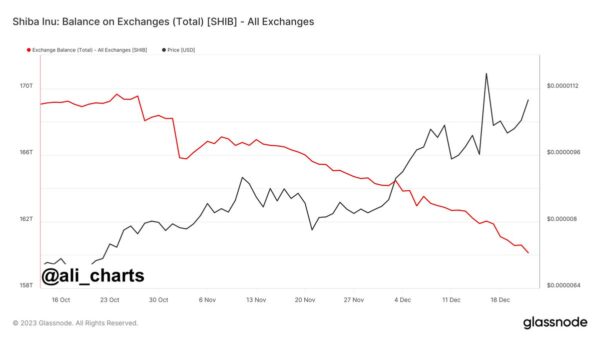
The amount of Shiba Inu (SHIB) held on crypto exchange platforms has dropped by 8 trillion since November, fueling talks of less selling pressure that can push Shib prices higher.

The price of SHIB has surged nearly 30% in the past month amid a broader crypto market resurgence and renewed interest in meme coins. At the same time, the amount of SHIB held on cryptocurrency exchanges has depleted, raising hopes that there will be less selling pressure on the token as the market recovery continues.

According to data from Glassnode, as shared by popular data Analyst Ali, over 8 trillion SHIB tokens (approximately $88 million) have been withdrawn from exchanges since November. At the start of the month, exchanges held around 168 trillion SHIB (approximately $1.8 billion), a supply that now stands at 160 trillion ($1.7 billion).

Shiba Inu Balances
Shiba Inu Balances

The cumulative amount of SHIB withdrawals evidently includes a recent 237 billion tokens ($2.3 million) withdrawal from Binance by a new whale. Tron founder Justin Sun also recently withdrew 577 billion SHIB (approximately $6 million) from the leading crypto exchange.

According to Santiment, “keep an eye” on Shiba Inu as top wallets move away coins from exchanges.


Lower Selling Pressure?

The depleting SHIB supply on exchanges is typically considered evidence that investors are purchasing SHIB and withdrawing them into private wallets for long-term holding. In such a scenario, the cryptocurrency usually sees less selling pressure as there is less circulating supply to be traded on exchange.

Conversely, a growth in the balance held by exchanges is considered bearish. It typically indicates that more investors are moving funds to these platforms where they are most likely to be liquidated.

Meanwhile, it is worth noting that a fraction of SHIB is actively traded on decentralized exchanges, suggesting that not all tokens withdrawn from exchanges enter cold storage. For instance, traders exchanged $1.2 million worth of SHIB on leading DEXes Uniswap and ShibaSwap.

At the time of writing, SHIB is trading at $0.00001079, representing a 1% decline on the day. The second-ranked memecoin has a market cap of $6.3 billion, following a mild market retracement over the weekend.

Kraken Intervenes in Lawsuit Claiming XRP is a Security

0

Popular U.S.-based exchange Kraken files a motion to intervene in the ongoing Zakinov v. Ripple lawsuit, which alleges that XRP is a security.

Kraken’s filing in the case was in response to a court order mandating all U.S.-based crypto exchanges to submit private trading data of their XRP customers.

Aside from customers’ trading data, the court also wants exchanges in the U.S. to disclose the identities of customers who traded XRP.

Kraken Defends Users’ Privacy

Instead of revealing its users’ trading information, the prominent crypto exchange expressed concern about the potential risks of revealing its customers’ sensitive information.

Although Kraken took a neutral stand in the case, it feared customers might misconstrue its compliance as a form of support to the plaintiff.

Kraken fears that revealing its customers’ private trading data could undermine its relationship with its clients and jeopardize users’ trust.

The exchange’s concern could help it preserve its reputation while emphasizing the importance of user privacy within the crypto space.

Zakinov v. Ripple

For context, the primary issue in the Zakinov v. Ripple legal tussle is whether XRP in itself should be classified as a security or currency. In the lawsuit, the plaintiff, Zakinov, charged Ripple, its CEO Brad Garlinghouse, and its subsidiary XRP II with offering XRP as an unregistered security.

However, Ripple denied this claim, arguing that XRP is similar to other cryptocurrencies like Bitcoin and Ethereum. Despite Ripple challenging the certification of the lawsuit, U.S. District Judge Phyllis J. Hamilton certified the class in June.

Per the ruling, the judge asserted that the class met the four requirements for certification. While the verdict sparked concern among XRP investors, Attorney John Deaton pointed out that the class applies to U.S. investors.

He described the class action as a mere pimple compared to Ripple’s lawsuit against the Securities and Exchange Commission (SEC), emphasizing that the latter has far-reaching implications.

Will the Zakinov Judge Follow Judge Torres’s Ruling 

Notably, less than two weeks after the U.S. District Court for the Northern District of California certified the class against Ripple, Judge Analisa Torres issued her summary judgment decision.

In the SEC v. Ripple ruling, the judge found that XRP in itself is not a security. She also held that Ripple did not violate the law by selling XRP on exchanges via blind bid/ask transactions.

Whether Judge Hamilton will follow Judge Torres’ ruling on XRP remains to be seen.

It bears mentioning that Kraken relisted XRP shortly after Judge Torres declared the coin as a non-security.

XRP Targets 94% Surge to $1.2: Here’s the Projected Timeline

0

Prominent market analyst EGRAG recently predicted that XRP would rally 94% to the $1.2 price target, citing the imminent breach of three pivotal resistance thresholds.

The analyst presented an XRP chart on the 12-hour timeframe, calling attention to multiple resistance and support levels for the crypto asset at its current price position. He drew out these pivotal levels with varying colored lines.

XRP Resistance Points Below $1.2

The first resistance level stood at $0.5976, stationed at the Fib. 0.382 point. XRP breached the $0.5976 resistance on Oct. 31, flipping it into support in November. The crypto token has since faced pressure from the bears, leading to retests of this support. However, XRP has sternly defended it.

In his latest analysis, EGRAG drew a blue fractal, tracing a projected trajectory to see XRP breach the following resistance points to the $1.2 price territory. According to the analyst, if this path plays out, it will result in an explosive and rapid short-term rally.

XRP 12H Chart
XRP 12H Chart | EGRAG Crypto

The second resistance point to break is the $0.7495 level, currently at Fibonacci 0.5. The last time XRP retested this resistance was on Nov. 13. However, it faced a potent roadblock that saw it drop 23% to a low of $0.5734 eight days later. 

EGRAG is convinced the asset will conquer the $0.7495 resistance this time around. Should this occur, the third resistance point at $0.9399 would come into play. This was XRP’s peak price this year, attained on July 13 upon the ruling from Judge Analisa Torres.

This price zone has presented the biggest roadblock to XRP’s rally, hedging against the token’s uptrend to higher levels on July 13. If XRP crosses above $0.9399, it would eventually engineer a measured move to reclaim the $1 price. This would bring the $1.104 resistance into play.

Timeline for the $1.2 Target

EGRAG believes XRP would still break the $1.104 resistance, making its way to the much-coveted $1.2 price zone. According to the analyst, XRP would breach these resistance levels to hit the $1.2 price within a maximum of 55 days. This puts the target period in February. 

The chartist admitted that up to 90% of XRP holders have lost their optimism due to the token’s recent underperformance. Recall that Solana recently surpassed XRP in market cap amid an explosive run.

EGRAG further called attention to a possible drop to $0.55 or $0.50. However, he remains convinced that the asset would eventually skyrocket in price, touting such a drop as a potential springboard for a more substantial run. XRP currently trades for $0.6165. Hitting $1.2 from this point would require a 94% surge.

New Court Document Shows Ripple to Claim Over $11M Worth of FTX Assets

0

A new court document shared by popular XRP proponent @WKahneman shows that Ripple Singapore would claim a whopping $11.4 million worth of FTX assets.

In a startling development, prominent XRP community member @WKahneman recently shared a document highlighting Ripple Labs’ exposure to FTX’s assets.

Ripple Has a Claim of $11.4M

According to the document, Ripple Labs Singapore Pte. Ltd, the Singapore arm of top U.S. crypto payments company Ripple, will claim $11,403,976 ($11.4 million) from bankrupt crypto exchange FTX.

Although the document was initially released in a court filing on December 7, @WKahneman called attention to it in a tweet yesterday.

Other FTX Claimants

Interestingly, the document also featured other prominent names in the list of claimants, including Shaquille O’Neal, an iconic NBA superstar of the Los Angeles Lakers.

Per speculation, the living legend representing himself and his company, ABG-Shaq, LLC, might have secured a $750,000 endorsement deal from the former leading exchange.

Despite this speculation, O’Neal’s claim to FTX assets remains unknown at the time of writing this line. Furthermore, the document also mentioned Avalanche (BVI), Inc., a company affiliated with the leading blockchain platform Avalanche (AVAX), as one of the claimants in the FTX case.

Notably, the document did not indicate the value of Avalanche’s claim. It is interesting to note that Ripple Singapore Pte. Ltd has the largest disclosed sum of all entities listed as claimants to FTX’s assets. 

Commenting on the development, @WKahneman pointed out that Ripple Singapore is making the claim against Alameda Research, a sister company of FTX.

Recent Developments in FTX Case

The FTX saga has continued to attract the attention of crypto investors, as new facts are released on a weekly basis. Last week, Jameson Lopp, the CTO at Casa, revealed that FTX now owes more funds to lawyers handling its bankruptcy case than the amount owed to its customers.

As reported earlier, while FTX bankruptcy fees stood at $1.45 billion, customers’ shortfall was valued at around $1.42 billion. Although most FTX-related news has been disappointing for customers, news of the exchange’s Solana (SOL) holdings surging to $6 billion recently put smiles on the faces of many.

Recall that the exchange’s holding of 55.8 million SOL plunged to $1 billion earlier this year following a devastating collapse of SOL price. With SOL surging to over $95 last week, FTX’s SOL holdings skyrocketed to around $6B.

At press time, SOL was changing hands at $113, while FTT, the native token of FTX, was trading at $3.68.

Industry Leaders Invited to File XRP Spot ETF in Hong Kong

0

Members of the XRP community now anticipate an XRP spot exchange-traded fund (ETF) in Asian soil amid a pivotal development that has unfolded in the region.

In particular, Dizer Capital founder Yassin Mobarak has invited crypto industry leaders to move for an XRP ETF in Hong Kong following a recent regulatory greenlight.

Crypto ETF in Hong Kong

In a circular last Friday, top regulatory bodies in Hong Kong stated they have reassessed their current policy concerning intermediaries seeking involvement in crypto-related activities. 

Specifically, the Hong Kong Monetary Authority (HKMA) and the Securities and Futures Commission (SFC) expressed their readiness to accept crypto spot ETFs. 

According to the circular, the revision reflects recent market advancements, with the SFC granting authorization for crypto futures ETFs. As a result, SFC and HKMA proclaimed that they are now open to receiving applications for the approval of additional funds featuring exposures to cryptocurrencies. 

The regulators specifically cited “virtual asset spot exchange-traded funds (VA spot ETFs)” among potential ETFs it would welcome.

Invitation to File XRP Spot ETF

This crucial update from the Hong Kong regulatory agencies has caught the attention of prominent figures in the XRP community, such as Yassin Mobarak of Dizer Capital, a venture capital and private equity firm.

Specifically, Mobarak called other crypto industry participants to capitalize on the development and submit an application for an XRP ETF. 

“Someone should file an XRP spot ETF application in Hong Kong,” the crypto founder tweeted.

Reacting to Mobarak’s view, an XRP enthusiast based in Hong Kong echoed his sentiment. “That’s a really good idea,” the commenter remarked.

Hong Kong Stock Exchange Ready to File Crypto Spot ETF

Similarly, Luo Boren, who leads securities product development at the Hong Kong Stock Exchange, has expressed readiness to capitalize on opportunities presented by the regulatory authorities. 

He emphasized the exchange’s commitment to collaborating closely with issuers and all stakeholders to incorporate crypto spot ETF into the Hong Kong ETF market.

XRP ETF in the US

While XRP is the only digital asset in the United States with regulatory clarity, the outlook for an XRP spot ETF remains uncertain in the region. Industry leaders have questioned this turnout, challenging prominent asset managers like BlackRock for their apparent reluctance to file for an XRP ETF.

When Will Shiba Inu Breach Its All-Time High of $0.00008616 Again?

0

Shiba Inu (SHIB) ecosystem members are enthusiastic that the token may retest its All-Time High (ATH) of $0.00008616 in the next bull run.

Shiba Inu is a digital currency that has notably defied all the odds since it was first introduced in 2020. After rallying to an All-Time High (ATH) of $0.00008616, Shiba Inu has buckled under the pressures of the crypto winter and has slumped as much as 87.85% from this level.

From this level, proponents of this project believe it is a matter of time before the fortunes are turned around. While this disposition seems feasible, the current price outlook is further boosting the interest in this impressive drive.

When Will SHIB Break ATH?

This question comes with varying forecasts as Shiba Inu’s price action has been relatively unimpressive thus far this year. In the Year-to-Date (YTD) period, it has only managed to soar by 29.01%, a growth rate that is sharply different from its early days when unbelievable rallies pushed the token’s early buyers into millionaire status.

Changelly’s prediction comes in handy in predicting the possible timeline Shiba Inu could soar back to its historic highs. 

According to the crypto exchange, Shiba Inu may not breach the ATH before 2029, when it forecasted the token’s price would hit $0.0000869913. For SHIB investors banking on the future growth of the token, the wait to reclaim history may take another six years if this projection comes to pass.

SHIB Growth Fast Track is Possible

While the forecast from Changelly shows the potential of Shiba Inu to grow conservatively, it may not entirely consider the project’s current innovative milestones bordering on the SHIB burn rate and its measures to catalyze mainstream adoption.

With the presence of Shibarium, the emergence of new Decentralized Applications (DApp) is now amplified. This is complemented by the planned burn portal that will impact the supply of Shiba Inu in the long term. With these fundamentals, chances are that Shiba Inu may pick up an impressive pace and retest the ATH when the next bull cycle comes calling.

Top Analyst Identifies Key Technical Indicators for Cardano to Signal a Massive ADA Rally

0

Cardano (ADA) bull Dan Gambardello has pointed at some key technical indicators that prove the cryptocurrency is billed for a massive rally.

The analyst, known for his bullish targets for Cardano, said the digital currency is “pounding on the bull market doors,” implying an imminent rally is just around the corner. He explained that the bull market doors seen in Bitcoin charts are Fibonacci Retracement levels marked by a bull market high and a bear market low, leaving a defined retracement area.

Using the Fibonacci indicator, Gambardello pointed out that identifying the bull market doors for Cardano becomes difficult as this metric means the coin will have to soar as high as 700% to 1000% from its current level to hit the lower highs. 

Cardano Bull Market Door Indicators

To accurately determine this bull market door that Gambardello described as a “big deal” for a subsequent rally, a key indicator to deploy is the Change of Character (ChoCh). Per his explanation, ChoCh is formed when the price breaks a prior swing low during an uptrend. 

According to him, an asset displaying ChoCh is the first stage that forms in pursuit of the bull market doors. Secondly, he mentioned the “Change of Structure” setup that forms when a price breaks a previous swing high during an uptrend. The Change of Structure setup is the direct opposite of the ChoCh indicator.

Additionally, he talked about “Signals and Overlays” being the precursor to the bull market doors that have just been triggered on the weekly chart. While the timeline for these trends and the ultimate push to new highs might be marked by consolidations along the way, Gambardello implied that keeping an eye on these trends might be a strategic play for long-term ADA traders.

Per earlier reports, Gamberdello foresees Cardano hitting a price mark of $11 next year, and these indicators just confirm the likelihood.

Cardano’s Attractive and Investor Caution

Of the top layer-1 blockchain protocols around today, Cardano has a very impressive luster that might favor all traders in the long run. With new DApps and innovations ranging from stablecoins to AI chatbot Girolamo, Cardano’s potential as a gateway to bridge the gap between blockchain and the financial ecosystem is being showcased the more.

While this might boost the demand for Cardano in the long term, it can also usher in fraudsters in the ecosystem, and traders will need to watch out for these and exhibit proper risk management strategies.

Ripple Predicts a Major US Retailer to Accept Crypto in 2024

0

Ripple’s vice president of global policy has made a bold prediction that a major U.S. retailer would enable crypto purchases before the end of next year.

Crypto market sentiment is largely bullish going into the new year. With the first set of spot Bitcoin ETFs almost set to go live in the coming months, many are already heralding 2024 as the year that cryptocurrencies reach mainstream adoption. 

Ripple’s vice president of global policy, Rob Grant, shares similar sentiments and has made bold predictions about the emerging industry going into the new year. One such major forecast is that a major U.S. retailer will open the doors for crypto payments to customers. 

If and when the prediction does come true, it would mark another critical step in the adoption of cryptocurrencies. It would also pave the way for these assets to serve its core use case around payments, which their speculative appeal has mostly overtaken. 

Notably, the Ripple VP of policy did not specify which major U.S. retailers he expects to be in the running to adopt crypto payments. Additionally, Rob Grant did not mention if the move would involve Ripple-backed XRP or if the company is pursuing any potential partnerships on that front. 

Yet, it is publicly known that Ripple’s core product revolves around facilitating global payments with XRP. Therefore, such major adoption might potentially involve XRP and further enhance the mainstream perception of the cryptocurrency. 

CBDCs Also On The Way

Beyond native cryptocurrencies, Ripple’s vice president of global policy predicts that 2024 will see the advent of central bank-backed digital currencies (CBDCs). Many central banks around the world are already experimenting with the technology, some in conjunction with Ripple. 

However, Rob Grant believes the coming year will see a G7 country introduce a CBDC. G7 nations include countries like the United States, United Kingdom, Canada, Italy, France, Germany, Japan, and the EU. The Ripple official believes that a move by one of these countries to launch a CBDC would usher “in a new age of government-backed currencies.” 

Will The Federal Reserve Use XRP?

0

The query, “Will the Federal Reserve use XRP?” is increasingly relevant in the world of cryptocurrencies, particularly in the context of central bank digital currencies (CBDCs).

Recently, the U.S. Federal Reserve received multiple suggestions regarding the use of XRP in a public questionnaire about CBDCs, prompting speculation about the potential integration of this cryptocurrency into the Federal Reserve’s operations.

How Did XRP Land in the Federal Reserve’s Radar?

XRP, developed by Ripple, has gained prominence due to its capabilities in facilitating instant cross-border payments and settlements; its potential role in shaping CBDCs was highlighted in the Federal Reserve’s public questionnaire, which sought insights into the risks, benefits, privacy concerns, and other aspects of CBDC adoption.

The questionnaire’s focus on XRP’s utility in the digital currency landscape marks a significant recognition of its technological advantages.

The Federal Reserve’s Stance on Cryptocurrencies

While the Federal Reserve has not made any definitive decisions regarding the adoption of a CBDC, it is actively exploring the benefits and risks of such digital currencies.

This exploration includes understanding how a CBDC could enhance the U.S. domestic payments system, which is already efficient and secure.

The Federal Reserve’s investigation into CBDCs indicates an openness to incorporating digital currencies like XRP in its framework if they align with its objectives.

Potential Scenarios for the Federal Reserve’s Adoption of XRP

Several scenarios could lead to the Federal Reserve’s adoption of XRP:

1.      Instant Settlements

XRP’s speed and efficiency in processing transactions could make it a valuable asset for instant settlements in a CBDC framework.

2.      Cross-Border Transactions

XRP’s proven track record in facilitating cross-border payments may position it as a bridge currency for international transactions involving a U.S. CBDC.

3.      Interoperability

XRP’s ability to integrate with various payment platforms could enhance the interoperability of a CBDC, ensuring seamless transactions across multiple networks.

Expert Opinions, Market Predictions, and Future Insights

The idea of the Federal Reserve using XRP has generated diverse opinions:

1.      Technology Advocates

Some industry experts have highlighted XRP’s potential in overcoming technical challenges, such as offering effective offline capabilities for CBDCs:

▪          James Hughes

Advocated for an open approach towards cryptocurrencies like XRP by the Federal Reserve, emphasizing consumer choice and innovation.

▪          Ryan Hanna

Highlighted XRP’s offline capabilities and its potential to facilitate seamless point-of-sale transactions.

▪          Kenneth Walker

Pointed out XRP’s speed in settling cross-border payments and its cost-effectiveness compared to traditional systems​​.

2.      Critics and Skeptics

Others remain cautious, questioning the necessity of integrating a cryptocurrency like XRP into the Federal Reserve’s system:

▪          Federal Reserve Considerations

The Federal Reserve’s discussion paper on CBDCs reflects a cautious approach, considering the potential impact on the U.S. financial system’s structure and the need for consumer privacy and defense against criminal activities​​​​.

3.      Future Predictions

The growing mentions of XRP in discussions related to the Federal Reserve’s CBDC plans may indicate a potential shift towards considering cryptocurrencies in official financial strategies:

▪          Luke Keagy

Proposed utilizing XRPL as a foundational technology for interoperability between public chains and CBDCs.

▪          Ernest Shackleton

Expressed confidence in XRP’s ability to facilitate transferability across various payment platforms.

Ripple’s Expansion and Collaborations

Ripple’s strategic moves, including partnerships with major financial players and technology firms, demonstrate its growing influence in the financial world.

These partnerships, along with Ripple’s technological advancements, may bolster the case for XRP’s role in the Federal Reserve’s CBDC plans.

1.      Notable Partnerships

Ripple’s collaboration with entities like Mastercard for an XRP debit card points to its increasing practicality in everyday financial transactions.

2.      Technological Prowess

Ripple’s technology, particularly the XRP Ledger, has been lauded for its efficiency and reliability, further enhancing XRP’s appeal to institutions like the Federal Reserve.

Keeping Up with Ripple and XRP Developments

For the latest updates and insights on XRP, Ripple, and their potential involvement with the Federal Reserve and CBDCs, stay tuned to The Crypto Basic; we provide comprehensive coverage on the evolving landscape of crypto coins and cryptocurrencies news.

In Conclusion

The question, “Will the Federal Reserve use XRP?” remains open-ended – the Federal Reserve’s exploration of CBDCs and the multiple recommendations for XRP reflect a growing interest in the potential of cryptocurrencies to revolutionize the financial scene.

As the dialogue continues, XRP’s role in the future of digital currencies, particularly in the context of the Federal Reserve, warrants close attention.