Home Blog Page 172

Analyst Maintains $0.70 XRP Outlook but Says Happy to Be Wrong

A widely followed XRP analyst has shared new updates on his earlier projection calling for a price dip to around $0.70.

This comes as XRP continues to hover around $1.30 for several months without much change. While price action remains muted, analysts remain split between downside risks and a potential recovery setup.

Key Points

  • XRP holds near $1.30, and analysts remain split between downside risk and a potential recovery phase.
  • ChartNerd says a drop to $0.70 is possible but would create a strong buying opportunity for investors.
  • The asset has traded within a tight $1.13–$1.66 range for weeks, showing limited momentum.
  • On-chain data suggests an accumulation phase, with deeply negative MVRV signaling a potential rebound.

Analyst Stands by Cautious Targets, but Hopes for Upside

In a recent tweet, analyst ChartNerd reiterated his earlier projection that XRP could revisit the $0.80–$0.70 range. However, he made it clear that he would welcome being wrong about this price prediction.

He noted that XRP is his largest holding, stressing that his lower targets are not to create fear but to prepare investors for all scenarios. According to him, a drop into that range would represent an opportunity.

At the same time, a move higher would validate bullish expectations and benefit him as a holder. He essentially sees any direction XRP takes as a win-win scenario, since a dip would be an opportunity to buy lower for further upside.

XRP Stuck in a Range

In his previous analysis in March, ChartNerd highlighted that XRP must break above key resistance levels at $1.80, $2.00, and $2.40 to shift momentum in favor of bulls. He stressed that as long as XRP remains below these zones, the possibility of a deeper retracement toward the $0.80 region remains on the table.

So far, XRP has held around $1.30 for two months without much price movement. In the first week of February, the price dipped to $1.13 but recovered to around $1.66 in the second week of the month.

Since then, XRP has neither exceeded $1.66 nor fallen below $1.13, keeping it mostly range-bound around $1.30.

Holders Sit on Heavy Losses

Meanwhile, the current range has not been favorable for long-term holders. Recent metrics indicate that the average XRP holder is sitting on a loss of around 41%, with the MVRV ratio at levels last seen during the FTX-era market stress.

More than half of the circulating supply is currently underwater, with consistent realized losses recorded over recent months. This ongoing selling pressure has contributed to XRP’s inability to sustain a strong recovery.

“Opportunity Zone” Emerges Despite Weak Sentiment

Despite the bearish backdrop, on-chain data suggests XRP is entering an accumulation phase.

Deeply negative MVRV levels have historically aligned with periods where selling pressure begins to fade. Current conditions indicate XRP may be in what analysts describe as an “opportunity zone,” a period when long-term investors start to re-enter the market.

Past trends show that similar setups have preceded strong rebounds. The last time XRP reached comparable MVRV levels, the asset went on to post over 60% gains in the following months.

Outlook

Ultimately, XRP’s price sits at a crossroads. Failure to reclaim higher resistance levels could open the door to the $0.70–$0.80 range highlighted by ChartNerd.

However, growing signs of market exhaustion and historical recovery patterns suggest that a base may be forming beneath the surface.

Whether XRP drops into a final correction or begins a recovery phase, the coming weeks will tell.

Rwanda Reiterates Ban on Franc-to-Crypto Trading After Bybit Move

0

Rwanda’s central bank has reiterated that crypto transactions using the national currency remain illegal, following Bybit’s move to enable franc-based peer-to-peer trading on its platform.

Key Points

  • Bybit enabled franc-based peer-to-peer crypto trading on its platform.
  • The National Bank of Rwanda stated that crypto transactions with the franc are prohibited.
  • Crypto-assets cannot be used for payments, conversions, or P2P trading involving FRW.
  • Licensed financial institutions cannot facilitate crypto-franc conversions.
  • The Rwandan franc remains the country’s only legal tender.
  • NBR warned that crypto users face financial risks with no legal protection against losses.

Central Bank Pushes Back on Bybit Update

On Friday, Bybit announced that users could now buy and sell cryptocurrencies using the Rwandan franc (FRW). The update was quickly met with a response from the National Bank of Rwanda (NBR), which issued a public notice on Sunday via X.

In its statement, the central bank made it clear that such transactions are not permitted under current regulations. Moreover, it stressed that crypto-assets cannot be used for payments, currency conversion, or P2P trading involving the franc. The NBR also warned users of the financial risks, emphasizing that there is no legal protection against losses.

National Bank of Rawanda Tweet
National Bank of Rwanda Tweet

Legal Status of the Franc and Financial Restrictions

In addition, the central bank reiterated that the Rwandan franc remains the country’s only recognized legal tender. It also confirmed that licensed financial institutions are prohibited from converting the franc into cryptocurrencies or facilitating related transactions.

These measures reflect Rwanda’s long-standing cautious approach to digital assets. Indeed, since 2018, authorities have limited crypto-related activities to protect monetary stability and maintain control over the financial system.

Supporting this broader context, data from Google Finance shows the franc has lost around 60% of its value since 2010.

Digital Currency Plans and Regulatory Developments

Despite its strict stance on private cryptocurrencies, Rwanda is actively exploring a state-backed digital alternative. The country is currently developing a central bank digital currency (CBDC), the e-franc rwandais, which remains in the proof-of-concept stage and could move to pilot testing if progress continues.

At the same time, regulators are working on a formal framework for the crypto sector. In March, the Capital Market Authority introduced a draft proposal to oversee virtual asset service providers while supporting responsible innovation.

According to the proposal, cryptocurrencies would not be recognized as legal tender. The draft also outlines bans on crypto mining, mixer services, and tokens linked to the franc. However, it opens the door for licensed firms to operate under regulatory supervision, signaling a controlled approach rather than a complete prohibition.

Low Crypto Adoption in Rwanda

Given this regulatory backdrop, crypto usage in Rwanda remains relatively limited. Data from Chainalysis shows that transaction volumes in 2024 and 2025 were modest compared to other African markets.

By comparison, countries such as Nigeria and South Africa have seen significantly higher levels of adoption. This contrast highlights Rwanda’s cautious stance and its impact on market growth.

Crypto Adoption in African States

Cardano Founder: Midnight Decentralization Started from Day One

0

Cardano founder Charles Hoskinson has outlined several steps to decentralization for the Midnight network and how it is already ahead in certain parameters.

Hoskinson shared these insights in a recent interview alongside key ecosystem stakeholders, like Midnight president Fahmi Syed. During the podcast, he discussed the Midnight mainnet launch and plans for decentralization, among others.

Key Points

  • Cardano founder Charles Hoskinson says Midnight decentralization started from day one.
  • He highlighted several criteria that Midnight would need to meet to achieve full independence, one of which is developmental decentralization.
  • He also talked about network decentralization, where Midnight slowly transitioned from a federated node operation system to stake pool operators (SPOs).
  • The Cardano founder highlighted governance decentralization as the final piece to full decentralization.
  • To measure the progressive decentralization roadmap of Midnight, Hoskinson noted they would use the Edinburgh Decentralization Index (EDI).

Midnight Strong Start to Decentralization: Cardano Founder

When asked about plans to decentralize Midnight, Hoskinson highlighted the roadmap to achieving this goal. Meanwhile, he noted that the Cardano sidechain already has an advantage in that regard, unlike Cardano, which took 10 years to fully decentralize.

The Cardano founder, who claims he is one of the few people to fully decentralize a network, cited Midnight’s “asset decentralization” as the major advantage. For the uninitiated, Midnight airdropped its NIGHT token to eligible users on seven different blockchains during the Glacier Drop earlier in the year.

The ADA ecosystem claimed half of the total 24 billion NIGHT supply, while Bitcoin, XRP, BNB, and Solana holders shared the remaining half. Hoskinson noted that this asset distribution has already created decentralization. 

He called NIGHT one of the “most distributed cryptocurrencies of all time” following this broader allocation to several blockchains. Citing this, he claimed that Midnight had begun its journey toward full decentralization from the first day.

Different Parts of Midnight Decentralization

Meanwhile, he noted that this was just one path of decentralization. He highlighted several criteria that Midnight would need to meet to achieve full independence, similar to Cardano.

One of them is development decentralization. Hoskinson highlighted that Midnight is “ahead of schedule” in this, with over 12 companies building on the network. The Midnight team is also working with several member-based organizations, all to foster decentralization in network development.

He also talked about network decentralization, where Midnight slowly transitioned from a federated node operation system to stake pool operators (SPOs). Here, since Cardano SPOs can perform the same task for Midnight, the founder believes it would be an easier move as well. The team will also take lessons from the Cardano Shelly Era during this transitional period, further smoothing the process.

Finally, the Cardano founder highlighted governance decentralization as the final piece. Hoskinson noted that users can do more on Midnight under a decentralized governance system, enabled by next-generation on-chain voting capabilities. Here, there is anonymous voting, ZK quadratic voting, and so on.

Progress Assessment

To measure the progressive decentralization roadmap of Midnight, Hoskinson said they would use the Edinburgh Decentralization Index (EDI). This tool would assess whether the implementations of Midnight make the network more decentralized or not.

Notably, Hoskinson’s comments come days after Midnight launched on mainnet. The long-awaited debut gave broader access to the privacy-focused, fourth-generation blockchain, leveraging zero-knowledge proof to offer data protection and selective disclosure. 

Interestingly, Hoskinson had earlier predicted that Midnight would have a massive impact on the Cardano network.

25% of Institutional Investors Now Plan to Gain XRP Exposure

The digital asset market is entering a new phase with more institutional investors preparing to expand their exposure to XRP.

This shift comes as regulation improves, technology advances, and more capital flows into the space. In a recent statement, Evernorth CEO Asheesh Birla said that progress in Washington, along with rising on-chain activity, could drive a change in how traditional financial markets engage with blockchain assets.

Key Points

  • Up to 25% of institutional investors plan to gain exposure to XRP, up from the current 18%, as confidence grows.
  • Regulatory clarity improves after SEC-CFTC guidance and progress on the CLARITY Act.
  • XRP adoption rises, with $1B ETF inflows and daily transactions hitting 4M.
  • XRP Ledger expands rapidly, with tokenized assets surpassing $2B in value.

Regulatory Breakthrough as Turning Point

According to Birla, two key developments in March could mark the end of a long-standing regulatory stalemate.

On March 17, the U.S. SEC and CFTC issued their first joint guidance classifying certain digital assets, including XRP, as commodities under federal law. This distinction reinforces XRP’s existing legal clarity following its court outcome with Ripple.

Just days later, lawmakers introduced a bipartisan compromise on a key provision of the proposed CLARITY Act, with a committee review expected later this month.

Birla noted that while each development is significant on its own, together they represent something the industry has long lacked: regulatory definition and legislative momentum.

Institutional Capital Begins Flowing Into XRP

Beyond regulation, capital inflows are beginning to reflect institutional confidence. Birla highlighted that spot XRP ETFs in the United States have already attracted over $1 billion in net inflows since launching last year.

At the same time, a joint survey by Coinbase and Ernst & Young found that the proportion of institutional investors planning to gain exposure to XRP could rise to 25% in 2026, up from 18% currently.

Source: Coinbase Survey

This trend is supported by rising network activity. The XRP Ledger recently recorded a two-year high of 4 million daily transactions, reflecting strong engagement across its ecosystem.

XRP Ledger Sees Rapid Growth in On-Chain Finance

The infrastructure behind XRP is also expanding rapidly in tokenized assets and decentralized finance. Real-world asset (RWA) tokenization on the XRP Ledger has surged from just $24.7 million at the start of 2025 to over $2 billion by March 2026.

Meanwhile, the network now hosts around 27,000 automated market maker pools, with XRP pairs dominating decentralized exchange routing.

Birla stressed that the focus for institutions is shifting beyond simple transaction speed. Instead, attention is moving toward capital efficiency: how XRP can function as collateral, liquidity, and a base layer for financial instruments within a growing on-chain ecosystem.

Evernorth Positions Itself as Institutional Bridge

Amid these developments, Evernorth is positioning itself as a gateway for institutional capital into the XRP ecosystem.

The company plans to go public via a merger with Armada Acquisition Corp. II. It aims to combine public market access with active on-chain participation.

Its strategy involves holding XRP and deploying it across the XRP Ledger to provide liquidity and support financial infrastructure.

Birla stressed that this approach differs from simply holding XRP as an asset as it offers exposure to its role in emerging financial systems.

Familiar Pattern in Market Evolution

Birla compared the current stage of digital assets to past financial transformations, such as the rise of electronic equity trading and the expansion of global FX markets.

In those cases, technology existed long before widespread adoption. It was only when regulation and institutional capital aligned that growth accelerated rapidly and became irreversible.

According to Birla, digital assets and XRP, in particular, are now entering that same phase. As this alignment strengthens, XRP’s role will evolve from a fast-settlement tool to a core component of next-generation financial infrastructure.

Bitcoin Could “Go to Zero,” Warns the Economist Who Saw 2008 Collapse

0

Economist Steve Keen, known for calling the 2008 Financial Crisis, has renewed his long-standing skepticism toward Bitcoin, warning that the cryptocurrency could eventually lose all value.

Speaking on The Diary Of A CEO podcast, Keen argued that a combination of structural weaknesses, energy constraints, and geopolitical risks has undermined Bitcoin’s long-term viability. Notably, his latest remarks build on years of criticism of the economic foundations of digital assets.

Key Points

  • Steve Keen argues Bitcoin’s energy-intensive design threatens its long-term viability amid global climate pressures.
  • He highlights geopolitical risks, such as energy disruptions from international conflicts, as a potential threat to Bitcoin’s network.
  • Keen warns Bitcoin’s fixed supply could trigger deflation, reducing spending and economic activity.
  • He questions Bitcoin’s ability to function as practical money, calling it primarily a speculative asset.
  • Bitcoin’s price moves with risky assets, undermining its ‘digital gold’ narrative and its claims of stability.

Structural Weaknesses and Energy Constraints

At the core of Keen’s argument is the belief that Bitcoin’s design may not be sustainable over time. Specifically, he pointed to the network’s heavy reliance on energy-intensive computing, which underpins its security but comes at a high cost.

According to Keen, growing global pressure to reduce energy consumption could put cryptocurrencies in the regulatory spotlight. As governments confront climate and resource challenges, high-energy systems like Bitcoin may face increasing restrictions.

In this context, environmental concerns could directly shape policy decisions affecting crypto.

Geopolitical Risks Add Pressure

Beyond environmental issues, Keen emphasized the role of geopolitical instability in amplifying Bitcoin’s vulnerabilities. For instance, he cited tensions involving Iran as an example of how global crises could disrupt energy supplies.

In such scenarios, governments would likely prioritize essential services like food production and heating. Consequently, energy-intensive networks such as Bitcoin could be sidelined or even shut down, accelerating the risks already associated with its high energy dependence.

A Currency or a Speculative Asset?

Moreover, Keen questioned Bitcoin’s ability to function as money. In his view, it exists in a gray area between a speculative investment and a practical currency.

To illustrate this point, he referenced Gresham’s Law, which suggests that people tend to hoard assets expected to rise in value rather than spend them. Therefore, this behavior, he said, limits Bitcoin’s usefulness as a medium of exchange and undermines its original purpose.

Deflationary Pressures from Fixed Supply

Another key concern lies in Bitcoin’s fixed supply model. Keen warned that such a system could create persistent deflationary pressure, discouraging spending and investment.

While inflation presents its own challenges, he argued that deflation can be more damaging over time. In particular, it increases the real burden of debt and can slow economic activity—factors that, in turn, could weaken any system built around a fixed-supply currency.

A Crowded Market Facing Consolidation

Looking beyond Bitcoin itself, Keen compared the broader crypto ecosystem’s rapid expansion to the Cambrian Explosion, a period marked by a sudden surge in diversity.

With more than 20,000 tokens in existence, he believes the market is likely to undergo a sharp contraction. In fact, many projects, in his view, lack the trust and institutional backing needed to survive, suggesting that only a small number of assets may endure.

Market Behavior Challenges “Digital Gold” Narrative

Additionally, Keen pushed back against Bitcoin’s reputation as a stable store of value. He observed that its price often moves in tandem with risk-sensitive assets like technology stocks.

This correlation, therefore, contradicts the idea of Bitcoin as “digital gold”. Instead, it behaves more like a speculative asset driven by broader market sentiment, thus further blurring its identity.

BTC “Greater Fool” Dynamic Drives Valuation

Finally, Keen attributed much of Bitcoin’s valuation to investor expectations rather than intrinsic utility. He linked this to the Greater Fool Theory, where buyers purchase assets in the hope of selling them at higher prices later.

Such dynamics, he suggested, raise concerns about long-term sustainability—particularly if market sentiment shifts.

A Cautious Outlook

Taken together, Keen’s analysis presents a cautious view of Bitcoin and the wider crypto market. Overall, he connects energy concerns, economic structure, and geopolitical risks into a single narrative.

While his perspective remains open to debate, it contributes to ongoing discussions about the durability of digital assets in a changing global environment.

US Leads Mining Share as Global Bitcoin Hashrate Falls 5.8% Quarter-on-Quarter

0

Bitcoin global computing power has declined noticeably in early 2026, signaling mounting financial pressure across the mining sector.

Specifically, according to the Hashrate Index report, the network’s 30-day average hashrate fell to 1,004 EH/s in Q2 2026, down from 1,066 EH/s in the previous quarter. This marks a 5.8% decline, the sharpest contraction seen in several quarters.

This pullback coincides with a steep decline in Bitcoin’s price, which slid from $126,000 in October 2025 to $65,000 by February 2026, directly eroding mining revenues.

Consequently, profitability has deteriorated significantly. Hashprice, a key measure of miner earnings, has dropped to a record low of $27.89 per PH/s per day, underscoring the severity of the downturn.

Key Points

  • The Bitcoin network hashrate declined 5.8% to 1,004 EH/s in Q2 2026, signaling weakening mining activity and sector-wide financial stress.
  • A sharp price collapse in Bitcoin from ~$126K to ~$65K has severely reduced mining revenues.
  • Miner profitability has deteriorated to record lows, with hashprice falling to about $27.89 per PH/s/day.
  • High-cost mining rigs (with efficiency above ~25 J/TH) are becoming unprofitable, forcing large-scale hardware shutdowns and capacity exits.
  • Around 252 EH/s of computing power is estimated to be offline, reflecting widespread miner retreat and consolidation.

Profitability Challenges Force Equipment Shutdowns

With margins tightening, many mining operations are struggling to remain viable. Equipment operating above 25 J/TH efficiency is now running at negative margins, rendering older machines economically unfeasible.

In response, operators have begun shutting down less efficient hardware to curb losses. This wave of retirements has taken a substantial amount of capacity offline, with an estimated 252 EH/s now inactive—much of it likely retired permanently.

Taken together, these developments reinforce a familiar pattern: mining activity is closely tied to price cycles, with economics outweighing external political or regulatory factors.

Global Distribution Remains Concentrated

Even as total capacity declines, the geographic distribution of mining power remains largely unchanged.

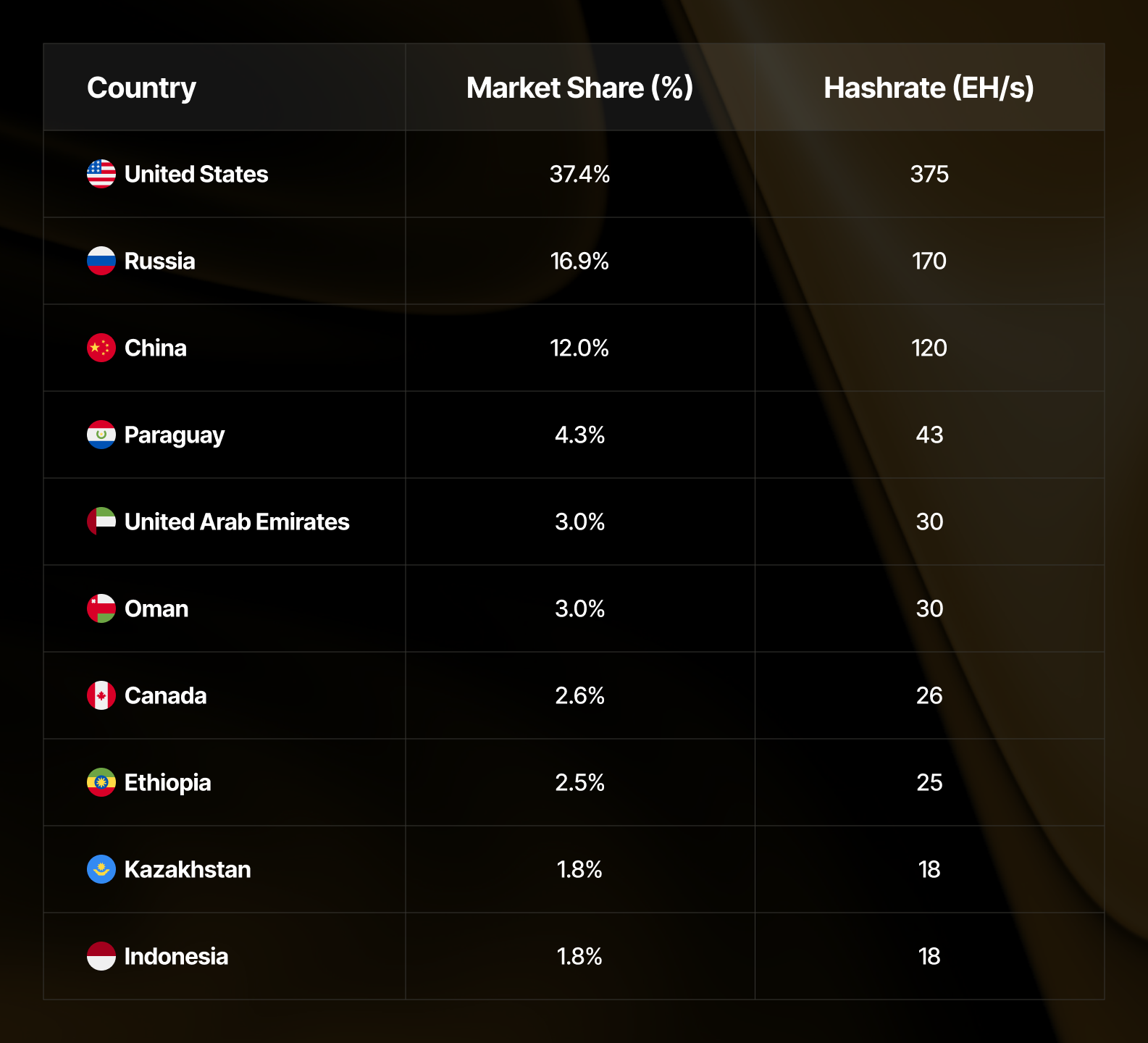
The United States remains the dominant player, accounting for 37.4% of global hashrate, or roughly 375 EH/s. However, its share has edged slightly lower due to equipment retirements and a gradual pivot by some operators toward artificial intelligence infrastructure.

Meanwhile, Russia holds second place with a 16.9% share, maintaining stability despite sanctions and regulatory uncertainty. China follows with 12%, although its capacity declined after compliance actions in Xinjiang in December 2025 eliminated around 13% of its operations.

Together, these three countries still account for nearly 65% of global Bitcoin hashrate, highlighting the network’s persistent concentration.

Emerging Markets Gain Momentum

While established leaders retain dominance, several smaller markets are expanding rapidly and reshaping parts of the mining landscape.

Kyrgyzstan stands out for exceptional growth, posting a 300% year-over-year increase and a 167% quarter-over-quarter rise. This expansion follows the introduction of clearer mining regulations in mid-2025, which helped attract new investment.

Similarly, Paraguay has strengthened its position, growing 54% annually and reaching 4.3% of global hashrate. Its progress is largely driven by professional mining operations entering the market.

At the same time, Laos and Finland have each doubled their capacity compared to last year, benefiting from abundant hydroelectric resources and favorable climate conditions, respectively.

Ethiopia has also moved into the global top tier, securing 2.5% of total hashrate and ranking eighth overall. Notably, this growth continued despite a government pause on new permits in mid-2025. By honoring previously approved projects, authorities maintained investor confidence and allowed expansion to continue.

Declines in Other Regions

In contrast to these growth stories, several regions are experiencing clear declines. Iran’s hashrate fell by roughly 7 EH/s during the quarter, largely due to ongoing geopolitical tensions.

Argentina recorded an even sharper contraction, with a 42% year-over-year decline driven by persistent macroeconomic instability. Brazil, however, presents a more nuanced picture. Its hashrate increased by 133% over the past year, reaching 3.5 EH/s.

Despite this strong growth, the report notes that upcoming quarters will be critical in determining whether this rise reflects long-term expansion or a temporary surge.

Bitcoin Network Difficulty Adjusts to Changing Conditions

Amid these shifts, Bitcoin’s network continues to self-correct. In early April 2026, mining difficulty increased by nearly 4%, following an earlier decline of about 8%, reflecting the protocol’s built-in mechanism for responding to changes in active mining capacity.

Taken together, these adjustments, along with shifting regional dynamics, illustrate a mining sector that remains highly responsive to market conditions.

According to the Hashrate Index report, the current phase is less about external disruption and more about the natural impact of price cycles on operational sustainability.

Grayscale Reaffirms XRP Progress in Addressing Quantum Threat

Grayscale has reaffirmed the progress made by the XRP Ledger (XRPL) developer community in addressing the growing quantum threat.

Grayscale recently released a report that referenced research from Google on the risks linked to the fast growth of quantum computing and its possible impact on blockchain security. In the report, XRP stood out as one of the networks already taking steps to deal with this emerging threat.

Key Points

  • Grayscale cited Google research warning that quantum computing’s progress could pose a threat to blockchain security.
  • Google identified post-quantum cryptography as a solution, with networks like XRP Ledger already testing it.
  • The XRP Ledger has advanced quantum readiness by testing ML-DSA signatures and enabling key rotation, among others.
  • The report emphasized that the level of quantum risk depends on the blockchain design.

Google Paper Warns Against Delayed Action

The report, authored by Zach Pandl, Head of Research at Grayscale, called attention to the urgency of preparing for a post-quantum future. 

Pandl explained that in the mid-1990s, MIT mathematician Peter Schor created an algorithm that could allow quantum machines to solve the complex problems behind today’s encryption. Even after nearly 30 years, no computer can run this algorithm at scale yet, but estimates suggest this could change within the next few years.

Grayscale referred to a recent paper from Google Quantum AI, which stressed that the uncertainty around timelines makes early action important. The research warned that progress in quantum computing may not happen gradually but could come in sudden jumps, which increases the risk of waiting too long.

The paper suggested that reaching this level of capability may require about 1,200 to 1,450 logical qubits, an important measure of computing power. 

While that point has not been reached, both Google and Grayscale believe blockchain networks should start preparing now. They noted that there is still a lot of work to do, including technical upgrades, community agreement, and handling possible side effects like lower transaction speeds.

XRP Already Making Progress

The Google research also stressed that this challenge can be solved. It mentioned a forward through the use of post-quantum cryptography. Notably, this field has already developed tools that experts have tested, reviewed, and even deployed in real systems.

These cryptographic methods already protect internet traffic and some blockchain activities. Grayscale pointed out that networks like Solana and the XRP Ledger have started testing these solutions. This early effort shows that some blockchains are not waiting but are already preparing for future risks.

For context, Google’s 2026 research highlighted the XRP Ledger as one of the few networks already testing post-quantum cryptography in real conditions. The research spotlighted XRPL’s progress, especially its use of key rotation, which helps improve security for tokenized real-world assets.

Notably, XRPL has been working toward quantum resistance by testing new cryptographic standards approved by NIST on its developer network, AlphaNet. 

In December 2025, developers added CRYSTALS-Dilithium, now ML-DSA, to support quantum-resistant transactions, accounts, and consensus. This replaces older systems like ECDSA secp256k1 and Ed25519 with signatures that are about 2,420 bytes in size.

The network also allows built-in key rotation, meaning it can upgrade its cryptography through validator agreement without stopping the system or affecting user accounts. These features are still being tested and are not yet live on the main network, but they show progress.

Quantum Vulnerability Varies Across Blockchain Designs

The Grayscale report explained that not all blockchains face the same level of risk. The level of exposure depends on how each network is built. 

For instance, systems that use the UTXO model, like Bitcoin, differ from account-based systems like Ethereum. Other factors include whether a network uses proof-of-work or proof-of-stake, supports smart contracts, or has special setup processes for privacy tools.

Bitcoin Supply by Address Type

Grayscale noted that Bitcoin may face fewer technical risks because of its design, which includes the UTXO model, proof-of-work, and no native smart contracts. Some address types are also safer if they are not reused. 

However, the bigger challenge is in decision-making. The community still needs to agree on what to do about coins with lost or inaccessible private keys. Options include burning them, leaving them untouched, or slowing how they can be spent. Reaching an agreement may be difficult, especially given Bitcoin’s history of debates.

Number of Cardano Whales Holding 10M ADA Balloons to a 4-Month High

0

The largest Cardano whales are on the rise, as the number of addresses holding at least 10 million ADA spikes to a four-month high.

While some panicked, smart money users are making major moves on Cardano (ADA). This trend has become evident in the increase in the number of wallets holding at least 10 million ADA tokens between December and now.

Key Points 

  • The number of addresses holding a minimum of 10 million ADA tokens has surged to a four-month high.
  • Wallets in this category rose 5.2% in 9 weeks to reach 424.
  • ADA is down 26.7% year-to-date, yet since its February 6 low, its valuation has added over 11%.
  • The Cardano network processed over 4 billion ADA in transactions over the past five days, culminating in $1 billion in on-chain volume.
  • A combination of strong network transaction volume and whale accumulation favors Cardano’s price.

Cardano Whales Rise 5% in 9 Weeks

Santiment identified this trend in a recent X post. The market intelligence platform noted that the number of addresses holding a minimum of 10 million ADA tokens has surged to a four-month high of 424.

Notably, ADA trades at $0.243 at the time of writing. While it has declined consistently over the past four months, it would require an average of $3.5 million to buy 10 million ADA during this period. This is a massive bet on ADA, one that comes only with conviction of its price potential.

Santiment highlighted that the last time such a number of whales held 10 million ADA was in December 2025. Amid the downturn since then, as prices trended lower, wallets in this category dropped. However, interest seems to be returning, as the largest Cardano whales are back buying the dip.

Notably, wallets in this category rose 5.2% in 9 weeks to reach 424, reflecting the recent shift from distribution to accumulation among ADA whales. An accompanying chart further confirms the growth from around 402 wallets holding 10+ million ADA in late January to the current figure.

Cardano Whale With 10M+ Hits 4-Month High/Santiment

Cardano Valuation Adds 11% Despite Bearish Trend

Furthermore, Santiment highlighted that while Cardano has joined the broader altcoin market’s underperformance from the start of 2026, its price and valuation have gained significantly from recent lows.

Per CoinMarketCap, ADA is down 26.7% year-to-date. Yet from its low on February 6, its valuation has added over 11%. The price has also followed suit, rising 10.4% from $0.22 to $0.243. At its peak rebound of $0.313 on February 25, it represents a 42% increase.

4 Billion ADA Transactions in 5 Days

Elsewhere, TapTools also highlighted another bullish development for the Cardano ecosystem. The network processed over 4 billion ADA in transactions over the past five days, culminating in over $1 billion in on-chain volume.

The notable transaction increase suggests strong network activity on Cardano, undermining the “ghost chain” narrative surrounding the blockchain. Such substantial on-chain activity reflects its utility, as users leverage its low fees and swift transaction features to move value.

Notably, a combination of strong network transaction volume and whale accumulation favors Cardano’s price. It has also held above key support levels, keeping the prospect of a recovery alive as the broader market stabilizes.

Shiba Inu: 68% of the Largest Binance Whales Are Long on SHIB

0

Shiba Inu is in focus, as the top 20% of traders on Binance have maintained a bullish bias toward the meme coin amid signs of stabilization in its price.

According to Binance data, a staggering 68% of these “smart money” traders are long on Shiba Inu (SHIB), the second-largest meme coin by market cap. This level of conviction, despite prior uncertainties, is bringing renewed attention to SHIB.

Key Points

  • According to Binance data, a staggering 68% of the top 20% of traders on the platform are long on Shiba Inu (SHIB).
  • Data from the Top Trader Long/Short Ratio by positions shows a ratio of 2.12, meaning that for every $1 short position, there is a $2.12 long position among the accounts.
  • These Binance whales are looking beyond the current shaky price and focusing on the impressive risk-to-reward ratio for SHIB.
  • SHIB is the largest meme coin on Ethereum, and the top 20% traders on Binance might be seeing it as a beta play when Ether starts to recover.

Top 20% Binance Traders Long on Shiba Inu

Data from the Top Trader Long/Short Ratio by positions on Binance highlights this disposition. On the 15-minute timeframe, it shows a ratio of 2.12, representing approximately 68% longs and 32% shorts on SHIB, among the largest traders on Binance.

Shiba Inu Top Trader Long/Short Ratio (Positions) on Binance

The metric suggests that for every $1 short position, there is a comparably larger $2.12 long position among the accounts holding the biggest balances on the largest crypto exchange by trading volume.

When these top market users maintain such a high level of bullish bias towards an asset, it raises eyebrows. Do they know something that retail traders don’t? Subsequent price developments would provide answers to these questions.

Why They Could Be Long on Shiba Inu

Notably, Shiba Inu trades around multi-year lows after steadily grinding downwards for several months. From its high of $0.00001765 in May 2025, the meme coin has retraced nearly 67% to its current price of $0.00000585.

Historically, SHIB has bottomed around these areas, as seen in 2021 and 2023. If history repeats, the token could soon enter an accumulation phase, with a sustainable rebound to follow.

The current lows make SHIB an intriguing opportunity. As it is already over 90% below its all-time high and trades near historical support, many analysts don’t see the token falling much lower from here.

This narrative might be what these “smart money” Binance whales understand. As such, while prices look shaky in the near term, they are looking beyond that and focusing on the impressive risk-to-reward ratio for SHIB if history repeats.

The Ethereum Beta Play?

Another reason for these heavy longs on Shiba Inu is its position in the Ethereum ecosystem. SHIB is the largest meme coin on the network, and the top 20% traders on Binance might be seeing it as a beta play when Ether starts to recover.

Analysts view ETH as massively undervalued at its current price, owing to growing institutional traction for Ethereum. As a result, the sentiment could be that when the altcoin king reprices to meet the fundamentals around its ecosystem, SHIB could deliver an outsized gain. However, this remains a high-risk bet.

Meanwhile, Shiba Inu is beginning to stabilize around $0.0000058, holding the key support at $0.0000056. With negative exchange netflows signaling accumulation over distribution, SHIB might be building momentum toward higher prices.

XRP Holders Sit on 41% Average Loss as MVRV Drops to FTX-Era Lows

As XRP struggles to regain momentum, fresh on-chain data shows that most holders are now sitting on significant losses.

The asset is trading around $1.31, down 2.14% on the day. This extends a broader decline that has seen it fall by more than 60% from its July 2025 peak of $3.66.

Recent insights from Santiment reveal that the average XRP wallet active over the past year is down roughly 41% on its holdings. This has pushed the MVRV (Market Value to Realized Value) ratio to its lowest level since the FTX collapse, a period widely associated with extreme market stress and forced capitulation.

Key Points

  • XRP holders face average losses of 41% as MVRV drops to levels last seen during the FTX market collapse.
  • More than half of XRP’s supply is underwater, with daily realized losses reaching up to $110 million.
  • Persistent selling pressure has kept XRP from recovering, with only 43.4% of supply still in profit.
  • Historically, such deep losses signal a potential bottom, with data pointing to a possible 63% upside ahead.

Deep Losses for XRP Holders

The MVRV metric measures whether traders are in profit or loss, and current levels suggest that XRP investors are deep in negative territory. According to Santiment’s analysis, this goes beyond a simple price drop; it reflects actual realized losses among market participants.

Historically, such deeply negative returns point to what traders describe as a “blood in the streets” phase, when selling pressure begins to run out. Glassnode noted that in zero-sum markets like crypto, this environment tends to reduce downside risk, as a large portion of weaker hands have already exited their positions.

Glassnode Data Confirms Persistent Selling Pressure

Supporting this trend, data from Glassnode shows that more than half of XRP’s circulating supply is currently underwater.

Investors who bought above $2 over the past year have been consistently realizing losses. Specifically, daily realized losses have ranged between $20 million and $110 million since November 2025.

Image

According to Glassnode, only 43.4% of XRP supply remains in profit, marking the lowest level since July 2024. This reflects sustained selling pressure, as holders continue to exit positions at a loss, contributing to XRP’s inability to stage a strong recovery.

Image

Opportunity Zone in Play

Meanwhile, the combination of falling MVRV and declining supply in profit suggests a market reset. While short-term sentiment remains weak, these conditions have historically aligned with late-stage corrections, where long-term investors begin to accumulate.

Notably, Santiment data confirms XRP is now in an “opportunity zone,” which typically occurs when the MVRV ratio falls to around -30%. With the one-year MVRV at -41%, history suggests a potential 63% upside opportunity in the coming months.

Specifically, Santiment noted that the last time XRP’s MVRV ratio reached -41% was in December 2022, which preceded a 63% gain over 4.5 months. If history repeats, today’s XRP dip buyers could become significantly profitable by August. However, this remains uncertain.

Image

Ultimately, XRP’s price remains under pressure, but the data points to a potentially promising setup.

As losses mount and weaker participants exit, the market may be quietly forming a more stable base that could eventually support a recovery when broader conditions improve.