Home Blog Page 171

XRP Quantum Vulnerability Test Shows 300K Accounts with 2.4B XRP Remain Quantum Safe

Amid concerns around the growing quantum threat, an XRP validator recently shared the result of an XRPL quantum vulnerability check.

His findings show that about 300,000 accounts out of 7.8 million are currently safe from quantum threats. These accounts hold around 2.4 billion XRP and remain protected as their public keys remain hidden, since they have never made any transactions.

Key Points

  • A vulnerability check found that about 300,000 XRPL accounts holding 2.4 billion XRP remain quantum safe.
  • Only two dormant accounts holding 21 million XRP with exposed public keys present a notable risk.
  • XRPL differs from Bitcoin, where large inactive wallets often have exposed keys under older formats.
  • The XRPL has tested quantum-resistant systems on AlphaNet using ML-DSA (CRYSTALS-Dilithium).

XRP Has Limited Whale Risk

Vet explained that the lack of public exposure gives these 300,000 accounts an important advantage. Specifically, since their public keys are unknown, they are harder to target using quantum methods. 

He also noted that only two accounts holding a combined 21 million XRP have been inactive for over five years while still having exposed public keys. This makes these accounts more vulnerable, but the affected figure remains negligible.

According to Vet, large dormant holders on XRPL do not pose much risk. He pointed out that vulnerable inactive whale accounts are extremely rare. Most accounts on the network remain active, and even though their public keys are visible, users can update or rotate their keys if needed.

This is different from the situation with Bitcoin, where large amounts of funds often sit in inactive wallets. Some of these wallets, including those linked to Satoshi Nakamoto, have exposed public keys under older formats like pay-to-public-key (p2pk). This means XRPL may handle quantum risks differently, especially when it comes to inactive large holders.

Vet noted that this risk affects only about 0.03% of the total XRP supply. He added that there are currently no quantum computers capable of breaking public blockchains, and by the time such technology becomes a real threat, the industry will have found solutions.

XRP Dormancy Rate

Notably, at press time, the network has over 7.76 million activated addresses, with roughly 1.13 million dormant wallets. Many of these inactive wallets only hold the minimum reserve of about 10 to 20 XRP, which limits their overall impact.

Also, dormancy levels have remained steady. Accounts inactive for more than two years make up around 3.8% to 4.1% of the network and remain part of a small permanent-loss group. 

While the number of untouched accounts with hidden keys may change slightly over time, XRPL still benefits from having fewer exposed public keys in comparison with many other blockchains.

XRPL Progress Toward Quantum Resistance

The XRPL is not yet fully protected against quantum threats on its main network. It still depends mainly on traditional cryptographic systems like ECDSA (secp256k1) and Ed25519, which could be broken by quantum methods such as Shor’s algorithm.

Despite this, the network has taken early steps to prepare for future risks. One important feature is built-in key rotation, which allows users to change their signing keys without changing their wallet address. 

The XRP Ledger also uses an amendment system where validators agree on upgrades, making it easier to introduce changes compared to the slower process seen in Bitcoin.

AlphaNet Becomes Quantum Secure

In December 2025, Denis Angell from XRPL Labs announced that AlphaNet, the developer testnet, had become fully quantum secure. The network adopted CRYSTALS-Dilithium, now known as ML-DSA (ML-DSA-44/65/87 variants), which is a post-quantum signature method approved by NIST.

The system also includes Quantum Accounts, Quantum Transactions, and Quantum Consensus, allowing even validator communication to use quantum-resistant cryptography. Developers also added native smart contracts and successfully tested quantum-signed transactions.

However, this progress comes with trade-offs. Dilithium signatures are much larger, about 2,420 bytes, compared to around 64 bytes for traditional signatures. This increase affects transaction size, storage, speed, and overall network performance. Engineers are still working to improve these areas.

Ongoing Research

Work on quantum resistance continues across the XRPL ecosystem. Developers are exploring ideas like enforced key rotation and hybrid systems that combine current and post-quantum signatures during the transition. Research teams at Ripple, including contributors like Ayo, are also working on solutions, with more updates expected in the future.

Meanwhile, industry groups have started to take notice. Most recently, Grayscale highlighted XRPL and Solana as early leaders in testing post-quantum cryptography. They called these efforts a possible model for the rest of the blockchain industry, citing Google Research.
Maket Updates: DOJ Advances Tornado Cash Case, Circle Expands Stablecoin Payments in Asia, FDIC Moves Toward Stablecoin Regulatory Framework

0

Latest Market Updates: As of 8th April 2026.

DOJ Advances Tornado Cash Case

Notably, market sentiment softened as regulatory pressure intensified. The U.S. Department of Justice has rejected a motion to dismiss the case against Tornado Cash developer Roman Storm, allowing the prosecution to proceed.

In particular, prosecutors with the Southern District of New York allege that Storm was aware of illicit activity facilitated on the platform and failed to act. They also argue that Tornado Cash lacked substantial legitimate use cases.

With the dismissal request denied, the case moves forward, underscoring the U.S. government’s continued focus on crypto privacy tools and developer accountability.

CFTC Chair Calls for Direct Crypto Exposure in Regulation

In contrast, a more reform-oriented regulatory perspective emerged from CFTC Chair Michael S. Selig.

Speaking with Anthony Pompliano, Selig criticized earlier regulatory frameworks that limited direct engagement with digital assets, arguing this created a significant knowledge gap among policymakers. He said this disconnect has hindered effective oversight and, in his view, amounted to a “disservice” to the public.

To address this, he proposed allowing regulators structured, firsthand exposure to crypto systems to improve technical understanding and inform more effective policy design.

Circle Expands Stablecoin Payments in Asia

Against this backdrop of regulatory debate, global adoption efforts continue to accelerate. Circle has expanded its footprint in Asia, introducing its Stablecoin Payouts service for Circle Mint partners in Singapore.

The move strengthens its cross-border payments infrastructure and supports compliant settlement using USDC.

It also reflects growing demand for regulated stablecoin rails in Asia, where fintech development and digital payments adoption continue to advance rapidly.

FDIC Moves Toward Stablecoin Regulatory Framework

Meanwhile, in the United States, banking regulators are also working to clarify the rules governing stablecoin issuance.

According to Bloomberg, FDIC Chair Travis Hill said the agency has drafted new guidelines for banks and fintech firms that issue digital tokens.

Specifically, the proposed framework covers reserve requirements, redemption processes, capital standards, and permissible activities. Moreover, it clarifies that tokenized deposits will remain subject to the existing protections that apply to traditional deposits.

The FDIC is now seeking public feedback on open questions, including yield generation, insurance treatment, and capital requirements. This move indicates an evolving approach, albeit one that remains cautious.

Southeast Asia’s Largest Bank Cites XRP in New Crypto Report

The Chief Investment Office of DBS Bank, the largest bank in Southeast Asia, has highlighted XRP in a new report examining emerging risks in the crypto space.

The report, titled “Digital Assets: Quantifying Quantum Risks in Crypto,” also mentioned other major crypto projects, including Solana and Ethereum. It highlights institutional attention not just to crypto adoption, but to long-term technological threats that could reshape the industry.

Key Points

  • DBS highlights XRP alongside Ethereum and Solana, flagging rising quantum risks across crypto networks.
  • Advances in quantum computing could eventually threaten blockchain security, though current capabilities remain far from dangerous.
  • Faster networks like XRP and Solana may reduce attack windows due to quick settlement times.
  • DBS urges preparation, noting the industry is already developing quantum-resistant solutions.

DBS Flags Quantum Threat to Crypto Networks

According to DBS CIO Daryl Ho, advances in quantum computing could eventually challenge the cryptographic foundations that secure blockchain networks.

The report references recent Google research suggesting that a sufficiently powerful quantum computer could break Bitcoin’s elliptic curve cryptography far faster than previously expected.

While such technology is still theoretical, the timeline may be accelerating, raising concerns about future vulnerabilities.

However, DBS highlights that current quantum hardware remains far from this level. Even the most advanced systems today are nowhere near the scale required to pose an immediate threat.

XRP, Ethereum, and Solana Could Withstand Current Risk

DBS specifically pointed to differences in blockchain design, noting that faster networks like XRP, Ethereum, and Solana may have some structural advantages against certain types of attacks.

For example, transaction confirmation times vary significantly across networks. Bitcoin transactions typically take around 10 minutes to confirm. Meanwhile, XRP settles in roughly 3–5 seconds, Solana in under a second, and Ethereum in 12-15 seconds.

This speed reduces the window for a potential “on-spend” quantum attack, where a malicious actor could attempt to intercept and override a transaction before it is finalized.

Still, the bank cautions that future improvements in quantum computing could eventually introduce risks even to faster chains.

Source: DBS report
Source: DBS report

Industry Already Moving Toward Solutions

The report notes that major blockchain ecosystems are already working on post-quantum cryptography solutions.

For instance, the Ethereum Foundation is targeting a full transition to quantum-resistant systems by the end of the decade. Meanwhile, proposals within the Bitcoin ecosystem aim to upgrade address formats and signature schemes to reduce long-term exposure.

Likewise, XRP Ledger is testing post-quantum cryptography, including NIST-backed standards and key rotation features.

DBS frames this as a race between quantum breakthroughs and defensive innovation, with the crypto industry historically adapting quickly to new challenges.

No Immediate Panic, But Preparation Matters

Despite outlining serious long-term risks, DBS maintains that there is no need for immediate concern. The gap between current quantum capabilities and real-world threat levels remains wide.

Instead, the bank encourages preparation over panic. It advises crypto users to follow best practices, such as avoiding address reuse, using modern wallets, and staying up to date on post-quantum developments.

In its conclusion, DBS suggests that even in a worst-case scenario, the crypto ecosystem would coordinate upgrades or forks to adapt just as it has done in the past.

Cardano Price: Two Major Signs that $5 is the Next ADA Target

0

Cardano could rally from its current price to unprecedented levels, with two major price indicators supporting this potential move.

Over the past 24 hours, Cardano (ADA) has increased 7.15%, the second-best performance in the top 15 crypto ranking by market cap. While it has joined a broader market resurgence that saw Bitcoin reclaim $71,000, an analysis of its higher-timeframe chart points to further price expansion.

Key Points

  • Cardano shows several reversal signals on its weekly chart, all pointing to a rally to much higher prices.
  • The first identified catalyst for this move is a classic higher-timeframe double bottom.
  • The second reversal signal is the imminent breakout from a falling wedge.
  • A breakout would target a potential 1,801% rally to a new all-time high of $5. 

Cardano Reversal Signals

An analysis from “GoTX” has highlighted reversal signals on Cardano’s weekly chart, all pointing to a rally to much higher prices. He suggested that a new cycle is in the works for the prominent altcoin, with its price action shifting from distribution to expansion.

Notably, the first identified catalyst for this move is a classic higher-timeframe double bottom. The accompanying chart shows that ADA has found support in the same demand zone, indicating that bears can’t breach key price levels despite their dominance.

Cardano Double Bottom and Falling Wedge/GoTX

These two bottoms are three years apart, further strengthening the conviction that it would be massive for the cryptocurrency’s price. The first happened in June 2023 when Cardano was still grinding downwards after its 2021 peak of $3.10. Its price dropped to $0.2200 in early June 2023, which marked its lowest price that cycle.

Second Bottom Formation

After recovering considerably from there to March 2024’s high of $0.810 and further to December 2024’s high and this cycle’s peak price of $1.320, bears stepped in again. The high of $1.020 in August 2025 turned out to be a lower high, with Cardano slowly but consistently dropping to lower levels.

In February, ADA finally retested the previous cycle’s bear market lows, dropping to $0.2205. This was almost the exact price it reached in June 2023. As seen earlier, the coin also bounced from this low and currently trades at $0.262, approximately 19% above the local support area.

The analysis views this as a double-bottom formation, one of the catalysts for a new bullish cycle in which ADA starts to recover considerably.

Cardano Wedge Breakout Targets $5

Meanwhile, the second reversal signal is the imminent breakout from a falling wedge. Notably, this pattern has been forming since June 2025, with prices making a lower high and a lower low within it.

The first move was a wave (B) relief rally, taking Cardano from $0.510 to the August 2025 high of $1.020. It followed a corrective wave (A), which dragged the coin from $1.320 in December 2024 to the point where the falling wedge began forming.

Afterward, another wave of correction pushed ADA to the second bottom at $0.2205, completing wave (C). ADA has continued to trade within this falling wedge but is nearing a breakout. Its 4.7% rise this week brings it close to the wedge’s neckline resistance.

A breakout would have a substantial impact on Cardano, with the analyst targeting a rally to $5. The potential 1,801% surge from the current price of $0.263 to the new all-time high would take it to the 1.618 Fibonacci extension.

Before this target are key levels at $3.160 and $2.037, aligning with the 100% and 61.8% Fibonacci levels.

Grayscale Highlights XRP Consistently Ranked Among Top 6 Since 2018

Grayscale recently tracked the top crypto assets by market cap since 2018, and data shows XRP has consistently ranked among the top 6.

Despite being one of the earliest crypto assets to launch after the advent of Bitcoin (BTC) in 2009, XRP has managed to maintain its relevance in the space for over 13 years. Grayscale confirmed tracking the top assets by market cap since 2018 and found that XRP has maintained a top 6 position within this period.

Key Points 

  • XRP remains one of the few pre-2015 crypto assets to retain its relevance.
  • A recent Grayscale report confirms that since 2018, XRP has maintained a top 6 position in the market.
  • XRP’s highest ranking was the second position, which it forfeited to Ethereum in 2020 and has failed to reclaim since.
  • XRP collapsed to sixth, its lowest ranking, in 2022 amid the SEC lawsuit that started in December 2020.
  • Besides XRP and Bitcoin, no pre-2015 coin is currently in the top 5.

Current XRP Ranking 

Grayscale shared its report on X amid the ongoing crypto market downturn that has dealt a blow to asset prices since the fourth quarter of 2025. Notably, the altcoin market has lost $198 billion worth of valuation since the start of the year, and XRP contributes $26.5 billion to this figure.

Interestingly, the token has held up better than BNB, which has lost $35 billion within the same period despite having a lower market valuation overall. While XRP has occasionally relinquished its third spot to BNB during the downturn, it has often recovered it. At the time of the Grayscale snapshot, XRP held third, holding an $85 billion market cap.

XRP Consistently Ranks Among Top 6 Grayscale
XRP Consistently Ranks Among Top 6 | Grayscale

Meanwhile, Ethereum (ETH) retained its second spot, which it has sustained over the past six years, boasting a market cap of $270 billion. As for Bitcoin, the crypto firstborn has had an unchallenged run at the top, remaining the only constant factor in the ranking with a current valuation of $1.44 trillion.

XRP’s Historical Rankings

Launched in 2013, XRP quickly worked its way to the top 3 ranking in August, the same month it started trading publicly. During that period, the top 10 featured a list of tokens that most investors today would fail to recognize due to names that have lost their relevance in today’s market.

Specifically, Bitcoin led the ranking, with Litecoin in second and XRP securing third. From fourth to eighth featured Namecoin (NMC), Peercoin (PPC), Feathercoin (FTC), Novacoin (NVC), and Primecoin (XPM). For context, all lists exclude stablecoins.

Top 10 Crypto Rankings in August 2013 CoinMarketCap
Top 10 Crypto Rankings in August 2013 | CoinMarketCap

By the end of September 2014, XRP had overtaken Litecoin to become the second-largest crypto asset. It maintained this position until the launch of Ethereum in July 2015. From February 2016, the battle between XRP and Ethereum for the second spot began. XRP eventually lost this battle in 2020, the same year the SEC lawsuit began.

XRP Maintains Top 6 Spot

According to Grayscale’s report, XRP’s lowest ranking since 2018 came in 2022 in the heat of the SEC lawsuit, which led to reduced trading volumes and delistings in the U.S. Notably, XRP dropped to the sixth spot that year, slipping below BNB, Solana (SOL), and Cardano (ADA).

While XRP overtook ADA and occasionally pushed above SOL in the years that followed, it remained below BNB until the November 2024 rally. This run allows XRP to firmly recover its third spot. Meanwhile, during its period of underperformance, XRP managed to maintain a top 6 spot, excluding stablecoins.

Since 2025, XRP has retained the third ranking, occasionally relinquishing it to BNB during market declines, but recovering the position almost immediately each time. 

Interestingly, the Grayscale data confirms that Bitcoin and XRP are the only pre-2018 tokens that have remained in the top 5 ranking at press time. Dogecoin (DOGE), which launched in December 2013, ranks seventh. The rest of the pre-2015 tokens in the top 20 are Monero (13th), Stellar (14th), and Litecoin (17th). Of these tokens, only Litecoin launched before 2013.

Cardano IOG Halts Acropolis and Tiered Pricing Development, Reallocates 4.1M ADA to Boost Cardano Growth

0

Cardano engineering arm Input Output Global (IOG) has announced a strategic shift in its development priorities to accelerate the network’s long-term growth. 

Specifically, the organization will halt further work on the Acropolis project and cancel the proposed Tiered Pricing model. Instead, it will redirect resources toward chain abstraction technologies and development aligned with the upcoming Leios scaling architecture.

Key Points

  • Cardano engineering firm IOG has halted further development of the Acropolis project and the proposed tiered pricing mechanism. 
  • The firm will redirect resources toward chain abstraction technologies and development aligned with Ouroboros Leios to accelerate Cardano’s long-term growth. 
  • This move will see roughly 4.1 million ADA returned to Cardano’s treasury for community governance allocation. 
  • Cardano founder Charles Hoskinson expects Leios to launch this year. 

IOG Cancels Acropolis and Tiered Pricing Development

In a recent blog post, IOG confirmed that it will officially end development of the Acropolis project this month, April 2026. Originally designed as a Rust-based alternative node implementation for the Cardano network, Acropolis aims to increase node diversity and strengthen the ecosystem’s infrastructure.

Notably, the project delivered several milestones, including a Data Node that enables blockchain synchronization in roughly an hour rather than several days. However, IOG concluded that continued development would no longer deliver the greatest value to the ecosystem. 

As a result, the engineering team behind Acropolis will transition to a set of chain abstraction initiatives designed to simplify how developers and users interact with Cardano. 

Meanwhile, IOG has also canceled the proposed Tiered Pricing mechanism. New research tied to the Leios scaling architecture showed that the design could soon become outdated.

Since Leios introduces a fundamentally different model for transaction processing and throughput, the organization believes continuing the Tiered Pricing framework would likely create unnecessary technical debt. 

Notably, IOG founder Charles Hoskinson previously expressed a strong interest in launching Leios this year. He argues that the upgrade could help Cardano achieve the long-standing blockchain trilemma of scalability, security, and decentralization. 

Reallocation of 4.1M ADA Resources

As part of this strategic shift, IOG will return the full 2.7 million ADA allocated for Tiered Pricing development, along with the remaining 1.4 million ADA assigned to Acropolis. In total, 4.1 million ADA will be returned to the Cardano Treasury, where the funds can be redistributed through the network’s governance process.

IOG emphasized that transparency and responsible stewardship of community funds guided the decision. Rather than continuing projects that no longer align with Cardano’s evolving roadmap, the organization chose to halt development and reallocate the resources.

Looking ahead, IOG believes that improving usability and developer accessibility will serve as the strongest catalyst for Cardano’s expansion.

By reducing friction for developers and users alike, the organization hopes to attract more applications, increase on-chain activity, and ultimately drive greater liquidity and economic participation across the ecosystem. 

Bitcoin Move Lacks Retail Hype as Google Search Trends Diverge From Price

New on-chain observations suggest retail investors aren’t showing much interest in Bitcoin.

Benjamin Cowen, founder of Into The Cryptoverse, shared data comparing Bitcoin’s price with Google search trends. It shows that while Bitcoin pushes upward, search interest remains much lower than in past bull runs.

Key Points

  • On-chain observations suggest retail investors aren’t showing much interest in Bitcoin
  • Google search trends show far less attention than past bull runs.
  • Institutions, not retail, are increasingly driving Bitcoin’s price movements.
  • Maturing market suggests steadier growth and reduced extreme volatility ahead.

Bitcoin Rises Without Retail Frenzy

In earlier bull runs, especially around 2017, spikes in Google searches closely tracked Bitcoin’s price surges. For instance, as Bitcoin traded near $20,000 in late 2017, retail search interest reached a maximum score of 100.

In other words, as more people searched for Bitcoin, demand increased, pushing prices toward cycle highs.

This time looks different.

Despite Bitcoin trading at significantly higher levels than in past cycles, search interest has not returned to those extreme highs. Currently, the score is under 20, with Bitcoin trading at $68,500—compared to a maximum score of 100 when BTC was below $20,000 in 2017.

The absence of strong retail curiosity suggests the current market may not be driven by the same wave of new participants seen in previous rallies.

Image

A More Mature Market

The divergence points to a possible shift in who is driving the market. Unlike retail investors, institutions do not rely on search engines to gain exposure. Instead, they access Bitcoin through funds, structured products, and direct market participation.

This aligns with the narrative that Bitcoin is gradually evolving into a more mature financial asset, where price movements are less dependent on hype and more influenced by capital flows from larger players.

At the same time, it reflects growing familiarity. Bitcoin is no longer a niche topic that requires widespread searching during every rally. Many investors already understand the asset, reducing the need for repeated spikes in online curiosity.

BTC Price in a Maturing Market

This maturing state also means the extreme price volatility that defined its earlier history may no longer be in play.

Ark Invest CEO Cathie Wood has said Bitcoin is becoming more stable, with massive crashes (once as large as 95%) likely to become less common as institutional investors enter the market.

Right now, Bitcoin trades around $68,500, still well below its previous peak of $126,000. Ark Invest predicts Bitcoin could reach a $16 trillion market cap by 2030 (around $761,900 per coin), driven by ETFs and growing corporate adoption.

Meanwhile, Bitwise CIO Matt Hougan believes Bitcoin could eventually exceed $1 million. He compares it to digital gold and points to the massive global store-of-value market (around $40 trillion). Bitcoin currently holds only a small share (4-5%), leaving plenty of room to grow if adoption increases.

His view is that returns will likely come steadily over time, not through sudden spikes, supported by institutional demand and a more mature market.

Bitcoin Long-Term Holder Supply Change Flips Positive Again

The Bitcoin long-term holder supply change has flipped positive over the past 30 days, indicating that investors have chosen not to sell.

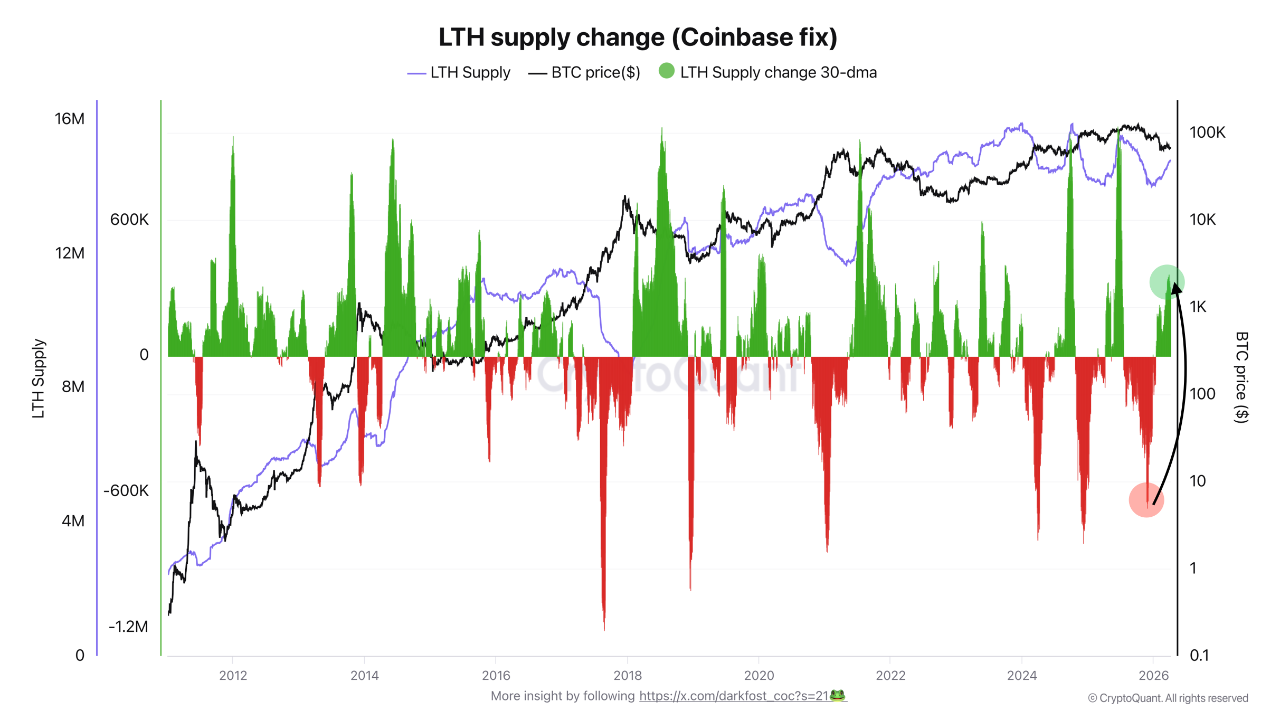
Bitcoin faces renewed selling pressure after failing to hold above the $70,000 level on April 6. Despite this weak price performance, data highlighted by CryptoQuant analyst Darkfost shows that the change of Bitcoin long-term holder (LTH) supply has turned positive over the past 30 days.

Key Points

  • Bitcoin climbed above $70,000 on April 6 but failed to hold this level, falling to $68,000.
  • Long-term holder supply increased over the past 30 days, flipping from -674,000 BTC to about +308,000 BTC.
  • The rise in long-term holder supply comes from coins aging past six months and slipping into the LTH category rather than new accumulation.
  • Currently, 29% of long-term holder supply is in loss, still below past cycle bottom levels of 44%-53%.
  • Despite solid spot demand, Bitcoin may hit new yearly lows in Q2 2026.

Bitcoin Long-Term Holder Supply Change Turns Positive

Darkfost’s recent analysis confirmed geopolitical tensions and their economic effects continue to create pressure, especially on risk assets, but some investors remain focused on the long term.

According to him, the supply held by long-term holders is gradually increasing, which is a positive sign. Even though demand remains relatively weak, more Bitcoin is now staying in wallets long enough to be classified as long-term holdings than is being sold by these investors.

Darkfost also clarified that this data comes from UTXO-based analysis. This means it does not necessarily show active buying. Instead, it comes from Bitcoin that was moved six months ago and has remained untouched, naturally shifting from short-term to long-term holder status. This trend shows that more investors are choosing to hold rather than sell.

Data Shows Change in Investor Behavior

Data from the chart indicates a change in the metric. After dropping to -674,000 BTC (30-day moving average) at the end of November 2025, the metric has now turned positive. On average, about +308,000 BTC has been added back into long-term holder supply.

Bitcoin Long-Term Holder Supply Change CryptoQuant
Bitcoin Long-Term Holder Supply Change | CryptoQuant

Darkfost called this a change in behavior, where holding now outweighs selling, despite Bitcoin persistently trading within a range. In the past, similar changes have often come before price increases. However, he warned that it is too early to be certain.

According to him, in bear markets, this kind of change can happen without leading to a strong and lasting trend. For now, the market analyst suggested that investors watch closely. If the increase in long-term holder supply continues, it could become a stronger signal for the market.

Analysts Warn of Possible Deeper Downside

Elsewhere, another analyst, Ardi, explained that during past market bottoms, 53% of long-term holder supply was in loss in 2015, 45% in 2018, and 44% in 2022. Each of these extreme levels matched the market bottom. 

Share of Bitcoin Long-Term Holder Supply in Loss Checkonchain
Share of Bitcoin Long-Term Holder Supply in Loss | Checkonchain

Right now, the figure stands at 29% and is still rising, suggesting that the market has not reached its lowest point yet but may be moving in that direction.

Meanwhile, market analyst Ted Pillows pointed out that Bitcoin recently tested the $69,000-$70,000 resistance zone but failed to break through. He said that while spot demand remains solid, any short-term rise may not last. To him, Bitcoin could fall to new yearly lows in Q2 2026.

Bitcoin May Hit $110,000 as Michael Saylor’s Strategy Is Driving a Supply Shock

0

Bitcoin continues to move within a bearish technical structure, yet persistent accumulation by Michael Saylor’s Strategy is beginning to challenge that outlook.

Notably, Bitcoin (BTC) remains within a bear flag formation, a setup that typically signals further downside. Under normal conditions, this pattern could indicate a move below the crucial $60,000 support region to new lows.

However, recent market behavior suggests that strong demand from Strategy, the largest Bitcoin treasury firm, may be offsetting this pressure.

Key Points

  • Bitcoin (BTC) remains within a bear flag formation.
  • Recent market behavior suggests that strong demand from Strategy may be offsetting the pressure.
  • Strategy has added 46,233 BTC to its holdings since March 2, nearly three times the 16,200 BTC miners have produced over the same period.
  • Despite the ongoing bearish setup, a break above the upper boundary of the bear flag around $75,000 would invalidate the bearish continuation pattern.
  • If this occurs, attention could shift toward a projected move between $108,000 and $110,000.

Persistent Strategy Bitcoin Buying Counters Bear Flag

For context, Saylor’s Strategy has added 46,233 BTC to its holdings since March 2. Over the same period, miners produced approximately 16,200 BTC, meaning the firm has absorbed nearly three times the new supply entering circulation. This imbalance has played a key role in stabilizing price action and could tend towards a BTC supply shock if such buying pressure persists. 

Strategy Bitcoin Purchase/Saylor Tracker

Notably, many of the purchases have come in through STRC, Strategy’s perpetual preferred stock with an 11.5% annual return, which it has repeatedly used to raise capital for Bitcoin purchases.

Strategy recently secured $102.6 million through STRC sales last week, contributing to its acquisition of 4,871 BTC worth $330 million. This activity possibly contributed to Bitcoin’s 4.6% growth last week and its strong opening to this week.

Earlier in March, between March 9 and 13, STRC-related funding reached $776 million. This capital supported the purchase of more than 11,000 BTC, contributing to the premier asset’s 12% rally during the same period, despite the S&P 500 dropping 1.6%. BTC ended that week with a 10.3% increase, its highest weekly gain since May 2025.

At the same time, a decline in STRC issuance has coincided with notable pullbacks. In mid-March, when the stock dipped below its $100 reference level, issuance declined, and Bitcon dropped nearly 7%. A similar event in January aligned with the 25% corrections in three weeks from $97,900 to $60,130.

Bitcoin Targets Higher Prices if Breakout Occurs

Despite the ongoing bearish setup for Bitcoin, a move above key resistance could change the outlook. A break above the upper boundary of the bear flag around $75,000 would invalidate the bearish continuation pattern.

Bitcoin Bear Flag Breakout

If this occurs, attention could shift toward a projected move between $108,000 and $110,000, where the next major resistance level lies. Notably, this scenario mirrors past behavior, including a similar pattern failure observed around Bitcoin’s 2018 bottom.

The asset broke upward from a typically bearish rising wedge in April 2019 after falling into and consolidating within this pattern from November 2018. It bottomed within this pattern with support from the 200-week simple moving average. What followed was a 2,109% price expansion from the lows around $3,124 to the 2021 peak of $69,000.

In the current cycle, the same 200-week MA limited further downside attempts in February, suggesting that a base may be forming. Historically, this level has acted as a bottom during major corrections and could provide the required momentum for the 59% and 62% rallies to reach between $108,000 and $110,000.

Evernorth Looking to Incorporate AI in Its XRP Treasury Risk Management

0

Evernorth is exploring how it can integrate AI into its XRP treasury operations, focusing on improving risk management. 

t54 Labs co-founder Chandler Fang revealed this during a recent podcast with Evernorth CEO Asheesh Birla. Notably, they discussed the risks and opportunities of combining AI with crypto, especially in an always-active market, where risk management is important.

Key Points

  • Evernorth’s Asheesh Birla raised concerns about AI unpredictability and how firms could navigate it.
  • Fang said companies should adopt AI quickly but with caution, stressing that AI can reduce human error and improve risk management.
  • According to Fang, Evernorth is exploring how it could integrate AI into its XRP Treasury operations, especially in risk management.
  • Evernorth holds over 473 million XRP and plans to grow value through DeFi, lending, and options strategies.

Evernorth CEO Raises Concerns Over AI

During the discussion, Birla explained that most organizations do not start their day thinking about innovation, but instead focus on making sure essential tasks like payroll run without issues. He used this point to show that while new technology is important, stability remains the top concern for treasury teams.

Birla shared an example involving a Meta safety professional, where an AI agent reportedly deleted all her email accounts after behaving unpredictably. 

He used this case to call attention to the possible dangers of relying on AI systems that may act on their own without proper control. According to him, there could be concerns when such systems are used in financial operations.

He then turned to crypto-related risks. While blockchain improves speed by removing delays in moving money, Birla pointed out that instant transactions also increase the chances of mistakes or misuse. He explained that once funds move instantly, there is little room to correct errors. 

t54 Labs CEO Calls for Cautious but Active AI Adoption

Birla then asked Fang how treasury managers should approach using AI in areas like agent-based commerce in 2026. He questioned whether they should move quickly or wait until the technology becomes more stable.

In response, Fang said companies should move forward with AI adoption, but with care and a focus on managing risk. He stressed that AI is improving quickly, mentioning tools from companies like OpenAI and Anthropic that already show impressive capabilities. According to Fang, this change is already happening, and businesses should not ignore it.

At the same time, Fang agreed that risk is still the main concern for treasury managers. He explained that people naturally try to avoid losses and uncertainty, which makes hesitation around AI understandable. However, he suggested looking at the issue from a different angle, arguing that AI can actually help reduce risk rather than increase it.

Evernorth Looking to Incorporate AI

To support his point, Fang used the example of Tesla’s autopilot system. Even though some people do not fully trust it, insurance companies often offer lower premiums for cars that use it. He explained that this is because data shows humans make more mistakes than machines. 

Applying this idea to crypto, Fang commended Evernorth for already exploring how AI can be used in daily risk management. He said this can improve efficiency and help reduce risks, especially in a market that runs 24/7 and is highly volatile.

“The MicroStrategy of XRP”

Evernorth calls itself the “MicroStrategy of XRP,” looking to build and manage what it says will become the largest public or institutional XRP treasury. Instead of just holding XRP, the company plans to actively manage its assets to increase value over time.

In October 2025, Evernorth announced a planned merger with SPAC Armada Acquisition Corp. II, which trades on Nasdaq under the ticker AACI. The deal sought to raise over $1 billion from institutional investors, with most of the funds going into XRP investments.

By November 2025, Evernorth confirmed it had purchased XRP worth about $214 million. This brought its total purchased and committed holdings to more than 473,276,430 XRP, representing around 0.473% of the total XRP supply. 

The company plans to actively manage its treasury to grow XRP per share. Its strategy includes taking part in on-chain and DeFi activities, such as using Ripple’s RLUSD stablecoin in XRP liquidity pools, lending XRP, providing liquidity as an automated market maker, and using options strategies like covered calls and cash-secured puts.

On March 18, 2026, Evernorth filed its Form S-4 with the SEC, moving forward with its SPAC merger. The filing outlines its business model, treasury plans, and investor backing.