Home Blog Page 177

Ripple Ex-CTO Shares Three Big Advantages XRP Has Over Stablecoins

Ripple CTO Emeritus David Schwartz has joined the ongoing discussions about whether banks will adopt XRP — and, in turn, boost its price.

His comments come as questions grow around XRP’s long-term relevance in a market increasingly dominated by stablecoins. In response, Schwartz highlighted several advantages that cryptocurrencies like XRP have over stablecoins.

Key Points

  • XRP offers a neutral bridge across currencies, unlike stablecoins tied to single fiat systems globally.
  • Stablecoins carry control risks like freezing and clawbacks, adding counterparty exposure in sensitive use cases.
  • Schwartz argues crypto’s upside potential can outweigh volatility, especially in long-term or non-stability-driven scenarios.
  • He dismisses claims banks would avoid XRP, saying firms won’t reject profitable solutions just to avoid enriching Ripple.

Stablecoins vs XRP: Where Each Fits

Schwartz acknowledged that stablecoins do have clear advantages in certain use cases. He explained that when volatility is a major concern, stablecoins or regulated assets with trusted counterparties can be a better option.

However, he argued that this does not make cryptocurrencies like XRP obsolete. Instead, each serves different roles depending on the application.

1. Limited Flexibility Across Global Currencies

According to Schwartz, one major limitation of stablecoins is that they are tied to a single fiat currency.

In a global financial system where multiple jurisdictions operate with different native currencies, a single stablecoin may not meet all needs. He noted that a stablecoin with the exact properties required, such as regulatory clarity, liquidity, and trust, may not even exist for certain regions.

This is where XRP can offer an advantage, acting as a neutral bridge asset not tied to any single fiat system.

2. Control Risks: Freezing and Clawbacks

Schwartz also highlighted the control mechanisms of stablecoins, which issuers can freeze. Using Ripple as an example, he noted that regulated entities must comply with court orders, which means user funds could be affected by legal or political decisions.

This introduces a layer of counterparty risk that cryptocurrencies aim to avoid in cross-border or censorship-sensitive use cases.

3. Upside Potential Favors Crypto in Many Cases

Finally, Schwartz argued that for many use cases, the potential upside of cryptocurrencies outweighs their volatility.

He explained that if stability is not essential, such as in long-term escrow scenarios, assets like XRP or Bitcoin may be preferable to fiat-backed stablecoins. Unlike fiat currencies, which typically do not appreciate significantly, cryptocurrencies offer potential value growth over time.

Bank Adoption and XRP Supply Concerns

Notably, the discussion was sparked by crypto commentator Mason Versluis, who questioned why global banks would use XRP if it could significantly enrich Ripple given its large token holdings.

He pointed to Ripple’s 38 billion XRP holdings and argued that banks may avoid adopting a cryptocurrency in such concentrated ownership. The concern centers on whether institutions would be comfortable indirectly driving up the value of a private company.

In response, Schwartz dismissed the idea that businesses would avoid profitable solutions simply because another entity benefits. He framed it as unrealistic for institutions to reject a system that makes economic sense just to avoid enriching Ripple.

Ultimately, Schwartz’s argument suggests that stablecoins and cryptocurrencies are not direct replacements but complementary tools. While stablecoins may dominate in low-volatility environments, XRP and similar assets still provide unique advantages in global liquidity, neutrality, and long-term value potential.

Shiba Inu Lead Shytoshi Kusama Says Not “Appointed Time” for SHIB Rally to $0.00055

0

Shiba Inu lead ambassador Shytoshi Kusama has clarified a misconception about his recent comment, particularly as it affects the price of SHIB.

Kusama sounded spiritual in his string of new X posts, discussing his newfound enthusiasm around doctrines. Meanwhile, a particular comment is drawing attention among Shiba Inu enthusiasts, one they feel relates to the price trajectory of the prominent meme coin.

Key Points

  • A tweet by Shytoshi Kusama stating that the “next appointed time” has arrived is drawing reactions from the Shiba Inu community.
  • One reaction suggested that Kusama was discussing the appointed time for SHIB to rally to $0.00055.
  • However, Kusama quickly discarded this line of thought, clarifying that the tweet had nothing to do with the token’s price.
  • Shiba Inu at $0.00055 would imply a market cap of $324 billion at the current circulating supply.

“Appointed Time” for Shiba Inu to $0.00055

One of Kusama’s tweets stated that the “next appointed time” has arrived. While the SHIB ambassador mentioned other things, this part drew attention and elicited discussion in the community.

The comment received several interpretations, including those related to the price of Shiba Inu. For instance, Leeron Shim, a prominent community voice, suggested that Kusama was discussing the appointed time for SHIB to rally. Specifically, Shim claimed the lead ambassador’s comments meant this was the time for SHIB to reach $0.00055.

Notably, clamoring for much higher prices has been a long-standing desire in the Shiba Inu community. Despite recent downsides, proponents believe the future remains bright for the dog-themed meme coin, and the hope is what keeps the ecosystem buzzing.

The $0.00055 price mark is one of the milestones that holders anticipate. It marks a 9,222% increase from the current market price and is well above the current all-time high of $0.0000885. As such, when Kusama’s “appointed time” tweet came, Shim took it to mean he was suggesting the time had come for SHIB to hit the highly coveted price mark.

Nothing to Do with the Price of Shiba Inu

However, Kusama quickly discarded this line of thought. The lead ambassador replied that the tweet had absolutely nothing to do with the token’s price.

He further clarified it was about what he called a “global appointed time.” While he did not provide a clear context for this, Kusama claimed that those who feel the shift have chosen to ignore it.

Notably, he seems willing to shed more light on this. In his earlier post, the lead ambassador had noted that he would explain his assertions in detail at a later date.

Can Shiba Inu to $0.00055 Ever Happen?

At this time, Shiba Inu remains well within bearish territory. After underperforming in the last bullish phase, its price has pulled back considerably from earlier highs. For context, the token sits 60% below its September high of $0.0000148.

Despite these, analysts point to a mid and long-term recovery, targeting prior highs and possibly unprecedented levels. But is $0.00055 plausible for Shiba Inu?

According to the prediction site Telegaon, Shiba Inu would begin approaching this price level after 2035. It set a maximum price of $0.000516 by 2035 but a minimum price of $0.000804 by 2040, suggesting that SHIB would attain this price mark between 2036 and 2040.

Shiba Inu Prediction/Telegaon

However, Changelly does not see SHIB nearing this target even by 2050. Its maximum price target of $0.00000353 by 2050 is well below this ambitious price mark.

Notably, Shiba Inu at $0.00055 would imply a market cap of $324 billion if the current circulating supply of 589.24 trillion remains unchanged. Some view this as a big ask for a meme coin with little real-world use case, even if the sector does expand substantially in the future.

XRP Liquidity Index on Binance Crashes to New Lows

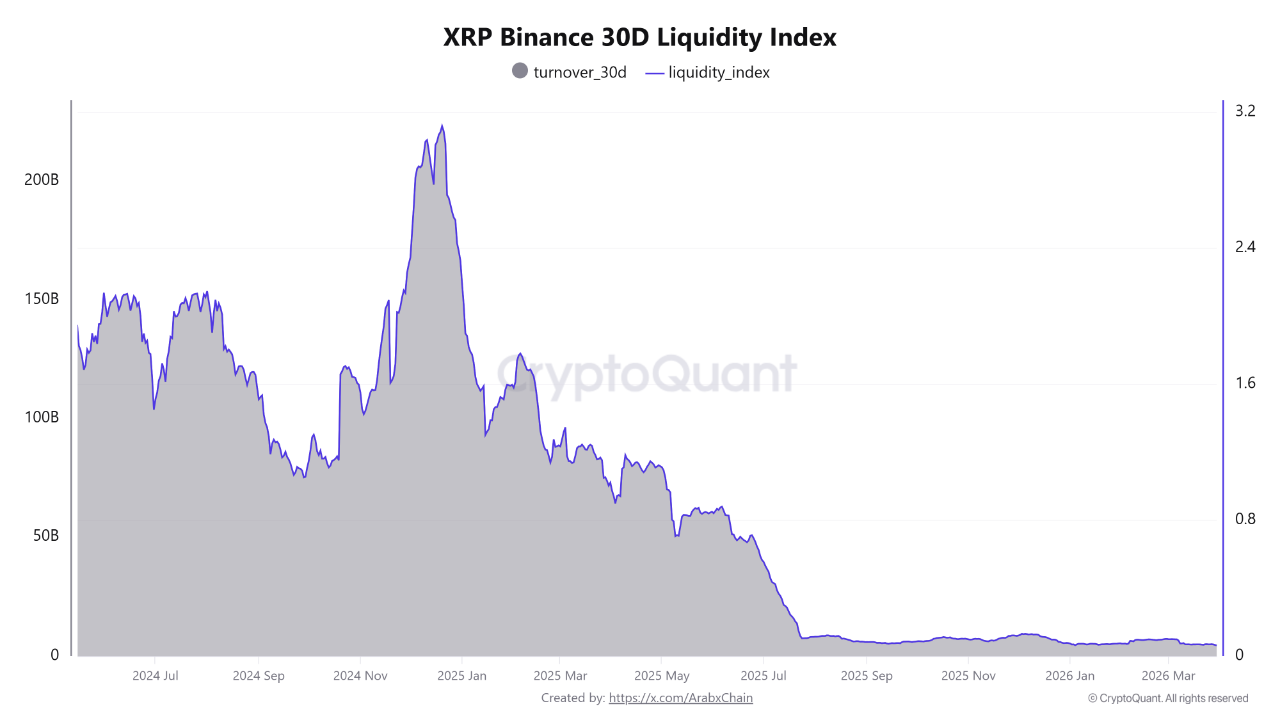
The XRP 30-day liquidity index on Binance has crashed to its lowest level in recent times, making prices more prone to sudden swings.

As XRP pulls back from the latest lower high of $1.36, liquidity and trading activity have fallen to some of their lowest levels in recent periods, indicating weaker investor participation. This situation now makes the XRP market more sensitive to price swings.

Key Points

  • Amid the recent price pullback, XRP has begun recording steeper declines in its liquidity index on Binance.
  • Data shows the 30-day liquidity index fell to about 0.062 alongside a turnover of roughly $4.46 billion.
  • The decline in liquidity means weaker market participation and could lead to sharp price swings.
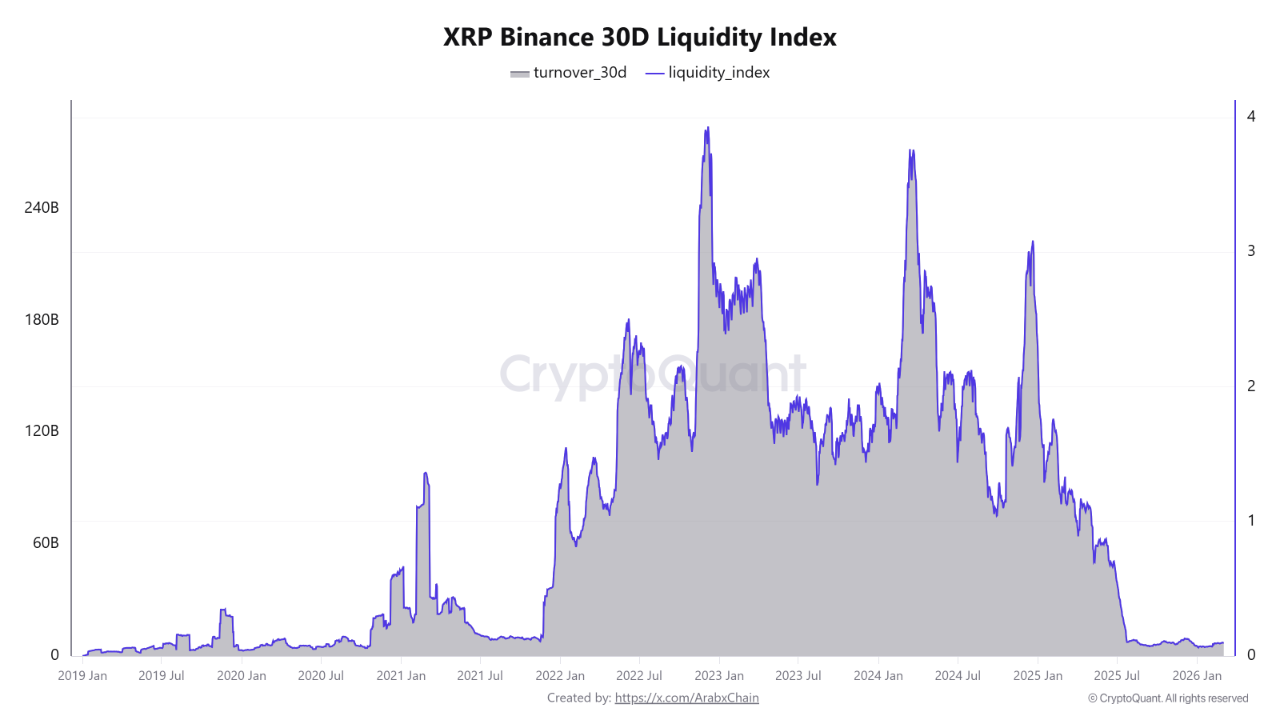
  • Between 2022 and 2024, liquidity exceeded 3, and turnover reached 180-240 billion XRP, but both began falling from July 2025 onward.
  • XRP has remained in a falling channel since March 18, with resistance at $1.35.

Falling XRP Liquidity and Turnover Show Weak Interest

CryptoQuant analyst Arab Chain confirmed this in a recent report. According to him, XRP’s 30-day liquidity index on Binance has dropped to about 0.062, one of the lowest levels in recent times. This means there are fewer buy and sell orders in the market, reducing overall depth compared to periods when liquidity was stronger.

XRP 30D Liquidity Index on BInance CryptoQuant

Further, the 30-day turnover index also shows weakness, currently sitting at around $4.46 billion. This is a relatively low figure, confirming the drop in trading activity. According to Arab Chain, both metrics show that large investors and smaller traders are less active in the market right now.

Notably, low liquidity often makes prices more sensitive. When there are fewer orders, even a single large trade can cause a sharp move. At the same time, lower turnover means less money is flowing into the market, which can keep prices stuck or push them lower in the near term.

Historical Data Shows Extent of Decline

Arab Chain had earlier called attention to this trend in a report from early March. As of March 3, XRP’s turnover rate had already dropped to about 7.02 billion XRP, while the liquidity index stood near 0.097, which was already considered very low.

Historical Data
Historical Data

This was very different from what the market looked like in the recent past. Specifically, between 2022 and 2024, XRP saw strong activity on Binance, with the liquidity index rising above 3 at times. During those periods, turnover reached between 180 billion and 240 billion XRP, showing high trading activity and strong market conditions.

The change began in 2025. From July 2025, turnover started to fall, and the liquidity index dropped below 1. Since then, both measures have continued to decline, reaching the near-zero levels seen today. This steady drop shows that the market has been weakening for a long time.

XRP Transaction Activity Drops

Meanwhile, transaction data also confirms the decrease in investor interest. Arab Chain recently reported that XRP activity on Binance has fallen to its lowest level since 2025, with both deposits and withdrawals declining.

In the past 30 days, there were about 310,500 deposit transactions and around 329,400 withdrawals. This leaves a net difference of about -18,900, meaning more funds are leaving the platform than entering it.

However, the bigger concern is that total transaction activity has dropped overall. This shows that the market is slowing down, with fewer participants taking part. It shows a period where traders are less active, and the market is moving with less energy.

Price Trend Stays Weak Despite Slight Relief Signs

The declining investor interest comes amid an obvious weakness in XRP’s price action over the past few days. Specifically, after rising to $1.36 on April 1, XRP fell by 2.06% on April 2, continuing a downward trend that began on March 18.

This decline started after XRP reached $1.6 on March 17 amid the Iran conflict. After the peak, the price began to move within a descending channel, forming lower highs and lower lows. The MACD indicator showed fading green bars after the March 17 high, indicating that buying strength was fading and sellers were taking control.

By March 27, XRP had dropped below $1.35, and this level has since turned into resistance. Each attempt to move above it, including the push to $1.36 on April 1, has failed and led to another drop.

XRP 1D Chart
XRP 1D Chart

Although the MACD histogram now flashes red, the bars are becoming lighter, which suggests that selling pressure may be easing slightly. However, XRP needs to move clearly above the $1.35 level to break out of the current downward channel. Until this happens, both the price trend and market data suggest that XRP remains under pressure.

Crypto Founder Explains How XRP Can Settle $50 Million Between Two Big Banks

Digital Ascension Group chairman Jake Claver recently explained what it actually takes for XRP to handle large institutional transactions.

In a post on X, Claver broke down how XRP could function as a bridge currency between banks. He highlighted that price alone is not the key factor; liquidity may be the deciding piece.

Key Points

  • XRP can settle $50M bank transfers, but only if liquidity is deep enough to avoid major price swings.
  • Low liquidity could make large XRP transactions unstable, raising concerns about its reliability for institutions.
  • Claver argues higher XRP prices boost efficiency, but extreme price predictions still lack strong justification.
  • Banks may favor stablecoins or in-house solutions over XRP to avoid enriching Ripple and managing volatility.

Why Liquidity Matters More Than Hype

According to Claver, for XRP to successfully settle a $50 million transaction between two major banks, the network must have enough liquidity to process the trade without causing sharp price swings.

In simple terms, if liquidity is too low, a transaction of that size could move the market significantly, making XRP unreliable for institutional use.

At the moment, XRP has a market cap of $83 billion. This implies the network cannot seamlessly handle an intentional settlement worth $100 billion. For this to happen, XRP’s price would need to rise to around $10, giving it a $600 billion valuation for a successful attempt.

This reinforces the popular idea that XRP’s price “needs to rise” to be liquid enough to support large-scale financial flows.

XRP Role as a Bridge Currency

The concept of XRP as a bridge asset has long been central to Ripple’s vision. The idea is that XRP can act as an intermediary between two different fiat currencies, enabling fast and low-cost cross-border transfers.

Claver’s explanation builds on earlier arguments that XRP becomes more efficient at higher valuations.

Last year, he argued that XRP is “programmed” to reach $10,000 to handle trillion-dollar transactions more efficiently. He dismissed market cap concerns, claiming they are irrelevant to XRP’s valuation.

He explained that as XRP’s price rises, fewer tokens are needed to transfer large sums, boosting network utility.

While the logic holds, it still fails to justify extreme price predictions popular in the XRP community and the aggressive timelines leaders like Claver attach.

XRP vs Stablecoins

Meanwhile, recent discussions have also questioned whether XRP will play a central role in banking at all. Some industry voices argue that stablecoins may be more practical for payments due to their fixed value.

Moreover, commentator Mason Versluis argues banks may resist boosting an asset that could make Ripple extremely wealthy. He notes that banks would closely assess XRP’s token distribution and retail speculation before adopting it, regardless of its fast, low-cost payment utility.

In other words, if adopting XRP could send its price soaring and significantly enrich Ripple, banks may instead opt for alternative solutions. This trend is already emerging, as major banks entering crypto are launching their own stablecoins and blockchains.

The Evolution of Crypto Trading: How Automation is Replacing Emotion in Capital Management

In the high-stakes crypto market of 2026, success is defined by execution speed rather than just intuition. The primary hurdles for private investors remain the same: psychological pressure and the grueling necessity of 24/7 market monitoring. The QBots platform addresses these challenges by offering institutional-grade tools to automate trading across the most liquid Top 50 digital assets.

Precision and Discipline: Strategies for Every Market Phase

Unlike manual trading, QBots algorithms operate without hesitation or fatigue. The system allows users to deploy battle-tested strategies tailored to various market conditions:

  • Accumulation and Sideways Markets: The Grid Trading and DCA (Dollar-Cost Averaging) modules turn market noise into structured profit.
  • Volatility Management: The Mean Reversion algorithm effectively capitalizes on price corrections back to historical averages.
  • Trend Following: The Momentum module identifies strong directional impulses to ensure high-probability entries.
  • Micro-Efficiency: Arbitrage and Scalping strategies allow users to extract value even from the smallest price fluctuations.

Security and Integration: Powered by Bybit & MEXC

A cornerstone of the QBots ecosystem is its robust security architecture. The platform operates exclusively via secure API connections to two of the world’s leading exchanges — Bybit and MEXC.

This setup ensures that:

  1. You Retain Custody: Your assets never leave your exchange account. The platform has no permission to withdraw your funds.
  2. Full Control: You can stop any bot or adjust risk parameters instantly through a clean, intuitive dashboard.
  3. Instant Execution: Direct integration minimizes latency, ensuring orders are filled with minimal slippage.

Scaling Your Wealth: The Referral Ecosystem

For those viewing the crypto space as a comprehensive income opportunity, QBots offers a highly rewarding affiliate program. This is a chance to build a stream of passive rewards that complements your trading performance.

How it works: By inviting new users through your referral link, you earn a percentage of the subscription revenue they generate. As long as your referrals remain active, your rewards continue to flow. Furthermore, using the native QIE token to pay for platform services unlocks exclusive discounts, further enhancing the overall ROI for ecosystem participants.

The Bottom Line

In 2026, manual trading is becoming a relic of the past. To survive and thrive in modern markets, speed and discipline are non-negotiable. By combining proven institutional strategies, the security of Bybit/MEXC API integration, and a scalable partnership model, QBots stands out as the premier choice for both veteran traders and those seeking a systematic approach to crypto investment.

Ready to deploy your first automated strategy? Join the community of professional traders today via this link.

Former CFTC Chairman Says Banks Need Clarity Act More Than the Crypto Industry

0

Chris Giancarlo, a former CFTC chairman, has made a bold statement on who needs the Clarity Act more between the crypto industry and banks.

Speaking on the Paul Baron podcast recently, Giancarlo claims that banks need this crypto market structure more than the digital asset sector. While the bill focuses on providing regulatory clarity for crypto in the United States, the former Commodity Futures Trading Commission (CFTC) chair insists it would favor banks more.

Key Points

  • Chris Giancarlo, a former CFTC chairman, recently claimed that banks need the crypto market structure more than the digital asset sector.
  • According to him, crypto firms can move abroad and still thrive; the banking industry can’t.
  • Giancarlo says banks need the Clarity Act to be passed in the US to “stay with the curve” and avoid falling behind in the sector’s adoption.
  • The bill has stalled, but Coinbase CLO Paul Grewal told FOX Business that a compromise on the stablecoin reward issue would be reached in the next 48 hours.

Banks Can’t Build Abroad, Crypto Can: Giancarlo

Giancarlo used the flexibility of the digital asset space to back his argument. According to him, crypto firms can move abroad and still thrive; the banking industry can’t.

“They (crypto firms) are going to build this even if they have to go offshore and go to the UAE or Singapore,” Giancarlo stated, insisting that the Clarity Act can’t stop the sector from building its technology.

The former CFTC chairman termed crypto leaders “intrepid and fearless” and said they would take their invention elsewhere if the US environment doesn’t enable them. 

In contrast, banks can’t go offshore. If banks and major financial institutions don’t have clear guidelines on how to interact with the digital assets, it would stiffen adoption. As such, they need the Clarity Act to be passed in the US to “stay with the curve” and avoid falling behind in the sector’s adoption.

Since they can’t move offshore, they lose to foreign competition. Giancarlo suggested that the digital asset would succeed even without the legislation. However, this gives away the first-mover advantage to other countries, a situation that US President Donald Trump has heavily warned against.

The US Could Miss Out if the Clarity Act Stalls

Giancarlo noted that the Clarity Act would favor banks more than the crypto industry. If the recent loggerheads between the two sectors persist and the bill stalls, the US could lose its current leadership of the digital asset industry.

This pushes innovation abroad, handing foreign competitors an advantage. While this might mean nothing now, the former CFTC boss noted that the banking sector would realize in the next five years that they have fallen way behind in the adoption of blockchain technology.

Notably, Giancarlo had made this argument earlier. He did this in a previous podcast with the Wolf of All Streets’ Scott Melker, where he insisted that banks can’t afford regulatory uncertainty, particularly as it relates to digital assets.

Major Breakthrough on Clarity Act’s Major Hurdle?

For the uninitiated, the Digital Asset Market Clarity Act aims to address issues related to asset classification and broader oversight of the crypto market. While there is an established law—the GENIUS Act—that governs the stablecoin market, it does not address certain provisions, particularly those related to rewards.

Notably, this has been a major issue that has delayed the Clarity Act’s passage for months. Traditional banks claim that allowing yields on stablecoins, which is currently well above their current reward system, would cripple their operations. On the other hand, the crypto industry argues that stopping this reward system eliminates competition.

This back-and-forth has persisted, stalling the bill’s passage in the US Senate. Despite this, Ripple CEO Brad Garlinghouse remains optimistic that the legislation will pass before May 2026.

Meanwhile, Coinbase CLO Paul Grewal told FOX Business on April 1 that a compromise on the stablecoin reward issue would be reached in the next 48 hours.

Standard Chartered Predicts $500K Bitcoin and $40K Ethereum by 2030

A Standard Chartered analyst has laid out one of the most bullish long-term forecasts yet for Bitcoin and Ethereum.

The projection suggests BTC and ETH could reach astronomical highs by the end of the decade. In particular, Geoff Kendrick, the bank’s Global Head of Digital Assets Research, outlined a base case in which Bitcoin hits $500,000, and Ethereum climbs to $40,000 by 2030.

Key Points

  • Standard Chartered predicts Bitcoin could hit $500K and Ethereum $40K by 2030.
  • Ethereum may deliver roughly 20x gains, outperforming Bitcoin’s projected 7.5x growth.
  • Institutional adoption, especially “Ethereum-first” strategies, could drive ETH’s long-term growth.
  • Rising network activity and use cases like DeFi and tokenized assets may boost Ethereum’s value.

Ethereum to Deliver 20x Upside

In a recent podcast with John Gillen, host of Milk Road, Kendrick projects a roughly 20x increase in Ethereum from current levels. He positioned it as a stronger relative performer than Bitcoin over the same period.

He pointed to the ETH/BTC ratio, currently around 0.03, as a key indicator. According to his outlook, that ratio could rise to 0.04 in the near term. This suggests Ethereum will gain value faster than Bitcoin.

Using a simplified scenario, Kendrick noted that if Bitcoin reclaims $100,000 by the end of 2026, Ethereum could trade near $4,000.

For context, Bitcoin is trading at $66,400, while Ethereum is at $2,036. Kendrick’s year-end target implies gains of 50% and 96% for BTC and ETH, respectively.

As the year progresses, the analyst expects the gap in gains to widen further. In other words, his outlook highlights Ethereum’s steady outperformance relative to Bitcoin over the decade.

Specifically, while Ethereum reaching $40,000 by 2030 represents a 20x increase, Bitcoin’s $500,000 price over the same period amounts to roughly 7.5x gains.

TradFi Could Drive Ethereum’s Growth

A major pillar behind the bullish Ethereum thesis is increasing adoption by traditional finance institutions.

Kendrick explained that banks and large financial players tend to prioritize security and reliability when building blockchain-based products. Because Ethereum’s base layer has a long track record of stability, it often becomes the default starting point for institutional development.

He highlighted how asset managers like BlackRock initially deploy products on Ethereum before expanding to other networks. This “Ethereum-first” approach, he suggests, will likely shape how the financial industry adopts blockchain technology in the coming years.

Network Activity Key to Price Growth

Another core part of Kendrick’s analysis focuses on network usage. He emphasized that rising activity, measured through fees paid on Ethereum applications and protocols, tends to correlate with higher token valuations.

As more use cases, such as stablecoins, decentralized finance, and tokenized real-world assets, continue to grow on Ethereum, this increased demand could translate directly into price appreciation.

First-Mover Advantage in Blockchain Adoption

Kendrick ultimately believes Ethereum’s biggest strength lies in its position as the primary hub for early-stage innovation in crypto.

While he acknowledged that activity could eventually spread to other blockchains, he expects the “first phase” of institutional and real-world adoption to occur largely on Ethereum. That early dominance, combined with growing ecosystem usage, forms the basis for his long-term outperformance thesis.

With Bitcoin still expected to lead in absolute value, the forecast suggests Ethereum could quietly deliver even stronger returns.

Bitcoin Currently Following a Historical Trend That Always Plays Out in Midterm Years

0

The recent Bitcoin pullback may be part of a historical trend that has always played out during midterm years. 

While most Bitcoin investors have blamed the latest Bitcoin drop on President Trump’s recent speech concerning the Iran conflict, Benjamin Cowen believes Bitcoin may simply be following a pattern that has appeared many times during U.S. midterm election years. 

Key Points

  • After rising to $69,268 on April 1, Bitcoin has collapsed as April progresses.
  • Many investors blame the drop on Trump’s April 1, 2026, speech, where he warned of stronger action against Iran.
  • Benjamin Cowen believes Trump’s speech may not be solely behind the drop, citing a historical pattern that follows midterm years.
  • Cowen stated that Bitcoin typically records a February low, March lower high, and April pullback during midterm years.

Bitcoin Crashing into April

Notably, Bitcoin has shown volatility in recent days. After rising to $69,268 between late March and April 1, the asset quickly reversed and fell to $65,696 today, April 2. Although it has recovered slightly, the price still nurses a 2.05% drop on the day, trading at $66,704.

Bitcoin 1D Chart
Bitcoin 1D Chart

Most traders have blamed this decline on President Donald Trump’s primetime national address on April 1, 2026 (evening U.S. time). During the speech, he took a tougher position on Iran than markets had expected. 

Investors had hoped for signs of easing tensions or a quick resolution, and some had already priced that expectation into the market. 

However, Trump spoke about possible escalation, including plans to act strongly within 2–3 weeks and threats to target power plants and energy infrastructure if the Strait of Hormuz was not reopened or secured. This change in tone unsettled the market and likely added pressure on Bitcoin. 

Bitcoin Following Midterm Years Pattern

However, Cowen believes it is too simple to say the speech alone caused the drop. According to him, Bitcoin often follows a specific pattern in midterm years. He stressed that the price usually forms a low in February, rises to a lower high in March, and then falls again in April. 

To him, many investors try to explain price changes with current events, but these explanations often come after the move has already happened. He also warned against letting emotions guide decisions, noting that market narratives can be persuasive, but they do not always reflect the bigger picture. 

Interestingly, Cowen shared this theory over a month ago. Specifically, while Bitcoin recovered toward $70,000 on Feb. 25, Cowen stressed that the crypto asset often rallies into March, suggesting that March could see some upward push to lower highs. However, he predicted a drop into April. 

Historical Evidence from 2022, 2018, and 2014

Historical data confirms this theory. Specifically, in 2022, the last midterm year, Bitcoin dropped to $34,324 in February before recovering to $48,234 on March 28. Despite the rise, March only produced a lower high compared to earlier peaks. The price then fell again into April, reaching $39,218 by April 11.

A similar trend appeared in 2018. Notably, Bitcoin fell to $5,921 on Feb. 6, then climbed to $11,688 on March 5, again forming a lower high. As March ended, the price started to drop, reaching $6,510 by April 6, 2018.

The same pattern showed up in 2014, as Bitcoin touched a low of $400 on Feb. 25 and later rose to $710 on March 3, which also marked a lower high. As March continued, the market weakened, and the decline extended into April, with the price falling to $358 by April 10, 2014.

Bitcoin Following Similar Pattern

This year appears to follow the same path. Bitcoin fell to $60,000 on February 6, 2026, then climbed to a lower high of $76,000 on March 17. Now, as April begins, the price seems to be entering another correction phase.

However, it remains uncertain how the rest of April will play out, as past results have not always been the same. In April 2022, Bitcoin dropped by 17.31%, but in April 2018, it ended up gaining 33% after a weak start. In April 2014, the decline was smaller at 1.31%.

These mixed outcomes show that while the pattern often appears, the final result can be different. Bitcoin is following the expected trend so far, but whether it continues to fall or turns upward later in the month remains unclear.

Why Would Global Banks Use XRP and Drive Up Its Price If Ripple Holds 38B Tokens?

A fresh debate is unfolding in the XRP community about whether global banks could realistically adopt XRP, given Ripple’s massive token holdings.

XRP commentator Mason Versluis raised the question on X. He noted that if XRP’s price were to surge significantly, Ripple, holding 38 billion tokens, could become one of the most powerful financial entities in the world.

According to Versluis, this scenario may not sit well with traditional banking institutions, meaning large-scale adoption of XRP might not align with their interests.

Key Points

  • XRP adoption by banks may be limited due to Ripple’s massive 38B token holdings.
  • Banks scrutinize XRP’s market, distribution, and volatility before any adoption.
  • Stablecoins like RLUSD may offer banks more practical, predictable payment options.
  • XRP’s role could shift from global bridge currency to broader blockchain ecosystem use.

Banks, Due Diligence, and the XRP Question

Versluis emphasized that global banks don’t make decisions lightly. Adopting a cryptocurrency like XRP involves scrutiny not just of the technology, but also of its market structure, token distribution, and public perception.

Banks evaluating XRP would consider several factors:

  • Large retail holder participation
  • Speculative narratives and price predictions
  • Ripple’s significant token control

The core question is whether the utility XRP offers, such as fast, low-cost cross-border transactions, is compelling enough for institutions to overlook these concerns.

Notably, Ripple’s combined escrow holdings (33.5 billion) and spendable wallet (5 billion tokens) amount to 38.5 billion tokens. Accordingly, if XRP’s price were to reach $30 per coin, Ripple’s holdings would total $1.14 trillion. By comparison, today the value stands at $51.3 billion.

In other words, XRP price appreciation gives Ripple extraordinary financial power that may not sit well with industry rivals.

Versluis urged investors to rethink assumptions and avoid becoming overly emotionally attached to bullish price expectations.

Stablecoins Like RLUSD Enter the Conversation

Panos Mekras, CEO of Anodos Finance, joined the conversation and suggested that banks may not adopt XRP for payments at all. He added that Ripple itself recognized this, which partly explains why the company launched the RLUSD stablecoin in December 2024.

Mekras believes stablecoins such as RLUSD offer a more practical solution for banks’ payment needs. Stablecoins maintain a fixed value, making them predictable and less volatile.

From this perspective, XRP’s role may not be as a direct “banking tool,” but rather as part of a broader blockchain ecosystem.

Is XRP’s Global Bridge Currency Narrative Shifting?

Versluis further questioned whether XRP is moving away from its original idea as a global bridge currency. If stablecoins begin handling most payment flows, XRP may need to compete more directly with other blockchains based on real-world use, adoption, and developer activity.

This raises questions about whether XRP is still intended to be a key part of global finance, or if its role is evolving alongside new products like RLUSD.

Within the XRP community, opinions remain split. Some still believe in large-scale institutional adoption, while others advocate for a more realistic understanding of how banks operate.

Cardano New Entry Presents 3,270% Opportunity

0

Cardano looks good for an entry, and the target is a nice rebound with massive upside potential.

A TradingView analysis from MasterAnanda identified this development, even as the recent dip presents a new opportunity. Notably, Cardano has dropped 3.8% in the past 24 hours, a sideways trend that mirrors the broader crypto condition.

Key Points

  • Cardano has dropped 5.8% in the past 24 hours, a sideways trend that mirrors the broader crypto condition.
  • The recent dip on March 31 to $0.2342 is the lowest price ADA has seen since the February 6 capitulation to $0.220.
  • The Tuesday drop marked a higher low, presenting a great entry opportunity.
  • The broader market remains relatively stable, with Bitcoin and Ethereum’s resilience lending support to ADA’s rebound.
  • Cardano targets the 0.382 Fibonacci level at $0.643 and the 0.618 Fibonacci level at $0.904, but could reach $1.05.
  • Reaching the target would result in a potential 3,270% gain for a 10x long position.

Cardano Retracement Presents New Opportunity

MasterAnanda noted that the recent dip has presented a new opportunity for Cardano. The analyst highlighted the recent dip on March 31 to an intraday low of $0.2342 as the lowest price ADA has seen since the February 6 capitulation to $0.220.

Notably, despite the over 3% correction in the past 24 hours, the coin has yet to reach the March 31 low, with the price bottoming at $0.2357 at press time. According to the market watcher, the Tuesday drop marked a higher low, presenting a great entry zone.

Furthermore, this is the closest Cardano has been to a multi-year low. The current support band between $0.233 and $0.280 is a local demand zone, with the last visit in August 2024, when prices bounced from $0.275 to hit $1.32 by December 2024.

Bitcoin and Broader Market Stable

The analysis also identified that the broader market remains relatively stable. Bitcoin reacted to Donald Trump’s recent update on the Iran conflict, dropping to $66,300. However, this has happened before, and the crypto leader has somehow managed to recover.

It rebounded to above $68,000 yesterday from under $65,000 last week, reinforcing its resilience in the face of this geopolitical uncertainty. Recall that BTC has outperformed gold and the S&P 500 since this tension started.

Ethereum, on the other hand, has also shown resilience. It reclaimed $2,100 before yesterday’s event but still remains above $2,000 despite the washout.

MasterAnanda believes that while bulls are not in control, the current stability could build momentum for a recovery. This could help Cardano’s course to rebound considerably to higher prices.

Cardano Uptrend Targets

Meanwhile, his accompanying chart presents where Cardano could be headed if it holds the current support. The first is the 0.382 Fibonacci level at $0.643, and the next is the 0.618 Fibonacci level at $0.904. However, the analyst noted that the rally could exceed this point to $1.05.

Cardano Target from Support/MasterAnanda

In view of this, the chartist recommended a 10x long position with a 5% allocation. The entry point is around $0.2050 and $0.2500. Notably, reaching the target would result in a potential 3,270% gain. The stop for this position is a weekly close below $0.2230.

However, it is important to note that this may not play out as expected due to the unpredictable nature of the crypto market, which could lead to losses. As a result, investors should not regard this as investment advice.