Home Blog Page 178

Are XRP and Ripple Treasury Now Directly Linked to SWIFT? Here’s What We Know

0

Recent commentaries suggest XRP and Ripple Treasury now have a direct link to SWIFT, but the real situation may be more complex.

Discussions around a possible link between XRP and SWIFT have emerged after Chad Steingraber highlighted Ripple Treasury’s presence in SWIFT’s Certified Partner Program.

However, this connection is not new and does not mean XRP directly integrates with SWIFT. The SWIFT linkage existed long before Ripple acquired GTreasury, and Ripple’s role has mainly been to improve the platform by adding blockchain capabilities.

Key Points

  • Chad Steingraber recently highlighted Ripple Treasury’s listing in SWIFT’s partner program, suggesting a direct XRP-SWIFT connection.
  • XRP does not directly connect to SWIFT, as the integration exists only at the treasury platform level and not between their core networks.
  • GTreasury had already integrated with SWIFT’s Alliance Lite2 platform as far back as 2014, long before Ripple’s acquisition in 2025.
  • Ripple is now upgrading the platform by introducing blockchain capabilities.

Claims of an XRP-SWIFT Connection

Chad Steingraber made his disclosures in a recent post on X, sharing a screenshot showing Ripple Treasury, formerly GTreasury, listed in the SWIFT Certified Partner Program. 

He suggested that this translates to a direct connection between XRP and SWIFT, pointing out that Ripple Treasury integrates with SWIFT’s Alliance Lite2 platform and supports IBAN and ABA lookups through SWIFTRef.

SWIFT as Connectivity Partner to Ripple Treasury

He also called attention to the fact that the platform allows corporate treasuries to communicate securely with banks using several channels, including SWIFT, EBICS, APIs, and others. 

This led to excitement among XRP proponents, as it hinted that a link between Ripple’s blockchain system and traditional banking networks may actually exist. However, the full picture is not as straightforward as presented by Steingraber’s commentary.

The SWIFT Link Started Before Ripple

For one, the connection to SWIFT actually goes back long before Ripple got involved. GTreasury, which Ripple acquired for $1 billion in October 2025, had already been part of SWIFT’s Certified Partner Program for years. Its integration with Alliance Lite2 dates back to around 2014.

The integration allowed corporate users to access SWIFT through a simpler, cloud-based system. Companies could send and receive standard SWIFT messages, like payment instructions and confirmations, without needing complex infrastructure. 

Moreover, it also included SWIFTRef services, making it easier to handle IBAN, ABA, and BIC lookups within treasury operations. Notably, SWIFT’s official directory confirms GTreasury’s long-standing integration, and its platform already worked with major enterprise systems like NetSuite, Oracle, and SAP.

What Ripple Brought After the Acquisition

After acquiring GTreasury, Ripple rebranded it as Ripple Treasury and has begun adding new features. Most recently, the firm introduced tools like Digital Asset Accounts and a Unified Treasury interface. 

This allows users to manage both traditional money and digital assets, such as XRP and RLUSD, in one place. The system also combines balances from bank accounts and digital custodians, which gives companies a single view of their funds. 

Ripple’s rebranding doesn’t replace existing systems. Instead, it adds blockchain as an optional layer. In 2025 alone, GTreasury handled about $13 trillion in fiat payments, most of which still moved through traditional financial systems instead of blockchain.

Also, the practical implication of Ripple’s acquisition is that the firm may now have a better path to sell enterprise treasury and payment workflows that can sit alongside SWIFT connectivity, but this is still different from “XRP is on SWIFT.”

So, Is XRP Connected to SWIFT?

Overall, XRP does not have any sort of connection with SWIFT, at least not directly.

The integration exists at the platform level, not between the networks themselves. Specifically, Ripple Treasury connects to SWIFT for messaging, while XRP operates separately on the XRP Ledger. The two systems don’t directly interact at the protocol level.

This difference is important. The idea that XRP now has direct links to SWIFT comes from a misunderstanding. The SWIFT connection is due to GTreasury’s older setup, while Ripple’s role has been to add blockchain features on top. This is bullish for the XRPL, but it does not mean a direct connection between XRP and SWIFT.
CNBC Trader Ran Neuner Challenges Bitcoin Store-of-Value Role

0

Doubts are mounting around the role of Bitcoin as a dependable store of value, with CNBC crypto trader Ran Neuner publicly challenging the narrative. 

His remarks highlight broader market uncertainty about how the asset should be understood and presented to investors.

Key Points

  • Ran Neuner questions Bitcoin’s reliability as a long-term store of value, citing difficulty explaining its investment case.
  • Bitcoin’s market behavior often diverges from traditional safe-haven assets like gold, raising doubts about its role.
  • Neuner urges investors to focus on fundamentals, capital flows, and economic trends and avoid short-term price speculation.
  • Emerging technologies, especially AI, could reshape Bitcoin’s utility and relevance beyond current narratives.
  • Coinbase executive John D’Agostino counters, framing Bitcoin as a resilient safe-haven asset amid geopolitical uncertainty.

Uncertainty Around Bitcoin’s Core Identity

Expanding on his concerns, Neuner said he is finding it increasingly difficult to explain why investors should choose Bitcoin. In a recent interview, he admitted that even a basic investment case has become harder to articulate.

At the heart of this issue is Bitcoin’s evolving identity. Over time, it has been framed both as a decentralized payment system and as a store of value comparable to gold. However, these roles do not always align in practice, creating confusion about cryptocurrency’s true purpose.

This tension is reflected in its market behavior. According to Neuner, Bitcoin’s price behavior often fails to mirror that of traditional safe-haven assets. This inconsistency, he said, raises deeper questions about how the asset derives and sustains its value.

Focus on Fundamentals Over Price Predictions

In light of this ambiguity, Neuner pushed back against short-term price speculation and urged investors to rethink their approach. Rather than focusing on short-term price predictions, he recommended prioritizing long-term positioning, data analysis, and disciplined risk management.

He further explained that broader economic forces tend to drive market movements more than daily speculation. In particular, he highlighted geopolitical tensions, oil price shifts, and inflation trends as key influences.

In this context, Neuner argued that tracking capital flows provides more reliable insight than reacting to headlines, offering a clearer picture of underlying market dynamics.

Emerging Technologies Could Reshape Bitcoin’s Narrative

Despite his concerns, Neuner acknowledged that Bitcoin’s story is still unfolding. Looking ahead, he pointed to emerging technologies as potential catalysts for redefining its role.

He specifically mentioned artificial intelligence as a key development to watch. According to him, AI-driven systems could eventually conduct transactions on blockchain networks independently.

If realized, such innovations could expand how crypto infrastructure is used, potentially giving Bitcoin new relevance beyond its current narratives.

Contrasting Views From Coinbase Executive

However, not all industry voices share Neuner’s cautious outlook. Offering a contrasting perspective, John D’Agostino, a senior executive at Coinbase, continues to frame Bitcoin as a reliable safe-haven asset.

He tied this perspective to ongoing geopolitical uncertainty, including tensions between the United States and Iran, and argued that Bitcoin has consistently demonstrated resilience under such conditions.

To support his claim, D’Agostino pointed out that Bitcoin has ranked among the top-performing assets in 11 of the past 12 years. He added that Bitcoin has recently delivered gains about 25% higher than gold and 10% to 12% higher than the S&P 500.

Market Data Reflects Mixed Signals

Even so, short-term market data present a more nuanced picture. At the time of writing, Bitcoin is trading at $66,822, down 4.5% over the past week.

Meanwhile, gold has moved in the opposite direction, rising 3.21% to 4,638 per ounce. This divergence further highlights the disconnect between Bitcoin’s competing narratives and its recent performance.

Taken together, these differing perspectives highlight a clear divide within the crypto space. On one side, skepticism remains about Bitcoin’s fundamental value. On the other hand, strong historical performance continues to support its reputation.

Shiba Inu Ready for Descending Channel Breakout? Key Levels to Watch

0

Shiba Inu is exhibiting positive momentum within a multi-month descending channel, maintaining the chances of a breakout.

The prominent meme coin has shown strength despite all conditions stacked against it. Specifically, geopolitical tension and broader market weakness have dampened the mood around Shiba Inu (SHIB), suppressing all attempts to break higher. 

However, it has remained above key support levels. Market observers believe this keeps bullish prospects intact.

Key Points

  • Shiba Inu rebounded and has held above a key support level around $0.0000052 and $0.0000056.
  • This support aligns with the lower band of a descending wedge, and holding it keeps breakout momentum alive.
  • If the breakout attempt strengthens, the key resistance to watch sits at $0.00000645-$0.00000650.
  • Clearing the resistance with conviction puts $0.00000815 in view, representing a 38% increase from here.

Shiba Inu Shows Signs of Life

A recent CoinCodex TradingView analysis identified this trend, as Shiba Inu shows signs of life. Despite correcting 3% since the start of the day, the token is still up slightly this week, building on its positive close in the previous week.

Additionally, SHIB rebounded from a key support level around $0.0000052 and $0.0000056. It tested this area early last month, touching $0.00000523 on March 8. The strong bounce followed, with a 23% rise to $0.00000644 by March 16. While the token has retraced slightly to $0.0000058 at press time, it remains above the support level.

Descending Channel Breakout?

Meanwhile, this $0.0000052-$0.0000056 support aligns with the lower band of a descending wedge. Notably, this channel has guided Shiba Inu’s price since July 2025, when it reached a high of $0.0000159.

Its lower support aligns with the bottom of the historic October 2025 crash, with the meme coin now compressed within this channel. According to CoinCodex, holding the $0.0000052 support keeps the potential of a breakout alive.

Shiba Inu Descending Channel/CoinCodex

However, the key resistance to watch is $0.00000645-$0.00000650, which is 10% above the current price of $0.00000587. The area aligns with the channel’s upper resistance, and a breakout would trigger an even bigger move.

The analyst emphasized the importance of this zone, noting that it would play a key part in a stronger recovery. Clearing the resistance with conviction puts $0.00000815 in view, representing a 38% increase from here.

Shiba Inu On-Chain Activity Adds Weight to Breakout

With the breakout prospect still intact, Shiba Inu is not showing fundamental strength. The analysis highlighted that active addresses have dropped from 2,900 to 1,900 as user participation dwindles.

Data also indicate increased selling pressure. Specifically, Shiba Inu exchange netflow has increased 1% in the past 24 hours to 101.25 billion. The notable influx into exchanges suggests that holders are increasingly considering liquidating their positions, as market conditions remain unfavorable.

Why the XRP Price Remains Down Despite Multiple Bullish Ripple News

The XRP price has collapsed by more than 53% since October 2025 despite bullish developments surrounding Ripple.

XRP has continued to struggle along with the rest of the crypto market, recording a 28.58% drop so far this year. The token has now posted its sixth straight monthly loss for the first time in 12 years. 

This weak performance comes despite Ripple continuously witnessing positive developments, including new partnerships, acquisitions, and regulatory progress. 

Key Points

  • XRP has dropped 28.58% year-to-date, having recently recorded six straight monthly losses for the first time in 12 years.
  • The recent price weakness comes despite bullish developments surrounding Ripple.
  • Data shows that XRP’s price does not react directly to Ripple’s announcements because it functions as a liquidity asset, not ownership in the company.
  • XRP’s performance depends more on overall market liquidity and Bitcoin’s price action than on individual news events.
  • XRP’s large circulating supply means it requires more demand to move compared to smaller tokens.

Why XRP Price Remains Down

The gap between bullish Ripple-related developments and XRP’s falling price has left many investors frustrated. Amid the frustration, XRP community commentator Zach Humphries recently addressed this issue, explaining why the token has not reacted to positive headlines. 

In a video commentary on X, Humphries pointed out that XRP does not behave like traditional stocks such as Apple, Nvidia, or Amazon, where good news often leads to a price increase.

According to him, XRP is not ownership in Ripple but a liquidity asset. Holding XRP does not give investors access to the company’s earnings or cash flow. 

Instead, its price depends on network adoption and how much demand exists for the token. Right now, he believes there is a massive gap between Ripple’s growth and actual demand for XRP itself.

Other Factors Impacting the XRP Price

Humphries also highlighted other issues affecting XRP’s performance. Specifically, he mentioned the recently-concluded case with the U.S. SEC, which he said held the price down for about four years. 

For context, when the case began in December 2020, major exchanges such as Coinbase delisted XRP and most U.S.-based financial institutions largely avoided it because of the uncertainty.

Although the case has ended positively, Humphries believes institutions are still cautious and slow to act. Many are waiting for full legal clarity, which could come through measures like the Clarity Act. Even then, large investors usually wait for stable conditions and lower risk before stepping in.

He also stressed that supply plays an important role in XRP’s price action. Notably, XRP has a large circulating supply, along with ongoing token unlocks from Ripple. 

This means it takes much more demand to move its price compared to smaller tokens that can rise quickly. The market pundit noted that while XRP once surged 6x in just six weeks, long-term growth now depends on steady inflows of capital and real-world use.

Liquidity Matters More

According to Humphries, XRP does not move because of announcements but because of liquidity. He explained that when Bitcoin performs well, it often lifts the entire altcoin market by increasing investor confidence and risk-taking. That is when XRP tends to rise, not simply when Ripple releases new updates.

He added that much of Ripple’s progress, such as developments involving RLUSD and institutional tools, happens behind the scenes. This means adoption can grow without immediately affecting the token’s price. As a result, positive news and weak price action can happen at the same time.

Despite the current situation, Humphries still sees XRP as a strong long-term opportunity. He acknowledged its role in cross-border payments but stressed that there is now growing competition from stablecoins and banks building their own blockchain systems. 

He suggested that XRP’s future growth could come from areas like AI systems, the agentic economy, and tokenization. These sectors could create more direct demand for the token, especially if combined with clear regulations and strong institutional involvement. 

Ripple’s Expanding Global Strategy Since October 2025

Humphries’ comments come on the back of multiple bullish developments around Ripple. Notably, since October 2025, when the ongoing downtrend began, Ripple has made several major moves to expand its reach. 

In October 2025, the company acquired GTreasury for $1 billion, looking to tap into the $12.5 trillion-plus corporate treasury payments market. In February 2026, Ripple partnered with Aviva Investors to bring tokenized products to the XRP Ledger.

A month later, the firm secured an Australian Financial Services Licence, helping it expand in the Asia-Pacific region. Within the same month, Ripple strengthened its presence in Brazil by expanding its payment services, applying for a VASP license, and growing its customer base.

Most recently, on April 1, Ripple, through the Treasury division, introduced its first Treasury Management System with built-in digital asset features. Despite these developments, XRP has collapsed 53.8% since October 2025.

Bitcoin Inflows Fail to Counteract Selling Pressure, CryptoQuant Analysis Shows

0

Bitcoin continues to experience sustained demand pressure, as retail selling and whale distribution outweigh ongoing institutional inflows, according to CryptoQuant.

Key Points

  • Bitcoin demand remains structurally negative, signaling persistent market-wide selling pressure.
  • Retail investors and whales are the primary drivers of ongoing distribution.
  • Institutional inflows, including ETFs, are insufficient to rebalance supply and demand dynamics.
  • Whale selling since mid-2025 signals prolonged downside pressure rather than short-term volatility.
  • Broader participation, including U.S. demand, is weakening across multiple investor segments.

Market Demand Remains in Contraction

Specifically, the data analytics firm reported that apparent demand fell to around –63,000 BTC by the end of last month. This metric, which compares buying interest against newly mined supply, indicates that selling pressure is currently dominating the market.

Notably, this is not a short-term development. CryptoQuant noted that demand has been in steady decline since late November 2025, suggesting a prolonged phase of gradual investor distribution rather than episodic selling.

Even as overall demand weakens, institutional participation has remained relatively strong. Exchange-traded fund inflows continue, and firms such as Strategy Inc. are still accumulating Bitcoin.

However, these inflows have proven insufficient to offset broader market selling. According to CryptoQuant, persistent distribution by retail investors and other market participants continues to outweigh institutional demand, leaving the market structurally imbalanced.

Whale Distribution Intensifies Pressure

This imbalance becomes more evident when examining the behavior of large holders. Bitcoin whales, who previously supported the market, have shifted toward selling.

During the 2024 bull cycle, these investors accumulated about 200,000 BTC. Yet since mid-2025, they have steadily reduced their exposure, with sales accelerating into the fourth quarter.

According to CryptoQuant, such sustained distribution by whales has historically aligned with extended periods of price weakness. This pattern suggests that current selling pressure is not temporary but structural.

Broader Participation Weakens

Beyond whales, other investor groups are also showing reduced activity. Mid-sized holders, who once added consistent demand, are now slowing their purchases. 

At the same time, regional indicators reflect declining interest. The Coinbase Premium has turned negative again, signaling weaker demand from U.S.-based investors.

Together, these trends point to a broader cooling in market participation, removing multiple layers of support that previously helped sustain Bitcoin’s price.

Price Action Reflects Fragile Recovery

Against this backdrop, Bitcoin’s recent price performance offers only limited reassurance. The asset rose 2.2% in March, ending a five-month losing streak.

Despite this rebound, Bitcoin remains below $67,000, roughly 45% below its $126,000 peak in early October, indicating that the recovery remains tentative.

Meanwhile, external factors continue to shape sentiment. Rising energy costs and inflation concerns, linked to tensions involving Iran, have weighed on global risk assets, including cryptocurrencies.

Outlook Hinges on Macro Developments

Looking ahead, macroeconomic developments are likely to play a decisive role. CryptoQuant suggests that any easing of geopolitical tensions could improve market sentiment.

In particular, a de-escalation in the US-Iran situation may act as a short-term catalyst, potentially triggering a relief rally.

Until then, however, the data indicates that selling pressure remains the dominant force, limiting the impact of institutional buying on Bitcoin’s price trajectory.

RLUSD Minting on XRPL Does Nothing for XRP Price: Top Dev

A fresh mint of RLUSD on the XRP Ledger has sparked discussion in the community about its potential impact on XRP’s price.

This follows the minting of 150 million RLUSD by a U.S. exchange over the past day, which some commentators expected to boost XRP’s value. Meanwhile, a top XRPL validator says investors may be misunderstanding the effect of stablecoin minting on the XRP blockchain.

Key Points

  • Gemini minted 150M RLUSD on XRPL, sparking debate over its impact on XRP price.
  • XRPL validator Vet says RLUSD issuance does not create buying pressure for XRP.
  • RLUSD acts as a liquidity on-ramp, aiding transactions and network adoption, not price.
  • Ripple CTO Schwartz confirms XRPL initiatives boost ecosystem, but don’t directly move XRP.

Gemini Mints 150M RLUSD on XRPL

In a tweet, XRPL validator Vet highlighted that crypto exchange Gemini recently minted 150 million RLUSD on the XRP Ledger in collaboration with Ripple. According to him, this level of minting suggests that an equivalent amount of U.S. dollar liquidity is now in a Ripple-controlled bank account to back the issuance.

He added that Ripple’s RLUSD minting and redemption system is functioning smoothly, with funds quickly routed to distribution accounts set to supply customer balances and network liquidity.

Does Nothing for XRP Price

The development prompted questions from community members about whether such large-scale minting could affect XRP’s price.

One user directly asked how minting RLUSD on the ledger translates into price movement for XRP. The question highlights a common belief that increased activity on the network could drive demand for the token.

Responding to the question, Vet dismissed the idea of any immediate price effect. He explained that RLUSD is simply one of many assets issued on the XRP Ledger, which operates as a multi-asset network.

As a stablecoin, RLUSD maintains a fixed value, meaning its issuance does not inherently create buying pressure for XRP.

Liquidity On-Ramp, Not Price Catalyst

Instead of directly affecting price, Vet pointed to RLUSD’s broader role in the ecosystem. He noted that stablecoins like RLUSD serve as key liquidity on-ramps, allowing users and institutions to bring capital onto the network more easily.

This liquidity can then be used for transactions, trading, or other financial activities within the XRP Ledger. While this may strengthen the network’s utility and adoption over time, it does not immediately translate into upward price movement for XRP itself.

The continued expansion of tools like RLUSD could, however, play a longer-term role in boosting network usage, which some analysts believe may eventually support XRP’s value.

Ripple CTO Also Confirms XRPL Initiatives Don’t Directly Move XRP

Earlier this month, Ripple Emeritus CTO David Schwartz said RLUSD activity, RWA tokenization, and XRPL bridging do not directly impact XRP’s price. He noted their only immediate effect is burning small transaction fees.

He also dismissed the idea that token burns drive price gains, citing historical data showing no clear impact.

Meanwhile, Schwartz emphasized that these developments could have massive indirect effects by boosting adoption, liquidity, and overall ecosystem growth, which may strengthen XRP’s long-term value.

Bitcoin Records Worst First Quarter in Nearly a Decade with a 22% Drop

0

Bitcoin closed Q1 2026 with its weakest start to a year in nearly a decade, posting a sharp double-digit loss. 

The decline marks Bitcoin’s worst first-quarter performance since 2018 and raises fresh concerns about the cryptocurrency’s near-term outlook.

Key Points 

  • Bitcoin closed Q1 2026 with a 22% loss, marking its weakest start to a year in nearly a decade.
  • Although BTC opened the year at $87,500, it fell steadily to end the quarter at $68,233.
  • Escalating tensions in the Middle East further pressured Bitcoin’s price throughout the quarter. 
  • Despite the current weakness, historical trends show April has typically been a bullish month for Bitcoin.

Bitcoin Records Worst Q1 Performance in Eight Years 

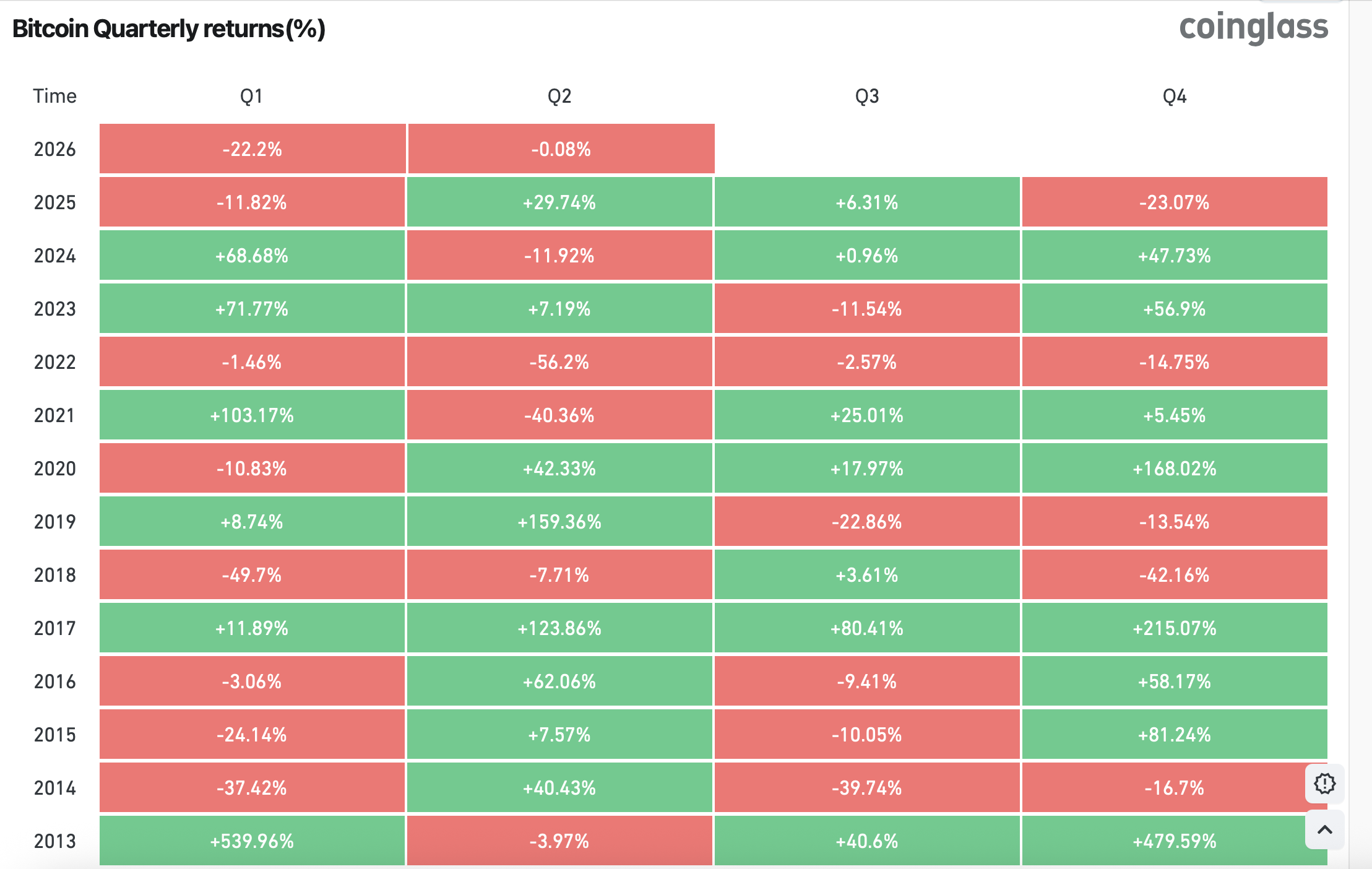
According to Coinglass data, Bitcoin fell 22% in Q1 2026, its steepest first-quarter drop since 2018, when it plunged nearly 49.7%. For context, Bitcoin has displayed a mixed quarterly performance since 2018. 

The asset gained 8.74% in 2019, declined 10.83% in 2020, and then surged 103% in 2021. It later slipped 1.46% in 2022 before rebounding strongly with gains of 71% and 68% in 2023 and 2024, respectively. 

However, momentum weakened again in 2025 with an 11.82% drop, and the asset has now recorded a deeper 22.2% decline in Q1 2026. 

Historical Bitcoin Q1 Data From CoinGlass
Bitcoin Quarterly Returns 

Middle East War Impacts Bitcoin Price in Q1 2026

Overall, the downturn reflects a turbulent start to the year, driven by heightened volatility and shifting investor sentiment. Initially, Bitcoin showed strength, climbing from $87,500 to nearly $95,000 early in the quarter. 

However, it soon reversed course, falling steadily and dropping as low as $60,000 on February 6. Although it briefly recovered to around $70,000 later that month, bearish pressure returned, pushing the price down to $63,000 following geopolitical tensions in the Middle East amid the assassination of Iran’s Supreme Leader, Ali Khamenei. 

Meanwhile, continued conflict further weighed on Bitcoin throughout March, triggering sharp price swings. As a result, the asset closed the quarter at $68,233, sealing a 22% loss. 

BTC Sees Fresh Dip  

Moreover, these geopolitical tensions have continued into Q2. Yesterday, Bitcoin faced renewed selling pressure after U.S. President Donald Trump signaled a shift away from prior peace efforts and threatened further military action in the coming weeks. 

Amid the escalation, Bitcoin fell 3.13% within 24 hours to $66,700. At the same time, the broader crypto market weakened, with Ethereum, BNB, and XRP each posting losses of roughly 3% to 4%. 

Despite the downturn, traders remain optimistic as Bitcoin has historically performed well in April. According to data from Coinglass, Bitcoin posted an average gain of 11.94% in April, while the median monthly return was 5.04%, suggesting the month has often delivered positive momentum for the asset. 

However, it remains uncertain whether Bitcoin will end the month in the green, as the ongoing Middle East conflict could continue to weigh on its performance, as it did last quarter.

Shiba Inu Next Major Move Looms Amid Bollinger Bands Tightening

0

Shiba Inu is gearing up for a decisive directional move as the Bollinger Bands tightens, but the direction remains a key topic of discussion.

In the past 24 hours, SHIB has dropped 2.5%. Its downward move is not isolated—it follows the lead of the crypto leader, Bitcoin, which fell amid uncertainty following US President Donald Trump’s speech on the Iran conflict.

Before the retracement, Shiba Inu was showing promising signs. Despite pulling back considerably yesterday, it still ended up with a green candle, but with a slight increase. The Wednesday closing was its third straight positive closing until the macro factor clamped down on bullish prospects.

Key Points

  • On the daily chart, Shiba Inu has witnessed an obvious Bollinger Bands tightening.
  • Typically, when the Bollinger Bands tighten, it indicates that volatility has been compressed, which precedes a breakout.
  • The tighter and longer the Bollinger Bands, the stronger the subsequent breakout.
  • Volume remains modest, so any move outside the Bollinger Bands under these circumstances could be a false alarm.

Shiba Inu Major Move on the Horizon

Notably, the momentum for a decisive directional move is building up for Shiba Inu, according to signs provided by the Bollinger Bands. On the daily chart, there has been an obvious tightening of the band, hinting that a breakout is on the horizon.

The analytical tool, developed by John Bollinger, consists of an upper, middle, and lower band. Technical analysts usually employ the indicator to measure volatility and identify whether an asset is overbought or oversold.

Typically, when the Bollinger Bands tightens, it indicates that volatility has reduced. Such conditions usually precede a breakout and the formation of a new price trend. Notably, these conditions align with developments on the SHIB/USD daily chart.

The bands have continued to tighten compared to the width seen earlier in the year. In addition, Shiba Inu has also consolidated, shuffling between $0.0000066 and $0.0000052 since early February. The aligning trend suggests SHIB is building momentum for a decisive breakout.

Shiba Inu Bollinger Band Tightening/TradingView Chart
Shiba Inu Bollinger Bands Tightening/TradingView Chart

The Longer the Better

Meanwhile, the tighter the Bollinger Bands, the stronger the subsequent breakout. The duration of this compression also plays a key role. The longer this tightening goes on, the bigger the move that would follow. Interestingly, the bands has been compressing for several weeks now, making the impending break more intriguing.

However, a true breakout usually needs strong volume. If market activity does not tick up, any move outside the Bollinger Bands could be a false alarm. In the meantime, trading volume is still modest.

Key Shiba Inu Technical Levels to Watch

Technically, Shiba Inu is holding above the $0.0000052 support, which is a good base for any bullish price action. Recently, the token cleanly broke out of a “counter trendline” on the daily chart before the recent consolidation.

The next area of interest for SHIB is the $0.00000616-$0.00000640 horizontal resistance band. Further upside momentum would take the token to a descending trendline near $0.0000070.

However, breaking below the $0.0000052 support could increase selling pressure, with the local demand zone at $0.0000050 the next key area.

Shiba Inu Logs 4.8B Exchange Inflows in 24 Hours as April Opens with 2% Decline

0

Fresh on-chain data shows significant movement of billions of Shiba Inu (SHIB) tokens across centralized exchanges, drawing increased attention from market observers.

Blockchain analytics platform Arkham Intelligence reported that 4.8 billion SHIB flowed into exchanges in the past 24 hours, worth roughly $27,000 at current prices.

The transfers occurred on the first days of April, a month that historically delivers mixed but occasionally positive performance for the memecoin.

Notably, several entities, including Revolut, Binance, and Bithumb, contributed to the net flow of nearly 5 billion SHIB tokens into exchanges.

Key Points 

  • More than 4 billion Shiba Inu tokens moved into exchanges over the past 24 hours. 
  • Revolut, Binance, and Bitstamp led Shiba Inu inflows, with billions of tokens shifted to these platforms. 
  • Revolut, alongside Bithumb and Robinhood, also saw billions of SHIB leave their wallets. 
  • Historical data from CryptoQuant shows Shiba Inu averages 3.16% gains in April. 

Revolut and Binance Top Shiba Inu Daily Inflows 

Revolut accounted for the largest share of these movements over the past day. One of the platform’s wallets received about 849.21 billion SHIB during the period. However, Arkham’s data indicates that the transfer was likely internal, as the tokens originated from another Revolut-controlled wallet. 

Meanwhile, Binance and Bitstamp followed with inflows of 177.05 billion and 163.64 billion SHIB, respectively. Other exchanges, including Wintermute, Bybit, and OKX, also recorded notable inflows during the same period. 

Shiba Inu Inflows into exchanges

SHIB Outflows 

Revolut also led the outflow metrics for SHIB within the same timeframe. The platform moved out roughly 849 billion SHIB from one of its wallets.

Several other exchanges also recorded significant withdrawals. Bitstamp saw 194.39 billion SHIB leave its wallets, while Binance recorded 129.48 billion SHIB in outflows.

Similarly, Bithumb and Robinhood registered withdrawals of 70.75 billion and 69.51 billion SHIB, respectively. Additional platforms, including Kraken, OKX, Crypto.com, and Wintermute, also posted billions of SHIB in outflows. 

SHIB Exchange Onflows

Following these back-and-forth transfers, net inflows totaled about 4.8 billion SHIB, meaning that a small portion of the tokens ultimately increased exchange balances after the movements.

Shiba Inu exchange flow

Shiba Inu April Performance 

The activity occurred on April 1, a month that historically produced mixed results for SHIB. So far, the month has started on a negative note. The memecoin has already dropped 2.12%, slipping below $0.000006.

However, historical data from CryptoRank suggests that SHIB still posts an average April return of around 3.16%, even though the median performance remains negative at 4.26%.

April 2021 remains the token’s strongest month, with SHIB surging 69.4%. In contrast, the asset recorded declines of 22%, 6.41%, and 26.9% between 2022 and 2024, before rebounding with a 6.92% gain last year. 

Shiba Inu Monthly Performance

Although the month has begun with modest losses, it remains too early to determine SHIB’s full April trajectory. At the time of writing, SHIB trades around $0.000005802, down 2.27% over the past 24 hours. 

Ripple CEO Says “Secret Sauce” Behind New Ripple Treasury Product Solves Two Key Pain Points

0

According to the Ripple CEO, the secret sauce behind the latest product from Ripple Treasury solves two major pain points in corporate finance.

Ripple has introduced a new treasury management system that combines fiat and digital asset management into a single, real-time platform. The product removes the need for multiple systems and allows companies to manage liquidity better.

Brad Garlinghouse, the Ripple CEO, emphasized that the system solves two major challenges by giving companies a trusted, regulated way to access digital assets within their existing workflows and by removing friction between managing fiat and crypto accounts. 

Key Points

  • Ripple launched a treasury management system with built-in digital asset capabilities.
  • Brad Garlinghouse said the update solves two key issues by providing a trusted entry point and removing friction between fiat and digital account management.
  • Ripple Treasury processed $13 trillion in payments in 2025.
  • A 2026 survey of over 1,000 finance leaders found that 72% believe offering digital asset solutions is necessary to stay competitive.
  • The new system includes Digital Asset Accounts and Unified Treasury, featuring real-time visibility and automated tracking.

Ripple CEO Highlights “Secret Sauce” Behind the Product

Ripple called its latest product the first treasury management platform with built-in support for digital assets. For context, the new system allows chief financial officers to manage both fiat and crypto liquidity in one place, in real time, without switching between different tools.

Soon after the launch, Brad Garlinghouse shared his thoughts, stressing that the “secret sauce” behind the new product solves two major challenges in treasury management. 

He explained that the first step was giving companies a trusted and regulated way to access digital assets without changing how they already work.

He then highlighted the second challenge, which involved reducing the friction involved in managing different accounts, whether fiat or digital. According to him, Ripple Treasury now addresses both issues with the latest product.

Speaking further, the Ripple CEO called attention to the platform’s impressive performance, noting that it processed $13 trillion in payments last year. According to him, adding built-in digital asset features could drive even more growth in 2026.

Details of the Latest Ripple Treasury Product

Garlinghouse’s comments came shortly after an official announcement from Ripple, which confirmed the launch of Digital Asset Accounts and Unified Treasury within its platform. The company stressed that this represents the first time digital asset features have been built directly into an enterprise treasury management system.

The product allows CFOs and treasury teams to view, hold, receive, and manage both fiat and digital funds across bank and custody providers from a single interface. This removes the need for separate systems and simplifies day-to-day operations. 

Ripple said the new features build on more than 40 years of treasury management experience, now extended into digital assets after its acquisition of GTreasury in 2025. In that same year, the platform handled $13 trillion in payments for a wide range of users, including small businesses and Fortune 500 companies.

The company also noted that several customers had already tested the system before its full release. It highlighted the growing demand, citing a 2026 survey of over 1,000 global finance leaders, where 72% said they need digital asset solutions to stay competitive. 

Digital Asset Accounts and Unified Treasury Capabilities

Notably, the Digital Asset Accounts feature lets treasury teams create and manage regulated digital asset accounts directly within the platform. There is no need for third-party custody or external systems. 

Balances such as XRP and Ripple USD (RLUSD) appear alongside cash holdings, with real-time values based on live exchange rates that update within seconds of each transaction. The system also supports 15-decimal precision, which helps ensure accurate on-chain values and avoids rounding issues. 

The Unified Treasury feature builds on this by giving users a single dashboard to see all their cash and digital asset positions in real time. Importantly, users can connect multiple custodians using APIs that can be set up in minutes through Ripple’s ClearConnect system.

Ripple said these features are just the beginning of a larger plan for its treasury platform. The company plans to expand the system to connect with other products that support cross-border and intercompany payments. The overall design seeks to treat digital assets the same as cash within treasury operations.