The number of crypto presales active at any given moment has grown considerably over the past two years. So has the number that quietly disappear after raising funds. For participants trying to separate credible projects from ones that won’t survive to mainnet, the filtering problem has become the central challenge of presale participation in 2026.
Price projections and tokenomics breakdowns are easy to produce. Independent security audits and third-party identity verification are not — and that gap is increasingly how serious participants are doing their initial screening before committing capital. Everlight is one of the few presale-stage projects that completed both before accepting a single deposit, a detail that has drawn consistent attention from participants who start their due diligence with verification documentation.
What a Smart Contract Audit Covers
A smart contract audit is a technical review of a project’s on-chain code by an independent security firm. Auditors examine contract logic for vulnerabilities that could allow unauthorized fund access, ownership transfers outside protocol specifications, or supply manipulation beyond what the token contract defines.
The timing of an audit matters as much as its existence. A review completed after a presale has already raised significant funds tells participants very little — the contract they interacted with may not be the one that was reviewed, and any issues found after capital is committed create a very different set of options than issues found before a single deposit is accepted. Pre-launch audits give participants the ability to verify what they are interacting with before any commitment is made.
Bitcoin Everlight completed two independent smart contract audits — Spywolf and Solidproof — before the presale opened. Both reports are publicly accessible. The BTCL contract carries a fixed total supply of 21 billion tokens with no inflation mechanism — the audit process covered ownership controls, minting functions, and transfer logic, the areas most commonly exploited at the presale stage.
The Accountability Gap That KYC Closes
Where a smart contract audit examines code, KYC verification examines people. Third-party KYC firms cross-reference identity documents, confirm real-world existence, and screen against relevant watchlists to verify that the individuals behind a project are who they claim to be.
Anonymous founding teams were once broadly accepted in crypto as a cultural norm. That norm has eroded in direct proportion to the number of anonymous teams that raised presale funds and disappeared. The pattern is documented well enough at this point that anonymity has shifted from a neutral characteristic to a credibility liability for projects seeking serious participation.
Verified team identity doesn’t guarantee project outcomes. What it does is establish that real people with real identities are accountable for what gets built — a meaningful baseline in an environment where accountability has historically been the missing variable when things go wrong.
Bitcoin Everlight completed dual team identity verification through Spywolf KYC and VitalBlock, both completed before the presale opened and publicly linked from the project’s documentation from day one.
BTCL Current Presale Breakdown
Bitcoin Everlight is currently in Phase 3 of its presale, with BTCL priced at $0.0012 per token. Over $2.0 million has been raised across all phases to date. Four shard tiers structure participation: Jade activates at $100 earning up to 6% APY in BTCL, Azure at $500 with up to 12% APY, Violet at $1,500 with up to 20% APY, and Radiant at $5,000 with up to 25% APY. Deposits are accepted across more than nine cryptocurrencies.
Shards activated during Phase 3 begin accumulating BTCL rewards immediately. At mainnet launch, positions transition automatically to live network routing fee rewards — no migration, no manual action required on the participant’s end.
For participants who start their due diligence with verification documentation rather than ending there, the audit reports and KYC certificates have been publicly accessible since before the first deposit was accepted. In a presale landscape where that combination is still the exception rather than the rule, it remains one of the clearer ways to distinguish projects built for the long run.
Phase 3 Is Open Now
Current pricing at $0.0012 per BTCL moves higher when Phase 3’s allocation is absorbed. Activate your shard, begin accumulating rewards immediately, and transition automatically to live network rewards at launch.
Disclaimer: This Press release article is provided by the Client. The Client is solely responsible for this page’s content, quality, accuracy, products, advertising, or other materials. Readers should conduct their own research before taking any actions related to the material available on this page. The Crypto Basic is not responsible for the accuracy of info and any damage or loss caused or alleged to be caused by the use of or reliance on any content, goods, or services mentioned in this press release article.
Please note that The Crypto Basic does not endorse or support any content or product on this page. We strongly advise readers to conduct their own research before acting on any information presented here and assume full responsibility for their decisions. This article should not be considered investment advice.
A new Google research paper is raising concerns about quantum threats to blockchain systems, and the XRP Ledger enters the discussion amid its early steps toward post-quantum security.
Notably, the study was led by Google Quantum AI with help from academic researchers and the Ethereum Foundation. It warns that future quantum computers could break current cryptography much sooner than expected.
Key Points
A Google Quantum AI-led study warns quantum computers could break blockchain cryptography sooner than expected.
The research shows that elliptic curve cryptography used by Bitcoin and Ethereum may be cracked in minutes.
It highlighted XRP Ledger for early post-quantum efforts, including key rotation and ML-DSA testing.
The report stresses urgency as blockchains secure more value, with XRP Ledger active in tokenized assets.
Quantum Threats Could Arrive Faster Than Expected
According to the paper, advances in quantum computing could make it much easier to break elliptic curve cryptography, which blockchains like Bitcoin and Ethereum rely on.
The researchers believe a powerful enough quantum computer could carry out these attacks in minutes, possibly exposing transactions while the network is still processing them. This creates a risk of “on-spend” attacks, where the system intercepts transactions before the network completes them.
Notably, they shared these findings using zero-knowledge proofs, which allowed them to prove the risk without revealing sensitive details about how the attacks would work.
XRP Ledger’s Early Moves Toward Quantum Resistance
As part of this analysis, the paper mentions the XRP Ledger for its ongoing experiments with post-quantum cryptography. Community figures, including XRPL validator Vet, pointed to developments such as:
A test environment for quantum-resistant algorithms
Built-in key rotation at the protocol level
Early testing of post-quantum ML-DSA signatures
The paper confirms these experiments, showing that XRP Ledger is one of the few blockchains already working on quantum-resistant technology.
Wow!! Today is Quantum Day! Google released new research on Quantum risk in Blockchains.
Highlighting XRP and its efforts multiple times. Here are the findings and why especially Bitcoin:
>Denis testnet of the XRP Ledger with full quantum proof algorithms.
Furthermore, the report noted that some blockchains are more vulnerable due to their design. For example, networks like Solana and Ethereum may face higher risk over time. This is due to exposed public keys and older account structures.
The XRP Ledger differs in one key way: it supports built-in key rotation, meaning users can update their cryptographic keys without losing their accounts. This doesn’t fully solve the quantum threat, but it’s an important step toward future upgrades.
The paper also notes that blockchains handling smart contracts and tokenized assets carry more risk because they secure large amounts of value. The paper highlighted XRP Ledger as being increasingly used for real-world asset tokenization, including tokenized U.S. Treasury products.
Because of this growing use, there’s a greater urgency to adopt quantum-resistant security early.
Community Reaction: “The Future Is Being Built on XRP”
Following the publication, XRP community commentator Xaif described the findings as a validation of the network’s direction. He pointed out that research on quantum-resistant solutions have already begun citing XRPL, while many other blockchains are still in earlier stages.
Importantly, the study doesn’t say XRP boasts full protection against quantum threats yet. But it does highlight that post-quantum security is becoming a real priority, and some networks like XRP Ledger are already starting to prepare for it.
Solana’s explosive growth has turned API infrastructure into the backbone of every serious Web3 project, and choosing the right provider can mean the difference between a seamless user experience and a frustrating bottleneck. The network now processes thousands of transactions per second, supports a massive DeFi and NFT ecosystem, and attracts enterprise builders from fintech to gaming. Whether you need portfolio-level market data, raw RPC access, parsed transaction history, or real-time gRPC streaming, the provider landscape has matured dramatically heading into 2026.
The broader best crypto API landscape now spans dozens of providers across multiple chains, but Solana’s unique architecture and throughput demands call for specialized evaluation. This guide breaks down the five best Solana API providers available today, evaluated on Solana-specific capabilities, pricing transparency, developer experience, and reliability. Each serves a different niche, from data aggregation and portfolio tracking to ultra-low-latency infrastructure, so builders at every stage can find the right fit.
CoinStats API stands out as the most comprehensive crypto data aggregation API with first-class Solana support. Rather than providing raw blockchain RPC access, CoinStats delivers pre-structured, developer-ready data: wallet balances, transaction histories, portfolio analytics, DeFi positions, and real-time market data, all through a single unified REST API spanning more than 120 blockchains and 200 exchanges.
The base URL sits at https://openapiv1.coinstats.app/, with authentication handled via a simple X-API-KEY header. Developers sign up for a free API key at openapi.coinstats.app and get immediate access to endpoints covering market data for 20,000+ cryptocurrencies, wallet queries across Solana, Ethereum, Bitcoin, and every major EVM chain, plus portfolio-level analytics typically reserved for enterprise platforms.
Solana-Specific Capabilities
The dedicated Solana Wallet API retrieves complete SPL token balances, native SOL holdings with live USD pricing, and full transaction histories with detailed metadata for any Solana address. DeFi portfolio tracking covers positions across protocols like Raydium, Orca, and Serum. A particularly powerful feature is multi-wallet querying: a single API call using the wallets=solana:<addr1>,solana:<addr2> parameter returns consolidated data across multiple Solana wallets simultaneously.
The endpoint structure is clean and intuitive. A GET request to /wallet/balance?address=<SOL_ADDRESS>&connectionId=solana returns all token balances at 40 credits per call. Transaction history syncs via a PATCH request at 50 credits, then retrieves via GET at 40 credits. Every response includes current market prices, 24-hour changes, token metadata, and ranking data, eliminating the need to cross-reference multiple APIs.
MCP Integration for AI Agents
What truly differentiates CoinStats in 2026 is its MCP (Model Context Protocol) integration, which transforms the entire API into callable tools for AI assistants and developer environments like Claude Code and Cursor. This positions CoinStats uniquely for the emerging AI-agent economy, where autonomous systems need structured crypto data without parsing raw blockchain responses.
Pricing
CoinStats prices its OpenAPI through a credit-based model. Developers get a free plan at signup, then upgrade only when they need more credits or higher rate limits. Credit usage depends on the endpoint and request complexity, making the model flexible for both evaluation and production use.
Best for: Developers building portfolio trackers, trading bots, tax tools, crypto dashboards, or AI-powered financial assistants who need clean, aggregated data rather than raw blockchain infrastructure.
Helius is the undisputed leader in Solana-specific API infrastructure. Founded in 2022 by former Coinbase and AWS engineers, the company has raised $34.35 million through its Series B (led by Haun Ventures and Founders Fund, September 2024) and counts Solana co-founder Anatoly Yakovenko among its angel investors. It processes over 8 billion daily RPC requests and powers the vast majority of major Solana applications, including Phantom, Jupiter, Coinbase, Magic Eden, Raydium, and DexScreener.
Solana-Specific Capabilities
The platform’s Solana capabilities are the deepest in the ecosystem. Its Digital Asset Standard (DAS) API provides unified access to regular NFTs, compressed NFTs (cNFTs), fungible tokens, Token-2022 assets, and inscriptions through methods like getAsset, getAssetsByOwner, and searchAssets with trait filtering. LaserStream, its gRPC streaming product, delivers ultra-low-latency block and transaction data through regional endpoints across Frankfurt, Amsterdam, Tokyo, Singapore, Los Angeles, London, and more. The Sender service routes transactions through both Helius and Jito simultaneously for maximum landing rates at zero API credit cost.
Helius also offers shred delivery via UDP for the earliest possible on-chain signals, enhanced WebSockets with granular filtering, webhooks watching up to 100,000 addresses per hook, priority fee estimation across six levels, and transaction parsing through 100+ decoders. Its custom Rust-built Gatekeeper edge gateway eliminates third-party CDN overhead for the lowest possible latency. The company operates Solana’s largest validator, securing over $2.5 billion in value, and holds SOC 2 Type 1 compliance.
Pricing
Pricing spans five tiers:
Free: 1 million credits per month, 10 RPS
Developer: $49/month, 10 million credits, 50 RPS
Business: $499/month, 100 million credits, 200 RPS
Additional credits cost $5 per million on paid plans. Annual billing saves two months.
Best for: Teams building directly on Solana who need the deepest possible integration: DeFi protocols, NFT marketplaces, wallets, trading platforms, and any application where Solana-specific performance is non-negotiable.
QuickNode has evolved from a simple node provider into a full-stack blockchain infrastructure platform supporting 81+ chains and 135+ networks, the widest multi-chain coverage among top-tier providers. Founded in 2017, the Y Combinator graduate has raised approximately $106 million at an $800 million valuation (Series B, January 2023) and scaled to handle 5 trillion API requests in 2025 alone. The company holds SOC 2 Type 2, SOC 1, and ISO 27001 certifications.
Solana-Specific Capabilities
On Solana specifically, QuickNode provides full archive data on mainnet-beta (no pruning), the Metaplex Digital Asset (DAS) API for NFT and token queries, and Yellowstone Geyser gRPC for high-throughput streaming. Its Metis Jupiter Swap API enables DEX aggregation directly through the API, complemented by the Titan Swap API, Pump Fun API, and JITO Bundle support for MEV protection. A dedicated Priority Fee API delivers real-time fee estimates, and the platform recently launched x402 on Solana, a protocol letting AI agents pay for RPC access with USDC.
QuickNode’s Streams product provides blockchain ETL with built-in reorg handling, data transformations, and guaranteed delivery including historical replay. Functions, its serverless edge compute offering, enables developers to run custom code in response to on-chain events. Both ship free on all plans. The unique Marketplace ecosystem offers third-party add-ons for extending functionality (compliance tools, analytics, swap APIs, and more), a feature no other provider matches.
Pricing
The pricing model is credit-based, with Solana endpoints carrying a 1.5x multiplier versus EVM chains:
Build: $49/month, approximately 80 million credits, 50 RPS
Accelerate: $249/month
Scale: $499/month
Business: $999/month, approximately 2 billion credits, 500 RPS
Enterprise: Custom configurations with 24/7 phone support
A flat-rate RPS billing option is also available for predictable costs. Notably, QuickNode does not offer a permanent free tier, only a one-month trial, which is worth factoring into evaluation. Notable customers span Web2 (Adobe, PayPal, Samsung) and Web3 (Coinbase, OpenSea, Phantom, Dune Analytics).
Best for: Multi-chain builders who need a single provider across Solana, Ethereum, and dozens of other networks, plus teams that value the add-on marketplace and serverless compute capabilities.
Alchemy, the largest Web3 infrastructure company by valuation at $10.2 billion (February 2022), initially built its reputation on Ethereum but has invested heavily in Solana through its 2025 acquisition of DexterLab and partnership with Bware Labs. The result is a purpose-built Solana infrastructure layer running on custom HBase architecture (not a port from EVM) that the company claims delivers up to 20x faster historical block and transaction retrieval than competitors.
Solana-Specific Capabilities
The platform supports 80+ networks, powering applications for Robinhood, Coinbase, Visa, Stripe, Circle, and Polymarket. On Solana, Alchemy provides Yellowstone-compatible gRPC streaming with pay-as-you-go pricing starting at $80/TB and no lock-in contracts. All transactions route through 100% staked connections for faster delivery and higher landing rates. Smart WebSockets guarantee zero dropped connections with automatic reconnection. Enhanced APIs include Token, Prices, Transfers, Portfolio, and NFT endpoints, plus webhooks for address activity monitoring.
The developer experience is widely regarded as best-in-class. The dashboard includes real-time analytics, request logs, a mempool visualizer, a multi-chain sandbox, and the Composer tool for testing API calls. Alchemy University provides free Web3 education, and the platform extends beyond RPC into Smart Wallets, Gas Sponsorship, Account Abstraction bundlers, and Rollups-as-a-Service.
Pricing
Alchemy’s biggest competitive advantage is its permanent free tier, the most generous in the industry:
Free: 30 million Compute Units/month (roughly 1.1 million simple requests), 25 RPS, five apps, five webhooks. No credit card required, no expiration.
Pay As You Go: $0.45 per million CUs for the first 300 million CUs monthly, dropping to $0.40 beyond that. Throughput scales to 300 RPS.
Enterprise: 1,000+ RPS with signed SLAs, SAML SSO, and role-based access controls.
Best for: Developers who want the safest free-tier entry point, teams already building multi-chain with Alchemy’s EVM infrastructure, and enterprises requiring signed SLAs with the most well-capitalized provider in the space.
Shyft rounds out this list as a Solana-focused infrastructure provider that has carved a distinct niche through its unlimited, flat-rate pricing model and proprietary streaming technology. Founded in 2022 in Bengaluru, India, Shyft’s mission is lowering the barrier for Solana developers, and its pricing structure reflects that philosophy: paid plans include unlimited API credits with no bandwidth metering and no overage charges, a rarity in an industry dominated by complex compute-unit calculations.
Solana-Specific Capabilities
The standout technical innovation is RabbitStream, a proprietary shred-level streaming system that detects unconfirmed transactions approximately 10 milliseconds faster than standard Yellowstone gRPC. For latency-sensitive use cases like arbitrage, liquidation bots, and real-time trading, that edge matters. Shyft also provides full Yellowstone gRPC implementation with automatic slot replay (backfilling up to 150 missed slots on reconnection), staked RPC connections across seven regions and three continents, and parsed transaction APIs supporting Jupiter, Meteora, Pump.fun, and Raydium.
The SuperIndexer is another unique capability. Given any Anchor IDL, it spins up a GraphQL API for querying on-chain program data with pagination and filtering, replacing the notoriously expensive getProgramAccounts RPC call. It supports cross-program queries, meaning developers can pull data from Raydium and Orca pools in a single call. NFT APIs handle one-call minting with automatic IPFS/S3 upload and metadata creation. DeFi APIs cover pool data, liquidity details, and integrated Jupiter V6 Swap routing with region-specific endpoints.
Pricing
Pricing is straightforward:
Free: Unlimited credits, 10 RPS
Build: $199/month. Unlocks gRPC, RabbitStream, DeFi APIs, GraphQL, callbacks, Jito simulateBundle, and 100 RPS. Notably, mainnet gRPC access at one-fifth the cost of Helius’s Professional tier.
Grow: $349/month
Accelerate: $649/month
Dedicated nodes: Starting at $1,800/month
The Ladybug SDK provides TypeScript and Rust protocol-specific gRPC parsing for top DEXes, and GitHub repositories include extensive open-source examples.
Best for: DeFi and trading developers who need unlimited streaming at predictable costs, builders who want gRPC access without enterprise pricing, and teams that value GraphQL-based on-chain data querying.
Shyft
How These Five Providers Compare at a Glance
Provider
Focus
Solana Specialization
Free Tier
Entry Paid Plan
gRPC Streaming
Chains Supported
Best Use Case
CoinStats API
Data aggregation
Wallet, portfolio, DeFi, NFT data
Yes (free API key)
Credit-based scaling
N/A (REST API)
120+
Portfolio trackers, trading bots, AI agents
Helius
Solana-native infra
DAS API, LaserStream, Sender, shreds
Yes (1M credits/mo)
$49/mo (Developer)
Yes ($999/mo+)
Solana only
DeFi protocols, wallets, NFT platforms
QuickNode
Multi-chain RPC
DAS, Jupiter Swap, Jito, gRPC
No (trial only)
$49/mo (Build)
Yes (paid plans)
81+
Multi-chain apps, marketplace add-ons
Alchemy
Multi-chain platform
Custom HBase archive, staked connections
Yes (30M CU/mo)
Pay-as-you-go
Yes ($80/TB)
100+
Enterprise apps, multi-chain expansion
Shyft
Solana-native infra
RabbitStream, SuperIndexer, gRPC
Yes (unlimited credits)
$199/mo (Build)
Yes ($199/mo)
Solana primary
DeFi trading, latency-sensitive bots
Choosing the Right Solana API Depends on What You’re Building
The Solana API landscape in 2026 no longer forces developers into one-size-fits-all solutions. Each provider on this list occupies a distinct position.
CoinStats API excels when you need structured, aggregated crypto data across chains (portfolio balances, market prices, DeFi positions, and transaction histories) without managing raw blockchain infrastructure, and its MCP integration makes it the leading choice for AI-agent workflows.
Helius is the default for teams building exclusively on Solana who need the deepest ecosystem integration and highest reliability, backed by the strongest customer base in the network.
QuickNode serves multi-chain builders who want one provider across 81+ networks with serverless compute and a marketplace of extensible tools.
Alchemy offers the safest starting point with the industry’s most generous free tier and a rebuilt Solana stack that delivers genuine performance gains on archive data.
Shyft provides the most cost-predictable path to gRPC streaming and shred-level data, with unique GraphQL indexing that no other provider matches.
The most effective approach for many teams will be combining providers: using CoinStats for market data and portfolio aggregation alongside Helius or Shyft for low-level on-chain infrastructure. With Solana’s throughput demands only increasing and new use cases emerging around compressed state, token extensions, and AI-native applications, investing in the right API stack now pays compounding dividends throughout 2026 and beyond.
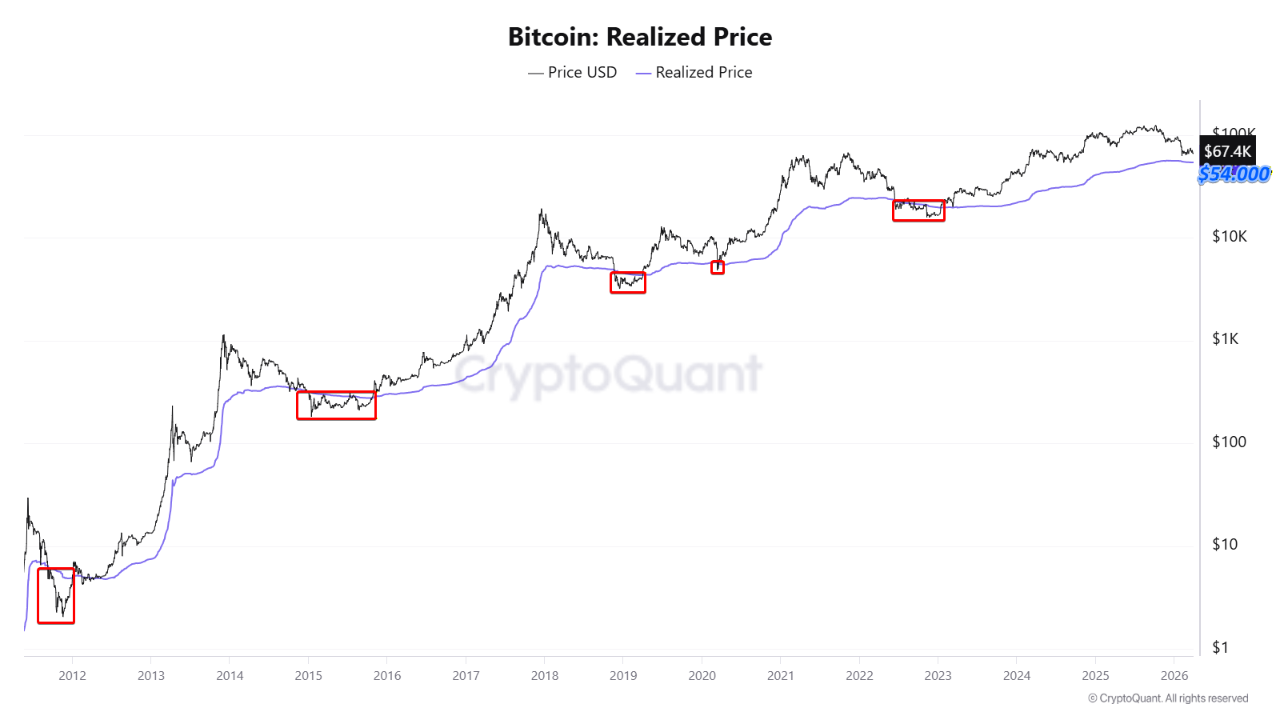
Historical data from past Bitcoin bear markets has identified what could be the best Bitcoin buy zone in relation to the Realized Price.
Bitcoin has stayed under pressure in recent months, posting a 22.92% drop this year while trading around $67,300. The broader decline began in October 2025 and has now resulted in a 41% price drop for Bitcoin.
Amid the ongoing downturn, investors who believe a rebound is imminent have continued to anticipate an attractive buy zone, seeking out whenthe price could find a bottom. Historical data shows the Bitcoin Realized Price metric could offer reliable signals.
Key Points
Bitcoin is down 22.92% year-to-date to $67,300 and has declined 41% since October 2025.
Historical data shows Bitcoin often enters its best buy zone when the actual price falls below the Realized Price.
Currently, Bitcoin’s Realized Price stands at around $54,000.
Dropping below the Realized Price would not automatically mark the bear market bottom, as BTC could collapse further.
Data from past bear markets confirm that Bitcoin can remain below the Realized Price for 7 to 301 days.
Bitcoin’s Best Buy Zone
Market analyst Tugce recently discussed this, as she shared how investors could spot buying opportunities using the Realized Price metric on CryptoQuant. She explained that this metric represents the average cost at which the market holds Bitcoin, and helps to judge whether the asset trades at a premium or a discount.
Tugce pointed out that when Bitcoin falls below this level, it often indicates market capitulation, a phase where fear is high, and sentiment turns very negative. She noted that while these periods can feel uncomfortable, they have often marked the best times to accumulate for investors who focus on the long term.
Right now, the Realized Pricesits at about $54,000. According to Tugce, if Bitcoin drops to $54,000 or below, those levels could serve as strong zones for gradual buying.
Bitcoin Realized Price | CryptoQuant
However, she clarified that trying to catch the exact bottom is not practical, since no one can time the market perfectly. For context, BTC would have to further drop by at least 20% from its current price of $67,300 to slip below the Realized Price.
Uncertainty Below the Realized Price
Despite this outlook, Tugce warned that investors should stay realistic. She explained that in past cycles, Bitcoin has stayed below the Realized Price for anywhere between 7 days and 301 days. This wide range shows that recoveries do not follow a fixed timeline.
She also stressed that once the price moves below this level, it can still fall further before reaching its lowest point.As a result, investors should be ready for deeper drops and avoid putting all their capital in at once. Notably, a steady, step-by-step approach can help manage risk and emotions during these periods.
Nonetheless, the market analyst maintained that any price below $54,000 places Bitcoin below the market’s average cost, making it relatively cheap and suitable for gradual accumulation.
Historical Data
Data from Tugce’s chart supports this view, showing how Bitcoin behaved in earlier bear markets. During the 2014/2015 bear market, Bitcoin moved below the Realized Price in early January 2015, when it traded at $314 compared to a Realized Price of $321.
The price later dropped further to $176 in mid-January 2015, which marked the bottom. Notably, it stayed below the Realized Price for about 303 days before recovering in October 2015.
In the 2018 bear market, Bitcoin fell below the Realized Price in November 2018, trading at $4,465 while the Realized Price stood at $4,824. It continued to decline to $3,236 in December 2018, forming the cycle low. Meanwhile, the price remained below the Realized Price for 140 days before moving back above it in April 2019.
The pattern also appeared in the most recent cycle. In November 2022, Bitcoin dropped below the Realized Price at $20,924, while the Realized Price was $21,000. The price later fell to around $15,000, marking the bottom. It stayed below this level for about 179 days before recovering above it in January 2023.
Network activity in the Dogecoin ecosystem has ticked up in the past seven days, but technical analysis shows the price is yet to break out.
Dogecoin (DOGE) might be struggling, but its network is getting an uptick in attention, as disclosed by recent on-chain data. Participation has increased over the past seven days, with users keen on the meme coin regardless of the broader market conditions.
Key Points
Dogecoin’s active addresses have surged 28% in the past week from 57,000 to 73,000.
When active addresses increase, it suggests more wallets are interacting with the network’s native tokens and, in some cases, accumulating them.
Coinglass data show that spot accumulation has increased over the past seven days.
Despite this positivity, Dogecoin remains stuck within a descending triangle.
Dogecoin Active Addresses Increased to 73,000
Market analyst Ali Martinez highlighted in a recent X post that Dogecoin’s active addresses have surged 28% in the past week. The metric rose from 57,000 to 73,000, continuing its recovery process.
Dogecoin Active Addresses/Ali Martinez
For context, active addresses represent the number of unique wallets that interacted with a chain in a given period. More users mean more adoption, as they might simply be moving their holdings to new locations or participating in other activities possible on the blockchain. Generally, this is good for any network, and in this case, Dogecoin.
Furthermore, it could suggest more demand for DOGE. When active addresses increase, it confirms that more wallets are interacting with the network’s native tokens and, in some cases, accumulating them. Such activities also foster positive sentiment within the Dogecoin ecosystem.
Notably, Coinglass data show that spot accumulation has increased over the past seven days, providing context for the increase in active addresses. During this period, $541.28 million in DOGE left exchanges for self-custody addresses, compared with $481.3 million that came in, bringing the netflow to nearly -$60 million.
DOGE Price Still Stuck
Despite this positivity, Dogecoin remains in bearish territory. While active users grew 28%, its price fell by 2.55% in that timeframe. At the time of writing, the token trades at $0.0913, down 1.76% in the past 24 hours.
A parallel analysis from Martinez also highlighted that Dogecoin is stuck within a descending triangle on the 4-hour chart. This structure began to take shape around the January 28 highs of $0.127, with price forming lower highs while maintaining a base around $0.086.
Dogecoin in Descending Triangle/Ali Martinez
Attempts to break out have proven futile, with the neckline resistance proving too strong to overcome. For context, DOGE peaked at $0.117 on February 15, $0.104 on March 17, and $0.979 on March 25, and these tops aligned with the triangle’s upper trendline.
Martinez had earlier noted that if the meme coin broke out of this triangle, a 29% move would follow. This is in line with the distance between the structure’s peak and lower range.
Global payments firm Convera has entered a strategic partnership with blockchain company Ripple to launch crypto-enabled payment and treasury services.
The move reflects growing corporate demand for faster and more flexible cross-border transactions powered by stablecoins.
Key Points
Convera and Ripple are jointly launching blockchain-powered cross-border payment and treasury services for businesses.
The model uses a “stablecoin sandwich,” with fiat at entry and exit and stablecoins used only during settlement to reduce volatility risk.
Convera will handle customer-facing payment operations while Ripple provides blockchain-based settlement, liquidity, and infrastructure support.
The partnership aims to deliver faster and more flexible global payments for enterprises without requiring direct digital asset management.
Partnership Targets Faster Global Payments
Specifically, the partnership combines Convera’s global payments infrastructure with Ripple’s blockchain technology to streamline international money movement for businesses.
Under the agreement, Convera will manage the end-to-end payment experience, ensuring continuity and ease of use for customers. Meanwhile, Ripple will provide the underlying blockchain infrastructure, including liquidity provisioning and settlement services.
A key feature of the solution is the so-called “stablecoin sandwich” structure. Transactions are initiated and completed in fiat currency, while stablecoins are used during the settlement phase. This approach reduces exposure to crypto volatility while still enabling faster and more efficient cross-border transfers.
Commenting on the partnership, Convera CEO Patrick Gauthier said the company has been closely tracking growing demand for digital currencies and sees Ripple as a natural fit to meet evolving customer expectations.
Ripple SVP of Product Aaron Slettehaugh echoed this view, noting that enterprises increasingly want faster and more flexible payment solutions without the complexity of directly managing digital assets.
Scale and Infrastructure Underpin Rollout
The partnership is supported by Convera’s extensive global payments network, which processes approximately $190 billion in annual transaction volume.
For context, its network includes more than 50 banking partners and over 500 accounts worldwide. In addition, it supports transactions across more than 200 countries and in over 140 currencies.
Given this scale, the collaboration is well-positioned to address gaps in regions where traditional banking options are limited. Consequently, businesses operating in underserved corridors may see the greatest benefits.
Stablecoins Gain Corporate Traction
This partnership also comes at a time when stablecoins are gaining traction among large corporations. Industry leaders are increasingly viewing them as a practical tool for modern finance.
Last week, Brad Garlinghouse, CEO of Ripple, described stablecoins as a “ChatGPT moment” for the crypto sector in an interview with Fox Business. He noted that executives and board members are actively exploring how to integrate stablecoins into their financial strategies.
He also cited figures from a Citibank analyst estimating that stablecoin transactions reached $33 trillion last year, underscoring their expanding role in global finance.
Looking ahead, projections suggest even greater expansion. According to Bloomberg Intelligence, stablecoin flows could climb to $56.6 trillion by 2030.
Competitive Landscape and Ripple’s Expansion
Despite rapid growth, the stablecoin market remains highly concentrated, with roughly 90% of volume dominated by Tether (USDT) and USD Coin (USDC).
Ripple is positioning itself more aggressively within this ecosystem following the launch of its own stablecoin, RLUSD, in late 2024. According to CoinGecko, RLUSD has since entered the top ten by market capitalization, surpassing $1.4 billion.
In parallel, the company has also expanded its capabilities through strategic acquisitions. It acquired Hidden Road, now known as Ripple Prime, for $1.25 billion. It also purchased GTreasury, rebranded as Ripple Treasury, for $1 billion.
According to Garlinghouse, both acquisitions are performing ahead of expectations in early 2026. He also noted that Ripple Prime has significantly increased its revenue run rate since the deal.
Independent audit firm Deloitte has verified that Ripple’s RLUSD stablecoin is fully backed by liquid reserves.
The attestation confirms that, as of late February 2026, RLUSD maintained reserves exceeding its circulating supply, reinforcing the stability of its 1:1 U.S. dollar peg.
Key Points
Deloitte’s audit confirms that Ripple’s RLUSD maintained reserves exceeding circulating supply as of late February 2026.
As of February 27, 2026, RLUSD held $1.568 billion in reserves against 1.495 billion tokens in circulation.
The report also confirmed that RLUSD’s reserve structure aligns with NYDFS regulatory guidance.
Ripple’s official data shows RLUSD had 1.41 billion tokens in circulation with roughly $1.49 billion in reserves as of this week.
Ripple’s RLUSD Stablecoin is Overcollateralized
Ripple is pushing deeper into regulated finance, as Deloitte’s independent report confirms that RLUSD maintains a strong reserve position. As of February 27, 2026, the stablecoin held approximately $1.568 billion in reserves against 1.495 billion tokens in circulation, thereby ensuring full backing with an additional buffer.
Just days earlier, on February 19, RLUSD’s circulating supply stood at 1.54 billion tokens, supported by $1.61 billion in reserves. This earlier snapshot further demonstrates consistent reserve coverage despite fluctuations in the number of tokens in circulation.
Notably, Deloitte’s attestation confirms that the RLUSD Reserve Report, covering February 19 and February 27, 2026, was prepared in accordance with clearly defined criteria and accurately reflects the reserve assets backing the stablecoin.
For context, Ripple is not the first firm to subject its stablecoin reserves to a Big Four audit. Earlier this month, Tether took a similar step by selecting KPMG to audit its USDT stablecoin reserves, as it advances its U.S. expansion efforts.
Notably, the guidelines require issuers to hold reserve assets in segregated accounts and restrict eligible backing assets to conservative instruments. These include overnight reverse repurchase agreements, short-duration U.S. Treasuries, approved money-market funds, and insured bank deposits.
Collectively, these safeguards help ensure liquidity, preserve capital, and maintain the ability to meet redemption requests.
RLUSD Current Balance
Furthermore, the latest attestation follows earlier statements from Standard Custody, Ripple’s regulated subsidiary, which maintained that reserve assets consistently matched or exceeded the number of RLUSD tokens in circulation.
The newly reported figures validate that claim by showing a clear surplus of reserves over liabilities on both reporting dates. In the meantime, data from Ripple’s data shows that RLUSD has a circulating supply of 1.41 billion tokens ($1.41 billion), with reserves valued at roughly $1.49 billion as of March 26, 2026.
Some XRP holders recently linked a new partnership between American Express and the National Football League to XRP.
The move followed an initial teaser from American Express concerning a new reveal. However, respected voices in the community have pushed back on this hype.
Key Points
American Express enters a new partnership with the National Football League.
XRPL validator Vet dismissed claims, stating the announcement is purely a sports-focused deal, not a blockchain move.
The multi-year deal makes Amex the NFL’s Official Payments Partner starting in 2026, with a focus on fan perks.
Past ties between Amex and Ripple fueled confusion, but XRP is not involved in this deal.
The XRP hype
Well-known XRPL validator Vet, in a tweet, dismissed claims that American Express’s announcement had anything to do with XRP. He stressed that the development was purely a commercial partnership tied to sports and fan engagement.
The validator criticized influencers who attempted to link the news to XRP, urging the community to ignore the “hopium.”
The clarification comes after speculation spread across social media suggesting the partnership could signal renewed institutional interest in XRP or blockchain-based payments.
What the American Express–NFL Deal Actually Is
In reality, the announcement centers on a multi-year global partnership between American Express and the National Football League. Specifically, it names Amex as the league’s Official Payments Partner starting from the 2026 season.
The deal focuses on enhancing fan experiences rather than introducing blockchain infrastructure. Card members will gain access to ticket presales, exclusive on-site experiences, and perks at major NFL events, including the Super Bowl and NFL Draft.
The partnership also extends to international games, highlighting the NFL’s expanding global footprint.
Additionally, both organizations plan to roll out co-branded offerings, such as the NFL Extra Points American Express credit card. The move aims to deepen fan engagement through rewards and exclusive access.
Why XRP Got Dragged Into the Conversation
The confusion appears to stem from American Express’ past involvement with Ripple. In 2017, the payments giant partnered with Ripple and Santander to explore blockchain-based cross-border payments using RippleNet.
That initiative sought to improve transaction speed and transparency between the U.S. and U.K., leveraging Ripple’s enterprise technology.
However, it is important to note that the system did not rely on XRP as a bridge asset at the time. Instead, it focused on messaging and settlement efficiency, with Ripple executives mentioning XRP only as a potential future component.
Ultimately, while the historical connection between American Express and Ripple is real, the latest NFL partnership has no direct link to XRP or blockchain adoption.
The episode highlights a recurring trend in the crypto space in which token holders link major corporate announcements to digital assets without confirmation.
Global asset manager Franklin Templeton has disclosed in a recent regulatory filing that XRP is one of the major digital assets included in its crypto index ETF.
The 10-K filing, submitted yesterday, provides insight into how the firm allocates exposure across cryptocurrencies within the Franklin Crypto Index ETF (EZPZ), showing that XRP ranks as the third-largest holding behind Bitcoin and Ethereum.
Key Points
XRP is one of the major digital assets included in the Franklin Templeton Crypto Index ETF (EZPZ).
XRP held a 5.91% portfolio weight at the end of 2025, which has been slightly adjusted to around 5.85% at press time.
The ETF currently manages around $10 million in total assets, with XRP accounting for $591,000.
Franklin’s standalone spot XRP ETF has attracted $321.54 million in net inflows and holds $210.78 million in assets.
XRP Ranks as Third-Biggest Asset in Franklin’s Crypto Index Fund
The company filed its Form 10-K with the U.S. SEC yesterday, providing detailed information about the holdings and structure of the Franklin Crypto Index ETF (EZPZ). The product launched on February 20, 2025, becoming the second crypto index ETF introduced in the United States.
Initially, the ETF offered exposure only to Bitcoin and Ethereum. However, in December 2025, the company expanded the portfolio to include six other cryptocurrencies.
Within the diversified structure, XRP currently stands as the third-largest asset in the fund. As of the end of 2025, the token carried a portfolio weight of 5.91%, which has since slightly adjusted to 5.85% in more recent data.
Meanwhile, the ETF remains heavily concentrated in the two top cryptocurrencies by market cap. Bitcoin currently dominates the allocation, accounting for more than 76% of the fund, while Ethereum accounts for roughly 12%.
Other assets, including Solana, Dogecoin, Cardano, Chainlink, and Stellar, make up smaller portions of the portfolio.
XRP Holdings Valued at $591K
At press time, the ETF manages approximately $10 million in total assets. Within this portfolio, the fund holds about 447,679 XRP tokens, valued at roughly $591,026 based on a unit price of $1.32. As a result, the ETF reports a net asset value (NAV) of $16.84.
Franklin EZPZ Holdings
Meanwhile, XRP continues to gain representation across major U.S. index products. For instance, it is featured in the Hashdex Nasdaq Crypto Index ETF, where it holds approximately 5.88% weight.
In addition, Franklin Templeton also has a standalone spot ETF tied to XRP. The product, introduced last year, has since attracted $321.54 million in net inflows and now holds $210.78 million in net assets. This positions the fund as the third-largest XRP-focused ETF, behind offerings from Canary Capital and Bitwise Asset Management.
While XRP has continued to face declines, the Chairman of Yellow believes the market has not yet priced in three bullish ecosystem developments.
XRP has remained under pressure along with the crypto market, falling 28.8% since the start of the year. This prolonged decline has wiped out over $90 billion in market value, putting XRP on track for a sixth straight month of losses, a first in 12 years.
Despite the weak performance, some analysts believe the market is overlooking major developments that could support a recovery. Alexis Sirkia, Chairman of Yellow, recently highlighted three important ecosystem developments that have not yet been fully reflected in XRP’s price.
Key Points
XRP has fallen 28.8% in 2026 and 53.9% since October 2025, losing over $90 billion in market cap.
Yellow Chairman Sirkia insists that the XRP market has not yet priced in three bullish ecosystem developments.
One such development is regulatory clarity, as the SEC and CFTC recently branded XRP a digital commodity.
The second involves multiple upgrades that the XRP Ledger has recorded in recent years to attract more institutional use.
The link between XRP and RLUSD, which has continued to see impressive growth, represents the third bullish development.
Regulatory Clarity Could Lead to Institutional Access
Sirkia revealed this while speaking with Cointelegraph Magazine. Specifically, he first called attention to regulatory clarity. For context, earlier this month, the U.S. SEC and the CFTC released a 68-page interpretive rule explaining how existing securities laws apply to crypto assets.
In the document, regulators introduced a functional classification system and labeled XRP, along with assets like Bitcoin, Ethereum, Solana, and Cardano, as a digital commodity.
Sirkia noted that this decision removes a major barrier that had kept large institutions on the sidelines. As the U.S. adopts clearer rules, pension funds, asset managers, and bank treasuries can begin to take part in the market.
He suggested that the focus now moves to how these institutions will respond and what opportunities they will see. To him, this change is a strong positive signal that the market has not yet fully priced in for XRP.
XRPL Upgrades to Attract Institutional Adoption
The second point Sirkia raised focuses on the upgrades to the XRP Ledger. He called this campaign a “quiet transformation” into a system that focuses on compliance and real-world use.
According to him, over the past two years, developers have introduced six major upgrades, adding features like on-chain identity checks, asset clawback options, and a permissioned decentralized exchange.
Specifically, the Automated Market Maker (AMM) feature went live in March 2024 to bring built-in liquidity to the decentralized exchange. Then, Multi-Purpose Tokens (MPT) launched in October 2025, allowing more flexible token creation with detailed data for real-world assets.
Meanwhile, further upgrades have followed in 2026. Notably, Permissioned Domains (XLS-80), launched in February, made it possible to create controlled environments on the public ledger, while Permissioned DEX (XLS-81), also introduced last month, allowed verified participants to trade in a compliant setting.
The Native Lending Protocol (XLS-66) with Single Asset Vaults also entered its voting and activation stage through rippled v3.1.0, which will add fixed-term lending and credit features. Essentially, these upgrades show how the XRP Ledger is becoming more suitable for institutional use.
RLUSD Growth and Connection to XRP
For the third point, Sirkia discussed the link between XRP and Ripple’s stablecoin, RLUSD. Ripple launched the product in December 2024 through its regulated unit, Standard Custody & Trust.
Sirkia said many people misunderstand howRLUSD and XRPrelate to each other. He explained that they are not competitors but instead work together.
Specifically, XRP acts as a fast and low-cost settlement layer, while RLUSD provides a stable unit of value. As RLUSD grows, it increases activity on the XRP Ledger, which in turn supports XRP. He added that prices usually follow real usage, but markets often take time to catch up.
RLUSD’s growth has been strong since launch. It reached a market cap of about $294 million by April 2025, just three months after launch, and then passed $600 million in supply by July 2025.Today, the token now holds a $1.41 billion value, currently the eighth-largest stablecoin globally.