Home Blog Page 226

Ethereum Price Analysis for Mar 5: Price Stabilizes Near $2,100 — Can ETH Push Toward $2,400 Next?

0

Ethereum steadies near a key price zone as traders assess whether bulls can drive a move toward the next resistance level.

Ethereum (ETH) trades around $2,126, showing modest upward movement as the market rebounds from an earlier dip near the $2,040 region. The intraday chart displays a quick recovery followed by a push toward the $2,190 area, where momentum slows and the price begins moving sideways. 

After the brief surge, Ethereum now holds within a narrow band near the $2,120 level, reflecting a pause as traders assess the strength of the latest bounce. With the market entering a consolidation phase, the key question remains: can Ethereum build enough momentum to extend the recovery and challenge nearby resistance levels?

Ethereum Technical Indicators 

On the daily chart, recent candles show price stabilizing near the $2,000–$2,200 range, where the market begins forming a short consolidation zone. This structure suggests selling pressure has slowed, while buyers attempt to defend the area following the sharp drop.

Ethereum 1D Analysis

Technical indicators suggest that the strong downward trend may be losing strength. The Average Directional Index remains around 35, indicating the previous trend still carries influence even as volatility begins to moderate.

Meanwhile, the Awesome Oscillator stays below the zero line but shows green bars. This shift signals that negative momentum has faded, which could allow Ethereum to attempt a rebound toward the $2,300–$2,400 resistance zone if buying pressure continues to build.

Ethereum Liquidation Data 

Recent liquidation data highlights significant volatility in the Ethereum derivatives market as traders adjust positions during the latest price swings.

Over the past 24 hours, total liquidations reach about $126.45 million, with short positions accounting for roughly $101.40 million, while long liquidations stand near $25.05 million. The imbalance suggests that a large number of traders betting against Ethereum are forced to close positions.

Ethereum Liquidation Data

Shorter time frames show a similar pattern of market pressure. In the last 12 hours, liquidations total approximately $21.57 million, split almost evenly between long and short positions. Meanwhile, $7.64 million in liquidations occur in the four-hour window, followed by $1.88 million within a single hour.
Possible Implications as XRP Pushes Above the 200-Week EMA

0

XRP is approaching a technically important area as recent bullish price action pushes prices close to a major long-term indicator.

Specifically, XRP is attempting to sustainably close above its 200-week exponential moving average, a level many analysts view as a thin line between continued price weakness and renewed strength. How XRP handles this crucial level would determine its next near-term price trajectory.

Key Points

  • XRP is attempting to sustainably push above its 200-week exponential moving average.
  • The weekly indicator sits at $1.41, slightly below the current market price of $1.42, and a weekly close above it would be crucial for XRP.
  • The $1.55 resistance level is also a notable price level, and a weekly close above could signal improving short-term momentum.
  • Even if XRP briefly climbs above these levels, a broader descending channel still defines the current structure.
  • A much stronger bullish reversal signal could appear if the price eventually closes a week above the channel’s upper resistance neckline at the $2.20 region.

XRP Around Key EMA and Resistance

A recent technical analysis from EGRAG Crypto highlights the recent XRP trend towards the 200-week exponential moving average. The coin is up 5.5% this week, with much of that gain coming from the Wednesday rally. It pushed XRP to a high of $1.47 before settling near its current market price of $1.42.

According to the analyst, this closely aligns with the 200-week EMA. Market data confirms this. The weekly indicator sits at $1.41, slightly below the current market price. Notably, he stressed the importance of this level, highlighting that a weekly close above it would be crucial for XRP.

Meanwhile, EGRAG also spotlighted the $1.55 resistance level as a notable price level. It aligns with a crucial resistance level and reaching it would require an over 9% increase from the current market price.

Closing above both points on the weekly timeframe could signal improving short-term momentum. Market sentiment may begin to shift as participants interpret the move as a sign that buyers are regaining control.

Descending Channel Still Poses Downward Risk

However, even if XRP briefly climbs above these levels, EGRAG notes that a broader descending channel still defines the current structure. As a result, analysts stress that confirmation would require sustained movement beyond the channel to totally decimate corrective momentum.

The descending channel formed after the July 2025 peak of $3.66. Since then, the downward-facing wedge has directed XRP’s price in a lower-highs, lower-lows trend.

XRP Descending Channel/EGRAG Crypto

A much stronger bullish reversal signal could appear if the price eventually closes a week above the $2.20 region, which aligns with the channel’s upper resistance neckline. Such a move would set XRP up to break above other major resistance levels, confirming that the corrective phase is losing momentum.

Possible Scenario if XRP Loses $1.55

If the $1.55 region fails to hold, the analyst suggests the possibility of a deeper pullback. In that case, price could revisit the next support zone at $1.2, representing an 11% correction from here. 

XRP could still retest lower support areas at $0.95 and $0.85. These levels align with previous support zones and trendline intersections on the chart.

Senator Cynthia Lummis Sees a Future Where Banks Are Gateways to Crypto

0

U.S. Senator Cynthia Lummis believes that Wall Street banks and crypto companies could soon operate within the same financial ecosystem.

Her remarks followed a notable development involving crypto exchange Kraken, which recently obtained access to a Federal Reserve master account. Specifically, the approval connects the company directly to the U.S. central banking payment infrastructure.

Speaking during an interview with CNBC on Wednesday, Lummis said that the move reflects a growing alignment between digital asset firms and traditional financial institutions.

Key Points

  • Kraken became the first crypto-focused firm to connect directly to the Federal Reserve’s payment system via Wyoming’s SPDI framework.
  • Senator Cynthia Lummis says the move allows regulators to apply traditional banking safety standards to digital asset companies.
  • Integration could enable customers to manage fiat currencies and cryptocurrencies in a single account.
  • Lummis anticipates mergers, acquisitions, and partnerships between traditional banks and crypto firms.

Step Toward Crypto Integration With Banking

Kraken secured the approval through Wyoming’s Special-Purpose Depository Institution (SPDI) framework. This regulatory structure allows certain institutions to operate under state oversight while managing digital assets.

Through this pathway, Kraken became the first crypto-focused company to gain entry to the Federal Reserve’s payment rails.

According to Lummis, this development allows regulators to apply established banking safety standards to digital asset institutions. At the same time, it creates a bridge between traditional financial infrastructure and crypto-based services.

Consequently, financial institutions may gradually begin integrating digital assets with U.S. dollar–based systems. This process could represent an early step toward broader financial convergence between the two sectors.

Future Banks May Offer Both Crypto and Fiat

Looking ahead, Lummis expects the relationship between banks and crypto firms to grow significantly stronger.

For instance, she suggested that mergers, acquisitions, and partnerships could emerge between the sectors. Traditional banks may acquire digital asset firms, while crypto companies could also pursue ownership of banking institutions.

Over time, this shift could reshape how financial services are delivered. Customers may eventually access both fiat currencies and cryptocurrencies through a single financial provider.

In practical terms, a bank could allow clients to manage U.S. dollars alongside digital assets such as Bitcoin within the same account. 

Lummis said such integration could help modernize financial services and support the development of a system better suited to an increasingly digital economy.

Tax Reform Proposal Targets Small Crypto Payments

Beyond banking integration, Lummis also addressed cryptocurrency tax policy.

Specifically, in July, she introduced a reform proposal to simplify everyday crypto transactions. Lawmakers are currently considering a $300 threshold that would exempt small digital asset payments from capital gains taxes.

If adopted, the proposal would remove one of the biggest barriers to routine crypto usage. Under current rules, even small purchases made with digital assets can trigger tax reporting requirements. 

Lummis said lawmakers are attempting to resolve this issue so cryptocurrencies can function more effectively as a medium of exchange.

Congress Still Debating Digital Asset Rules

Beyond taxation, lawmakers are continuing efforts to establish clearer regulatory guidelines for the digital asset sector. Lummis chairs the Senate Banking Subcommittee on Digital Assets and remains closely involved in the legislative discussions.

She noted that Republicans on the Senate Banking Committee have already incorporated numerous requests from Democratic colleagues during negotiations. According to the senator, more than 90 Democratic proposals have been accepted so far. Even so, a final agreement has not yet been reached.

While the U.S. House of Representatives has passed its version of the digital asset legislation, discussions in the Senate are still ongoing as lawmakers attempt to finalize a comprehensive regulatory framework.

Bitcoin Outlook for Mar 5: BTC Eyes Recovery Toward $85K if Support Holds

0

Bitcoin stabilizes near a key support zone as traders watch whether sustained buying pressure can drive a broader market recovery.

Bitcoin (BTC) trades near $72,004, recording a daily gain of about 3.9% as buyers return to the market. The intraday chart shows a strong upward movement from the $69,000 region, pushing the price toward a session high close to $73,950 before momentum slows. 

After the rally, the price retreats slightly and begins moving within a narrower range, indicating short-term consolidation following the earlier surge. As the market stabilizes around the $72,000 level, traders monitor whether Bitcoin can sustain support and attempt another push toward the recent intraday highs.

Bitcoin Price Prediction

On the weekly chart, Bitcoin is attempting to stabilize after a sharp decline from the October 2025 highs above $120,000. Price action shows the asset falling below the 50-week EMA near $91,325 and the 100-week EMA around $84,390, signaling weakening bullish momentum in the medium term.

Bitcoin Price Analysis

Bitcoin had also made the 200-week EMA near $68,351 a resistance level but has now flipped to support. Meanwhile, the Relative Strength Index sits around 35, moving away from the oversold region. 

This level suggests selling pressure is cooling, after spending some time in the exhaustion zone. If Bitcoin holds above the 200-week EMA, it may attempt a recovery toward the $84,000–$91,000 range, where the next major resistance levels align with the 100-week and 50-week moving averages.

Key Support Levels for Bitcoin

Crypto analyst Ted highlights how Bitcoin recently touched the $74,000 level before pulling back slightly. According to his analysis, the $70,000–$71,000 range now acts as a key support zone that could determine the next short-term move for the market.

Bitcoin Prediction
Bitcoin Prediction

The analyst notes that as long as Bitcoin holds above this level, the market may retain the potential for another upward move. A sustained hold above the support range could allow the asset to attempt another rally towards $79,000-$85,000.

DTCC Patent Highlights XRP as Potential Bridge Asset in Liquidity Networks

0

XRP appears in a U.S. patent from DTCC, which discusses a system for creating and managing liquidity tokens on distributed ledgers.

A U.S. patent application from Securrency and linked to the financial services giant Depository Trust & Clearing Corporation (DTCC) reveals how digital tokens like XRP could act as bridge assets in tokenized liquidity systems.

Key Points

  • The DTCC patent reveals a system where liquidity tokens encode the rules, fees, and settlement logic for converting one asset to another.
  • It highlights XRP as a bridge asset in routes like Asset A – XRP – Asset B, taking advantage of its fast settlement and on-ledger exchange features.
  • XRPL’s decentralized exchange allows issuers to create and trade tokens on-chain, which makes it technically compatible with tokenized liquidity structures.
  • The document mentions how cross-ledger interoperability could allow digital assets on one blockchain to convert into tokenized securities on another using bridge assets like XRP.

Tokenized Liquidity Could Change Financial Markets

Published as US 2024/0005409 A1 on January 4, 2024, the patent reveals a system for creating liquidity tokens that represent the relationship between two assets on distributed ledger platforms. While it emerged two years ago, the document recently began making the rounds in the XRP community.

The patent comes from Securrency, Inc., a blockchain infrastructure company founded by Dan Doney, which later became part of DTCC. DTCC announced an agreement to acquire Securrency in October 2023, finalizing the deal in December of that year. Following the acquisition, Securrency was rebranded as DTCC Digital Assets.

Notably, the patent mentions a system where tokens show liquidity pathways, essentially describing how one asset can be converted into another. Specifically, each token could encode rules for pricing, fees, and settlement, essentially acting as a digital shortcut for asset exchanges.

XRP and the XRPL as Liquidity Bridges

The patent specifically highlights the XRP Ledger (XRPL) as an example of a blockchain capable of supporting these liquidity pathways. XRPL’s fast settlement and built-in decentralized exchange features make it the perfect bridge between different assets.

XRP in DTCC Patent
XRP in DTCC Patent

In the thesis, a liquidity token could represent a route like Asset A to XRP to Asset B. Here, XRP acts as the intermediary that allows value to flow between assets or ledgers that wouldn’t normally be compatible. 

Interestingly, this is similar to XRP’s bridge-asset model: instead of needing direct liquidity between every asset pair, transactions can pass through a widely available intermediary. The process reduces friction and improves execution efficiency.

The patent also highlights XRPL’s decentralized exchange infrastructure, which already allows asset issuers to create tokens, trade them on-chain, and settle transactions quickly. This makes it technically compatible with a system designed to tokenize liquidity relationships.

Turning Market Infrastructure into Tradable Assets

Generally, the document sees liquidity tokens as investable assets. A token could represent the economic value of a specific conversion pathway between two currencies, digital assets, or tokenized securities.

Notably, platforms could create a non-fungible token representing a liquidity structure and then fractionalize it into fungible units. Users would then store these tokens in digital wallets and trade them across distributed ledger networks. Essentially, investors could own pieces of liquidity corridors instead of just the underlying assets. 

For instance, a token could represent the liquidity path between a stablecoin and XRP or between XRP and a tokenized security. When demand for a particular route grows, the token’s value could rise, introducing a new type of asset linked to market infrastructure itself.

Important Caveats

It’s important to note that the patent does not confirm DTCC plans to use XRP in its systems. XRPL appears as one of several compatible distributed ledgers. Patents often mention multiple blockchains to show technical versatility rather than signal a firm adoption plan.

Nonetheless, XRP’s inclusion in a patent tied to a major financial infrastructure player has sparked interest. It demonstrates that tokenized liquidity corridors can support bridge assets like XRP, especially for cross-ledger transactions where direct liquidity is limited.

Bitwise XRP ETF Becomes Largest in U.S. After $10M Weekly Inflows

0

The Bitwise XRP ETF (XRP) has reached a major milestone, becoming the largest XRP exchange-traded fund in the United States. 

Hunter Horsley, CEO of Bitwise Asset Management, announced the achievement in a post on X, emphasizing that strong inflows from investors this week drove the fund to the top position.

Key Points 

  • The Bitwise XRP ETF has become the largest XRP ETF in the U.S., overtaking a similar fund from Canary Capital.
  • Bitwise’s fund now manages $289 million in net assets, slightly ahead of Canary’s $285 million.
  • The shift occurred after the Bitwise product attracted around $10 million in inflows this week. 
  • Currently, the five XRP spot ETFs collectively boast $1.26 billion in cumulative inflows and $1.08 billion in total assets under management.

Biggest XRP ETF in the US 

Currently trading on NYSE Arca under the ticker XRP, the Bitwise fund climbed to the top spot after attracting $10 million in inflows this week alone. Notably, Bitwise achieved this milestone in less than four months, as the ETF began trading on November 21, 2025.

Although Bitwise was the first firm to file for a spot XRP ETF, it was not the first to launch. Canary Capital introduced its competing product on November 13, 2025, one week before Bitwise entered the market. 

As the first to launch, Canary’s XRP ETF led the market in assets under management (AUM) for months and held the title of the largest XRP ETF in the U.S. 

Bitwise’s XRP ETF Outpaces Canary’s 

However, sustained demand for the Bitwise product shifted the balance. This week’s $10 million inflow pushed its total net assets to approximately $289 million, narrowly surpassing Canary’s $285.79 million. 

Consequently, Bitwise now leads the U.S. XRP ETF market, underscoring rising investor demand and intensifying competition among crypto-focused ETFs. Reacting, Horsley expressed gratitude to investors for entrusting their capital to Bitwise. 

Consistent Inflows Into XRP ETFs

Meanwhile, demand for XRP ETFs continues to accelerate. Data from SoSoValue shows that these funds have recorded consistent inflows since February 24. Yesterday, they added approximately $4.19 million in a single day, pushing cumulative net inflows to $1.26 billion.

Additionally, total net assets across the five XRP ETFs now stand at $1.08 billion. At current prices, the funds collectively hold about 765.95 million XRP. 

While Bitwise Asset Management and Canary Capital rank first and second by AUM, Franklin Templeton, 21Shares, and Grayscale Investments rank third, fourth, and fifth, respectively. Specifically, Franklin holds $247 million in net assets, 21Shares manages $179 million, and Grayscale oversees $78 million. 

XRP ETF data
XRP ETF data

Ripple Did Not Spend Billions for $20 XRP: Pundit Points to $4B Infrastructure

XRP commentators believe Ripple’s multibillion-dollar expansion strategy shows ambitions far beyond modest price expectations for XRP.

Nick Shukri, a crypto commentator on X, stated that Ripple’s aggressive investment in financial infrastructure suggests the company is building toward a much larger long-term outcome for the asset.

In particular, Shukri stressed that “Ripple did not spend billions of dollars” for XRP’s price to linger around $1, $2, and $3 or even the ambitious $20. For context, XRP is trading at above $1.40 today.

His remarks came alongside an infographic outlining four major acquisitions completed in 2025. To gether, the investments form part of Ripple’s plan to create an end-to-end global payments and liquidity infrastructure.

Key Points

  • XRP pundits say Ripple’s $4B expansion shows ambitions far beyond $1–$20 price expectations.

  • Nick Shukri highlights Ripple’s acquisitions signal a long-term build for global financial infrastructure.

  • Key deals include Hidden Road, GTreasury, Rail, and Palisade, enhancing liquidity, treasury, and payments.

  • Ripple aims to bridge TradFi and DeFi, boosting XRP adoption and on-chain liquidity through its ecosystem.

Ripple’s $4B Ecosystem Expansion

According to the infographic shared by Shukri, Ripple has invested roughly $4 billion into its ecosystem, targeting key areas of financial infrastructure, including liquidity, custody, treasury management, and stablecoin payments.

One of the most notable deals is the $1.25 billion acquisition of Hidden Road, which has since been integrated into Ripple’s platform as Ripple Prime. The firm operates as an institutional prime brokerage service. It offers clearing, financing, and trading infrastructure for over-the-counter digital asset transactions, including XRP and Ripple’s stablecoin RLUSD.

Another major purchase was GTreasury (now Ripple Treasury), a treasury management platform acquired for about $1 billion. The company brings decades of experience in corporate treasury operations and processes trillions of dollars in payments annually.

Ripple plans to integrate blockchain capabilities into that system, introducing crypto and stablecoin functionality to corporate finance workflows.

Ripple also acquired Rail, a stablecoin payments platform, in a deal worth around $200 million. Rail provides virtual accounts and enables 24/7 stablecoin payments across multiple digital assets.

Completing the group of acquisitions is Palisade. This wallet infrastructure provider adds “wallet-as-a-service” technology for banks, fintech firms, and crypto companies. The system supports high-frequency transactions, subscription payments, and rapid settlement flows through Ripple’s payment infrastructure.

Image

Ripple’s Strategy: Bridging TradFi and DeFi

Ripple leadership has repeatedly emphasized that these acquisitions are part of a plan to connect traditional finance with decentralized finance.

During a recent interview, Ripple CEO Brad Garlinghouse explained that the company’s acquisitions seek to build infrastructure that integrates crypto into existing financial systems.

He noted that many institutions, including corporate treasurers and financial executives, are actively searching for ways to modernize payments and settlement systems using blockchain technology.

Ripple believes its expanding suite of services, from custody and liquidity to treasury software and stablecoin payments, can serve as the bridge between traditional financial markets and on-chain infrastructure.

XRP Role in Ripple’s Expansion

Ripple executives maintain that these investments strengthen the ecosystem around XRP and the XRP Ledger.

Garlinghouse has previously said the company’s acquisitions are strategically aligned with improving liquidity and utility across the network. The introduction of Ripple’s stablecoin RLUSD deepens on-chain liquidity and supports institutional use cases.

For supporters like Shukri, the scale of Ripple’s spending suggests that the company is building financial rails that could support far greater adoption of XRP than current price levels imply.

Moreover, a higher XRP price benefits Ripple, considering its holding nearly 40% of the coin’s supply. In this context, a $25 XRP price would mean about $1 trillion for the firm.

Shiba Inu Prediction for Mar 5: SHIB Tests Key Bollinger Band Level as Analyst Predicts 2–3x Upside

0

Shiba Inu stabilizes after a recent decline as analysts highlight potential upside while traders monitor key resistance levels for confirmation.

Shiba Inu (SHIB) trades near $0.00000565, showing a 3.9% increase over the past 24 hours as buying activity returns to the market. The intraday chart shows a steady climb toward roughly $0.0000058 before mild selling pressure pushes the price slightly lower. 

Despite the pullback from the session’s peak, SHIB maintains support around the $0.0000056 range, signaling short-term consolidation after the upward move.

The asset holds a market cap above $3.3 billion, while 24-hour trading volume approaches $190 million, reflecting sustained market participation. Overall, the chart indicates that SHIB is stabilizing after recent declines, with traders closely monitoring whether the token can maintain momentum in the near term. Can SHIB maintain momentum?

Shiba Inu Price Analysis

On the 4-hour chart, Shiba Inu attempts to stabilize after a sustained decline. The recent bounce begins from the lower Bollinger Band around $0.00000530, where buyers step in and push the price back toward the higher bands. This movement indicates short-term recovery momentum, although the price still struggles above the middle band range.

Shiba Inu Price Analysis

For SHIB to recover, it needs to close above the middle Bollinger Band, which sits near $0.00000555. A sustained move above this level could open the path toward the upper band near $0.00000580, where the next resistance forms.

Meanwhile, the Advance-Decline Line moves around 1,602, reflecting a modest improvement in market breadth. The indicator’s slight upward movement suggests that more assets in the broader market are advancing than declining, which can support short-term sentiment. 

Analyst Predicts 2x–3x Upside for SHIB

Elsewhere, crypto market commentator Shib Knight says Shiba Inu could see 2x to 3x upside in the short term, highlighting what he views as a potential opportunity in the current market structure. 

SHIB Prediction
SHIB Prediction

The chart shared by the analyst shows SHIB trading below key resistance areas around $0.00001003 and $0.00001492, levels that previously acted as major price barriers. A strong recovery toward these zones could significantly expand upside potential if buying momentum strengthens in the market.

A Staggering 7,030,000,000 XRP Left Exchanges in February: Details

0

Billions worth of XRP left crypto exchanges in February alone, as holders moved their stash at levels last seen since November.

This reallocation is notable because it comes at a time when XRP is struggling to find its footing. A combination of investor sell-offs and an unfavorable macro environment has hampered the asset’s price trend for months, pushing it below key support levels.

However, recent data shows that the earlier skeptical stance is gradually waning, with whales appearing to have ramped up accumulation.

Key Points

  • Total XRP withdrawals reached 7.03 billion XRP in February, marking the highest level of exchange outflows since November.
  • The surge in outflows suggests that many holders may be relocating their tokens away from exchange wallets, a development that often reflects changing market behavior.
  • The majority of the activity originated from Binance, with approximately 3.38 billion XRP leaving its exchange wallets.
  • Other exchanges also recorded notable withdrawals, with around 770 million XRP moved off Bybit, while roughly 395 million XRP left OKX.

Binance Leads Heavy XRP Withdrawal Scheme

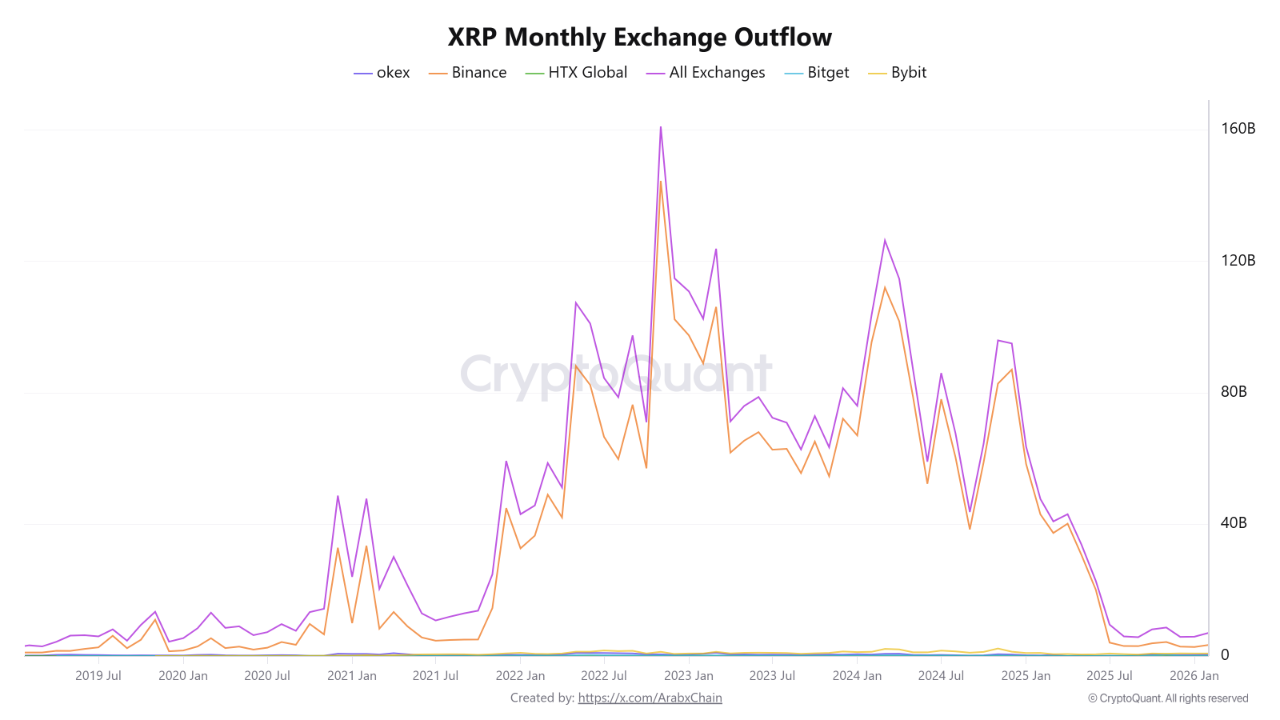
CryptoQuant data highlighted by Arab Chain indicate notable XRP activity across major exchanges in February. The analysis shows that a large amount of the asset left trading platforms. Specifically, total withdrawals reached 7.03 billion XRP during the month, marking the highest level of exchange outflows since November.

The surge in outflows suggests that many holders may be relocating their tokens away from exchange wallets, a development that often reflects changing market behavior.

When examining the distribution of these withdrawals, the data shows that the majority of the activity originated from Binance, the largest centralized exchange globally. The platform saw approximately 3.38 billion XRP leave its exchange wallets, accounting for 48% of total outflows.

Meanwhile, other exchanges also experienced notable withdrawals. Around 770 million XRP moved off Bybit, while roughly 395 million XRP left OKX. These withdrawals paint a rather bullish picture, contrary to the current price trend.

XRP Monthly Exchange Outflow/CryptoQuant

What Growing XRP Outflows Suggests

In the crypto scene, exchange flows often provide insight into participant behavior. When assets move onto exchanges, they can quickly become available for selling. Conversely, when large quantities leave exchanges, it often suggests that holders are moving their tokens to private wallets for potential accumulation.

Therefore, the recent spike in XRP withdrawals may indicate that a portion of the circulating supply is temporarily leaving the immediate trading environment. Over time, this kind of shift can influence liquidity conditions on exchanges because fewer tokens remain readily accessible for spot transactions. This sometimes leads to a supply shock, which affects prices.

Additionally, it shows that holders are refusing to sell or adding to their XRP stash amid the dip. This shows conviction beyond the short-term bearish price action that the coin has massive potential in the near future.

Moreso, a shift from distribution to accumulation signals seller exhaustion. Market participants now find the current price levels attractive to buy, which affects market sentiment and consequently enables a demand-driven rebound.

Morgan Stanley Names BNY and Coinbase as Custodians for Proposed Bitcoin ETF

0

Morgan Stanley has chosen Coinbase and Bank of New York Mellon to safeguard the Bitcoin backing its proposed Bitcoin Trust ETF.

The decision was disclosed in a filing submitted to the U.S. SEC, which details how the Wall Street bank intends to manage custody of the digital assets supporting the fund.

Key Points

  • Morgan Stanley named BNY Mellon and Coinbase as custodians for the Bitcoin backing its proposed Bitcoin Trust ETF.
  • The custody arrangement was disclosed in an SEC filing detailing how the ETF’s digital assets will be secured and managed.
  • Most of the fund’s Bitcoin will be held in offline cold storage, with limited use of hot wallets for ETF share creation and redemption.
  • The proposed Bitcoin ETF is part of Morgan Stanley’s broader plan to launch crypto investment products, including a separate ETF tracking Solana.

Custody Structure Detailed in SEC Filing

According to the filing, Coinbase and BNY will serve as the official custodians of the ETF’s Bitcoin holdings. In this capacity, the two institutions will be responsible for securing the digital assets and facilitating trade execution when required.

Most of the Bitcoin will be stored in cold storage, where private keys are kept offline. This approach significantly reduces exposure to cyber threats and is widely used to safeguard large digital-asset reserves.

However, the filing notes that a portion of the holdings may occasionally be transferred to internet-connected hot wallets. These temporary transfers are to support the creation and redemption of ETF shares, processes that require readily accessible liquidity. Consequently, limited short-term online storage may be necessary at times.

Additionally, the document clarifies the regulatory status of the custodians. BNY operates as a bank chartered in New York State. Meanwhile, Coinbase Custody functions as a limited liability trust company regulated in the same jurisdiction. According to the filing, both firms provide digital-asset custody and trade-execution services.

Morgan Stanley’s Expanding Crypto Strategy

More broadly, the custody arrangement reflects Morgan Stanley’s effort to expand its presence in digital assets. In January, the bank filed applications with the SEC to launch two cryptocurrency exchange-traded funds.

One of the proposed funds would track Bitcoin, while the other would focus on Solana. Both vehicles are structured as passive investment products designed to hold the underlying cryptocurrencies and mirror their market performance.

This initiative also aligns with a broader trend of institutional engagement in the crypto market. Large financial firms have increasingly explored digital-asset products, even during periods of market weakness.

For context, Bitcoin continues to trade far below its historical peak, down approximately 42% from its highest value of $126,000.

Nevertheless, recent ETF activity suggests investor demand may be returning. For instance, BlackRock’s spot Bitcoin ETF recorded $322 million in inflows on Tuesday. Those gains helped offset outflows from competing products by Fidelity Investments and Grayscale Investments.

Consequently, total inflows for the week reached approximately $683.3 million, down from $787.3 million the week prior. Notably, that week had marked a brief turnaround, producing the first positive inflows after five consecutive weeks of withdrawals totaling nearly $4 billion.

Strategic Impact for Morgan Stanley

Industry observers say Morgan Stanley’s ETF could strengthen the bank’s position in the crypto sector. Jeff Park, an adviser at asset management firm Bitwise Asset Management, said the launch would help the bank establish a stronger foothold in digital assets.

Park noted that the fund does not need to dominate the market to be valuable for the company. Leading products such as BlackRock’s iShares Bitcoin Trust already command significant market share.

Even so, introducing a Bitcoin ETF could deliver several strategic benefits. Beyond attracting investor interest, it may help Morgan Stanley recruit experienced professionals from the crypto industry and support broader initiatives tied to blockchain technology.

Finally, Park added that institutional developments of this kind are generally positive for the crypto ecosystem, as they signal that interest in digital assets extends beyond the current investor base.

Morgan Stanley executives have echoed this perspective. Speaking to analysts during the Q4 2025 earnings call, CEO Ted Pick remarked that the bank is well-positioned to capitalize on developments in cryptocurrency and tokenized assets. According to Pick, the bank sees considerable long-term potential in the evolving digital finance landscape.