
Home Blog Page 225

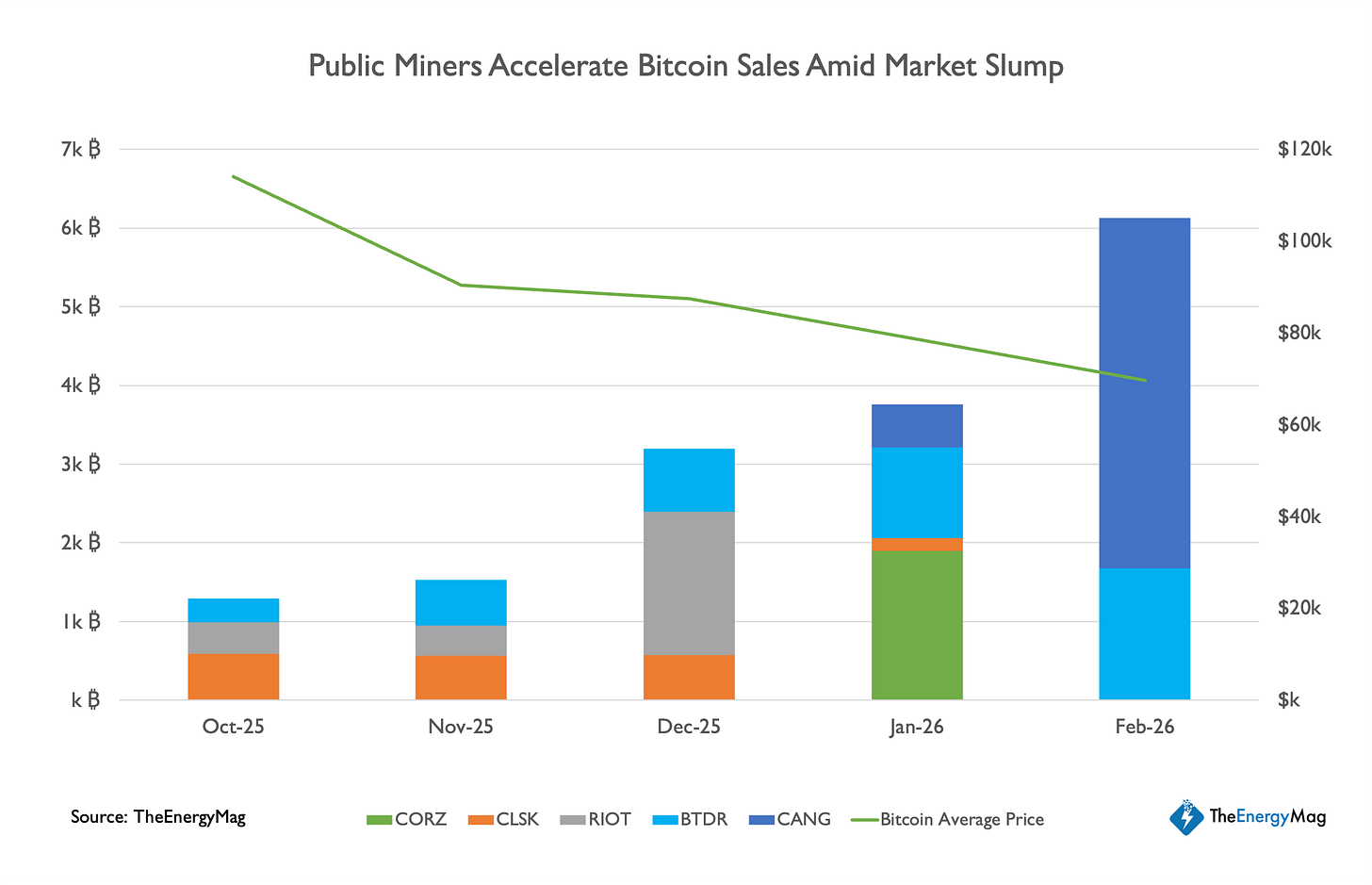
Bitcoin Miners Dump 15,000+ BTC Since October

0

Publicly traded Bitcoin miners have offloaded more than 15,000 BTC since October.

The selling began after the market reached a peak and then experienced a sharp flash crash, forcing many miners to reassess their treasury strategies.

Data cited by TheEnergyMag’s Miner Weekly newsletter shows that several major mining firms have already reduced their Bitcoin reserves. As profitability tightens, industry observers suggest that additional sales may follow in the coming months.

Key Points

  • Public Bitcoin mining firms have sold over 15,000 BTC since October, signaling growing financial strain in the sector.
  • Cango sold 4,451 BTC (about 60% of its reserves) in February, one of the largest treasury reductions this year.
  • Bitdeer liquidated its entire Bitcoin treasury, while Riot Platforms sold BTC in December, highlighting an industry-wide shift.
  • Core Scientific plans to sell around 2,500 BTC in Q1, suggesting additional miner-driven supply may enter the market. 
  • MARA Holdings clarified it has no immediate plans to sell, despite filings permitting it to buy or sell BTC as needed.

Major Mining Firms Lead the Recent BTC Sell-Off

Several large mining companies account for a significant share of the recent Bitcoin liquidations, illustrating how miners are adapting to a shifting market environment.

According to TheEnergyMag, Cango sold 4,451 BTC in February, representing roughly 60% of its total Bitcoin reserves. This transaction stands among the largest treasury reductions reported so far this year.

Other firms have taken even more aggressive steps. The newsletter reported that Bitdeer disposed of its full Bitcoin position last month, signaling a decisive shift toward strengthening liquidity.

Meanwhile, Riot Platforms conducted multiple Bitcoin sales during December, further reinforcing the emerging industry trend. Looking ahead, Core Scientific has indicated plans to liquidate roughly 2,500 BTC in Q1, suggesting that miner-driven selling pressure may continue.
MARA Holdings Signals Flexible Bitcoin Strategy

Amid these developments, attention has also turned to MARA Holdings, the largest publicly traded Bitcoin mining company.

Recent regulatory filings suggested that the firm could buy or sell Bitcoin depending on market conditions. The disclosure initially raised concerns among market participants that significant sales might be imminent.

However, Robert Samuels, vice president at MARA, later clarified the company’s position. He explained that the filing only provides operational flexibility rather than signaling plans to sell the majority of the firm’s holdings.

Currently, MARA holds nearly 54,000 BTC, making it the second-largest public corporate holder of Bitcoin. Meanwhile, the top position remains held by Michael Saylor’s Strategy, according to BitcoinTreasuries.net.

From Treasury Strategy to Liquidity Focus

The current selling trend marks a notable departure from the approach many miners adopted during the 2024–2025 crypto market rally.

During that period, numerous mining companies chose to retain a large portion of their self-mined Bitcoin rather than sell it immediately.

Research from Digital Mining Solutions and BitcoinMiningStock.io suggested that miners expected continued price appreciation and viewed Bitcoin holdings as a way to strengthen their balance sheets.

At the same time, several firms expanded into adjacent sectors such as AI infrastructure, high-performance computing, and data center services. These initiatives reflected ambitions to diversify revenue streams.

However, market conditions have changed significantly since the October peak.

Margin Squeeze Forces Balance Sheet Adjustments

As prices weakened and operational costs remained high, mining profitability came under increasing pressure. Industry observers now describe the current environment as one of the most severe margin squeezes Bitcoin miners have faced.

In response, many companies have begun adjusting their financial strategies to reduce risk and preserve liquidity. CleanSpark, for context, recently repaid its Bitcoin-backed credit line in full. The company said the move was intended to lower financial exposure as mining margins tighten.

Taken together, these developments suggest that many miners are shifting their priorities away from aggressive Bitcoin accumulation and instead toward maintaining liquidity and strengthening balance sheets during a more challenging phase for the industry.
Cardano Goes Retail as 137 Stores in Switzerland Now Accept ADA Payments

0

The Cardano Foundation has forged a strategic partnership that brings Cardano into everyday retail payments through integration with DFX.swiss. 

Notably, the initiative enables shoppers at 137 SPAR outlets in Switzerland to pay directly with ADA. According to a press release, the move marks a major milestone, as ADA enters into brick-and-mortar retail payments for the first time. 

Key Points 

  • Shoppers in Switzerland can now pay with Cardano at 137 SPAR stores nationwide.
  • This development follows Cardano Foundation’s integration with DFX.swiss.
  • ADA holders can use DFX’s payment infrastructure to convert tokens into fiat and seamlessly save or spend them within a single platform.
  • Cardano Foundation CEO Frederik Gregaard said the integration signals Cardano’s transition from an experimental project to a real financial transformation. 

SPAR Shoppers Can Now Pay with Cardano

Per the announcement, the Cardano blockchain has integrated into DFX.swiss’ payment infrastructure, introducing real-world retail payment functionality for ADA. 

The integration revolves around Open Crypto Pay, a payment standard developed by DFX.swiss that enables cryptocurrency transactions directly at point-of-sale terminals.

As a result, customers can now pay with ADA at 137 SPAR supermarkets across Switzerland. Transactions are processed in real time and can be completed directly from native ADA wallets without relying on centralized intermediaries, such as exchanges.

The integration will benefit consumers and merchants. Specifically, Shoppers gain an additional payment option, while merchants can reduce transaction fees by roughly two-thirds compared with traditional payment networks.

Additional Benefits of the Integration

Beyond retail payments, ADA holders can leverage DFX.swiss’ expanded on- and off-ramp infrastructure to convert their tokens directly into fiat currencies through their accounts. This capability strengthens Cardano’s real-world adoption by bridging traditional banking systems with the network.

The infrastructure also supports new fintech applications. For instance, the urble app developed by Brick Towers integrates with DFX.swiss, allowing users to save and spend ADA on a single platform. Through the app, individuals can set savings goals, such as funds for children or family members, while still making direct ADA payments.

Commenting on the development, Frederik Gregaard, CEO of the Cardano Foundation, described the initiative as a sign that Cardano is moving beyond its experimental stage and entering a phase of genuine financial transformation. 

Unified Structure Drives Cardano Progress 

Meanwhile, the Cardano ecosystem has recorded notable progress since its founding entities, including the Cardano Foundation, came together under a unified structure known as the Pentad. 

The group aims to accelerate growth across five strategic areas, including attracting a Tier-1 stablecoin and expanding the network’s DeFi sector.

Notably, Input Output Global (IOG), led by Charles Hoskinson and also part of the Pentad, recently launched USDC on the network via the bridged asset USDCx. The launch has already boosted Cardano’s on-chain activity, with the stablecoin market cap rising 40.75% over the past seven days to $47.55 million. 

Cardano Stablecoin Metric

Notably, the Cardano Foundation’s latest move further advances the network’s real-world utility as it allows shoppers to purchase goods with ADA across 137 SPAR locations in Switzerland. 

Large XRP Whales Accumulated 4,180,000,000 XRP Since 10/10 Crash

0

XRP whales have added over 4.18 billion tokens to their cumulative balance since the Oct. 10 crash that marked the start of the ongoing downtrend.

The broader crypto market has been on a sustained downward trend since the events of Oct. 10, 2025, and XRP has not escaped the bloodbath, down exactly 50% from its opening price that day.

While panic has engulfed the market since then, large XRP whales holding between 10 million and 1 billion tokens appear to be leveraging the dip to add to their balances in what has been a months-long accumulation campaign.

Key Points

  • The ongoing market downtrend picked up following the Oct. 10 crash that shocked the market, with XRP now down 50% from its opening price that day.
  • Amid the downward pressure, XRP shark addresses and smaller whales have panic-sold, distributing 2.87 billion XRP since then.
  • While panic engulfed the scene, large XRP whales holding 10 million to 1 billion tokens remain unfazed, having accumulated 4.18 billion XRP.
  • These XRP whales now hold 19.61 billion XRP, representing 32% of the XRP circulating supply and marking their largest combined balance in history.
  • Wallets holding 10 million to 100 million tokens contributed the most to this trend, adding 2.88 billion XRP in six months.

XRP Impacted in the 10/10 Crash

Data from market intelligence resource Santiment confirms development, which details the divergent reactions to the 10/10 crash and the ongoing downtrend across different XRP address tiers.

For context, XRP opened Oct. 10, 2025, with a price of $2.8, as it battled a mild downward pressure after reaching $3.1 earlier that month. However, the sudden market crash pushed prices down 43% to $1.58 on Bitstamp. Despite a recovery to $2.37, XRP saw a 15.32% crash that day. Since then, XRP has dropped 50% to the current price of $1.39.

XRP Down Since Oct 10

The dump spread across the entire crypto market, with Bitcoin (BTC) and Ethereum (ETH) suffering similar hits. Since then, the market has continued to face bearish pressure that appears to have lingered until now. Some market commentaries suggested that the 10/10 crash may have contributed to the ongoing downturn.

Large XRP Whales Amass 4.18B Tokens

While panic has dominated the scene since then, Santiment data indicates that large XRP whales may be taking advantage of the opportunity to scoop up more tokens at lower prices. 

Specifically, after the crash, on Oct. 11, 2025, XRP whales holding 10 million to 100 million tokens held a balance of 7.99 billion XRP. Meanwhile, those with 100 million to 1 billion tokens had 7.44 billion XRP. Together, these whales with 10 million to 1 billion XRP possessed 15.43 billion tokens or 25.7% of the circulating XRP supply then.

Interestingly, at press time, their cumulative balance has grown to a whopping 19.61 billion XRP tokens, representing 32% of XRP’s circulating supply. This indicates that these XRP whales have procured 4.18 billion XRP tokens since the Oct. 10 crash occurred. The current figure represents their largest combined balance in history.

Large XRP Whales Accumulating Santiment
Large XRP Whales Accumulating | Santiment

Notably, wallets holding 10 million to 100 million XRP contributed the most to the accumulation trend. Specifically, these addresses have increased their balance from 7.99 billion XRP on Oct. 11, 2025, to 10.87 billion XRP today, representing an addition of 2.88 billion tokens. Meanwhile, those with 100 million to 1 billion XRP have added 1.3 billion XRP.

XRP Sharks and Smaller Whales Distributing 

As larger whales seize the current opportunity to add to their balances, smaller whales and shark addresses appear to be panic-selling. For context, wallets holding between 100,000 and 10 million XRP had a cumulative balance of 12.97 billion tokens as of Oct. 11, 2025, a day after the 10/10 crash.

Sharks and Smaller Whales Distributing Santiment
Sharks and Smaller Whales Distributing | Santiment

Today, these addresses now hold 10.1 billion XRP, showing that they have distributed 2.87 billion XRP following the market crash and amid the ongoing downtrend.

Crypto Founder Shares How XRP Could Become a Global Reserve Asset

0

An XRP community figure and crypto founder recently shared a pathway through which XRP could become a global reserve asset.

Discussions about XRP becoming a global reserve asset have picked up speed, especially after the United States added XRP to its crypto stockpile in March 2025. However, the idea has always remained theoretical, with no practical path for XRP to assume the ambitious position.

Interestingly, Versan Aljarrah, founder of The Black Swan Capitalist, recently shared how he believes XRP could take up the role, which may allow it to move beyond price speculation to become part of the global financial system. 

Key Points

  • Since the United States included XRP in its crypto stockpile in March 2025, discussions around XRP becoming a global reserve asset have picked up.
  • However, this idea had remained theoretical, with no actual pathway for XRP to assume such an ambitious position.
  • Crypto founder Versan Aljarrah recently shared an avenue through which XRP could take up the role.
  • He said sovereign adoption must come first, with XRP integrating into central banks, treasuries, and payment systems, particularly in emerging markets and BRICS nations.
  • He called the Clarity Act a turning point, which could require Ripple to reduce its XRP holdings below set thresholds to avoid securities classification and encourage institutional trust.
  • Aljarrah said the IMF, which currently recognizes the dollar, euro, yen, pound, and yuan in its reserve basket, could eventually acknowledge XRP if it proves reliable for global settlement.

Sovereign Adoption of XRP Comes First

The market commentator shared his idea in an article on X. Aljarrah believes that no asset can reach reserve status without support from governments. In the past, assets such as gold, the U.S. dollar, and Electronic Special Drawing Rights (ESDRs) gained global trust because countries accepted and used them. 

He explained that XRP would need to become part of several national financial systems, including central banks, treasuries, and state-backed payment networks. 

He believes this process has already started. Notably, the market pundit called attention to emerging markets that have already begun exploring blockchain tools to improve liquidity, lower transaction costs, and stabilize unstable currencies.

He also mentioned the BRICS bloc, noting that countries with volatile or dollar-dependent economies could use XRP as a neutral bridge for settlements. Because XRP can connect local currencies directly, it reduces reliance on the dollar and avoids the geopolitical pressure that aligns with what he described as the military-industrial complex. 

He argued that the actual question is not whether countries will use XRP in this way, but when they will do it. According to him, several nations already use XRP within their payment systems for cross-border transactions.

How The Clarity Act Could Help

Aljarrah suggested that the Clarity Act would represent a major moment for digital asset regulation. The bill separates strategic digital assets from securities and directly affects companies like Ripple. Under the Act, Ripple could be required to reduce its XRP holdings below 20% to avoid securities classification.

Aljarrah said governments hesitate to hold assets that a single company heavily controls. If Ripple keeps a large share of XRP’s supply, the control could slow institutional and sovereign adoption. If it lowers its holdings to meet the Clarity Act’s limits, Ripple would reduce its influence and strengthen XRP’s neutrality.

Aljarrah argued that once Ripple complies with those thresholds, XRP becomes legally clearer and more accessible on a global scale. He believes clarity would make it easier for institutions and governments to hold and use XRP without running into securities-related concerns.

IMF Recognition of XRP 

After sovereign adoption and regulatory clarity, Aljarrah says recognition from the International Monetary Fund (IMF) represents the next step. The IMF oversees global liquidity and reserve assets and helps in maintaining macroeconomic stability. Although it does not officially endorse currencies, it recognizes assets that serve as dependable tools for settlement.

The IMF’s reserve basket currently includes the dollar, euro, yen, pound, and yuan. Aljarrah believes XRP fits with the idea of a programmable Special Drawing Right in a more digital financial system. With institutions such as BRICS pushing forward with digital finance initiatives, he sees room for XRP to align with those changes.

He added that once XRP serves as a reserve settlement asset, its value would depend more on how much money it moves rather than market speculation. Essentially, liquidity depth, transaction volume, and settlement activity within networks of sovereign participants would determine price discovery.

XRP Moving from Payment Token to Global Settlement Layer

Speaking on, Aljarrah said XRP’s journey has always been about structure. He sees it moving beyond a bridge currency and becoming a reserve settlement layer that supports global trade, debt payments, and financial connections between countries and individuals.

The pundit called attention to XRP’s ability to process instant, low-cost transactions between digital and fiat currencies. He also noted that its programmability allows it to connect tokenized commodities with traditional financial systems. To him, holding XRP means holding a piece of the infrastructure that could support global liquidity. 

Important Caveats

While Aljarrah believes there remains a path for XRP to become a global reserve asset, some parts of his theory remain unlikely anytime soon. For one, coordinated adoption across several governments involves political decisions that do not happen quickly. Although many countries test blockchain solutions, full-scale integration is a gradual process.

Moreover, the jump from regulatory clarity under the Clarity Act to formal IMF recognition would also require major policy shifts. The IMF’s reserve basket currently consists only of major national currencies, so adding a digital asset would be unprecedented.

XRP Holders Are Being Lied To, Analyst Reveals How

Zach Humphries, a prominent crypto YouTuber, has warned that many XRP holders are being misled by unrealistic price predictions circulating across social media.

He recently released a video arguing that exaggerated projections for XRP’s future price are harming investors and distorting expectations about the asset’s long-term potential.

Key Points

  • YouTuber Zach Humphries warns that viral price predictions are misleading XRP holders.

  • Humphries criticized claims that XRP could reach $245–$350 this year, calling them unrealistic based on current market data.

  • He said a $245 price would push XRP’s market cap near $15T, far above the roughly $2.5T total crypto market.

  • Despite the criticism, Zach Humphries remains long-term bullish on XRP but urges realistic expectations.

Unrealistic XRP Price Targets

In his analysis, Humphries criticized viral claims that XRP could surge to $245, $315, or even $350 by the end of this year.

According to him, these figures ignore basic market math and create false hopes among investors. He noted that many influencers promote such predictions to attract views and engagement rather than provide realistic market analysis.

Humphries highlighted that while he supports XRP and believes the asset has long-term potential, predictions in the hundreds of dollars are not grounded in current market fundamentals.

Market Cap Math Raises Questions

The commentator explained that reaching $245 per XRP would require roughly a 173x increase from current levels, pushing the asset’s market capitalization to around $15 trillion.

To illustrate the scale of that number, he pointed out that the entire cryptocurrency market currently sits just around $2.5 trillion, making such projections difficult to justify in the short term.

Even higher predictions, such as $350 per XRP, would imply a market valuation exceeding $21 trillion, a level he described as unrealistic based on today’s market conditions.

Long-Term Bullish, But Cautious

Despite the criticism, Humphries clarified that he remains bullish on XRP over the long term.

He said the asset still has strong potential within the altcoin market and highlighted the continued growth of the ecosystem around Ripple. According to him, the company’s resources and ongoing efforts to expand adoption could support XRP’s value over time.

However, he urged investors to avoid basing financial decisions on extreme projections. Instead, the focus should be on realistic expectations tied to adoption, market structure, and long-term development.

Concern for New Investors

Humphries also warned that exaggerated predictions often attract inexperienced investors who believe that holding a small amount of XRP could quickly turn them into millionaires.

He said this narrative can encourage risky investment behavior and lead to disappointment when the market fails to meet those expectations.

Instead, he advised the community to prioritize factual analysis and responsible discussion around XRP’s potential rather than viral price targets designed primarily for attention.

Top Failed XRP Predictions of 2025

Earlier this week, The Crypto Basic reported that several prominent XRP analysts faced scrutiny after bold 2025 price projections failed to materialize. Many had forecast XRP would break its all-time high and reach double- or even triple-digit prices, but the year ended with XRP below $2 after peaking near $3.66.

In a post on X, community figure King Vale criticized what he called “fake super clowns” promoting unrealistic targets to attract attention from investors.

He highlighted several invalidated forecasts, including Jake Claver ($750), Chad Steingraber ($250), Crypto Sensie ($5,769), Time Traveler ($73,000), JackTheRippler ($100), Remi Relief ($1,000–$1,200), and Sistine Research ($37–$50) by year-end.

These developments have reinforced the need for caution around highly optimistic XRP forecasts.

Bitcoin Rallies to $73,000 Driven by ETF Inflows and Derivatives Activity

0

Bitcoin has shown strength, recovering to $73,000 in the face of market uncertainties from geopolitical tension, spurred by two major catalysts.

The price of Bitcoin has recently shown how quickly sentiment can shift in the crypto market. After sliding into the mid-$60,000 range in late February, the asset rebounded sharply in early March, rallying past $73,000 in days.

Key Points

  • After sliding into the mid-$60,000 range in late February, Bitcoin has rebounded sharply in early March, rallying past $73,000 in days.
  • The sudden reversal followed a period of heightened volatility triggered by conflicts in the Middle East.
  • A key factor behind the rebound is renewed activity surrounding spot Bitcoin exchange-traded funds (ETFs) in the United States.
  • Since the start of March, over $1.15 billion has flowed into these funds, providing direct support for spot demand in the BTC market.
  • OI grew from $43 billion on March 2 to $49.6 billion on March 5, while funding rates moved into negative territory, providing short liquidity when BTC started to recover.

What Caused the Price Decline

A recent CryptoQuant analysis highlighted that the sudden reversal followed a period of heightened volatility triggered by geopolitical developments in the Middle East. Reports of military strikes by the US and Israel on Iran at the end of February rattled global markets and pushed Bitcoin down toward $63,000 on February 28. 

However, the reaction proved temporary. BTC quickly recovered to $67,000 on that day, laying the foundation for further rebounds. By March 2, the asset had already recovered to $70,000. Then, renewed buying pressure in subsequent days drove the rally to a high of $74,000 yesterday, before the momentum cooled off.

ETFs Inflows Crucial to Bitcoin Recovery

A key factor behind the rebound is renewed activity surrounding spot Bitcoin ETFs in the United States. Since the start of March, over $1.15 billion has flowed into these funds, providing direct support for spot demand in the BTC market.

On March 4, $461 million flowed into the ETFs, driven by renewed interest in the BlackRock iShares Bitcoin Trust (IBIT). This movement suggested that large financial participants are once again allocating capital to Bitcoin through ETF products after a period of reduced activity. The additional demand helped strengthen the price recovery push.

Further analysis from Glassnode shows that inflow into BTC ETFs is now stabilizing. The 14-day netflow trend has broken higher, signaling an early stage of re-accumulation as the asset broke past $70,000. While this does not confirm that institutional pressure is back in full force, it suggests that earlier selling pressure is dwindling.

Bitcoin 14-Day Spot ETFs Netflow/Glassnode

Short Covering Sparks Bitcoin Resurgence

At the same time, derivatives markets added another layer of support to the rally. Specificially, Open interest expanded quickly from $43 billion on March 2 to $49.6 billion on March 5, while funding rates moved into negative territory. Such conditions often indicate that many market participants are shorting the asset. 

Consequently, when Bitcoin began to rise, short positions were forced to close, creating a wave of short covering that accelerated the upward move.

Mixed On-Chain Signals Despite the Rebound

While the price recovery has been significant, on-chain data show that the broader market structure remains complex, with some indicators still leaning toward caution. 

For context, the 90-day realized profit-to-loss ratio remains below 1.0, suggesting that many coins recently moved on-chain have been sold at a loss. In addition, the number of coins held with unrealized losses has increased during the recent volatility.

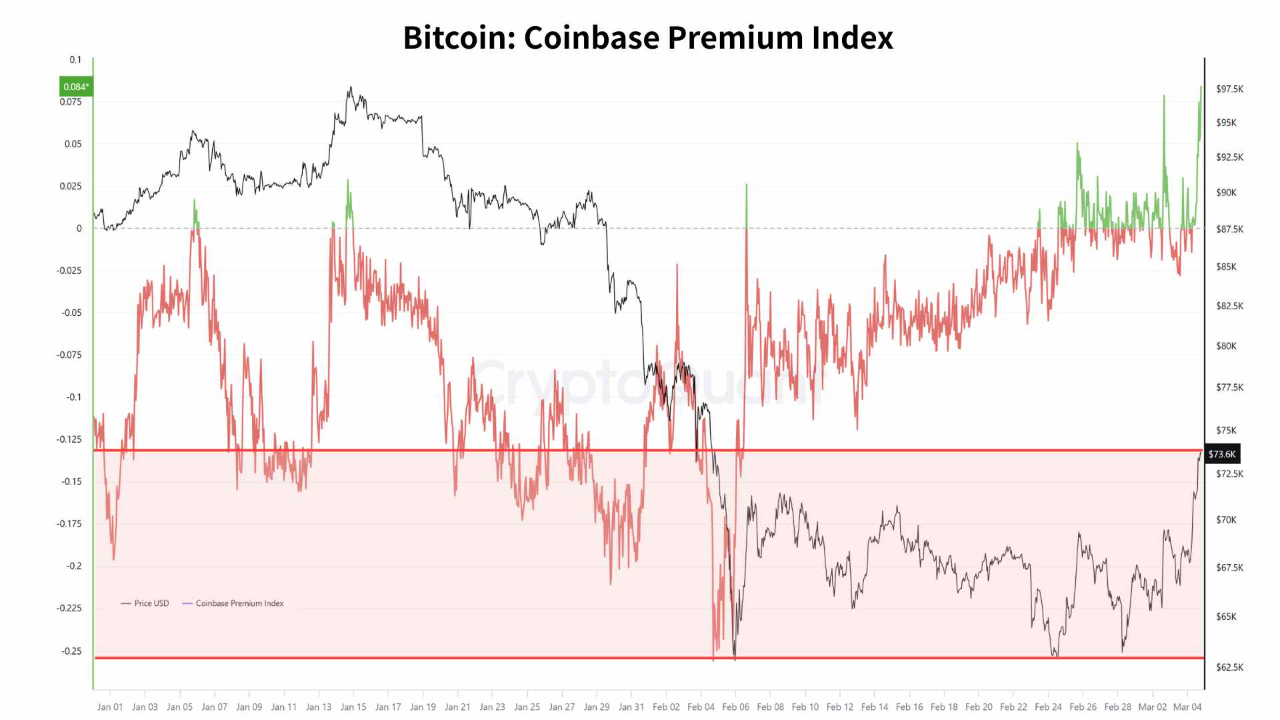
Nevertheless, other metrics have begun to improve. The Coinbase Premium Index turned positive after spending an extended period below zero. This shift indicates stronger demand from U.S. investors.

Bitcoin Coinbase Premium Index/CryptoQuant

Meanwhile, the geopolitical conditions continue to influence sentiment. During periods of global uncertainty, Bitcoin comes across to investors through two different lenses. On the one hand, it behaves like a risk-sensitive asset, reacting quickly to macro shocks. On the other hand, it serves as a tool for capital mobility and wealth preservation.

Bitcoin Whales Now Distributing Heavily Above $73K: What Does BTC Need to Scale Higher?

0

Amid the ongoing Bitcoin recovery campaign, large whales have begun distributing heavily above the $73,000 mark, creating stern resistance.

For context, Bitcoin has been climbing again despite the pressure that global markets faced following the conflict between Iran and Israel. The leading cryptocurrency fell to $63,000 on Feb. 28, around the time the conflict began to escalate.

However, soon after the drop, Bitcoin started pushing upward again. Since the start of the conflict, BTC has risen 11.7%, putting it on track to record its first weekly gain in seven weeks. Amid the uptrend, data shows that Bitcoin now faces a major resistance zone above $73,000, where large sell orders have formed.

Key Points

  • Bitcoin dropped to $63,000 on Feb. 28 as the Iran-Israel conflict escalated, but has since climbed 11.7%, putting it on pace for its first weekly gain in seven weeks.
  • Whale activity increased during the rally, with large buying concentrated between $70,000 and $72,500 before notable selling appeared above $73,000.
  • A strong resistance area has formed between $74,000 and $75,000, where large sell orders remain stacked.
  • The presence of large orders on both sides of the order book suggests Bitcoin could soon move toward one of these zones to trigger liquidity before the next major trend develops.
  • Bitcoin has the potential to stage a renewed upward push if it can hold above $70,000-$71,000.

Bitcoin Whale Activity Shows Where Big Traders Are Positioning

CoinGlass confirmed this in a recent report. The analytics platform shared a whale order flow chart that reveals how large investors behaved during Bitcoin’s climb. The chart tracks whale trades on a 15-minute timeframe, showing large buy and sell orders with colored bubbles.

Specifically, as Bitcoin moved from around $69,000-$70,000 up toward $73,000-$74,000, the chart displayed multiple green bubbles, which represent large buy orders. The strongest cluster of these buy orders appeared between $70,000 and $72,500, suggesting that whales bought heavily in that range and helped drive the recovery.

Bitcoin Whale Order Flow Chart Coinglass
Bitcoin Whale Order Flow Chart | Coinglass

However, once Bitcoin moved higher, the pattern changed. Near $73,000, the chart began showing more red bubbles, which indicate an emergence of large sell orders. 

Around $73,500-$74,000, these red markers became more pronounced, indicating that whales started taking profits as the price rose. CoinGlass concluded that multiple large traders likely distributed their holdings once Bitcoin climbed above $73,000.

Strong Sell Orders Form a Wall Near $75K

The order book also reveals why Bitcoin has slowed near its recent highs, as it currently trades around $71,700. Specifically, the chart shows several thick red liquidity bands above the current price, representing large sell orders waiting to be filled.

The most noticeable group of sell orders sits between $74,000 and $75,000, creating a strong resistance area. Notably, big clusters of sell liquidity appear around $74,000, $74,200, $74,600, and $75,000. Each of these levels holds millions of dollars in orders, forming a sell wall.

Essentially, this means Bitcoin will likely need strong buying pressure to push through that zone. Without enough demand, the price could struggle to break past those levels in the short term.

Bitcoin Buyers Waiting Around $70K

However, while sellers are lining up above the market, buyers are also preparing below it. The chart shows several green liquidity bands underneath the current price, which represent large buy orders placed in advance.

The biggest support area appears between $70,000 and $71,000, where multiple clusters of buy orders sit. Major bid levels include $71,500, $71,200, $71,000 and $70,800. 

Some of these areas contain more than $10 million to $20 million in buy orders, and this shows strong interest from traders who want to accumulate Bitcoin if the price dips. These buy orders could act as a cushion for the price if bears push Bitcoin toward these lower levels.

Analysts Remain Cautious Yet Optimistic

Meanwhile, market analysts remain cautious yet optimistic. For instance, Ted Pillows believes the most important support now sits between $70,000 and $71,000, stressing that Bitcoin still has a good chance of rallying again as long as it stays above that range.

Bitcoin 2D Chart Ted Pillows
Bitcoin 2D Chart | Ted Pillows

According to market veteran Michaël van de Poppe, the market has already reached an important resistance level, and it is normal for the first attempt at a breakout to fail because markets usually need time to build momentum.

However, he believes Bitcoin’s short-term trend has now turned upward, calling it the most important trend change since the major market crash that happened on Oct. 10, 2025. If Bitcoin continues to hold key support levels, this shift could indicate the start of a stronger bullish phase.

Xaman Founder Warns XRP Users: “There Is No Xaman Browser Plugin” as Fake Extensions Emerge

Fresh warnings have emerged in the XRP community as scammers circulate fake browser extensions for Xaman Wallet.

The alert comes as a suspicious Chrome extension surfaced online claiming to offer a web version of the self-custodial XRP wallet.

Key Points

  • Wietse Wind warns XRP users that any browser plugin claiming to be from Xaman Wallet is fake and likely a scam.

  • A suspicious Google Chrome extension claiming to be a web version of Xaman raised concerns after requesting unusual wallet permissions.

  • Wind says Xaman Wallet uses QR-based authentication and has no browser plugin, desktop wallet, or external support channels.

  • The alert comes as Xaman activity grows, with over 538M XRP active and integrations expanding via Flare Network.

Founder Issues Scam Notice

Wietse Wind, founder of Xaman Wallet, took to X to caution users that any browser extension claiming to be linked to Xaman is fraudulent.

He said Xaman does not provide any browser plugins, and users do not need one to interact with the ecosystem. Instead, the wallet uses QR-based authentication, allowing websites to securely interact with the mobile application.

He stressed that all Xaman browser plugins currently circulating are fake and originate from scammers attempting to compromise user funds. Wind urged community members who encounter such extensions to report them immediately to browser platforms such as Chrome or Firefox.

Suspicious Chrome Extension

The warning followed a post by X user Florian, who flagged a Chrome extension that claimed to be Xaman’s web version. The extension requested unusual permissions, raising suspicions that it could extract sensitive wallet data to drain funds from unsuspecting users.

In response, Xaman reiterated that the wallet has no browser plugin, no desktop wallet. Moreover, it offers no support channels through email, social media, or Telegram. The team emphasized that users should rely exclusively on the mobile app and its in-app support system.

Not the First Scam Attempt

This is not the first time scammers have attempted to exploit Xaman’s brand. Back in April 2025, Wind warned that impersonation accounts were sending direct messages promoting fake Xaman web wallets and browser extensions.

These schemes attempted to trick users into entering their secret keys to access their wallets and empty them.

Meanwhile, Wind noted that Xaman’s security model is built around signing transactions only through the native mobile application, which is one reason the team avoids browser extensions and web wallets entirely.

Xaman’s Growing Role in the XRP Ecosystem

The scam alert comes as Xaman continues to see significant activity within the XRP ecosystem.

Earlier this year, the wallet revealed that more than 538 million XRP were active on its platform during the first days of 2026. The surge in activity coincided with XRP’s rally from $1.84 to $2.41 within the first week of 2026.

Xaman positions itself as a gateway to the XRP Ledger. It enables users to maintain self-custody of their assets while still accessing the broader ecosystem.

Specifically, integrations with platforms like Flare Network have expanded what users can do with their XRP. Through Flare’s infrastructure, holders can lock XRP in vaults to mint FXRP and deploy across DeFi protocols to generate yield.

With hundreds of millions of XRP moving through the wallet, the latest warning highlights the importance of security as scammers increasingly target the expanding user base.

Bitcoin Mining Cost Climbs to $70,027 Per BTC

0

The average cost of mining one Bitcoin has climbed above $70,000, marking a sharp increase from the $67,704 recorded earlier this year. 

Ki Young Ju, founder of CryptoQuant, highlighted the rising production cost, citing recent filings from MARA Holdings. Notably, the surge in Bitcoin mining costs is primarily due to rising energy prices, which have steadily increased since last year. 

Key Points 

  • The average mining cost for Bitcoin has climbed to $70,027 per BTC.
  • With Bitcoin trading above $72,000, MARA Holdings and other miners remain profitable despite tighter margins.
  • MARA has updated its treasury policy to allow the sale of Bitcoin from its digital asset reserves when needed.
  • The company ranks second among corporate holders of Bitcoin, with 53,822 BTC currently in its treasury.

Average Mining Cost Per BTC Exceeds $70,000 

Citing MARA’s latest disclosure, Young Ju stated that the average mining cost now stands at approximately $70,027 per BTC, up 3.43% from the $67,704 figure he shared in February. It’s worth noting that total mining cost depends on how companies calculate expenses.

At the base level, MARA’s electricity alone now costs about $38,956 per Bitcoin, a notable jump from $29,084 in 2024. When miners add hosting and site operations, the operating cost rises to $70,027 per BTC. 

Moreover, once firms factor in selling, general, and administrative (SG&A) expenses, Young Ju estimates the all-in production cost increases to between $110,000 and $113,000 per BTC. 

MARA Currently Profitable 

Despite these elevated costs, MARA remains profitable for now. At press time, Bitcoin trades at $72,748, which is slightly above the estimated $70,000 average mining cost. Nonetheless, profitability remains sensitive to price fluctuations.

When Bitcoin trades below production cost, as observed last month when the price crashed to $60,000, miners like MARA face losses.

In response to market volatility, MARA recently updated its 2026 policy by modifying its digital asset treasury strategy to allow the sale of BTC held on its balance sheet. However, the company clarified that it will base sales decisions on capital allocation priorities and market conditions. 

Current Holdings

According to its latest filing, MARA Holdings held 53,822 BTC as of December 31, 2025, making it the second-largest corporate holder of Bitcoin at the time of publication.

Of this total, MARA loaned 9,377 BTC to third parties to generate additional yield. In addition, it pledged 5,938 BTC as collateral under its credit facility.

The company also allocated 15,315 BTC to its digital asset management strategy, recording them as receivables. Meanwhile, MARA classified the remaining 38,507 unrestricted BTC as long-term digital assets.

Ex U.S. Combat Medic Claims U.S. Global Conflicts Tie to Financial War Involving XRP

0

A former U.S. combat medic recently shared a controversial theory linking global conflicts to a financial struggle involving XRP and Bitcoin. 

U.S. Veteran Patrick L. Riley argues that recent military actions involving the United States across several regions come from a broader competition for monetary dominance, particularly between the U.S. Dollar and the Chinese Yuan.

To him, geopolitical tensions, cryptocurrency competition between Bitcoin and XRP, and even the growing AI rivalry between OpenAI and DeepSeek all represent part of a wider contest to dominate the global financial system over the next decade. However, this remains unconfirmed.

Key Points

  • Patrick Riley claims global conflicts involving countries such as Iran, Venezuela, Mexico, Ecuador, Syria, and Russia come from a financial rivalry between the U.S. dollar and the Chinese yuan.
  • Major geopolitical events cited include the recent operation in Iran that killed Ayatollah Ali Khamenei and the January 2026 U.S. raid in Caracas that captured Venezuelan President Nicolás Maduro.
  • Riley links the alleged financial struggle to crypto competition, suggesting that the rivalry between Bitcoin and XRP indicates a broader battle over the future of global finance.
  • However, this remains speculative, as most experts suggest recent U.S. military actions relate to security and geopolitical factors, not a currency war.

Riley Says Global Tensions Indicate a Larger Financial Struggle

Riley made these comments in a post on X. According to him, many people misunderstand what really drives conflicts around the world today. To him, the tensions go beyond traditional geopolitics and indicate a financial struggle between the United States Dollar and the Chinese Yuan.

Riley argued that the weakening position of the dollar has pushed the United States into confrontations with several countries that have strong economic ties to China. He mentioned Iran, Venezuela, Mexico, Ecuador, Syria, and Russia as examples of nations that have experienced some form of U.S. military pressure. 

He alleged that these actions connect to a broader effort toward maintaining global financial influence while China expands its reach.

U.S. Global Involvements

Specifically, in Iran, the United States and Israel recently carried out major strikes during an operation that killed Iran’s Supreme Leader Ayatollah Ali Khamenei and destroyed parts of the country’s missile and nuclear infrastructure. Iran has responded with missile and drone attacks targeting U.S. bases and regional allies.

Meanwhile, in early January, U.S. forces carried out an operation called Absolute Resolve in Caracas. During the raid, parts of the capital were bombed, and Venezuelan President Nicolás Maduro and his wife were captured on charges linked to narcotics trafficking and terrorism. 

While Riley also mentioned Mexico, there have been no confirmed large-scale campaigns there besides the killing of drug lord El Mencho. In Ecuador, the United States has mainly worked alongside local authorities in joint operations targeting narco-terrorism rather than launching independent military strikes.

Riley Links XRP, Bitcoin, and AI Rivalries to the Same Battle

Interestingly, Riley claimed that the alleged ongoing financial struggle extends to technology and digital assets. He argued that rivalries in emerging sectors remain part of the same global contest over who will control the financial system in the future.

As part of the argument, Riley highlighted the competition between Bitcoin and XRP. He suggested that different financial powers may support competing digital assets as they set themselves up for what he believes could become the next global currency framework.

He also mentioned the growing competition in artificial intelligence between OpenAI and China-based DeepSeek. Riley believes these rivalries link to the same global power struggle shaping finance and technology.

According to Riley, the visible military conflicts around the world are not the central issue. Instead, he claims they are side effects of a much larger race to determine what the global monetary system will look like in the next decade. In his view, the key question is which currency or digital asset will eventually define global finance.

A Reality Check

While Riley’s interpretation has gained attention online, the ideas rely heavily on speculation. Notably, there is no widely documented commentary supporting any of his claims regarding the purpose of the war or ties to a financial struggle.

In addition, while competition exists between cryptocurrencies such as Bitcoin and XRP, it largely plays out through adoption, technology, and regulation, not global military conflict. 

The same applies to artificial intelligence competition. Essentially, recent U.S. military actions relate mainly to issues such as nuclear risks, counter-terrorism efforts, and anti-narcotics operations instead of a hidden financial war involving cryptocurrencies like XRP.