Home Blog Page 250

New SEC Guidance Allows Security Tokens to Trade Directly With Bitcoin

0

The U.S. SEC Division of Trading and Markets has issued updated guidance on crypto market activity, providing greater clarity for exchanges, broker-dealers, and alternative trading systems (ATSs).

While the agency did not introduce new rules, it signaled it would not object to certain crypto trading structures and capital treatments, provided firms continue to comply with existing federal securities laws. 

The guidance addresses crypto pairs trading, stablecoin capital calculations, disclosure standards, clearing obligations, and Regulation M considerations for crypto exchange-traded products (ETPs).

Key Points

  • SEC allows direct trading between security tokens and assets like Bitcoin without fiat conversion.

  • Broker-dealers can treat proprietary stablecoins as readily marketable with a 2% haircut.

  • ATS broker-dealers may combine brokerage, custody, and clearing if laws are met.

  • SEC permits crypto ETP trades under its Regulation M framework if rules are followed.

Exchanges and ATSs May Facilitate Crypto Pairs Trading

A central feature of the update is clarification around crypto pairs trading. The Division stated that federal securities laws do not prohibit national securities exchanges or ATSs from facilitating direct trades between a crypto asset security and a non-security crypto asset, such as Bitcoin.

In practical terms, this means a security token may trade directly against a non-security crypto asset without first being converted into fiat currency. However, the Division emphasized that existing regulatory obligations remain unchanged. ATSs must continue to comply with Regulation ATS requirements, including recordkeeping and reporting responsibilities.

In addition, the guidance addresses valuation mechanics when trades are priced in non-U.S. dollar assets. For reporting and National Market System quotation purposes, firms may convert transaction values into U.S. dollars. However, the Division stated that any conversion method must be applied consistently, impartially, and reasonably. This clarification aims to ensure transparency while accommodating crypto-denominated pricing structures.

Stablecoin Capital Treatment and Broker-Dealer Operations

Beyond trading mechanics, the Division provided additional clarity on broker-dealer capital requirements, particularly under Rule 15c3-1, the Net Capital Rule.

The Division stated it would not oppose a broker-dealer considering its proprietary holdings in a payment stablecoin as readily marketable. In calculating net capital, the firm may apply a 2% haircut to the market value of its larger long or short proprietary stablecoin position. This position offers greater certainty for firms engaging in crypto-related activities.

The guidance then expands to operational roles. A broker-dealer that operates an alternative trading system may simultaneously perform custodial, brokerage, or clearing functions. However, each function must independently comply with applicable federal securities laws. In other words, combining roles is permitted, but regulatory responsibilities remain distinct.

Closely related is the question of clearing agency registration. The Division stated that separate registration would not be required when a broker-dealer clears and settles customer trades as part of customary brokerage or dealing activity. For example, this may involve debiting and crediting internal customer accounts. This clarification helps define the boundary between brokerage functions and clearing agency obligations.

Disclosure Standards and Regulation M Relief for Crypto ETPs

The update also addresses transparency requirements for trading venues. The Division has clarified that disclosures concerning crypto asset security operations can be made using Form ATS or Form ATS-N. Broker-dealers must describe differences in subscriber access, onboarding procedures, settlement processes, and trading mechanics linked to crypto activities. This includes specific disclosures concerning pairs trading arrangements.

Finally, the Division turned to crypto exchange-traded products. It stated that it would not object to transactions in crypto ETP shares under circumstances similar to those outlined in the SEC staff’s 2006 Regulation M no-action letter for commodity-based investment vehicles. This position applies only if the ETP shares are listed on a national securities exchange, and participants avoid conduct that would violate Regulation M outside a permitted distribution.

Overall, the guidance does not alter the regulatory framework governing crypto markets. Instead, it clarifies how existing securities laws apply to evolving trading structures, capital treatments, and product offerings in the digital asset space.
Top Chartist Predicts Timeline for XRP to Reach $9

0

A prominent market analyst has projected a sharp rally that could send XRP to as high as $9 within weeks.

XRP has continued to battle cautious selling sentiment, trading at $1.41, a range it has held since last week. The coin initially dipped to $1.11 this month but has since established support around $1.40. Now, discussions are emerging about where the next breakout could take the XRP price.

Key Points

  • Analyst CryptoBull says XRP could hit $4 soon, citing a 2017-style breakout fractal.

  • He also projects a possible surge to $9, implying gains of up to 7x from current levels.

  • Other analysts argue XRP’s 60% drop from $3.66 may be a final shakeout before $10.

  • Skeptics warn the bottom may not be in, with some eyeing a potential dip toward $0.50.

Timeline for Major XRP Breakout

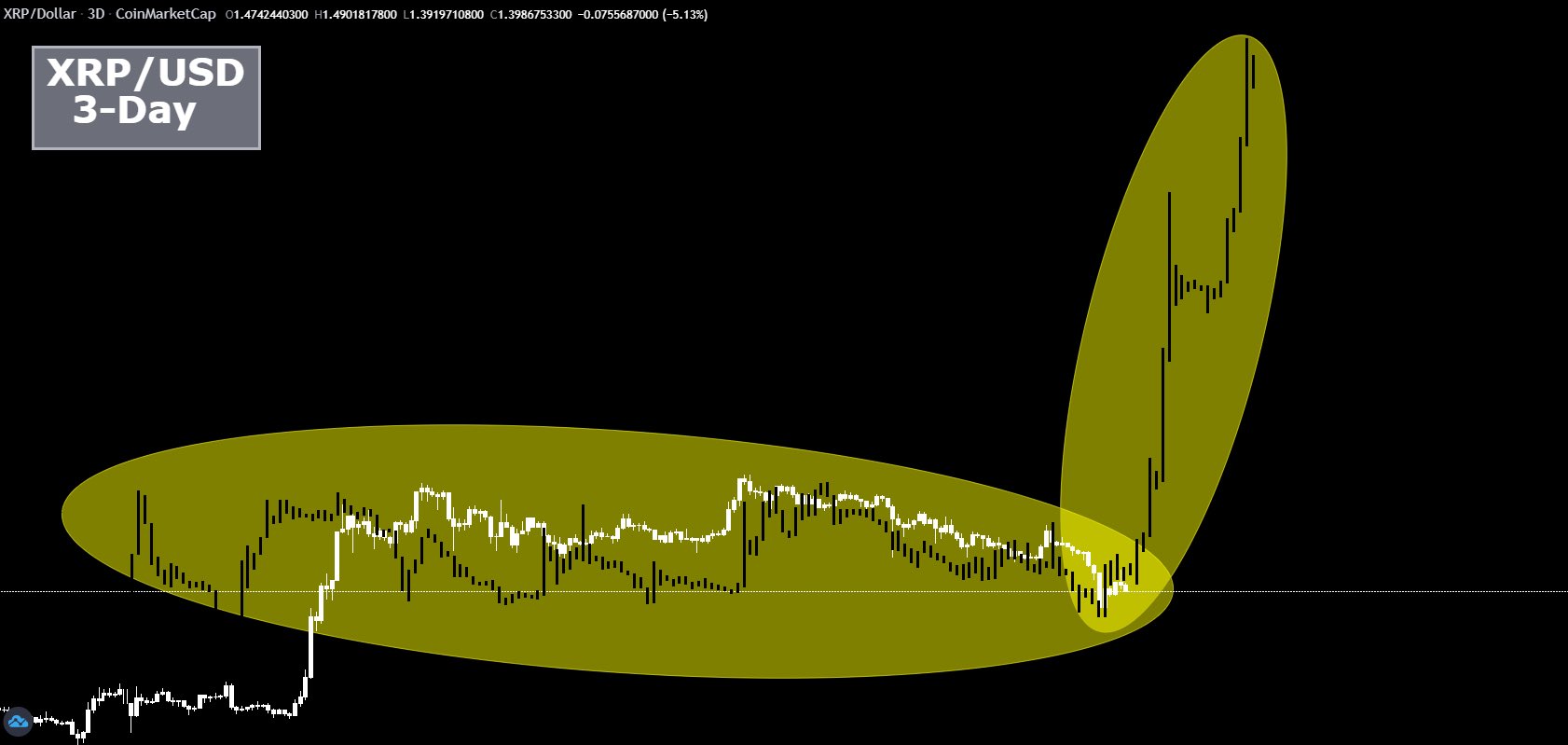
Widely followed XRP analyst CryptoBull shared a bold outlook in a post on X, stating that March could be “extremely bullish” for XRP. According to his analysis, the current 3-day chart structure closely mirrors XRP’s 2017 breakout pattern, a fractal that preceded one of the asset’s most explosive rallies on record.

In a chart shared alongside his commentary, CryptoBull overlaid XRP’s current 3-day structure with its 2017 price action. The comparison highlights a prolonged consolidation phase followed by a sharp vertical breakout, which drove XRP to an all-time high.

Image

The analyst believes the similarity is “striking,” suggesting that XRP may be on the verge of a comparable breakout. Based on this fractal projection, XRP could reach $4 by March 2. This price would mark a new all-time high for the coin and deliver nearly a 3x gain for today’s holders.

$550B Cap in March?

Meanwhile, CryptoBull also suggested XRP could extend the rally toward $9 by March 11. If realized, such a move would mark a significant expansion from current levels, pushing its market cap from $86 billion to $550 billion.

Notably, his March timeline suggests XRP could deliver 2x to 7x gains over the next three weeks. However, given the current state of the market, some commentators consider the outlook overly ambitious.

“Buying Now Is a Major Opportunity”

Notably, many other analysts also share CryptoBull’s XRP outlook, considering how low the current price is compared to its peak.

In a recent analysis, CryptoPatel pointed out that XRP is about 60% below its $3.66 peak. He argued that the pullback represents a final shakeout before a move toward $10.

He cited that XRP confirmed a macro reversal after breaking a four-year descending wedge, rallying over 600% from $0.50 to $3, and now consolidating in a $1.00–$1.50 re-accumulation zone. He believes a resumption of the upside is due, considering the massive drawdown from the peak, and sees $10 as possible.

However, some analysts believe the bottom is not in yet. A few are calling for lows around $0.50, arguing that a strong reversal from that point is possible.

Ultimately, while speculative, the $9 to $10 targets from pro-XRP commentators reflect optimism among analysts who expect strong performance if the broader crypto market improves.

XRP Price if Clarity Act Passes and XRP Achieves Integration with U.S. Banks

0

The XRP price could witness a decisive push if the Clarity Act passes and XRP achieves seamless integration with U.S. banking networks.

While the Clarity Act has hit a roadblock amid disagreements on stablecoin yield, Ripple CEO Brad Garlinghouse insists there is a 90% chance the bill will pass by April 2026. Such a development could have a positive impact on altcoins like XRP in terms of regulatory clarity.

Key Points

  • The Clarity Act faces delays due to disagreement over yield-bearing stablecoins and their impact on bank capital.
  • Garlinghouse said he previously assigned an 80% chance of passage in April, but now sees a 90% probability that the bill will pass.
  • Crypto and banking leaders recently attended a White House meeting on the bill, with Ripple’s chief legal officer representing the company.
  • XRP currently trades at $1.40 but could see greater adoption if full regulatory clarity follows the bill’s passage.
  • Gemini suggested that XRP could rise to a range between $5 and $100 if the Clarity Act allows it to achieve seamless integration with U.S. banking networks.

Ripple CEO 90% Sure Clarity Act Will Pass in April

Notably, the Clarity Act has hit a snag as banks and crypto companies argue over whether stablecoins should offer yield. Banks insist that if stablecoins pay yield, money could leave traditional bank accounts and flow into crypto instead. This concern has slowed the bill for now, with discussions still ongoing.

Meanwhile, Ripple CEO Brad Garlinghouse remains confident the bill will move forward. He had earlier said he was about 80% sure the Clarity Act would pass in April this year. 

However, speaking later on FOX Business, he admitted that no one can fully predict what the Senate or Congress will do. Still, he called attention to prediction markets that jumped after comments from Senator Bernie Moreno, who backs the bill. According to Garlinghouse, there is now a 90% chance that the legislation will pass by the end of April.

XRP and Crypto Await Full Clarity

At press time, XRP changed hands at around $1.40. The token has gained a level of regulatory clarity after actions taken under the Trump administration, including the end of the Ripple vs. SEC lawsuit and other crypto-friendly steps. Despite this, XRP and the broader crypto market still do not have full regulatory clarity. The Clarity Act could finally provide the missing piece.

If lawmakers pass the bill and XRP receives complete regulatory certainty, some believe it could fully connect with U.S. banking networks. This may lead to broader use in the financial system. 

However, no one knows exactly how the price would respond to such a development. As a result, we asked AI chatbot Google Gemini to assess what could happen under the most positive conditions.

XRP Price if It Achieves Integration with U.S. Banking Networks

In its response, Google Gemini suggested that once regulators clear XRP, its value could move beyond retail speculation and instead reflect its role as a regulated bridge asset for the U.S. financial system. Gemini shared three possible price stages based on different levels of adoption and integration.

The first stage ranges from $5.00 to $10.00. In this case, the Clarity Act would officially classify XRP as a digital commodity, removing the regulatory uncertainty that has weighed on its price for years. 

XRP Price Prediction Google Gemini

The second stage falls between $15.00 and $30.00. Here, full regulatory clarity would lead to XRP’s use in U.S. domestic payment systems, including by Tier-1 banks for internal liquidity management. Gemini highlighted liquidity depth as a major factor. 

Specifically, at $1.40, a $1 billion transfer would use up a large share of exchange liquidity and cause sharp price swings. At $20 or more, XRP would have enough depth to handle multi-billion-dollar transfers without major disruption.

The final and most bullish scenario pushes XRP above $100.00. In this case, the Clarity Act would allow XRP to act as the main liquidity layer for the U.S. banking network. Gemini argued that the token’s value would need to rise in line with the amount of money it moves. 

Shiba Inu Stalls Below Key Resistance as Cautious Whale Activity Caps Breakout

0

Shiba Inu remains trapped below a critical resistance level, as weak buying pressure and cautious whale behavior continue to cap upside momentum. 

While on-chain data shows improving fundamentals, including falling exchange reserves and steady accumulation, Shiba Inu’s price has remained below $0.0000066 over the past few days, preventing a meaningful breakout. 

Key Points 

  • Shiba Inu remains capped below $0.0000066, as cautious whale activity continues to limit upside momentum. 
  • The asset’s rebound above $0.000007 in mid-February was short-lived, and the price fell to $0.0000062. 
  • Whale activity has slowed, with large holders choosing to store tokens in cold wallets rather than actively trading. 
  • Analysts warn that continued weakness could push SHIB toward $0.0000055, with a potential retest of the $0.0000050 monthly low.  

Shiba Inu Remains Stuck Below Key Resistance 

On February 15, SHIB staged a strong rally, breaking above $0.000007 and briefly peaking at $0.0000072. At the time, many investors anticipated further upside and a potential move to erase one zero. 

However, the rally quickly faded, and a sharp correction pushed the token back below $0.0000066, turning former support into firm resistance. Since then, SHIB has repeatedly failed to reclaim this level, as sellers consistently step in to halt upward attempts, sustaining bearish pressure.

At the time of writing, SHIB trades at $0.00000625, consolidating within a tight range that reflects market indecision. 

Shiba Inu Price Actioon
Shiba Inu Price Action

Falling Exchange Reserve and Whale Accumulation Fail to Drive Upsurge 

Meanwhile, on-chain metrics remain constructive. Over recent weeks, exchange reserves have dropped significantly, declining from about 82 trillion to 81.47 trillion tokens, signaling that holders are moving assets off centralized platforms. 

Shiba Inu Exchange Reserves

Typically, this trend reduces short-term selling risk. However, lower exchange supply alone has not been enough to lift prices. Instead, SHIB still requires strong demand, particularly from whales. 

While large holders showed moderate activity last month, including a notable 15 billion SHIB withdrawal from WazirX, they now appear to be holding rather than actively trading. Consequently, this strategy reduces the likelihood of sudden sell-offs but also limits fresh buying pressure, keeping price action subdued below resistance. 

Traders Remain Cautious Amid Declining Trading Volume

Technical indicators further reinforce the cautious outlook. The Relative Strength Index (RSI) remains neutral, while MACD momentum continues to fade, highlighting the lack of strong directional conviction. 

In addition, trading volume has steadily declined, falling 4.74% over the past day to $103 million, underscoring weak market participation. Without a sharp increase in buying activity, analysts warn that SHIB could drift toward lower support at $0.0000055 or even retest the $0.0000050 monthly low. 

Conversely, a decisive breakout above $0.0000065, supported by rising volume, could quickly shift sentiment and reignite bullish momentum. Beyond technical factors, ecosystem developments and broader market conditions could influence SHIB’s next move. 

However, recent updates, including the launch of the Shib Owes You (SOU) NFT to compensate Shibarium victims and speculation surrounding a potential SHIB-linked ETF from T. Rowe Price, have failed to spark price appreciation, adding further pressure to the token. Until stronger catalysts or broader market momentum emerge, SHIB is likely to remain range-bound. 

XRP Closes Gap on Ethereum, Now 173% Rise Away from Overtaking ETH

0

XRP appears to be closing the gap with Ethereum, now requiring just a 173% rise to overtake ETH as the second-largest crypto asset.

While the broader crypto market downturn has impacted Bitcoin (BTC) and altcoins, some assets have held up better than others. This is true for Ethereum and XRP this year, as the former witnesses steeper declines, while the latter exhibits greater resilience against the predominant selling pressure.

This divergence in performance has now further closed the gap between Ethereum and XRP, as XRP price records an over 17% gain against ETH this year. As a result, XRP now requires just a 173% increase to overtake Ethereum as the second-largest crypto asset in the market.

Key Points

  • The broader crypto market downturn has dealt a blow to all major assets, but some have held up better than others.
  • While Ethereum and XRP have both suffered declines this year, XRP appears to be exhibiting greater resilience than the altcoin king.
  • As a result, XRP has increased more than 17% against Ethereum this year, rising from 0.0006199 ETH to 0.0007250 ETH.
  • Due to the downturn, Ethereum’s market cap has dropped 35% this year to $233 billion, while XRP’s valuation has declined 24% to $85 billion.
  • At the current position, XRP would only need a 173% increase in its price to overtake Ethereum as the second-largest crypto asset.

XRP Showing Greater Resilience

According to market data, the broader crypto market has lost $653 billion this year amid the ongoing winter phase. Bitcoin, the firstborn crypto, contributes the most to this loss, having shed $404 billion since 2026 began. Meanwhile, Ethereum sees the second-largest contribution, with a decline of $124 billion.

Interestingly, while XRP stands as the third-largest crypto asset (excluding stablecoins), it has not witnessed the third-largest drop in valuation, only seeing a $25.63 billion loss this year. For context, this is lower than the loss from BNB (-$35.94 billion), and only slightly higher than Solana’s $23.04 billion drop.

This confirms that XRP has shown greater resilience, only down 23.45% this year. This represents a better performance than Ethereum (-34.57%), BNB (-29.52%), and Solana (-33.56%). Also, it is comparable to Bitcoin’s 23.15% decline, which is surprising, considering Bitcoin often sees lower volatility due to its larger market cap.

Due to this greater resilience, XRP has only continued to gain against Ethereum this year. Notably, the XRP/ETH pair began the year at 0.0006199 but has now increased to 0.0007280. This represents a 17.4% increase year-to-date, as XRP gains on the altcoin king.

XRP Gains 17 Against Ethereum

XRP Now Only Needs 173% Rise to Overtake ETH

This divergence in price performance has continued to close the gap between Ethereum and XRP, with ETH losing more market valuation (-$124 billion) than XRP (-$25.63 billion) within the same timeframe.

At press time, Ethereum now boasts a market cap of $233 billion, while XRP’s valuation stands at $85.8 billion, representing a $147 billion difference. For XRP to surpass Ethereum’s current valuation of $233 billion, its price would need to increase to $3.83 per token, considering the circulating supply of 61 billion tokens.

Meanwhile, XRP currently changes hands at $1.4. To reach $3.83, the price would need to rise 173.5%. For perspective, at the start of this year, XRP needed a 220% rise to overtake ETH. 

However, it is important to note that while the math seems straightforward, XRP’s push to overtake Ethereum may not follow this pattern. Specifically, if the market recovers and XRP surges 173%, Ethereum will likely witness its own upsurge. This development would demand a greater rally from XRP than 173%.

Crypto Jurisdictions as MiCA Alternatives to Consider in 2026

0

The implementation of the MiCA regulation has undeniably brought a high degree of certainty to the European market.

However, for many Crypto Asset Service Providers (CASPs), the trade-off such as high capital requirements, strict physical substance rules, and intensive reporting can be a barrier to entry.

In 2026, the global landscape offers several “mid-shore” and offshore alternatives that provide agility, tax efficiency, and robust legal frameworks without the specific constraints of an EU crypto license.

Whether you are looking for a rapid market entry, specialized activity-based rules, or a tax-neutral home for your treasury, these jurisdictions represent the strongest alternatives to MiCA compliance.

  1. Dubai (VARA): The Specialized Global Hub

If you are looking for a jurisdiction that treats crypto as its primary focus rather than an add-on to traditional finance, the Dubai VARA crypto license is the premier choice for 2026.

Why Choose Dubai VARA?

  • Activity-Specific Rulebooks: Unlike the broader MiCA framework, VARA provides tailored rulebooks for specific activities like custody, exchange, and broker-dealer services. This allows for more precise operational planning.
  • Tax Neutrality: Dubai remains one of the most tax-efficient hubs in the world, offering 0% corporate tax for qualifying activities in many free zones.
  • Speed and Innovation: The application process is generally more interactive and faster than the typical 12-month wait for an EU crypto license.

For firms targeting the MENA region and institutional capital, the Dubai VARA crypto license offers a level of prestige that rivals any European regulator.

  1. Canada: The Low-Barrier Gateway to North America

For startups that prioritize speed and cost-effectiveness, the Canada crypto license with MSB (Money Services Business) registration is often the fastest route to a reputable Western license.

The Canadian Advantage

  • No Minimum Capital: Unlike MiCA, which requires up to €150,000 in Tier 1 capital, Canada has no fixed minimum capital requirement for MSB registration.
  • Rapid Onboarding: Registration with FINTRAC can often be completed in 3 to 5 months, making it significantly faster than pursuing a Poland crypto license or CASP license in Malta.
  • FMSB Option: Canada allows for “Foreign Money Services Business” status, enabling some firms to operate without a full-scale physical headquarters in the country.
  1. The British Virgin Islands (BVI): The Professional Offshore Choice

The BVI crypto license (under the VASP Act) has become the gold standard for token issuers and DeFi protocols that require a tax-neutral environment.

Why the BVI?

  • Zero Tax: 0% corporate tax, 0% capital gains tax, and no withholding tax on dividends.
  • Legal Stability: Based on English Common Law, the BVI offers a highly predictable legal environment that investors and VCs trust.
  • Flexibility for Token Issuers: For those issuing a MiCA-compliant token, the BVI offers a compelling “Plan B” with far fewer restrictions on how token generation events (TGEs) are structured.

Asia’s Emerging Titans: Hong Kong and Singapore

For firms looking to tap into the world’s most active retail and institutional trading markets, securing a crypto license in Asia is a strategic necessity.

  1. Hong Kong (SFC)

By 2026, Hong Kong has fully opened its doors to retail trading. It provides a stable, highly regulated environment that serves as the primary bridge to liquidity from Mainland China.

  1. Singapore (MAS)

While the MAS is known for its rigorous standards, a Singaporean license is essentially a “seal of quality.” It is the preferred choice for major payment institutions (MPI) that want to combine crypto services with traditional fiat processing.

Strategic Comparison: 2026 Crypto Licensing Landscape

Jurisdiction Primary LicenseTimelineMin. CapitalTax Profile

Dubai VARA License 4-7 Months ~$50k-$150k 0% – 9%
Canada MSB Registration 3-5 Months Varies ~15% – 27%
BVI VASP License 4-6 Months Varies 0%
EU (e.g. CZ) Czech Republic CASP license 6-12 Months €50k – €150k 19% – 21%


Global Expansion with LegalBison

Choosing a jurisdiction is the most consequential decision a founder can make. LegalBison is a leading legal firm specializing in global company formation and crypto licensing.

By providing end-to-end support from initial feasibility studies to the final submission of your application; LegalBison ensures your business is structurally sound and compliant with local regulators, whether you’re targeting the Middle East, the Americas, or Asia.

Diversification is the New Compliance

In 2026, the most successful crypto businesses are rarely “single-jurisdiction” entities. While MiCA compliance provides a massive market, alternative hubs like Dubai, Canada, and the BVI offer specialized advantages that can significantly lower your operational burn rate.

By working with a dedicated partner like LegalBison, you can ensure that your choice of jurisdiction aligns with your long-term roadmap, whether that includes issuing a MiCA-compliant token or expanding your footprint across the Asia-Pacific region.

Disclaimer: This Press release article is provided by the Client. The Client is solely responsible for this page’s content, quality, accuracy, products, advertising, or other materials. Readers should conduct their own research before taking any actions related to the material available on this page. The Crypto Basic is not responsible for the accuracy of info and any damage or loss caused or alleged to be caused by the use of or reliance on any content, goods, or services mentioned in this press release article.

Please note that The Crypto Basic does not endorse or support any content or product on this page. We strongly advise readers to conduct their own research before acting on any information presented here and assume full responsibility for their decisions. This article should not be considered investment advice.

XRP Down 60% From ATH — Is This the Best Buy Opportunity Before $10?

0

XRP is down 60% from its peak of $3.66, and market watchers are debating whether this pullback is a final shakeout before a push toward double digits.

Technical analyst CryptoPatel weighed in on this in a recent chart outlook. XRP’s price had dipped to around $1.15 following his comments before rebounding to the $1.40 level, keeping volatility elevated.

Key Points

  • XRP down 60% from $3.66 ATH; traders debate if current dip is a buy opportunity before $10.

  • CryptoPatel sees macro trend reversal after 4-year wedge breakout; XRP may consolidate $1–$1.50.

  • Strategic buy zone $0.70–$0.80; targets $3.50, $5, $8.70, and potential $10 if bullish trend continues.

  • AI forecasts 2026 XRP price $2–$3.5 base, bullish $3.5–$8.5; drop below $1.35 could risk $1.

600% Rally After 4-Year Wedge Break

In his post, CryptoPatel argued that XRP has already confirmed a macro trend reversal after breaking out of a four-year descending wedge that formed between 2020 and 2024. According to his analysis:

  • XRP surged more than 600% from the $0.60 breakout zone
  • The long-term descending wedge resistance has been breached
  • The market is now consolidating in what he describes as a re-accumulation phase

He identifies the $1.00–$1.50 range as a Fair Value Gap (FVG) and re-accumulation zone, suggesting that trading within this band could lead to a longer-term continuation upward.

Image

Bullish Above $1, But There’s a Line in the Sand

Despite the recent dip, CryptoPatel says XRP’s long-term outlook remains bullish as long as it stays above $1. He notes that a weekly close below $1.30 would invalidate this view. Notably, XRP briefly dipped to $1.15 days after his post, trading temporarily below that level.

Strategic Entries and $10 Target

While XRP is currently around $1.40, the analyst suggests a deeper buy zone between $0.70 and $0.80 to take advantage of a potential dip before the next upward move. He expects the token could rise to $3.50, then $5.00, followed by $8.70, and potentially surpass $10.

Since XRP is still about 60% below its $3.66 peak, many traders view the current range as a discount zone if the broader bullish trend continues.

Bulls see support above $1 as keeping the macro breakout intact, while a weekly close below $1.30 could turn sentiment bearish. Some analysts predict a drop to as low as $0.50 for XRP, while bulls believe the worst is over.

AI Projections for XRP Price in 2026

Alibaba’s AI model KIMI has also weighed in on XRP price forecasts for 2026. It projects XRP will finish the year between $2 and $3.50, with a base case of $2.45–$3.26. The model anticipates price growth driven by adoption and infrastructure rather than speculation.

Under a bullish scenario, XRP could reach $3.50–$5, or up to $8.50 in an extreme case, if institutional inflows, stablecoin usage, legal clarity, and cross-border adoption align.

However, downside risks remain. KIMI notes that a drop below $1.35 could push XRP toward $1 if macro conditions tighten or institutional flows stall.

Other AI models, like ChatGPT, estimate a base case of $2.50–$5.50, bullish up to $6–$9. Interestingly, Elon Musk’s AI, Grok, predicts $10, though some analysts consider this unlikely.

“Never Been More Bullish,” Saylor Says as Bitcoin Loses $1.2T in Five Months

0

Strategy Chairman Michael Saylor has maintained a bullish stance around Bitcoin despite the premier crypto asset losing over $1 trillion in market value.

Bitcoin (BTC) has borne the largest losses within the crypto market in terms of declining valuation, being the largest asset by market cap. Specifically, the global crypto market has lost $2.02 trillion since October 2025, and BTC accounts for $1.2 trillion of this loss, representing 59% of the total.

Despite this, Strategy Chairman and Bitcoin bull Michael Saylor remains optimistic about the crypto firstborn’s future prospects, recently insisting that he maintains a bullish stance on Bitcoin despite Strategy facing unrealized losses worth $7.2 billion from the ongoing market dump.

Key Points

  • Bitcoin has lost $1.2 trillion since October 2025, dropping from a peak valuation of $2.52 trillion to the current $1.32 trillion.
  • The declining Bitcoin prices have dealt a blow to Strategy’s holdings, resulting in an unrealized loss of $7.2 billion for the firm.
  • Despite the current discouraging situation, Strategy Chairman and Bitcoin bull Michael Saylor confirms he maintains a bullish stance on BTC.
  • This bullish stance has translated to continued purchases, as Strategy buys $4 billion worth of BTC this year amid the ongoing downturn.

Bitcoin’s $1.2T Loss Puts Strategy at Loss

Saylor disclosed his stance to the Bitcoin community in a recent comment on X while his firm faces paper losses. For context, Bitcoin soared to a peak valuation of $2.52 trillion in October 2025 when its price hit the all-time high of $126,000 then. At this point, Strategy’s BTC holdings had an over $32 billion unrealized gain.

However, as the crypto market saw selling pressure that picked up in Q4 2025, Bitcoin has felt the biggest impact, being the largest asset. Today, BTC has a market cap of $1.32 trillion, translating to a loss of $1.2 trillion in market value. Also, the current price of $66,000 now puts Strategy at an unrealized loss of $7.2 billion.

Saylor Says He’s Never Been More Bullish

Nonetheless, Saylor remains unfazed. In his latest comment, the Strategy Chairman stressed that he had never been more bullish on Bitcoin than he is currently. The Bitcoin permabull expressed this sentiment while prices have dropped 48% from the all-time high, with analysts expecting steeper declines.

Michael Saylor on Bitcoin

Notably, Saylor’s recent post appears to reference a comment from Eric Trump, Co-founder and Chief Strategy Officer of BTC mining firm American Bitcoin. For context, during a forum at Mar-a-Lago, Eric Trump insisted that Bitcoin would rise to $1 million, suggesting that he’s “never been more bullish” on the premier crypto asset. Saylor reposted the comment on X.

The Strategy Chairman’s latest posts on X have also confirmed that his conviction remains the same despite the downturn. Last week, Michael Saylor again urged the public to “go Bitcoin today,” nudging investors into an accumulation trend. According to him, the money will not fix itself.

Strategy Maintains Accumulation Spree

Notably, Saylor is leading by example, with Strategy maintaining its Bitcoin accumulation spree amid the crypto winter. Interestingly, the firm has spent $4.093 billion on its Bitcoin purchases this year alone, while BTC has collapsed 24% within this period. 

Interestingly, Strategy’s last three accumulation announcements came up this month amid struggling prices. The latest announcement disclosed the purchase of 2,486 BTC for $168.33 million on Feb. 17, two days ago. Meanwhile, the last two announcements came up on Feb. 9 and 2, accumulating 1,142 BTC for $90.01 million and 855 BTC for $75.22 million.

This Indicator Shows Bitcoin at a Generational Buying Zone

0

An indicator has deemed the current Bitcoin price level a generational buying zone, as it coincides with zones where an impulsive uptrend started.

Recent Bitcoin price action has been marked by volatility, as the broader crypto sector stutters from whale sell-offs and macro uncertainties.

After weeks of bearish momentum, the apex cryptocurrency has slipped into a zone historically associated with periods of maximum pain. Yet under these circumstances, the Sharpe Ratio is flashing a signal that has previously appeared only near major cycle lows.

Key Points

  • An indicator has deemed the current Bitcoin price level a generational buy zone, as it coincides with zones where an impulsive uptrend started.
  • Bitcoin now has a short-term Sharpe Ratio reading of -38.38, an unusually deep negative level that reflects severe risk-adjusted underperformance.
  • Historically, those conditions have surfaced only four times for Bitcoin: in 2015, 2019, late 2022, and currently.
  • Each of those moments aligned with market bottoms that later gave way to sustained BTC price recoveries.
  • Analysis highlights that external factors, such as tightening liquidity or macro shocks, could prolong price weakness.

Bitcoin Sharpe Ratio Signals Rare Stress Zone

CryptoQuant verified author I. Moreno highlighted that Bitcoin now has a short-term Sharpe Ratio reading of -38.38. Notably, such an unusually deep negative level reflects severe risk-adjusted underperformance.

Bitcoin Sharpe Ratio/CryptoQuant

For the uninitiated, the Sharpe Ratio evaluates return relative to risk. When it turns deeply negative over short time frames, it indicates that price swings are producing severe pain compared to reward. 

Historically, those conditions have surfaced only a handful of times for Bitcoin. It has recorded similar extremes only four times, the first of which was around the lows of $287 in August 2015. The Sharpe Ratio also dropped to such lows around the $4,100 price bottom in early 2019. The last occurrence before this was during the late 2022 bear market when BTC bottomed at $15,000.

Each of those moments aligned closely with market bottoms that later gave way to sustained BTC price recoveries. In each case, sentiment had deteriorated, participation cooled, and volatility spiked before conditions gradually stabilized.

What It Means for Bitcoin

Rather than simply showing weak returns, the -38.38 figure suggests traders are absorbing heavy losses relative to volatility, a combination that often accompanies emotional capitulation.

In past cycles, similar readings did not emerge during the early stages of downturns. Instead, they appeared close to exhaustion points when sellers had largely run out of momentum.

Because Bitcoin tends to follow historical cyclical patterns tied to supply dynamics, liquidity, and sentiment shifts, such readings often mark the point where selling pressure begins to fade. Once that pressure eases, the crypto leader spearheads a violent recovery as sidelined capital returns.

Positive, but Risks Remain

However, this does not guarantee an immediate rebound. The CryptoQuant analysis highlighted that external factors, such as liquidity tightening or macro shocks, could prolong the weakness. Still, previous cycles suggest that when risk metrics reach these extremes, the price may have already reflected much of the downside.

This is relatable, as Bitcoin has dropped a staggering 47% from its all-time high of $126,200 in October 2025 to its current price of $65,990. While this falls short of past price corrections, analysts argue that the bottom is close and this cycle is different.

100,000,000 XRP Getting Yield on Flare as FXRP Surpasses 100M Supply

0

FXRP, the wrapped XRP asset on the Flare Network, has surpassed a major adoption milestone, reaching 100 million tokens in circulation.

Notably, this achievement comes just five months after FAssets launch in September 2025. It reflects surging interest in XRP decentralized finance (XRPFi) and rising demand for yield-generating products.

Key Points 

  • FXRP, the wrapped XRP asset on Flare Network, has surpassed 100 million tokens in circulating supply.
  • This milestone is driven by strong demand for XRP-based yield-generating products.
  • Most FXRP tokens are locked across Flare-native DeFi protocols, including Firelight.
  • Flare has temporarily paused FXRP minting after receiving a report from a security partner.

FXRP Surpasses 100M Circulating Supply 

Notably, FXRP reached the milestone only days after reports indicated that its circulating supply was only 1.18 million tokens short. As demand for XRP DeFi solutions accelerated, the supply quickly pushed past the threshold. 

At press time, FXRP’s circulating supply stands at 100.23 million tokens worth approximately $140.10 million, and has been minted across 38,030 transactions. This shows that 100M XRP is getting a yield on Flare.

FXRP Supply Crosses 100M

Meanwhile, more than 60% of the circulating FXRP remains locked in Flare-based DeFi platforms such as Kinetic and Firelight, where users deploy the assets to earn yield. Consequently, this high utilization rate highlights strong real-world use rather than speculative accumulation. 

Flare Highlights Significance of the New Milestone 

Following the milestone, Flare’s official X account stressed that the significance lies not in the number itself, but in what it represents. Specifically, the network described XRPFi as a platform engineered for large XRP balances, combining verifiable smart contracts, structured, risk-aware access to yield, and robust distribution rails, with a strong focus on user experience. 

In this framework, FXRP serves as the core infrastructure that enables predictable, reliable, and scalable participation in DeFi. 

Flare Suspends FAssets Bridging 

However, even as adoption accelerates, Flare has temporarily suspended FXRP minting. Hugo Philion, Flare’s co-founder, announced a proactive pause of FAssets bridging after receiving a report from a security partner. 

Notably, he clarified that the move does not stem from any active exploit or breach, and that no funds have been compromised. Instead, the team is preparing a contract upgrade to further strengthen security protections. 

Philion confirmed that Flare will deploy the update on both Flare and Songbird, with additional communication expected ahead of implementation. As a result, the team has halted the minting of the available 2.07 million FXRP until the upgrade is complete and all issues are fully resolved.