Home Blog Page 258

Ripple Beats Bitcoin and Ethereum to Emerge as Fourth Strongest Brand Intimacy Crypto Project

0

Global brand-intimacy research firm MBLM ranks Ripple as the fourth-strongest crypto brand by emotional connection, ahead of industry giants such as Bitcoin and Ethereum.

In its latest ranking, MBLM highlights Ripple’s strong standing in the sector, emphasizing the depth of users’ emotional connection to the brand compared to other established crypto entities. 

Key Points 

  • MBLM’s latest crypto brand intimacy ranking places Ripple as the fourth strongest brand in the industry. 
  • Ripple ranks ahead of Bitcoin and Ethereum, which place sixth and tenth, respectively. 
  • Ripple’s strong performance reflects its success in positioning itself as a reliable, enterprise-focused blockchain payments company. 
  • The XRP Ledger (XRPL) also featured in the ranking, outperforming major industry players like Binance and Coinbase. 

Ripple Ranks Ahead of Bitcoin and Ethereum in MBLM Crypto Ranking 

In the overall ranking, Ripple sits in fourth place in MBLM’s crypto category, trailing only Solana, Polkadot, and Tether, with Solana leading the ranking. Notably, Ripple ranks above Bitcoin and Ethereum, which rank sixth and tenth, respectively. 

Although those networks dominate in decentralization and market capitalization, Ripple outperforms them in brand trust, emotional loyalty, and perceived utility. 

Other projects ranked below Ripple include Dogecoin, Cardano, Coinbase, Binance, and USD Coin. The ranking measures emotional connection rather than market cap, token price, or trading volume. 

Rationale Behind Ripple’s High Ranking

The results reflect Ripple’s success in positioning itself as a reliable, enterprise-focused blockchain payments company. Ripple prioritizes real-world financial applications, particularly cross-border payments and banking infrastructure. 

Moreover, the company has secured multiple licenses across key jurisdictions, including a recently obtained Electronic Money Institution (EMI) license in the U.K., which further strengthens user trust. 

As a result, Ripple has built institutional confidence, enhanced its regulatory credibility, and cultivated long-term partnerships, all of which support its high brand intimacy score. 

XRPL Secures 11th Position 

While Ripple ranks as the fourth strongest crypto brand, the XRP Ledger (XRPL) follows closely in 11th place. Notably, the blockchain outperforms major industry players such as Binance, Coinbase, Chainalysis, and USDC, underscoring its growing relevance and emotional appeal.

Moreover, XRPL emerged as one of the strongest brands in an industry with an average Brand Intimacy Quotient of 15. Designed primarily for fast and efficient payments, XRPL, alongside its native token XRP, has cultivated one of the most passionate and emotionally invested communities in crypto. 

This deep-rooted loyalty intensified during Ripple’s nearly five-year legal battle, a period that threatened the project’s survival but ultimately strengthened community solidarity and belief in its mission. 

Records Show David Schwartz Intended Codius to Bring BTC and ETH to XRP Ledger

0

Discussions from 2018 confirm that former Ripple CTO, David Schwartz, intended for Codius to bring assets like Bitcoin and Ethereum to the XRP Ledger.

Notably, Schwartz pointed out that the XRPL already featured a built-in decentralized exchange (DEX) that could allow users trade non-native assets like Bitcoin and Ethereum. However, he suggested that holding such assets on the XRPL posed counterparty risks, and Codius could solve that.

Key Points

  • Eight years ago, Schwartz explained in a community discussion that XRPL’s built-in DEX allows users to hold, pay, and trade arbitrary issued assets directly on the ledger.
  • However, he warned that gateways holding real Bitcoin or Ethereum pose counterparty risk and can split liquidity when multiple issuers offer separate versions of the same asset.
  • Schwartz proposed Codius as a decentralized smart contract platform that could act as a generic, trustless counterparty instead of a human-managed gateway.
  • Ripple paused Codius in June 2015 after Stefan Thomas described the market as too small and cited the lack of a universal web payment standard.
  • In mid-2025, Ripple launched an EVM-compatible sidechain and expanded interoperability through Axelar and Wormhole.

XRPL’s Unique DEX

The Ripple CTO Emeritus made his comments during a discussion in 2018. Notably, six years after the XRP Ledger went live, Schwartz, who served as CTO at the time, joined Reddit in February 2018 for an AMA session. 

During the discussion, a user asked how Codius would increase XRP usage. In response, Schwartz emphasized that there were multiple ways, but called attention to its potential to eliminate counterparty risk as his favorite.

He explained that from the very beginning, the team embedded a decentralized exchange into the XRP Ledger itself. This allows users to hold, send, and trade different types of assets directly on the network. 

While other blockchains relied on separate decentralized apps for trading, XRPL built this feature into the base layer. Schwartz noted that users could trade more than just XRP. Notably, they could trade issued assets such as gold, fiat currencies, or other tokens created on the ledger.

The Gateway Problem and Liquidity Split

However, the former Ripple CTO highlighted a major issue around this. Specifically, when users bring assets like Bitcoin onto the XRP Ledger, someone must hold the real Bitcoin on its native chain. A gateway issues a representation of that asset on XRPL.

This creates a counterparty risk because users must trust the gateway to safeguard the underlying asset. If the gateway fails or gets hacked, users lose confidence in the issued token.

He then pointed out another challenge. Notably, when several gateways issue their own versions of the same asset, liquidity spreads across multiple pools. For example, if five companies each issue their own version of Bitcoin on XRPL, traders deal with five separate markets instead of one deep pool. 

David Schwartz on Reddit

Codius as a Code-Based Counterparty

Schwartz noted that Codius was a solution to this problem. He called Codius a decentralized hosting platform for smart contracts. Users could rely on transparent code instead of trusting a company to manage assets. With this, smart contracts would act as a neutral counterparty and handle the movement of assets without human control.

He said a gateway built on Codius could allow assets like Bitcoin and Ethereum to trade on the XRP Ledger without exposing users to the same counterparty risks. This way, the system could reduce the chance that someone mismanages or misuses funds. 

He also mentioned XRP autobridging as a major strength of the ledger. For the uninitiated, autobridging uses XRP as an intermediary asset to complete trades between two assets that lack a direct market. 

If traders want to exchange one issued asset for another, the system can automatically route the trade through XRP. As long as XRP maintains strong liquidity, the network can support efficient trading across many assets.

Codius Abandoned

At the time Schwartz made these comments, Ripple had already paused Codius in June 2015. Notably, Stefan Thomas, Ripple’s former CTO and co-creator of Codius, said the decentralization market at the time was too small and early to support the project. He called the effort premature. 

The team also faced the absence of a universal web payment standard, which later led to the creation of the Interledger Protocol. Ripple then shifted its focus toward strengthening institutional partnerships instead of running a general-purpose hosting platform.

EVM Sidechain and Hooks

By 2026, several new technologies had addressed the concerns Schwartz raised in 2018. For instance, Ripple launched an EVM-compatible sidechain on mainnet in mid-2025. This sidechain allows Ethereum-style smart contracts to operate alongside the XRP Ledger. 

Meanwhile, Hooks introduced another step forward. Hooks allow developers to build Layer-1 smart contract logic, including smart escrows that release funds automatically when predefined conditions are met. While developers have not activated Hooks on the XRPL mainnet due to security concerns, they have implemented them on the Xahau sidechain.

XRP Liquidity Zones to Watch and Potential Bottom for the Downtrend

0

Market data has revealed multiple important XRP liquidity zones for traders to watch, as well as the potential bottom price for the ongoing downtrend.

XRP has remained under strong selling pressure since the fourth quarter of 2025. At its current price of $1.48, the token now trades 48% below where it stood in October 2025.

As the downtrend continues, market data now shows liquidity levels to watch and where this downtrend’s bottom could form. This rests on XRP’s price structure from 2021 to 2023, especially the breakout from a multi-year descending trendline that now appears to be forming again.

Key Points

  • XRP is trading at $1.48, down 48% from its October 2025 level, with ongoing bearish pressure since Q4 2025.
  • On the upside, liquidity sits around $1.90 and $1.98, with $1.98 holding about 101.2 million XRP in liquidity.
  • Meanwhile, a lower liquidity zone near $1.328 holds roughly 80.57 million XRP and sits about 10% below the current price.
  • XRP could see an ABC correction that may eventually retest $1.30 and possibly drop to $0.97 at the Fibonacci 1.618 level.
  • A confirmed trend reversal would require a breakout above a multi-year descending trendline and a move back above the ribbon on the five-day chart.

XRP’s Multi-Timeframe Signals Show Ongoing Weakness

CoinsKid, a well-known market analyst, discussed this amid the ongoing market uncertainty. He started the latest analysis by looking at XRP across different timeframes, confirming ongoing weakness.

Specifically, the 12-hour chart shows sell signals that point to short-term weakness. However, the daily chart still reveals a mild long setup, and the 3-day timeframe also leans slightly bullish. Despite this, he noted that XRP is running into resistance on the weekly chart, which led him to step back and study the bigger picture.

CoinsKid stressed that when he zoomed out, he found large areas of liquidity sitting both above and below the current price. As a result, the analyst expects an ABC correction to play out.

Liquidity Clusters at $1.98 and $1.328

He believes XRP could first move up toward $1.90, where liquidity sits, before turning lower again. After that, he sees a possible drop into a strong liquidity zone around $1.328. This level sits about 10% below the current $1.48 price and holds roughly 80.57 million XRP in liquidity.

On the monthly chart, CoinsKid highlighted an even larger liquidity area around $1.98. He had identified this level in a previous disclosure, with data showing it holds about 101.2 million XRP worth of liquidity. According to him, XRP could rise toward $1.98 as part of the ABC zigzag correction before starting another decline.

He noted that the move could push prices into the $1.90 to $1.98 range, form the B wave, shift into wave C, and then drop sharply toward lower liquidity. This drop could bring XRP back near the $1.30 level. While admitting he remains uncertain, the analyst confirmed that these liquidity zones will likely guide the next big price swings.

XRP Must First Breach the Multi-Year Descending Trendline

Meanwhile, on the five-day chart, CoinsKid pointed to a red sell dot that appeared at resistance. He explained that this signal correctly warned of the recent drop, which is why he expected downside instead of a breakout. 

He also spoke about the importance of a compression or consolidation phase. In 2024, XRP traded within such a compression phase in a tight range between $0.4 and $0.6. This sideways movement later led to a 580% surge in November 2024, with the price reaching about $3.4 by January 2025. 

He called this period a buy, sell, buy sequence before the breakout. For him, a similar pattern, along with a move above the ribbon and alternating red sell and green buy dots, could indicate another strong rally in the future.

Right now, XRP trades below the key ribbon and continues to face repeated resistance along the multi-year descending trendline. The price has tested that trendline several times, printed a red sell dot, and then fallen back to around $1.48. 

CoinsKid believes XRP must first break above the resistance at the multi-year descending trendline and move back above the ribbon to escape the downtrend. Until this happens, he does not see the strong accumulation signals that usually mark a true bottom.

Where XRP Could Find a Bottom

Even with the current weakness, CoinsKid noted that XRP has found short-term support at the Fibonacci 1.414 level near $1.14. He does not expect the price to collapse immediately. Instead, he believes XRP could move sideways in an ABC pattern before one final drop toward the Fibonacci 1.618 level at $0.97.

He suggested that $0.97 could act as the final bottom, similar to how the Fibonacci 1.618 level at $0.2734 marked the bottom in 2022. After this kind of move, the analyst believes XRP could trade sideways, build a base, and form the 2024-like compression that could lead to another expansion phase. 

The major signal would be a clear breakout above the multi-year descending trendline, just like the move seen between 2022 and 2023, along with a push back above the ribbon on the five-day chart.

How High XRP Price Could Go if Tom Lee’s $1 Quadrillion Projection for Crypto Plays Out

0

With Fundstrat’s Tom Lee suggesting that the crypto market has room for more exponential growth, XRP could benefit from such upside if it plays out.

Notably, Fundstrat co-founder Tom Lee presented a confident outlook for the crypto market at Binance Blockchain Week in Dubai, arguing that he sees far more growth ahead than behind. 

Lee pushed back against the belief that crypto has already hit its peak, suggesting that the last decade does not tell the full story of where this industry can go.

Key Points

  • Crypto Market Growth Potential According to Tom Lee: Tom Lee of Fundstrat sees significant growth opportunities ahead for the crypto industry, arguing that the industry is still in its early stages and has much more room to expand.
  • Large Untapped Market for Blockchain Assets: Lee highlights that only a small fraction of global wealth is invested in cryptocurrencies, suggesting a potential 200x increase in adoption if more people and institutions embrace blockchain assets.
  • Institutional Capital Remains Largely Unexploited: A Bank of America survey shows that 67% of professional fund managers have no exposure to Bitcoin, indicating a significant gap between potential demand and current institutional investment.
  • Shift Toward Tokenization of Real-World Assets: Major Wall Street firms aim to tokenize assets like real estate, which could total around $1 quadrillion, moving vast pools of traditional assets onto blockchain platforms.
  • XRP Could Benefit from Blockchain Growth, But Future Price Is Uncertain: If tokenization accelerates and XRP maintains a 4% market share in a $1 quadrillion ecosystem, its value could theoretically reach around $664 per token, though actual price reactions remain uncertain.

Tom Lee Says the Crypto Market Still Has More to Grow

He called attention to a major gap between today’s participation and the potential global audience. According to him, only about 4.4 million Bitcoin wallets currently hold more than $10,000. He then compared this to roughly 900 million people worldwide who keep more than $10,000 in their retirement savings. 

Lee, who also serves as BitMine’s Chairman, explained that if Bitcoin eventually reaches this kind of global presence, the market would see a 200x jump in adoption. He described this level of expansion as both exponential and firmly in hyper-growth territory.

The industry leader also highlighted a recent Bank of America survey that shows how much institutional capital still sits on the sidelines. According to Lee, 67% of professional fund managers report zero allocation to Bitcoin. He said this number shows the wide gap between potential demand and current exposure.

Lee then called attention to the massive push inside traditional finance to bring real-world assets onto blockchain platforms. 

He said major Wall Street institutions want to tokenize nearly every type of financial product. When he included global real estate in that estimate, he placed the value near $1 quadrillion. He argued that these firms want to move this entire pool of assets onto blockchain rails.

XRP Price If It Benefits from This Shift

Notably, this sort of environment could also support XRP. The asset holds roughly 4% market share among major cryptocurrencies. If tokenization accelerates and more financial activity shifts to blockchain settlement, XRP could gain from that momentum. 

Still, no one can say how XRP’s price will react as it remains unclear how much liquidity XRP could capture if this move takes hold. As a result, we asked Google Gemini to analyze Tom Lee’s projection. 

Gemini first explained that Lee’s $1 quadrillion figure represents the total addressable market for tokenized financial assets such as stocks, bonds, commodities, and real estate. The chatbot emphasized that this number refers to the value of assets that could eventually move on-chain, not the future market cap of cryptocurrencies alone.

XRP Price Prediction Google Gemini
XRP Price Prediction | Google Gemini

It then stressed that if the tokenized ecosystem eventually grows to $1 quadrillion and XRP keeps a 4% share within that environment, XRP would account for forty trillion dollars of value. 

Gemini used an estimated circulating supply of 60.2 billion tokens to run the calculation. When it divided the $40 trillion figure by the circulating supply, the hypothetical price came out to roughly $664 per XRP.

The chatbot called this a bullish scenario that requires several major developments. Specifically, it would need near-total tokenization of global markets, widespread use of blockchain settlement, and a leading liquidity role for XRP. 

Crypto CEO Explains How the Wealthy Use Assets Like XRP to Build Long-Term Wealth Without Selling

0

Jake Claver, CEO of Digital Ascension Group, has explained how wealthy investors use assets like XRP not for sale, but as collateral to unlock liquidity while preserving long-term upside.

In a recent post on X, Claver stated: “The wealthy don’t usually sell their assets; they borrow against them instead.”

He argued that the same strategy commonly used with real estate and equities can also apply to digital assets such as Bitcoin and XRP.

Key Points

  • Wealthy investors use XRP as collateral to unlock cash without selling and losing future upside.

  • Borrowing against crypto avoids taxes and keeps investors exposed to potential price gains.

  • Clear exit strategies and planning matter more than market timing for lasting financial freedom.

  • Proper business and trust structures help XRP wealth grow efficiently across generations.

Using XRP Without Selling It

According to Claver, selling crypto often triggers significant tax consequences and removes investors from future upside. Instead, he says XRP holders can use their tokens as collateral for loans, allowing them to access cash while retaining their XRP exposure.

“If you need cash for something, you don’t necessarily need to sell your XRP,” Claver explained. He added that his firm has established partnerships with lenders that offer XRP-backed loans. These arrangements allow investors to maintain their position while securing liquidity.

He describes this as a stage where investors avoid capital gains taxes by borrowing instead of selling, while still benefiting if XRP prices rise.

Exit Planning and Emotional Discipline

Claver has also warned that many crypto investors lack a clear exit or wealth-management strategy. He stressed that XRP price appreciation alone won’t be life-changing if decisions are driven by panic rather than planning.

“XRP price action won’t change your life if you sell in a panic,” he said. Accordingly, he urged investors to define limits and strategies before market volatility takes over. Claver stressed that financial freedom depends less on timing the market and more on being prepared when opportunity arrives.

Business Structures and Tax Efficiency

Beyond individual investors, Claver highlighted the role of business structure in crypto wealth management. He pointed to Wyoming LLCs as a potentially more flexible alternative to traditional S- or C-Corporations for crypto holders. He cited pass-through taxation, optional S-Corp election, and reduced payroll tax exposure when structured correctly.

Generational Wealth and Crypto

Meanwhile, in a recent YouTube video titled “How to Never Pay Taxes on Your Crypto,” Claver expanded the discussion to long-term estate planning. He warned that without proper structures, crypto wealth can be significantly eroded by estate and generation-skipping taxes over time.

He outlined strategies such as dynasty trusts and generation-skipping trusts, which, when properly set up, may allow appreciating assets like XRP to compound across generations while minimizing tax exposure.

Claver stressed that timing matters, especially with high-growth assets, because exemptions must be actively allocated before laws change.

XRP as a Tool

Claver’s comments highlight a changing narrative around XRP. Investors now see it not just as a speculative trade, but as a long-term financial tool for liquidity, income, and wealth planning.

Claver believes making money with crypto is only part of the process. How investors structure, protect, and plan around assets like XRP is what determines whether that wealth actually lasts.

Legendary Investor Ric Edelman Sees Bitcoin Reaching $500,000 by 2030

0

Veteran investor Ric Edelman believes Bitcoin could climb to $500,000 by 2030 on the back of a 1% capital allocation from global portfolios.

Bitcoin currently changes hands at $68,300, which means the asset would need to rise about 632% to hit the $500,000 target. Notably, such an increase would represent a 64% compound annual growth rate (CAGR) over four years for the premier crypto asset.

However, Edelman insisted that his $500,000 forecast was conservative. He pointed out that some analysts expect Bitcoin to reach $1 million, while others talk about prices between $2 million and $5 million. Compared to those projections, he says his own estimate is measured and realistic.

Key Points

  • Legendary investor and innovator Ric Edelman believes Bitcoin could reach the $500,000 mark by 2030.
  • With Bitcoin changing hands at $68,300, the crypto firstborn would need a 632% increase to reach $500,000.
  • The projection suggests a 64% CAGR over four years for Bitcoin.
  • Global assets total about $750 trillion, including $56 trillion in cash, and a 1% allocation could mean $7.5 trillion in Bitcoin inflows.
  • While Edelman expects BTC to reach $500,000, some analysts predict $1 million, while others estimate $2 million to $5 million.
  • Other industry leaders, such as Standard Chartered’s Geoff Kendrick and Anthony Scaramucci, also predict BTC to hit $500,000 by 2030.

The Math Behind the $500,000 Projection

Edelman made the prediction while speaking with Altcoin Daily’s Austin Arnold in a recent podcast episode. Notably, he stressed that while others have predicted higher targets such as $1 million and even $2 million, they often fail to present their reasoning.

However, he based his own case on global asset allocation. Edelman argued that most investors around the world still do not own Bitcoin. As the crypto market matures, he expects higher participation from governments, sovereign wealth funds, pension funds, hedge funds, insurance companies, banks, and brokerages.

The market commentator then highlighted the scale of global wealth. According to him, stocks, bonds, real estate, gold, and cash together amount to roughly $750 trillion worldwide. Real estate alone stands at about three times the size of the stock market, and there is around $56 trillion in cash circulating across global currencies.

From here, he assumed that if investors with diversified portfolios allocate just 1% of their assets to Bitcoin, this would translate into approximately $7.5 trillion in inflows. When combined with Bitcoin’s existing market value, this level of demand could support a price near $500,000 per coin. 

Nonetheless, he cautioned that the journey would not move in a straight line from $70,000 to $500,000. Instead, he expects sharp swings and turbulence along the way, similar to what the market has already shown in recent months. Despite this, he remains confident that Bitcoin can reach $500,000 by 2030.

Why Allocation Size Matters

Edelman added that investor behavior already supports his idea. He said more investors are beginning to allocate to Bitcoin, and many are committing more than 1% of their portfolios. In fact, he noted that allocations closer to 5% are becoming common among adopters.

This higher allocation assumption helps explain why some market figures project much larger price targets. For instance, Strategy’s Michael Saylor has argued that Bitcoin could reach $5 million, a figure that assumes investors dedicate a much larger share of their portfolios than 1%. 

Edelman acknowledged that under those conditions, a $5 million valuation does not seem unreasonable. Still, he prefers to focus his forecast on $500,000.

Other Industry Leaders Targeting $500,000

Edelman is not the only one expecting Bitcoin to reach $500,000. Geoff Kendrick, Head of Digital Assets Research at Standard Chartered, initially projected Bitcoin would reach $500,000 by 2028. However, last December, the bank revised its outlook and shifted the timeline to 2030, bringing it in line with Edelman’s view.

Changpeng “CZ” Zhao, the founder and former CEO of Binance, has also suggested Bitcoin could rise to between $500,000 and $1 million during the current market cycle. While he did not attach a specific year to that forecast, he suggested it could materialize in this cycle.

In late August 2025, Anthony Scaramucci, founder of SkyBridge Capital, predicted Bitcoin could reach $500,000 within five to six years or around 2030 to 2031. However, he warned that the asset could drop as much as 40% before eventually climbing toward $500,000. 

At the time of his statement, Bitcoin traded at $108,000. Since the forecast, Bitcoin has fallen 36.7% from the $108,000 level.

Harvard Trims Bitcoin Holdings 21%, Makes First Ethereum ETF Bet

0

Harvard Management Company scaled back its Bitcoin ETF holdings in the fourth quarter while initiating its first investment in an Ethereum-focused fund.

According to a recent filing with the U.S. SEC, the university endowment had $352.6 million in combined exposure to the two largest cryptocurrencies as of December 31.

Key Points

  • Harvard reduced its Bitcoin ETF stake by 1.48 million shares, a 21% decline from last quarter, yet it remains the largest holding.
  • The endowment initiated its first Ethereum ETF investment, acquiring 3.87 million shares valued at $86.8 million at the end of December.
  • Combined Bitcoin and Ethereum ETF holdings reached $352.6 million.
  • Academic experts questioned the strategy, highlighting high risk and a lack of intrinsic value.

Bitcoin Stake Trimmed in Fourth Quarter

Specifically, the Form 13F, submitted to the SEC on Friday, details the portfolio adjustments. As of December 31, Harvard held 5.35 million shares of BlackRock’s iShares Bitcoin Trust (IBIT), valued at $265.8 million. During the quarter, the fund reduced its stake by 1.48 million shares. 

By comparison, in the previous quarter, Harvard reported owning 6.81 million IBIT shares, worth $442.8 million. The latest figures reflect a 21% decline in share count.

However, despite trimming the position, Bitcoin remained the endowment’s largest publicly disclosed equity holding. Notably, the $265.8 million allocation exceeded its reported stakes in Alphabet, Amazon, and Microsoft, based on the same SEC filing.

Harvard Initiates First Ethereum ETF Position

While reducing its Bitcoin exposure, Harvard simultaneously expanded its footprint in digital assets. The filing shows the endowment initiated a new position in BlackRock’s iShares Ethereum Trust (ETHA). Specifically, it purchased 3.87 million shares, valued at $86.8 million at quarter-end.

This move marks Harvard’s first publicly disclosed investment in an Ethereum-linked ETF. When combined with its Bitcoin holdings, the total crypto ETF exposure reached $352.6 million as of December 31.

Market Turbulence Shaped the Quarter

These portfolio changes came during a volatile stretch for cryptocurrency markets. Bitcoin dipped from roughly $126,000 in October 2025 to $88,429 by year-end. Over the same period, Ethereum declined about 28%.

At the time of publication, Bitcoin was trading near $69,369, while Ethereum hovered around $2,000, according to CoinGecko data. The shifting market backdrop provides context for the endowment’s rebalancing decisions.

Academic Experts Question the Strategy

Beyond market performance, Harvard’s crypto allocations have drawn scrutiny within academic circles. The Harvard Crimson reported Monday that finance scholars raised concerns about the strategy.

Andrew F. Siegel, emeritus professor of finance at the University of Washington, described the Bitcoin allocation as risky. He noted the asset was down 22.8% year to date and cited its lack of intrinsic value as a concern.

Similarly, Avanidhar Subrahmanyam, a finance professor at UCLA, said the addition of Ethereum heightens his reservations. In his view, cryptocurrency remains an unproven asset class with unclear valuation frameworks. Moreover, he added that recent performance reinforced his earlier skepticism about Harvard’s Bitcoin exposure.

Bitcoin Took 1.5 Years to Fill 2022 CME Gap, as New Gap Sits at $84,000

0

Bitcoin now faces a technical risk that could extend its consolidation phase or delay any meaningful upside move. 

In an X post today, widely followed crypto analyst Max reignited debate over Bitcoin’s near-term trajectory after identifying an unfilled gap in the Chicago Mercantile Exchange (CME) futures around the $84,000 level. 

Key Points 

  • Bitcoin currently has an unfilled CME futures gap near $84,000.
  • At current prices, BTC must rally over 20% to close the gap.
  • Although Bitcoin typically fills CME gaps within days, rare exceptions have occurred, such as during the 2022 bear market.
  • If the 2022 pattern, which took roughly 1.5 years to close, repeats itself, Bitcoin’s next meaningful bullish momentum could face a prolonged delay.

Bitcoin Faces Massive CME Gap 

Over the weekend, selling pressure intensified, pushing Bitcoin below $68,500. As investors look for signs of recovery, Max emphasized that a massive CME gap could complicate Bitcoin’s path to a sustained rally.

According to his analysis, Bitcoin’s recent pullback has left a CME futures gap near $84,000. With Bitcoin currently trading at $68,372, the market would need to rally approximately 22.85% to close the gap. Historically, Bitcoin has typically filled most CME gaps within days. However, rare exceptions do exist.

For instance, during the 2022 bear market, Bitcoin formed a CME gap near $35,000. Although gaps typically close quickly, Bitcoin did not fill this one until late 2023, roughly 18 months later, highlighting how prolonged bearish conditions can delay gap closures.

Given this precedent, Max expressed concern that a repeat of the 2022 scenario could lead to a similarly extended wait before Bitcoin eventually fills the current CME gap at $84,000.  

Potential Implications 

Max’s commentary highlights a potential risk that Bitcoin’s current downtrend could persist longer than expected. If the market follows the 2022 pattern, the $84,000 level may not be revisited for months, potentially delaying bullish momentum. 

However, the comparison serves as a cautionary reference rather than a firm forecast, as market structure and liquidity conditions vary across cycles. Meanwhile, Max’s analysis has sparked mixed reactions. Some investors hope Bitcoin avoids a repeat of the 2022 pattern that delayed gap closure for over a year, while others downplayed the concern. They argue that Bitcoin often leaves CME gaps unfilled during the early phases of bear markets and typically closes them later in the subsequent bull cycle. 

Moreover, several commentators stressed that CME gap closures depend more on liquidity cycles and macroeconomic conditions than on strict historical repetition. Consequently, they advised traders not to rely solely on past patterns when assessing Bitcoin’s next move.

Here’s How Low XRP Could Go as XRP Prints Concerning Daily Gravestone Doji Candlestick

0

XRP is up over 1% since the start of today but has printed a gravestone doji candlestick on the daily chart, raising fresh skepticism about its price direction.

Typically, the gravestone doji indicates that bears are in control of the market. Unless bulls step in to invalidate this candlestick on the next closing, the recent price high might be another lower high before the next leg down.

Key Points

  • XRP is up over 1% today but has printed a gravestone doji candlestick on the daily chart, raising fresh skepticism about its price direction.
  • A gravestone doji forms when a candlestick opens bullish, but bears step in at some point, dragging the asset below the opening price.
  • In this case, XRP opened at $1.50 on Sunday and climbed to a high of $1.66, then pulled back to $1.44 before closing at $1.47.
  • The gravestone doji last printed on the weekly chart in January, and the result was a 46% decline from the close to the recent lows.
  • XRP could still turn things around if it engulfs the gravestone doji or prints a strong bullish candle.

XRP Prints Gravestone Doji

Notably, analyst Ali Martinez first highlighted this formation in a Sunday tweet. He noted that the XRP daily chart is forming a gravestone doji, signaling bullish price exhaustion.

A gravestone doji forms when a candlestick opens bullish, but bears step in at some point, dragging the asset below the opening price. Specifically, this pattern is characterized by a long wick at the top, indicating strong rejection at higher prices.

In this case, XRP opened at $1.50 on Sunday and climbed to a high of $1.66. That marked the price high, as a pullback ensued immediately, dragging the coin to a low of $1.44 before closing at $1.47.

What Happened the Last Time?

Martinez went further to explain in a parallel tweet that XRP fell drastically when the last gravestone doji appeared. He highlighted that this event occurred on the weekly chart in the week of January 5, and that the result was a 46% decline from the closing price to the recent lows.

For context, XRP opened that week at $2.04 but quickly climbed to $2.41 in a matter of days. It ended the week at $2.07, completing the candlestick. Subsequently, XRP dropped 46% from the closing to the February 6 low of $1.12.

The analyst noted this to highlight the concerning scenario that could play out if history repeats. While there is no certainty about this, and XRP’s price has not shown much weakness since today, things could worsen for XRP if history repeats.

EGRAG Crypto Agrees

Further adding to the skepticism is a stamp of approval from XRP permabull EGRAG Crypto. In response to the tweet, the market technician stated that he “agrees” with the gravestone doji behavior.

His wealth of experience and super-bullish stance on XRP make his reactions ones that enthusiasts want to keep an eye on. Taking a bearish stance, even in the short term, brings additional concerns to holders.

However, XRP could still turn things around if it engulfs the gravestone doji or prints a strong bullish candle. How it closes in the coming days will determine whether history repeats or bulls step back in again.

Again, XRP Defies Market Slump With Fresh Inflows as $173M Exits Crypto Funds

0

Digital asset investment products have recorded a fourth straight week of outflows, yet XRP continues to swim against the tide.

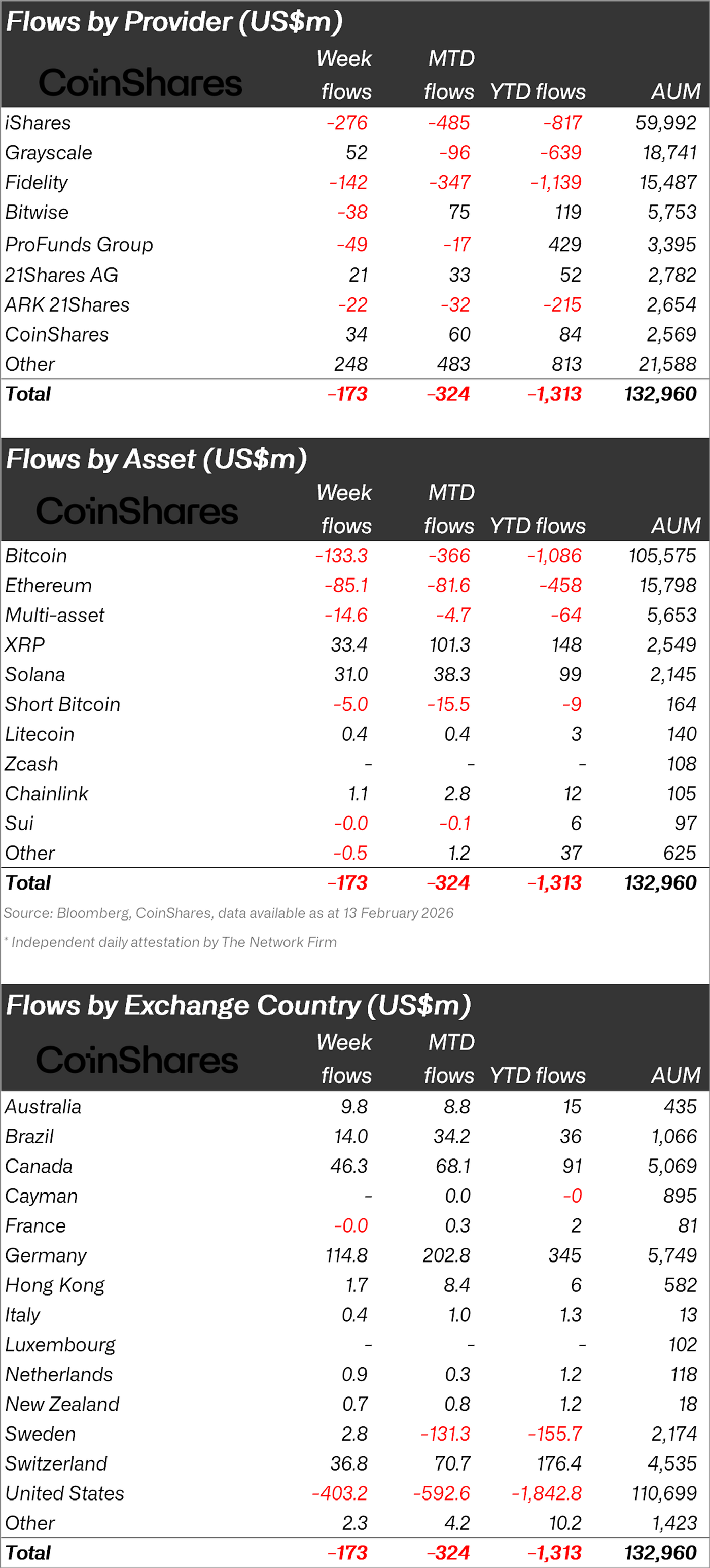
According to the latest weekly report from CoinShares, crypto investment products saw $173 million in outflows last week, extending the four-week total to $3.74 billion. The persistent withdrawals come amid continued weakness in the United States, even as select altcoins show resilience.

Key Points

  • Digital asset funds saw $173M in weekly outflows, marking four straight weeks of investor withdrawals.
  • Bitcoin led losses with $133M in exits, while Ethereum followed with $85M in outflows.
  • XRP defied the trend, attracting $33M in inflows and extending its positive streak.
  • Europe and Canada added exposure as US investors pulled $403M, highlighting regional divergence.

Four Weeks of Pressure, But a Late-Week Bounce

The week started on a stronger footing, with $575 million in inflows. However, sentiment quickly reversed, leading to $853 million in outflows as prices weakened. A softer-than-expected CPI print toward the end of the week helped stabilize markets, triggering $105 million in Friday inflows.

Trading activity also cooled significantly. ETP volumes fell to $27 billion, down sharply from the previous week’s record $63 billion. This signals reduced investor participation.

US Weakness vs. Europe and Canada Strength

The regional breakdown reveals a strong divergence in sentiment. The United States accounted for $403 million in outflows, driving most of the global weakness. In contrast, other regions collectively posted $230 million in inflows. Germany led the way with $114.8 million, Canada followed with $46.3 million, and Switzerland with $36.8 million.

This split suggests that while US investors remain cautious, European and Canadian markets are selectively adding exposure.

Bitcoin and Ethereum Lead Outflows

Bitcoin experienced the largest withdrawals, with $133.3 million exiting investment products last week. Interestingly, short Bitcoin products also registered outflows reaching $15.4 million over the past two weeks

Ethereum followed with $85.1 million in outflows, reflecting broader caution among investors toward major-cap digital assets.

XRP and Solana Stand Out

In contrast, XRP once again attracted strong inflows. XRP-based investment products recorded $33.4 million in inflows last week, pushing month-to-date inflows to $101.3 million and year-to-date inflows to $148 million.

In its previous report, CoinShares revealed that XRP products recorded $63 million in inflows, while Bitcoin recorded $264 million in outflows. In other words, XRP is maintaining the streak of positive inflows even as the overall market bleeds.

Notably, Solana also maintained positive momentum, bringing in $31 million during the week. The continued allocations into XRP and Solana highlight investor preference toward select altcoins.

With total assets under management still at $132.96 billion despite recent outflows, the data suggests that, while macro uncertainty weighs heavily on the broader market, confidence in specific assets like XRP remains intact.