Home Blog Page 28

XRP Sharpe Ratio Spikes to 1-Year Peak: Implications on Price

0

According to recent on-chain data, the XRP Sharpe Ratio on Binance, the world’s largest crypto exchange, has risen to a 1-year peak.

While XRP has pulled back from the $1.69 three-month high it reached during the rally two weeks ago, on-chain data shows that its risk-adjusted performance has improved.

XRP Sharpe Ratio Hits 1-Year Peak

The XRP Sharpe Ratio on Binance has risen to around 0.207, its highest level since August 2025 and a one-year peak for the indicator.

The rise came as XRP’s price recovered to around $1.40, suggesting that the recent price gains also improved returns compared with the level of risk and volatility involved.

Notably, for much of the period since August 2025, XRP’s Sharpe Ratio stayed around negative or neutral levels, with the indicator falling notably during XRP’s broader decline.
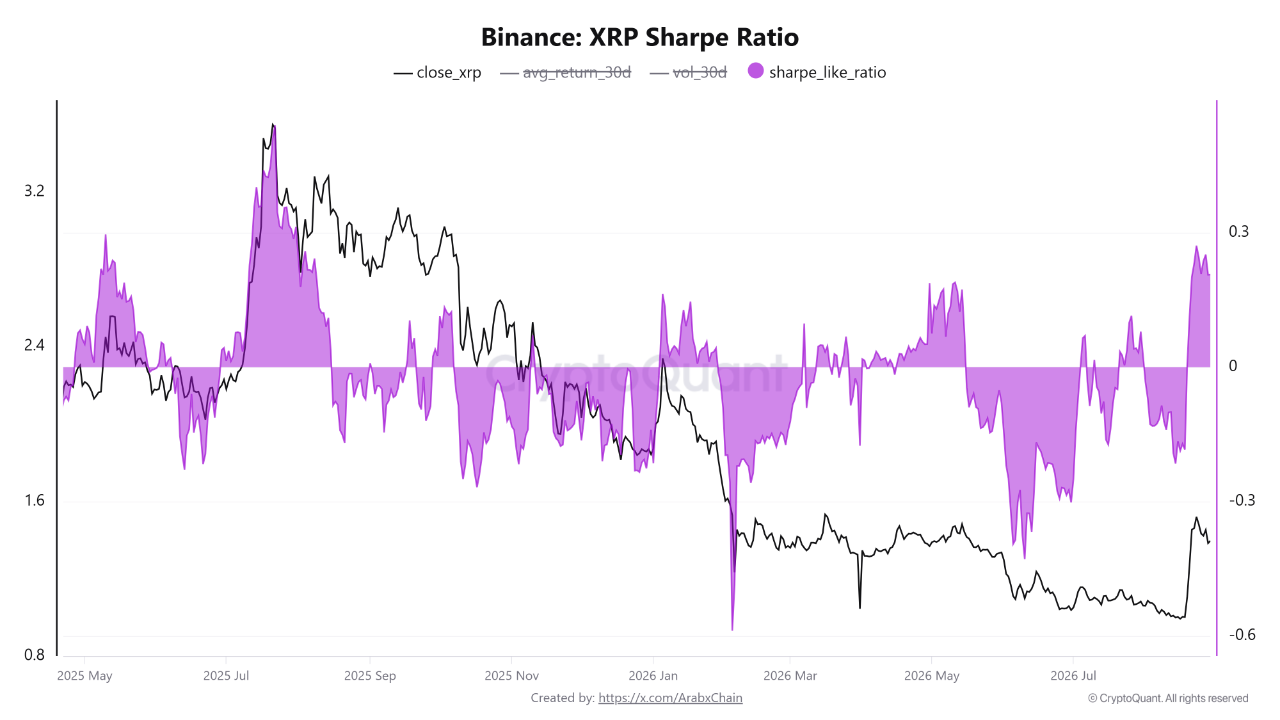
XRP Sharpe Ratio | Source: CryptoQuant

The latest increase shows a change in the relationship between XRP’s returns and volatility. Compared with most of the period since August 2025, investors now see better returns relative to the level of risk associated with XRP.

XRP Sharpe Ratio Surge Comes Along Price Spike

For context, the XRP Sharpe Ratio indicator rose as XRP’s price improved, showing that the recent rally involved more than a simple increase in value. Essentially, XRP also saw better risk-adjusted returns during the move.

Still, a high Sharpe Ratio does not confirm that XRP will continue rising. The indicator could also fall if volatility increases or XRP suffers another sharp correction.

XRP’s latest price action also shows why caution remains necessary. Currently, XRP trades at around $1.35, down 3% over the past 24 hours and 10.20% in the last seven days. 

XRP Faces Support After Rejection at $1.50-$1.55

The latest decline followed XRP’s rejection from the $1.50-$1.55 resistance zone. After briefly reaching $1.69 during the August rally, XRP has started to retrace toward the $1.30 support level. A break below $1.30 could trigger stop-loss selling and potentially push the price toward the $1.25 downside target.

The pullback also follows the rally that pushed the 14-day RSI to 85.41, putting the indicator in extreme overbought territory. Meanwhile, the 38.2% Fibonacci retracement from the August surge sits at $1.42, while the 50% retracement at $1.34 now provides another important support level.

These levels give bulls several areas to defend during the correction. The $1.42 level remains just above XRP’s current price, while $1.34 sits close to the current market level. If sellers push XRP below these areas, attention could shift toward the $1.30 support and eventually the $1.25 target.

Spot Selling Adds Pressure to XRP

Market data also points to strong selling pressure. Spot distribution is currently overwhelming bid-side liquidity, while net sell-side volume remains elevated across major exchanges as traders take profits around key technical levels.

This selling pressure creates an important test for XRP’s improving Sharpe Ratio. Although the indicator points to better risk-adjusted returns, continued spot selling and higher volatility could weaken the improvement. XRP will need stronger buying demand to support its recovery and prevent the current pullback from becoming deeper.

XRP spot ETFs, however, continue to provide a source of demand. XRP spot ETFs recorded $110.49 million in weekly net inflows through Aug. 28, their strongest week of 2026. Those inflows also pushed cumulative ETF inflows to $1.66 billion.

For the short-term outlook to improve, bulls need XRP to reclaim $1.42. Holding the $1.34 50% Fibonacci retracement and the $1.30 support could also help the price stabilize. A break below $1.30, however, could open the way toward the $1.25 target.

Real Trump Coins Denies Role in GOLD Token as Team-Linked Wallets Sell Holdings

0

Real Trump Coins said it had no role in launching, promoting, or authorizing Trump Digital GOLD, distancing itself from the Solana-based token after it appeared across its online presence and subsequently collapsed.

In an X post on Saturday, Real Trump Coins attributed the promotion to “third-party bad actors” and said authorities were involved as it worked to determine what had happened.

Lookonchain Flags Concentrated GOLD Holdings

Blockchain analytics platform Lookonchain reported that, before the sell-off, 82.45% of GOLD’s total supply was held across the developer wallet and newly created addresses.

The firm also said 15 of those wallets, which it identified as being associated with the team, subsequently offloaded their tokens for about $330,000, booking an estimated profit of $312,000.

Meanwhile, questions over the token’s promotion centered on its appearance across multiple Real Trump Coins online platforms. For context, on Saturday, GOLD appeared in promotional posts on the company’s X account, which pointed users to RealTrumpCoins.com. The website also featured the token. However, the X posts were later deleted.

Crypto observer Rune subsequently questioned how both the X account and the domain could have been compromised.

Real Trump Coins Domains Raise Further Questions

The Real Trump Coins X account now links to TrumpCoins.com, a separate domain. However, the account had directed users to RealTrumpCoins.com as recently as Aug. 25 in a post that remained online at the time of publication. 

RealTrumpCoins.com also continued to display the GOLD promotion at the time of publication.

Separately, Trump continued to follow the Real Trump Coins X account, one of 53 accounts he followed on the platform.

David Gokhshtein Doubles Down on Cardano, Hints at Buying More ADA

0

David Gokhshtein has doubled down on his bullish outlook for Cardano, hinting that he could buy more ADA despite criticism from some members of the crypto community.

The host of The Breakdown podcast made the comment after an X user advised him to stay away from Cardano and XRP. Instead of accepting the warning, Gokhshtein replied briefly, “I’ll buy more — thanks.”

Although his response does not confirm that he immediately purchased additional ADA, it shows that the criticism has not changed his view of Cardano.

Gokhshtein Maintains Bullish Cardano Outlook

Gokhshtein’s latest comment came amid a broader debate about Cardano’s ability to recover its previous all-time high.

For context, Cardano reached an all-time high of $3.10 on September 2, 2021. However, ADA has since suffered a significant decline and currently trades around $0.1966. At this price, ADA remains 93.66% below its previous peak.

Consequently, the wide gap has fueled debate over whether Cardano can return to $3.10 during another strong market cycle. Nevertheless, Gokhshtein’s latest response suggests that investors should not automatically dismiss that possibility simply because ADA remains far below its 2021 peak.

Gokhshtein has previously maintained a bullish stance on Cardano. He also argued that the continued attention surrounding ADA shows that the project should not be prematurely written off.

While Gokhshtein has publicly confirmed that he owns ADA and has repeatedly expressed optimism about Cardano, he has not disclosed the exact size of his holdings. Therefore, his latest comment should not be interpreted as confirmation that he has made a specific purchase or increased his position by any particular amount.

Can ADA Reclaim $3.10?

Gokhshtein’s comments have also reignited speculation about whether ADA can eventually reclaim its previous all-time high.

Popular Cardano stake pool operator Sssebi has suggested that ADA could revisit $3.10 and potentially surpass that level during the next major bull market. According to Sssebi, ADA would need to rise roughly 15.8 times from its current price of $0.1962 to return to $3.10.

However, that scenario remains a market projection rather than a certainty. To reclaim $3.10, ADA would likely need to attract substantial new demand while benefiting from stronger broader market conditions and continued growth across the Cardano ecosystem.

More Markets Lending Reserve Drained of $9.3 Million on Flow EVM, Blockaid Says

0

DeFi protocol More Markets had about $9.3 million of digital assets drained from a lending reserve on Flow EVM, according to blockchain security firm Blockaid, which linked the incident to the use of a liquid staking token and an efficiency-mode borrowing feature.

Blockchain data shared by Blockaid on Monday showed about 15.5 million Wrapped Flow (WFLOW) tokens were taken from the mFlowWFLOW reserve. The security firm valued the assets at roughly $9.3 million.

More Markets had not publicly confirmed the incident or said whether users incurred losses at the time of the initial report.

Blockaid Links Drain to ankrFLOW and E-Mode

Blockaid said the attacker used Ankr Staked FLOW (ankrFLOW), a liquid staking token, together with E-mode to borrow more assets from the reserve.

E-mode, or efficiency mode, is a feature introduced in Aave V3 that allows greater borrowing capacity for assets expected to maintain correlated prices, including a liquid staking token and its underlying asset.

August Crypto Hack Losses Reach $139.7 Million

The incident added to a string of crypto exploits in August. Cryptocurrency hack losses for the month reached $139.7 million, the third-highest monthly total of 2026, according to DefiLlama data. That remained below the $254 million recorded in July. 

The broader security concerns extended into the weekend. On Sunday, Cronos halted its blockchain after an exploit involving the lending protocol Tectonic. The Tectonic incident was estimated at $75 million, though the protocol had not confirmed the amount.

XRP Must First Drop to Retest the 300WMA Before a Surge to the Chasm at $50

0

XRP has the potential to rally toward a two-digit price target, but it may first need to correct further to retest support at the 300WMA.

After rising to a three-month high of $1.69 two weeks ago, XRP ran into resistance at this level and started to pull back. The correction has now lasted nine days, with XRP falling to $1.3680 at the time of writing. Despite the recent decline, XRP remains up nearly 29% in August.

However, market analyst EGRAG believes the price may have more room to fall before the next major upsurge. To him, XRP could decline toward the $1.00-$1.10 range, where it would retest the 300-week moving average (300W MA). 

XRP Could Follow the 2020/2021 Pattern

Notably, the idea comes from how XRP behaved around the 300W MA in previous market cycles. EGRAG believes the current market may be approaching a similar retest phase. 

Historically, XRP has moved through several stages: it first breaks above and reclaims the 300WMA, then returns to test the level as a fear-driven event or major news creates more volatility. If the level holds, XRP can build strength and eventually move into a larger expansion.

This pattern played out during the 2020/2021 cycle. Notably, XRP reclaimed the 300WMA in July 2020 and moved above the indicator as its price climbed toward a high around $0.79 by November 2020. 

The market then collapsed, with XRP falling back to retest the 300WMA at around $0.17 in December 2020. Bearish reports linked to the SEC’s lawsuit against Ripple added to the selling pressure at the time.

XRP and the 300W MA | Source: EGRAG Crypto
XRP and the 300WMA | Source: EGRAG Crypto

Despite the negative news and multiple delistings from U.S. exchanges, XRP held its structure around the 300W MA and continued to use the level as support. By January 2021, XRP had started to recover, eventually reaching a new high of $1.96 by April 2021.

XRP Faces the 300WMA at $1.03

Data from the chart shows that the 300W MA currently sits at around $1.03, and the moving average continues to rise. Because of this, EGRAG does not consider a drop toward $1.00-$1.10 automatically bearish. However, he sees it as a possible retest of an important long-term indicator.

If XRP returns to that area, trades around the level through short-term wicks, and then moves back above the 300W MA, the move could provide the confirmation needed. From there, the roadmap points to $1.65 as the first major level XRP needs to reclaim, followed by $2.00-$2.80 as the next major area of resistance.

A break through those levels could then open the larger price channel. EGRAG’s longer-term roadmap places potential targets at $15, $27, and $50. These targets align with the Chasm line, which has acted as XRP’s target level since 2017.

EGRAG also mentioned the possibility that negative news surrounding the Clarity Act, or another major headline, could trigger the volatility necessary for XRP to return to the $1.00-$1.10 area. 

However, he admitted that the chart cannot predict what news will emerge. Essentially, the 300WMA near $1.03 represents the first major level to watch if the correction continues. If XRP holds the moving average, its broader bullish structure could remain intact.

Sberbank Forecasts $46 Billion in Crypto Trading on Russia’s Regulated Exchanges in First Year of New Rules

0

Sberbank expects cryptocurrency trading on Russia’s regulated exchanges to reach 3.5 trillion to 4 trillion rubles ($40.6 billion-$46.4 billion) during the initial 12 months after the country’s new digital-asset rules take effect on Sept. 1, Deputy Chairman Anatoly Popov told state news agency TASS.

The lender’s SberCIB Investment Research unit estimates exchange-based volume could rise to between 4.75 trillion and 5.25 trillion rubles by 2028 and reach about 7.5 trillion rubles ($87.1 billion) in 2029.

Popov cited Russian Finance Ministry data showing cryptocurrency transactions in the country at about 50 billion rubles a day as of February, equivalent to roughly 18 trillion rubles annually. SberCIB expects only about 20% of that activity to move onto regulated exchanges initially, with a substantial share continuing through other crypto exchange services.

Sberbank Prepares Crypto Lending and Wallet Services

Sberbank also plans to expand lending secured by digital assets under the new regulatory framework. Popov said the lender intends to accept Bitcoin, Ethereum and the USDT stablecoin as collateral, adding that Ethereum and USDT would be introduced after the Bank of Russia permits their public circulation.

The bank has already gained experience with cryptocurrency-backed lending and plans to adapt its existing products as the regulatory provisions take effect, Popov said.

Sberbank is separately preparing cryptocurrency infrastructure for customers. The lender plans to integrate a crypto wallet into its Sber and Sber Investments applications and have digital-asset depository infrastructure ready by early December.

The bank has offered qualified investors structured bonds and digital financial assets linked to Bitcoin and Ethereum since 2025.

Russia’s Crypto Framework Takes Effect Sept. 1

President Vladimir Putin signed legislation on Aug. 4 establishing Russia’s first comprehensive regulatory framework for digital currencies and digital rights. Its core provisions take effect on Sept. 1, 2026, while other requirements will be phased in during 2027.

Under the framework, non-qualified investors can purchase approved cryptocurrencies through regulated intermediaries, subject to an annual limit of 300,000 rubles per intermediary and investor testing requirements. Qualified investors can buy cryptocurrencies without that investment cap after completing required testing.

Russia will continue to prohibit cryptocurrency as payment for goods and services domestically. The legislation permits certain exceptions, including crypto settlements under foreign-trade contracts between Russian residents and non-residents.

Existing crypto service providers have until July 1, 2027, to comply with registration requirements. A separate transition deadline of March 1, 2027, applies to existing digital financial asset exchange operators, while certain technical provisions governing digital financial assets take effect on Sept. 1, 2027.

XRP ETFs See Record $110 Million Weekly Inflows, Biggest of 2026

0

U.S. spot XRP exchange-traded funds (ETFs) recorded a major rebound in investor demand last week.

They attracted $110.49 million in net inflows, as institutional interest accelerated alongside XRP’s sharp price rally. The latest weekly inflow figure marks a significant turnaround from the previous week, when XRP ETFs recorded just $39.78 million in net inflows. 

Week over week, inflows rose 177.7%. The recovery is even more notable compared with the week before, when XRP ETF inflows stood at only $2.25 million.

Remarkably, this is the largest weekly inflow of 2026. The latest figures suggest that demand for investment products offering exposure to XRP has strengthened considerably. 

XRP ETF Inflows Jump as Demand Accelerates

The latest inflows were supported by several major U.S. spot XRP ETFs.

On Friday alone, XRP ETFs recorded approximately $26.20 million in net inflows. This pushed cumulative inflows since launch to around $1.66 billion.

Bitwise’s XRP ETF led Friday’s inflows with $15.40 million, bringing its cumulative net inflows to approximately $602.63 million.

Franklin Templeton’s XRP ETF attracted another $2.99 million, lifting its cumulative inflows to $62.86 million. Canary Capital’s XRP ETF recorded $5.12 million in inflows, bringing its cumulative total to roughly $483 million.

Meanwhile, the 21Shares XRP ETF recorded $2.69 million in inflows on Friday. Despite the latest addition, its cumulative net flow remains negative at approximately $17.37 million. Grayscale’s XRP ETF recorded no inflows on Friday, while its cumulative inflow total stood at approximately $137.67 million.

Together, the figures highlight the demand for XRP exposure through regulated investment products.

Monthly XRP ETF Inflows Also Reverse Sharply

The improvement is not limited to weekly flows. XRP ETFs have now recorded $153.54 million in monthly inflows. This is a dramatic increase from the $27.29 million recorded in the previous month.

June also saw stronger demand than July, with approximately $59.46 million in inflows.

The sharp reversal suggests institutional and traditional-market demand for XRP exposure strengthened substantially in August. The trend coincided with one of XRP’s strongest rallies of the month.

XRP Weekly inflow
Largest Weekly XRP ETFs inflow of 2026

XRP Rallied More Than 71% Before Correction

Notably, XRP climbed from approximately $0.9888 on August 18 to $1.70 on August 22, representing a gain of about 71.9% in just four days.

However, the rally was followed by a sharp correction. XRP has since fallen more than 20% from the $1.70 peak, trading around $1.37.

Despite the correction in the spot market, the surge in ETF inflows provides a constructive signal for XRP bulls.

Weekly inflows rose from $2.25 million to $39.78 million, then to $110.49 million, showing that demand for XRP investment products has accelerated.

Rather than entering the correction with weakening institutional demand, XRP is now seeing substantially stronger ETF participation. Continued ETF inflows could provide a source of persistent buying pressure and help XRP recover from its recent decline.

Cardano Founder Says He Was Once Among Bitcoin Largest Holders With 108K BTC

0

Cardano founder Charles Hoskinson suggested that his longstanding network within the Bitcoin community could give Cardano an advantage in the race to build Bitcoin DeFi.

Speaking recently on The Breakdown podcast, Hoskinson revealed that he was once among the world’s largest Bitcoin holders. He noted that Cardano’s early crowdsale controlled 108,000 Bitcoin. He explained that funds raised in Japanese yen during the crowdsale were converted into Bitcoin, resulting in the massive holding.

At Bitcoin’s price of roughly $250 at the time, the 108,000 BTC would have been worth about $27 million. Hoskinson also recalled discussing the holding with BitGo CEO Mike Belshe, describing the period as a “wild time.”

However, Hoskinson did not clarify whether he or any entity associated with the Cardano project still holds the Bitcoin. Notably, he suggested that his early involvement in Bitcoin helped him build longstanding relationships with major holders across the ecosystem. He believes those connections could become valuable as Cardano seeks to attract Bitcoin liquidity into DeFi.

Cardano Targets Bitcoin’s Idle Liquidity

According to Hoskinson, Bitcoin holders could allocate capital to DeFi if Cardano delivers products that offer compelling, reliable yield opportunities.

At the same time, he stressed that Bitcoiners want DeFi solutions that respect Bitcoin’s core principles. These include self-custody, control over assets and properly structured lending, without requiring changes to Bitcoin or forcing users into specific Layer-2 solutions.

That vision aligns with Pogun, an initiative by Input Output Group designed to connect Bitcoin’s idle liquidity to Cardano’s DeFi ecosystem while allowing users to retain custody of their private keys.

Pogun Advances Toward Bitcoin DeFi

Pogun’s 2026 roadmap includes a non-margin, oracle-free credit market in Q2, followed by a fixed-term yield DApp in Q3. The initiative is also targeting a BitVM-based, trust-minimized Bitcoin bridge in Q4.

Hoskinson has additionally highlighted major improvements in the technology supporting Cardano’s Bitcoin DeFi strategy. He said the size of a Bitcoin DeFi proof has fallen from 40 GB to 28.1 MB, while validation time has dropped from roughly 354 seconds to 0.149 seconds.

The cost of validating a transaction has also reportedly declined sharply, from around $14,000 to $37.

$1.5B Potential Demand

Meanwhile, Pogun CEO Omer Husain recently said the project is already building its loan book ahead of launch. According to Husain, its founding borrowers have indicated $500 million in demand, while regulated institutions on the lending side have expressed interest in providing up to $1 billion.

The reported demand and technological improvements could strengthen Cardano’s efforts to tap Bitcoin’s vast liquidity pool. However, the success of that strategy will ultimately depend on whether Pogun and other Cardano-based Bitcoin DeFi products can deliver the security, custody, and lending standards Bitcoin holders expect. 

Michael Saylor Signals Strategy Is ‘Back’ to Bitcoin Buying

0

Strategy Executive Chairman Michael Saylor has fueled expectations that the company could resume buying Bitcoin after posting “We’re Back” on X, following a roughly two-month pause in its accumulation program.

The message did not disclose a purchase or specify the size or timing of any potential transaction. Saylor has previously posted brief weekend messages ahead of Strategy’s Monday treasury disclosures, prompting market participants to interpret the latest post as a possible signal of renewed buying.

Strategy Built Dollar Liquidity During Buying Pause

Strategy shifted its focus to liquidity and balance-sheet management during its recent pause in Bitcoin purchases.

Specifically, the company increased its U.S. dollar reserve to $5.1 billion and established a separate $1.59 billion cash pool using proceeds from common-stock sales. The additional liquidity can be used for purposes including Bitcoin purchases, while the existing reserve is primarily intended to cover preferred-stock dividends and interest obligations.

Strategy currently holds 840,447 Bitcoin acquired at an average cost of about $75,385 per coin, giving it the largest Bitcoin position among publicly traded corporate holders.

Bitcoin Recovery Lifts Strategy Holdings Above Cost

Saylor’s post came after Bitcoin recovered above Strategy’s average acquisition price, reversing paper losses on the company’s holdings. 

Bitcoin recently moved above $80,000 after trading below Strategy’s cost basis during the summer. The rebound put the company’s Bitcoin position back into unrealized profit.

Any resumption of purchases remains unconfirmed until Strategy reports a transaction. Saylor’s post did not provide a purchase price, Bitcoin amount, or other transaction details.

Cronos Halts Network After Tectonic Exploit, Researcher Estimates $75M Loss

0

Cronos halted its blockchain on Sunday after detecting an exploit involving the decentralized lending protocol Tectonic, while on-chain researcher Weilin Li estimated that about $75 million in assets were affected.

Tectonic advised users not to interact with the protocol while it investigates the exploit. Neither Tectonic nor Cronos had confirmed the cause or total losses, and no timetable for restarting the network had been announced. 

Researcher Traces Exploit to TONIC Price Manipulation

Li attributed the exploit to manipulation of TONIC, Tectonic’s governance token, which had a 20% collateral factor despite limited market liquidity.

According to Li, the attacker drove TONIC’s price roughly 100-fold higher in about 20 minutes, then used the inflated collateral value to borrow other assets from Tectonic. He characterized the method as similar to the pump-and-borrow strategy used in the Mango Markets exploit.

Li initially estimated that about $66 million was affected. He said roughly $6 million was bridged to Ethereum before Cronos stopped the network, leaving about $60 million on Cronos. His estimate later rose to approximately $75 million after he found an additional address linked to the attacker that held about $8 million.

Crypto.com Says App and Exchange Unaffected

Crypto.com Chief Executive Kris Marszalek said the company’s app and exchange continued operating normally and that funds held through those services were safe.

Cronos and Tectonic had not disclosed whether they planned to restrict the identified attacker addresses, seek the return of the funds, or reimburse users affected by the exploit.