Home Blog Page 284

BTCL Network Targets Execution Efficiency Through Lightweight Routing

0

Transaction systems tend to degrade when too many responsibilities are forced into a single layer. Networks tasked with validating, settling, and executing activity simultaneously often perform well at low volumes, but exhibit increasing friction as throughput rises. Delays, cost spikes, and inconsistent confirmation behavior are symptoms of structural overload rather than isolated inefficiencies.

BTCL approaches this constraint by narrowing its operational scope. Instead of attempting to change settlement mechanics, the network focuses on execution handling. Transaction flow is coordinated through a dedicated routing environment designed to absorb short-interval demand without pushing congestion back into settlement.

Execution Load and Cost Predictability

As activity increases across any shared execution surface, cost behavior becomes harder to forecast. Users and operators are forced to respond to fluctuating confirmation times and pricing conditions that are not directly tied to their own usage patterns. Over time, this uncertainty discourages consistent participation and complicates infrastructure planning.

BTCL’s routing layer is designed to operate independently of settlement congestion. Transactions are coordinated across a distributed node set and confirmed through a defined quorum process that prioritizes completion speed and cost consistency. This execution pathway is intentionally constrained: it does not modify validation logic, alter settlement rules, or introduce discretionary fee markets.

Where required, routed activity can be referenced back through optional anchoring, preserving traceability without forcing every transaction through the same confirmation bottleneck.

BTCL Tokenomics and Presale Structure

BTCL operates with a fixed supply of 21,000,000,000 tokens, with distribution parameters defined in advance to support infrastructure deployment and ongoing network operation. Allocation is structured as follows: 45% public presale, 20%node rewards and network incentives, 15% liquidity provisioning, 10% team allocation under vesting conditions, and 10% reserved for ecosystem development and treasury use. 

Presale distribution follows a staged release schedule: 20% unlocked at TGE, with the remaining 80% released linearly over 6–9 months. Team allocations follow a 12-month cliff with 24-month vesting thereafter. 

BTCL utility is functional and network-scoped. The token is used for routing fees, node participation thresholds, performance-based incentives, and anchoring operations tied to execution-layer activity.

Routing Nodes and Participation Tiers

Execution coordination within the BTCL network is handled by specialized routing nodes. These nodes are not responsible for maintaining full settlement history. Their role is limited to transaction coordination, confirmation signaling, and availability.

Participation is structured across defined tiers. Nodes that meet higher operational requirements are assigned increased routing capacity and expanded responsibilities. This model links execution throughput to measurable participation, not just speculative capacity expansion, with the goal of maintaining stable confirmation behavior under load.

Security Review and Project Verification

BTCL-related contracts have undergone external technical review by multiple independent auditing firms, including SpyWolf Audit and SolidProof Audit. These assessments focus on contract logic, access control design, and deployment configuration to confirm that the system behaves as documented at this stage of development.

In parallel, project identity verification has been completed through third-party providers, including SpyWolf KYC Verification and Vital Block KYC Validation. This step establishes accountability and disclosure standards before network participation expands and infrastructure roles scale.

Together, these reviews provide an external checkpoint on implementation accuracy and project transparency during early deployment, setting a baseline for evaluation as development and participation progress.

Execution Scope Without Settlement Risk

Networks that attempt to resolve execution constraints by changing settlement behavior often introduce additional risk surfaces. BTCL avoids that tradeoff by keeping its scope tightly defined. The network focuses on execution stability and predictable cost behavior while leaving settlement mechanics untouched.

As infrastructure evaluation standards mature, constraint-first design is increasingly viewed as an intentional architectural decision. Limiting scope has become a way to reduce systemic risk and preserve reliability under load, not a signal of incomplete design.

Technical documentation, audit reports, and node participation details for the BTCL network are available through the project’s official channels.

Website
Security
How to Buy

Disclaimer: This Press release article is provided by the Client. The Client is solely responsible for this page’s content, quality, accuracy, products, advertising, or other materials. Readers should conduct their own research before taking any actions related to the material available on this page. The Crypto Basic is not responsible for the accuracy of info and any damage or loss caused or alleged to be caused by the use of or reliance on any content, goods, or services mentioned in this press release article.

Please note that The Crypto Basic does not endorse or support any content or product on this page. We strongly advise readers to conduct their own research before acting on any information presented here and assume full responsibility for their decisions. This article should not be considered investment advice.
Investors Pull $1.7B From Crypto Funds as YTD Flows Turn Negative

0

Crypto investment products have extended their losing streak, as investors withdrew significant capital for a second consecutive week amid mounting macroeconomic and market pressures.

According to asset manager CoinShares, global digital asset investment products recorded roughly $1.7 billion in outflows over the past week. Consequently, year-to-date flows have slipped into negative territory, with net outflows now totaling about $1 billion.

Key Points

  • Global digital asset investment products saw approximately $1.7 billion in outflows over the past week.
  • Year-to-date fund flows have turned negative, totaling roughly $1 billion in net outflows.
  • Assets under management have fallen by about $73 billion since peaking in October 2025.
  • U.S.-listed crypto products recorded around $1.65 billion in outflows in a single week.
  • Bitcoin investment products lost approximately $1.32 billion, the largest weekly outflow among digital assets.

Macro Pressures Weigh on Crypto Funds

The latest wave of selling comes as markets adjust to a more restrictive outlook from the U.S. Federal Reserve. CoinShares also cited distribution by large holders as well as rising geopolitical risks as key drivers of the pullback.

Together, these factors have triggered a sharp contraction in assets under management. Specifically, since peaking in October 2025, total holdings across crypto investment products have declined by approximately $73 billion.

The United States led the withdrawals, with about $1.65 billion exiting U.S.-listed products in a single week. Canada and Sweden also saw notable outflows, totaling roughly $37.3 million and $18.9 million, respectively.

In contrast, parts of Europe showed relative resilience. Switzerland attracted inflows of about $11 million, while Germany recorded approximately $4.3 million in new investments, highlighting uneven regional sentiment.

Bitcoin and Ethereum Lead Broad-Based Withdrawals

Selling pressure was widespread across major digital assets. Bitcoin products bore the brunt of the redemptions, shedding around $1.32 billion during the week. Ethereum followed with outflows of approximately $308 million.

Other tokens that had drawn attention earlier in the cycle were not immune. XRP-linked products saw withdrawals of roughly $43.7 million, while Solana products lost close to $31.7 million over the same period.

Still, a handful of segments moved against the broader trend. Short Bitcoin products attracted about $14.5 million in inflows.

CoinShares noted that assets in these products are now up more than 8% year-to-date. Meanwhile, hype-focused investment products gained approximately $15.5 million, reflecting increased on-chain activity linked to tokenized precious metals.

US Spot Bitcoin ETFs Under Pressure

The broader market weakness has also weighed heavily on U.S. spot Bitcoin exchange-traded funds. Bitcoin is now trading below the average acquisition cost of these ETFs, after experiencing their second- and third-largest weekly outflows ever recorded last month, according to Alex Thorn, head of research at Galaxy.

U.S. spot Bitcoin ETFs currently manage about $113 billion in assets and collectively hold roughly 1.28 million Bitcoin. Based on those holdings, the estimated average purchase price is around $87,830 per coin. With market prices below that level, the average ETF position is now underwater, Thorn said.

Outflows from these products have accelerated in recent weeks. Data from CoinGlass show that U.S. spot Bitcoin exchange-traded funds have seen net outflows of roughly $2.8 billion over the past two weeks. Of this total, about $1.49 billion exited in the most recent week, with $1.32 billion leaving the week prior.

Despite the drawdown, some signs of institutional resilience remain. Since October, the total value held in spot Bitcoin ETFs has dropped by roughly 31.5% from a high near $165 billion, while Bitcoin’s market price has slipped about 40%.

Nevertheless, cumulative ETF inflows remain only about 12% below their peak, suggesting that long-term investors have largely maintained their positions, according to Galaxy Research.

White House Meets Crypto Firms and Banks as Stablecoin Yield Battle Intensifies

0

The White House is set to host a meeting today at 1 p.m. ET with representatives from crypto firms and traditional banks.

According to the host of Crypto in America, Eleanor Terrett, the discussion will focus on stablecoin yield. This issue has become one of the biggest obstacles to U.S. crypto market structure legislation.

Key Points

  • White House meets crypto firms and banks today as the fight over stablecoin yield heats up.
  • Stablecoin yield has become a major roadblock to passing U.S. crypto market rules.
  • Banks warn yield-bearing stablecoins could drain trillions from traditional finance.
  • The meeting may shape stablecoin rules and the future of crypto legislation.

Stablecoin Yield

Banks have been aggressively lobbying lawmakers to ban stablecoin yields. They believe interest-bearing digital dollars could trigger massive deposit outflows from traditional banking systems. 

Estimates from Standard Chartered suggest unrestricted stablecoin yields could drain as much as $500 billion from developed economies and up to $1 trillion from emerging markets by 2028.

However, crypto firms see the push for a ban as an attempt to suppress competition rather than protect financial stability. They argue that yield-bearing stablecoins are a natural evolution of digital finance and a key innovation for users in both developed and emerging markets.

Industry Not Fully Aligned on Yield

Despite the crypto industry’s resistance to yield restrictions, not all players are on the same side. Tether recently signaled support for a draft U.S. crypto bill that includes a prohibition on stablecoin yields.

The White House meeting aims to reduce friction between the two industries and encourage open dialogue. Senior policy officials and major trade associations from both banking and crypto are set to participate in today’s meeting.

Senate Pushes Ahead Despite Partisan Divide

The meeting comes amid recent momentum in Congress. On January 29, the U.S. Senate Agriculture Committee advanced its version of a crypto market structure bill on a party-line vote. This is the first time such legislation has passed a Senate committee.

The bill would grant the CFTC authority over digital commodities and establish a regulatory framework for spot crypto markets. However, the Senate Banking Committee, where the stablecoin yield debate is most contentious, has yet to move forward with its companion bill.

Meanwhile, Democrats have flagged concerns over ethics, DeFi provisions, and the lack of rules to stop public officials from profiting from crypto projects. None of their proposed amendments passed during the Agriculture Committee vote.

Ultimately, as banks and crypto firms battle behind the scenes, today’s White House meeting could be crucial in shaping stablecoin rules.

Bitcoin Drops Below 1-Year Holders’ Realized Price for First Time Since Sept 2023

0

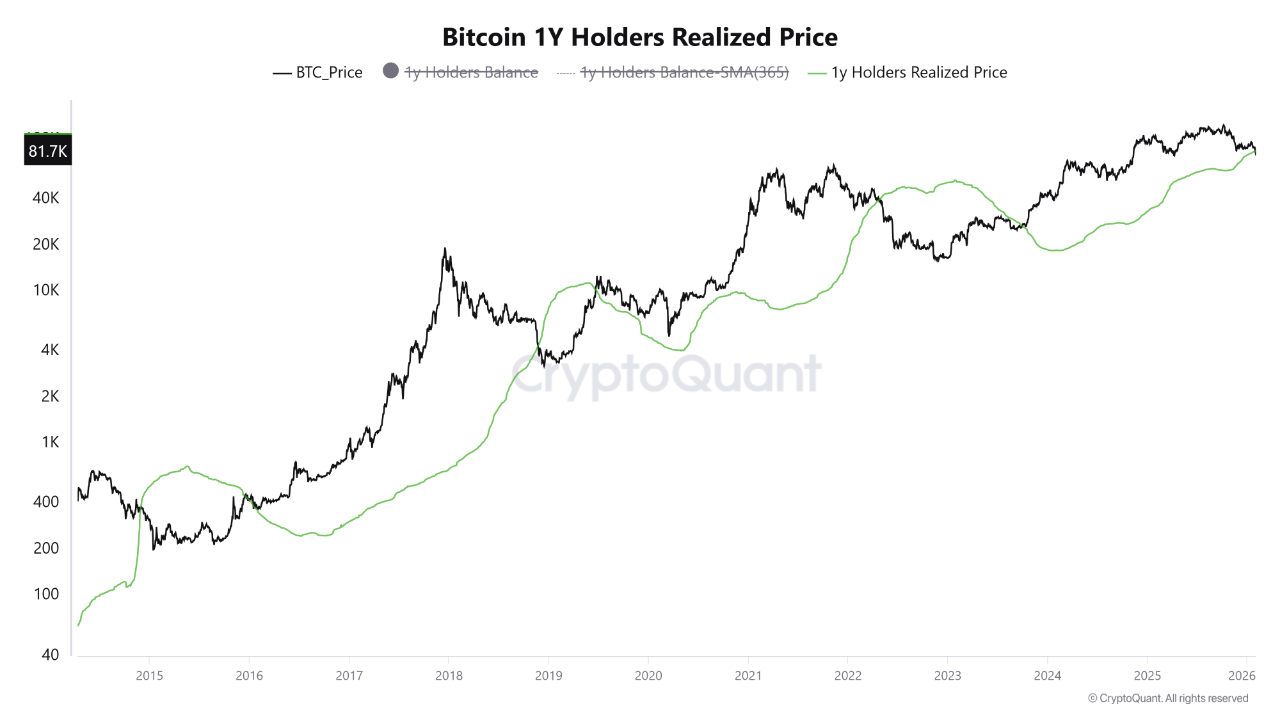
Amid the renewed selling pressure, Bitcoin has now slipped below the realized price of 1-year holders for the first time since September 2023.

For context, Bitcoin entered a new bearish phase over the past week after a brief recovery pushed prices above $90,000 on Jan. 28. The rebound failed to hold, and selling pressure quickly returned. From Jan. 29 onward, Bitcoin recorded four straight intraday losses, driving a sharp 14.42% decline over the period.

On-chain data now shows Bitcoin has fallen below the realized price of 12-18 month holders at $84,462, pushing this key investor group into losses for the first time in over a year. Notably, this development has historically aligned with extended bearish phases.

Key Points

  • Bitcoin has fallen 14.42% since Jan. 29 after a failed move above $90,000 last week.
  • The price has now dropped below the 12-18 month holders’ realized level of $84,462 for the first time since September 2023.
  • A similar breakdown in 2022 preceded a fall from about $42,000 in April 2022 to $15,479 by November 2022, worsened by the Terra collapse in May and the FTX crash in November.
  • Accumulation among 12-18 month holders has slowed, with one-year holders selling 37,263 BTC over 30 days.
  • The $84,462 mark now acts as resistance, with rallies likely to struggle until Bitcoin reclaims this level with stronger buying momentum.

Price Falls Below the 12-18 Month Holders’ Cost Basis

Pseudonymous analyst Crazy Block highlighted this trend in a recent CryptoQuant analysis. According to him, Bitcoin has dropped below the realized price of holders who acquired coins between 12 and 18 months ago. 

This group represents medium-term investors whose cost basis often indicates cycle stability and long-term conviction. Specifically, their realized price currently stands at $84,462, while Bitcoin trades far below that level at $78,275.

Bitcoin 1-Year Holders Realized Price CryptoQuant
Bitcoin 1-Year Holders Realized Price | CryptoQuant

This marks the first time since September 2023 that Bitcoin has slipped under this specific realized price threshold. After breaking above it in late 2023, Bitcoin remained consistently higher until the latest sell-off. With the price now below this level, the entire cohort has moved into unrealized losses.

Historical Context Points to Deeper Bearish Phases

Crazy Block noted that previous instances where Bitcoin broke and stayed below this cost basis typically led to extended bearish regimes. The most notable instance occurred during the 2022 bear market. 

In mid-2022, Bitcoin lost this same support zone and went on to plunge from about $42,000 in April 2022 to $15,479 by November 2022. However, this collapse played out alongside major market shocks, including the Terra ecosystem failure in May 2022 and the FTX exchange collapse in November 2022. 

Accumulation Slows as Conviction Weakens

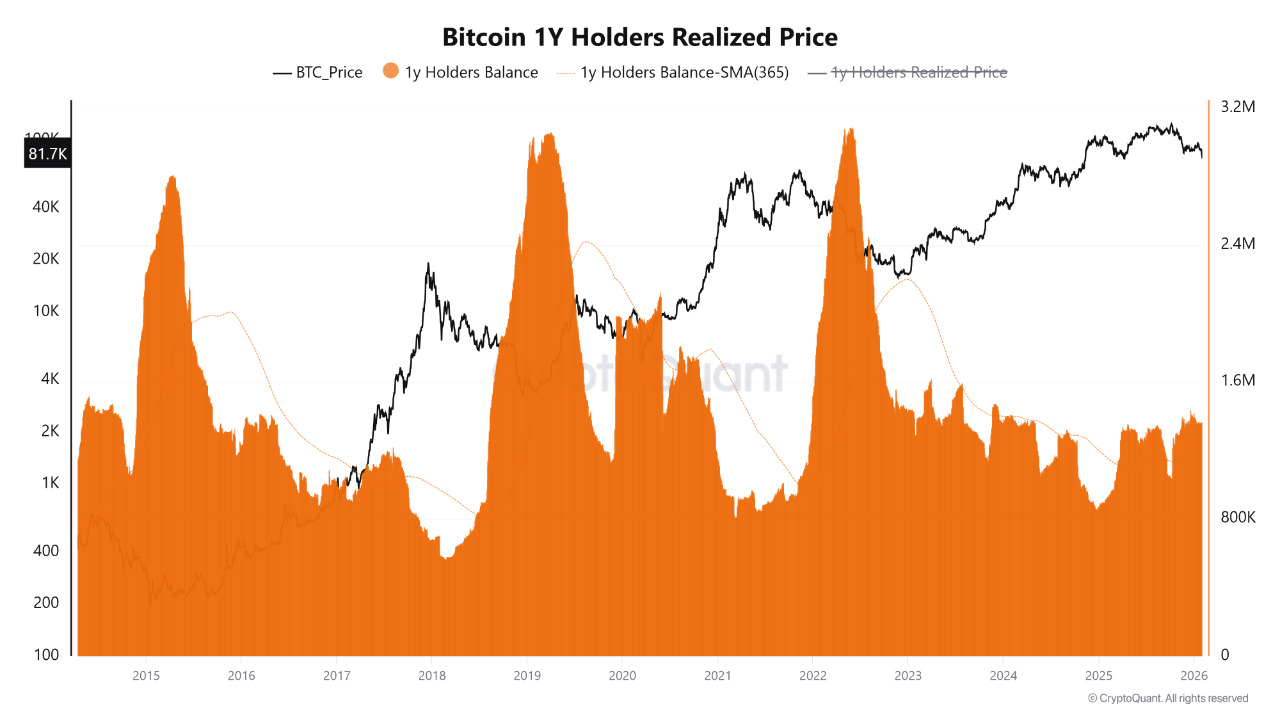
Meanwhile, supply data shows that the 12-18 month holder group still controls a large portion of Bitcoin’s circulating supply, and their 30-day balance change remains positive. 

However, the pace of accumulation has slowed noticeably. According to Crazy Block, this indicates a drop in marginal conviction. Notably, this pattern often comes before wider distribution phases in previous cycles.

Bitcoin 1-Year Holders Balance CryptoQuant
Bitcoin 1-Year Holders Balance | CryptoQuant

At the same time, one-year holders have begun trimming exposure. Over the past 30 days, this group offloaded 37,263 BTC, reducing their total balance to 1.354 million BTC.

Realized Price Turns into Overhead Resistance

Now, the realized price for the 12-18 month cohort has remained relatively flat near $84,462, confirming it has now flipped to resistance. Historically, when Bitcoin trades below a stable or rising realized cost basis, relief rallies often fail as investors look to exit positions near breakeven levels.

Crazy Block emphasized that the combination of negative unrealized profits, slowing balance growth, and price staying below realized cost has consistently aligned with prolonged bearish phases. 

Until Bitcoin decisively reclaims this level with renewed accumulation strength, the market structure could continue to favor consolidation, fragile rebounds, and heightened downside risk instead of a confirmed recovery.

What Next for Bitcoin?

Meanwhile, CryptoQuant CEO Ki Young Ju recently stressed that Bitcoin has continued to witness a lack of fresh capital inflows. He explained that Realized Cap has flattened, indicating that new money has stopped entering the market. 

As the Bitcoin market cap falls in such an environment, the conditions no longer resemble a bull market. He added that early holders have taken profits since early last year after ETF-driven demand and Strategy purchases pushed Bitcoin near $100,000. 

Downside pressure has increased as those inflows dry up. While Ju noted that he does not expect a 70% crash like previous cycles unless Michael Saylor sells aggressively, he expects a broad sideways consolidation as the bear market develops.

Market veteran Michaël van de Poppe observed that Bitcoin historically follows gold after major peaks and suggested that once Bitcoin reclaims the $88,000 level, Ethereum typically gains strength as well. Van de Poppe said he does not expect new all-time highs for gold and silver during 2026, and this could ultimately redirect capital flows back into crypto.

Fundstrat’s Tom Lee Sees Crypto Prices Catching Up to Strong Fundamentals

0

Fundstrat’s head of research, Tom Lee, argues that crypto may be nearing a bottom and could rebound as fundamentals strengthen. 

He shared this view while assessing current market conditions on CNBC, noting that improving fundamentals could act as near-term catalysts for a recovery.

Key Points

  • BitMine is currently facing nearly $7 billion in unrealized losses amid the ongoing crypto downturn.
  • Tom Lee attributed the decline to a strong rally in precious metals and rising policy uncertainty in Washington.
  • Meanwhile, Lee believes crypto prices may be approaching a market bottom.
  • He expects a rebound if underlying fundamentals continue to strengthen.

Factors Behind Crypto’s Decline

Over the past weeks, the crypto market has suffered devastating downturns. Billions of dollars have been wiped out since October 2025 after Bitcoin hit an all-time high near $126,000.

Meanwhile, Lee’s Ethereum treasury firm, BitMine, has taken a hit and is currently sitting on an unrealized loss of $6.95 billion.

Reacting, he said the recent crypto downturn has been deeper than expected, largely due to the absence of leverage in the market. He explained that crypto’s earlier deleveraging in October 2025 amplified the decline, while strong rallies in gold and silver diverted capital away from digital assets. As a result, prices weakened despite positive fundamentals.

In addition, Lee highlighted rising policy uncertainty in Washington, particularly decisions that “pick winners and losers,” among key drivers of volatility across risk markets.

Weakness May Signal a Market Bottom

However, Lee suggested that the recent pause in the gold and silver rally could ultimately benefit crypto. He believes the current weakness in crypto prices may be setting the stage for a market bottom.

He cited timing and valuation signals from a BitMine crypto adviser, who has projected that Bitcoin will fall to $77,000 and Ethereum to $2,400 since mid-November.

According to Lee, this alignment could occur this weekend, as crypto has fallen enough to drain remaining bearish momentum. Consequently, he believes the market is entering a bottoming phase rather than facing a deeper sell-off.

Fundamentals Remain Supportive for a Rebound

Notably, Lee emphasized that the fundamental backdrop remains supportive, pointing out that the U.S. economy is still in good shape. Moreover, he highlighted Ethereum’s rapidly rising active addresses, driven by Wall Street’s active development of products and infrastructure on the network, as clear evidence of strengthening fundamentals.

According to Lee, this acceleration reflects deepening institutional adoption. As a result, he projected that if these fundamentals remain intact, crypto prices are likely to follow and rebound in the near term.

XRP at a Crossroads: Why the $1.60 Level Matters Most Right Now

0

XRP is once again at a critical decision point, with analysts closely watching whether bulls can defend a key price zone that could determine the next major move.

XRP is now trading at $1.64 after recovering slightly from a dip to $1.53 over the weekend. At this stage, the coin is approaching a pivotal moment.

Key Points

  • XRP trades at $1.64 as analysts watch whether bulls can defend the critical $1.60 support zone.

  • Losing $1.60 could send XRP down toward $1.15, a key trendline.

  • Holding $1.60 keeps XRP’s bullish structure intact and allows for higher lows to form.

  • After four red monthly candles, history suggests a 70% chance XRP rebounds this month.

The Battle at $1.60 Intensifies

According to analyst Matt Hughes, the $1.60 level has become a must-hold zone for XRP. This is because its price action continues to compress near long-term technical support.

Hughes shared a long-term weekly XRP chart showing the price grinding along an ascending trendline that has guided XRP higher since the 2017 cycle. In a follow-up update, he described the situation as “the battle at $1.60,” emphasizing how important this level has become.

At the time of his analysis, XRP was hovering just above $1.60, with multiple weekly closes testing buyers’ conviction. A sustained hold above this zone would keep XRP within its bullish structure.

Image

What Happens If XRP Breaks $1.60?

The chart also outlines a more cautious scenario if support fails. If XRP convincingly loses $1.60, Hughes’ illustration suggests the price could slide toward the rising trendline, which currently sits around $1.15.

Notably, a dip to $1.15 from XRP’s current position would represent another 30% price decline. Compared to its 2025 peak of $3.66, such a move would amount to nearly a 70% drawdown.

On the bullish side, holding above $1.60 keeps the door open for XRP to continue forming higher lows. Hughes’ projection shows a potential stair-step move higher if buyers regain control, eventually setting the stage for a push toward a new all-time high.

For now, all eyes remain on how XRP’s price behaves around $1.60, as this level may determine whether the market stabilizes or slips into a deeper pullback.

“70% Chance of Rebound This Month”

Beyond this support level, other market watchers are turning to historical trends to call a potential XRP bottom.

XRP has now recorded four consecutive red monthly candles, a pattern not seen since 2017. The token closed January 2026 at $1.6455, down from an opening price of $1.84, and slipped further to $1.53 in early February.

Analyst Bird noted that XRP has not posted five straight red monthly closes in nearly eight years. Historically, similar setups have favored a rebound, with past cycles showing roughly a 70% chance that the following month closes higher.

Previous periods of extended monthly losses often marked seller exhaustion. In both 2018 and 2022, multi-month declines were followed by strong green candles, including gains of up to 73% in the subsequent month.

XRP Historical Chart

But broader market conditions, particularly Bitcoin’s trend and overall sentiment, could still influence outcomes. For now, history suggests February is more likely to break the losing streak.

Epstein Email Reveals Google’s Early Interest in Ripple for African Payments

0

A resurfaced 2013 email shows Jeffrey Epstein being briefed on Google’s plans to expand digital payments in Africa using Ripple’s blockchain technology. 

Key Points 

  • A 2013 email shows Jeffrey Epstein being briefed on Google’s plans to expand digital payments in Africa. 
  • Part of that effort includes Google’s investment in Ripple. 
  • A crypto commentator says the email framed Ripple and XRP as a Google-endorsed alternative to traditional banking systems. 
  • Despite the early investment, there is no evidence that Google ever adopted Ripple’s technology or the XRP Ledger. 

Epstein Emails Spotlight Google’s Early Investment in Ripple 

According to the document, a redacted sender informed Epstein that Google invested in OpenCoin, which later rebranded as Ripple, as part of efforts to expand digital payments in Africa. 

The email identified Kenya as a key adoption market, citing the country’s rapid mobile phone growth and the widespread use of Safaricom’s M-PESA as a strong foundation for digital finance. 

It also noted Google’s broader strategy in achieving this vision, which includes linking Google Wallet payments to email and Google Ventures’ investment in OpenCoin. 

Interestingly, the email described OpenCoin as the company behind a blockchain technology similar to Bitcoin. The document provides insight into how major technology firms were already exploring partnerships with Ripple to transform cross-border and mobile payments. This has happened years before crypto entered the global regulatory spotlight. 

Epstein email spotlights Google Investment in Ripple

Ripple and XRP as a Google-Endorsed Alternative to Traditional Banking Systems 

Commenting on the development, popular crypto commentator Jungle Inc said the email framed Ripple and XRP as a Google-endorsed structural alternative to traditional banking systems. 

He noted that Bitcoin was widely viewed as “anarchic play money” in 2013, while influential players already saw Ripple and the XRP Ledger (XRPL) as a scalable solution for global payments. 

Consequently, he argued that XRP’s utility-first role was established early, with major institutions exploring its potential long before the broader crypto market caught on.

His commentary aligns with the broader community’s view, which consistently emphasizes XRP’s role in global payments. The token and the XRP Ledger have already built credibility in finance, driven by Ripple’s partnerships with major institutions, including Japan-based SBI Group. 

No Evidence of Google’s Adoption of Ripple Tech 

However, despite Google’s early investment in Ripple, there is no evidence that it ever used Ripple’s payment technology or the XRP Ledger for global payments. Instead, Google later began developing its own blockchain for financial services last year. The blockchain, known as Google Cloud Universal Ledger (GCUL), was labeled an “XRP killer.”

Nonetheless, the two systems differ fundamentally. GCUL is designed as a private, permissioned blockchain, while the XRP Ledger remains public and decentralized. Moreover, Google’s planned ledger does not include a native token.

XRP Has a 70% Chance to Close February in Green After Rare Monthly Losing Streak

0

XRP may be approaching a key turning point after recording four consecutive red monthly candles, a pattern that has not appeared in nearly eight years.

Notably, XRP closed January 2026 at $1.6455, after opening the month at a much higher level of $1.84. Starting February, XRP has already dipped further, reaching as low as $1.53, a price point last seen in October 2025.

XRP’s latest negative monthly close marks the fourth consecutive month it has closed lower than it opened. Meanwhile, historical data suggests the odds now favor a reversal rather than a continuation of losses.

Key Points

  • XRP posts 4th red month in a row, a streak unseen since 2017.

  • Historical data gives XRP a 70% chance to close February higher.

  • Past cycles show long red streaks often precede a relief rally.

  • XRP trades at $1.60, aiming to recover from its recent dip.

Rare Pattern Not Seen Since 2017

XRPL developer Bird highlighted XRP’s fourth consecutive monthly negative close in a post on X. He noted that XRP has not printed five red monthly candles in a row since 2017. Over the past eight years, similar conditions have consistently led to a green monthly close.

Based on past data, Bird said the probability of XRP closing a fifth straight red month sits at roughly 30%, implying a 70% chance that February breaks the streak and finishes higher.

History Favors XRP Bounce, Not More Selling

Previous cycles show that prolonged monthly weakness in XRP often signals seller exhaustion. Historically, after three or four consecutive months of losses, the following month often turns green.

For instance, in 2022, XRP closed April, May, and June with losses ranging from 21% to 28.4%, then posted 14.6% gains in July. Later that year, it recorded losses from October to December and posted 20% gains in January 2023.

In 2018, XRP posted losses of 26.9%, 23.8%, 6.77%, and 23% from May to August. By September, it surged 73%. The trend repeated later that year, with losses from October to January, followed by a 1.13% gain in February 2019.

XRP Histoical Chart
XRP Historical Chart

The monthly chart highlights how extended red streaks have often aligned with accumulation phases preceding a relief rally.

Market Context Still Matters

While historical probabilities lean bullish, broader market conditions remain a key factor. Bitcoin’s direction, overall crypto sentiment, and liquidity trends could influence whether XRP follows its historical pattern or deviates from it.

Moreover, in 2015 and 2014, XRP recorded streaks of five and six consecutive monthly losses, respectively, before gains of 43.8% and 37.3%. This suggests that while there is optimism for a rebound in February, XRP’s price could still close the month in red.

XRP Historical Chart

Still, the rarity of the current setup has drawn attention from traders who view February as a pivotal month for XRP’s medium-term direction.

For now, history suggests the odds favor a break in the losing streak and a potential shift in momentum for XRP. The coin is currently trading at $1.60, attempting to recover from the latest dip.

Ex-Ripple CTO: Epstein Doc Shows Blockstream Co-founder Saw XRP and XLM Supporters as Enemies

0

David Schwartz, former Ripple CTO, highlighted a 2014 email from the Epstein document that he believes reveals the hostility toward Ripple and Stellar during the early years of crypto development. 

Schwartz shared the email following the release of new documents related to the Jeffrey Epstein scandal. Notably, the email shows an aggressive attitude that went beyond normal business competition, with Schwartz suggesting it may only be the tip of the iceberg.

Key Points

  • Former Ripple CTO, David Schwartz, has interpreted an email from the newly released Epstein documents as an aggressive attitude toward Ripple and Stellar.
  • Austin Hill sent the July 2014 email to Jeffrey Epstein and Joichi Ito, and criticized Stellar while raising concerns about Jed McCaleb.
  • Hill said Stellar and Ripple created problems for Blockstream and suggested that investors should not support competing blockchain projects at the same time.
  • The email revealed that Blockstream co-founders discussed reducing or removing investment allocations tied to Epstein and Ito.
  • The email has re-ignited XRP community theories that Bitcoin maximalists have persistently worked against Ripple.

Details of the 2014 Email

The email in question was written by Austin Hill on July 31, 2014. Hill was a co-founder of Machine Phase Systems and also a co-founder of Blockstream, a Bitcoin-focused infrastructure company that was founded that same year. 

The message carried the subject line criticizing Stellar and was sent directly to Jeffrey Epstein and Joichi Ito. Reid Hoffman, a well-known entrepreneur and investor, appeared on the email as a copied recipient.

Austin Hill Email on Steller and Ripple

In the email, Hill acknowledged that the recipients had likely already reviewed Stellar’s public information. He then raised concerns about Stellar and its direct connection to Jed McCaleb. Hill explained that this situation had become a serious problem for him and his company, requesting a phone conversation to explain his concerns in more detail.

Hill also revealed that the other co-founders at Blockstream had asked him to scale back or completely remove the recipients’ allocation. This allocation appeared to relate to an investment or ownership stake in Blockstream. 

He justified this by arguing that Ripple and Stellar, including McCaleb’s involvement in both projects at different times, were harmful to the ecosystem Blockstream aimed to build. He argued that it damaged the company to have investors supporting competing blockchain projects, describing the situation as backing two competitors at once. 

Background on the Figures and Projects

At the time the email was sent, Stellar had only just launched earlier in 2014. Specifically, Jed McCaleb had founded Stellar shortly after leaving Ripple, which itself had been operating for about two years by then. Blockstream, the company Hill represented, was also established in 2014.

Jeffrey Epstein and Joichi Ito were both connected to Blockstream as investors or potential participants. Joichi Ito was the co-founder of Digital Garage, a Japanese technology company that invested in Blockstream. He also served as an advisor to the Stellar Development Foundation during that same year. 

Reid Hoffman, who was copied on the email, held a board position at Blockstream at the time, further highlighting the concentration of influential figures involved in the discussion.

Schwartz’s Reaction

After Schwartz shared the email, Marshall Hayner, the Chief Executive Officer of Metallicus, questioned what Hill meant by the phrase “backing two horses at the same time.”

In response, Schwartz suggested that Hill viewed Ripple and Stellar as threats to the ecosystem he wanted to build. According to Schwartz, Hill treated anyone who supported XRP or XLM as an opponent.

In a separate comment, Schwartz expressed his disappointment with this mindset, arguing that the crypto community is “all in this together.” He stressed that this sort of attitude involving hostility between projects ultimately harms everyone involved.

Renewed XRP Community Theories

The email has resurrected beliefs within the XRP community, as some proponents argue that Bitcoin and Ethereum maximalists have actively opposed Ripple and the XRP ecosystem for years. 

They extend this to the U.S. SEC lawsuit against Ripple, which began in 2020 and lasted nearly five years. According to these theories, Ethereum-aligned interests orchestrated the legal action as part of a campaign against Ripple. However, these claims remain speculative with no actual, undeniable proof.

Robert Kiyosaki Calls Gold, Silver, and Bitcoin Pullback a Buying Opportunity

0

Robert Kiyosaki, author of Rich Dad Poor Dad, says the recent pullback in gold, silver, and Bitcoin should be viewed as a buying opportunity rather than a warning sign.

In a post on X, Kiyosaki argued that market volatility tends to reward prepared investors who accumulate assets during downturns. His comments come as global markets experience heightened turbulence, a period he says once again highlights predictable investor behavior under stress.

Key Points

  • Gold plunged more than 12% in two days, marking its steepest decline since 1983.
  • Silver experienced historic volatility, falling 27% in a single session and losing another 6.7% the following day.
  • Bitcoin dropped below $75,000 amid broader risk-asset selloffs.
  • CME Group raised margin requirements for gold and silver futures, intensifying selling pressure.
  • Kiyosaki advocates buying assets during market downturns, using cash and debt strategically for long-term accumulation.

Volatility Sparks Contrarian Call from Kiyosaki

Kiyosaki’s post focused on how investors typically react when prices fall. He likened financial market crashes to retail discount events. While consumers often rush to buy discounted goods, many investors, he argued, do the opposite.

Extending this analogy to current market conditions, Kiyosaki said the recent drops in gold, silver, and Bitcoin resemble assets being offered at reduced valuations. According to his post, he is holding cash and preparing to add to his positions rather than stepping away from the market.

His view reflects a well-known contrarian investing philosophy. Market corrections can create entry points for investors with liquidity and discipline. Kiyosaki’s message emphasizes patience and gradual accumulation, particularly when sentiment turns negative.

Gold and Silver Prices Fall After Policy and Margin Changes

Kiyosaki’s remarks come amid a sharp selloff in precious metals. Gold and silver prices extended their losses on Monday after CME Group announced higher margin requirements for metal futures, set to take effect after market close.

Gold experienced heavy selling. Spot prices fell more than 9% on Friday, marking the metal’s steepest single-day decline since 1983. By Monday, spot gold had fallen another 3.6% to around $4,686 per ounce. U.S. gold futures for April delivery also moved lower, trading near $4,707 per ounce.

Silver saw even more dramatic swings. After plunging 27% in the previous session—its worst daily drop on record—spot silver slid another 6.7% on Monday to approximately $78.96 per ounce.

Political and policy developments in the United States played a role, including President Donald Trump’s nomination of Kevin Warsh as the next Federal Reserve chair. The announcement strengthened the U.S. dollar, which typically weighs on bullion prices.

At the same time, CME Group raised margin requirements across multiple contracts. Margins for COMEX gold futures were raised from 6% to 8%. Similarly, margins for COMEX silver futures increased from 11% to 15%. The exchange also raised margins on platinum and palladium futures.

Bitcoin Slides as Kiyosaki Reaffirms Long-Term Strategy

Cryptocurrencies were also swept up in the broader selloff. Bitcoin fell below $75,000 on Monday as selling accelerated amid weakening momentum across risk assets.

Despite the short-term declines, Kiyosaki has continued to emphasize his long-term investment framework. He has previously said that he uses debt to acquire income-producing real estate, generating steady cash flow that allows him to keep buying assets such as gold, silver, Bitcoin, and Ethereum without selling during downturns.

Within that strategy, silver plays a central role. Kiyosaki has repeatedly described the metal as undervalued and has shared bullish price expectations in public statements. For instance, when silver was trading near $50, he projected a near-term rise to $70 and even suggested it might reach $200 by 2026.

His outlook is tied to silver’s dual role as both a store of value and an industrial metal. Silver is extensively utilized in electronics, solar panels, medical equipment, electric vehicles, and defense technologies. This diverse industrial demand underpins Kiyosaki’s view of its robust long-term investment potential.

He has also downplayed short-term price volatility. In public comments, Kiyosaki has linked his accumulation of precious metals and digital assets to concerns over rising U.S. debt and monetary policy decisions by the Federal Reserve and the Treasury. From his perspective, these assets serve as protection against long-term currency erosion rather than vehicles for short-term market timing.