Home Blog Page 289

Ripple Exec David Schwartz Comments on XRP Reaching $50 to $100

0

David Schwartz, Ripple’s CTO Emeritus, has commented on whether XRP price could one day reach extreme levels such as $50 or even $100.

He offered a perspective that cuts through both blind optimism and outright dismissal.

Key Points

  • David Schwartz says XRP reaching $50–$100 is not entirely impossible.
  • He notes crypto history shows “unlikely” outcomes can still happen over time.
  • Schwartz argues prices reflect real investor conviction, not hype or hope.
  • XRP staying below $10 suggests weak belief in extreme price targets.

Ripple CTO on $50 to $100 XRP

Notably, the discussion began when an X user urged Schwartz to publicly tell XRP holders that such price targets were impossible, arguing that unrealistic expectations were harming investors.

However, Schwartz declined to make such a definitive statement. He explained that his past experience in crypto has made him cautious about declaring any price outcome impossible.

“I don’t feel comfortable saying something like that,” Schwartz remarked.

Why Schwartz Won’t Say XRP Can’t Reach $100

Schwartz acknowledged that while he does not believe a $50–$100 XRP price is likely, history has repeatedly shown that “unlikely” outcomes still happen in crypto.

He pointed to his own surprise during earlier market cycles, recalling a time when XRP trading above $0.25 and Bitcoin reaching $100 both seemed unthinkable. Today, however, XRP is trading near $1.70, while Bitcoin trades around $83,000.

Market Prices Reflect Collective Belief

According to Schwartz, if a meaningful number of rational investors genuinely believed there was even a 10% chance XRP could reach $100 within a few years, the current market price would look very different.

In that scenario, those investors would aggressively accumulate XRP at prices below $10, quickly drying up supply at lower levels. The fact that XRP continues to trade well below $10 suggests that most market participants do not hold that belief strongly enough to commit significant capital.

From Schwartz’s perspective, this is a clear signal that extreme price predictions are not widely supported by real-money conviction.

He also observed that major bull runs often stem from unexpected events rather than outcomes everyone is already anticipating. Overall, Schwartz stressed that markets price assets based on what investors are willing to risk, not on hope or hype.

“XRP Can’t Be Dirt Cheap”

Meanwhile, one X user asked Schwartz to clarify his 2017 statement in which he said XRP’s price cannot be “dirt cheap,” in light of his recent comments on $50 and $100 price targets.

In response, Schwartz explained that a low XRP price actually makes the asset more expensive to use for payments and exchanges, as larger amounts of XRP are required to move value.

On the other hand, a higher XRP price would make transactions cheaper and more efficient, since fewer tokens would be needed to process the same payments.

New XRP Price Glitch Sends XRP to $126 on CNBC Live

0

A recent XRP price glitch has appeared on mainstream live TV, pushing XRP to $126 on CNBC, one of America’s leading financial news networks.

XRP has frequently appeared in reports surrounding price anomalies within the crypto community, with no clear signs that this trend will slow down anytime soon. In the most recent instance, an XRP price glitch pushed the value of the token to $126 on live TV.

Key Points

  • XRP has always been at the center of most reports concerning price anomalies in the crypto market.
  • The latest incident occurred on CNBC live, where a recent XRP price glitch pushed the asset’s value to $126 on Wednesday, Jan. 28.
  • With XRP changing hands for $1.9 at the time of the incident, the $126 price represented a 6,532% increase from the actual value.
  • Previous instances of XRP price glitches have seen its value drop to as low as $0.0001 and surge to as high as $161 million.

The XRP Price Glitch on CNBC

Notably, the latest incident on CNBC occurred during an episode of its “Crypto World” show on Jan. 28. During the episode, the host spoke on the crypto market structure hearing by the Senate Agriculture Committee amid controversies surrounding the bill.

However, when presenting the prices and performances of the top crypto assets, CNBC shared that Bitcoin (BTC) changed hands at $89,532 with a 0.39% decline in the last week, with Ethereum (ETH) trading for $2,996, seeing a mild 0.77% drop within the same period.

Interestingly, the presentation suggested that XRP had a value of $126.01, with a 3.8% decline over the past week. For context, this figure represented a 6,532% increase from XRP’s actual price of $1.9 at the time. 

What Caused the Glitch?

While several ambitious XRP community members often argue that these high figures typically reflect XRP’s real price when the market factors in its utility, the latest incident was merely just a display issue on the part of CNBC.

Notably, CNBC’s Crypto World show often displays the prices of Bitcoin, Ethereum, and XRP, which it considers the top three crypto assets. However, on Jan. 28, the show mispriced XRP by using Solana’s value in its place. For context, at the time of the show, SOL had a price of $126, which CNBC wrongly attributed to XRP.

XRP Price Glitch on CNBC

Historical Data Around XRP Price Glitch

This latest XRP price glitch fits into a long history of sudden mispricing events that have appeared across major crypto platforms. Notably, several glitches have briefly pushed XRP to extreme lows before prices snapped back. 

For instance, in April 2023, Bitrue’s futures market showed XRP trading at $0.0001, which triggered liquidations before the price quickly returned to normal levels. A similar episode occurred in November 2025 on Kraken, where XRP first plunged to $0.00272 during a low-liquidity window. At the time, the market valued XRP at $2.18. 

Repeated Spikes to Unrealistic Highs

Meanwhile, price spikes have appeared even more often. Specifically, in May 2020, TradingView displayed XRP near $9,864 while the token traded close to $0.21. Also, data feed failures in December 2021 briefly showed XRP at $161 million on CoinMarketCap and Coinbase. 

Other incidents have also shocked the community, including $50 on Gemini in August 2023, $34,603 on CoinMarketCap in October 2023, $22.50 on Coinbase in August 2024, and more than $21,000 during a live TV broadcast in March 2025.

“We Love XRP”—Ripple Confirms It Prioritizes XRPL Over Ethereum for RLUSD Exchange Listing

0

A Ripple executive recently confirmed that the company prioritizes the XRP Ledger over Ethereum for RLUSD exchange listings.

Ripple’s Global Partner Success Lead, Luke Judges, recently addressed concerns around the company’s RLUSD stablecoin rollout across the XRP Ledger (XRPL) and Ethereum, following claims that Ripple favors Ethereum over the XRPL.

According to him, the company consistently places XRPL at the center of every exchange engagement. However, he noted that technical readiness explains why Ethereum integrations go live first. Judges confirmed that exchanges are already working toward XRPL support.

Key Points

  • While Ripple deployed RLUSD on the XRPL and Ethereum, some believe the firm is prioritizing Ethereum.
  • RLUSD currently has a circulating market cap of $1.450 billion across both Ethereum and the XRP Ledger.
  • More than $1.112 billion worth of RLUSD circulates on Ethereum, while roughly $337 million sits on XRPL.
  • Binance recently launched RLUSD support on Ethereum, with XRPL integration planned for a later date.
  • Ripple’s Luke Judges says every exchange onboarding RLUSD will either support XRPL at launch or has formally committed to integrating it.
  • According to him, faster Ethereum rollouts come due to existing infrastructure, not a lack of focus on XRPL.

Is Ripple Focusing on Ethereum?

Notably, Ripple launched RLUSD on both the XRPL and Ethereum to reach more users and improve liquidity across major blockchains. The company designed the stablecoin as a multi-chain asset to support wider adoption among institutions and everyday traders.

However, some critics believe Ripple favors Ethereum over XRPL. They usually cite blockchain data showing where most RLUSD currently sits. 

Specifically, Etherscan reports a circulating market cap of $1.450 billion, with more than $1.112 billion on Ethereum. Meanwhile, RWA.xyz shows that around $337 million remains on the XRP Ledger. This represents the foundation of the existing concerns around neglect toward the XRPL.

The concerns gained momentum after Binance recently enabled RLUSD trading only on Ethereum, even though the exchange confirmed that XRPL support will arrive soon. 

Ripple Confirms Prioritizing XRPL

Amid the growing concerns, Luke Judges explained on X that Ripple places XRPL at the center of every exchange conversation about RLUSD. He said some exchanges launch first on Ethereum simply because they already have systems in place, which speeds up the process, not because Ripple sidelines XRPL.

Judges also shared that several exchanges are already working to list RLUSD on XRPL. According to him, every platform in the pipeline will either support XRPL from launch or has formally committed to integrating it. “We love XRP and XRPL,” he remarked.

When someone suggested his comments sounded like an apology, Judges disagreed. He said Ripple has nothing to apologize for and only wanted to clear up misinformation spreading online. He added that outside opinions often misrepresent Ripple’s real strategy, which pushed him to speak directly.

Ripple Debunks Claims It is Pivoting from XRP

The concerns around RLUSD on the XRPL build on existing claims that Ripple may be pivoting away from XRP and the XRPL in general, while pushing toward other business areas. 

However, Ripple CEO Brad Garlinghouse and other executives have persistently debunked these claims. Last October, he reaffirmed that XRP sits at the center of Ripple’s strategy. Additionally, Monica Long, Ripple’s President, is expected to discuss why XRP remains at the core of Ripple’s operations on this year’s XRP Community Day.

Bitcoin Now More Undervalued Against Gold Than It Was During the 2015 Bottom at $152

0

Market data indicates that the Bitcoin valuation against gold currently sits much lower than it was during the Bitcoin bottom of 2015.

For context, Bitcoin’s 2015 bottom was $152, a floor price attained in January 2015 as the bear market engulfed the scene. During this period, the Bitcoin pair against gold (BTC/XAU) stood at 0.13, with the weekly Relative Strength Index (RSI) reaching a low of 27.62. This represented one of Bitcoin’s most undervalued moments, and a sharp upsurge emerged shortly after.

However, today, while BTC trades above $87,000 and the BTC/XAU ratio currently stands at 16, the RSI on the weekly chart against gold sits at 25.80, suggesting BTC is more undervalued against gold now than in 2015. Additionally, the BTC/XAU Z-Score sits at a lower value today than in January 2015, confirming this structure.

Key Points

  • Bitcoin has continued to decline against gold, with the BTC/XAU pair dropping from 29 in Q4 2025 to the current figure of 16.
  • This comes as Bitcoin witnesses consistent declines since reaching the $126,000 peak in October 2025, while gold sees new all-time highs.
  • Amid the ongoing trend, the RSI on the BTC/XAU weekly chart has dropped to 25.80, representing the lowest reading in 15 years.
  • This reading confirms that BTC is more undervalued against gold today than it was during the 2015 bottom, when the reading was 27.62.
  • Market data also shows that the BTC/XAU Z-Score is lower than it was during the 2015 bottom, confirming this extreme undervaluation.

Bitcoin Has Continued to Slip Against Gold

Michaël van de Poppe, a crypto market veteran, highlighted this during one of his recent analyses, as Bitcoin continues to slide against gold. For context, BTC has underperformed against gold since August 2025, when it collapsed from the peak of 37 ounces of gold.

A recovery effort took it to 29 ounces in Q4 2025, but the downturn persisted shortly after, and now the BTC/XAU pair currently sits at 16 after months of consistent declines. This comes as BTC drops to $87,274 from the $126,000 peak in October 2025, while gold rises to new all-time highs around $5,500. 

Bitcoin Now Extremely Undervalued Against Gold

Amid this downturn, Bitcoin is now extremely undervalued against gold, according to van de Poppe. Notably, the analyst cited the BTC/XAU Z-Score, which measures whether BTC is undervalued or overvalued against gold relative to its fair value. 

Data shows that the Z-Score has dropped closer to the -2 level, the lowest it has been since the metric was established. Interestingly, the current BTC/XAU Z-Score reading is lower than the reading that emerged when BTC dropped to its bottom price of 2015, which van de Poppe suggested was around $160. At the time, the BTC/XAU pair stood at 0.13. 

Bitcoin Z-Score Against Gold Bitwise
Bitcoin Z-Score Against Gold | Bitwise

This confirms that, while BTC currently changes hands at a much higher price of $87,000, and the BTC/XAU pair stands at 16, Bitcoin is currently more undervalued against gold than it was in 2015. Notably, such low Z-Score readings typically point to an imminent trend reversal to the upside.

BTCXAU RSI Confirms the Undervaluation

Moreover, the BTC/XAU weekly RSI also confirms the undervaluation. Specifically, during the Bitcoin bottom of 2015, the weekly RSI for Bitcoin against gold stood at 27.62, representing the lowest reading in years. This marked extreme Bitcoin undervaluation against gold.

BTCXAU Weekly RSI
BTCXAU Weekly RSI

Today, the weekly RSI has dropped to a lower reading of 25.80, indicating that Bitcoin is more undervalued against gold in the current cycle than it was when it reached the 2015 bottom. In addition, the 25.80 reading represents the lowest figure for the weekly RSI in 15 years. 

Is a Reversal Coming?

According to van de Poppe, if he had another opportunity to buy Bitcoin at the 2015 bottom, he would have taken it. This is largely due to BTC’s valuation at the time. With Bitcoin now trading at a much lower valuation than gold today, the analyst may be suggesting taking this opportunity in the current cycle. However, this represents his personal conviction.

He pointed out that after the 2015 bottom, Bitcoin saw a 100x rally. Market data corroborates this claim. Notably, following the drop to $160, BTC soared to a peak of $19,666 by December 2017, representing a 122x increase within two years. Whether another recovery push could emerge from here remains uncertain.

Bitcoin Supply in Loss Begins to Rise, Flashing Early Bear Market Signal

0

Bitcoin is showing early signs of a structural shift as on-chain data suggests losses are beginning to spread across the market. 

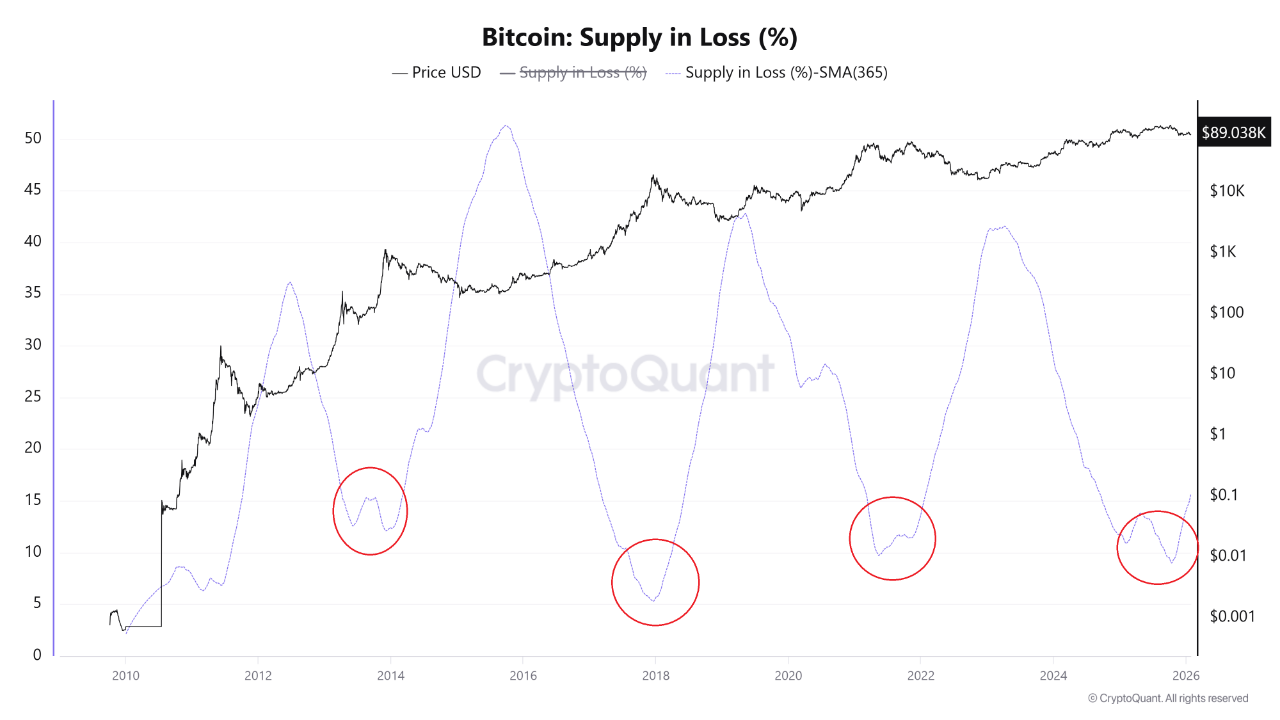
A key metric tracked by CryptoQuant, Bitcoin’s Supply in Loss (%), has started trending upward again. This move has historically aligned with the early stages of bear markets.

Key Points

  • Bitcoin’s Supply in Loss is rising, an early on-chain signal often seen at the start of bear markets.
  • The metric shows more holders going underwater, spreading losses beyond short-term buyers.
  • In past cycles, this shift appeared well before Bitcoin reached its eventual market bottom.
  • Loss levels remain below capitulation, but the trend hints at a broader downturn, not a dip.

What Rising Supply in Loss Means for Bitcoin

Supply in Loss measures the percentage of Bitcoin held at a price higher than the current market value. When this metric begins to rise, it indicates that more holders are underwater, not just recent buyers but increasingly longer-term participants as price weakness persists.

In past market cycles, this change in direction has marked the transition from bullish momentum into broader market stress, where selling pressure gradually expands beyond short-term holders.

Historical data shows a similar setup in previous cycles. In 2014, 2018, and 2022, Supply in Loss turned upward well before Bitcoin reached its actual market bottom. During those periods, the price continued to decline even after the signal appeared, with true bottoms forming only once losses spread much deeper across the network.

At present, the metric remains far below the extreme levels typically associated with full capitulation. However, the early directional shift itself is notable and suggests the market may still be in the early phase of a broader downturn.

Bear Market Structure, Not Just a Pullback

Rather than pointing to a short-term correction within an ongoing bull trend, the data hints at a possible transition into a bear market structure. If Supply in Loss continues to expand, it would strengthen the case that Bitcoin is entering a prolonged distribution phase rather than a quick recovery. 

Essentially, on-chain indicators suggest caution. At press time, Bitcoin trades at $87,500, down 2.5% over the past day and 31% from its all time high.

SEC Chair Says Time Is Right to Open $12.5T 401(k) Market to Crypto

0

SEC Chair Paul Atkins says the time is right to open the 401(k) market to crypto, arguing that the U.S. retirement system is ready for carefully managed crypto exposure.

He shared this view during a joint CNBC Squawk Box interview with CFTC Chair Mike Seligh ahead of their upcoming crypto event in Washington. His remarks signal a potential shift in retirement policy, with the SEC open to allowing crypto integration into regulated retirement frameworks. 

Key Points 

  • SEC Chair Paul Atkins says the U.S. retirement system is ready for carefully managed crypto exposure. 
  • Atkins confirms many American retirees already have access to cryptocurrencies through their professionally managed 401(k) accounts. 
  • The move aligns with recent government actions in the United States. 
  • Atkins also reaffirmed the SEC’s support for the Market Clarity Act and its collaboration with the CFTC to balance innovation with investor protection. 

Time Is Right to Expand Retirees’ Access to Crypto 

During the discussion, Atkins said many Americans already have indirect crypto exposure through pension funds and professionally managed retirement funds that include alternative investments. Moreover, he argued that crypto is not entirely foreign to retirement portfolios.

In the meantime, he stressed that the SEC is not promoting speculative investing. Instead, the agency aims to expand access in a controlled manner, similar to how it oversees private securities and equity funds.

Accordingly, he said crypto exposure should come through professionally managed 401(k) options rather than individual asset selection. This approach, he added, could support innovation while preserving safeguards to protect retirees’ long-term financial security. 

Opening $12.5T 401(k) Market to Crypto 

If adopted, this approach could open the $12.5 trillion 401(k) market to crypto through regulated, professionally managed products. It would mark a major policy shift, bringing digital assets closer to mainstream retirement portfolios while emphasizing risk controls and fiduciary responsibility. 

Notably, Atkins’ remarks align with broader U.S. efforts to expand retirees’ access to crypto. Over recent months, policymakers and the presidency have taken concrete steps in that direction. 

In May 2025, the U.S. Department of Labor reversed its 2022 guidance that discouraged crypto in 401(k) plans, clearing the way for digital assets like Bitcoin to enter retirement portfolios. Additionally, President Trump, in an executive order in August 2025, permitted crypto exposure in retirement funds.

Soon after, a group of U.S. lawmakers wrote to Atkins, urging him to establish a regulatory framework that would allow American workers gain indirect crypto exposure through their 401(k) accounts. Now, in his latest interview, Atkins has confirmed that the time has come to open the 401(k) market to crypto through professionally managed funds with appropriate safeguards.

SEC to Continue Support for Clarity Act 

Meanwhile, Atkins also addressed the Market Clarity Act. Although the markup has stalled after several leading crypto firms withdrew support, he stressed that the SEC has provided key technical input to the Senate and will continue backing the bill to push it toward the finish line.

In addition, he strongly supported working closely with the CFTC, aiming to encourage innovation while maintaining robust investor protections.

UAE Launches First USD-Backed Stablecoin Under National Regulations

0

The UAE has approved its first U.S. dollar–backed stablecoin, marking a significant milestone in the country’s push to build a regulated digital finance ecosystem.

The token, known as USDU, has gone live under a national regulatory framework following approval from the Central Bank of the UAE (CBUAE), according to a release issued Thursday.

Key Points

  • The Central Bank of the UAE approved a U.S. dollar–backed stablecoin under a national payments framework.
  • Universal Digital issues the stablecoin under federal and ADGM regulatory oversight.
  • USDU is backed 1:1 by U.S. dollar reserves held in onshore UAE bank accounts.
  • Emirates NBD, Mashreq, and Mbank provide reserve banking support.
  • Universal Digital has appointed Aquanow as a global distribution partner.

Central Bank Approval

The CBUAE granted authorization under its Payment Token Services Regulation, which governs the issuance, supervision, and management of payment tokens. With this approval, USDU is permitted to operate within the UAE’s formal payments infrastructure.

USDU is issued and managed by Universal Digital, which operates under the oversight of the Financial Services Regulatory Authority at Abu Dhabi Global Market. This structure provides regulatory supervision at both the federal level and within the financial free zone.

Reserve Structure and Banking Support

A core feature of the project is its reserve model. Universal Digital said USDU is fully backed by U.S. dollar reserves held on a one-to-one basis in safeguarded onshore accounts.

The reserves are maintained through partnerships with major local banks, including Emirates NBD and Mashreq, with Mbank also participating. The company said the banking relationships are designed to enhance trust and provide operational certainty for institutional users.

A Distinctive Global Position

Taken together, the regulatory framework and reserve safeguards position the UAE uniquely in the global digital payments landscape. According to the release, a U.S. dollar stablecoin is now operating under a central bank payments regime in the country, a step not yet fully realized in the United States, the European Union, or much of Asia.

In this context, Universal Digital framed the approval as a turning point for regulated digital value. Senior executive officer Juha Viitala said the registration delivers long-sought regulatory clarity for institutions, while backing from established UAE banks simultaneously strengthens confidence in the model.

Institutional Access and Global Distribution

As domestic operations begin, the company is also preparing for international distribution. Universal Digital has named Aquanow, a digital asset infrastructure company, as its global distribution partner to provide institutional investors with access to USDU in regions outside the UAE, in compliance with local regulations.

From the banking sector’s perspective, the launch reflects growing institutional interest in regulated digital instruments. Mashreq’s Group Head of Corporate and Investment Banking, Joel Van Dusen, said demand for compliant digital-value solutions continues to rise, thus calling USDU’s introduction a timely development for the market.

Broader Momentum in Crypto-Based Services

Meanwhile, the stablecoin approval comes as crypto adoption in the UAE expands beyond payments. Dubai Insurance has launched a crypto-enabled wallet allowing policyholders to pay premiums and receive claims using digital assets, including stablecoins.

The insurer described the offering as the first of its kind in the UAE market. Built on infrastructure from Zodia Custody, a crypto custody firm backed by Standard Chartered, the wallet emphasizes institutional-grade security and compliance with regulatory standards.

Canary Capital CEO Predicts When BlackRock Could File for an XRP ETF

0

The possibility of a spot XRP ETF from BlackRock may be closer than many expect, according to Canary Capital CEO Steven McClurg.

Speaking on a recent podcast, McClurg suggested that the world’s largest asset manager could make its move once a few key conditions fall into place.

Key Points

  • Canary Capital CEO says BlackRock could file a spot XRP ETF by late 2026 or early 2027.
  • McClurg notes delays are about timing and market readiness, not doubts around XRP itself.
  • Rival firms like Franklin Templeton and Grayscale already offer XRP ETFs with strong inflows.
  • BlackRock’s decision hinges on demand, market size, and growing institutional interest.

BlackRock’s XRP ETF Timeline

Responding to questions about what could trigger BlackRock’s entry into the XRP ETF race, McClurg said the timeline is tightening. He noted that it would not be surprising to see BlackRock file for a spot XRP ETF sometime toward the end of 2026 or into 2027.

In his view, the groundwork is already being laid, and the delay is more about timing and market readiness than uncertainty surrounding XRP itself.

Growing Competition Among ETF Giants

McClurg pointed out that BlackRock is no longer observing from the sidelines alone. Franklin Templeton has already entered the digital asset ETF conversation, while Invesco recently filed for a Solana ETF.

Notably, Franklin currently offers an XRP ETF, which has attracted $299.54 million in cumulative inflows. Other asset managers offering XRP ETFs include Canary Capital ($400 million), Bitwise ($331.56 million), and Grayscale ($234.39 million).

With multiple large asset managers moving deeper into crypto products, pressure is building on BlackRock to follow suit. As more traditional firms step in, XRP’s absence from BlackRock’s ETF lineup may become harder to justify.

Demand and Market Size Are the Key Triggers

According to McClurg, BlackRock’s decision will likely hinge on a few core factors: sustained demand, strong market capitalization, and continued institutional interest. These are the same benchmarks that previously paved the way for Bitcoin and Ethereum investment products.

He emphasized that once those conditions are clearly met, XRP’s inclusion becomes a matter of “when,” not “if.”

With institutional conversations around XRP growing louder and rival asset managers already making moves, McClurg believes patience is the final ingredient. As he put it, given enough time, XRP will inevitably reach the point where a BlackRock ETF filing makes strategic sense.

BlackRock’s Criteria Before Filing an ETF

In an interview in September 2025, BlackRock outlined the key criteria that would influence any decision to launch a spot XRP ETF.

BlackRock’s Head of Digital Assets, Robbie Mitchnick, explained that the firm evaluates new crypto ETFs primarily based on client demand, alongside fundamentals such as market capitalization, liquidity, maturity, and how the product fits into broader client portfolios. He stressed that this evaluation process is ongoing and cautious.

XRP is increasingly meeting BlackRock’s criteria, ranking as the fourth-largest non-stablecoin cryptocurrency with a $113 billion market cap and benefiting from improved regulatory clarity following the conclusion of the SEC lawsuit.

XRP Channel Map Points to $200 Ultimate Target

0

The XRP channel map may be pointing to an ambitious three-digit price target in a “black swan tail up” scenario.

XRP has faced bearish pressure alongside the rest of the crypto market, but market data suggests the crypto asset is still on track for greater price heights. Specifically, the XRP channel map, a multi-year channel that has dictated XRP’s price action, points to an ultimate target of $200 should a full-blown bull market emerge.

This channel map emerged in 2014 and has consistently guided XRP’s price action over the past 12 years, with the path now potentially leading to a $200 price. Notably, this target comes from an analysis of historical structure around the channel map, especially XRP’s price action during the 2017 rally.

Key Points

  • The XRP channel map, a multi-year channel that has dictated XRP’s price action since it emerged in 2014, points to a potential push to $200.
  • This target comes from an observation of XRP’s price movement within this channel, especially its price action during the 2017 bullish run.
  • After XRP recovers from the current bearish phase, market data first points to three targets of $4.5, $10, and $27 before the ultimate $200 mark.
  • While this $200 price represents a 677% rise from the channel’s top at $27, it would mark a 10,538% increase from current price levels of around $1.88.

XRP Still on Track for Bullish Push

The analysis pointing to this target came from watcher EGRAG Crypto, whose recent commentary suggests that XRP may still be on track for outsized gains despite recent struggles. For context, since pulling back from $2.41 on Jan. 6, XRP has struggled alongside the rest of the crypto market, down 22% from the yearly peak. 

Despite this downtrend, data from EGRAG’s chart shows that XRP remains in a respectable position within the multi-year ascending channel on the monthly timeframe. With XRP currently trading for $1.88, it has respected the immediate diagonal support, looking to breach the resistance for an upward push. A favorable push from here could lead to greater prices.

XRP 1M Chart EGRAG Crypto
XRP 1M Chart | EGRAG Crypto

XRP Historical Data Gives Clues

To determine how far XRP could go from the current position, EGRAG called attention to historical data. Specifically, XRP traded within a similar position inside this channel in 2017, albeit considerably lower. From that position, XRP soared past four resistance trendlines overhead and eventually hit the top of the channel at $0.3389 by May 2017.

After a pullback and consolidation from this peak, XRP witnessed a second bullish run, which took prices to a new high of $3.31 by January 2018, way above the channel’s top. EGRAG pointed out that the rally saw XRP jump by more than 677% above the top in what he calls an extended move.

Extended Move Now Eyes $200

EGRAG’s $200 target hinges on XRP repeating this explosive run. According to him, the current position aligns with the 2017 geometry. 

Notably, from the current position, he expects XRP to breach two resistance trendlines overhead, which sit at $4.5 and $10, respectively. EGRAG calls the $4.5 mark the “high conviction structural,” giving it an 80-90% probability of playing out. Meanwhile, he tags the $10 level “expansion dependent,” with a 60-75% chance.

After crushing these roadblocks, XRP would reach the channel’s top, which now sits at $27. The analyst calls this the “cycle peak scenario.” According to him, there is a 50-55% probability of XRP reaching this target. EGRAG then sets the full macro extension target at $200, which would represent a 677% rise from the channel’s top. He dubs this the “black swan tail up scenario.”

With XRP currently trading for $1.88, a rally to $200 would represent a 10,538% rise, which is highly improbable with current market conditions. With XRP giving the $200 target a mere 20-35% chance, it’s more likely not to play out. Even the lower targets remain highly speculative. As a result, investors should not take this as investment advice.

XRP Whales Have Bought $710M Worth of XRP This Month

0

XRP whales holding between 1 million and 100 million tokens have accumulated $710 million worth of XRP tokens in January 2026.

This comes amid what seems like an elaborate “buy-the-dip” campaign following the price correction from the Jan. 6 peak of $2.41. For context, after recovering from a bearish Q4 2025, which led to a 35% drawdown, XRP faced intense pressure around $2.41, eventually pulling back below the $2 level.

Notably, XRP whales holding 1 million to 100 million coins initially sold off parts of their bag a day after the drop. However, these investors have since begun capitalizing on the extended downturn, adding 380 million XRP tokens currently worth $710 million to their cumulative balance since the start of the month.

Key Points

  • XRP has continued to face downward pressure after pulling back from the $2.41 peak on Jan. 6.
  • XRP whales holding 1 million to 100 million tokens initially reacted negatively to the Jan. 6 drop, but have since begun adding to their balance.
  • These whales held a cumulative balance of 14.54 billion XRP at the start of the month, which has now increased to 14.92 billion, an addition of 380 million XRP.
  • Besides whales, retail investors holding between 1,000 and 100,000 XRP have also amassed $112 million in XRP this month.
  • An accumulation trend among retail and whale investors during downturns demonstrates confidence, potentially holding off further declines.

XRP Whales React to Initial Price Drop

Data from market intelligence resource Santiment confirms this ongoing trend, which has persisted even as XRP spends weeks below the psychologically important $2 area. However, the accumulation push comes after they had responded adversely to the initial drop from $2.41.

Specifically, at the start of January 2026, XRP whales holding between 1 million and 100 million tokens had a balance of 14.54 billion XRP. Of this total, those with balances ranging from 1 million to 10 million tokens held 3.57 billion XRP, while the larger whales with 10 million to 100 million tokens had a balance of 10.97 billion.

These investors increased their cumulative balance to 14.72 billion by Jan. 6 amid XRP’s upsurge from $1.84 on Jan. 1 to $2.41 five days later. However, as XRP collapsed from the $2.41 peak, their holdings returned to 14.54 billion XRP, marking the balance they began the year with.

An Accumulation Spree Emerges

Interestingly, as XRP’s downturn persisted over the following days, these XRP whales responded with an accumulation push, increasing their balance by 380 million XRP to the current total of 14.92 billion tokens. At the current price of $1.87, the 380 million XRP holds a worth of $710 million. 

XRP Whales Santiment
XRP Whales | Santiment

Notably, the whales holding 10 million to 100 million XRP contributed more to this balance increase, having amassed 220 million tokens since the start of the month. Meanwhile, those with 1 million to 10 million have accumulated 160 million XRP within the same period. 

Retail Investors Joining the Campaign

Further Santiment data confirms that retail investors have also persistently accumulated XRP this month, but at a much lower scale. Specifically, investors holding between 1,000 and 100,000 XRP have increased their cumulative balance from 10.48 billion XRP at the start of the month to 10.54 billion tokens, an addition of 60 million XRP worth $112 million.

XRP Retail Investors Santiment
XRP Retail Investors | Santiment

When whale and retail investors sustain an accumulation trend during downturns, it often suggests growing confidence in the market despite the price struggles. Moreover, such an accumulation spree could bolster XRP’s position around critical support levels, providing a cushion against steeper declines.