

Home Blog Page 304

ARK Invest Predicts Bitcoin Will Hit $16 Trillion Valuation by 2030

0

Ark Invest expects cryptocurrency markets to expand steadily through the end of the decade, with Bitcoin remaining the primary driver of growth.

In its Big Ideas 2026 report, the Cathie Wood–led investment firm forecasts that Bitcoin’s market capitalization could climb to roughly $16 trillion by 2030. If realized, that growth would help push the total cryptocurrency market to an estimated $28 trillion.

Ark’s projection reflects its view that Bitcoin is increasingly evolving into a mature, institutionally supported asset rather than a purely speculative instrument. Specifically, the firm now frames Bitcoin primarily as a digital store of value, more akin to gold rather than a transactional currency.

Key Points

  • Ark Invest projected the Bitcoin market cap at $16 trillion by 2030
  • The implied Bitcoin price is $761,900 based on a 21 million BTC supply
  • Total crypto market forecast at $28 trillion by 2030
  • Ark expects Bitcoin to grow at 63% CAGR over five years
  • ETFs and public firms hold 12% of the total Bitcoin supply
  • Smart contract platforms projected to reach a a $6 trillion market cap by 2030

Price Implications and Growth Assumptions

A $16 trillion market capitalization carries important implications for price formation. Based on Bitcoin’s fixed supply of 21 million coins, Ark estimates that such a valuation would translate to approximately $761,900 per Bitcoin.

However, reaching that level would require sustained and rapid expansion. Specifically, according to Ark, Bitcoin would need to grow at a compound annual growth rate of roughly 63% over the next five years. In turn, this growth would increase its market value from nearly $2 trillion today to $16 trillion by 2030.

Institutional Adoption Underpins the Forecast

Ark argues that institutional participation provides the foundation for this growth trajectory. Adoption among regulated investment vehicles and corporate treasuries has accelerated, reinforcing Bitcoin’s role as a long-term store of value.

For context, the firm reports that U.S. spot Bitcoin exchange-traded funds and publicly listed companies together now hold about 12% of the total Bitcoin supply. Notably, this share has risen sharply over the past year.

During 2025, Bitcoin holdings in U.S. spot ETFs increased by 19.7%, from 1.12 million BTC to 1.29 million BTC. Corporate adoption expanded even more rapidly, with public companies increasing their Bitcoin reserves by 73%, from around 598,000 BTC to approximately 1.09 million BTC.

Consequently, the combined share of Bitcoin held by ETFs and public companies rose from 8.7% to about 12%, highlighting the growing influence of institutional capital in the market.

Stablecoin Impact and Forecast Adjustments

Although Ark has maintained a consistently bullish stance on Bitcoin, it has adjusted some assumptions over time. For instance, in April of last year, the firm presented bear, base, and bull scenarios for Bitcoin’s projected price in 2030. The forecasts spanned a substantial range, from approximately $300,000 to $1.5 million.

Later, in November, Ark reduced its bull-case estimate by $300,000. The firm attributed the adjustment to the rapid expansion of stablecoins, which have absorbed some of the demand that Ark previously expected would flow into Bitcoin, particularly in emerging markets.

Nevertheless, Ark says its broader outlook for Bitcoin’s long-term role and value remains largely unchanged.

Smart Contracts as a Secondary Growth Engine

Beyond Bitcoin, Ark identifies smart contract platforms as the next major contributor to crypto market value. These networks could support decentralized finance, tokenized securities, and a growing range of on-chain applications.

The firm projects that smart contract platforms could collectively reach a market capitalization of approximately $6 trillion by 2030. At that level, they will generate $192 billion in annualized revenue, assuming an average take rate of 0.75%.

According to the report, most of this value is likely to concentrate in two or three dominant Layer 1 blockchains. Ark adds that valuations for these networks may depend more on monetary characteristics than on traditional cash-flow–based models.

Long-Term Market Outlook

Taken together, Ark’s projections describe a cryptocurrency market shaped by Bitcoin’s institutional adoption and reinforced by scalable blockchain infrastructure.

While specific assumptions have evolved, the firm continues to anticipate sustained growth across both Bitcoin and smart contract platforms through the end of the decade.

Shiba Inu Analysis for Jan 22: Where Next as SHIB Tests Bollinger Band Support?

0

Shiba Inu is testing the middle Bollinger Band support, with a recovery in open interest, signaling potential bullish momentum if the price holds.

The Shiba Inu (SHIB) price daily chart shows notable price action, with the price moving between a daily low of $0.000007694 and a high of $0.000008127. The coin has witnessed a decline of 0.7% within the last 24 hours, signaling a brief period of downward momentum.

The chart’s overall pattern indicates a peak followed by a steady pullback, creating a downward slope for the coin in the short term. This has led to a reduction in price, which now hovers around $0.000007909.

In terms of longer-term performance, Shiba Inu has shown resilience, experiencing a 10.3% increase in the last 30 days, despite some setbacks within the past week and 14 days, where it declined by 7.5% and 9.6%, respectively. Amid these setbacks, where could Shiba Inu head next?

Shiba Inu Price Prediction

The Shiba Inu price chart from TradingView shows SHIB is currently testing the middle Bollinger Band to the downside, sitting at approximately $0.00000792. Notably, for bullish momentum to return, it is crucial for SHIB to close above this middle band and remain supported at this level.

Shiba Inu Price Analysis

If the price fails to break above the middle band, there may be a continued downtrend, possibly testing lower levels, including the lower band at $0.00000772. 

In terms of volatility, the Standard Deviation is relatively low and still declining, indicating that volatility is declining and stabilization could be imminent. If SHIB manages to stabilize and close above the middle band, there could be potential for a bounce back toward the upper band near $0.0000081. 

However, if the price remains or closes below the middle Bollinger Band, it could signal further weakness in the short term, testing the lower band and liquidity zones around $0.0000075.

Shiba Inu Open Interest

Meanwhile, data from CoinGlass shows the recent Shiba Inu price behavior in relation to its open interest. Throughout much of the past few weeks, SHIB’s open interest had been relatively flat, spending most of the time below the $100 million mark. During this period, SHIB’s price action was generally reflective of the fluctuations in open interest.

Shiba Inu Open Interest

However, after peaking at around $145M and declining to $82.25, a positive shift has started to emerge. The open interest has begun to recover and is now sitting at approximately $87.26 million as of January 22, 2026.

Cardano Price Forecast for Jan 22: ADA Must Break Through $0.3732 for Confirmation

0

Cardano must break through the Parabolic SAR resistance to confirm bullish momentum and potentially test higher levels.

Notably, Cardano (ADA) has seen some notable movement in the past 24 hours. After initially staying flat, the price went through a W-shaped breakdown and tried to recover, but saw another drop to $0.3484.

From there, ADA saw a rebound, reaching a peak of $0.372 before stabilizing and entering a phase of sideways movement. The daily range shows this fluctuation, with the coin moving between a low of $0.3484 and a high of $0.372. The 24-hour trading volume remains robust at $656 million, albeit down by over 2%.

Despite the recent volatility, Cardano is showing resilience, as evidenced by the 1.8% surge within 24 hours. However, the broader trend over the past week reveals a slight decline, with a 7-day drop of 8.5%. Over the past 30 days, Cardano has seen only a modest decline, down by 0.7%. Can this consolidation phase lead to further price stability or a breakout?

Can Cardano Breakout?

In the 4-hour Cardano chart, the price is currently testing resistance at the Parabolic SAR, indicated by the blue dotted line at $0.3732 above the price. This suggests that Cardano is encountering resistance at this level, and the price will need to break above the Parabolic SAR to confirm bullish momentum.

Cardano Prediction
Cardano Prediction

If the price can surpass this resistance, it could signal a potential continuation of the uptrend, testing higher levels at $0.39 and beyond. Additionally, the current price action also shows bullish indications, with the MACD line above the signal line.

The Parabolic SAR, combined with the MACD crossover, highlights the ongoing struggle between bulls and bears. The MACD, which shows a negative value of 0.00172, signals a lack of momentum for a price rally, unless it can surge to the positive zone. Ultimately, the Parabolic SAR must be breached for a strong bullish movement.

ADA Liquidation Data 

The Cardano liquidation chart from CoinGlass provides further insights into market sentiment and risk for ADA traders. Over the past 24 hours, the total liquidation around Cardano has amounted to approximately $1.61 million.

Cardano Liquidation
Cardano Liquidation

The majority of this is tied to short positions, with around $457.76K in short liquidations, while long liquidations have accounted for the bigger portion, at $1.15M. The hourly liquidation data also shows significant short liquidations, amounting to $676.01, with no long positions liquidated during this period.

At the 12-hour and 4-hour levels, there are still notable short positions facing liquidations, with the 12-hour chart showing $338.00K in short liquidations, and the 4-hour chart reflecting a smaller amount of $4.08K. 

Cardano Foundation Delegates 220M ADA to 11 Community DReps

0

The Cardano Foundation has delegated 220 million ADA to 11 Delegated Representatives (DReps), shifting governance power to the community.

Specifically, the delegations target the Adoption and Operations governance pillars of Cardano. As a result, the restructuring reduces the Foundation’s overall voting power and transfers a majority of influence to community participants.

Notably, this announcement represents the first tangible milestone in the Cardano Foundation’s governance roadmap. It further reinforces Cardano’s broader transition toward a decentralized, community-led governance model. 

Key Points 

  • Cardano Foundation delegated 220 million ADA to 11 DReps, with each receiving 20 million coins. 
  • Priority is given to Adoption and Operations DReps. 
  • The move now brings the Foundation’s total delegation to the community to 360 million. 
  • The Foundation also self-delegated approximately 171 million ADA to eliminate passive voting. 

Cardano Foundation Delegates 220 Million ADA to 11 DReps

This week, the Cardano Foundation revealed that it has delegated 220 million ADA to 11 DReps, increasing its total delegation to 360 million ADA. According to the announcement, each selected DRep, focused on Adoption or Operations, will receive approximately 20 million ADA. 

Among the beneficiaries are Patrick Tobler (NMKR & Masumi), Goofycrisp (Snek), Florian Volery (Liqwid), James Meidinger (Mehen Finance / USDM), and Dave (DAVE Pool).

Through this move, the Foundation aims to ensure that decisions shaping Cardano’s future reflect a broader mix of expertise, incentives, and community perspectives. 

Why Adoption and Operations Matter

Prioritizing Adoption and Operations signals a governance model that now extends beyond core protocol development. Adoption-focused DReps include stake pool operators (SPOs) and ecosystem builders who drive real-world utility and onboard users into the Cardano ecosystem.

This approach aligns with the Foundation’s 2025/2026 adoption strategy. According to its roadmap, the Foundation plans a major expansion into real-world assets (RWAs), committing $10 million to Cardano-based RWA initiatives following its partnership with MembersCap. 

Last year, the Foundation also announced plans to allocate an eight-figure commitment in ADA to strengthen stablecoin liquidity across the ecosystem.

Additionally, Operations-focused DReps bring hands-on expertise in the network’s daily management and security. Their involvement helps ensure that governance decisions remain grounded in operational reality. 

Cardano already ranks among the industry’s most secure blockchain networks and has not suffered any full, prolonged network-wide outages since its 2017 mainnet launch. By delegating ADA to Operations DReps, the Foundation aims to preserve and strengthen this track record. 

Ending Passive ADA in Governance

Meanwhile, the Foundation adjusted its own voting posture. Rather than leaving a portion of its treasury on auto-abstain, it self-delegated approximately 171 million ADA, ensuring that all Foundation-held assets actively participate in governance.

Although this self-delegation exceeds earlier estimates, the net effect remains a 43 million ADA reduction in the Foundation’s overall voting dominance. Consequently, the majority of its ADA holdings now empower community DReps instead of reinforcing internal control. 

XRP Retail Traders Show “Extreme Fear,” Data Shows This Could Be a Rally Catalyst

0

XRP has again slipped into the “extreme fear” territory amid the persistent downtrend, but data indicates this may be good for the market.

The crypto market has not been favorable to XRP, as well as Bitcoin (BTC) and other top altcoins. As the total crypto market cap loses $200 billion following the Jan. 6 peak of $3.21 trillion, XRP has contributed $28.21 billion to this loss, with its price down by 19.5% since Jan. 6.

XRP and the broader crypto market engineered a recovery on Jan. 13, but geopolitical tensions and market uncertainty immediately capped this upside. Amid the ongoing downtrend, retail sentiments around XRP have turned sour, with social data confirming a slip into “Extreme Fear.” However, such positions typically lead to rebounds.

Key Points

  • XRP has struggled since reaching the Jan. 6 peak of $2.41, down 19.5% from this high, as it loses the $2 psychological price level.
  • These struggles have been triggered by a broader market downturn, with the total crypto market losing $200 billion since Jan. 6, and XRP contributing $28 billion to this loss.
  • Amid the ongoing downtrend, social data confirms XRP retail sentiments have dipped, slipping into the “Extreme Fear” territory.
  • Historical data confirms that a drop in retail sentiment to “Extreme Fear” often precedes price rebounds.

XRP Retail Sentiment Turns Sour

This is according to a recent market commentary from crypto intelligence platform Santiment, which recently assessed the impact of the ongoing market turbulence on retail sentiment. According to Santiment, social data confirms that XRP has collapsed into extreme fear for the third time this year.

Specifically, on Jan. 20, XRP’s ratio of positive sentiments against negative sentiments broke below the 1.873 level, slipping into Extreme Fear. The ratio has continued to dip since then, currently pushing toward the 1.794 mark, as retail investors show increased panic amid XRP’s position below the pivotal $2 psychological level.

Historical Context Around XRP Retail Sentiment

However, Santiment suggested that this sour sentiment may be a “buy signal,” citing historical data. Specifically, data indicates that each time retail sentiment slips below 1.873 and enters the “Extreme Fear” region, the XRP price often recovers from its lows. However, the extent of each rebound has varied.

The first time sentiment entered the Extreme Fear area this year was on Jan. 2, as XRP sought to recover the 30% loss from Q4 2025. Interestingly, after retail turned fearful, XRP built on an existing upward push, rallying from $1.87 to this year’s peak of $2.41. This marked a 28.8% increase.

XRP Sentiment and Price Reactions Santiment
XRP Sentiment and Price Reactions | Santiment

This trend played out again on Jan. 18, as investor sentiment turned sour following the retracement below the $2.41 peak. Notably, sentiments entered Extreme Fear again on Jan. 18, and XRP eventually recovered above $2 but immediately lost momentum, eventually closing that day bearish.

Further data also confirms that each time a rebound occurs and sentiment turns overly positive, XRP often faces a roadblock at the next resistance and suffers a pullback. This trend played out on Jan. 7, 11, and 13. 

Important Caveat

Interestingly, amid the latest dip in sentiment, XRP has staged a recovery, up over 3% since Jan. 21, as it now trades for $1.95. However, while retail sentiment remains fearful, it is important to note that this does not represent a certain signal that prices will continue to recover from here. In addition, the extent of recoveries during sentiment dips has always varied.

Permissioned Domains Attain Validator Approval to XRP

0

The XRP Ledger has reached an important milestone with the approval of the Permissioned Domains amendment, labelled XLS-80. 

After weeks of uncertainty, XPMarket recently presented the vote that pushed support beyond the required 80% threshold. Before this decision, the amendment had remained stalled at 79.41%, backed by 27 of 34 validators and sitting just one vote short of activation.

Following XPMarket’s vote, the amendment immediately entered its mandatory two-week activation period. As long as validator support holds, Permissioned Domains will go live on Feb. 4, 2026. This represents an important moment for the XRPL as it moves closer to supporting institutional-grade financial infrastructure on a public, decentralized blockchain.

Permissioned Domains Attain XRPL Validator Approval XRPScan
Permissioned Domains Attain XRPL Validator Approval | XRPScan

Key Points

  • The Permissioned Domains amendment (XLS-80) has entered a two-week activation period and could go live on Feb. 4, 2026.
  • XPMarket cast the deciding validator vote, pushing support above 80% after the amendment sat at 79.41% for weeks.
  • Permissioned Domains use credential-based access to support KYC and AML compliance without exposing sensitive personal data on-chain.
  • It sets the foundation for features such as Permissioned DEX and the Lending Protocol (XLS-66).
  • The amendment could help the XRPL act as a bridge between traditional finance and DeFi by enabling regulated institutional activity on a public ledger.

How Permissioned Domains Work on the XRP Ledger

Notably, Permissioned Domains introduce controlled environments within the XRP Ledger. These domains allow owners to define rules around who can participate in specific financial activities. Instead of opening every transaction to the entire network, domains limit access to accounts that meet predefined requirements.

To achieve this, Permissioned Domains rely on a credential-gating system. Specifically, domain owners decide which credentials users must hold to gain access. Any account that holds at least one matching credential automatically qualifies. 

Importantly, this system supports KYC and AML compliance without exposing sensitive personal data, as the ledger only records whether a credential is valid, not the underlying information.

Why Compliance Has Held Institutions Back

For years, compliance concerns have limited institutional adoption of public blockchains. Banks, payment providers, and regulated financial firms cannot rely on assumptions about their counterparties. Instead, they require guarantees that every participant meets regulatory standards.

Permissioned Domains directly address this challenge by demanding access controls on-chain. Institutions can now operate with certainty, knowing that all counterparties within a domain meet specific compliance requirements. 

At the same time, they retain access to the XRPL’s speed, transparency, and low transaction costs. This would avoid the trade-offs of private blockchains, which often sacrifice decentralization and liquidity to meet regulatory needs.

Setting up for a Permissioned DEX

However, Permissioned Domains do not provide immediate standalone functionality, but set the foundation for several upcoming XRPL features. One of the most important ones is the Permissioned DEX amendment (XLS-81). Validator voting on this proposal is currently underway, with support sitting at 53%.

Unlike the existing XRPL decentralized exchange, where any participant can match offers, a permissioned DEX restricts trading to credentialed participants within a specific domain. Ripple has called this model a major step toward institutional DeFi around compliance-first infrastructure, real-world utility, and open access.

As a result, a permissioned DEX could support regulated payment-related activity. Potential use cases include stablecoin–fiat foreign exchange swaps, payroll and contractor disbursements, international business-to-business transactions, and the management of corporate treasury functions. 

For instance, fintech firms could convert USD into RLUSD, move liquidity across borders, and exchange into local currencies within a permissioned trading environment.

Lending and AMM

Further, Permissioned Domains may also support the upcoming XRPL Lending Protocol (XLS-66) by allowing compliant lending and borrowing activity across the network. 

Permissioned Domains may also reshape automated market makers on the XRPL by allowing regulated entities to create compliant liquidity pools restricted to approved liquidity providers. This would allow institutions to DeFi without forcing them outside regulatory boundaries.

XRPL Could See Broader Institutional Use Cases

Overall, Permissioned Domains could lead to a wider range of future applications. These include regulated on-chain foreign exchange markets with the XRPL serving as the settlement layer. The amendment could also enable compliant secondary markets for tokenized real-world assets.

Meanwhile, additional possibilities include dedicated institutional stablecoin corridors for assets like RLUSD, CBDC integrations, and trade finance platforms built around verified participants. In each case, Permissioned Domains provide the compliance foundation necessary for institutional participation.

Bitcoin Pullbacks Tied to Rising Global Risk, Not Crypto Weakness: XWIN Research

0

The ongoing Bitcoin pullbacks may be less about crypto-specific weakness and more about rising global economic risk.

This view was shared in new research from Japan-based XWIN Research. The firm argues that renewed tariff pressure linked to U.S. President Donald Trump’s trade stance has become a clear downside factor for Bitcoin since 2025.

Tariff Pressure Reduces Risk Appetite

XWIN Research notes that tariffs directly affect corporate earnings, inflation expectations, and monetary policy outlooks. As these pressures build, overall risk appetite tends to decline, leaving risk assets like Bitcoin more exposed to price corrections.

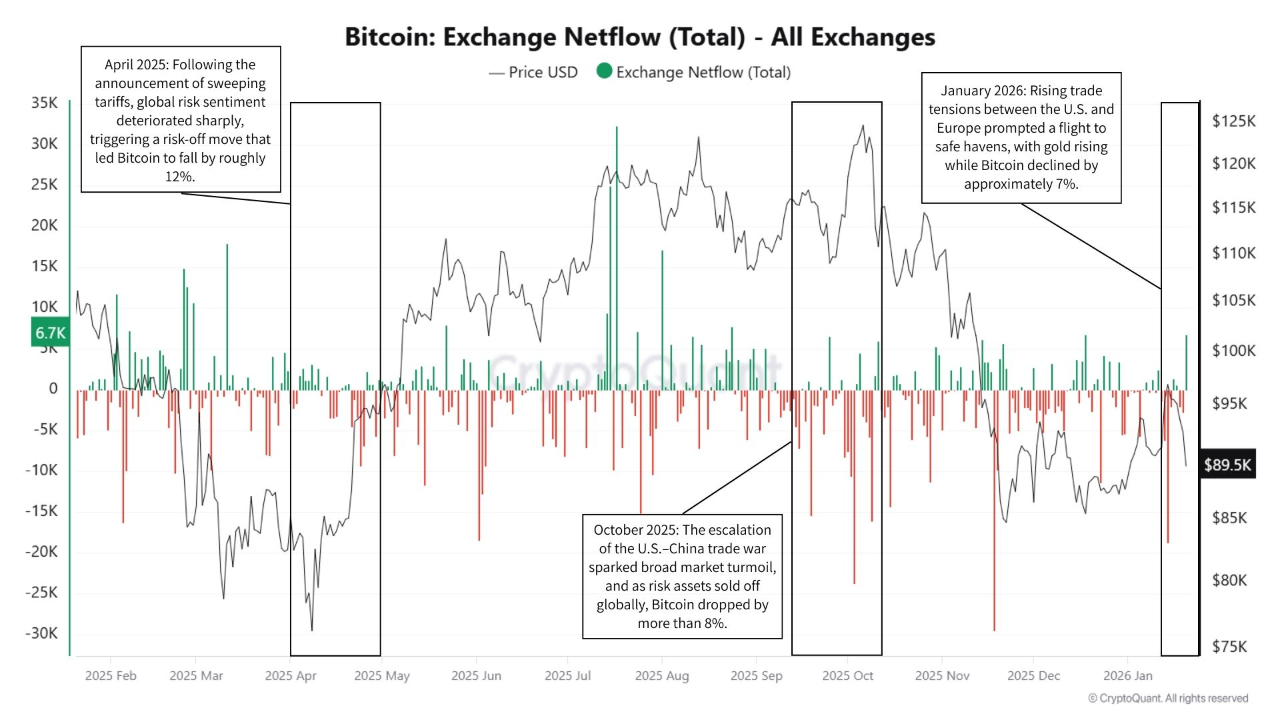
Since 2025, several Bitcoin downturns have coincided with periods of heightened trade tension and tariff hikes. During these phases, Bitcoin moved lower alongside equities, supporting the view that it is still treated as a macro-sensitive asset rather than a defensive hedge.

Bitcoin Still Trades Like a Risk Asset

The report highlights that economic uncertainty impacts Bitcoin because investor behavior adjusts quickly when growth and interest-rate expectations shift. In such environments, investors often reduce short-term exposure to limit portfolio risk.

Due to its liquidity, investors frequently use Bitcoin as a temporary risk-reduction tool. Rather than holding it strictly as a long-term store of value during uncertain periods, they often sell alongside other risk assets.

Exchange Netflows Show Temporary Selling

XWIN Research also examined exchange netflow data for additional insight. During correction phases, it observed brief increases in Bitcoin inflows to exchanges, consistent with short-term adjustments.

However, these inflows did not persist. This suggests there has been no sustained selling pressure so far, supporting the idea that recent declines are due more to macro uncertainty than long-term bearish sentiment.

Base Case: Macro Risk Still a Headwind

For now, XWIN Research maintains that rising economic risk tied to Trump’s tariff shocks remains a key factor weighing on Bitcoin prices. The firm notes that this view would change only if exchange inflows rise consistently and supply-demand indicators weaken.

Until then, Bitcoin’s price action will align closely with shifts in global risk sentiment rather than a breakdown in its long-term fundamentals.

BTC Price and Gold’s Historic Move

At press time, Bitcoin is trading at $90,250, down 0.62% over the past day as it attempts to recover after touching $87,500 earlier today. At its current price, Bitcoin is down 7% over the past week and 13% over the past year.

Bitcoin chart | CoinMarketCap

Meanwhile, during the same period, while Bitcoin’s price dipped, gold continued to set new all-time highs. Today, gold reached a peak of $4,890 following a five-day gain of 4.77%. Over the past year, gold has been up 12%, while Bitcoin has remained in negative territory.

This disparity suggests that investors are increasingly moving into gold as a safe haven while cutting exposure to Bitcoin.

Pressure Builds on Bitcoin as Binance Derivatives and Whale Activity Turn Bearish

0

Bitcoin has remained under sustained pressure after failing to hold its early-year rally, as spot and derivatives data point to increased selloffs. 

Bitcoin (BTC) started the year strong, climbing to $97,900 by Jan. 14, but momentum has turned bearish. Since then, it has recorded six consecutive intraday losses, falling 8.5% from its peak to around $89,500. The downtrend has been exacerbated by trade tensions triggered by President Trump’s recent tariff threats.

However, as external macro factors weigh on the crypto firstborn, pressure from derivatives traders and large holders has also added to the downward push. Specifically, aggressive selling activity and large BTC transfers to spot exchanges indicate a rise in downside risk.

Key Points

  • Bitcoin peaked at $97,900 on Jan. 14 before recording six consecutive intraday losses and falling 8.5% to around $89,500.
  • While external geopolitical factors have contributed to the price drop, market data also indicates selling pressure from whales.
  • Net Taker Volume has stayed mostly negative since mid-January, confirming continued urgency from sellers.
  • On Jan. 20, Net Taker Volume printed a sharp negative reading of -$319 million, the second decline below -$300 million.
  • The initial decline of this magnitude came on Jan. 16, triggering a Bitcoin drop from $95,000 to $90,000.
  • Also, whale wallets deposited more than $400 million worth of Bitcoin into spot exchanges on Jan. 20.

Bitcoin Under Pressure

CryptoQuant analyst Amr Taha highlighted these figures in a recent market commentary, confirming that Bitcoin is facing rising selling pressure across both derivatives and spot markets. 

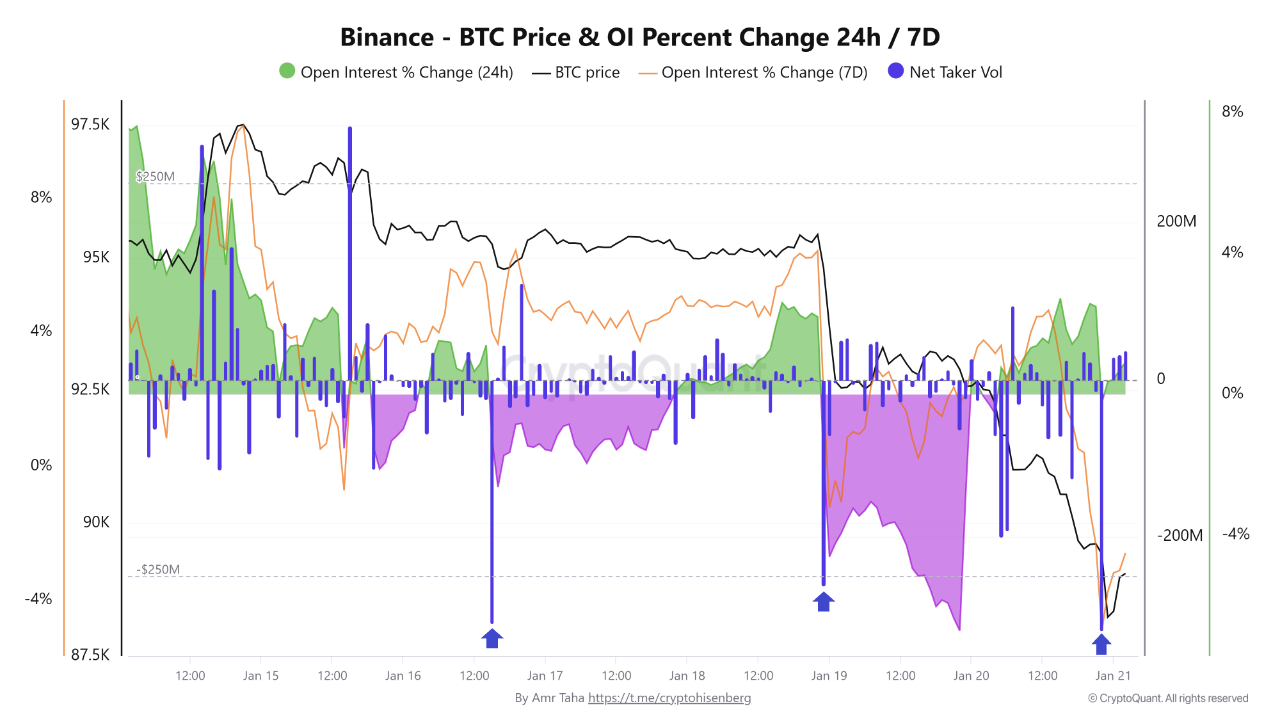
First, he noted that Bitcoin has faced a second wave of aggressive selling, as indicated by recent changes in price and open interest on Binance’s BTC derivatives over the past 24 hours and seven days. 

For this signal, he called attention to the Net Taker Volume, which measures how aggressively traders buy or sell by tracking market orders on Binance Futures.

For context, Net Taker Volume turns positive when buyers rush to purchase at the ask price, a behavior that usually supports higher prices. In contrast, it turns negative when sellers move quickly to offload positions at the bid price, increasing downward pressure. 

Bitcoin Net Taker Volume Remains Negative

Taha observed that Net Taker Volume has stayed mostly negative since mid-January, showing that sellers have remained in control for an extended period rather than stepping back after short bursts of selling.

Bitcoin Net Taker Volume CryptoQuant
Bitcoin Net Taker Volume | CryptoQuant

Specifically, selling pressure intensified on Jan. 20, when Net Taker Volume printed a sharp negative reading of -$319 million. This marked only the second time the indicator fell beyond the -$300 million level in recent weeks. 

Notably, the previous instance occurred on Jan. 16, when Bitcoin still traded above $95,000. Soon after that signal appeared, Bitcoin slipped below $90,000, reinforcing the indicator’s value as an early warning sign.

Large Whale Deposits to Exchanges

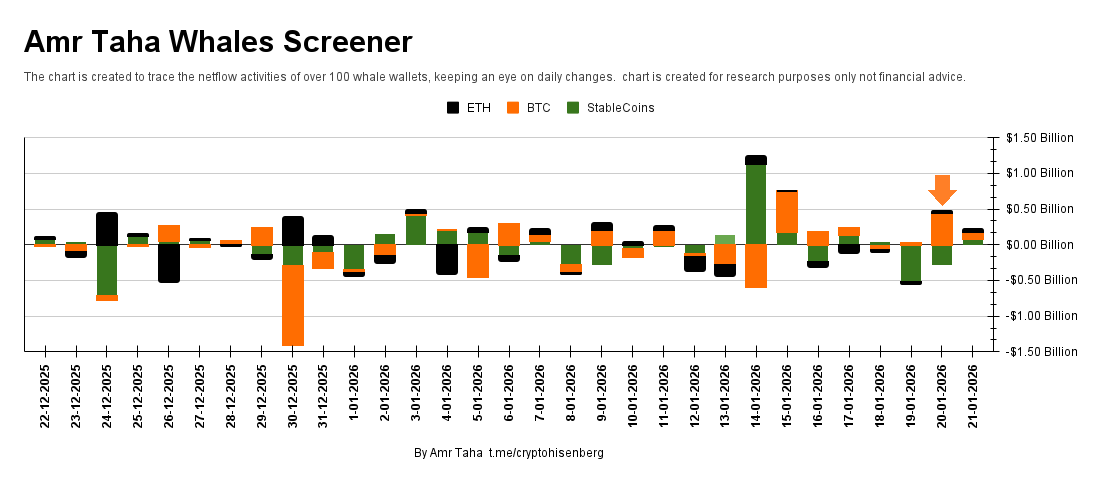
Secondly, Taha highlighted movements among large Bitcoin holders using CryptoQuant’s Whale Screener, which tracks real-time deposits and withdrawals of Bitcoin, Ethereum, and stablecoins from more than 100 active whale wallets interacting with spot exchanges. 

Specifically, on Jan. 20, whale wallets transferred over $400 million worth of Bitcoin to spot exchanges, representing the second major deposit spike in a short time frame.

Whale Screener
Whale Screener

The first surge occurred on Jan. 15, when whales deposited roughly $500 million worth of Bitcoin into spot exchanges. This move came just before a sharp drop in price from around $96,000. 

Historically, large Bitcoin deposits to spot exchanges often signal an intention to sell or, at the very least, an increase in available supply that can weigh on price.

Ripple CEO Cleverly Shows XRP in His RLUSD Listing Message

0

Ripple CEO Brad Garlinghouse subtly references XRP in reaction to Binance’s official listing of the company’s stablecoin RLUSD. 

Garlinghouse’s remarks follow reports that RLUSD will commence trading on Binance on January 22, 2025. Binance will initially roll out support for RLUSD on the Ethereum blockchain, with support for XRPL expected soon after.

Supported pairs include XRP/RLUSD and RLUSD/USDT. While users can now deposit RLUSD from Ethereum wallets, trading begins on January 22, with withdrawals opening on January 23.

Key Points

  • RLUSD will commence trading on Binance on January 22, with withdrawals slated to begin the following day.
  • Initial support for RLUSD will be on the Ethereum blockchain, with XRPL integration expected later.
  • Garlinghouse’s reaction to Binance’s official listing of RLUSD included a stylistic reference to XRP.
  • Ripple’s actions continue to reinforce XRP’s foundational role in the company’s long-term vision.

Why Binance Listing RLUSD Matters

Notably, the listing marks a major milestone for Ripple’s ecosystem. It expands RLUSD’s liquidity and visibility by tapping Binance’s vast global user base and deep order books.

Additionally, the XRP/RLUSD pair directly links the stablecoin to XRP markets, which could lift XRP trading activity. Moreover, as a regulated, compliance-focused stablecoin, RLUSD’s debut on Binance signals growing institutional acceptance and positions it as a credible, enterprise-grade digital dollar.

Ripple CEO Stylishly References XRP

Meanwhile, Ripple CEO Brad Garlinghouse joined the XRP community in celebrating the listing. Posting on X, he said he was “eXtRemely Positive” to see RLUSD listed on the world’s largest crypto exchange.

Interestingly, the deliberate capitalization of X, R, and P within the word “eXtRemely Positive” drew attention, given the subtle nod to XRP. Notably, a prominent community figure interpreted the message as a testament that XRP remains central to Ripple’s strategy.

Indeed, Garlinghouse has consistently emphasized XRP’s foundational role within Ripple, even as the company expands RLUSD’s use cases. He has reiterated this stance amid earlier concerns that Ripple was prioritizing RLUSD over XRP.

Notably, these concerns intensified after Ripple outlined RLUSD’s role in its Hidden Road acquisition without explicitly referencing XRP.

XRP Remains Central to Ripple’s Vision

However, Garlinghouse, who bears an XRP logo tattoo on his arm, has consistently pushed back, stressing that XRP sits at the center of everything Ripple does.

Moreover, Ripple has reinforced this stance through concrete actions. The company joined a venture alongside major players such as Kraken and SBI to help establish the world’s largest XRP reserve.

Additionally, last year, Ripple partnered with Mastercard to explore using RLUSD on the XRP Ledger, aligning with broader efforts to settle stablecoin transactions via fiat card networks.

Notably, Ripple is the largest holder of XRP, with roughly 34 billion tokens held in escrow. As a result, any rise in XRP’s price directly strengthens Ripple’s financial position, and vice versa.

Coinbase CEO Says Bitcoin Is More Decentralized and Independent than Central Banks

0

Brian Armstrong, the CEO of Coinbase, didn’t hesitate to correct the French Central Bank governor, Francois Villeroy de Galhau, on his Bitcoin misconception.

During the ongoing World Economic Forum, where key global financial leaders discussed tokenization and its future, Armstrong emphasized that Bitcoin remains a decentralized protocol more independent than central banks.

Key Points

  • Brian Armstrong, the CEO of Coinbase, has emphasized that Bitcoin is a decentralized protocol more independent than central banks.
  • Armstrong said this during the ongoing World Economic Forum, where key global financial leaders discussed tokenization and its future.
  • The Coinbase CEO also mentioned Bitcoin has no private issuer, unlike fiat currencies that suffer from control by central banks and government policies.
  • However, he called the fiat-crypto competition “healthy” as it leaves the choice in the hands of individuals.

Coinbase CEO Lauds Bitcoin’s Decentralized Nature

For context, Armstrong discussed Bitcoin and its role in curbing the debasement of value. He noted that fiat currencies often suffer from devaluation due to central bank money printing. If this continues, the Coinbase CEO noted that citizens would eventually lose trust in fiat and move to assets that store value.

However, he highlighted that Bitcoin has a fixed supply, which protects it from inflation. He also suggested that Bitcoin ranks alongside gold as an asset that investors run to during times of uncertainty.

However, the French Central Bank governor highlighted the trust thesis, noting that central banks have the trust of individuals. Furthermore, Galhau stated that he trusted “independent central banks” with a democratic mandate more than Bitcoin, which he believes is issued by private entities.

Bitcoin More Independent

Armstrong quickly corrected this impression, arguing that Bitcoin remains a decentralized protocol. He insisted that the apex cryptocurrency is more decentralized than central banks, citing its complete sovereignty from individual or institutional control.

He also mentioned that Bitcoin has no private issuer, unlike fiat currencies that suffer from control by central banks and government policies.

However, he called the fiat-crypto competition “healthy,” as it leaves the choice in the hands of individuals. Armstrong insinuated that the one with the highest trust and adoption wins.

“I think it (Bitcoin) is actually the greatest accountability mechanism on deficit spending,” the Coinbase CEO concluded.

Why The Clarity Matters

Notably, several misconceptions around Bitcoin and the broader crypto ecosystem have emerged within the traditional finance scene. As a result, correcting such misconceptions on a global stage, such as the World Economic Forum, helps large investors better understand its technology and benefits.

Remarkably, Bitcoin went from being seen as the currency used by bad actors for fraudulent activities to attaining recognition as a store of value and a hedge against inflation. Changing this narrative required significant publicity from industry leaders and BTC’s exceptional performance.

With more misconceptions like Galhau’s still lying around, especially among influential global figures, Armstrong’s quick explanation brings clarity and, consequently, adoption.